
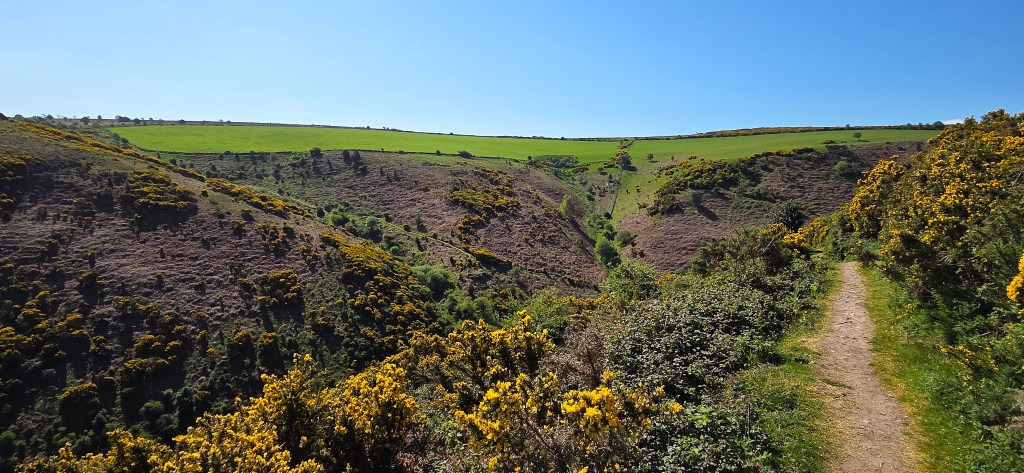
I completed the South West Coast Path in September 2025, arriving at Poole Harbour, South Haven Point some eight years after I had walked the section from Minehead to Porlock Weir in Autumn 2017.
But Tracy had unfinished business, because she didn’t join me until we walked from Porlock Weir to Lynmouth in 2019.
So, towards the end of April 2026, we decided to spend a couple of days in Minehead.
We travelled down on Tuesday morning, returning home on Thursday morning.
We planned to walk from Minehead to Porlock Weir on Wednesday, but also to arrive early enough to complete a small section of the England Coast Path, from Watchet to Minehead, on Tuesday afternoon.
Our outward journey was via the 09:34 GWR service from Paddington to Taunton, followed by the 11:48 First Bus 28 service from Taunton Station to Minehead, reaching our destination at 1312.
The train was extremely quiet and we arrived almost on time.
We met a local ‘character’ at the Station bus stop, waiting for a service to Chard. He remarked on a few occasions that it was ‘a bit fresh’ (there was a fairly stiff and distinctly chilly breeze), contrasting the temperature with that in Queensland, where he had lived for several years.
The bus was modern and comfortable, a distinct improvement on the jalopy I’d encountered back in 2017. Moreover, the journey was now gratis, courtesy of my Freedom Pass.
We were staying at the Beach Hotel, conveniently close to Minehead Station. I had reserved a deluxe double room, good value at £260 for two nights’ bed and breakfast.
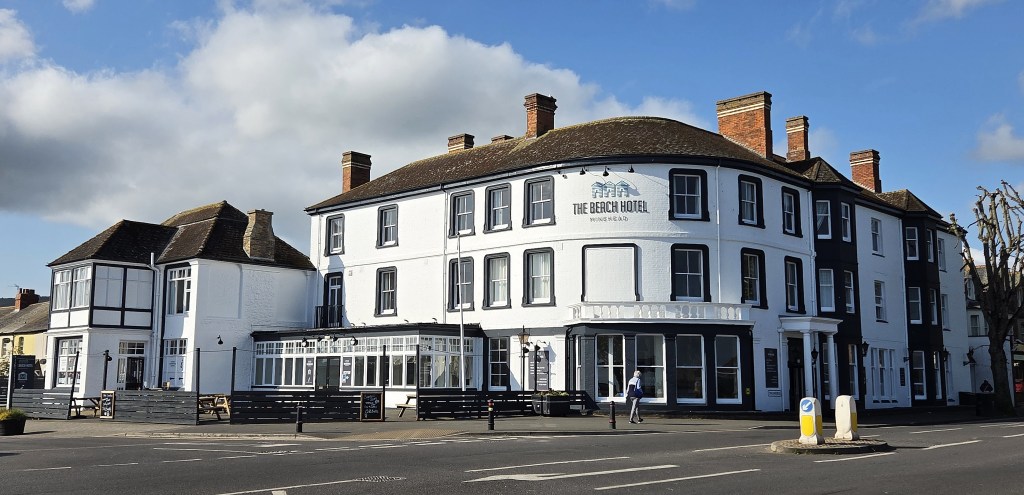
The Hotel is a charity under the control of the YMCA Dulverton Group. It employs several apprentices in both hospitality and catering, also providing a free community meal on the final Wednesday of each month.
It suited us well in all respects.
Check-in was not until 15:00, so we stashed our cases in the office and visited the Hotel’s Café for lunch. I ordered a Brie and Bacon Toastie with Slaw and Crisps.
It was extremely tasty, although the brie had melted rather aggressively, and was at risk of overflowing the wooden platter on which it was served.
Tracy asked for an explanation of the difference between ‘slaw’ and ‘coleslaw’, knowing me to be an aficionado of the latter, preferably spread generously over sliced cheddar with mixed salad leaf accompaniment, all wedged between two generous slices of homemade wholemeal bread.
I didn’t know but, apparently, coleslaw must contain shredded cabbage, since the name is derived from the Dutch word for ‘cabbage salad’. Slaw may contain alternative shredded vegetables in place of cabbage.
So all coleslaws are slaws but not all slaws are coleslaws!
English Coast Path: Watchet to Minehead
After a leisurely lunch we made our way to the Minehead Station ticket office, just across the road, buying two singles to Watchet on the 14:30 diesel service, costing £15 apiece.
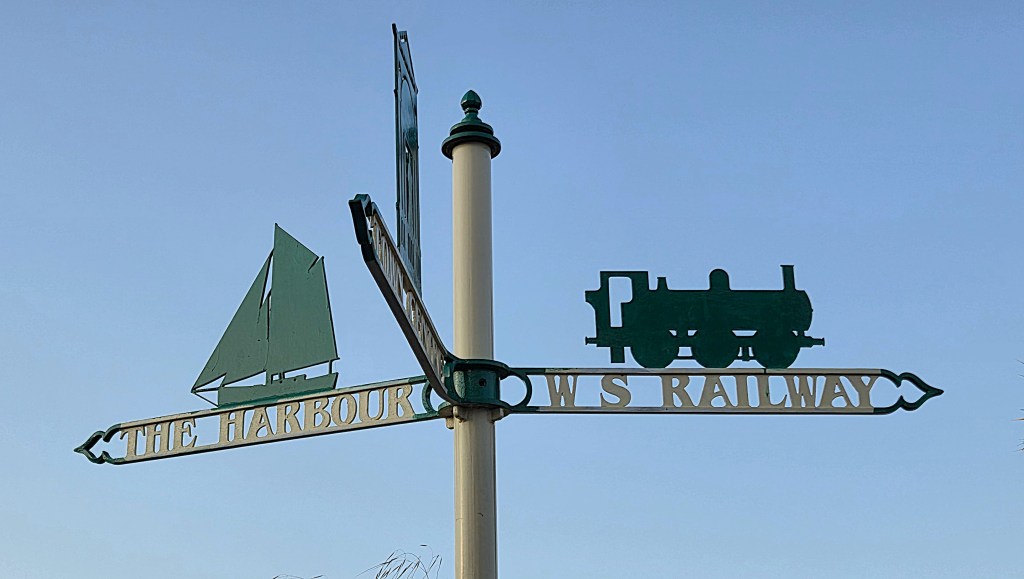
The West Somerset Railway opened originally in 1862, linking Taunton with Watchet before extending to Minehead in 1874. The service lasted not quite a century, eventually closing in January 1971.
But, following extended negotiations, it reopened in 1976 as a privately owned heritage railway based in Minehead. It gradually extended further along the line, reaching Bishops Lydeard by 1979.
At 20.5 miles, this made it the longest standard gauge independent heritage railway in the UK.
A further extension has been built to Norton Fitzwarren and there are occasional special services through to Taunton. A proposal to run regular scheduled services connecting with the mainline at Taunton were rejected by the Department of Transport in 2025.
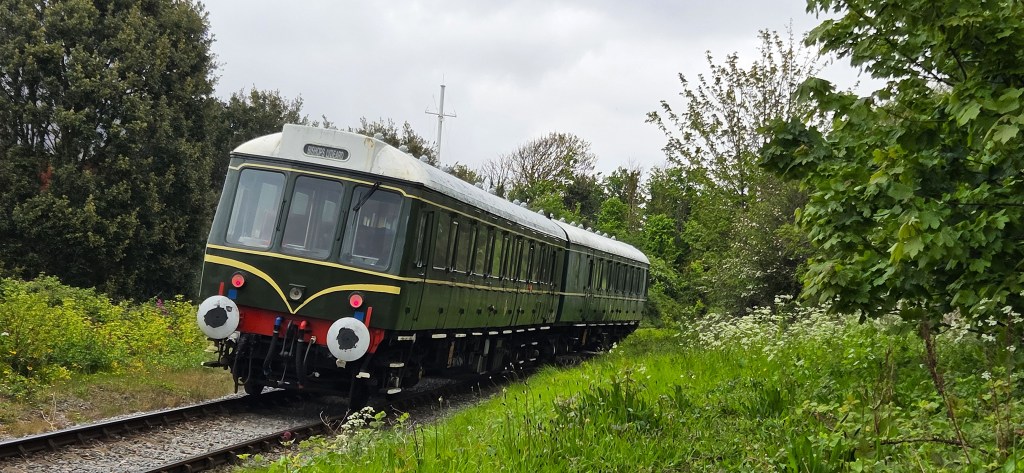
We climbed aboard a ‘Class 115 Diesel Mechanical Multiple Unit’, built in Derby in 1960. For much of its working life it operated on the Chiltern line out of Marylebone.
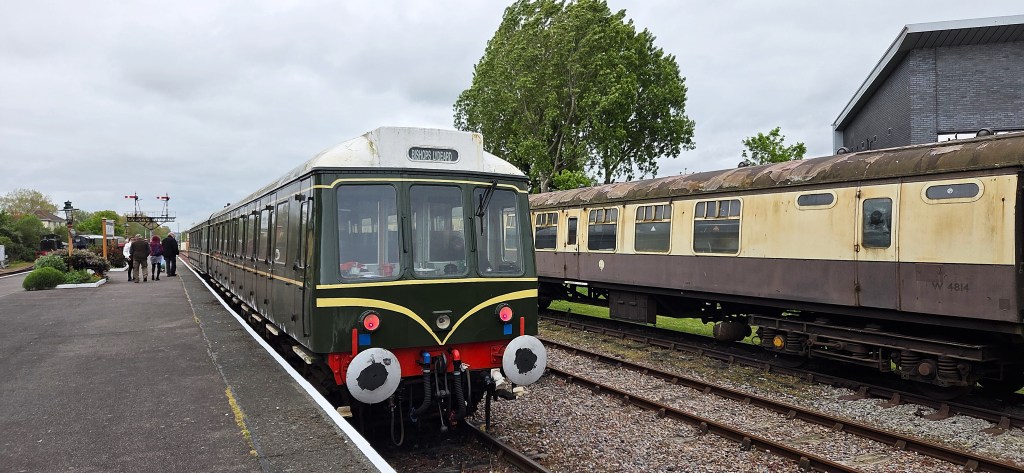
It reminded me of the old Alton trains serving Waterloo, caught frequently during my commuting days, back in the 1990s. The door catches were identical, but the luggage racks perched above the headrests were missing.
The service was almost completely full of elderly railway enthusiasts and their dogs.
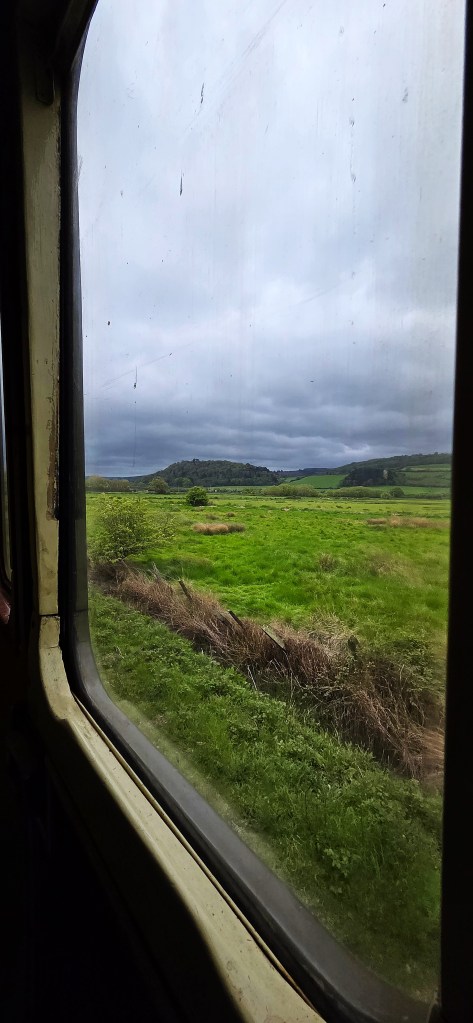
We passed slowly through Dunster, Blue Anchor and Washford, the train struggling valiantly along while I photographed the stations, each marooned in an idealised past, circa 1930-1960.
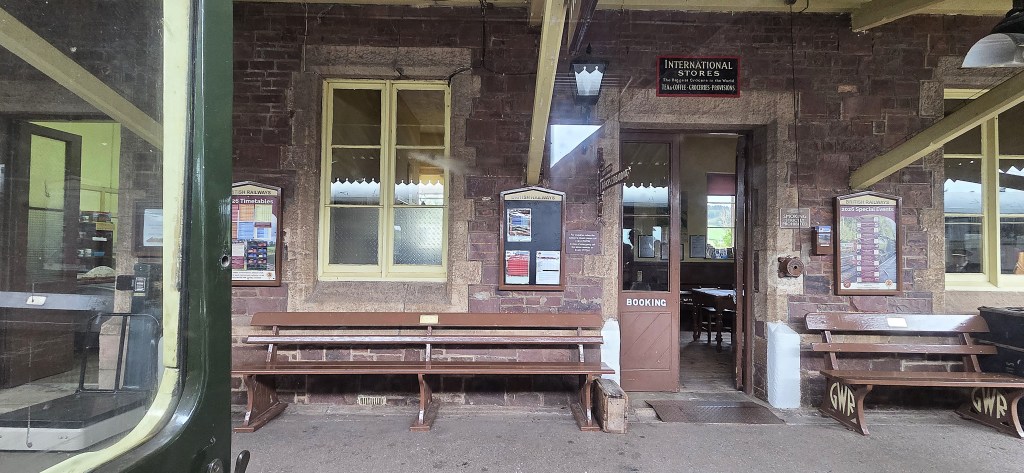
The guard, dressed in a black three-piece suit, with a carefully looped gold watch-chain, inspected our tickets, clipping them meticulously before handing them back.
It was a faintly surreal experience, and quintessentially English.
I leaned over to Tracy, remarking that, with me, she really did get to visit the most interesting and extraordinary places!
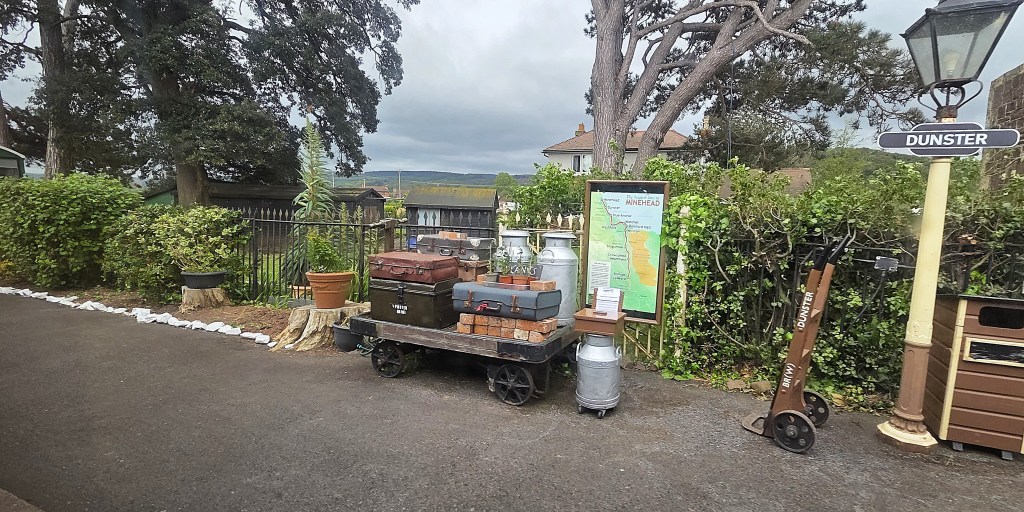
We reached Watchet roughly half-an-hour after departing Minehead.
It was a pleasure to repeat, once more, the door opening manoeuvre that I’d last executed some 30 years previously, and we alighted on the platform.
We walked seawards, towards the pedestrian level crossing, watching the train shunt off towards Doniford Halt and on to Bishops Lydeard.
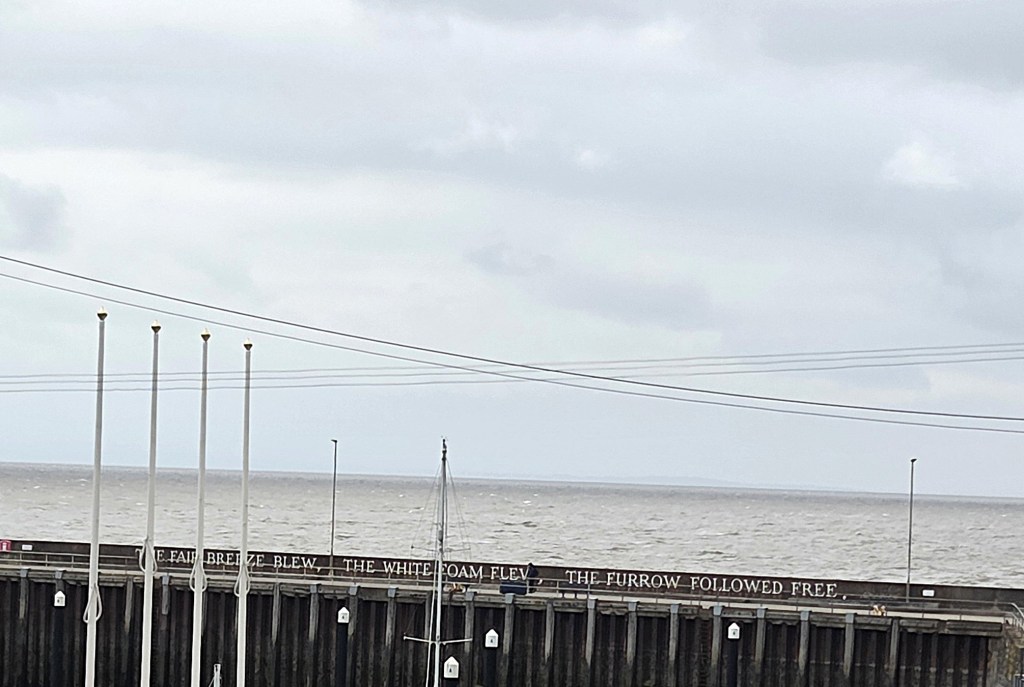
I dutifully noted the legend upon the side of Watchet Harbour:
‘The fair breeze blew,
The white foam flew,
The furrow followed free.’
This is from ‘The Rime of the Ancient Mariner’ by Samuel Taylor Coleridge (1772-1834), who is said to have hatched the idea for his Rime on a walk to Watchet Harbour, accompanied by William Wordsworth and Wordsworth’s sister, Dorothy.
The poem was inspired by an account of the travels of one George Shelvocke, leader of a privateering expedition to the South Pacific in 1719, who related how his deputy, Simon Hatley, had shot a black albatross, imagining it to be a bad omen.
Watchet is a small coastal town with some 4000 inhabitants whose name probably means ‘under the wood’.
The future Saint Decuman is said to have sailed across from Pembrokeshire late in the Seventh Century, sharing his raft with a cow.
He took up residence at Watchet, living as a hermit and serving as pastor and physician to his neighbours.
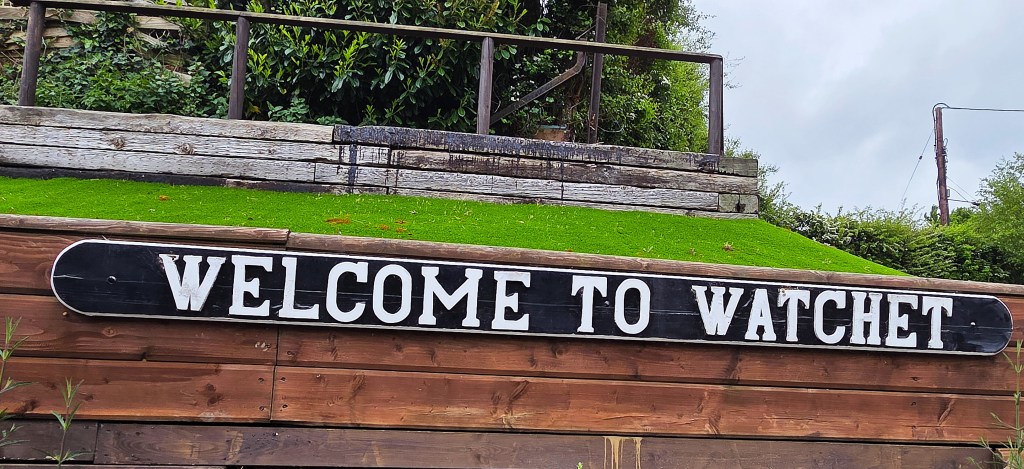
Decuman died in 706, but not before he had miraculously recovered from being beheaded by a pagan, which inspired his neighbours to help him build a church.
Originally located by the sea, erosion forced its removal to a hilltop further inland during the Twelfth Century.
The present-day Church has a Thirteenth Century Chancel, but otherwise dates mainly from the Fifteenth, though it was heavily restored at the end of the Nineteenth Century.
Watchet became a significant port during the reign of Alfred the Great.
According to the Anglo Saxon Chronicle, a Viking raid took place in 914, in which the Vikings were mostly slaughtered. Watchet was also twice plundered by the Danes, in 987 and 997 respectively.
During the Elizabethan period, Watchet grew prosperous by importing salt and wine from France.
In 1643 it was the scene of one of the more extraordinary incidents of the English Civil War. A Royalist ship was captured by Parliamentarian troops who advanced upon it at low tide.
A new harbour was constructed in 1708, courtesy of Sir William Wyndham, costing £1,000. This had to be replaced again in the mid-Nineteenth Century, following storm damage and to accommodate the growing trade in iron ore.
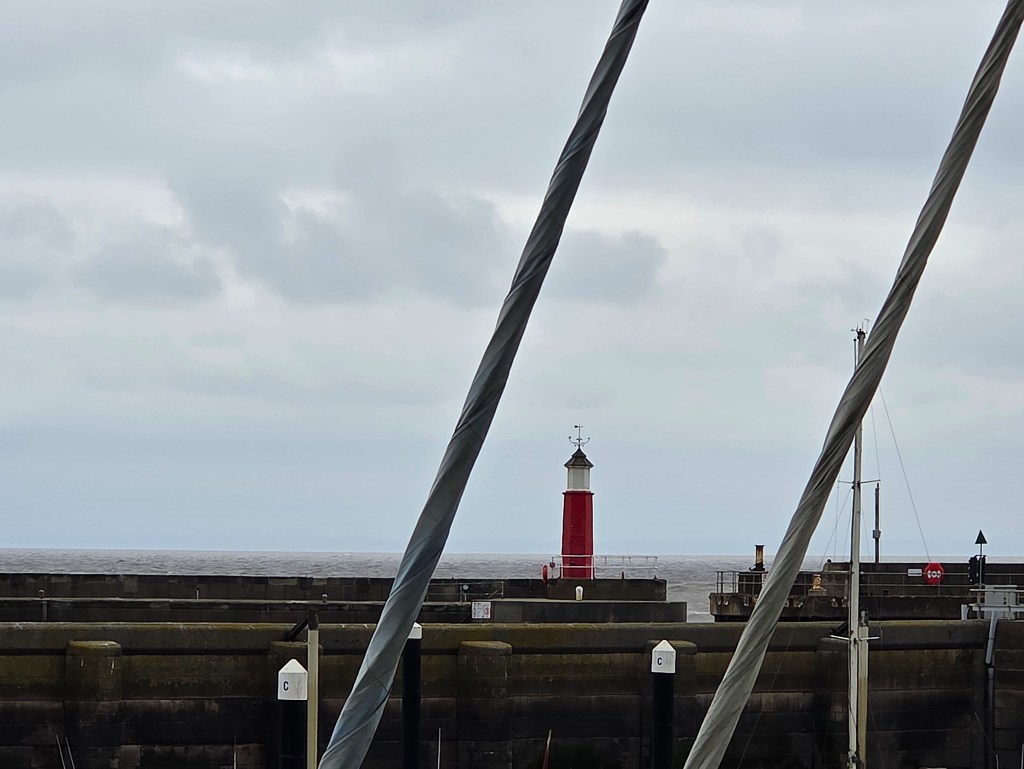
From 1861 the West Somerset Mineral Railway carried ore from the Brendon Hills mines, inland, down to Watchet Harbour and, by the end of the Nineteenth Century, some 40,000 tons of ore were being exported.
Sadly, both the mines and the railway were closed in 1898.
From the mid-Seventeenth Century onwards, Watchet developed as a centre for paper-making. Despite a serious fire in 1889, it became England’s largest manufacturer of paper bags by the end of the Nineteenth Century.
But the paper mill had closed by 2015.
There was a lifeboat station here from 1875 to 1944 though, in 1953, it became the Town Library.
Watchet survived as a trading port into the 1960s, but is no longer used commercially.
It was rather chill beside the Harbour and, thinking that we might fortify ourselves with coffee and cake, we sought a suitable café, but all of them seemed to be shutting up shop.
Early closing is increasingly prevalent in these straitened times, presumably because the owners calculate that their takings at the end of a ‘bad weather day’ won’t exceed the hourly rate they must pay to keep the place open.
So, duly zipped and buttoned up, we climbed up West Street, above Longsands Beach. The road was closed to motor vehicles owing to the risk of erosion, with several areas fenced off.
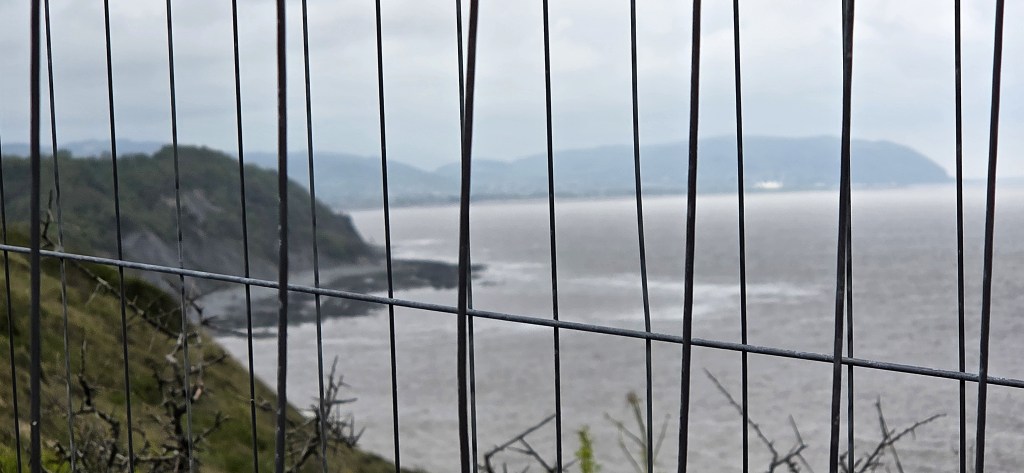
We reached what is left of Daw’s Castle, a Saxon Hill Fort being eaten away by erosion. It is named after Thomas Daw who owned this land in the mid-Sixteenth Century.
The first phase of construction has been dated to King Alfred’s reign; the second to the Tenth Century. Originally, curved ramparts would have protected the seaward facing slopes, while the cliffs protected the rear, providing an enclosed area of some two hectares.
This fortified settlement or ‘burh’ was probably where the bulk of the population resided. It was one of a network established across southern England to defend against Viking raids.
Unusually, a mint was located here, suggesting that this settlement had particular status. The mint was active from around 980 until shortly before the Norman Conquest.
It is believed that the fortification was abandoned shortly after the Conquest, the mint relocated to the present Town.
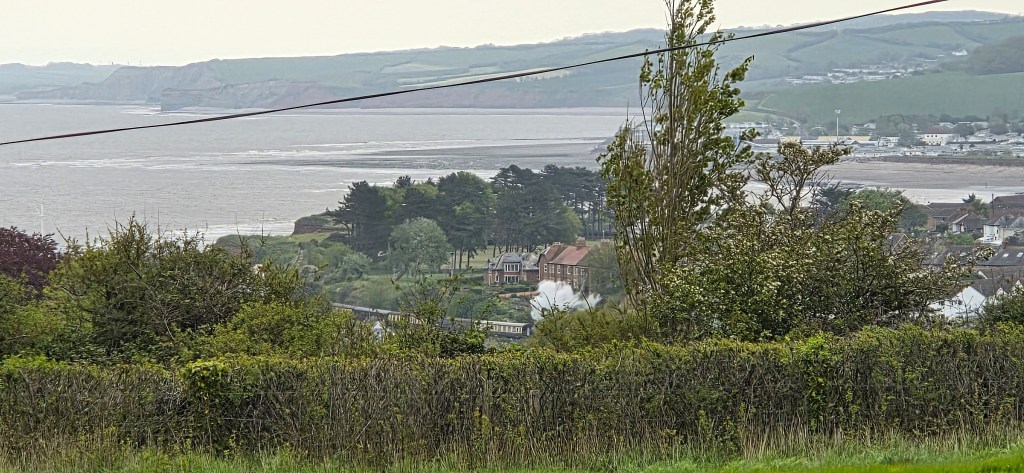
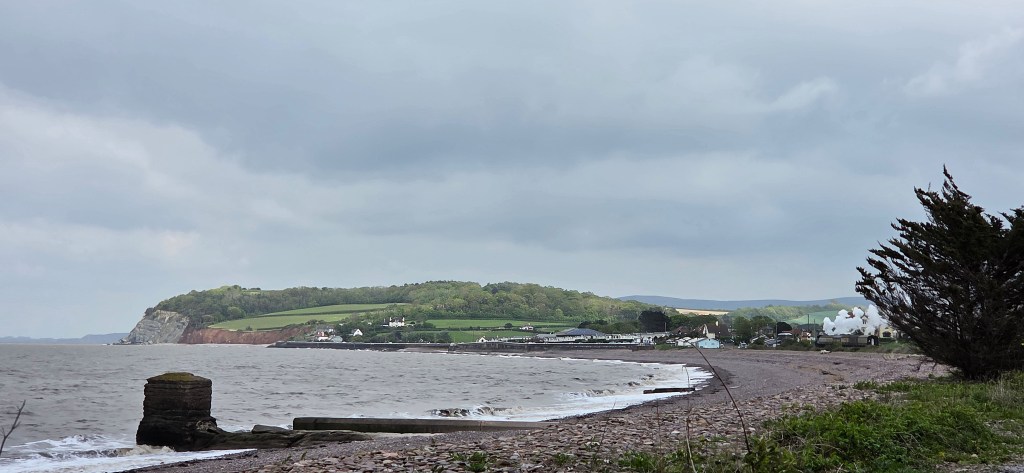
Behind us a train was getting up steam prior to departing Watchet Station in a Minehead direction. Beyond, lurking in the haze, a forest of cranes marked the site of Hinkley Point C, a power station, still under construction.
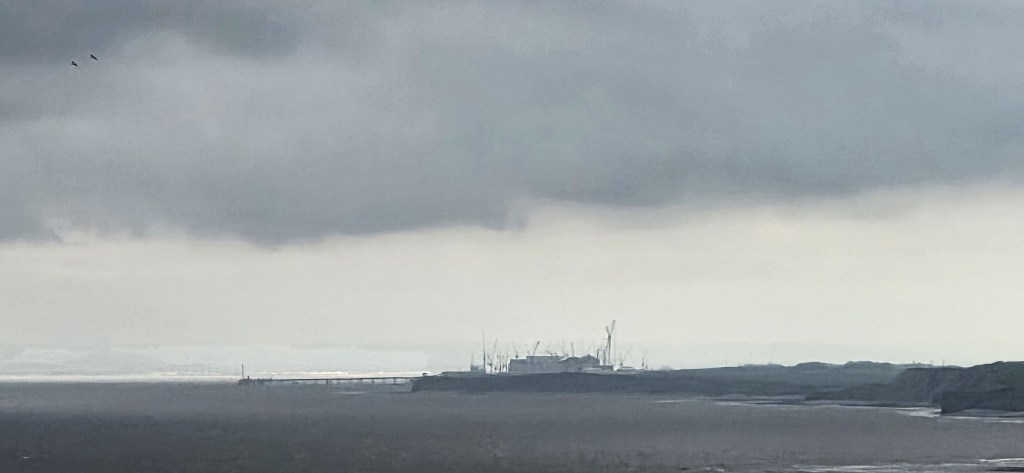
I’m unsure whether one of these is still the Sarens SGC250, reputedly the largest crane in the world. It arrived at Hinkley Point in 2019 and was originally scheduled to remain for four years.
Hinkley Point C was begun in 2017, its completion originally expected in 2025. After many delays, Unit 1 is presently projected to power up in 2030, but nobody’s holding their breath.
We now had a good view of the tower of St Decuman’s Church, inland.
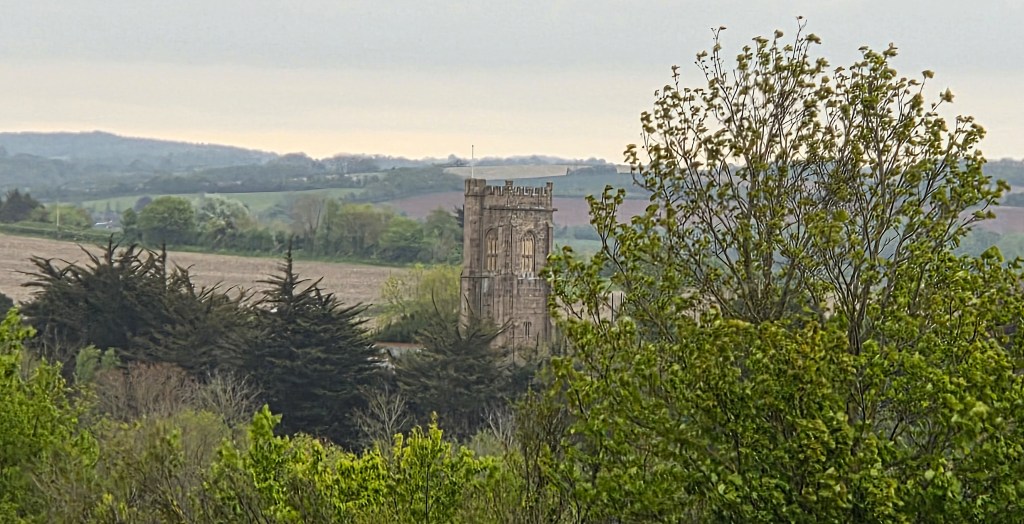
Passing in front of Warren Bay Holiday Village, we continued through a strip of undulating woodland until we reached an open field, looking down on Blue Anchor.
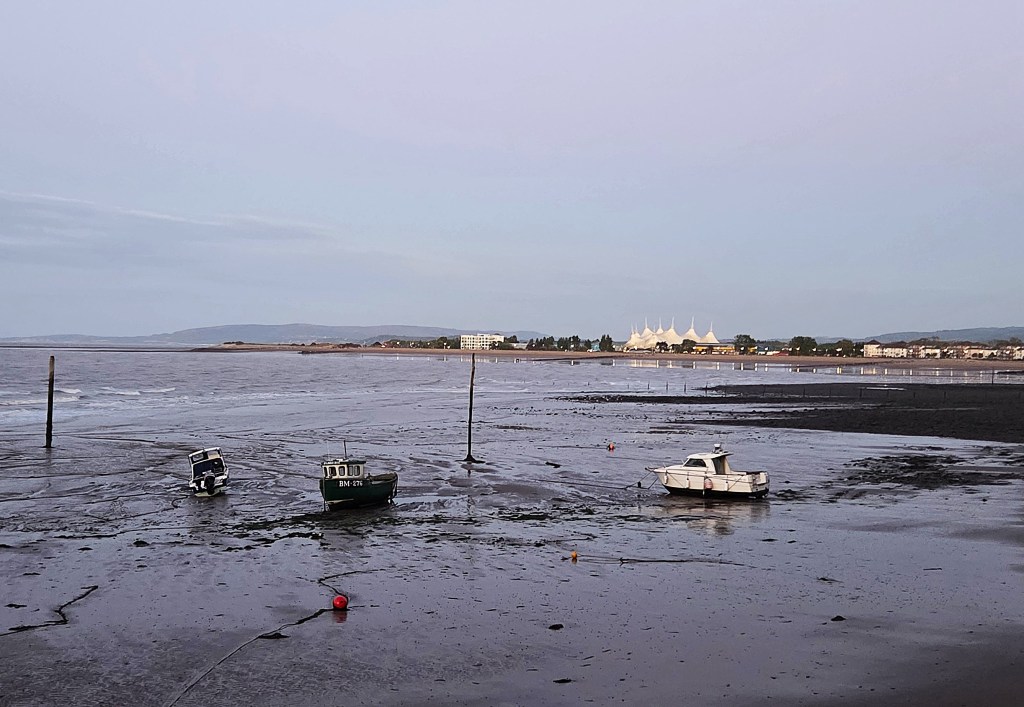
In the distance, balancing Hinkley Point behind, we could see the white tented spikes of Butlins Minehead.
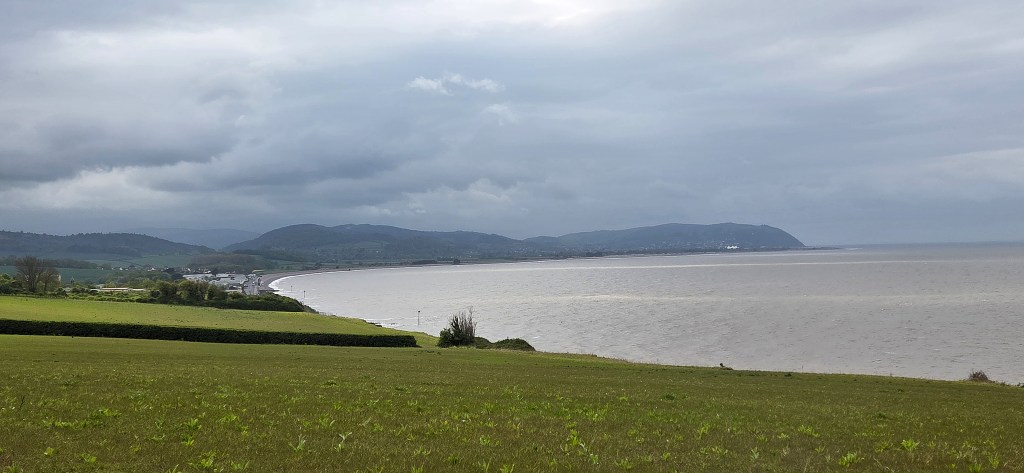
Ten minutes later we had completed our descent of Cleeve Hill, past the former Blue Anchor Hotel, now a holiday let.
A house called Blue Anchor, most likely an inn, is known to have existed in this vicinity by 1678. Several sources contend that this gave the village its name. Others claim that it derives from the bluish mud that stuck to the anchors of ships moored off the coast.
By 1861, the Blue Anchor Family Hotel was built close to the original inn and seems to have taken over its business. Latterly, the Hotel has been threatened by coastal erosion, until £3.5m was spent on shoring up the unstable cliffs with thousands of tons of rock.
It is now a holiday let.
Blue Anchor Station here was opened in 1874, initially served by a single track, until the Great Western Railway installed a second in 1904.
A camping ground was established in the 1930s, which has expanded into the extensive holiday parks located here today.
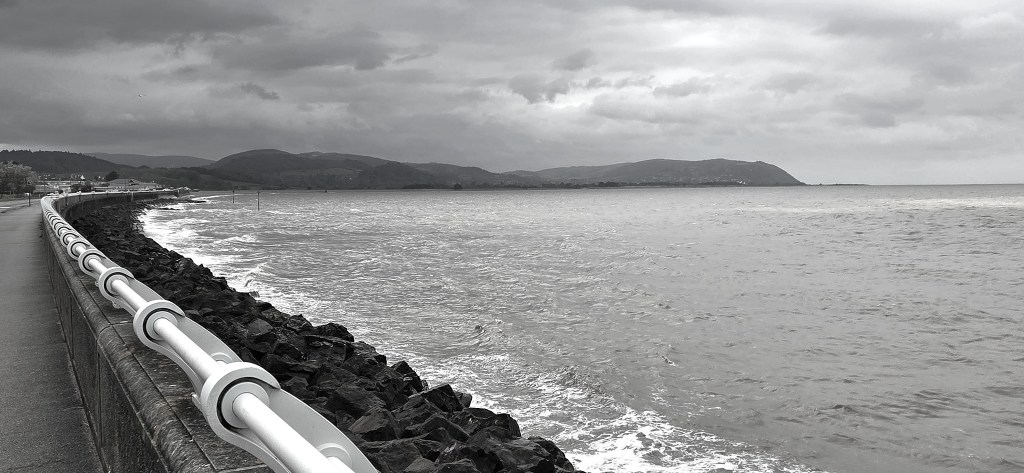
We passed along the strand, avoiding the butts of fishing rods leaning against the pale blue metal railing that tops the low concrete wall. The tide was in so the sandy beach was invisible.
As the B3191 curved round towards Carhampton, we continued straight on, past several residential chalets and then on beside the railway line.
A black steam train passed us, heading in the opposite direction.
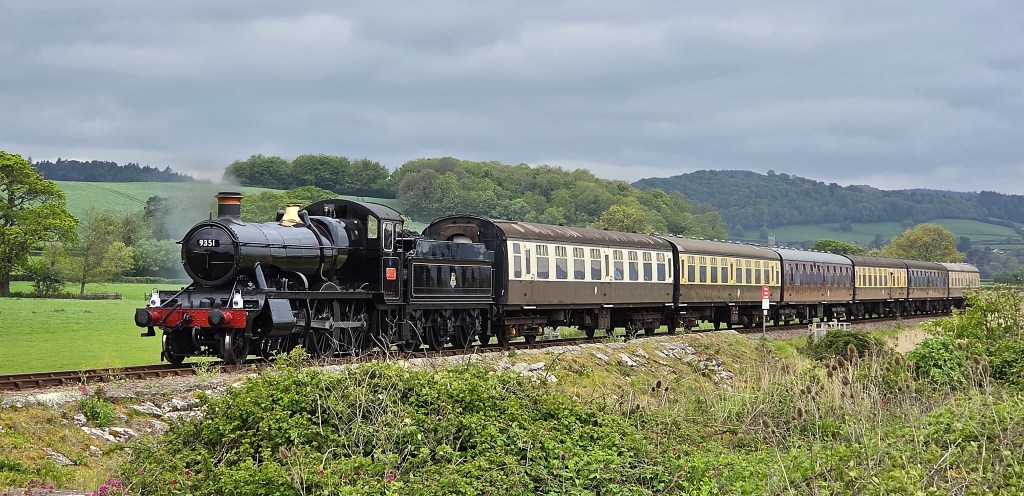
It is a 5101 Class 2-6-2T, built in 1934. It worked between Stourbridge, Birmingham and Wolverhampton before moving to Cornwall, then was based mainly at Whitland, Camarthenshire, before ending up at Barry Scrapyard.
It was rescued in 1979, transferring to the Steamport museum in Southport before being acquired by the West Somerset Railway in 1998.
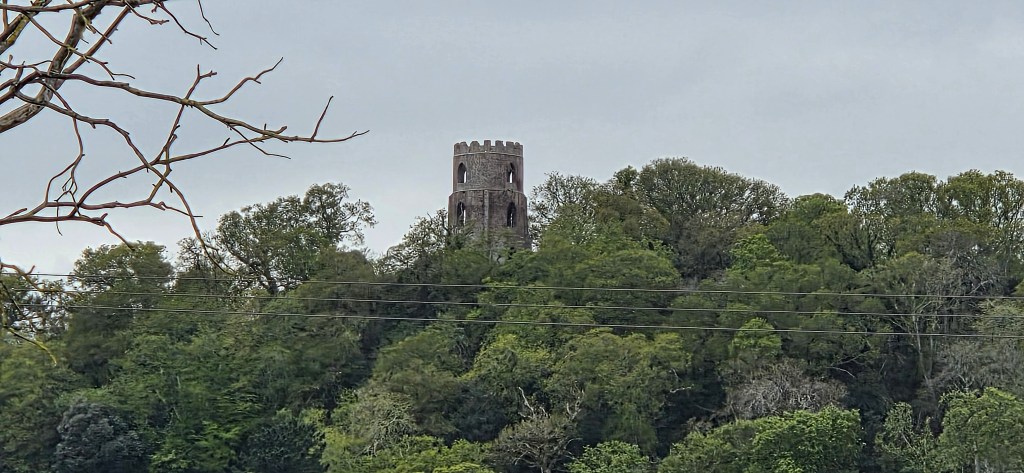
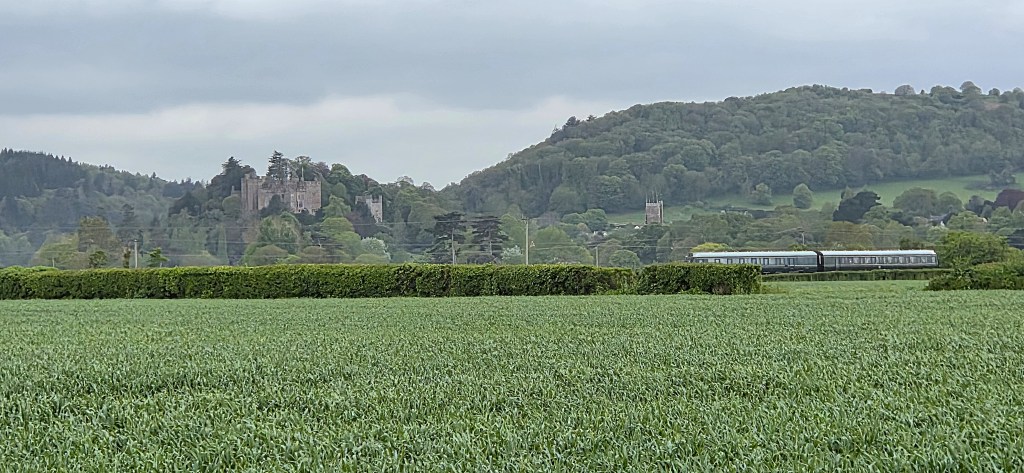
Ahead sat the Conygar Tower, perched on a hill above treetops. This three-storey folly, some 18 metres tall, was built in 1775 for Henry Luttrell, 2nd Earl of Carhampton (1743-1821), a rather unsavoury army officer, politician and occupant of Dunster Castle.
We could also see the Castle, standing on its Tor, across the tracks.
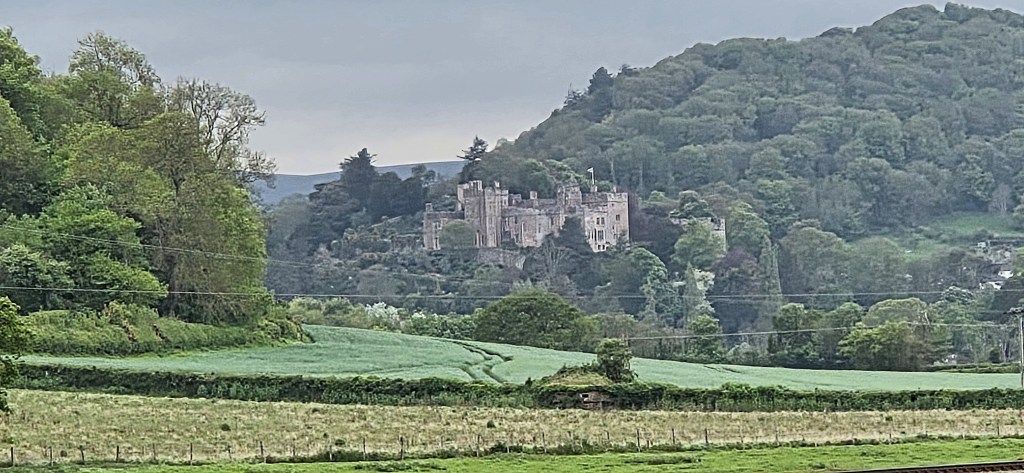
A wooden fortification was built by William de Mohun, First Baron of Dunster around 1086, on the site of an earlier Saxon hill fort.
His son, William de Mohun, Second Baron of Dunster (c.1090-c.1155), was a supporter of Empress Matilda (1102-1167) in her civil war against King Stephen (c1092-1154).
Stephen tried and failed to take the Castle, which was also besieged unsuccessfully. Matilda consequently made her champion Earl of Somerset.
The De Mohun family occupied the Castle until 1376, when it was sold to the Luttrell family after Sir John de Mohun, Ninth Baron of Dunster, died significantly in debt.
Sir Hugh Luttrell (c.1364-1428) made substantial repairs, but the Luttrells briefly lost control of the Castle from 1461 to 1485, when it was removed from them by Edward IV, only to be restored by Henry VII.
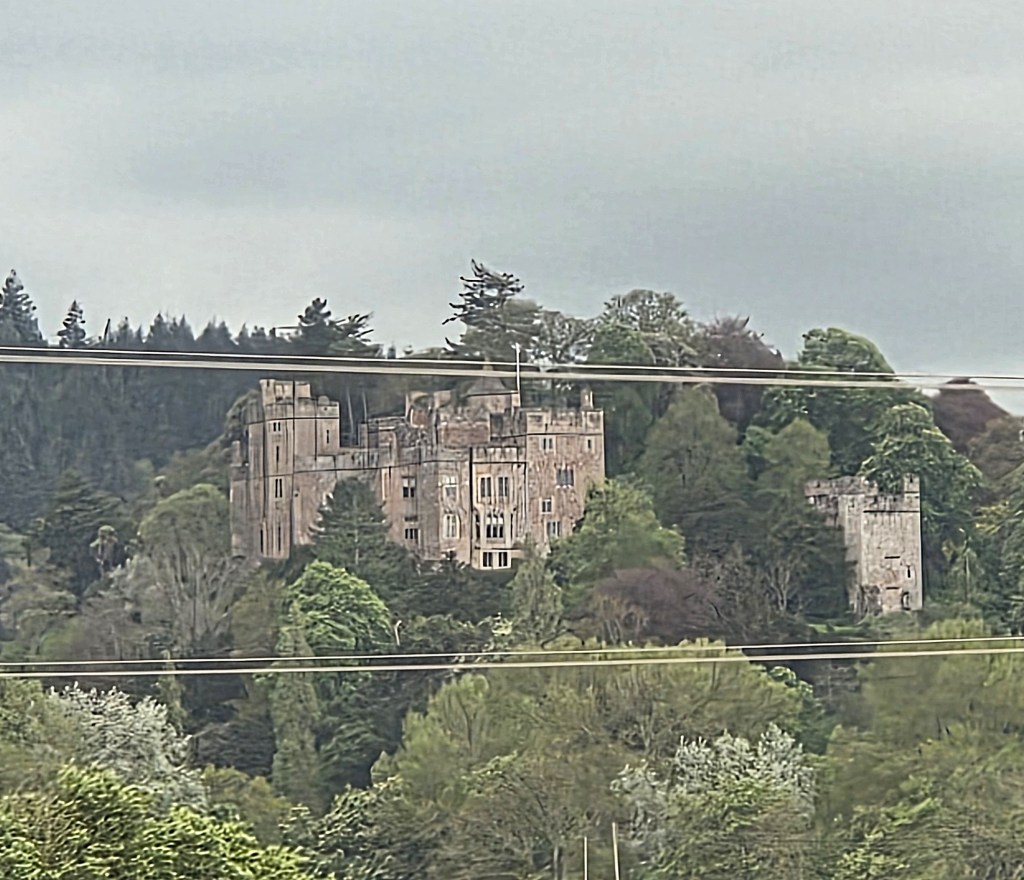
By the 1540s the Castle was already in some disrepair and, in 1617, George Luttrell (1560-1629) commissioned a substantial manor house within the Castle grounds.
During the English Civil War, Dunster was initially Parliamentarian under Thomas Luttrell (1583-1644). When attacked by the Royalists in 1642, it repulsed them. But when it was attacked a second time, in 1643, Thomas Luttrell promptly switched to the Royalist side.
The Parliamentarians besieged the Castle in their turn, causing it to surrender to them in 1646. They had the walls torn down in 1650, to prevent further use of the Castle against them.
The manor house was extensively modernised in the 1680s, courtesy of Colonel Francis Luttrell, and again in the 1760s under Henry Luttrell (1722-1780).
In 1868, under George Luttrell, it was effectively transformed into a large Victorian Gothic family home.
During the Second World War it became a convalescent home for Allied officers but, crippled by death duties when Alexander Luttrell died in 1944, the family were forced to sell up and lived as tenants for some years.
They managed to buy the Castle back in 1954, only for Sir Walter Luttrell to donate it to the National Trust in 1976.
We crossed the pebbles of Dunster Beach, reverting to the nearby trackside path after a while, judging that the pebbled route was not compulsory.
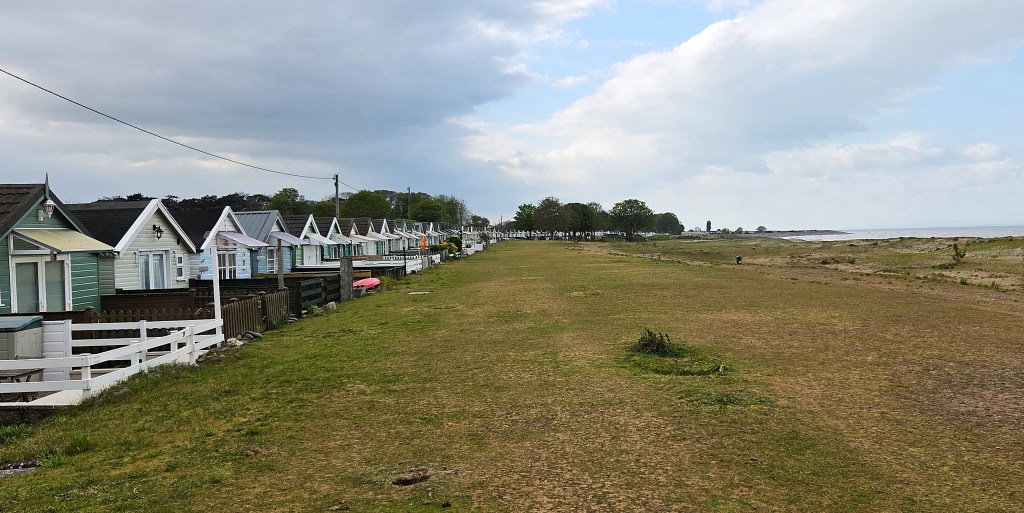
Eventually arriving at Sea Lane, we passed along the extensive row of chalets. The first were built here in the 1920s, the local council permitting further construction in 1935.
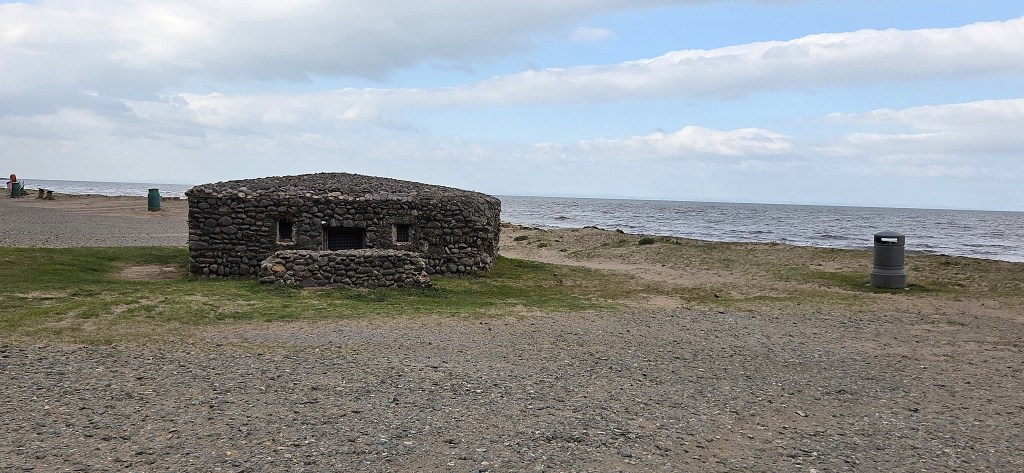
In 1940 they were requisitioned by the army, which also erected the fortifications upon the Beach.
When the land was sold by the Luttrells, it fell into private ownership, but was purchased back by the chalet owners in 1965. There are now 230 chalets located here, the owning families passing them down from generation to generation.
Arriving at the edge of the Minehead and West Somerset Golf Course, we were shocked to find a sign stating that the England Coast Path was closed along the full length of the course, from here to the edge of Minehead.
Apparently this is attributable to erosion following storms in late January 2026, and the closure will last until at least July 2026.
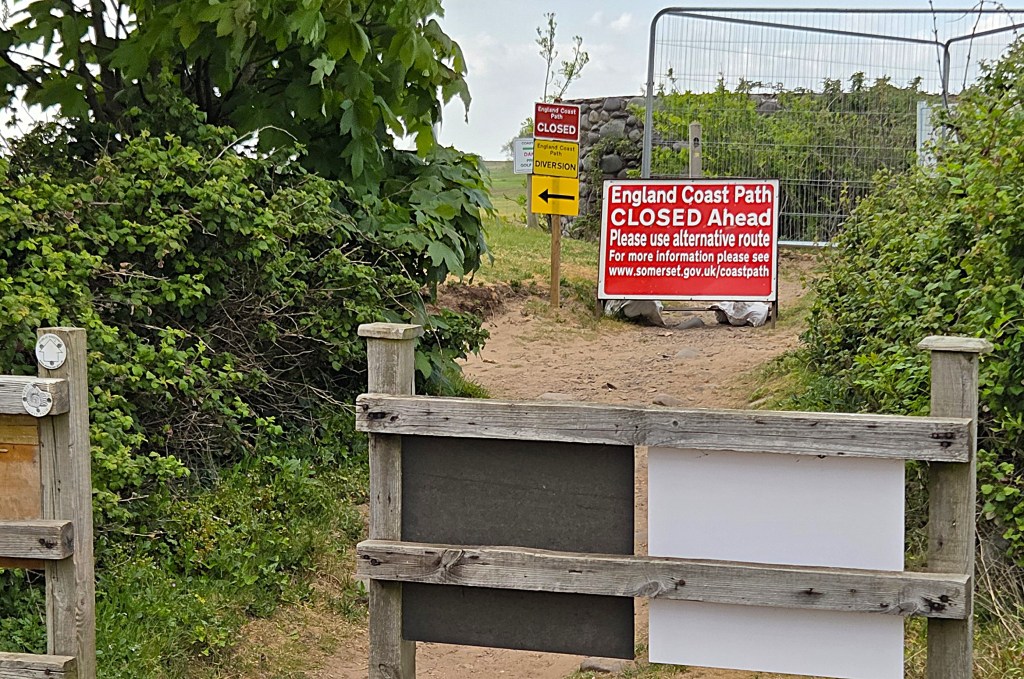
Since King Charles opened the England Coast Path on 19 March 2026, the closure predates that, so this stretch joins the near 600 miles of path that are not yet accessible to walkers.
Some walkers have been disregarding the closure, which is deemed necessary while Somerset Council adds to the sea defences on the beach, below. This is hardly surprising, since the diversion is colossal, sending one right back to Dunster and then along the A39.
Meanwhile, the Golf Club seems unable to tolerate walkers using the edge of its course instead. And, of course, the golfers are still free to golf while the work is done on the beach.
The diversion adding considerably to what should have been a comfortable walk of 7.7 miles, we arrived back at the Hotel later and more footsore than planned.
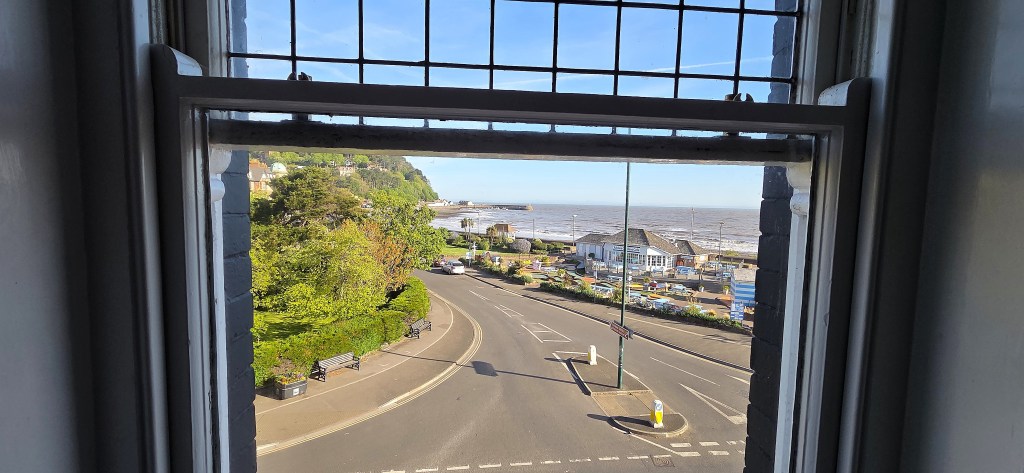
It was 18:00 before we checked into our room, Helwell Bay, on the first floor, looking out over two cafes on the Promenade and then over the Bristol Channel.
That evening we had dinner in the The Old Ship Aground, once the Pier Hotel, beside Minehead Harbour. I had also visited in 2017. Back then I was much taken by a picture of the Minehead Hobby Horse, which seems to have disappeared.
I had a huge portion of fish, chips and mushy peas, along with a pint of Tanglefoot, leaving no space for a dessert of any description.
Minehead
Minehead is also a smallish coastal town, though with a population approaching 12,000.
A port was operational here from as early as 1380.
The Parish Church of St Michael is predominantly Fifteenth Century, but with substantial Nineteenth Century restoration. Its tower formerly contained a beacon that helped guide ships back to harbour.
A Royal Charter established a free borough here in 1559 but, when the harbour silted up, it was revoked by James I, and the Luttrells regained control. They funded a new harbour, built in 1616.
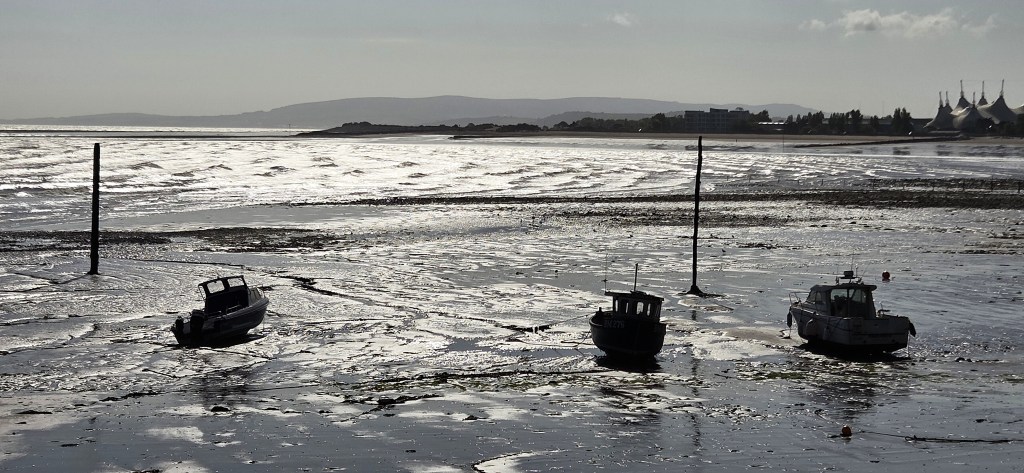
Trade was mostly conducted with Wales, for livestock, wool, butter, fish and coal. Some privateers also based themselves in Minehead.
The small market town established itself and, during the second half of the Seventeenth Century, several prominent merchants made it their home.
Smuggling increased significantly.
By the early Eighteenth Century, some forty fishing and trading vessels were using the harbour, the traders now venturing to Ireland as well as to Wales.
But the boom years were followed by decline, exacerbated by the failure of the local woollen industry. A major fire took hold in 1791, destroying much of the lower town. Proposals for extensive rebuilding were slow to take off. The population declined significantly.
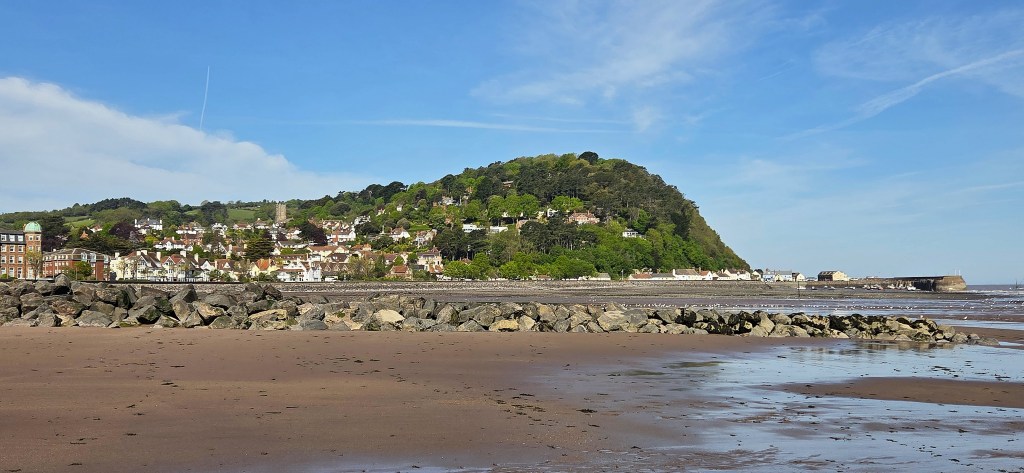
Then tourism began to take hold, prompted by the new interest in sea bathing. By the 1850s, Minehead was already becoming a popular retirement destination for wealthy industrialists.
An Irishwoman called Cecil Frances Alexander (1818-1895) is said to have written ‘All Things Bright and Beautiful’ here in 1848.
The arrival of the railway in 1874 prompted extensive hotel building and rapid growth. The Golf Club dates from 1882.
Arthur C Clarke was born in Minehead in 1917, but he is by far the most prominent of the Town’s alumni.
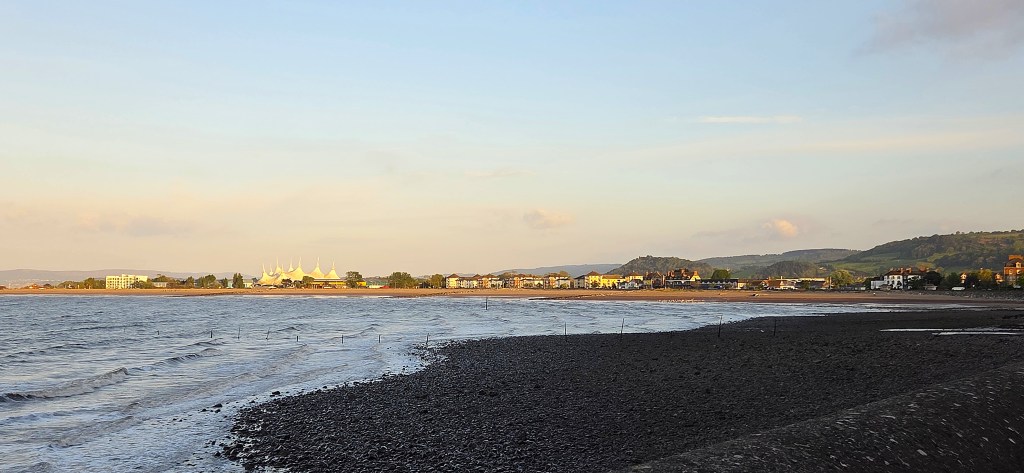
More recently, touristic growth was bolstered in 1962 with the opening of Butlins’ flagship holiday camp, one of only three now remaining.
But, in 1990, much of the beach was washed away in a bad storm which also caused extensive flooding. Some £13m was invested in new sea defences which opened in 2001.
Minehead is a pleasant, understated little town, rather low-key, but with a thriving community spirit. Though there has been some gentrification, this has not resulted in the establishment of any truly outstanding pubs or Michelin-starred restaurants.
South West Coast Path: Minehead to Porlock Weir
We were down for breakfast shortly after 08:00, having pre-ordered a Full English apiece the evening before. Our meals were tasty, but so hefty that it took us some time to finish them.
We were eventually under way by 09:30.
It was a sunny, breezy morning. The temperature grew steadily warmer. A few small, puffy clouds scudded briskly across the predominantly blue sky.
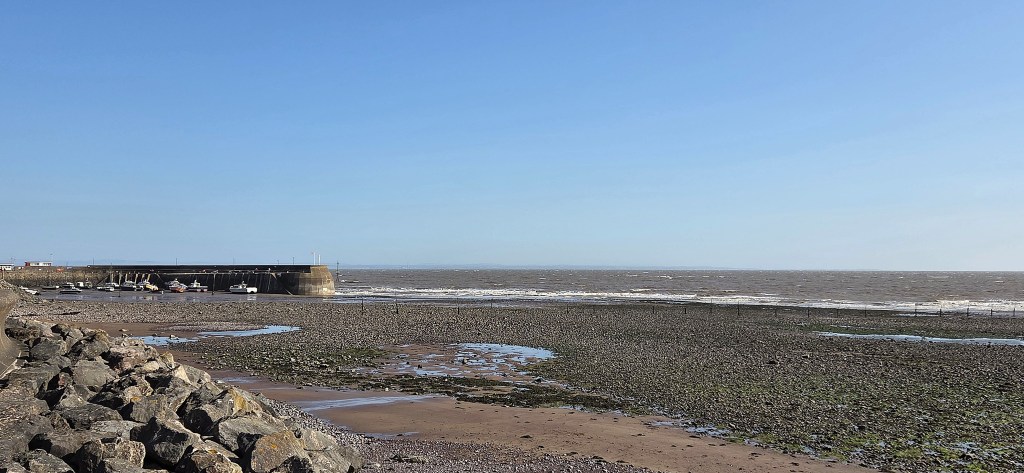
The tide was fully out, leaving the harbour high and dry. Minehead has one of the largest tidal ranges in the world, at 48 feet.
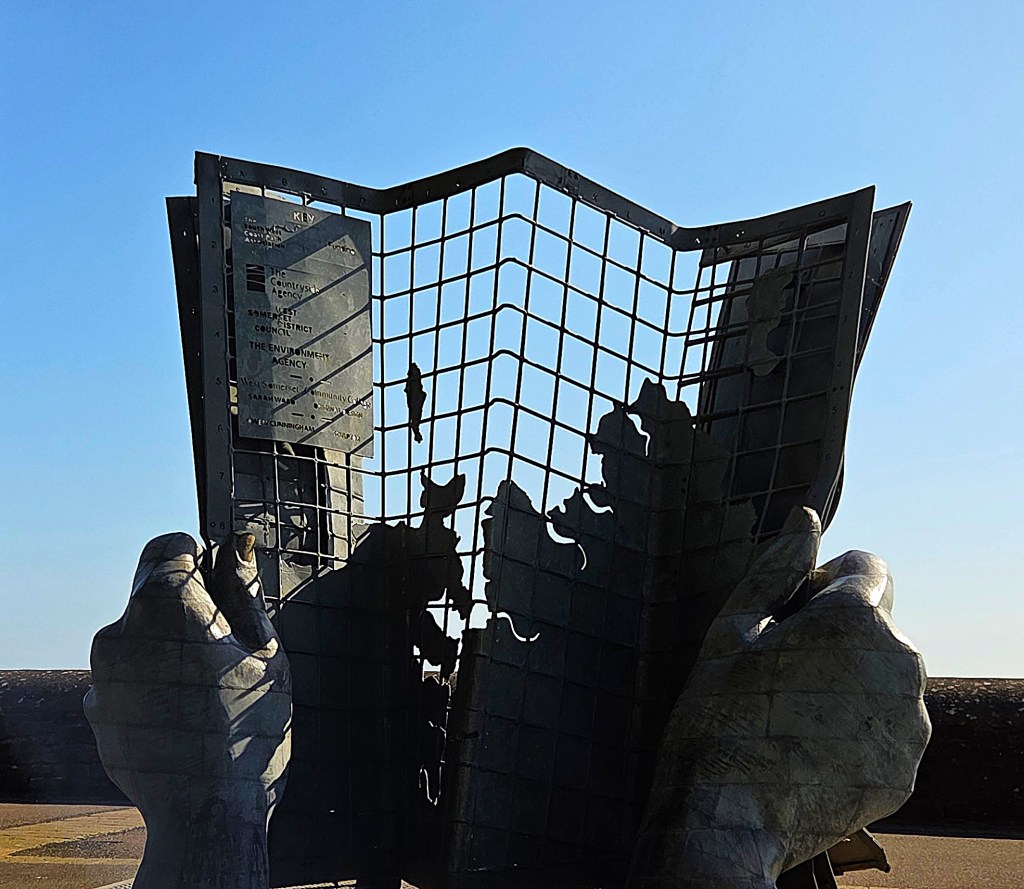
We stopped for the customary pictures of the ‘hands’ statue indicating the start of the South West Coast Path.
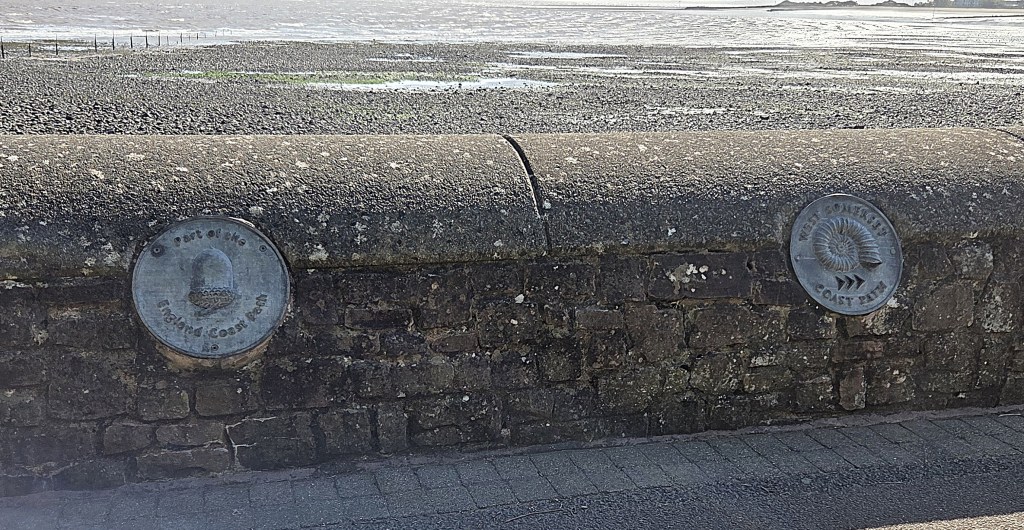
There are also now two studs in the sea wall, one marking the England Coast Path, the other the end of the West Somerset Coast Path.
We passed the lifeboat station, first established here in 1901. Shortly afterwards our attention was drawn by a wooden bench decorated with sunflowers, a collection of painted pebbles clustered around one leg.

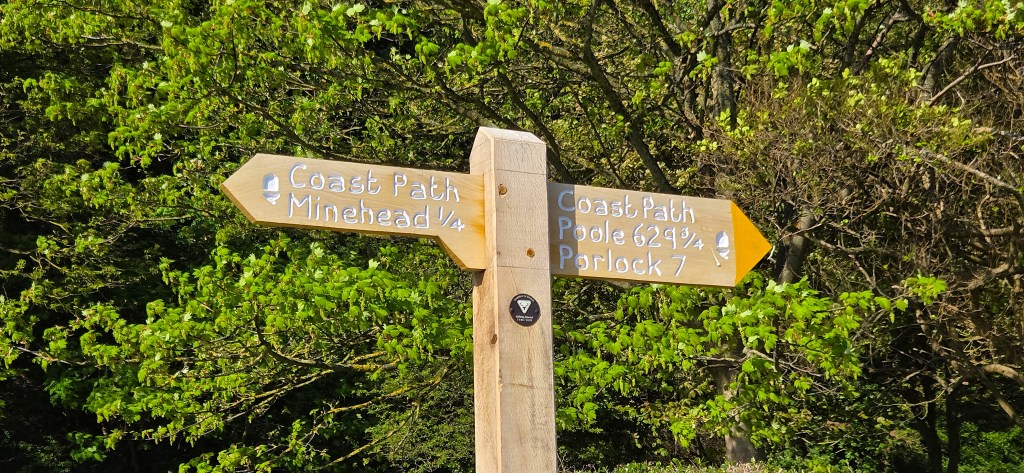
The brand new coast path sign informed us that Poole was exactly 629 and three-quarters of a mile distant.
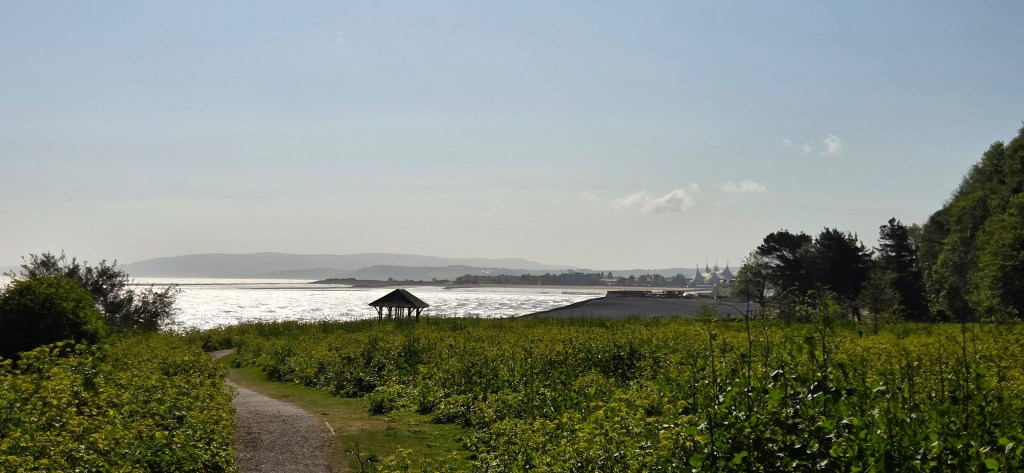
We entered a flat area, Culvercliffe Green, one tree marked as part of the Queen’s Green Canopy initiative. As we followed the well-defined path on to the top of Culver Cliff, a small, shingly beach could be glimpsed through the trees.
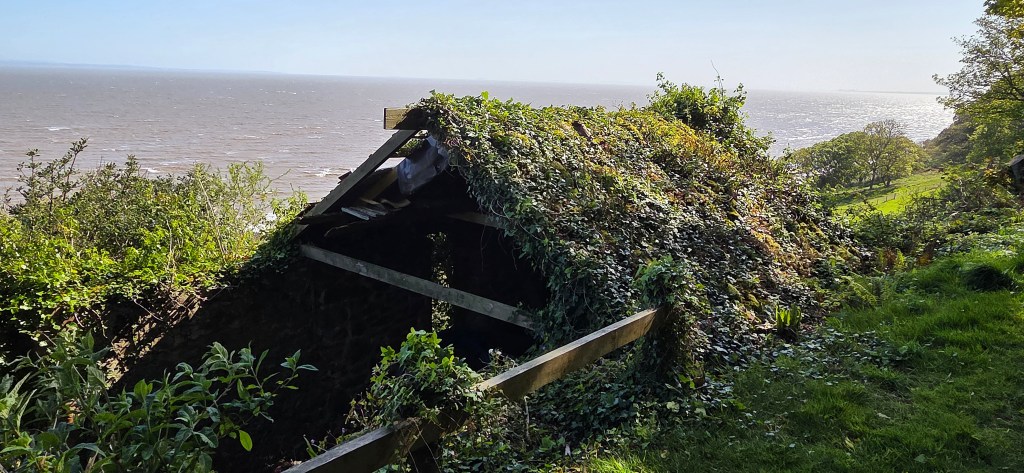
We remarked an old shed with a natural ‘green roof’ and, as we approached Greenaleigh Farm, could see a group of people assembling in the field far below, adjacent to the sea.
But our way lay upwards, on a steep path through woodland. Initially it had us doubling back on ourselves, until we reached the bridleway heading towards North Hill.
We reached the turning for the ruins of Burgundy Chapel, or Bircombe Chapel, as it is named in the household accounts of the Luttrell family for 1405.
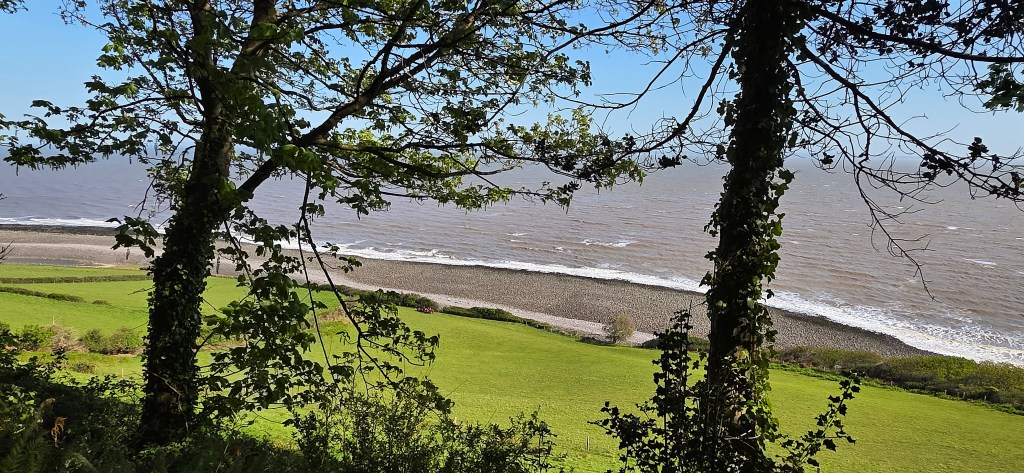
The Chapel was built on a platform cut out of the hillside, probably in the Fourteenth Century and is known to have been in ruins by 1717.
In a section nearby, two men were clearing rhododendron bushes from the slopes below, clearly a difficult task given the steepness of the terrain. Their quad bike was stationed on the path, warning of their presence.
Soon we arrived at the point, near Bramble Combe, where my 2016 Guide tells me to:
‘…leave the more rugged clifftop route to the seaward side (unless you intend to take this more dramatic and wild alternative). Keep straight on…’
That is exactly what I did in 2017.
But it seems that the rugged path has been much improved and is now the default route for the England Coast Path as well as the SWCP.
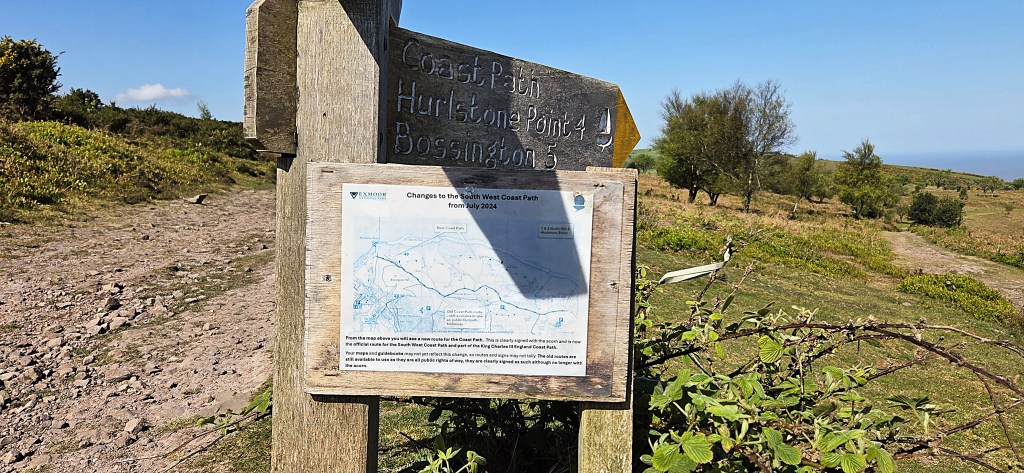
Judging by the sign, this change was introduced in July 2024. It makes this leg significantly different to the version I completed last time round.
It was now a beautiful, warm morning.
We skirted Grexy Combe and Furzebury Brake, passing beneath an Iron Age hill fort and the deserted medieval hamlet of East Myne.
This area was used to train Canadian and American tank crews during the Second World War. There was also a radar station here in the 1950s, which closed in 1964.
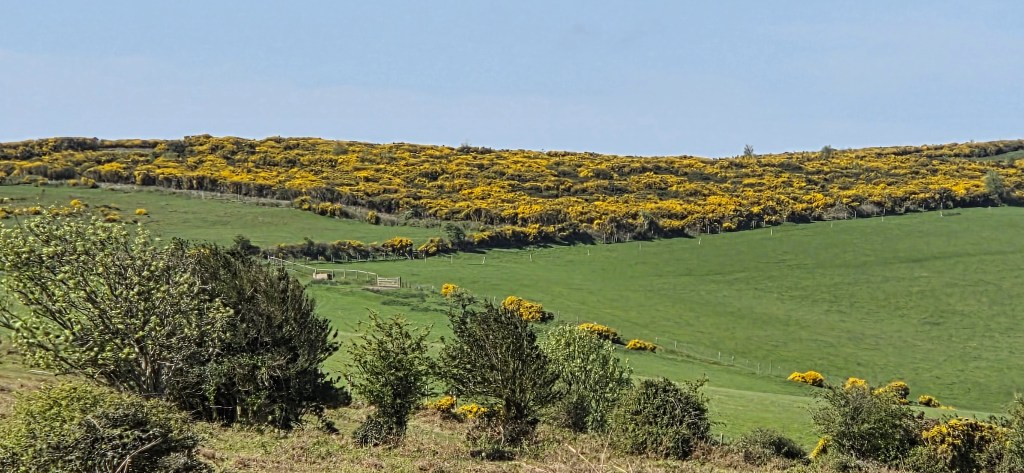
Expanses of broom were flowering, vividly yellow, upon the hillsides.
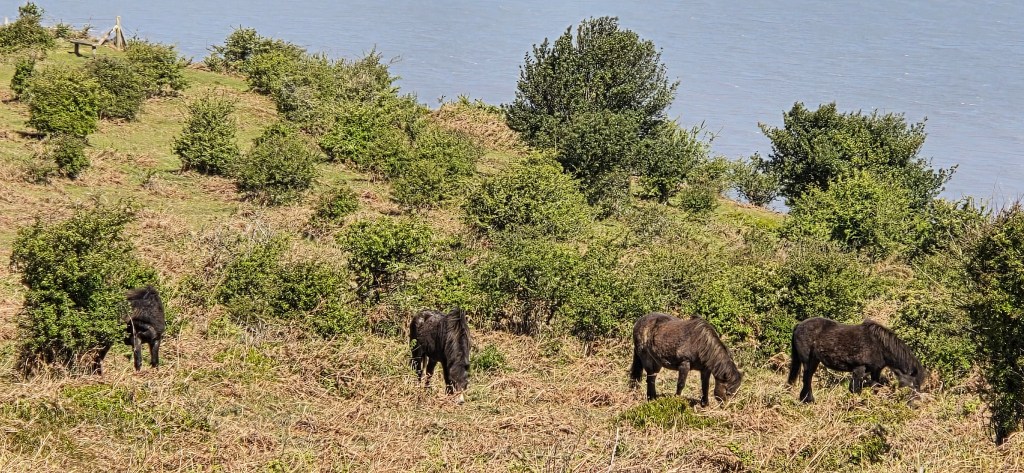
We came upon a quartet of Exmoor ponies grazing close to the cliff edge.
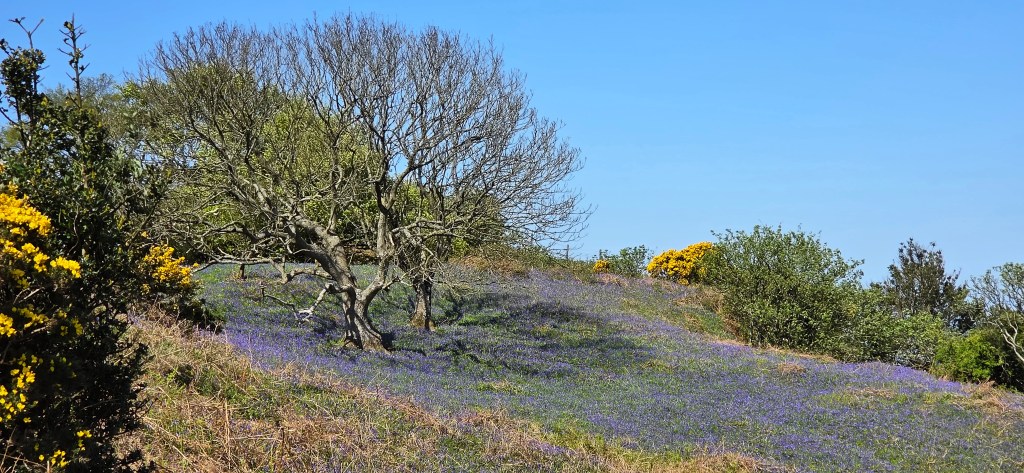
Soon the broom gave way to blankets of bluebells.
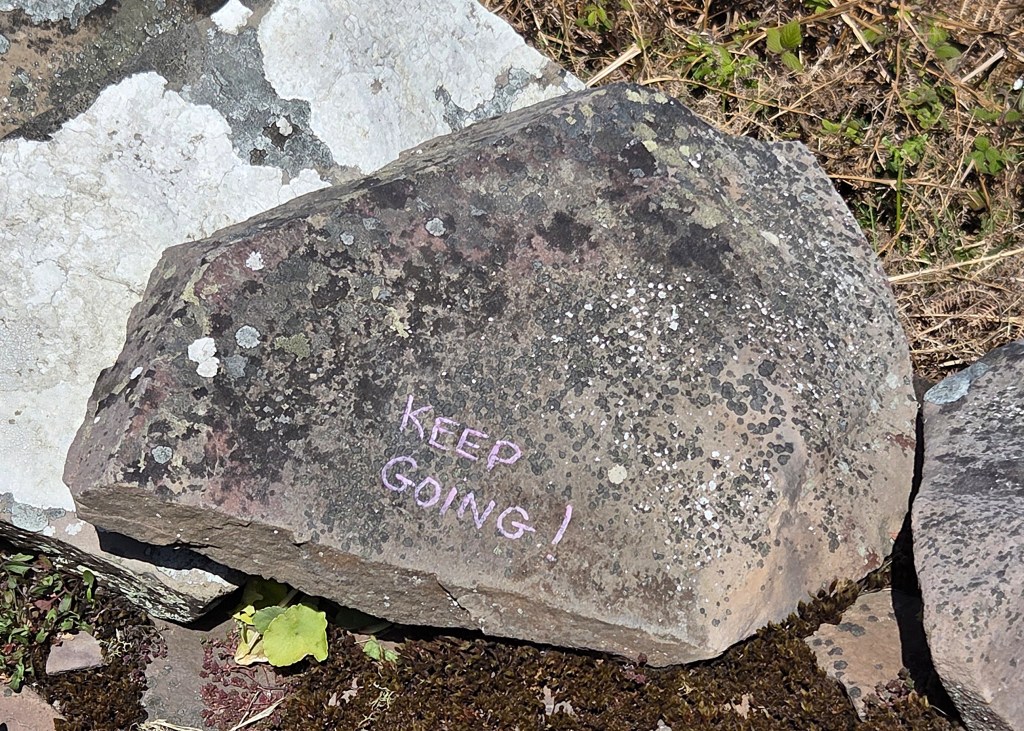
A trackside rock carried a motivational message.
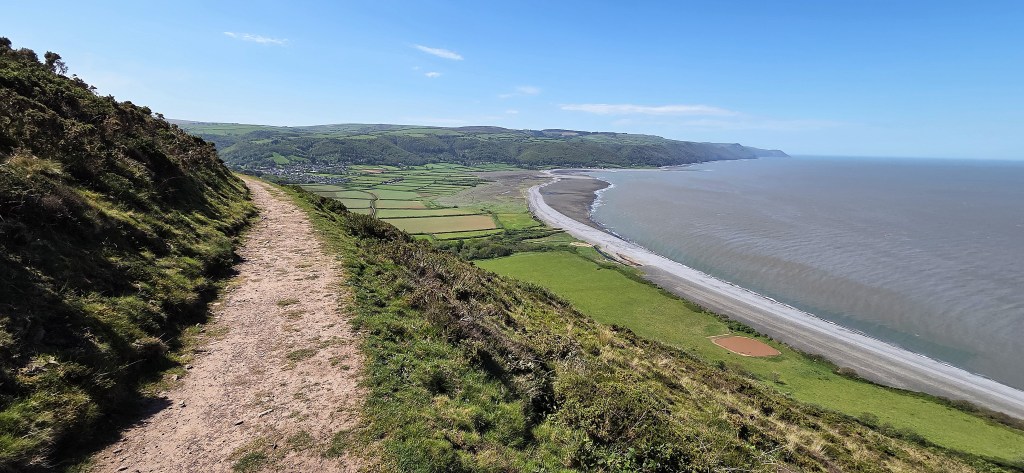
We were now abreast of Selworthy Sand, but the tide was in, so the reddish sand was covered with only the pebbly section visible.
Following the route changes, walkers now face a bewilderment of signs on the approaches to Hurlstone Point. We searched in vain for one clearly marked as the official coast path route.
Consequently, we failed to reach the Point itself, turning instead on to a path that took us around Bossington Hill and into the plantations above the Village.
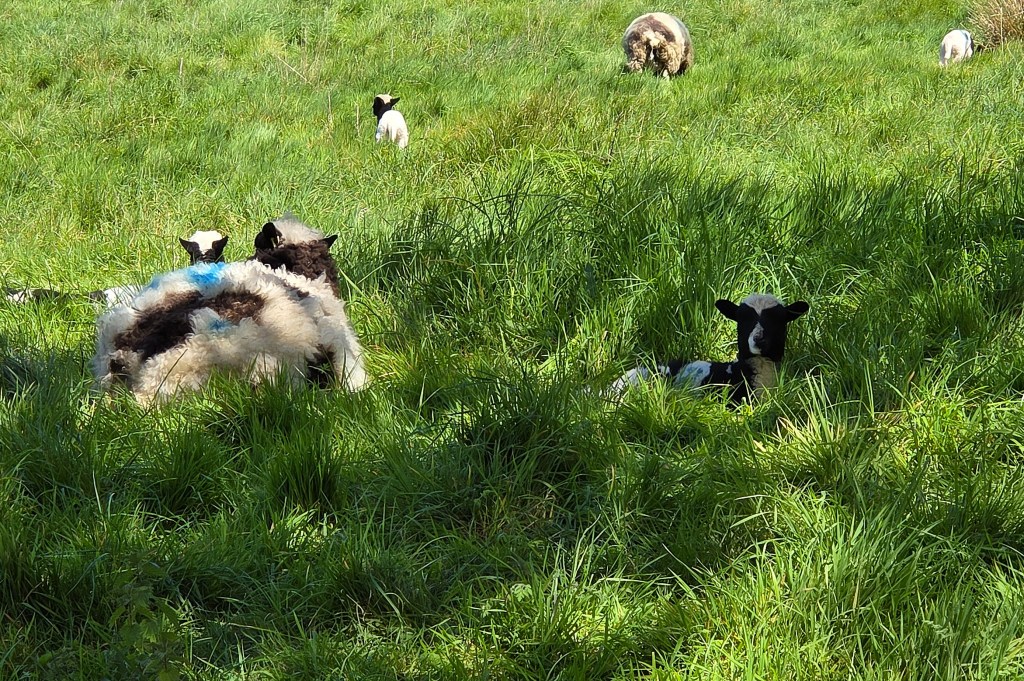
Finding that we had overshot Bossington, we followed a footpath through a field of ewes with their new-born lambs, ultimately arriving beside a bridge over the River Horner, where the official Coast Path arrives from the opposite direction.
Crossing the Horner, we headed straight for Kitnor’s Tea Garden, an oasis of calm tranquillity, punctuated by gentle humour, with outstanding coffee and cakes besides!
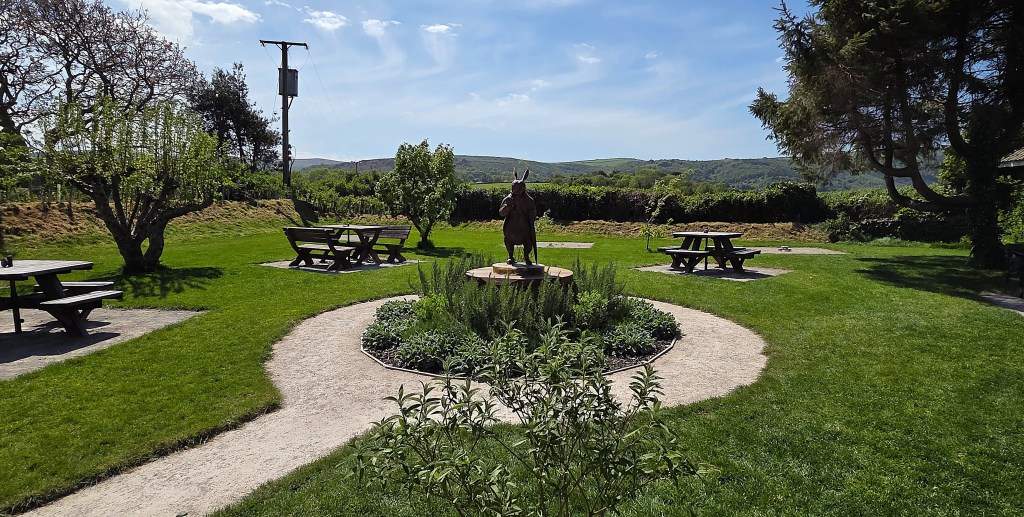
It was a struggle to leave, but eventually we did so, following the road seawards past a series of cottages.
Bossington is part of the National Trust’s Holnicote Estate, some 12,500 acres donated by Sir Richard Acland in 1944.
Acland (1906-1990) was initially the Liberal MP for Barnstaple, but he left in 1942, becoming one of the founders of the socialist Common Wealth Party, alongside author J B Priestley.
When Common Wealth split in 1946, Acland joined the Labour Party, becoming the Member for Gravesend in 1947.
He later worked as a maths teacher and lecturer in education, helping to found the CND in 1957.
Acland’s estates were sold to the Trust for £134,000. He donated some of the proceeds to Common Wealth, buying a house in Hampstead with the balance.
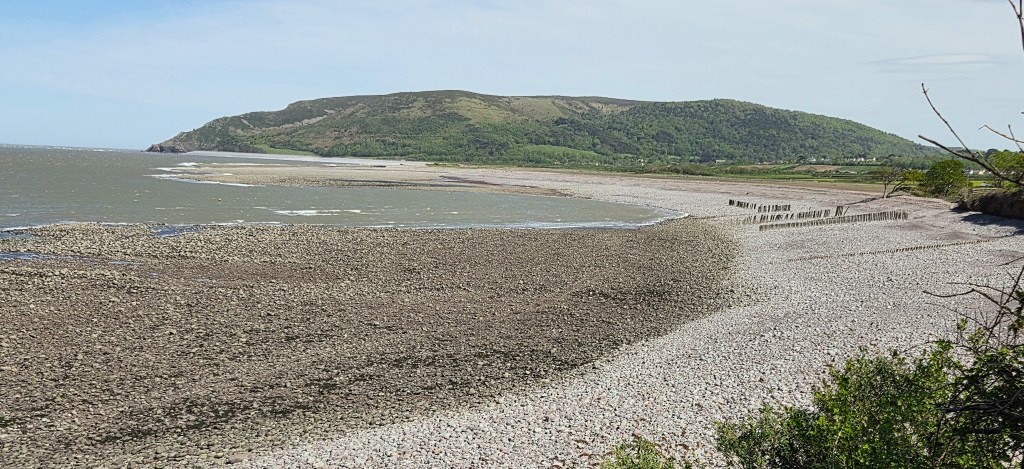
At the end of the lane the path turns westwards, following the field edges behind Bossington Beach, which extends from below Hurlstone Point to Porlock Weir.
The Coast Path originally followed the ridge of shingle at the rear of the beach but, in 1996, Storm Lili caused a breach. The land immediately behind the beach, which had been used to graze sheep and cattle, now became flooded at every high tide. Some developed into marshland.
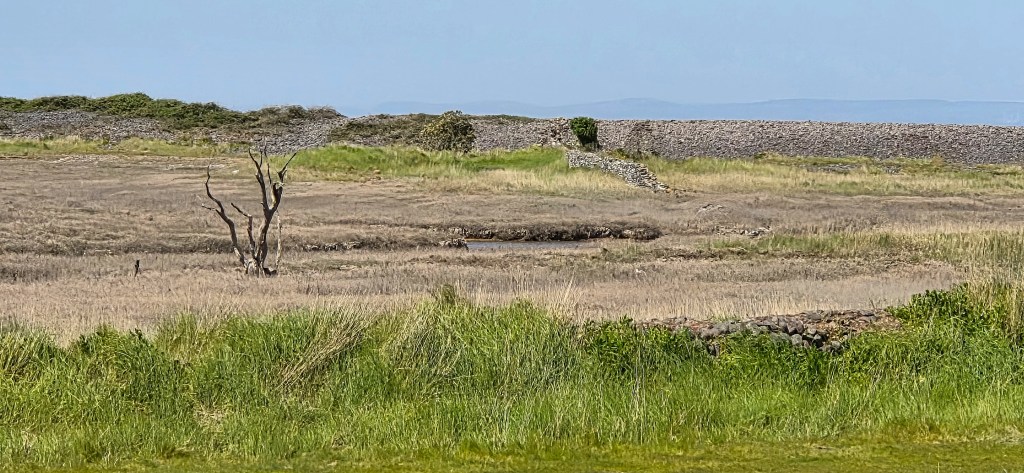
The last time I walked through here it was a glum, chilly day, rather late in October. The experience was completely different.
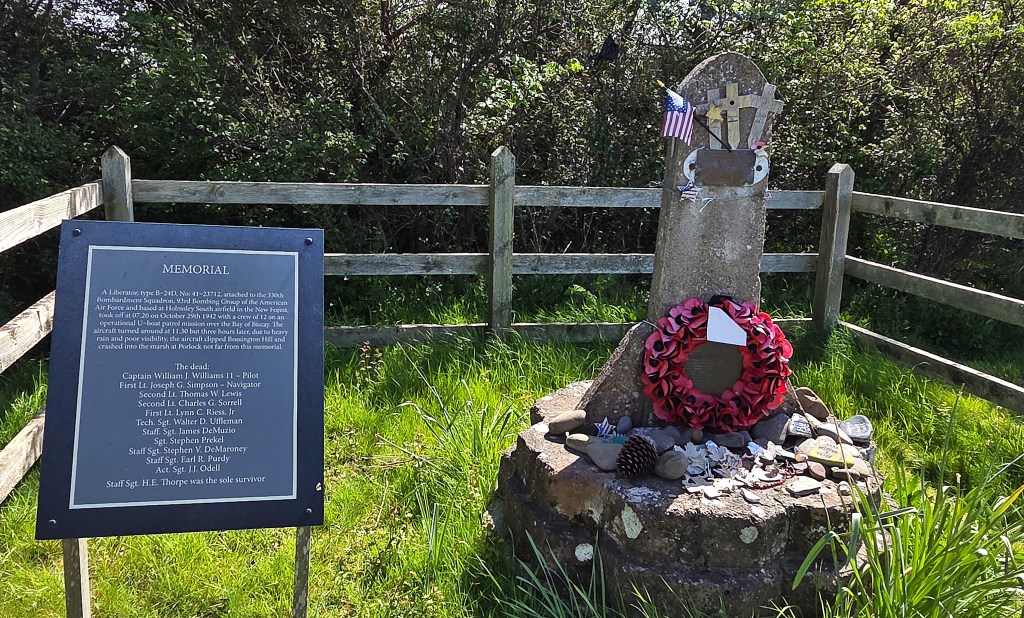
A sombre note is injected by a Memorial to the crew of a Liberator Bomber that crashed here on 29 October 1942, following a U-boat patrol over the Bay of Biscay, but on a sunny day it is soon forgotten, given the beauty of the natural surroundings.
The skeleton of a tree, when set against a vivid blue sky, is far less threatening.
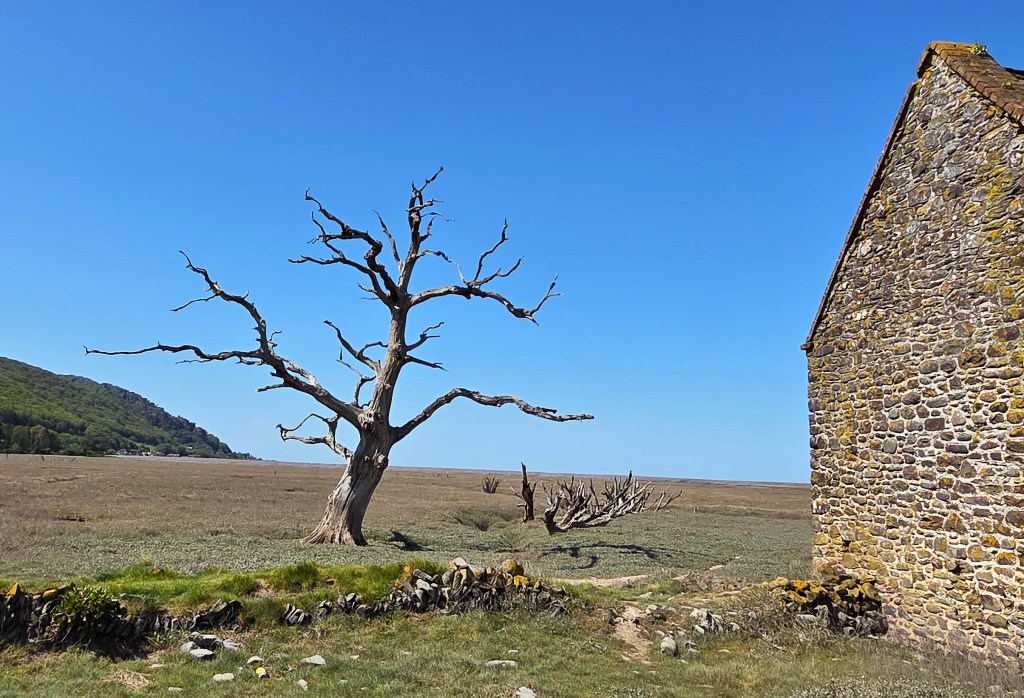
The path eventually joins the shingle ridge just beyond West Porlock, eventually joining the coast road just shy of Porlock Weir.
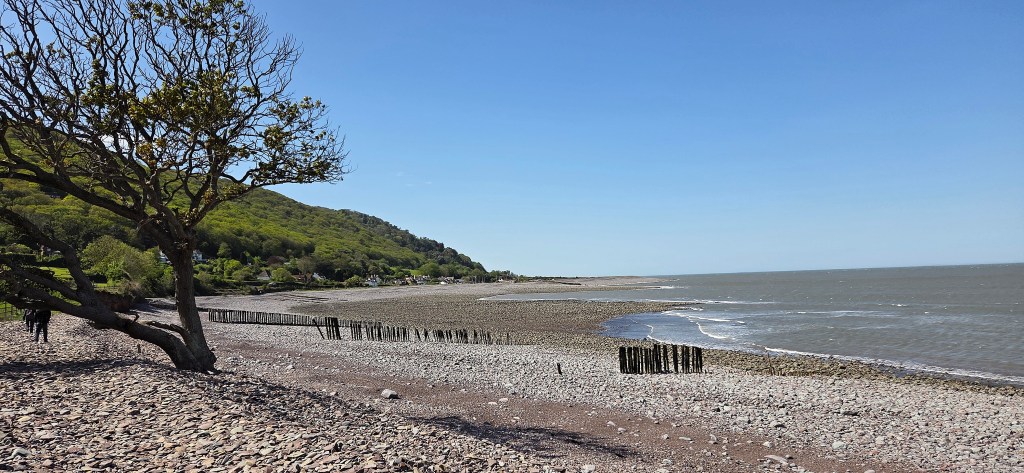
The village of Porlock is further inland, midway between Bossington and West Porlock, so Porlock Weir is a mile and a half from Porlock itself.
There is no longer a weir at Porlock, but only a small harbour, divided into inner and outer sections by lock-gates, first introduced in the Seventeenth Century. The inner harbour is protected by quays topped with quaint cottages.
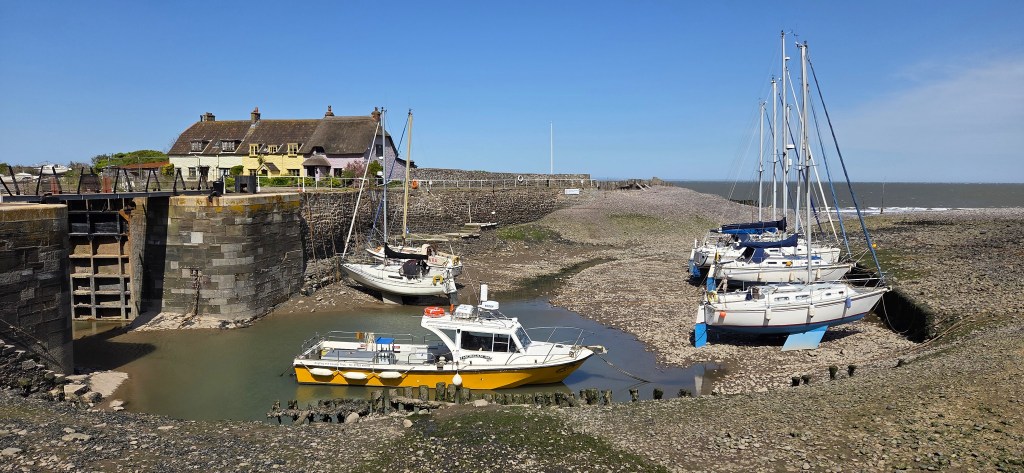
The name is probably attributable to the small fish weirs that were built in the locality from the Fifteenth Century onwards.
Records suggest that, during the Sixteenth and Seventeenth Centuries, vessels based here were trading primarily with Bristol, South Wales and North Devon, while local fishermen were particularly busy in early winter, when herring shoals were present in the Bristol Channel.
Coleridge was also famously a visitor to these parts, writing ‘Kubla Khan’ in nearby Culbone after an opium-fuelled dream, only to be interrupted by the notorious ‘person from Porlock’.
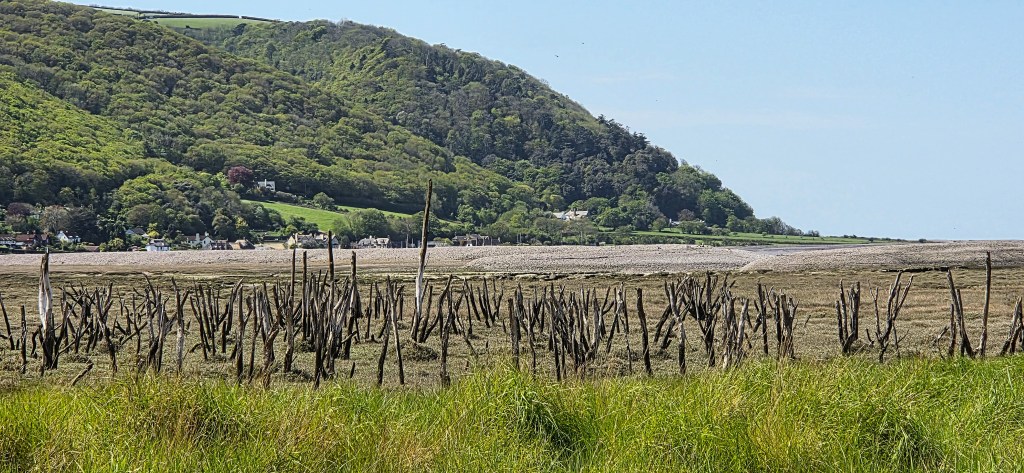
His pal Robert Southey (1774-1843) also visited in the summer of 1799, writing a sonnet in the local pub on a rainy day:
‘Porlock! thy verdant vale so fair to sight,
Thy lofty hills which fern and furze imbrown,
The waters that roll musically down
Thy woody glens, the traveller with delight
Recalls to memory, and the channel grey
Circling its surges in thy level bay.
Porlock! I shall forget thee not,
Here by the unwelcome summer rain confined;
But often shall hereafter call to mind
How here, a patient prisoner, ’twas my lot
To wear the lonely, lingering close of day,
Making my sonnet by the alehouse fire,
Whilst Idleness and Solitude inspire
Dull rhymes to pass the duller hours away.’
We quickly toured the local gift shops that have developed around the harbour.
Several have sprung up since my last visit, including the Porlock Cider Company.
Another new arrival is the Porlock Weir Pilot Gig Club, founded in 2018.
We bought ourselves ice creams and sat for a while on a bench overlooking the sea.
After a while we joined the queue for the 10 bus service back to Minehead, chatting to the Australian couple who were already in line.
They had seen us the previous evening in The Ship Aground, were over for an extended walking holiday and hoped to get as far as Port Isaac.
The bus proved to be a minibus, almost full by the time we left Porlock Weir. Prospective passengers further along the route were unfortunately turned away.
That evening we stopped for a pre-dinner drink at The Quay Inn, a seafront establishment that was very quiet, apart from a few residents eating their evening meals.
Dinner was at the Wheelhouse Restaurant, run by a husband and wife team, which was far busier. I enjoyed chicken liver pate, followed by lamb shank with apple and blackberry crumble to follow.
We chatted to the female partner who, we felt, had quite a bit of chatting owed to her if she was to even up the score with her husband.
She told us that they had also walked the Coast Path and had two daughters, one holding a Heilbronn Research Fellowship in Maths at Bristol University.
Minehead was already asleep as we returned to our Hotel by 21:30.
Homeward
We both opted for a Garden Breakfast, which was still more than ample, but slightly less calorific than the Full English option.
We strolled along the Avenue and then the Promenade, past Butlins, towards the Golf Club.
Just as we crossed on to the Promenade, the wife from The Wheelhouse appeared in jogging apparel, then rapidly disappeared as she tripped over a small hazard on the pavement, grazing her elbow.
I was sorry that we caused her run to end prematurely.
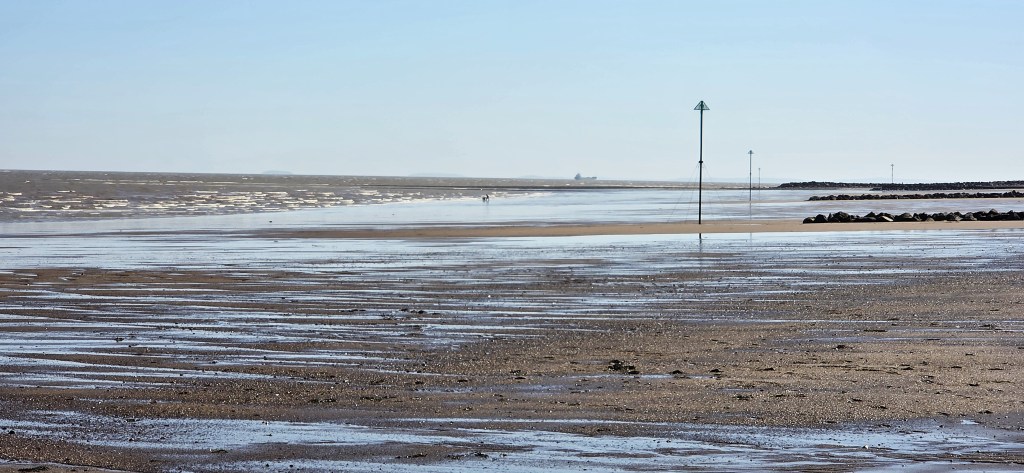
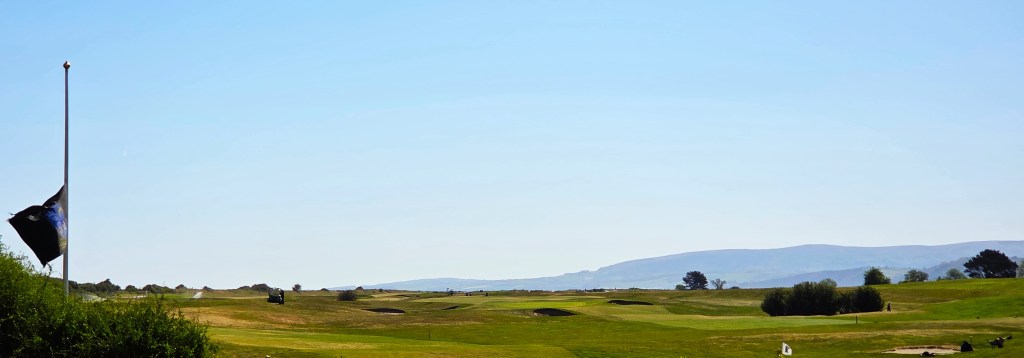
Arriving beside the Golf Club, we could see work ongoing to strengthen the sea defences on the beach below. A club flag flew at half-mast.
We turned about and, collecting our cases, caught the 28 bus back up to Taunton.
Though much busier than the outward service, our train arrived on time and transported us rapidly back to Paddington. We were home by mid-afternoon.
TD
May 2026








Leave a Reply