I had originally intended that our next leg of the Thames Path would take us from Maidenhead to Staines or Shepperton, with an overnight stop en route.
But, owing to time pressures, we opted instead for a day trip, arriving at Maidenhead by mid-morning and progressing to Datchet, or possibly beyond.
It was a bright, warm day in early April.
We travelled by train and tube to Paddington and, from there, caught the Elizabeth Line to Maidenhead. Since we began our outward journey after 09:30, my Freedom Pass made it entirely free for me, though Tracy had to pay £11.70.
Maidenhead
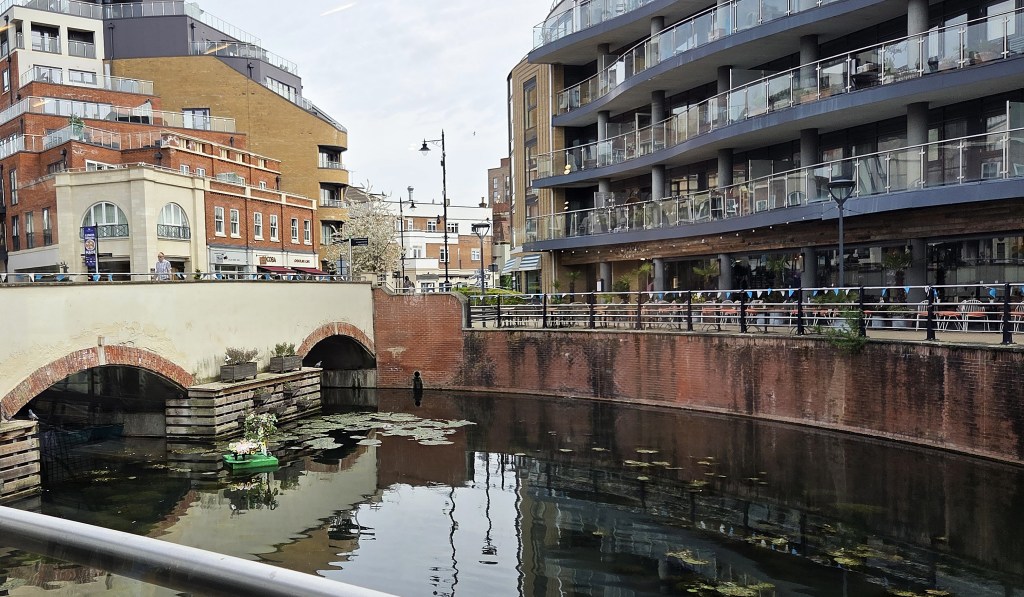
Maidenhead Station is some considerable distance from the Thames, and I needed my second coffee, so we stopped midway at the bakedd Artisan Bakery and Café, on the High Street, beside a stretch of water called The Cut.
The Café was already busy, so we sat in a covered area outside, overlooking The Cut, which, before it disappears beneath the High Street, courtesy of Chapel Arches Bridge, displays a flower-decked shopping trolley on a floating green island.
I enjoyed a modest almond croissant with my coffee, while Tracy chomped her way through a croissant of monstrous dimensions, crammed full of nutella.
Maidenhead is a large market town with a population of almost 70,000.
A Roman road once passed through the Town and there were Roman villas here, but the Town’s name is derived from the Old English for ‘new wharf’.
While a small community emerged around the River, the present Town centre developed as a separate entity known as South Ellington.
The first wooden bridge across the Thames was constructed in the late Thirteenth Century. The main road west to Gloucester and Bristol now passed across this bridge, while the old Saxon wharf was also replaced.
By the mid-Eighteenth Century, Maidenhead had become a prominent coaching town. Up to ninety coaches arrived daily, and there were numerous inns where travellers could rest overnight. The present road bridge was opened in 1777
The Great Western Railway arrived in 1840, though the original Maidenhead Station was over the River, near Taplow, until Maidenhead Railway Bridge came into service.
The present Maidenhead Station, opened in 1871, was formerly known as Maidenhead Junction.
Maidenhead gets short shrift in Jerome K Jerome’s ‘Three Men in a Boat’ (1889):
‘Maidenhead itself is too snobby to be pleasant. It is the haunt of the river swell and his overdressed female companion. It is the town of showy hotels, patronised chiefly by dudes and ballet girls. It is the witch’s kitchen from which go forth those demons of the river—steam-launches. The London Journal duke always has his “little place” at Maidenhead; and the heroine of the three-volume novel always dines there when she goes out on the spree with somebody else’s husband.’
These days, central Maidenhead is largely a concrete jungle, a hotch-potch of new buildings thrown up by piecemeal redevelopment, and few historic buildings remain.
There have been a few notable residents, including Richard Dimbleby (1913-1965), Diana Dors (1931-1984) and even Michael Parkinson (1935-2023) – though he more properly lived in Bray, nearby.
Maidenhead to Bray
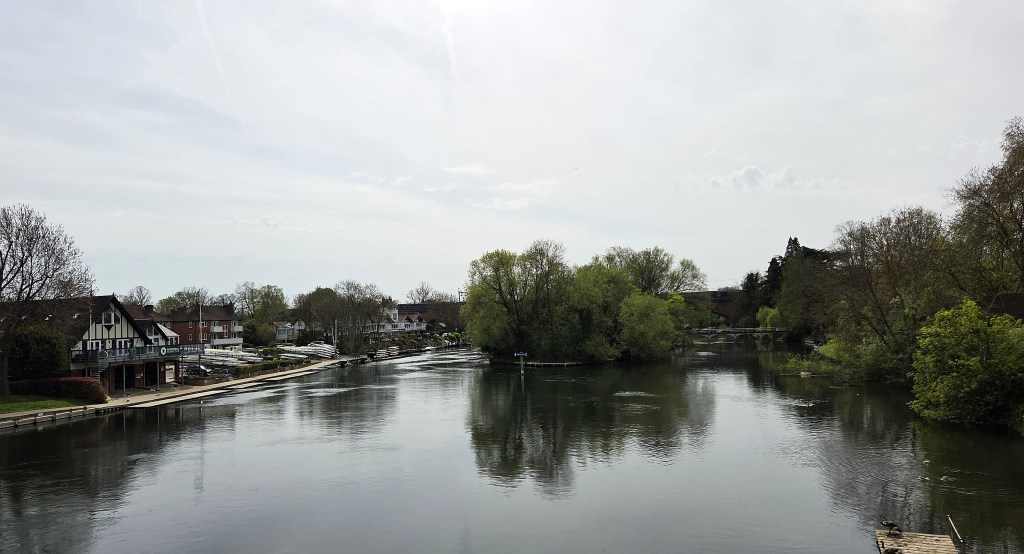
It was close to midday as we crossed Maidenhead Bridge to rendezvous with the Thames Path on the opposite, eastern side.
Ignoring the instructions in the official guide, which tell you to head left and left again, passing underneath the Bridge, we took the more sensible option and turned right along River Road.
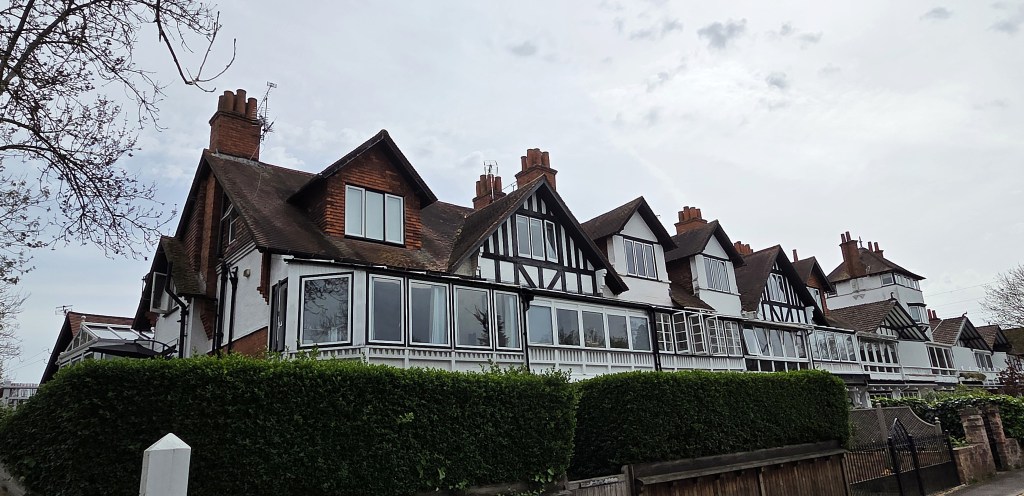
This passes in front of a handsome Edwardian terrace, with full-length windowed balconies, and directly behind Maidenhead Rowing Club, founded in 1876.
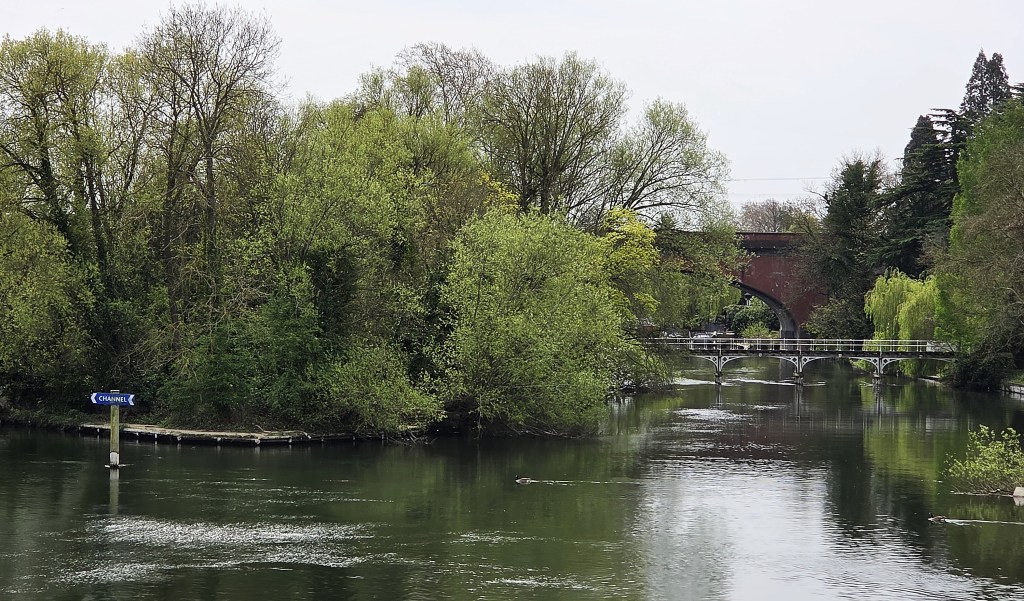
On the Thames we could see Guards Club Island, also known as Bucks Ait, opposite Guards Club Park on the opposite bank. The Island is attached to the Park by a renovated footbridge.
The Brigade of Guards established their boat club nearby in 1865, moving to Park and Island in 1904. They took over Riverside, on the opposite bank, which had been a gentlemen’s club since 1889.
It is said that officers often accommodated their mistresses in that Edwardian terrace on River Road. It was politely known as ‘Gaiety Row’, because some of the occupants were chorus girls from London’s Gaiety Theatre, but the more direct called it ‘Whores’’ Alley’ instead.
The Club featured as Cruikshanks Hotel in the film ‘Kind Hearts and Coronets’ (1949), closing in 1965.
Maidenhead Railway Bridge passes over the southern extremity of Guards’ Club Island. Comprising two wide arches spanning the river, with two narrower arches on either side, it was designed by Isembard Kingdom Brunel (1806-1859) and constructed in 1838.
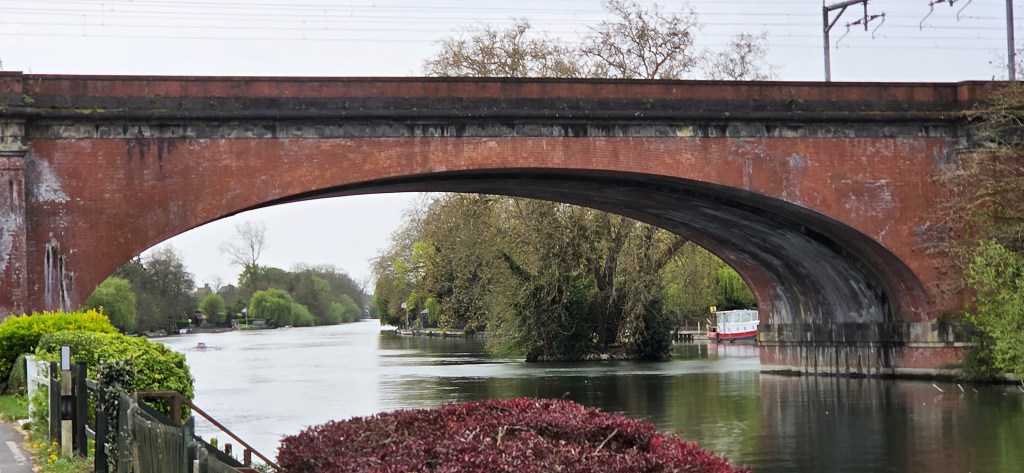
The two elliptical arches were the longest and lowest ever built, each 128 feet long and just 24 feet high. It was feared that the Bridge would not support the weight of trains passing across it, but these proved unfounded.
It was significantly widened in the early 1890s, from 30 feet to around 55 feet, and is now a Grade 1 listed building.
As we passed underneath, a mixed four and a mixed eight hurtled towards the Bridge, the four ultimately beating the eight.
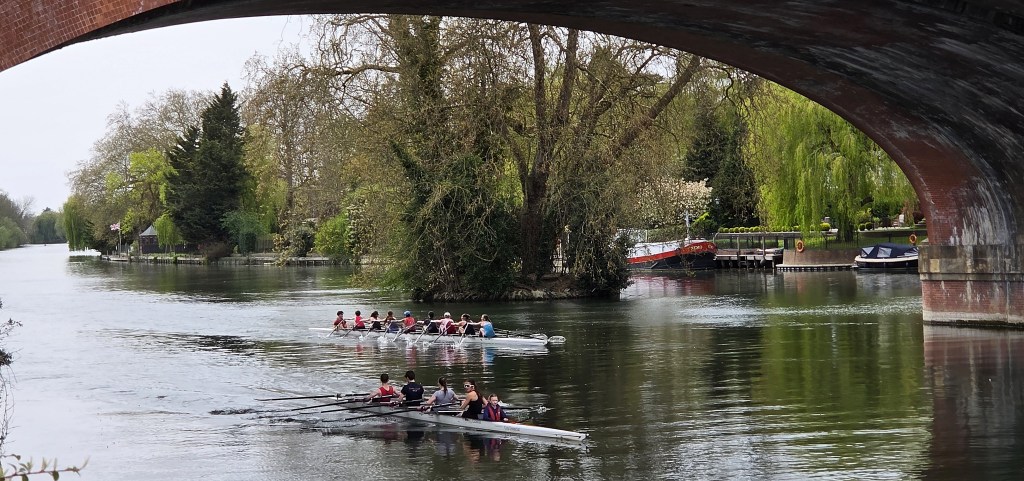
The opposite bank is graced by large riverfront residences, several with attendant boathouses, no doubt owned by the not-so-great and the not-so-good.
Twin Savills Estate Agents signs faced each other across the River.
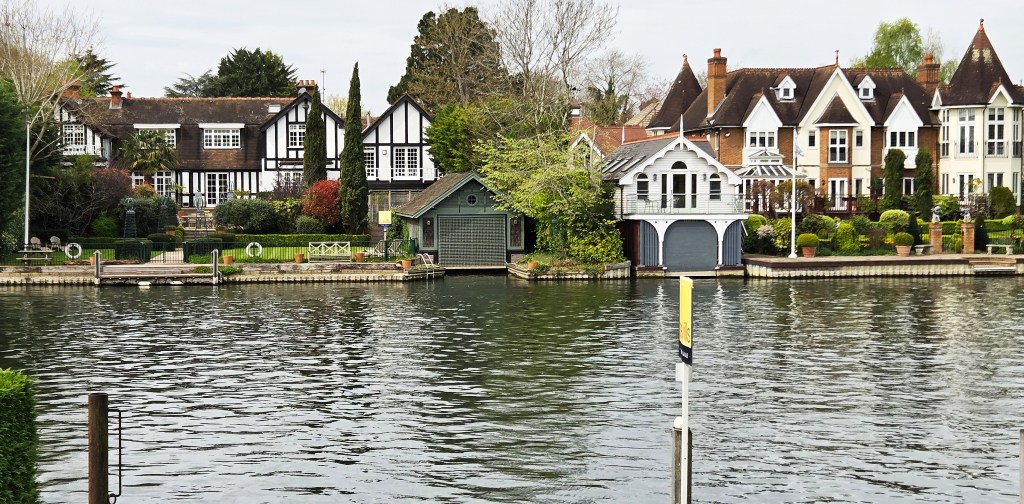
A little further on, two small, pugnacious dogs barked at us from the opposite bank.
One of the properties along this stretch was owned by Rolf Harris. He returned in 2017 upon release from prison, dying here in 2023.
The house was initially put up for sale at £4m, but failed to find a buyer.
Shortly before we passed by, it was auctioned with a guide price of £1.95m, but was withdrawn, having failed to reach its reserve price.
It is said to need extensive renovation, but prospective buyers are also put off by the stigma. At least one of Harris’s crimes took place here.
We were now opposite Bray, once a village in its own right but now essentially an extension of Maidenhead.
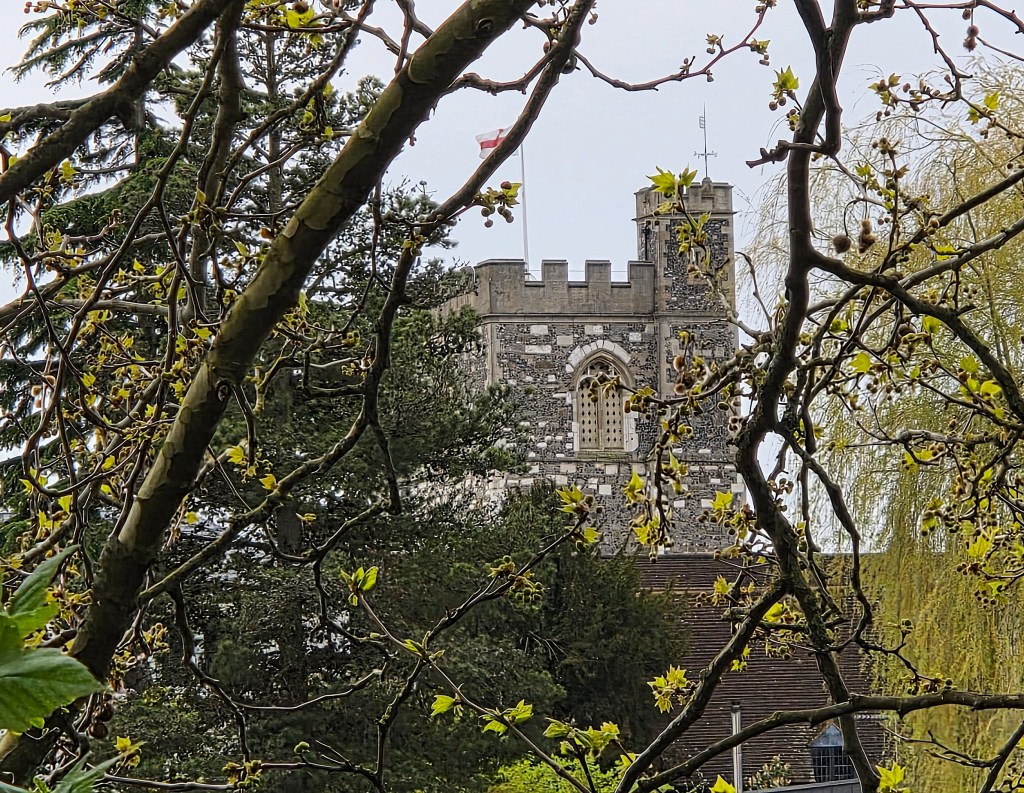
The parish church of St Michael dates from around 1300, but was partly rebuilt two centuries later and extensively modernised in the 1860s.
‘The Vicar of Bray’ is an early Eighteenth Century satirical song describing the political and theological contortions required of the subject as successive monarchs ascended the throne. It may be based on Francis Carswell, who was Vicar here from 1667 to 1709.
Bray has a couple of Michelin-starred restaurants: Heston Blumenthal’s Fat Duck and the Roux Brothers’ Waterside Inn. Tracy duly reported that she and the previous incumbent once stayed at the Inn on his birthday.
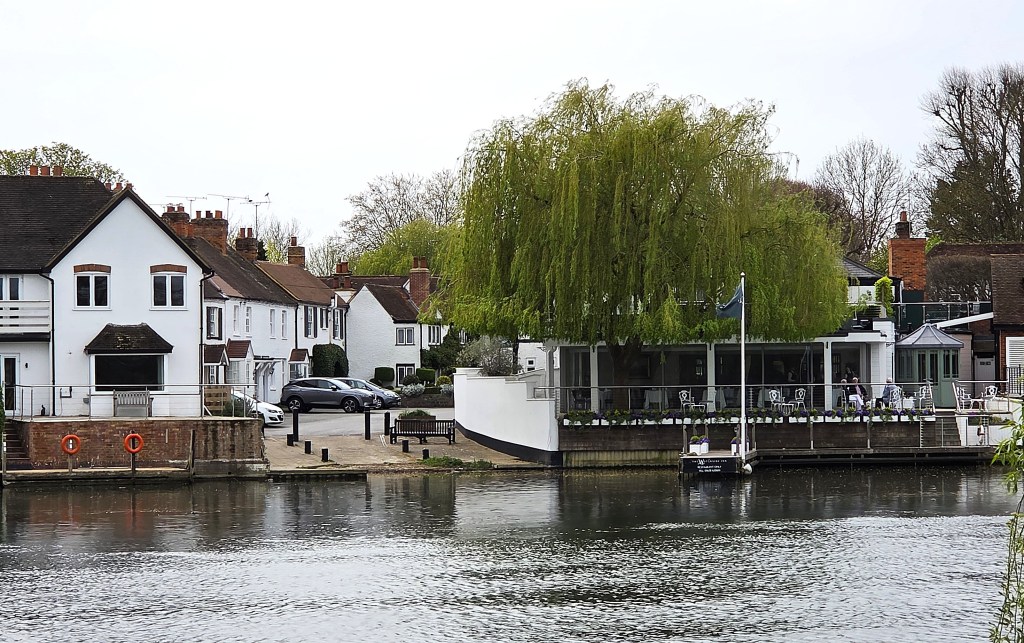
Aside from Parkinson and Harris, there are or have been several other notable residents including ‘Your Royal Ruler’ Tony Prince, Laurie Holloway and his wife Marion Montgomery.
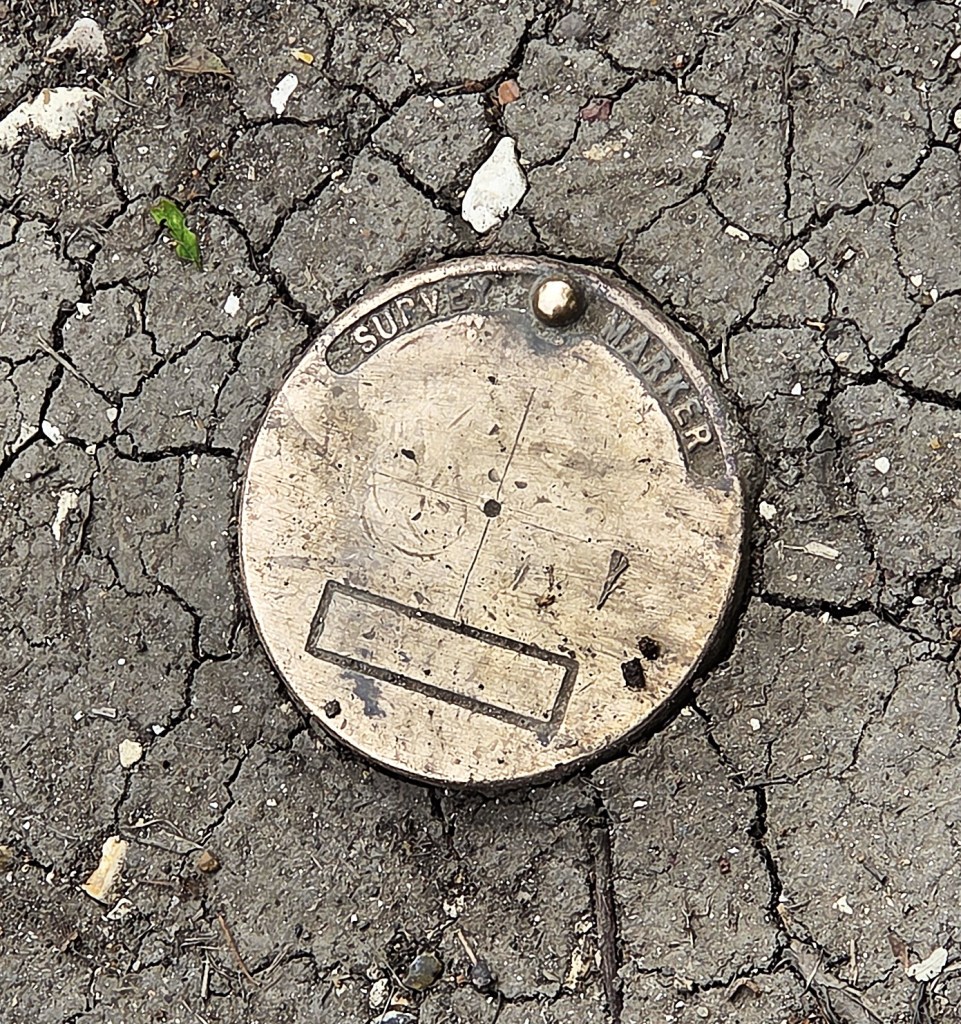
We passed over a small circular survey marker let into the path, opposite Headpile Eyot. I hadn’t previously encountered one of these.
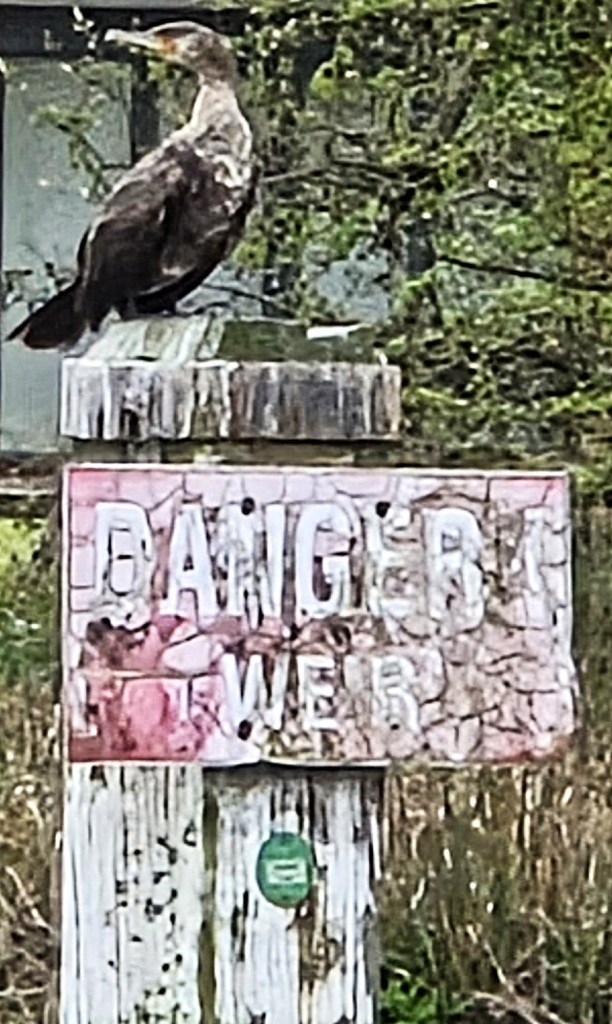
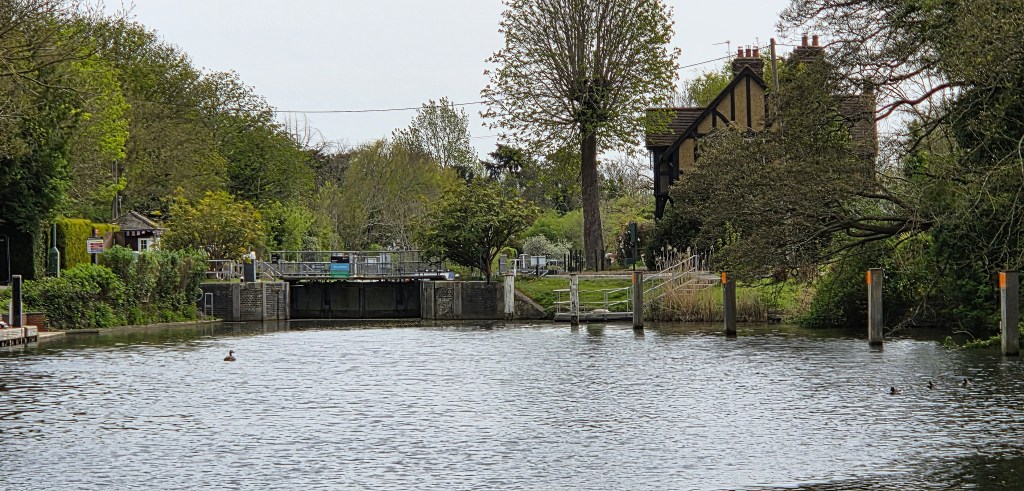
On the approach to Bray Lock, we noticed a large cormorant sitting atop a badly faded ‘Danger: Weir’ sign.
At the Lock itself, the Union Jack was flying.
There were at least two previous locks here before a pound lock was built in 1845, along with an impressive keepers’ house on nearby Parting Eyot. Both lock and weir were rebuilt in 1885.
Bray to Boveney
Emerging from the Lock, we could see several Little Egrets on the opposite bank, seemingly eating the fresh growth on surrounding trees, or perhaps looking for nesting material.
Egrets all but disappeared from England following the Victorian craze for their plumes. They began to breed here again from 1996 and are now well-established once more.
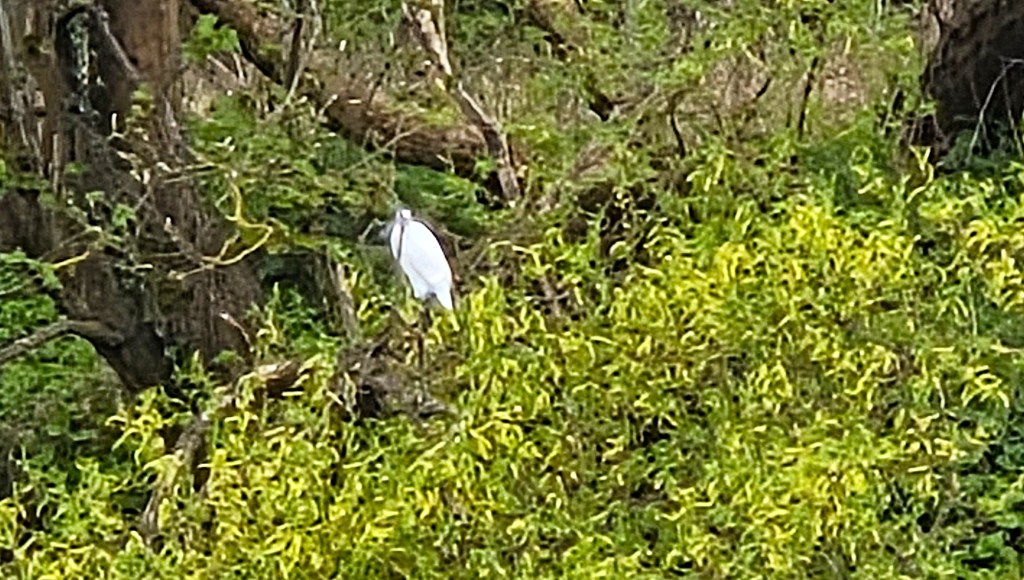
As we watched, a woman thrust open an attic window in a riverside house, her dressing-gowned arm matching the white of the egrets below.
We were now approaching the M4 Thames Bridge. There is a sign beside it commemorating Andre Pinto (1983-2019).
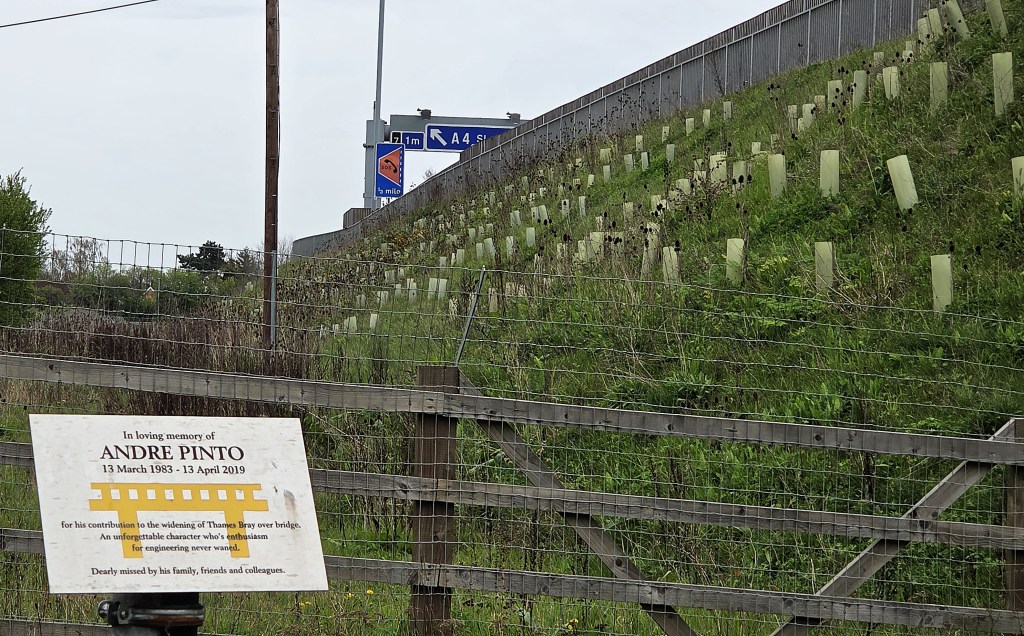
Shame about the grammatical error.
I enjoyed the geometrical shapes created underneath the bridge, though my enjoyment was tempered by teenagers performing cycling tricks on the slopes and steps.
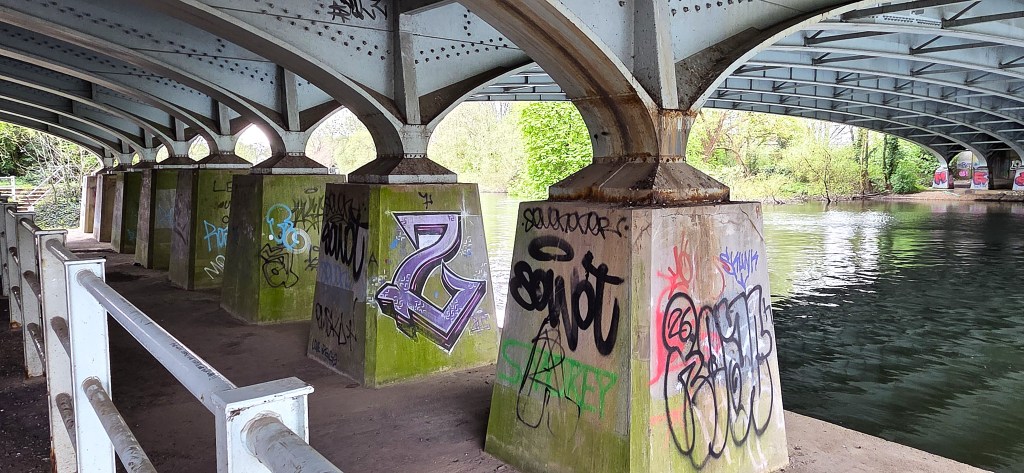
Shortly afterwards we reached Monkey Island. A group formed a circle, hugging, on the grass, then stood around sheepishly, obviously embarrassed.
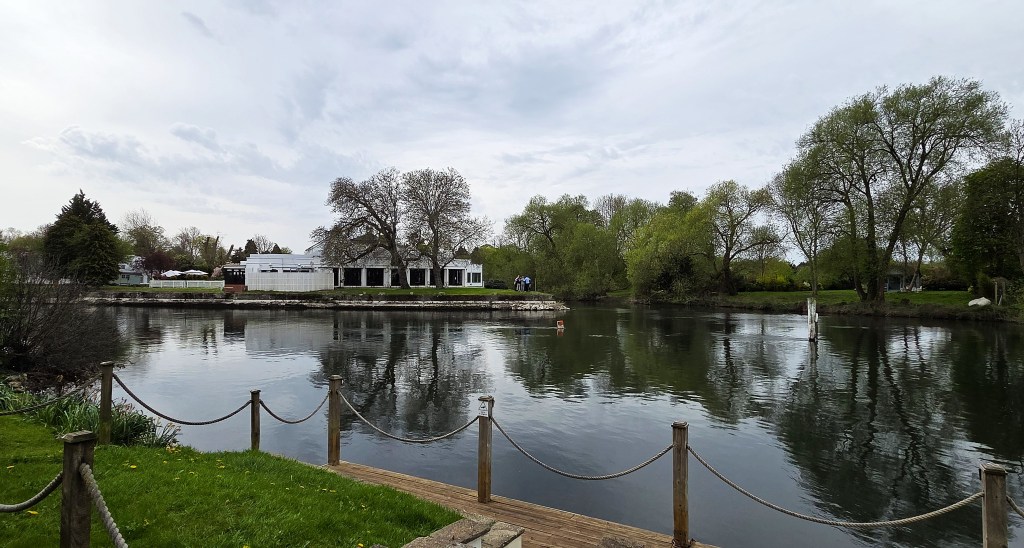
Monkey Island, formerly Monks’ Eyot, passed into the hands of the Engelsfield family early in the Seventeenth Century, but was bought by the Third Duke of Marlborough in 1738.
He built a fishing lodge and a fishing temple, decorating a room in the lodge with paintings of monkeys engaged in human activities. They were painted by Andien de Clermont (d. 1783). Such works are known as ‘singerie’, after the French for monkey.
By 1840 the lodge had become an inn and then, half a century later, the Monkey Hall Hotel.
King Edward VII was a frequent visitor. Siegfried Sassoon also stayed here, as did H. G. Wells and his mistress Rebecca West (1892-1983).
Her first novel, ‘The Return of the Soldier’ (1918) features memories of an idyllic pre-war summer on Monkey Island, when Chris, the soldier in question, fell in love with Margaret, the innkeeper’s daughter.
Monkey Island presently operates as a 40-roomed 5 star hotel. It will set you back some £300 per night.
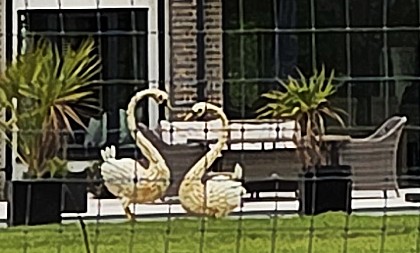
On our side of the river, a newly-built mansion sported a couple of giant swans upon its patio.
We passed beneath Summerleaze footbridge which, according to a plaque, was opened by the Chairman of the Countryside Commission in October 1996.
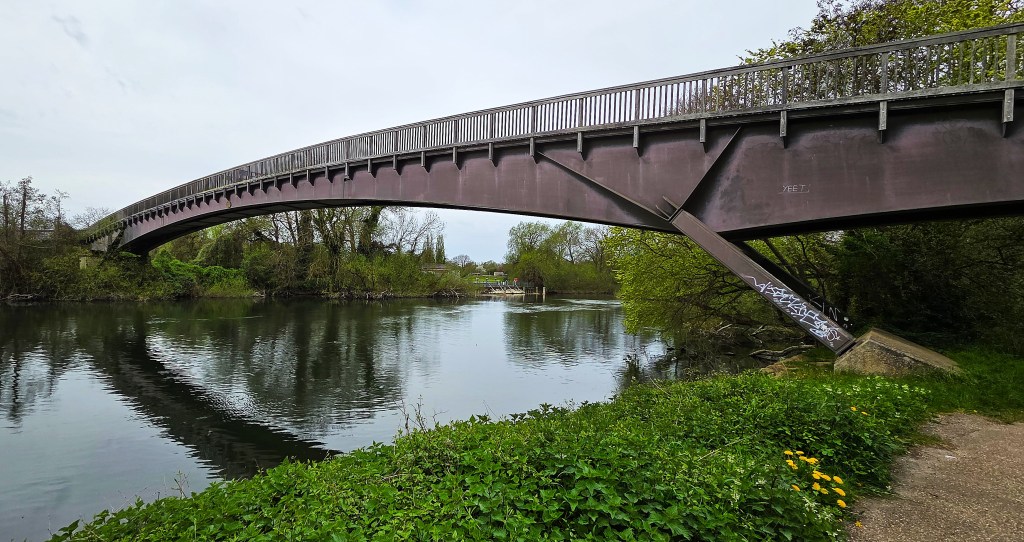
It was originally built to carry a conveyor belt, removing gravel displaced during the digging of Dorney Lake, whose northernmost extremity lies just behind.
Dorney Lake is owned by Eton College, which spent some £17m on its development over a 10-year period. It is 2,200m long, wide enough to accommodate eight rowing lanes, each 13.5m across, and has a minimum depth of 3.5m. It hosted all the rowing events in the 2012 Summer Olympic Games.
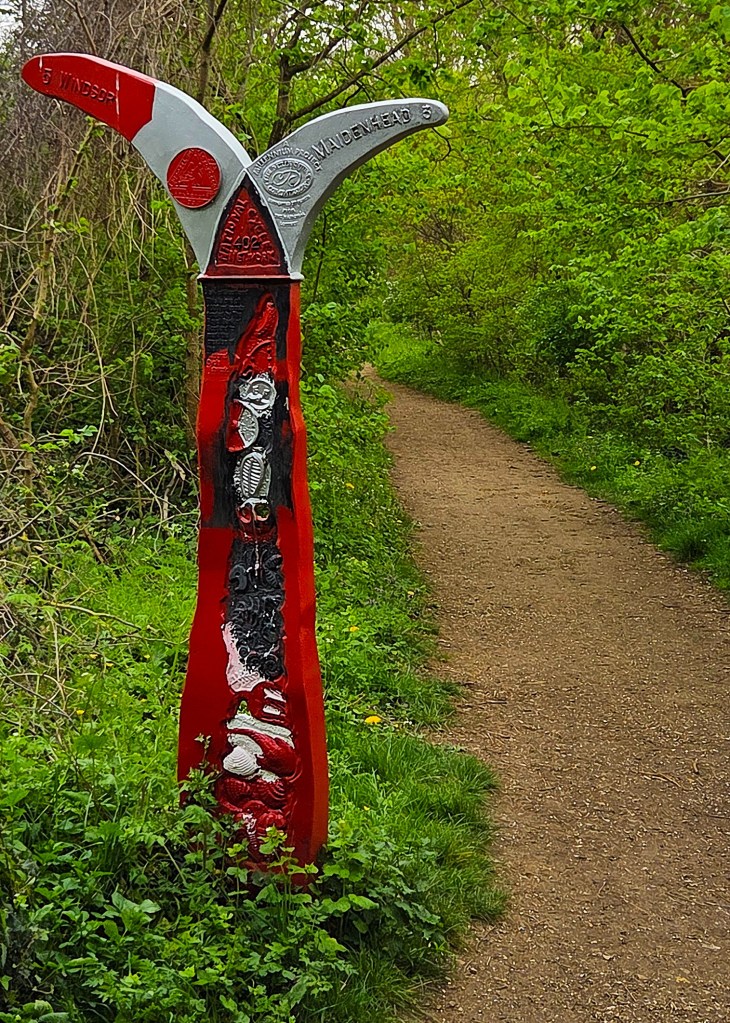
My attention was drawn by a vividly painted National Cycle Network milepost.
A little further on, our eyes drifted across the Thames once more, taking in a large marina and Queen’s Eyot, owned by Eton College.
Beyond, the small village of Water Oakley contains two notable buildings.
Bray Film Studios was originally Down Place, a substantial house built for William Tonson (1717-1772) Member of Parliament for Wallingford and, subsequently, for New Windsor.
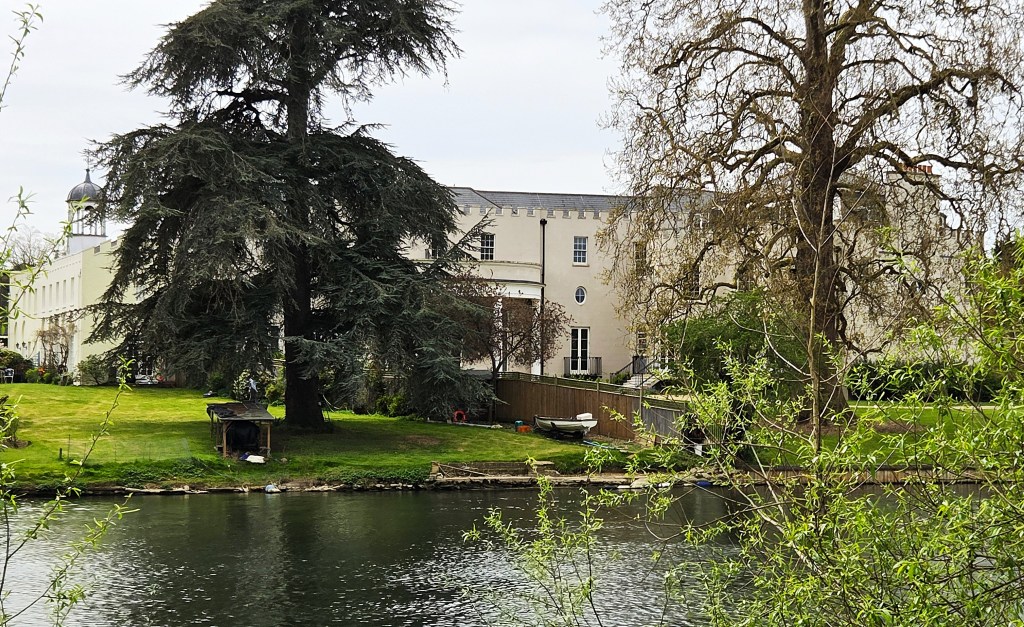
It passed through several different hands until it was purchased in 1951 by Hammer Film Productions. Since Hammer sold up in 1970, there have been several more owners, most of whom used the building for film production or as a rehearsal space for bands, notably Pink Floyd. Amazon Prime Video bought the property in 2024.
Oakley Court is a Victorian Gothic house built in 1859 for Sir Richard Hall-Say, High Sheriff of Berkshire. Hammer Films acquired it in 1949, using it as a regular filming location.
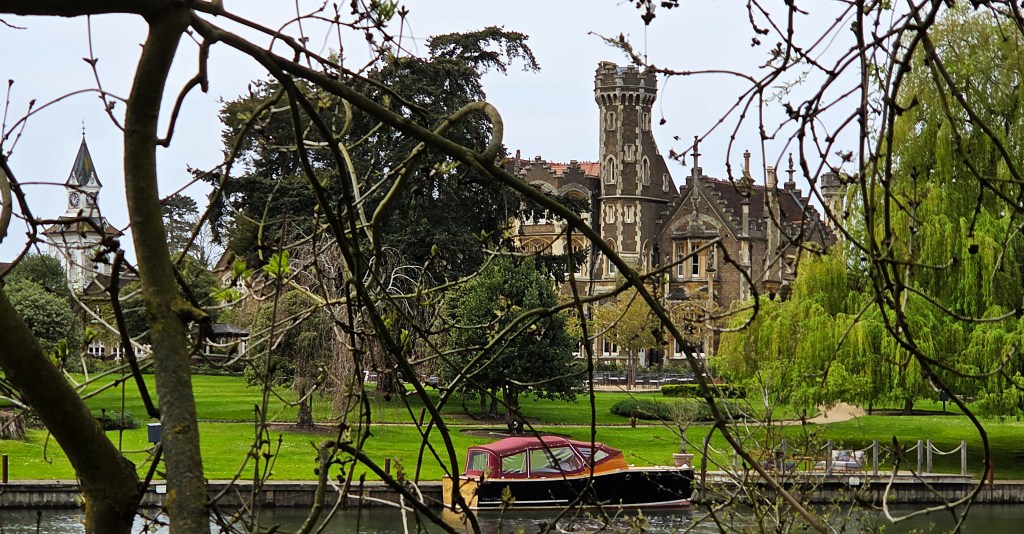
It was subsequently converted into a hotel, opening in 1981. A room here will also cost about £300 per night.
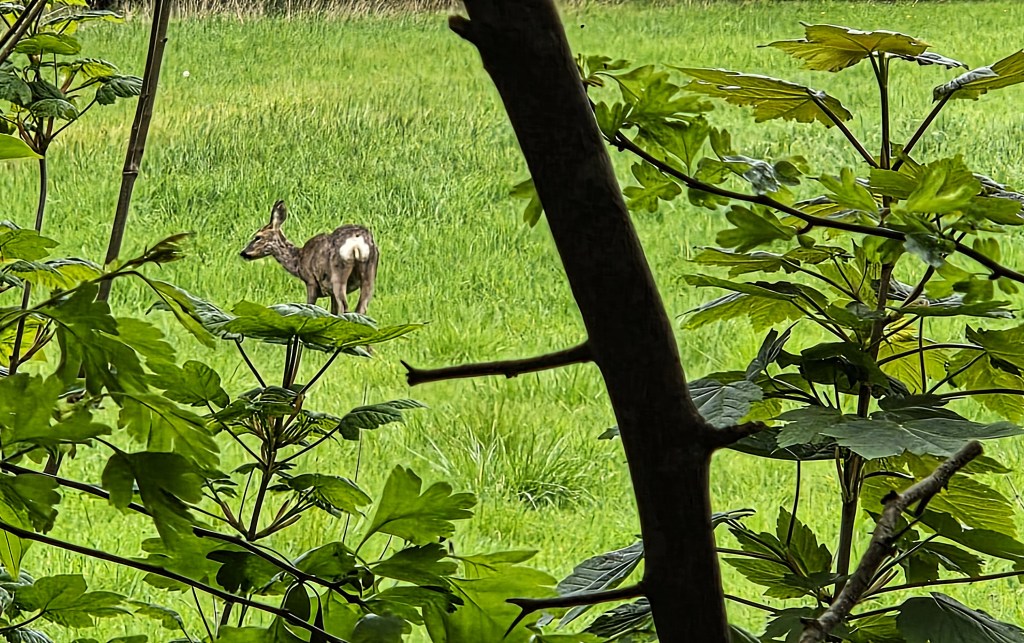
A few minutes later we spotted a solitary roe deer in the field beside us, between the Thames and Dorney Lake. She stopped grazing as we passed, looking steadily in our direction, but we were hidden from her view.
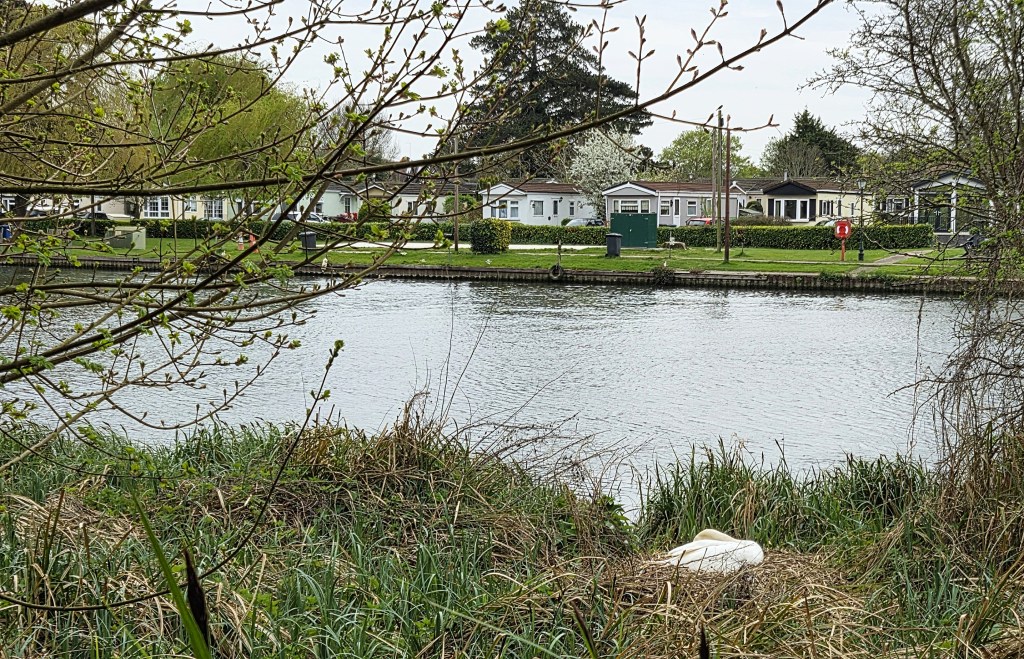
Almost immediately we passed a swan’s nest on our bank, opposite another marina and a large estate of park homes.
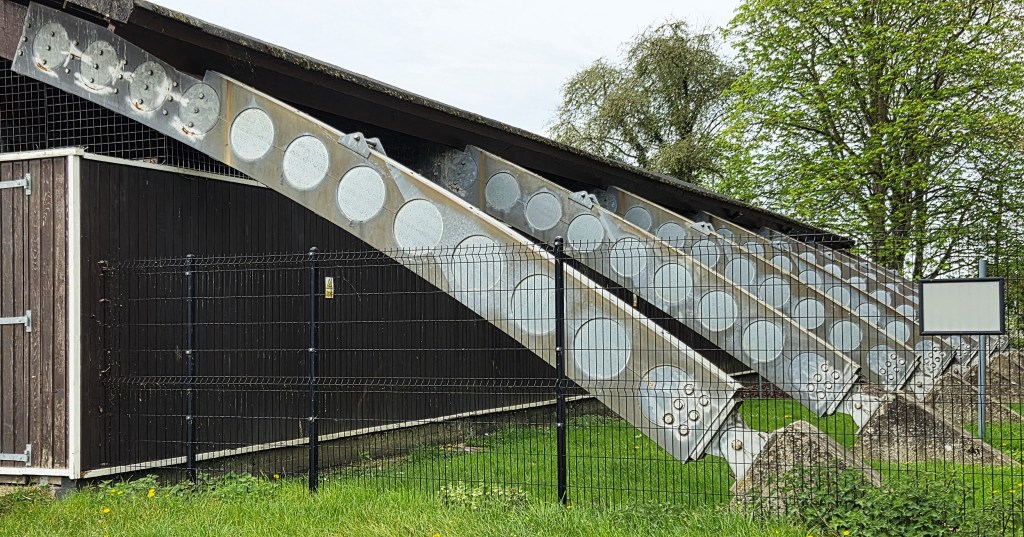
We were now rounding the southern extremity of Dorney Lake, where there is a large events venue as well as a boathouse set close to the Thames, opposite a triangular island known as Bush Ait.
Behind the Island lies the mouth of Clewer Mill Stream, which runs to the rear of Windsor Racecourse, rejoining the Thames at Clewer, downstream.
Though out of bounds, it was a magnet drawing adventurous Victorian Eton schoolboys, who would skiff close to the mill and, while the miller was distracted, carry their boat across, relaunching directly above the mill.
The River bends north-east at this spot, curving round towards Boveney Lock.
We were overtaken by MV ‘The Georgian’, belonging to the Windsor and Maidenhead Boat Company.
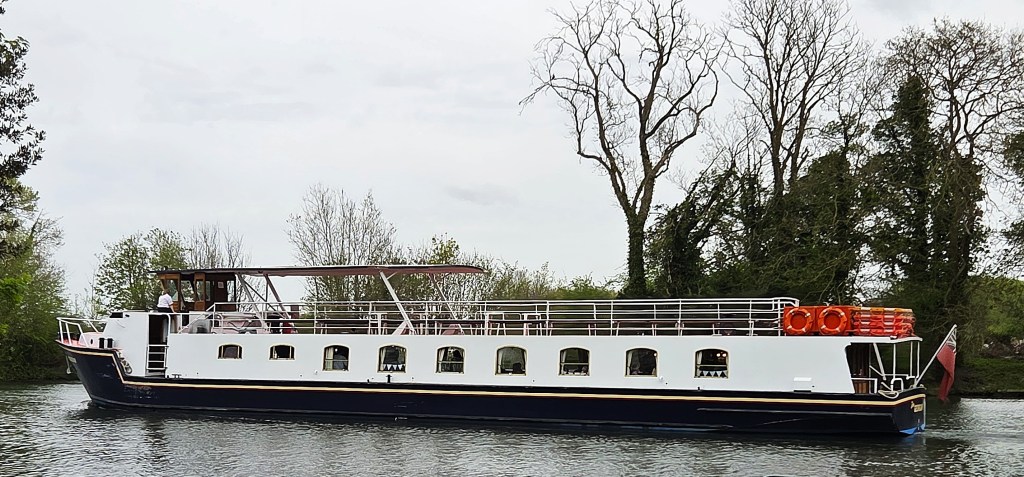
She is 30 metres long and 5.1 metres wide, which allows only 33cm of leeway when she enters Boveney Lock!
She normally carries a maximum of 125 passengers, but can exceed this number, up to a maximum of 150, provided that the ‘load line’ on the hull is not submerged.
The sky had clouded over almost completely by the time we stopped for lunch on a bench in front of the Chapel of St Mary Magdalene, which seems weirdly out of place beside the Thames.
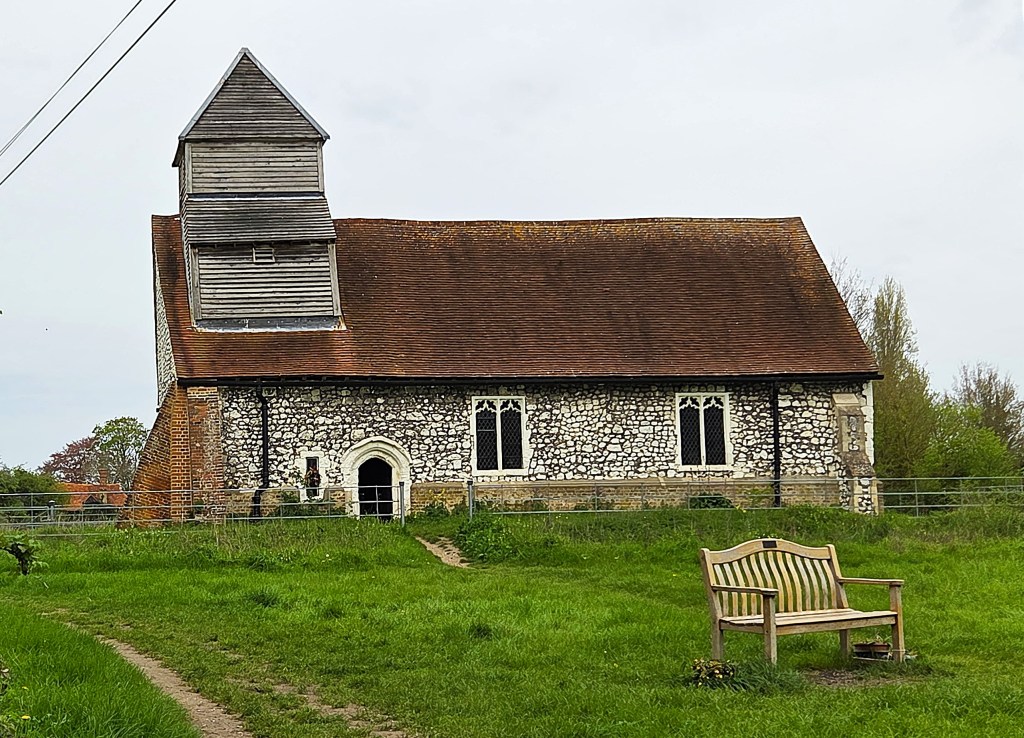
The Chapel is Grade 1 listed, but the list entry is unusually sparse. The building is said to date back to the Twelfth Century, though the first recorded documentary evidence is from 1266.
It was apparently built to serve the bargees who plied the Thames hereabouts, transporting timber from Windsor Forest
The tower was constructed in the Fifteenth Century, but there is a gap in the documentary evidence until 1508, when the Chapel was mentioned in a will.
At that time it operated as a chapel of ease attached to Burnham Parish and, in 1513, a Papal Bull was issued ordering the Vicar of Burnham to recruit a chaplain to celebrate mass there.
There are three bells in the tower, the oldest dating from the mid-Sixteenth Century; the other two from a century later.
In 1737 a Parliamentary Act was passed making the Chapel a living in its own right, but there were insufficient funds. Nevertheless, it strove to assert its independence from Burnham.
It was renovated in 1897 and, in 1911, became part of Eton College. Then, in 1975, it was deemed surplus to requirements only to be taken over by a charity called The Friends of Friendless Churches in 1983.
It has required extensive (and expensive) renovation, but remains consecrated.
We lunched first, before touring the interior. A Red Kite hovered menacingly above, reminding us that we had seen them raiding picnics on our approach to Henley a year or so before.
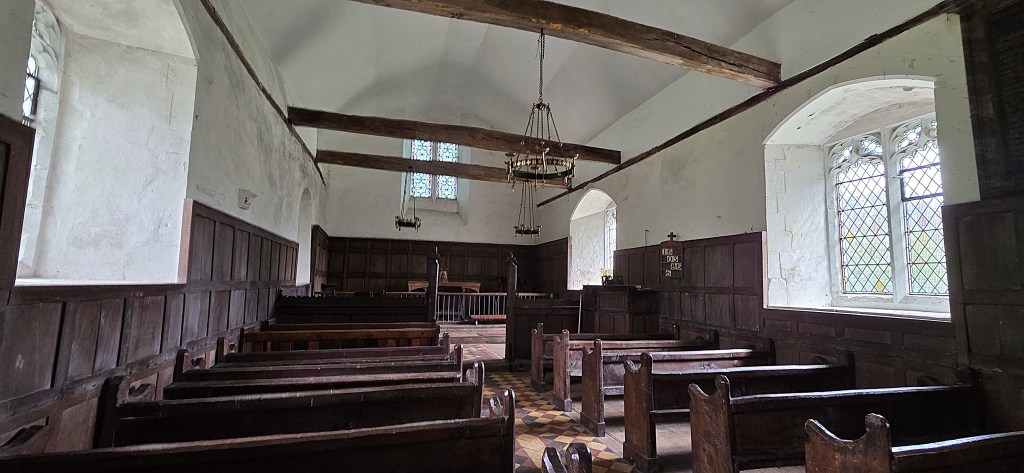
The inside of the Chapel is relatively spartan. There is a large Twelfth Century font and a handful of the wooden pews date back to the Fifteenth Century, though most are Nineteenth Century.
It, too, has been used as a location in many Hammer films.
Boveney to Windsor
Boveney gets a brief reference in the ‘Eton Boating Song’, written by a master there, William Johnson Cory (1823-1892).
He was forced to resign in 1872, having written ‘an indiscreet letter’ to a pupil. The jury is out over whether he had a sexual interest in the boys in his charge.
The second stanza of the Boating Song, first performed in 1863, includes these lines:
‘Let us see how the wine glass flushes,
At supper on Boveney meads.’
During the Second World War there was an army camp on Dorney Common, sandwiched between Boveney, Dorney and Eton Wick. This led to some local bombing by the Luftwaffe.
The body of a dead German fighter pilot, whose parachute failed, was retrieved in June 1940 and, in September 1941, a live pilot was captured nearby.
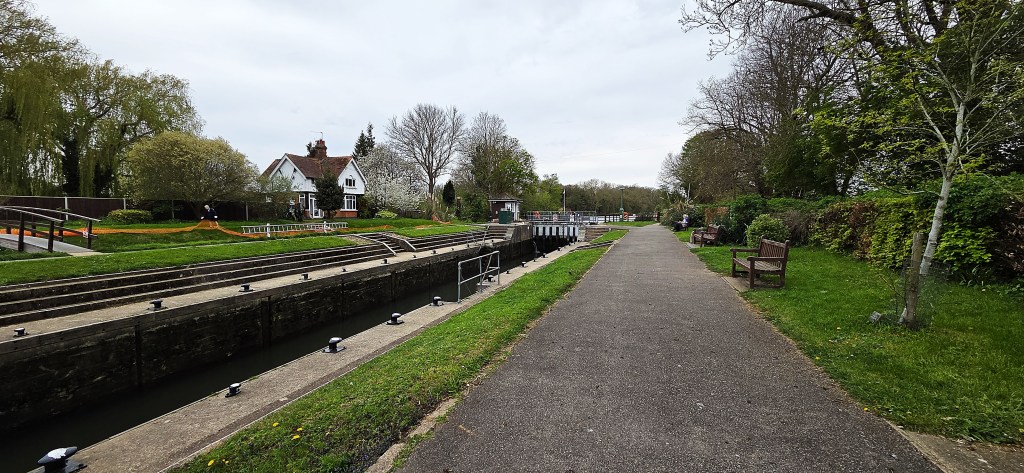
Soon we were under way once more, closing in on Boveney Lock, first constructed in 1838, then rebuilt in 1898. It was quiet as we passed through.
Shortly afterwards we reached a bench in front of an inscribed rectangular stone block. A notice board relates that this was ‘Athens’, a bathing spot used by Eton schoolboys from about 1830 onwards.
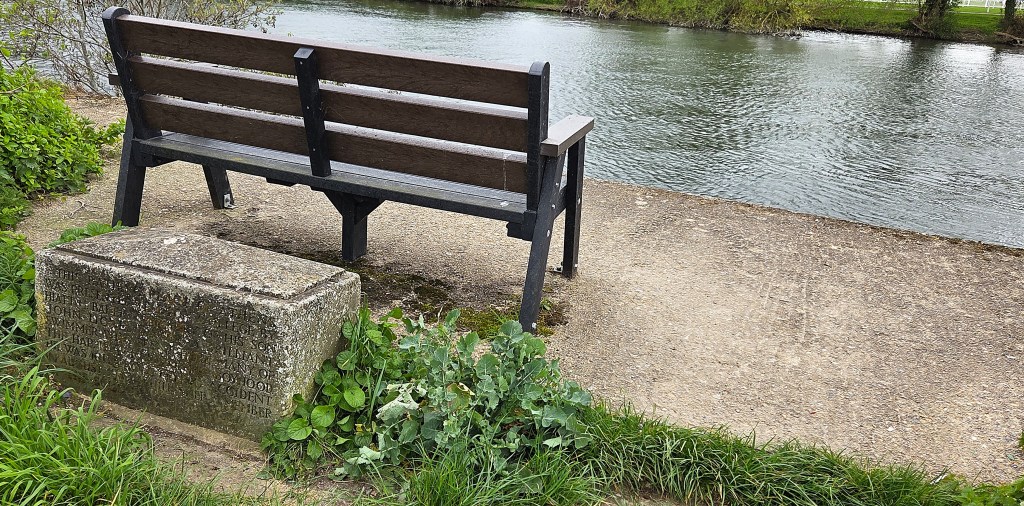
School rules stipulated that naked boys must enter the water or retire behind screens when boats containing ladies were approaching.
The land was bought and presented to the School by a father whose son, a keen Etonian swimmer, had been killed in a 1917 aeroplane accident.
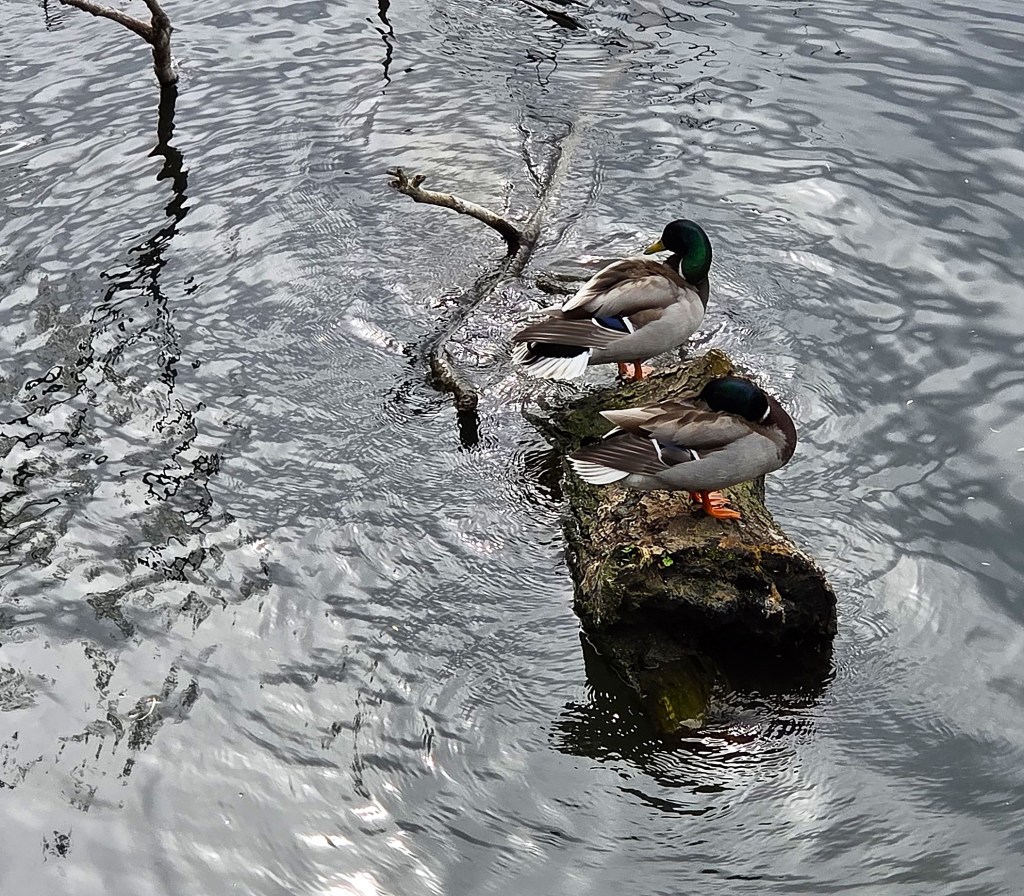
Oblivious of this sad history, two ducks perched on a floating log nearby.
Windsor Racecourse, opposite, is one of only two figure-of-eight courses in England. It held its first meeting in 1866. Unusually, it was allowed to hold races during the Second World War and, in 1944, a V1 flying bomb landed nearby during a race meeting.
At the turn I completely failed to spot the so-called Windsor Winding Post, a waist-high metal tube lurking in the undergrowth.
It was once used by bargees who would pass a rope around, so helping their horses to navigate the sharp bend.
We arrived opposite Clewer, where the Mill Stream re-enters the Thames, passing around White Lilies Island. Natalie Imbruglia lived upon it, naming her 2001 album accordingly. Her six-bedroomed property went up for sale in 2023.
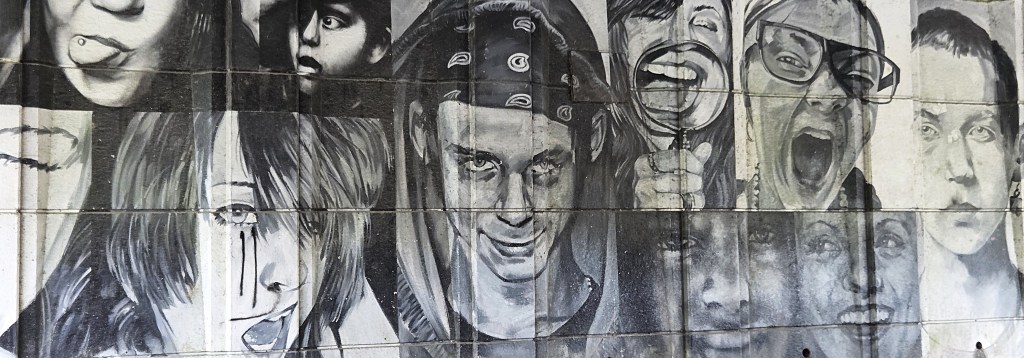
Passing beneath the Queen Elizabeth Bridge, completed in 1966, we admired the art work. It was painted by Cosmo Sarson in 2012, as part of the Windsor Olympic Art Trail and, allegedly:
‘Using the Aurasma platform, the 25-metre long mural, composed of portraits of local characters, could be animated and made interactive via smartphone, allowing members of the public to upload and engage with their own content.’
Though described as ‘the world’s first talking mural’, I don’t know if it still works.
We were now crossing the Brocas, opposite Baths Island, a large meadow named after Sir John Brocas (d. 1365) who became Chief Forester of Windsor Forest in 1334.
Baths Island was a local swimming spot from the 1860s onwards. There were once changing rooms erected close to the Windsor Railway Bridge.
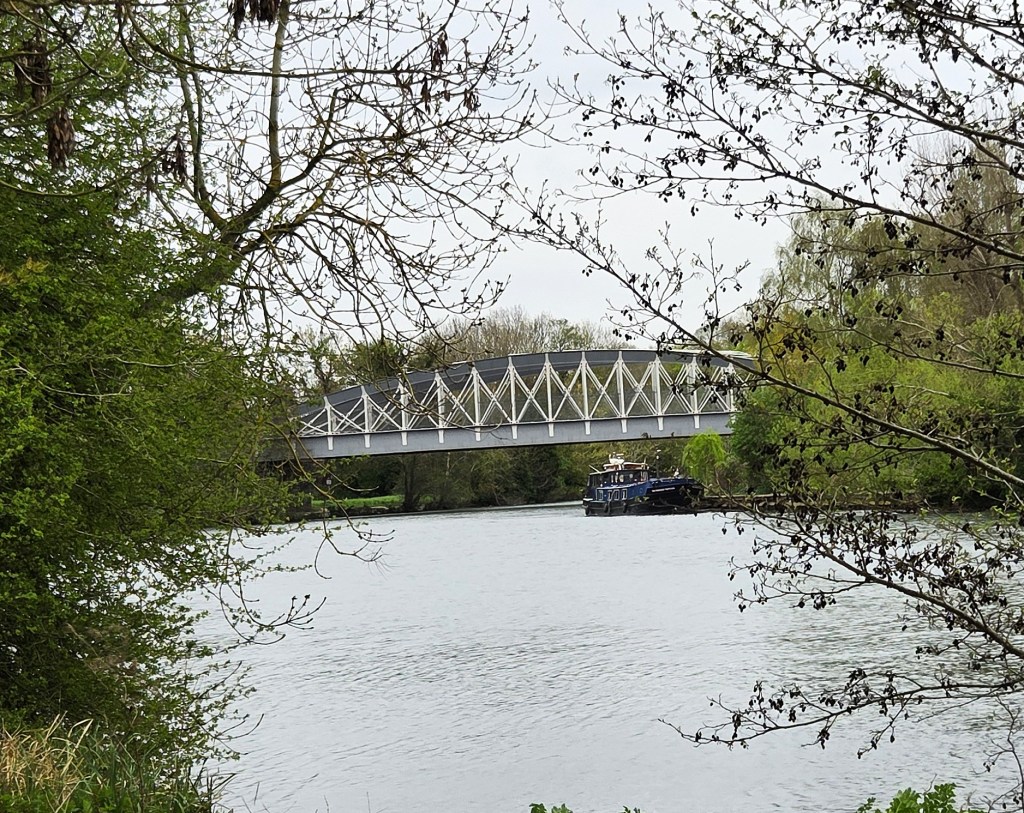
This Bridge was also designed by Isembard Kingdom Brunel, opening in 1849 to carry the Slough, Windsor and Eton Line of the Great Western Railway.
Owing to representations from Eton College, the design had to span the entire river, so keeping the waterway clear. The approaches on either side were originally wooden, but were replaced with brick arches in the 1860s. The original span was some 62m, but that was reduced when the original piles were replaced in 1908.
It is thought to be the oldest operational wrought iron bridge in the world.
Windsor and its Castle
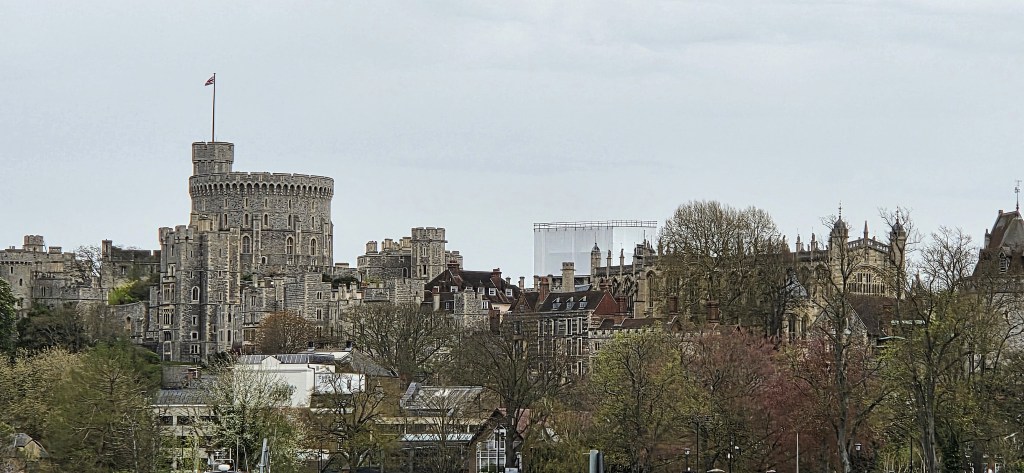
Windsor Castle now dominates the skyline. Though built on the orders of William the Conqueror, it was first used as a royal residence by King Henry I.
King John was based here during the process leading to the signing of Magna Carta in 1215.
Despite extensive building work under both Henry II and Henry III, Edward III decided to expand and rebuild it, spending over £50,000 in the third quarter of the Fourteenth Century.
Both Henry VIII and Elizabeth I made extensive use of the Castle, but it was looted by Parliamentarians during the English Civil War. A Royalist attempt to retake it failed, though the Royalist forces did take the Town, below.
The early Georgian Kings rather neglected Windsor Castle, but George III undertook extensive renovations. The extravagant George IV continued with an ambitious programme costing enormous sums.
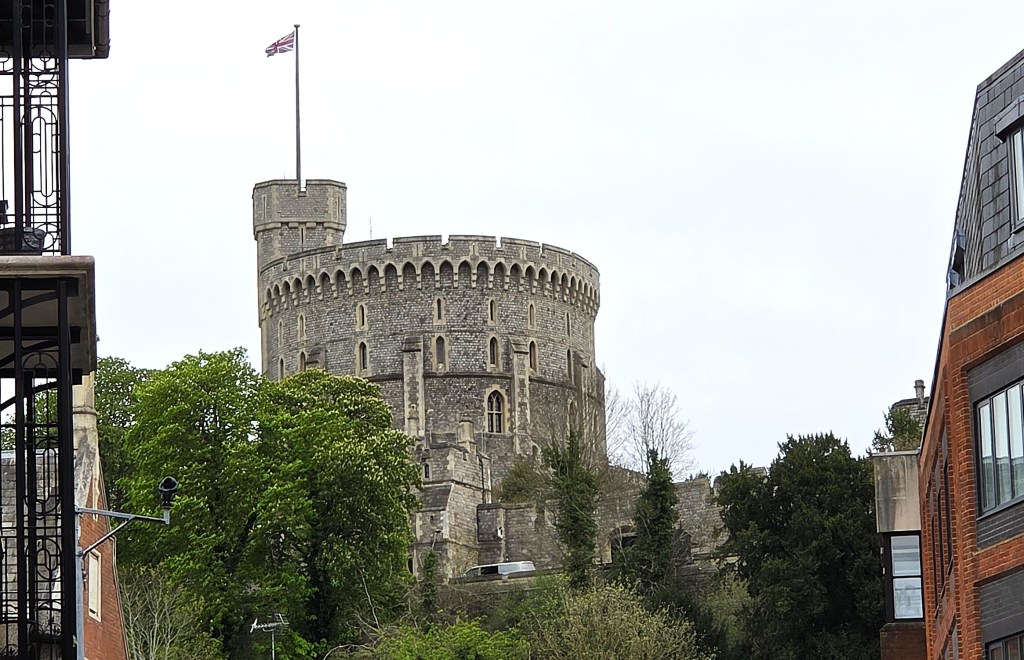
Queen Victoria made the Castle her primary royal residence, while both Edward VII and George V were enthusiastic modernisers. Elizabeth II adopted Windsor Castle as a weekend residence but gradually came to spend more time there.
All of which makes it the longest occupied palace in Europe and the largest inhabited castle in the world. It has become one of England’s leading tourist attractions.
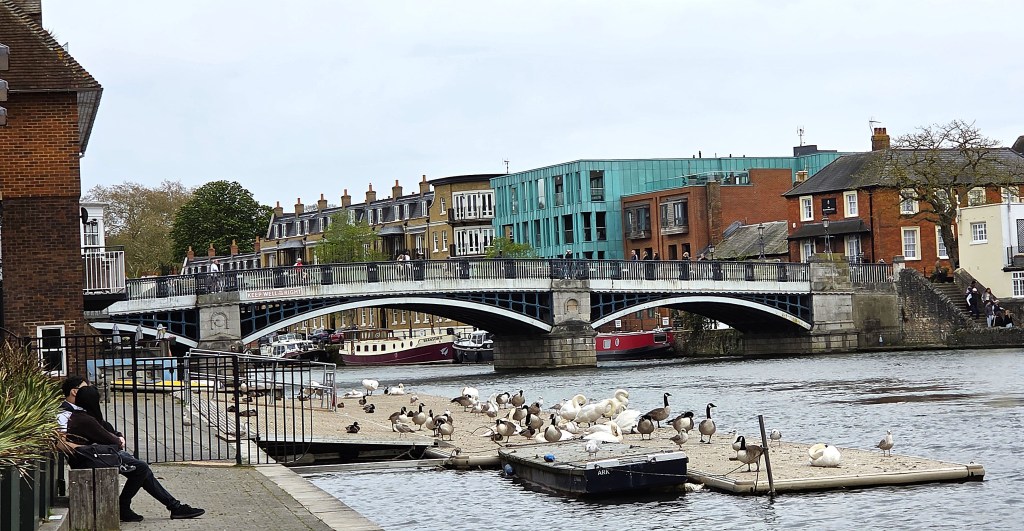
Making our way out from the Brocas, we crossed the Windsor Eton footbridge, briefly joining the other camera-wielding tourists, then sitting awhile on one of the benches while we decided where to conclude our walk.
It was with some consternation that we learned the trains were seriously disrupted, owing to an earlier suicide on the line between Clapham Junction and Waterloo.
Windsor’s name may derive from the Old English meaning ‘winch on the riverside’.
Old Windsor, a few miles to the south-east, was the more prominent settlement in Saxon times. The focus switched to the environs of Windsor Castle during the mid-Twelfth Century, when a bridge, hospital and hermitage were built nearby.
By the mid-Fourteenth Century, Windsor had become a particularly prosperous town, benefitting considerably from various Royal commissions to extend and improve the Castle. And, by the end of the Fifteenth Century, St George’s Chapel was gaining importance as a site of pilgrimage.
But, during the Sixteenth and Seventeenth Centuries, Windsor entered a period of decline, continuing into the Nineteenth Century. The location of two army barracks here led to extensive prostitution.
The arrival of the railway, together with Queen Victoria’s regular use of the Castle, led to a revival, followed by extensive modernisation and rebuilding. This has been sustained through the affluence of tourists.
Margaret Oliphant lived here from 1866 until her death in 1897. Amongst those born in Windsor are Ranulph Fiennes, Chesney Hawkes and Peter Osgood.
Windsor to Datchet
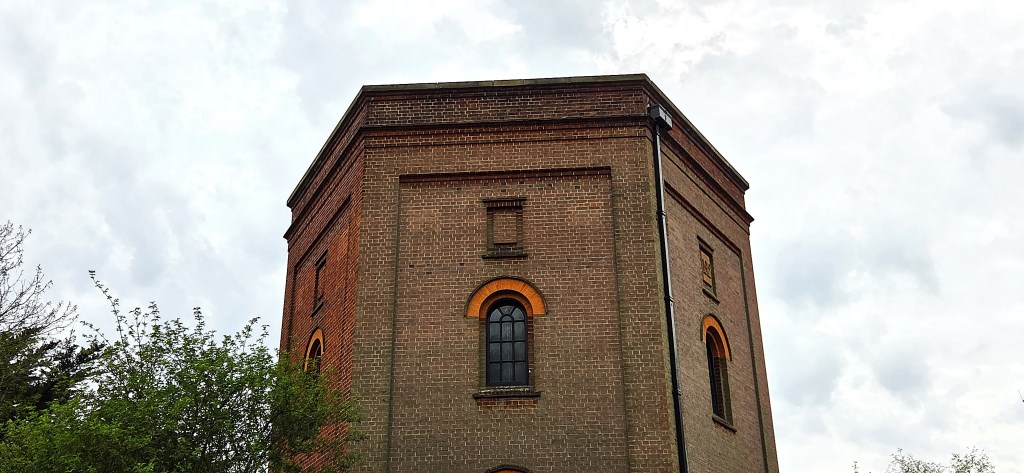
Having crossed the footbridge, we took a left turn on the Windsor side, passing along Thames Side and past a late Victorian waterworks building. Eventually we found ourselves on the extreme edge of Home Park.
Romney Lock, which is barely visible from the path, is followed by Black Potts railway bridge, built in 1850. It rests upon Black Potts Ait, where King Charles II was supposedly wont to fish.
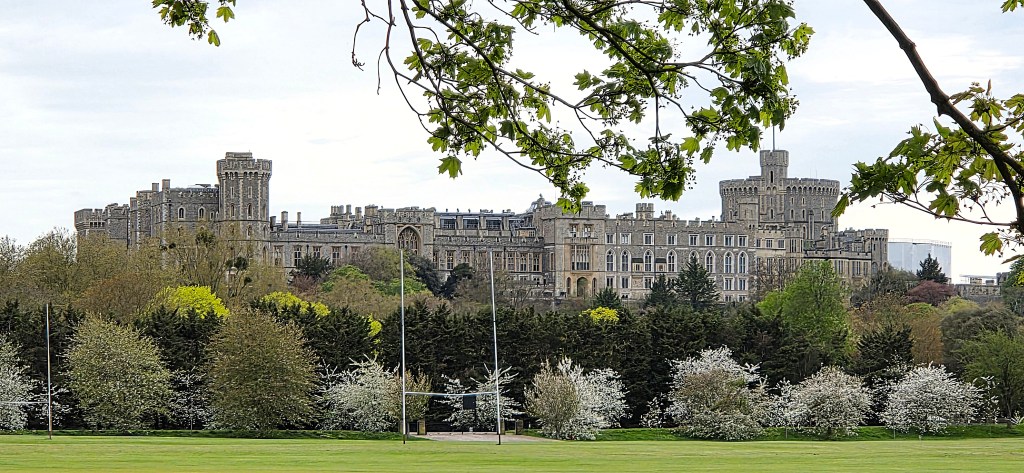
Home Park contains the private grounds of Windsor Castle and is distinct from Windsor Great Park. It has a golf course, cricket pitch, bowling green and tennis courts.
Prominent buildings include: Frogmore House; Frogmore Cottage, a five-bedroomed property which has seen several recent royal occupants; and Adelaide Cottage, inhabited by the Prince of Wales and his family from 2022 to 2025.
The Thames loops round Home Park until it reaches Victoria Bridge. It was built in 1851 of cast iron, but was eventually replaced by a concrete successor in 1967, two decades after the original was damaged by tanks crossing during the Second World War.
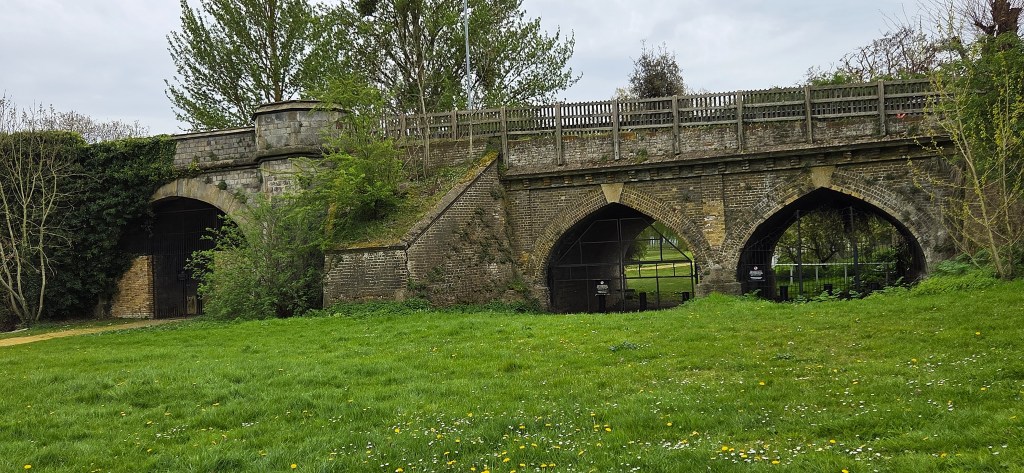
The guide book says the path beyond the Bridge is ‘closed for security reasons’, which presumably means that one is at risk of stumbling upon a lesser spotted member of the royal family.
So the route passes across the Bridge and down into a long strip of riverside woodland on the Datchet side. Meanwhile, on the prohibited, Windsor side, the trees curve round with the River, each festooned with boluses of mistletoe.
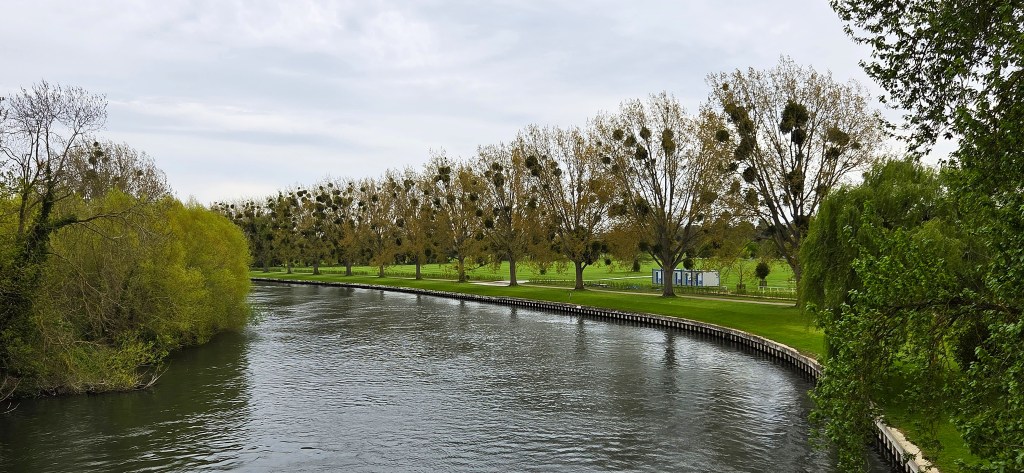
A British Airways jet passed noisily overhead as we crossed. I wondered if their royal highnesses were inured to aircraft noise.
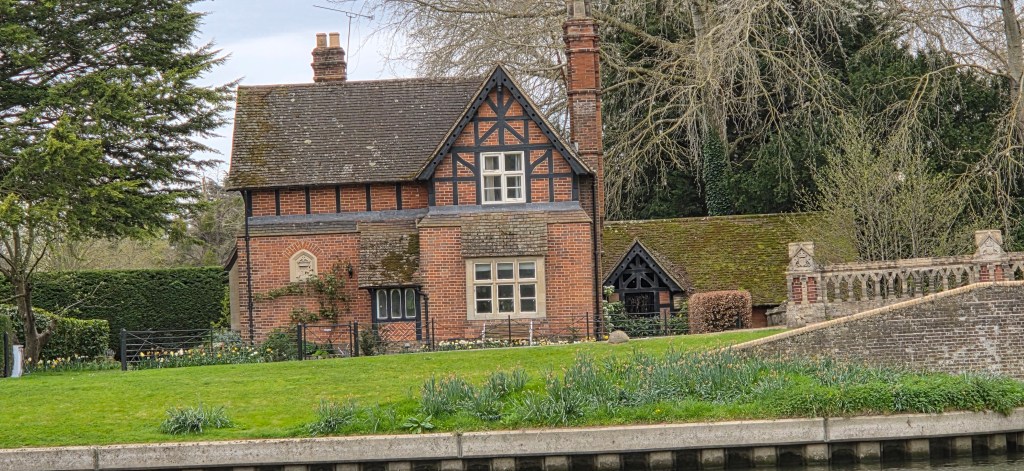
Passing through the woodland, we caught glimpses of a building on the other side. According to Historic England, it is Albert Cottage, a red brick structure built in 1861, with a linked boathouse behind.
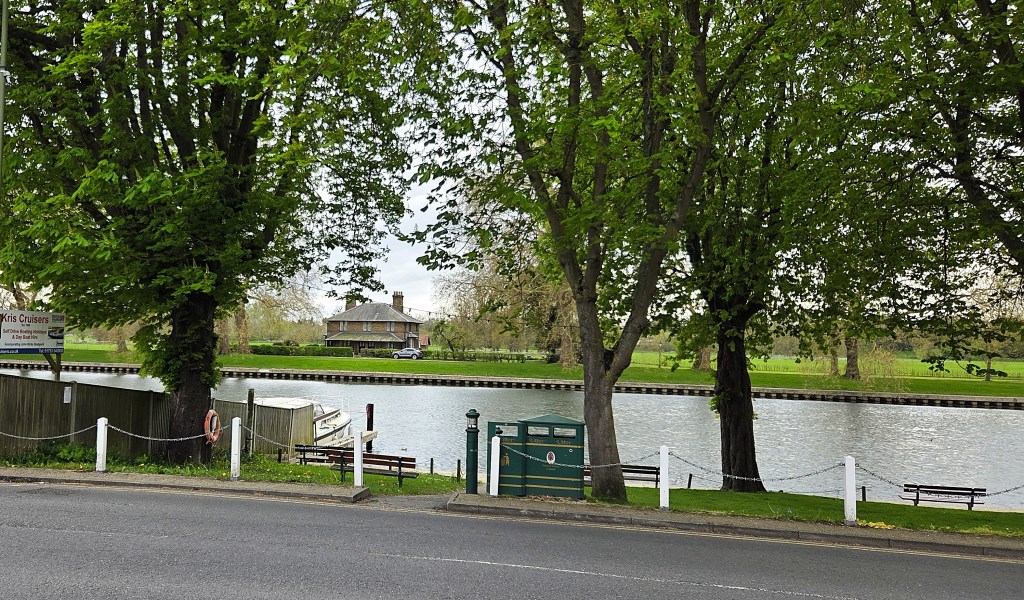
The Thames Path eventually makes its way towards Windsor Road, passing a lengthy wooden fence. A tall mast is just visible, suggesting that the fence protects a sizeable yacht from prying eyes.
During the late Nineteenth and Early Twentieth Centuries, the Datchet riverfront was a boating resort, with rowing boats, punts and canoes for hire, though not on the same scale as Henley or Maidenhead.
Datchet Regatta was first held here in 1888.
The ‘Three Men in a Boat’ passed Datchet by, though the characters do recall a previous occasion upon which the three of them did stop here.
They were exceedingly picky about where they stayed, only to find that all the available beds were taken.
They were just about to give up when:
‘ At that moment an angel came by in the disguise of a small boy (and I cannot think of any more effective disguise an angel could have assumed), with a can of beer in one hand, and in the other something at the end of a string, which he let down on to every flat stone he came across, and then pulled up again, this producing a peculiarly unattractive sound, suggestive of suffering.
We asked this heavenly messenger (as we discovered him afterwards to be) if he knew of any lonely house, whose occupants were few and feeble (old ladies or paralysed gentlemen preferred), who could be easily frightened into giving up their beds for the night to three desperate men; or, if not this, could he recommend us to an empty pigsty, or a disused limekiln, or anything of that sort. He did not know of any such place—at least, not one handy; but he said that, if we liked to come with him, his mother had a room to spare, and could put us up for the night.
We fell upon his neck there in the moonlight and blessed him, and it would have made a very beautiful picture if the boy himself had not been so over-powered by our emotion as to be unable to sustain himself under it, and sunk to the ground, letting us all down on top of him. Harris was so overcome with joy that he fainted, and had to seize the boy’s beer-can and half empty it before he could recover consciousness, and then he started off at a run, and left George and me to bring on the luggage.’
Homeward
There was no time for us to explore Datchet.
We turned up the High Street and hotfooted it to the Station, anxious to discover for how long we might be marooned.
But, as we arrived, a train drew in, so we quickly jumped aboard.
Arriving at Clapham Junction around 16:30, we found chaos. There was little clarity about which trains would be arriving where, so we had to keep dodging between platforms to update ourselves.
The first available train was very full, and the people inside the coach we were waiting to board simply refused to pack themselves any more tightly.
It didn’t help that it was still the Easter holidays, so the commuter spirit was in short supply.
I directed my very best death stares at the luckless passengers, enjoying their discomfiture while departure was delayed.
The next suitable train, around fifteen minutes later, was far less crowded and we managed to find seats without too much difficulty.
TD
April 2026








Leave a comment