
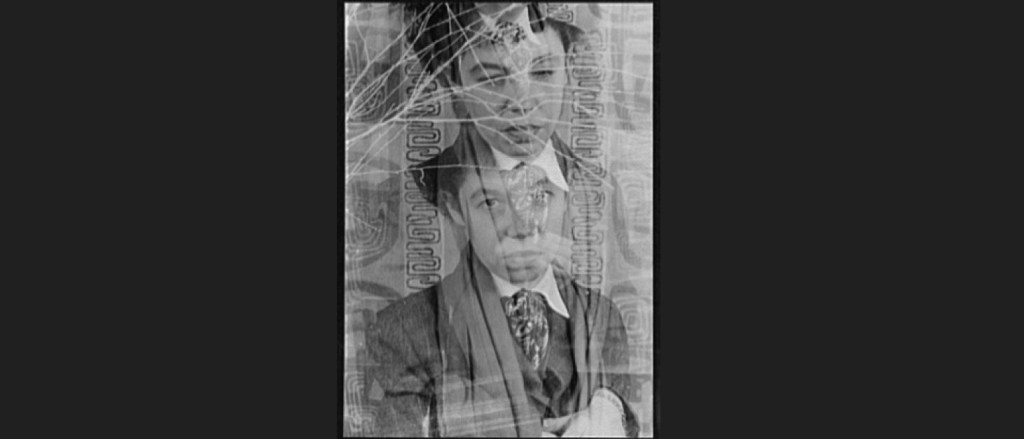
Jane Sydney Bowles, nee Auer (1917-1973) was born to Jewish parents in New York City. She was a sickly child, suffering from tuberculous arthritis, causing her mother to take her to Switzerland for treatment.
She met writer and composer Paul Bowles (1910-1999) in 1937 and they married the following year, honeymooning in Central America. Both soon embarked on a series of extramarital affairs, mostly lesbian in Jane’s case.
She had already begun work on ‘Two Serious Ladies’ (1943), her only novel, when she and her husband went to live in Mexico. There she met Helvetia Perkins, a divorcee more than 20 years her senior, who became her first post-marital lover.
By 1942, she and Perkins had returned to the United States, Perkins buying a Vermont house where she lived with Jane while the latter completed this novel.
By 1948, she and her husband had both moved to Tangiers, where Paul Bowles was to live for the rest of his life.
In 1949 he published ‘The Sheltering Sky’, his own semi-autobiographical novel whose two principal characters were modelled on himself and Jane.
Her health remained delicate, especially after a stroke in 1957 which affected her capacity to write, and she died in her mid-fifties, 16 years later.
Bowles and her novel have divided opinion since the book was first published. Her supporters include Truman Capote and Tennessee Williams, the latter going so far as to declare her:
‘the finest writer of the [Twentieth] century in English prose fiction’.
Of ‘Two Serious Ladies’ he gushed:
‘My favourite book. I can’t think of a modern novel that seems more likely to become a classic.’
The serious ladies in question are Christina Goering and Frieda Copperfield, both wealthy Americans of indeterminate age.
Christina forms a relationship with Lucie Gamelon, cousin of her former governess, who becomes her live-in ‘companion’.
Christina and Frieda are friends. They meet again at a party, shortly before Frieda departs with her husband on a trip to Panama.
At the same party Christina is propositioned by Arnold, who takes her to his home which he shares with his parents. There is some subsequent intrigue with Arnold’s father, who falls for Christina.
Meanwhile, Frieda and her husband arrive in Panama, where Frieda forms a relationship with Pacifica, a young prostitute.
She also makes the acquaintance of Mrs Quill, proprietor of the ‘hotel’ in which Pacifica lives. She rescues Mrs Quill from the swanky Washington Hotel, where she has been deserted by her date, left without money but with the unpaid bill.
Back home, Christina decides to move to a small house on an island with Lucie and Arnold. There are inevitable tensions, particularly between her two companions.
For reasons best known to herself, (but may be associated with the fact that Arnold and Lucie have more than set aside their differences), Christina decides that she must make trips from the house, catching a train and then a ferry across to a town on the mainland.
Here she meets Andy, and they begin a relationship, only for Christina to desert him in favour of Ben. She is attracted to Ben but he shows only limited interest. He takes her to a restaurant but begins a business meeting there, neglecting her.
So Christina telephones Frieda, who has returned from Panama, asking her to come for a drink. Frieda brings Pacifica, who has evidently accompanied her back to the United States.
But Pacifica is anxious to depart for a date with a young man ‘uptown’ who has asked her to marry him. Frieda plans to frustrate this by returning to Panama with Pacifica, claiming that she can no longer live without her. Frieda gets drunk.
The novel ends inconclusively, as Ben leaves the restaurant with his business colleagues, abandoning Christina. We never learn whether she returns to the company of Frieda and Pacifica, who reminds her of Lucie Gamelon, except that she is:
‘a much nicer person and more attractive physically’.
Perhaps she will prove another rival for Pacifica’s attentions.
‘Two Serious Ladies’ is certainly a tour de force for an aspiring author who was only in her mid-twenties.
The two wealthy, promiscuous women have prominent faults; neither is particularly likeable. Most of the characters are flawed in one way or another.
The narrative has a curious, dreamlike quality, different ‘scenes’ or incidents arising out of each other according to some strange internal logic that somehow defies reason.
The style is direct, occasionally staccato, sometimes a touch clumsy. Conversation is invariably stilted. I, for one, couldn’t recognise here the finest writer of prose fiction across the entire Twentieth Century.
But the novel does have a cultish individuality that still attracts influential advocates and admirers.
It has considerable curiosity value but, in my own humble opinion, while strange, possibly even unique, it is not quite outstanding.
TD
May 2026








Leave a Reply