
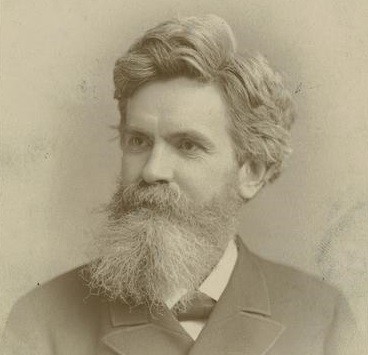
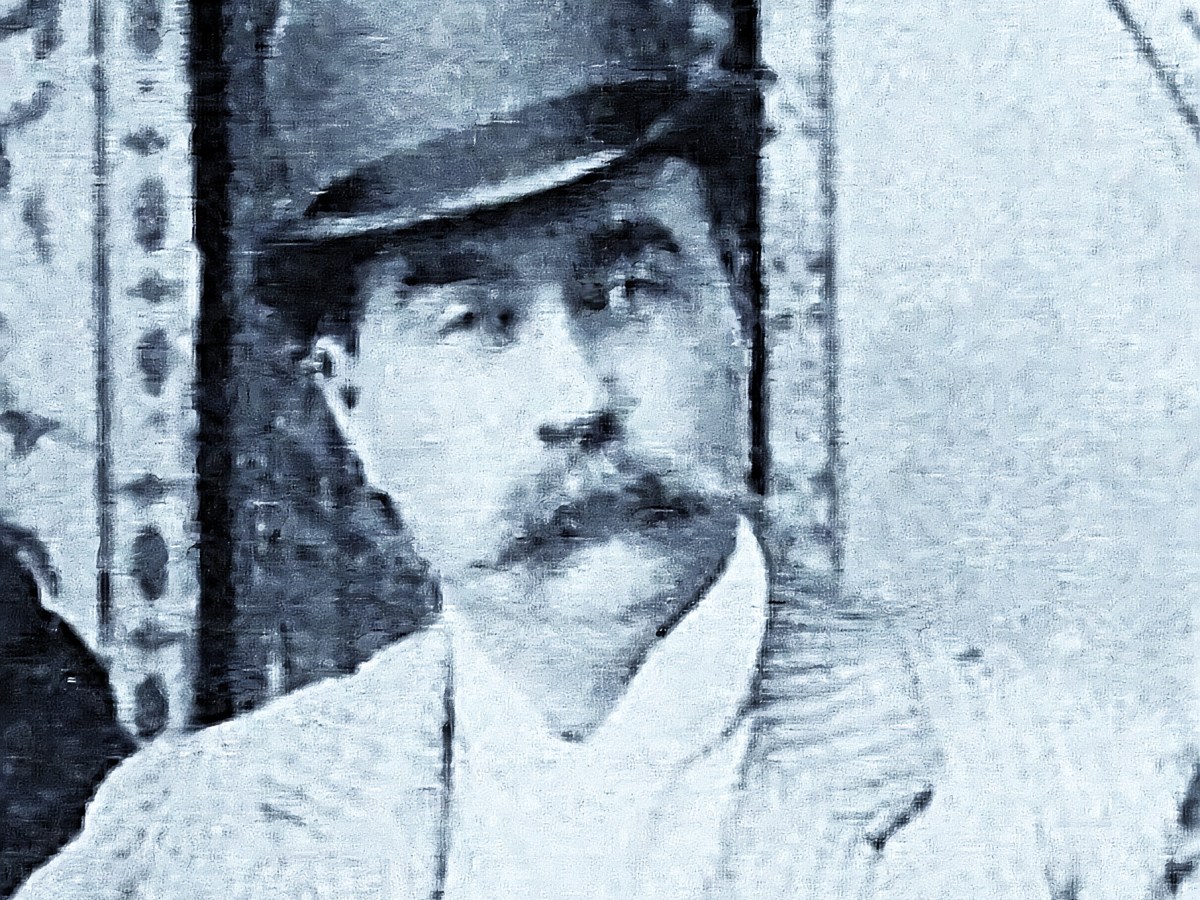
George Washington Cable (1844-1925) was born in New Orleans to another George Washington Cable and Rebecca, née Boardman. He was the fifth of their six children.
His parents, who were Presbyterians, had come to Louisiana from Pennsylvania and Indiana respectively. His father became a wholesale merchant and speculator in cotton. They prospered initially, but their fortunes soon declined, until Cable senior died in 1859.
Cable fought on the Confederate side in the American Civil War, after which he worked as a journalist for the New Orleans Picayune (its named derived from the Spanish coin initially charged for it). Some of his early fiction was also published in the Picayune.
In 1869 he married Louisa Stewart Bartlett and became an accountant for a firm of cotton brokers, continuing to write in his spare time.
In 1873 he began to offer stories to a literary periodical, Scribner’s Monthly, founded by publisher Charles Scribner (1821-1871) with several partners and published from 1870 until 1881.
Several of these stories, all with a New Orleans theme, were collected and published in 1879 under the title ‘Old Creole Days’.
Cable had already begun ‘The Grandissimes: A Story of Creole Life’, which was initially published in Scribner’s in a series of monthly episodes, running from November 1879 until October 1880.
The $1,500 he made from ‘The Grandissimes’, alongside its success with public and critics alike, convinced him to become a full-time author.
He was initially a hit on the conference circuit, particularly when he embarked on a joint tour with Mark Twain, but his fiction never quite achieved the same success.
Even so, he published 13 more novels between 1882 and 1918, as well as several collections of essays and short stories. The novels include Dr. Sevier (1882), John March, Southerner (1894), The Cavalier (1901), Kincaid’s Battery (1908) and Lovers of Louisiana (1918).
They have largely been forgotten.
Cable left New Orleans for Massachusetts in 1885. After his first wife died in 1904, he married twice more, in 1906 and 1923, before his own death, aged 80, in St Petersburg, Florida.
‘The Grandissimes’ is also set in New Orleans, at the turn of the Nineteenth Century.
Joseph Frowenfeld, American born of German parents, arrives with his family, only for them all to die from yellow fever. Following his own recovery, he sets up as an apothecary.
Frowenfeld is Cable’s alter ego, a reforming liberal and dedicated abolitionist.
He encounters various members of the Grandissimes, a prominent white creole family, notably Honoré Grandissime, the moderate head of the family and his ultra-conservative uncle Agricola Fusilier, an unashamed advocate for slavery.
He also meets Aurora Nancanou and her daughter Clotilde, who tend him during his recovery from yellow fever. Once wealthy, they are now extremely poor, while struggling to maintain appearances. Aurora’s husband gambled away their estates to Fusilier and was subsequently killed by him in a duel.
And of course he meets members of the quadroon (one quarter African) and negro populations, notably: a second Honoré Grandissime, half-brother to the first and the Nancanous’ landlord; Palmyre Philosophe, formerly Aurora’s slave maid, now freed, a dedicated practitioner of voodoo; and her accomplice, Clemence.
He also learns the story of Bras Coupé, an enslaved African prince who formerly fell foul of Fusilier.
The enlightened creole, Honoré Grandissime, perhaps influenced by Frowenfeld’s arguments, ultimately decides to return Aurora Nancanou’s estates, and to enter into a business partnership with his eponymous half-brother.
Both actions alienate him from his more conservative family, their views reflected and exaggerated by Fusilier.
Palmyre attacks Fusilier in the street and both are injured. Later, when Fusilier encounters the quadroon Honoré Grandissime in Frowenfeld’s shop, a fight ensues and Grandissime stabs Fusilier.
This Honoré Grandissime is in love with Palmyre, but she seems to be enamored with his namesake.
She tries to finish off Fusilier by means of voodoo charms, delivered by her accomplice Clemence, but Clemence is caught by the Grandissimes and murdered.
Ultimately, Fusilier also dies but, upon his deathbed, seems to wish to unite the creole Honoré Grandissime and Aurora Nancanou in matrimony. This Honoré is of course in love with Aurora.
Frowenfeld and Clotilde declare their love for each other. Aurora and the creole Honoré Grandissime just about do the same (though Aurora is maddeningly coy to the last).
The quadroon Honoré Grandissime accompanies Palmyre to France but, since she continues to reject his advances, he drowns himself. He has ensured that she will continue to receive largesse from Louisiana for the remainder of her life.
A white doctor, Keene, his health ruined by fever, provides an ironic, melancholic commentary upon much of the proceedings. He is also suffering from unrequited love for Clotilde.
The plot is far easier to summarise having completed the book than it is to follow as it unfolds. Maintaining two distinct Honoré Grandissimes was probably a mistake.
Sometimes Cable’s observations are startlingly powerful, particularly when voiced by one of the more three-dimensional male characters.
On the other hand, Clotilde and Aurora are little more than idealised caricatures – the ‘love interest’ – and much of their dialogue, delivered in a Frenchified creole, is utterly dismal.
The quality of the narrative is also maddeningly inconsistent. One suspects that it had to be padded for the sake of serialisation.
Had Cable cut its length by a third, editing it vigorously to eliminate the dross, his novel would have been far better.
Palmyre is an intriguing and complicated character. Her relationship with Frowenfeld is particularly striking.
At their first meeting:
‘When he presently lifted his eyes and looked full upon the woman with a steady, candid glance, she was regarding him with apparent coldness, but with secret diligence and scrutiny, and a yet more inward and secret surprise and admiration. Hard rubbing was bringing out the grain of the apothecary. But she presently suppressed the feeling. She hated men…
…It was many an hour after he had backed out into the trivial remains of the rain-storm before he could replace with more tranquillizing images the vision of the philosophe reclining among her pillows, in the act of making that uneasy movement of her fingers upon the collar button of her robe, which women make when they are uncertain about the perfection of their dishabille, and giving her inaudible adieu with the majesty of an empress.’
At their second encounter, she pleads with him, as a fellow ‘sorcier’, to make the creole Honoré Grandissime love her, but Frowenfeld seems close to becoming ensnared himself:
‘However harmless or healthful Joseph’s touch might be to the Philosophe, he felt now that hers, to him, was poisonous. He dared encounter her eyes, her touch, her voice, no longer. The better man in him was suffocating. He scarce had power left to liberate his right hand with his left, to seize his hat and go.’
Had Cable portrayed an equal, loving relationship between these twin ‘sorciers’, quadroon and white American, his novel would have been truly remarkable.
But, despite his liberal views about equality between the races, that would have been a bridge too far for his contemporary readers.
As it is, ‘The Grandissimes’ is a curate’s egg which has some curiosity value, drawing a vivid portrait of multiracial interaction in a society polluted by slavery.
TD
November 2026





Leave a Reply