
I return, with the greatest of pleasure, to one of my favourite Twentieth Century authors.
Henry Green was the nom de plume of Henry Vincent Yorke (1905-1973).
He was born in Tewkesbury, Gloucestershire, youngest son of Vincent Woodhouse Yorke, a wealthy landowner, businessman and manufacturer, and the Hon. Maud Evelyn, née Wyndham, second daughter of the even wealthier second Baron Leconfield, previously Conservative MP for West Sussex and resident at Petworth House.
Vincent Yorke had been academically outstanding, winning scholarships to Eton and Kings College Cambridge, ultimately taking a Double First in Classics. Both Henry’s brothers were equally promising, displaying both academic and sporting prowess, though Philip, the elder, died of leukaemia just before his 17th birthday.
Henry spent his early childhood in Gloucestershire but, from seven upwards, he was sent to a prep school in Sevenoaks, Kent before following his brothers to Eton. He could not match them, either in sport or academic study, but, from the age of 17, he began to publish short stories.
He experimented with being Henry Michaels (or was it Michaelis?) and Henry Browne before plumping for the fairly anonymous Henry Green.
In 1924 he departed Eton for Magdalen College, Oxford, but left after only two years without taking a degree.
A first novel, ‘Blindness’, completed at Oxford, was published in 1926.
Henry joined his father’s company, based in Birmingham. H. Pontifex and Sons manufactured beer bottling machines. He began as a factory hand, earning £1 per week, spending his evenings writing ‘Living’ (1929), about the lives of Birmingham factory workers.
In July 1929 he married the Hon. Adelaide Biddulph. She was a second cousin, eldest daughter of the second Baron Biddulph and descended from the first Baron Leconfield.
Their son, Sebastian Yorke, was born in January 1934.
By 1938, Henry was a Director of H. Pontifex and Sons, residing in London at 58 Rutland Gate, tucked conveniently between Harrods and the Royal Albert Hall.
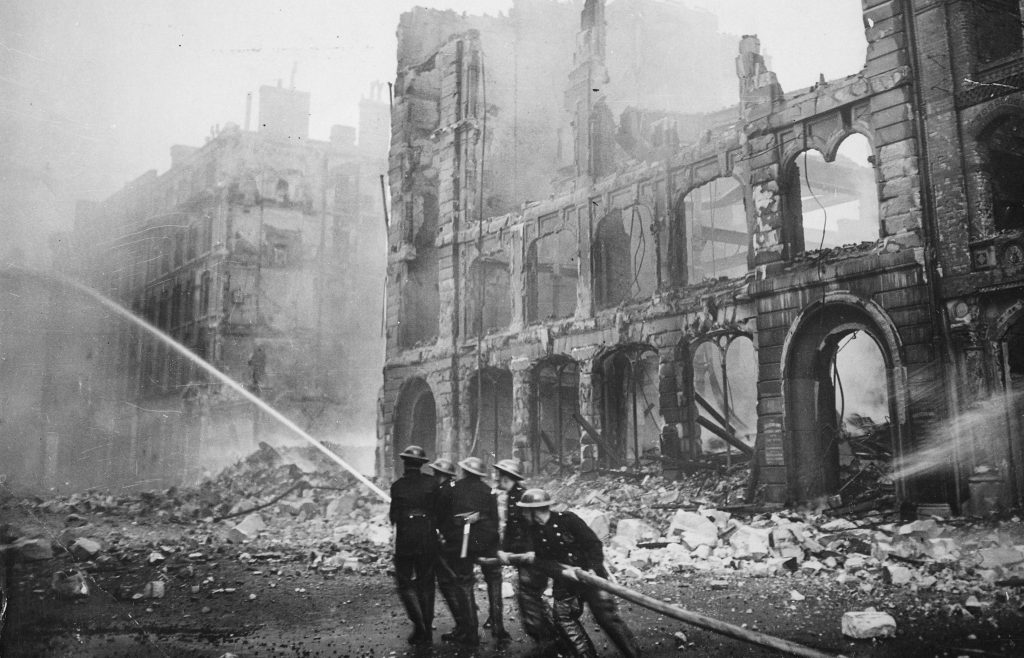
He joined a local Westminster section of the Auxiliary Fire Service (AFS), formed in January 1938 to support local fire brigades in the event of a German bombing campaign.
There were some 2,500 professional firemen serving in London, but the AFS hoped to recruit a further 28,000 volunteers, both non-conscripted men and women, the latter in supporting roles.
Green’s role as a company director might have been classified as a reserved occupation, meaning that he could not be conscripted into the armed forces, although still in his mid-30s.
Prior to the Blitz, the London public often considered Auxiliary Firemen ‘draft dodgers’, only to revise that opinion as German intentions became clearer, and especially during the 57 consecutive nights of bombing that London endured from 7 September 1940 onwards.
Some 327 firefighters, both professional and auxiliary, lost their lives in London during the Second World War and thousands more were injured.
Green had published ‘Partygoing’ in 1939 and a memoir ‘Pack My Bag: A Self-Portrait’ in 1940. ‘Caught’ was written between June 1940 and Christmas 1942 and published in 1943.
Five more novels were to follow: ‘Loving’ (1945), ‘Back’ (1946), ‘Concluding’ (1948), ‘Nothing’ (1950) and ‘Doting’ (1952).
After that, Green switched his attention to reviewing books by other authors and studying Ottoman history. He continued as managing director of his Comany, even becoming Chairman of the British Chemical Plant Manufacturers’ Association.
But, in his final decade, he became increasingly reclusive, hearing-impaired, alcoholic, spending much of his time in bed. He died, aged 68, in 1973.
‘Caught’ draws heavily on Green’s wartime experiences in the AFS. Its leading character, Richard Roe, has much in common with the author, except that he is a widower. We learn little of his wife, or her death, though he is clearly struggling with her loss.
He also serves with the AFS in Westminster, sending his young son Christopher to live in his parents’ country pile, under the charge of Dy, his sister-in-law. We never meet his parents.
‘Caught’ is dedicated to Green’s son, Sebastian, who must be the model for Christopher. A few months earlier, Christopher had been abducted, briefly, by a woman in a London store.
She turns out to be the unmarried sister of Pye, a fireman who, by coincidence, has been promoted to take charge of the station where Roe is stationed.
We only encounter Miss Pye indirectly, through Christopher’s recollections of their encounter, which are indicated in the text by parentheses (as are Richard’s later recollections of the Blitz, recalled while he speaks with Dy).
We learn that Pye’s sister has been admitted to a psychiatric hospital. Her doctor there asks Pye if he can recall anything from her past life that might help to explain her behaviour.
This prompt causes Pye to recall his own early sexual experience. He has always believed that he had intercourse twice with a local girl. But could the second occasion have been unintentionally an incestuous encounter, a case of mistaken identity?
Both he and we are left uncertain, but he is tormented by the possibility.
Roe also struggles in his leadership role, becoming increasingly entangled in a web of deceit. He cannot refrain from behaviour that will get him into trouble, should it be discovered. His misfortune is that it is mostly discovered, and his superiors lose their trust in him.
At the end of the novel we learn that he has committed suicide, and that Roe discovered him with his head in the oven.
The only firefighting action within the novel is described retrospectively, in the final chapter, after Roe has been invalided back to his parents’ country home. We learn that some of his fellow firefighters, prominent characters in earlier chapters, have since lost their lives.
The bulk of the narrative deals with the relationships between the firemen, their female colleagues and immediate neighbours, while they wait for the Blitz.
The gulf in social class between Roe and his colleagues proves difficult to overcome. Roe tries to curry favour by buying drinks.
The men, as well as the younger women, are keen to capitalise on the sexual liberty permitted both sexes in wartime. Pye conducts a brief liaison with Prudence, a woman living in a nearby flat, while Roe begins an affair with a driver, Hilly.
The firemen enjoy their brief ascendancy, even above pilots, as the most deserving sexual targets for nubile women.
Meanwhile, Mary Howells, an older woman who works in the kitchen, travels up to Doncaster to confront Ted, her soldier son-in-law. Her daughter Brid has returned to her mother with a new-born baby, clearly with her own mental health issues. Ted might or might not have knocked her about.
We come to appreciate the frailties and shortcomings of these characters, ostensibly ‘the salt of the earth’, even before they are tested to the limit by the Blitz.
Incompetence, indiscipline and cowardice are rife. Everyone is struggling to overcome the stress of waiting for the bombing to begin, on top of their own extensive personal problems and relationship issues.
This is emphatically not the propaganda that the War Office might have hoped!
Just as Pye is caught in a tangled web of deceit, all these characters are caught in the complex tangle of their inter-relationships, forced together by war and circumstance. These are too often permeated by evasiveness, deception, misunderstanding, exaggeration and downright lying.
The tension between Pye and Roe, (‘Pye-Roe’ is Green’s fiery little pun), lies at the heart of the novel.
They both strive to overcome the effects of the incident between their close relatives, and successfully forge a positive working relationship, even though the abduction ultimately contributes to Pye’s undoing.
Roe, himself unbalanced following the strain of the Blitz, is furious when, at the close of the novel, Dy is utterly dismissive of Pye:
‘”I can’t help it,” she said, “I shall always hate him, and his beastly sister.”
This was too much for the state he was in. He let go. “God damn you,” he shouted, releasing everything, “you get on my bloody nerves, all you bloody women with all your talk.”
It was as though he had gone for her with a hatchet. She went off without a word, rigid.’
This is not one of Green’s best-known or most celebrated novels.
Stylistically, it is sometimes staccato; occasionally convoluted, almost beyond understanding.
Yet, even when Green is struggling to communicate his meaning, one feels it necessary to try to understand.
This extract, containing the longest sentence in the entire novel, seems initially opaque but, on re-reading, proves an amazing description of a nightclub singer :
‘As she stood there, gently telling them in music, reflecting aloud, wondering in her low rich voice, the spot light spread a story over her body and dazzled her cheeks to bend and blend to a fabulous matching of the mood in which she told them, as she pretended to remember the south, the man who had gone, as she held all theirs with her magnificent eyes guardedly flashing, slowly turning from one couple to another, then again dropping her voice, almost sighing, motionless, while beads of sweat began to come like the base of a tiara on her forehead as she told the audience, that he could see only as the less dark below her and whose clouded heads, each one, drew nearer to a companion’s in this forced communion, the hyacinthine, grape dark fellowship of longing. The music floated her, the beat was even more of all she had to say, the colour became a part, alive and deep, making what they told each other, with her but in silence, simply repeatedly plain, the truth, over and over again.’
Green has an uncanny ear for dialogue, which became increasingly prominent in his later novels.
Moreover, his characters speak authentically, like real people, but their words often reveal a great deal about their characters and motivations.
Inevitably I am biased. I think ‘Caught’ is outstanding.
It substantiates the opinion I held before reading it: that Henry Green is scandalously underrated as a novelist – quite possibly the most scandalously underrated novelist of all time.
TD
October 2026








Leave a Reply