
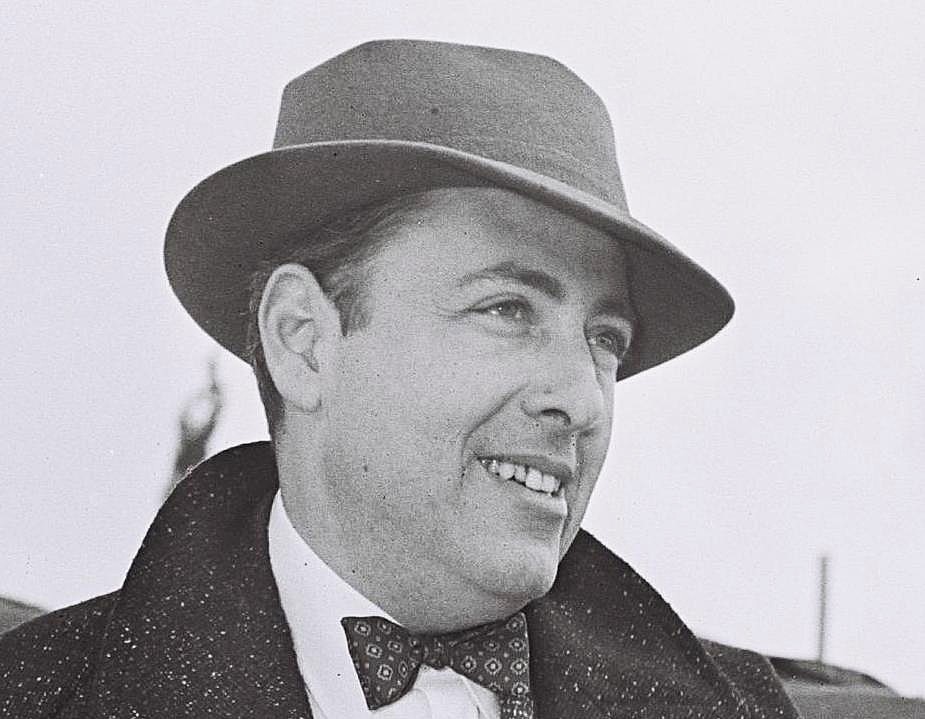
Herman Wouk (1915-2019) was born in New York to Russian Jewish immigrant parents, originally from Minsk.
Like many before them, Abraham Wouk and Esther, née Levine settled in the Bronx, where Abraham built from scratch a large and successful laundry business.
Herman attended the selective Townsend Harris Hall Prep School, progressing to Columbia University. He graduated in 1934 with a degree in comparative literature and philosophy. He also worked on the University newspaper, edited a humorous magazine and wrote two Columbia Varsity Shows.
Subsequently, he worked as unpaid assistant to a friend who secured a writing job at Camp Copake, a holiday camp for Jewish adults on Lake Copake, in the Hudson Valley, roughly 100 miles due north of the Bronx. He progressed to a ‘joke factory’ before taking up a role writing gags for a radio show.
Joining the US Navy in the wake of Pearl Harbor, he served aboard two destroyer-minesweepers in a variety of roles, meeting his future wife, Betty, née Brown, in the process.
She converted to Judaism to marry him and they had three sons, though the eldest died in a swimming pool accident, aged four.
Wouk began his first novel while still in the Navy, but it wasn’t published until 1947. His third was ‘The Caine Mutiny’, which won a Pulitzer Prize and was the best-selling American work of fiction since ‘Gone With the Wind’.
He published 14 novels in all, the last appearing in 2012, when he was comfortably into his 90s. He died in Palm Springs seven years later, just shy of his 104th birthday.
‘Marjorie Morningstar’ appeared in 1955, immediately following ‘The Caine Mutiny’. It is a classic ‘bildungsroman’ with a strong autobiographical flavour, except that the principal subject is female.
Marjory Morgenstern, beautiful 17 year-old daughter of Jewish parents, initially from the Bronx, is an aspiring actress who invents for herself the stage name ‘Marjory Morningstar’.
The basic plot is hackneyed: a morally upstanding ‘good girl’ falls for a morally delinquent ‘bad man’. She struggles to tame him, tempting him into marriage, while he struggles to escape.
Wouk has Marjorie operate within a rigid moral code. It expects her to marry as a virgin, ideally as soon as possible, to a somewhat older man with prospects – ideally a doctor or a lawyer – who, unlike her, has been free to sow a few wild oats.
Meanwhile, Marjorie’s peer group enjoy unlimited alcohol, chain smoking their way through every social encounter. Other drugs are, apparently, unknown.
They also engage frequently in bouts of ‘necking’, which seems to incorporate ‘heavy petting’ alongside kissing, though Wouk is vague on the point. ‘Affairs’, implying sex before marriage, are frowned upon.
Not once does Wouk mention birth control.
He is clearly invested in this peculiar code, believing it far preferable to the dissolute lifestyle embraced by the Bohemian community of actors and musicians that Marjorie aspires to join. A fish out of water, she must struggle to uphold her moral standards in the face of constant temptation.
As the novel begins, she is attending New York’s Hunter College, then a female-only institution. Starring in a student production of ‘The Mikado’, she is bitten by the theatre bug.
Through a friend, she gets a job as dramatic coach at a children’s camp situated on a lake, not unlike Copake. She is conveniently situated just across the water from South Wind, an adult holiday camp which her mother likens to Sodom.
Inevitably the two girls cross the lake in canoes, since Marjorie’s friend is having an affair with one of South Wind’s employees, much to Marjorie’s disgust.
They fraternise with the entertainers, led by Saul Ehrmann, talented elder son of a prominent Jewish judge and politician. Now in his late 20s, he has adjusted his name to ‘Noel Airman’.
His youthful assistant is Wally Wronken, obviously Wouk himself.
Wronken is smitten from the outset, but Marjorie only has eyes for the dissolute Airman, already lionised by the other camp entertainers because he has written a hit song and a musical, yet to be produced.
Wouk has serial womaniser Airman fall in love with Marjorie, stretching our credulity too far by having us believe that, for over a year, he is satisfied with ‘necking’, while Marjorie saves herself for marriage.
Such heroic restraint is ultimately impossible, even for her, and some 400 pages into the novel, she finally succumbs. Naturally Wouk has her undergo an unpleasant, shameful, painful experience. Only briefly (and very grudgingly) does he acknowledge that there might be some pleasure in premarital sex.
Airman’s musical is a flop, while Marjorie struggles to find any kind of professional role as an actress. We understand that she will never realise her ambition.
He, too, will also fail as a writer, whether of Broadway musicals or Hollywood films. He might be able to hold down a job in advertising, provided he can stomach the daily discipline of office work. But that is unlikely.
Meanwhile, Wronken is successful in his own terms, without aiming for the stars.
The novel skips the year-long ‘affair’ between Airman and Marjorie, resuming just as he is escaping to Europe without her, aboard the Mauretania.
Utterly lovelorn and bereft, Marjorie eventually follows him on the Queen Mary, her parents enabling her to travel first class. Aboard ship, she consorts with Mike Eden, a complicated older man, once a philosopher, now a chemist.
Eden previously killed his unloved wife in a car accident and was seriously injured himself. Wrestling with his guilt while recovering from his injuries has turned him into a nervous wreck. He is kept sane only by taking the pills he manufactures and injecting drugs intravenously.
He sells these pharmaceuticals in Germany, using that as a front while he helps to rescue Jews from the clutches of the Nazis.
Eden shows her something of Europe. Though emphatically not husband material, he illustrates for Marjorie the wider world beyond her narrow circle of aspiring New York entertainers, and the comparative insignificance of Airman.
With Eden’s help, she eventually tracks Airman down in Paris, where he is living with a German photographer. After cooking them a meal, he takes her on an extended tour of Montmartre nightspots before, ultimately, popping the question.
But Marjorie’s eyes have been opened! Having finally subjugated her Bohemian lover, she gently turns him down.
The last section of the novel is dedicated to finding her a suitable husband.
She makes a date with Wronken, but leaves prematurely, believing herself stood up. It as if Wouk can’t quite bring himself to tie things off so neatly, allowing himself to get the girl.
She eventually plumps for a lawyer, but the marriage is very nearly called off when she tells him she’s not a virgin. Fortunately, the lawyer swallows his pride and she at least gets to star in her own wedding, with Wronken and Airman both in the audience.
‘Marjorie Morningstar’ is definitely a page-turner, skilfully written, though this final section seems largely redundant.
Leaving aside the younger man’s astonishing sexual restraint, both Airman and Eden are convincing, three-dimensional characters. But Marjorie leaves something to be desired.
Though we are often in her head, and she somehow acquires a reputation for sound sense, there seems to be little of any substance in her reflections.
Perhaps she is a blank canvas, requiring theatrical roles to give her solidity.
Perhaps she is ‘Everygirl’, kept deliberately vague so that readers can better identify with her.
Or perhaps she is not quite as well developed a character as her male foils. Wronken is decidedly sketchy too.
Wouk’s brand of Jewish social and moral conservatism must have seemed dated even when the novel was first published. Today it seems positively antediluvian.
One feels that Wouk himself is half seduced by Airman’s charismatic, irresponsible, egotistical immaturity, for the devil always has the best tunes.
But, such are Wouk’s own beliefs, the rather tedious Marjorie must emerge the victor in this struggle between moral uprightness and moral rectitude, and be seen to live almost happily ever after, with her loving lawyer, her big house and her wonderful family.
That has always been her parents’ American Dream for her. Now that she has grown up a little, it has become her dream, too.
‘Marjory Morningstar’ is a competent, entertaining novel but it never quite escapes its own limitations. Take it for what it is, and enjoy!
TD
October 2026









Leave a Reply