

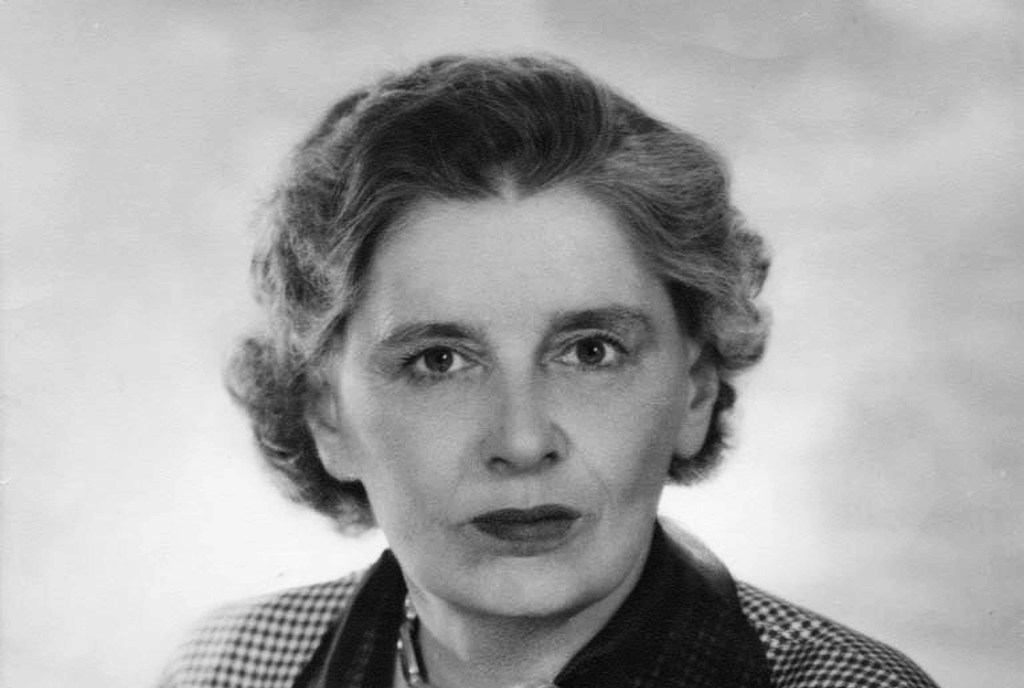
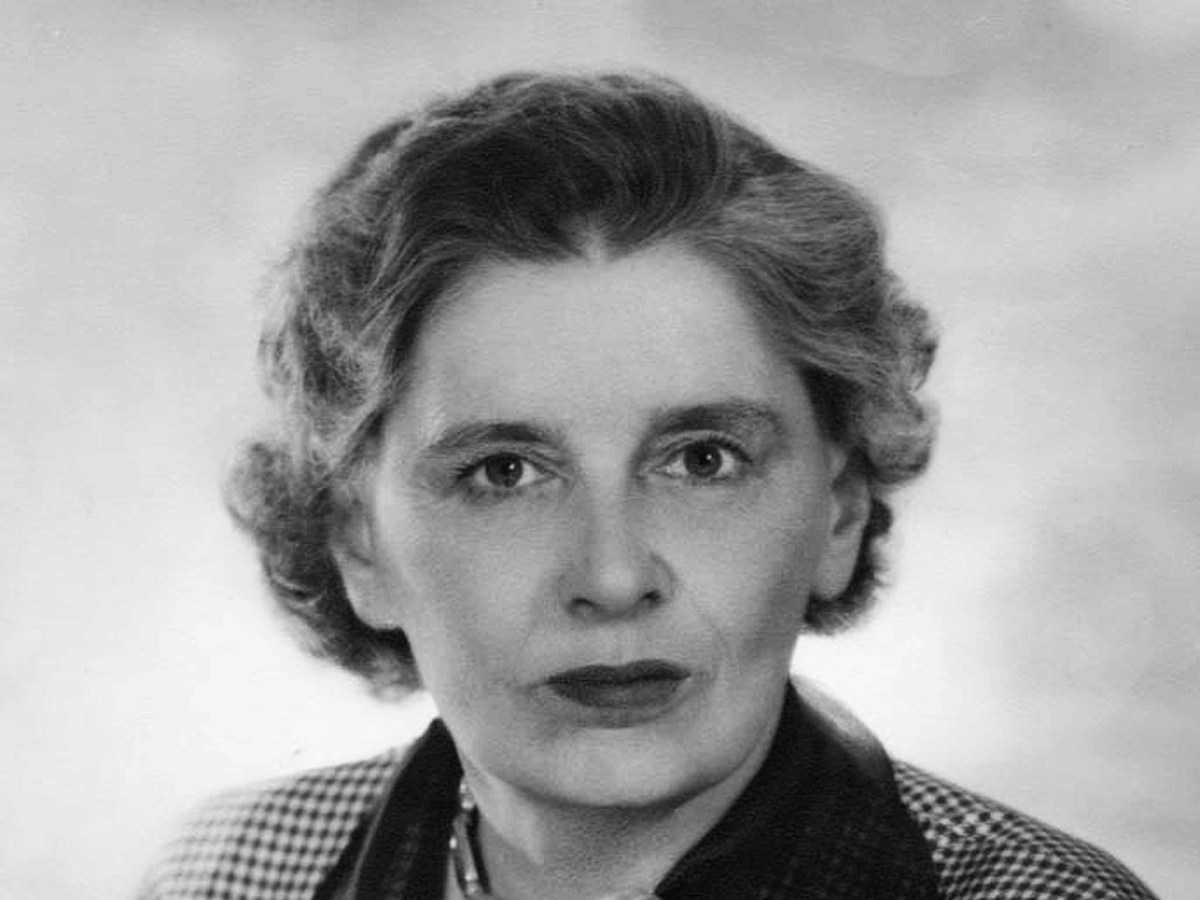
Brigid Antonia Brophy (1929-1995) was born in Ealing, London, to John Brophy, an author and journalist, and Charis, nee Grundy, a teacher.
She attended a variety of secondary schools before winning a scholarship to Oxford, where she studied classics.
But she was invited to leave without completing her degree, for reasons she preferred to gloss over, but which had something to do with her uninhibited lifestyle.
She worked as a typist for a while, living in a shared London flat. Her first novel, ‘Hackenfeller’s Ape’ (1953) was published when she was just 23. It established her as an ‘enfant terrible’ of the literary scene.
She had met Michael Levey (1927-2008), an art historian and later Director of the National Gallery, and they married in 1954.
Brophy was bisexual and the couple maintained an open relationship. This permitted a parallel affair between Brophy and her literary peer, Iris Murdoch (1919-1999), and didn’t prevent the birth of a daughter in 1957.
‘The King of a Rainy Country’ was Brophy’s second novel, published in 1956. Several more followed during the 1960s, and there were two final novels in the 1970s.
Betweentimes, she produced several non-fictional works, including two studies of Aubrey Beardsley (1872-1898) and one of Ronald Firbank (1886-1926).
She appeared frequently in the media, typically as an activist or spokesperson for one of a variety of causes, including gay rights, animal rights and vegetarianism.
After the conclusion of the affair with Murdoch, she had a second extended extra-marital relationship with a fellow author, Maureen Duffy (1933-2026).
It terminated shortly before Brophy was found to be suffering from multiple sclerosis.
Growing increasingly disabled, she and her family departed London for Lincolnshire, where Brophy took up residence in a nursing home. She died aged 66.
The title of ‘The King…’ is taken from one of Baudelaire’s ‘Les Fleurs du Mal’ (1857) which begins:
‘Je suis comme le roi d’un pays pluvieux,
Riche, mais impuissant, jeune et pourtant tres-vieux.’
‘I’m like the king of a rainy country,
Rich, but powerless; young yet also very old.’
The principal character is Susan, a young woman who, for two years, has continued an intense yet asexual relationship with Neale.
She moves into Neale’s flat near Tottenham Court Road and starts working as a typist for a pornographic bookseller. Neale works nights as a dishwasher, so she sleeps in their bed by night; he by day.
While inspecting the pornographer’s stock, she and Neale find a picture of Cynthia, a girl Susan went to school with.
Through a series of flashbacks, we learn that there was an attraction between the two schoolgirls, but the relationship ended before it had properly begun.
During a critical encounter, beneath the stage during a school play, Cynthia presents Susan with a discarded paper rose, pinning it in her lapel. They kiss and embrace, but are interrupted.
For reasons that are largely unexplained, Susan and Neale resolve to track down Cynthia.
Eventually Susan receives a letter from another schoolfriend. It reveals that Cynthia, a budding film starlet, will shortly be in Venice.
The pornographer is raided by the police, forcing him to relocate under a different identity.
Meanwhile, Susan and Neale are miraculously employed as substitute tour guides for a boisterous group of American holidaymakers. They must accompany them through Italy, culminating in a visit to Venice.
They learn ‘on the job’ and, after several picaresque adventures, finally reach their destination.
Here they are star-struck after spotting famous opera singer Helena Buchan. They stumble across Cynthia by accident and, having arranged to meet for coffee, Cynthia brings Helena with her, having made her acquaintance in the last few days.
Neale, whose relationship with Susan remains weirdly unconsummated, decides to fall in love with Helena.
But Helena takes Susan on a trip to Padua, leaving Neale behind. While visiting a photographer’s studio, she pushes a silk rose -one of the props – through Susan’s lapel.
We wonder whether Helena and Susan are destined to become lovers.
Meanwhile, back in Venice, Neale has slept with Cynthia and they plan to marry.
On her way back to London, Susan learns that Helena is dying and, on arrival, that she is already dead.
Collecting her belongings from a friend’s flat, she finds that Helena has made her a gift of her old wedding dress.
The novel is divided into three parts, the first in London, the second on tour with the Americans and the third predominantly in Venice.
The first and third parts are powerful, especially the denouement, but I felt the middle section – perhaps intended to mimic a medieval quest or a Chaucerian pilgrimage – was distinctly inferior.
Neale is an immature idealist with little to offer beyond cultural badinage. One wonders why Susan persists in her desire for him, unless it is simply because he will not consummate their affair.
I found Helena Buchan the most intriguing character, for Susan remains something of an enigma, her human potential as yet undeveloped.
Helena’s death introduces a note of mutability, and their relationship becomes a rite of passage that promises to deliver Susan a modicum of wisdom and maturity.
This subtle and understated novel is the first of Brophy’s that I’ve read.
I doubt it will be the last.
TD
June 2026








Leave a Reply