
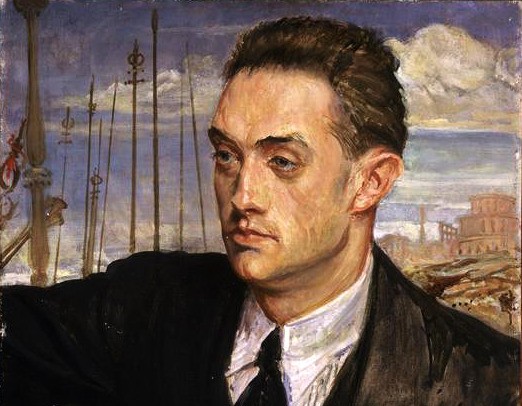
Henry Marie Joseph Fredéric Expedite Millon de Montherlant (1895-1972) was born in Paris to Roman Catholic and minor aristocrat parents.
His father, employed by the Ministry of Finance, died in 1914; his mother, formerly a society belle but latterly an invalid, succumbed the following year.
The youthful Henry had already been inducted into the mysteries of bullfighting, having visited Spain alone at the age of 15, and been expelled from his Catholic boarding school, having formed a secret society, possibly with homosexual undertones.
In 1916 he enlisted in the French infantry and was both wounded and decorated. Shortly after the War, he embarked on a career as a novelist, playwright and essayist.
He did not rise to prominence as a novelist until 1934, with ‘Les Célibataires’ (‘The Unmarried’), following this with ‘Les Jeunes Filles’ (‘The Girls’).
This latter work comprises four novels published between 1936 and 1939.
Following the German Occupation, de Montherlant remained in Paris, adopting an unashamedly pro-German outlook. But he managed largely to avoid post-War censure and was even elected to the Académie Française in 1960. His witing also attracted considerable critical acclaim.
In 1968 he lost sight in one eye, allegedly having been beaten up after groping a young man. His remaining eye also deteriorating, he committed suicide in 1972, taking cyanide and then shooting himself.
‘Les Jeunes Filles’ comprises ‘Les Jeunes Filles’, ‘Pitié pour les Femmes’ (‘Pity for Women’), ‘Le Démon du Bien’ (‘The Hippogriff’) and ‘Les Lepreuses’ (‘The Lepers’). Their narratives are chronologically sequential, beginning in 1927 and concluding in 1931.
I read them in an English translation by Terence Kilmartin.
The principal character is Pierre Costals, himself a writer in his mid-thirties. The novels deal almost exclusively with his relationships with several women. The three most prominent are:
- Andrée Hacquebaut, a provincial intellectual a few years younger than Costals. She believes herself in love with him, but this is not reciprocated. Their relationship is conducted mainly through a one-sided correspondence: she writes to him; he retains the letters unopened. When they do meet, he deliberately humiliates her. He finally manages to terminate her correspondence by making a date then standing her up.
- Solange Dandillot, a beautiful young Parisienne with whom Costals falls in love, getting to know her terminally ill father and, subsequently, her widowed mother (who he thinks resembles ‘a police horse’). Solange and her mother are inevitably contemplating marriage. Costals seems inclined to agree, but repeatedly gets cold feet. He conceives of marriage as the Hippogriff (a monstrous beast, half eagle, half horse, invented by the poet Ariosto in ‘Orlando Furioso’). The Hippogriff ultimately scares him away for good. Once Solange has finally married someone else, she writes to Costals again, but he repulses her with some cruelty.
- Rhadidja ben Ali, a precocious Moroccan girl of 16 or so who Costals has deflowered some four years previously, on an earlier trip to her country. He resumes their affair on returning to Morocco, only to discover that she has contracted leprosy. He arranges for her to receive treatment, then becomes convinced that he, too, is showing signs of the disease. This proves a false alarm.
Costals is not at all a likeable character, and de Montherlant does not shirk from exposing his egotism, cruelty and cowardice. Costals exploits women sexually, displaying a fierce misogyny while doing so. But he also expounds a philosophy which, he believes, justifies this behaviour.
His defining feature is his mistrust of women and romantic love, which he regards as a female invention, designed to trap men in marriage. He is strongly sexually attracted to women, but insists that relationships must always be on his terms.
Such ideas, attitudes and beliefs have become deeply unfashionable. It is no surprise that Simone de Beauvoir (1908-1986) critiqued them extensively in ‘The Second Sex’ (1949). Since then, they have shifted even further beyond the pale.
But it seems to me that de Montherlant has suffered from being too closely identified with his hero’s views.
The intelligent reader understands that Costals is ultimately a prisoner of his own fears and insecurities. When all is said and done, he is a bully, no matter how insistently and coherently he sets out a philosophical justification for behaving as he does.
That said, there may be a kernel of truth lurking behind all these words. And, if so, it may be a necessary antidote to the rather one-sided analysis of the relationship between women and men in most 21st Century discourse.
For the contemporary reader, these novels should definitely carry a prominent ‘trigger warning’. But they may also reward those with sufficient stamina, open-mindedness and intellectual curiosity.
TD
June 2026










Leave a Reply