
Well, this is a thoroughly nasty little novel, and no mistake!
Elizabeth Goudge (1900-1984) published ‘The Bird in the Tree’ in 1940.
It is the first part of a trilogy, the companion volumes written in 1948 and 1953 respectively.
Goudge was born into a wealthy academic-religious family and never married, living with her mother after her father’s death, which immediately preceded this novel.
It is set in 1938, overshadowed by the prospect of war.
But elderly matriarch Lucilla is almost completely untouched, living in Damerosehay, the remote house she has established as her personal refuge and symbol of enduring family unity. It sits on the Hampshire coast, close to the marshes.
Here she resides with her faithful servants and three grandchildren, born to her soldier son, George, and his former wife Nadine. For they have divorced and he has returned to soldiering in India.
Her oldest grandchild, David, an actor, is also her favourite. She intends him to inherit Damerosehay.
But David and Nadine have fallen in love and plan to marry. Lucilla is implacably opposed, enlisting the help of her vicar son Hilary and her obnoxious maid Ellen to part the lovers.
She demands that her grandson and daughter-in-law sacrifice their personal happiness, and that Nadine returns to the still lovelorn George, reviving her dead marriage for the sake of her children.
‘The divorce she swept away as being a lying thing of no consequence; though she considered it both wrong and silly of George to have acquiesced in it. She had fought him with all her strength but he had not listened. When what he considered to be Nadine’s happiness was at stake he could be as obstinate as he was brave.’
She draws false parallels between their situation and her own decision to walk away from a potentially adulterous relationship decades before. Since she chose to stay in a loveless marriage, so must Nadine!
She refuses to accept that David might inherit Damerosehay if married to Nadine, insisting – against all logic – that this must split the family apart rather than potentially drawing it closer together.
This insidious, pseudo-religious, mock-Victorian claptrap deserves short shrift. But, astonishingly, Lucilla prevails and the lovers are torn asunder, Nadine sent back to remarry George, to live out her life with a man she does not love.
There is also a half-arsed subplot featuring previous occupants of the house, one of whom lashes himself to the mast of his schooner as it is driven upon the marsh in a storm.
More false parallels are drawn, while Goudge herself is driven to the weak plotter’s last resort: an extravagantly detailed entry in a miraculously recovered old diary.
Oh, and there is a dog called ‘The Bastard’!
The novel is beautifully written, especially the descriptive passages about the Damerosehay gardens and the surrounding countryside, and occasionally insightful about the thought processes of young children.
But it is also sheer poison.
TD
August 2024
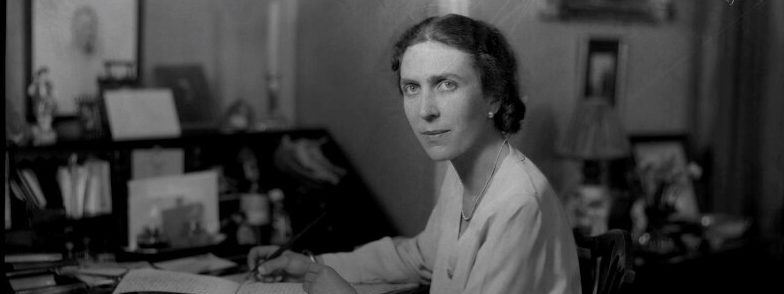
Image:
Elizabeth de Beauchamp Goudge by Bassano Ltd
whole-plate film negative, 10 May 1934
Given by Bassano & Vandyk Studios, 1974
Photographs Collection
NPG x151090








Leave a Reply