
Category: Archive
-
. This extended post investigates resurgent interest in specialist maths schools, as displayed by the Tories under Theresa May. It: Discusses developments during the first half of 2017, foregrounding the May Government’s draft industrial strategy, its spring budget and the Tories’ 2017 election manifesto. Reviews the difficult history of 16-19 specialist maths free schools, beginning…

-
. Summary This post explores the emerging definition of learners from ‘ordinary working families’ and the evidence published to date about their educational performance and how well they are served in the education system. It examines how learners from ordinary working families (hereafter referred to as ‘OWF learners’) fit within the broader visions for social…

-
. This extended post challenges the argument that all learners can be high attainers. It sets out the various strands of this argument, highlighting the weaker links and illustrating them with the assistance of two case studies, both branded school improvement strategies. It uses PISA 2015 data to demonstrate that none of the world’s leading…

-
. Brighton College to clone the London Academy of Excellence, a selective 16-19 free school, in every opportunity area https://t.co/xpfM9Hfyyo — Tim Dracup (@TimDracup) April 1, 2017 . .

-
There is no excerpt because this is a protected post.
-
. This short post outlines problems with ‘most able education’ – and what needs to change to bring about national improvement. The broad premiss is that, following a period in which comparatively prescriptive, centralised, top-down programmes were de rigeur, the English education sector has become wedded to a market-driven philosophy and ‘school-led system-wide improvement’. But…

-
. …Or ‘An exercise in policy design’. . This post considers proposals emerging for new selective schools that would select on the basis of ability or attainment and socio-economic disadvantage. It covers the following ground: The context provided by the selection green paper and the Opportunity Areas policy. Recent Advocacy for ‘pupil premium grammar schools’…
-
. This post investigates the practice of introducing selective grammar streams into comprehensive schools. It: Reviews recent advocacy for this practice. Distinguishes grammar streams from other, related approaches to within-school selection. Urges revision of the official distinction between ability and aptitude, based on the erroneous position taken by the School Adjudicator. Places grammar streams in…

-
. This post compiles some of the most recent and telling statistics about the state of high attainment in England. It includes a brief summary of the policy position as it stands ahead of the government’s response to the selection green paper. Finally it outlines a ten point improvement plan which does not involve building…

-
Originally posted on Gifted Phoenix: https://twitter.com/ProfCoe/status/532827085564575744 https://twitter.com/profstig/status/532865591288164352 I had been intending never to revisit the difficult topic of setting, secure in the knowledge that I could not improve on my earlier treatment of the pros and cons. Irrelevant picture of Norway by Gifted Phoenix But recent developments have caused me to reconsider, led me to…

-
. This post investigates what PISA 2015 results reveal about: Progress towards the government’s 2020 national performance targets; and Trends in the comparative performance of England’s high attainers. It complements a parallel post about the TIMSS 2015 results – Troubling TIMSS trends (December 2015). . About PISA The results of the 2015 Programme for International…

-
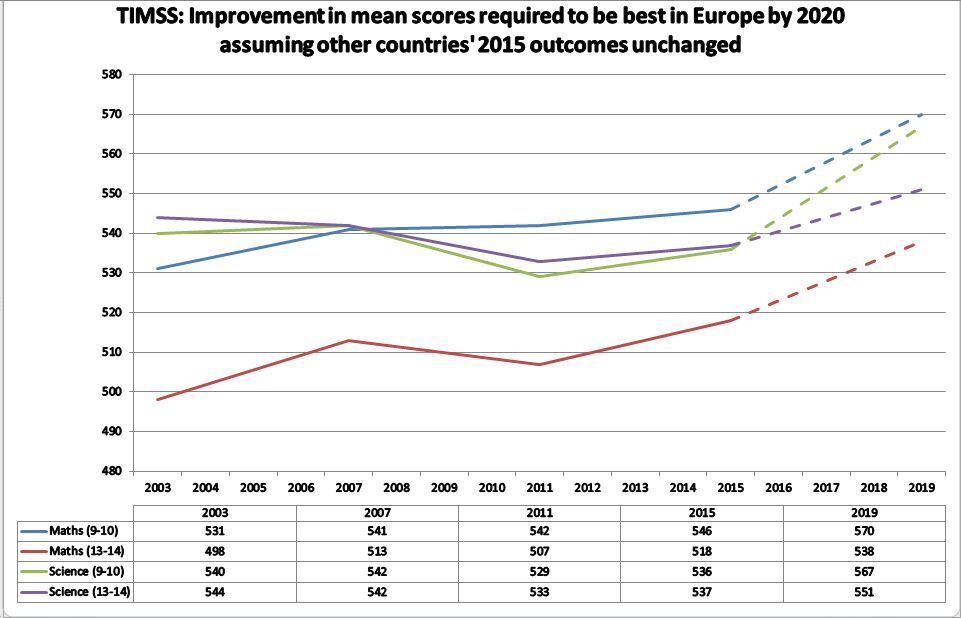
. This post reassesses Progress against the government’s national performance targets and The comparative performance of England’s high attaining pupils following publication of the TIMSS 2015 international comparisons study. . About TIMSS The results of the 2015 Trends in Maths and Science Study (TIMSS) were published at the end of November 2016. TIMSS is a…

-
. This post features analysis of the 2016 primary transition matrices, but mostly raises awkward questions. . Context Publication of the 2016 primary performance tables is imminent, together with revised national figures for achievement of the KS2 higher standard and new breakdowns by pupil characteristics, including receipt of pupil premium. We also await the results…

-
. This post probes the ‘centres of excellence’ proposal in the selection green paper. ‘Schools that work for everyone’ (September 2016) includes within its chapter on selection three proposals for ‘existing selective schools to do more to support children at non-selective schools’ This context is critical for understanding much of the confusion over centres of…

-
. This post reports five-year trends in the admission of disadvantaged students to selective universities, as revealed by the government’s key stage 5 destinations data. This half decade coincided almost exactly with the lifetime of a government that was strongly committed to social mobility through higher education. What does the destinations data reveal about the…

-
. This experimental post revisits the question whether all grammar schools are effective in closing attainment gaps between disadvantaged students and their peers. Ministers have asserted as much in recent speeches, but they are relying on a single piece of research, now more than a decade old. The Education Policy Institute has countered with qualified…

-
. I included in my last post, on the selection green paper, a set of seven draft principles to inform national policy on educating high-attaining learners from disadvantaged backgrounds. I wanted to lay out a framework that would challenge the thinking of proponents and opponents of selective education alike, to show how it might be possible…

-
. This extended post is about the selection green paper and the prime ministerial speech preceding it. I come at this issue from a different position to most. It is of course essential to ensure that the government’s proposals do not unduly disadvantage the majority of learners. But it is equally important to consider their…

-
. This post is about the new ‘achieving at a higher standard’ headline measure that will now feature in the primary performance tables. Provisional statistics indicate that only 5% of the 2016 end of KS2 cohort achieved this standard. That is disappointing, even allowing for the substantial impact of curriculum reform and new assessment arrangements.…

 Eponymous