

This is the second instalment of a two-part study examining the family history of four Dracup siblings who emigrated to the United States.
It complements a parallel study exploring the family history of four more siblings who chose to stay in England.
All eight were the children of George Dracup (1824-96) and his wife Jane, nee Bullock (1824-1886).
The first part of this post dealt with three of the four emigrants: Albert Bullock Dracup (1845-1913), Mary Dracup (1857-1916) and Martha Jane Dracup (1859-1937). I grouped them together because of the preponderance of female lines (four of Albert’s five children were girls).
This second part is dedicated to Henry Dracup (1853-1940) and Ruth, nee Illingworth (1849-1940), their five children (four of them sons), their families and descendants.
I have already touched on some of their lives in an earlier post: ‘Dracups emigrate to the United States: The second wave’ (June 2016)
This PDF chart shows the principal characters in both parts of this post and the relationships between them. It is not a full family tree.
I have sought to draw together all the material I can find in the public domain, especially relevant coverage in contemporary newspapers.
I have tried to present these lives objectively, each in their unique historical, social and economic context, always letting the facts speak for themselves.
I have tried not to be too judgmental.
Our ancestors were no angels, and I believe it is important not to gloss over the seamier side of their lives. That said, I understand that direct descendants might sometimes prefer certain unpalatable facts to be lost in the mists of time.
I’m always happy to discuss anything I write with the living descendants of my subjects, especially if they consider I’ve been unfair. I’m also grateful for any further information they are willing to share with others, especially photographs.
Should you wish to contact me, please leave a comment or use the contact form on my ‘About’ page.
Henry Dracup (1853-1940) and Ruth nee Illingworth
Henry’s death certificate gives his date of birth as 4 April 1850, while his gravestone gives his year of birth as 1851. I have no reason to quibble with his birthday, but the balance of evidence points to his birth year being 1853.
He was born after his elder brothers William (19 August 1851 in Tournai) and John (1852 in Liege), but before his younger brother Samuel (1856 in Liege). He was also born in Liege, Belgium and not in France as stated on his death certificate.
The 1861 Census showed him living in the family home, giving his age as 7. By 1871, though, he was residing in Aberdeen, Scotland, with his elder brothers Albert Bullock and William. All three were employed as worsted overseers, most probably at the Broadford Works. Henry is said to have been 19 and born in Belgium.
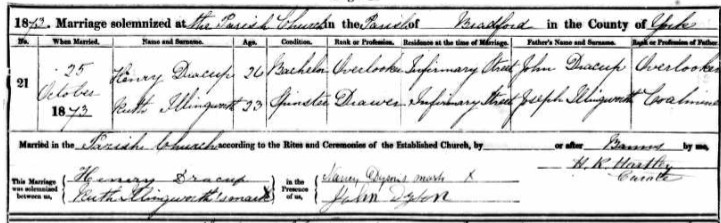
He had returned to Bradford by 1873 at the latest, since he married Ruth Clafton Illingworth on 25 October 1873 at the Parish Church. This record states that he was aged 26, employed as an overlooker and resident in Infirmary Street. He was probably only 20.
Ruth is described as 23, employed as a drawer, also residing in Infirmary Street. Her death certificate later stated her date of birth as March 11 1855, but her birth was actually registered in Bradford in 1849. It seems most probable that she was born on 11 March 1849, making her 24 at this point.
Ruth’s father was Joseph Illingworth, formerly a wool comber, but described on the wedding certificate as a coal miner. The evidence suggests he was already dead by this point, though the certificate does not describe him thus.
Her mother was Betty, nee Greenough, already a widow by the time of the 1861 Census, when she was living in North Bierley with her five younger children aged 8 to 16, earning her living as a washerwoman.

Her three daughters, aged 16, 14 and 12 (Ruth), were already spinners; her 10 year old son already a ‘coal hurrier’, pulling mined coal from the coal face in a trolley.
Although Henry signed the marriage certificate, Ruth could only leave her ‘mark’, proving she remained illiterate.
The wedding was witnessed by John and Nancy Dyson. Nancy was Ruth’s elder sister, some eight years her senior. At the time of the 1871 Census, she was living at 24 Infirmary Street with her husband. Ruth was also resident, aged 22 and unmarried, employed in wool combing.
A contemporary newspaper report mentions that Nancy Dyson of 24 Infirmary Street had a shawl stolen, only a week or so before the wedding.
Henry and Ruth’s first child, a daughter called Nancy after her sister, was born on 13 May 1874, so Ruth was already some weeks pregnant at the time of their marriage.

Nancy was baptised on 30 December that year, the couple both giving their address as 24 Infirmary Street, so they were probably living with the Dysons. Henry was described as an overlooker of wool combers.
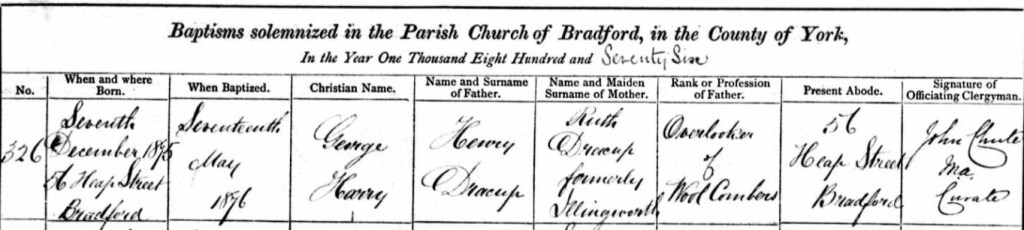
A son, George Harry Dracup, was born on 7 December 1875, at 56 Heap Street, and baptised on 17 May 1876. Henry remained an overlooker of wool combers.
Heap Street was on the opposite, eastern side of the city centre. We have already encountered this address, as the home of Henry’s sister Mary when she married Samuel Wilkinson in 1877. The two young couples were living together at this point.
A second son, James Henry Dracup, was born on 18 June 1877 and baptised on 11 July. This was just a few months before Mary’s first child Herbert was born. The family were still resident at 56 Heap Street, Henry’s employment was unchanged.

There are newspaper advertisements dating from 1878 advertising 56 Heap Street to let for 5s 3d per week, details from Joshua Hill and Thomas Hill, builders.
A third son, Joseph Dracup, was born on 20 January 1879, at an address that looks like 106 Isles Street, Manningham, (though Isles Street is more accurately in the area called Four Lane Ends) but was not immediately baptised.

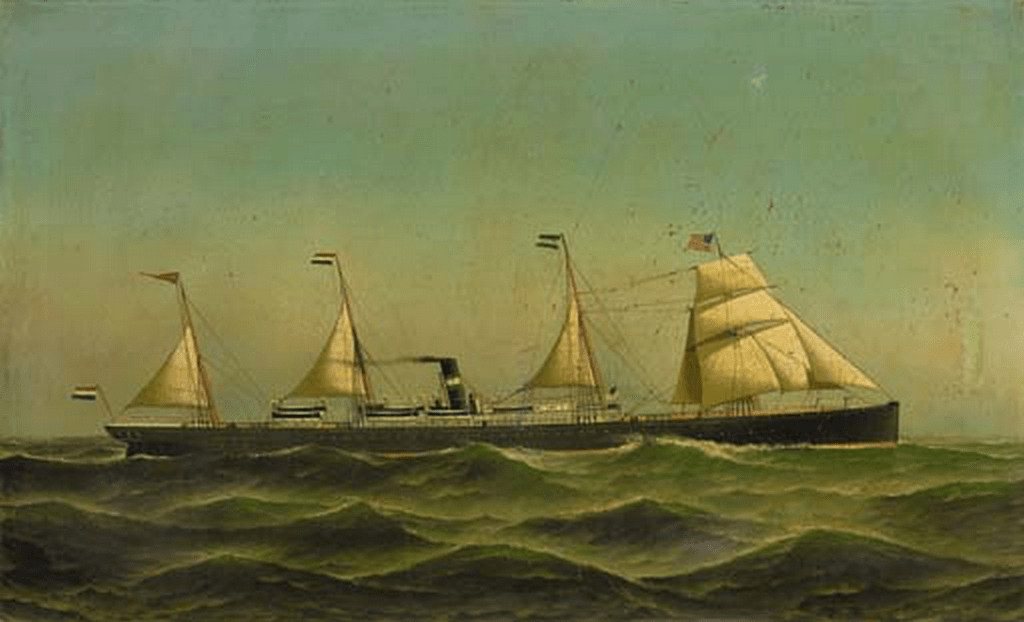
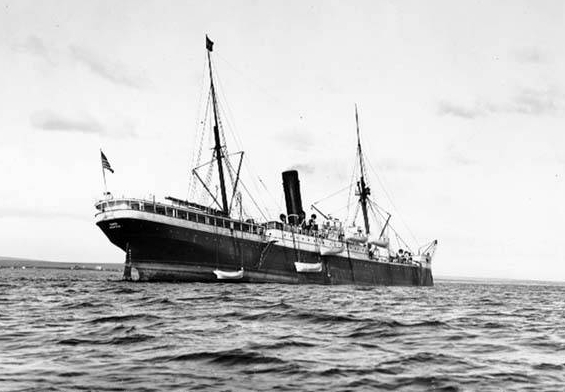
It seems that Henry made a first exploratory trip to the United States as early as 1880, traveling aboard the SS British Empire (2152 tons) from Liverpool to Philadelphia, arriving there on 29 August.
The 1881 Census, taken on 3 April that year, shows that Henry was still absent. Ruth had returned to live with her sister and brother-in-law, the Dysons, now at 39 Salem Street, fairly close to Infirmary Street.

Ruth, who gave her age as 33, was employed as a domestic servant while Nancy cared for her four children, aged 6, 5, 3 and 2 respectively. (Nancy had no children of her own, her only son having died, aged four, in 1863.)
Henry must have been back in Bradford by June that year since a fourth son, William Dracup, arrived on 11 March 1882. Both he and Joseph were baptised on 9 April 1882.
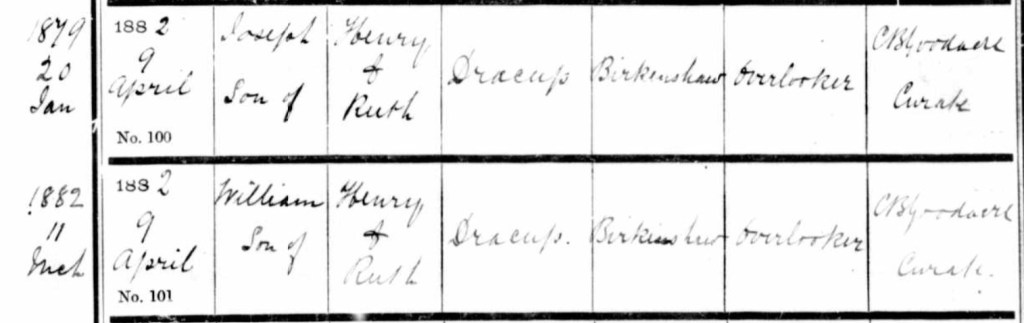
The address given was ‘Birkinshaw’ and Henry’s employment was recorded as ‘overlooker’. This must have been Birkenshaw, some miles to the south-east of central Bradford.
They emigrate
It took the family several years to make the leap across the Atlantic, presumably because they needed to save enough to make the journey.
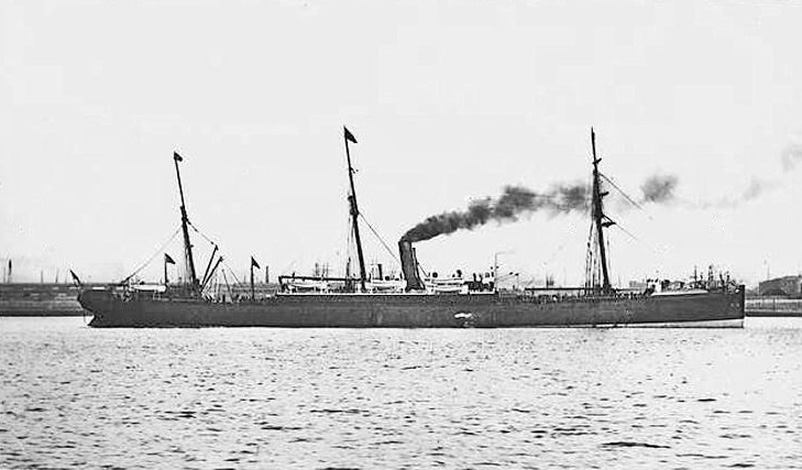
Ruth eventually arrived in Boston Massachusetts on 22 October 1888, aboard the SS Catalonia, accompanied by all five children – their names and ages given as: Nancy (14), George (11), James (10), Joseph (9) and Willie (6). They were traveling in aft steerage and had five pieces of luggage. Ruth gave her own age as 38.
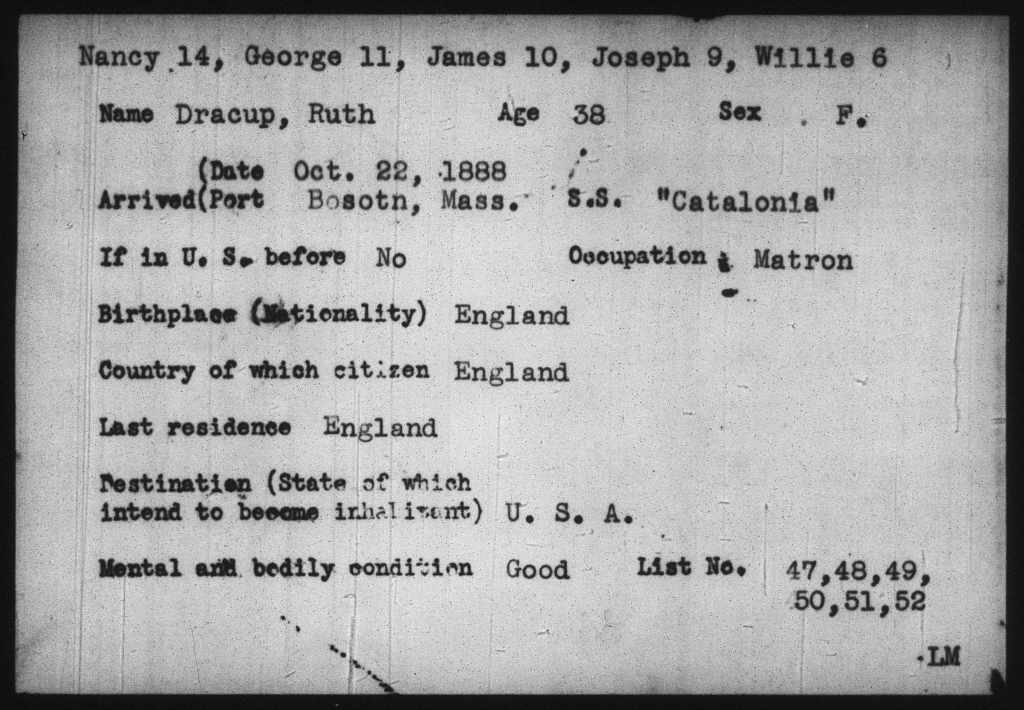
They were traveling alongside Ruth’s brother Henry Illingworth, his wife Rebecca, nee Thorpe, and their children Sarah (11), Henry (6) and Nancy (4).
The first evidence of the family settled in the United States is a record from a signature book for the Providence Bank for Savings, otherwise known as the Old Stone Bank, Providence, Rhode Island, dated 4 November 1889. The Bank was located at 86 South Main Street in Providence.

The signature record marks a personal deposit by Ruth Dracup ‘wife of Henry, nee Illingworth’, which is witnessed by her daughter Nancy. Ruth marks her signature with a cross, but Nancy signs her own name.
The address given is ‘Wanskuck, Providence’. Wanskuck at this time was dominated by it mills and had a large immigrant population.
The 1890 edition of the City Directory for Providence is the first to include an entry for Henry, now living at 512 Douglas Avenue, his occupation given as ‘Boss Comber’. This is just to the south of the Wanskuck district.
On 18 July 1890, a Joseph Hainsworth conveyed to Harry Dracup, in return for ten dollars, a tract of land, measuring 80 feet by 80 feet on Langdon Street in Providence, slightly to the east of the Wanskuck district, in the area known as Charles. The land comprised Lots 4 and 7, owned by one Mrs Amey Manton.
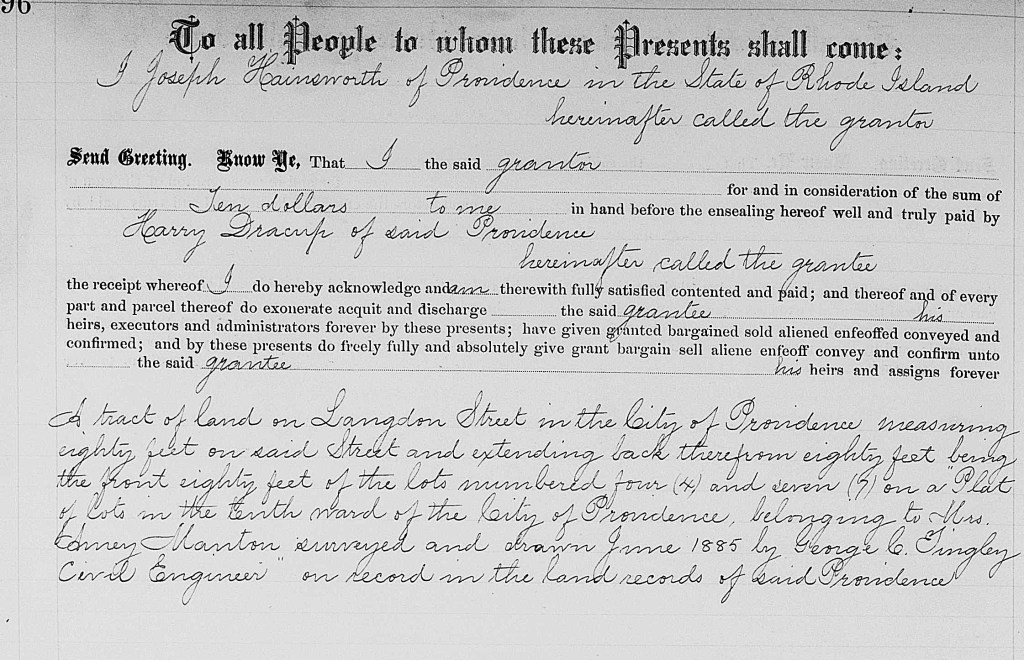
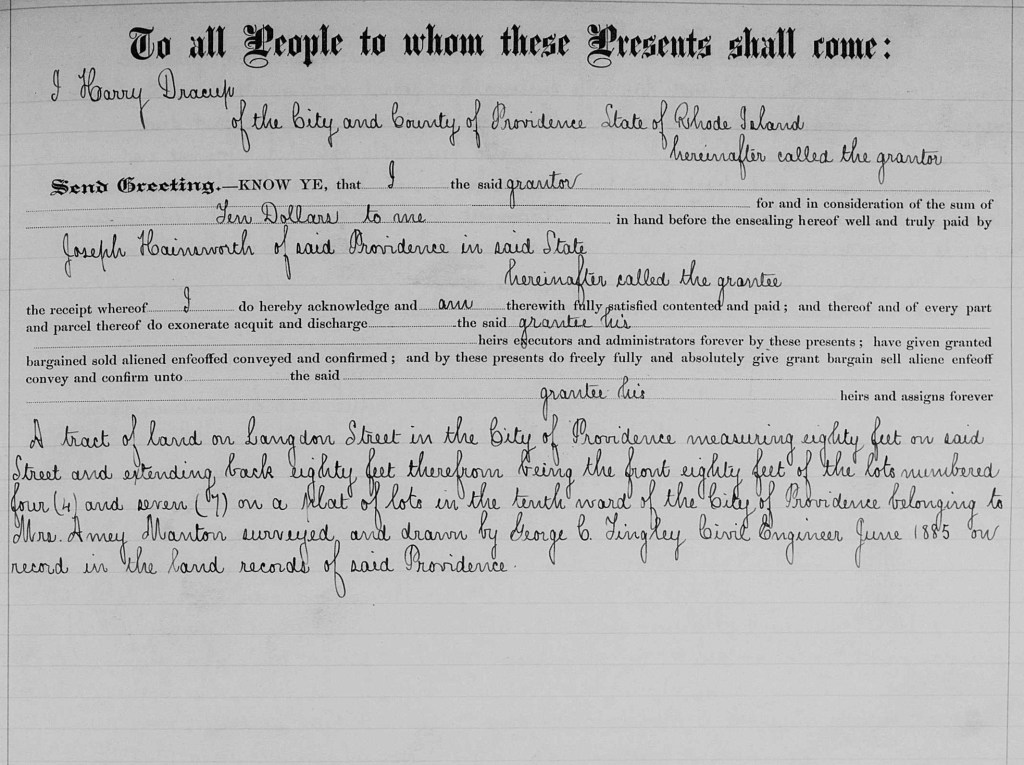
But Harry returned it to the same man in May 1893, Ruth also appending ‘her mark’ to this agreement.
There is also a note to the effect that a Committee appointed by the Board of Aldermen had agreed in January 1892 to a plan to lay out Langdon Street, from Branch Avenue to Sherman Street:
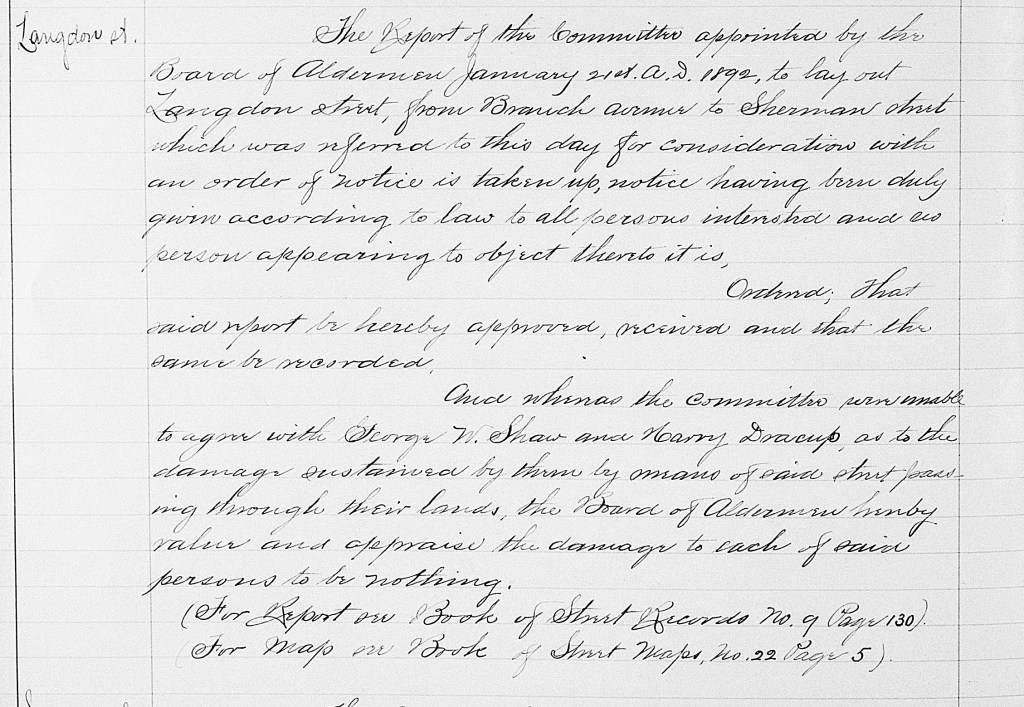
‘And whereas the Committee were unable to agree with George W Shaw and Harry Dracup as to the damage sustained by them by means of said street passing through their lands, the Board of Aldermen hereby appraise the damage to each of said persons to be nothing.’
The 1891 Directory for Providence says of Henry: ‘removed to Philadelphia, Pa.’ It seems likely that his departure was connected with this unsuccessful attempt to erect a property on Langdon Street.
But the family headed to Philadelphia via Chester, Pennsylvania, some miles west along the Delaware River. The 1891 Directory for Chester says: ‘Dracup Harry, op., 931 Morton Avenue.’
On 22 October 1892, the two eldest children, Annie/Nancy, 18, and George, 16, arrived in Philadelphia on board the SS Ohio, a note appended to their names saying ‘to parents at Germantown’. They must have returned to England for some reason.
From 1892 onwards, the Directory for Philadelphia includes Henry each year, the details changing annually as follows:
1892: ‘Dracup Henry, Comber, h 664 E Chelten av.’;
1893: ‘Dracup Harry, Carder, h 2427 Lombard’;
1894: ‘Dracup Harry, Foreman, h 4865 Anderson, Gtn’;
1895: ‘Dracup Henry, Foreman, h 4871 Anderson, Gtn’;
1896: ‘Dracup Henry, Foreman, h 4871 Anderson, Gtn’;
1897: ‘Dracup, Henry, h Somerville’;
1898: ‘Henry, Comber, h 4465 N Cleveland.’
Neither Henry, nor his sons are included in the 1899 Directory.
In 1900 we get: ‘Dracup Henry, Carder, h 2152 Nebro, Gtn.’ This is a typographical mistake, since the road was called ‘Nedro Avenue’.
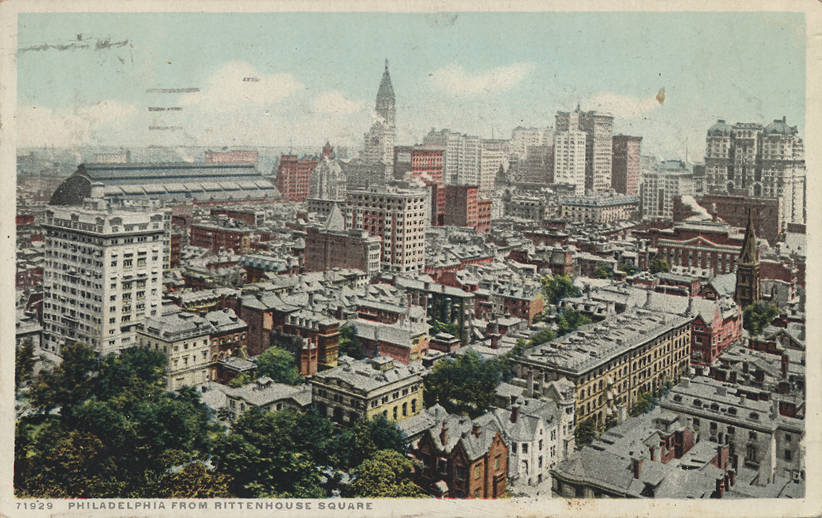
It is evident that, in these early years, Henry wasn’t always able to secure employment as an overlooker.
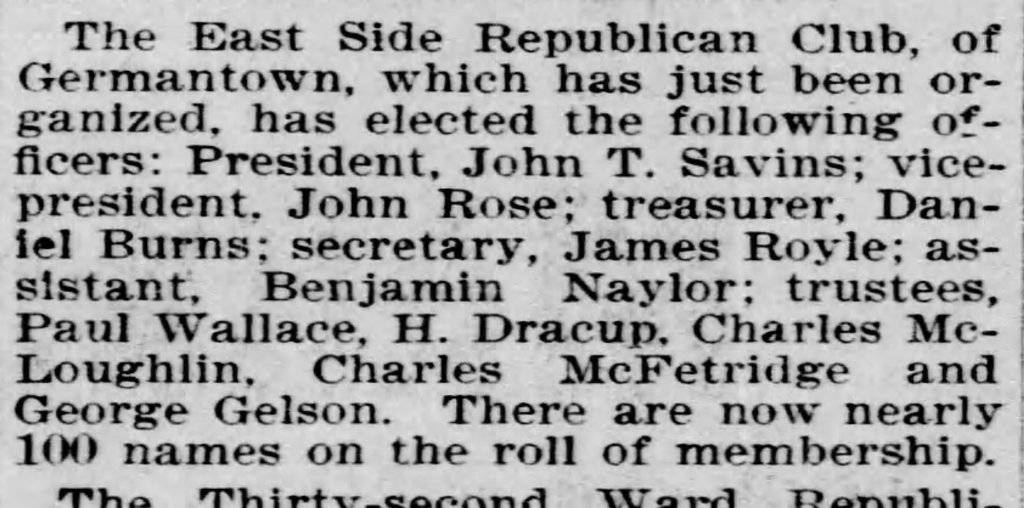
In 1894 he was mentioned as a trustee of the newly formed East Side Republican Club of Germantown. I could find no further reference to this organisation, or Henry’s role within it.
At around this time, all five of the couple’s children married, within a few years of each other. I shall reserve those details until dealing with their lives below.
The 1900 Census confirms Henry and Ruth at 2152 Nedro Avenue, although their surname is misspelled ‘Tracub’.


Henry said he was 49 (actually 47), renting his home and working as a wool comber. He was not naturalized. Ruth gave her age as 45 (actually 51) and confirmed that all five of her children were living. They both stated that they had arrived in the US in 1887.
All five children were still resident at home, though only two were working. Three were married by this point, but only Nancy declared herself to be so. She claimed she had been married only two years previously (it was actually five years since her marriage).
During the next few years, all five children moved away from the family home, leaving Henry and Ruth to their own devices, though some returned later in their lives, often after a marital breakdown .
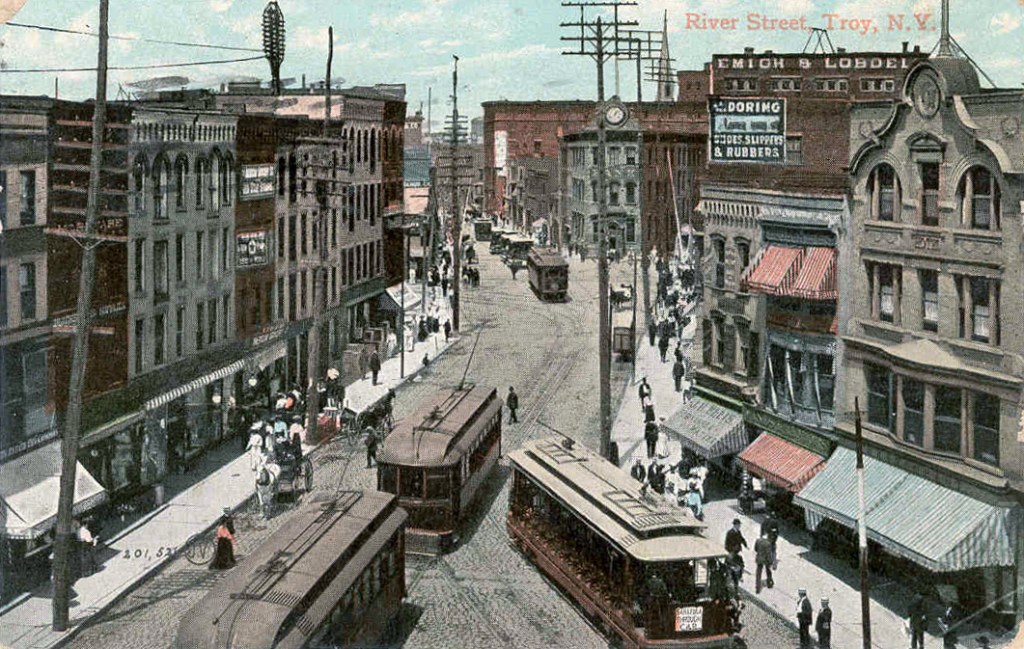
Henry next appears in the 1906 and 1907 Directories for Troy, on the banks of the Hudson slightly to the north of Albany in New York State. His entry is in the Watervliet and Green Island section His surname is misspelled ‘Dracoup’. The address is 913 Broadway.
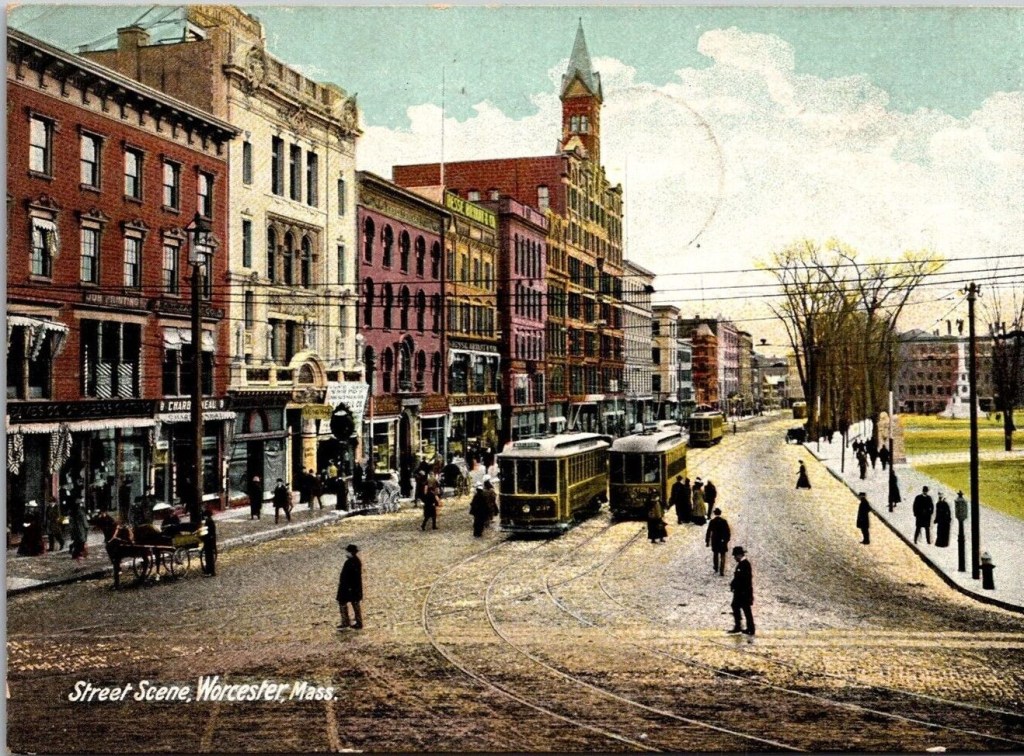
Then, in 1908, he appears for the first time in the Directory for Worcester, Massachusetts. He was working as an overseer at 775 Southbridge Street and living at 2 Homestead Avenue. The Directories for 1909 and 1910 repeat these addresses.
The former address was the location of Riverside Mills, Worcester, spinners of worsted and mohair yarns. The President and Treasurer at this time was Sylvanus B Roy (1877-1916), son of the late owner, Basil S Roy (1837-1906).
The 1910 Census confirms Henry’s residence at 2 Homestead Avenue. He gave his age as 57, while Ruth admitted to 56. His occupation was still ‘overseer, worsted mill’ and their home was rented. For some reason though, Harry stated that his immigration year was 1861 and that he was naturalized.
By Christmas 1911 the couple had moved to Saxonville, Massachusetts, midway between Boston and Worcester, Henry taking up a role as overseer at the Saxonville Mills and residing at 22 Central Street. His son Joseph was a close neighbour and employed at the same mill.
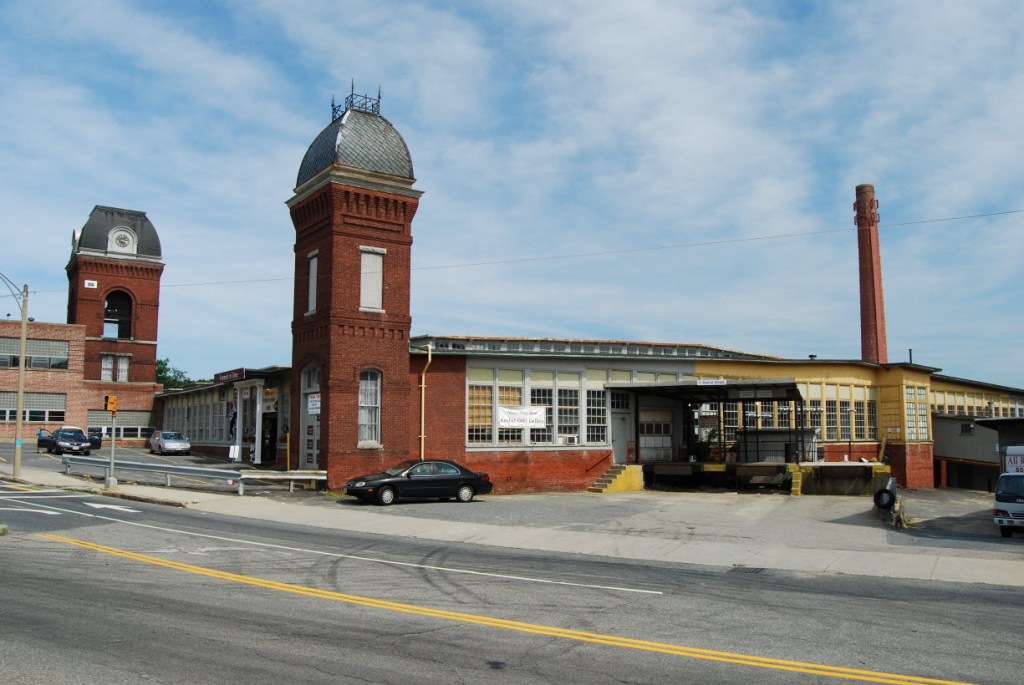
Henry remained there in 1914, but had moved to 12 Water Street, sharing that property with his son Joseph.
By 1916, Henry had ‘removed to Philadelphia’ once more. In February of that year he took out a mortgage of $7500 for a property at 5109 Lena Street.
In June 1917 he also seems to have purchased a building on Chew Street from a W J Magee for $3500. The area is estimated at 21 feet by 54 feet. Might this have been intended as the initial location for his sons’ garage?
Henry doesn’t actually appear in the Philadelphia Directory until the 1918 edition, now located at 5109 Lena Street, Germantown. This was most probably newly built when they moved in. In 1916 local newspapers were advertising new houses available on Lena Street comprising six rooms, plus bathroom and cellar, for $2,400.
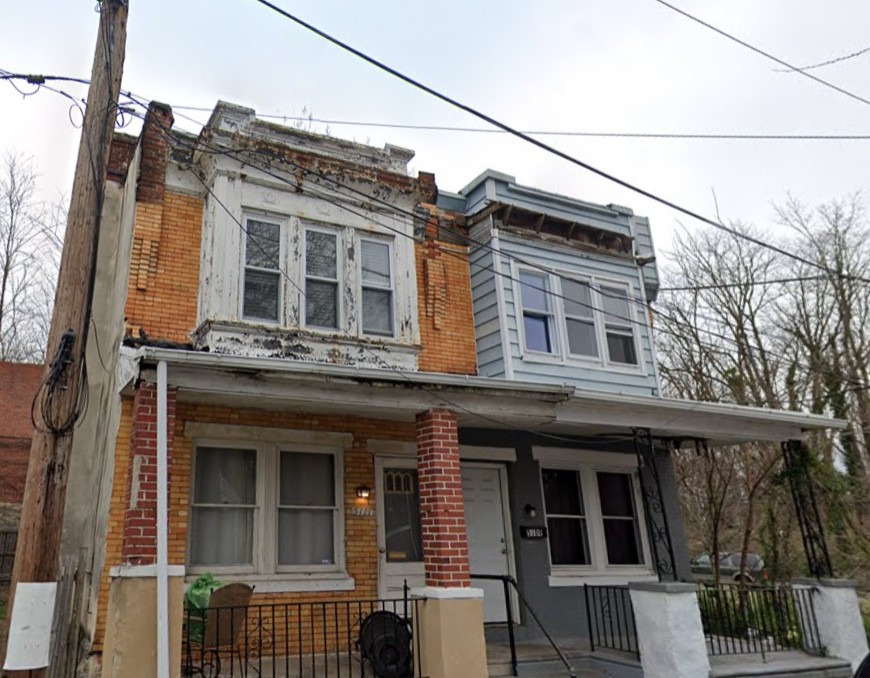
The home was shared with his son George, while Joseph lived at number 5111 Lena Street and James was nearby in East Wister Street.
Lena Street was known to the family, since James had been resident at Number 5120 with his family in 1912, when a fire destroyed an adjacent dye works (more about this below).
By the time of the 1920 Census, Henry and Ruth were still at 5109 Lena Street. The return confirms that they had taken out a mortgage on the property. On this occasion they both claimed to be 67, to have arrived in the US in 1880 and to have been naturalized in 1890. Henry was still working as an overseer.
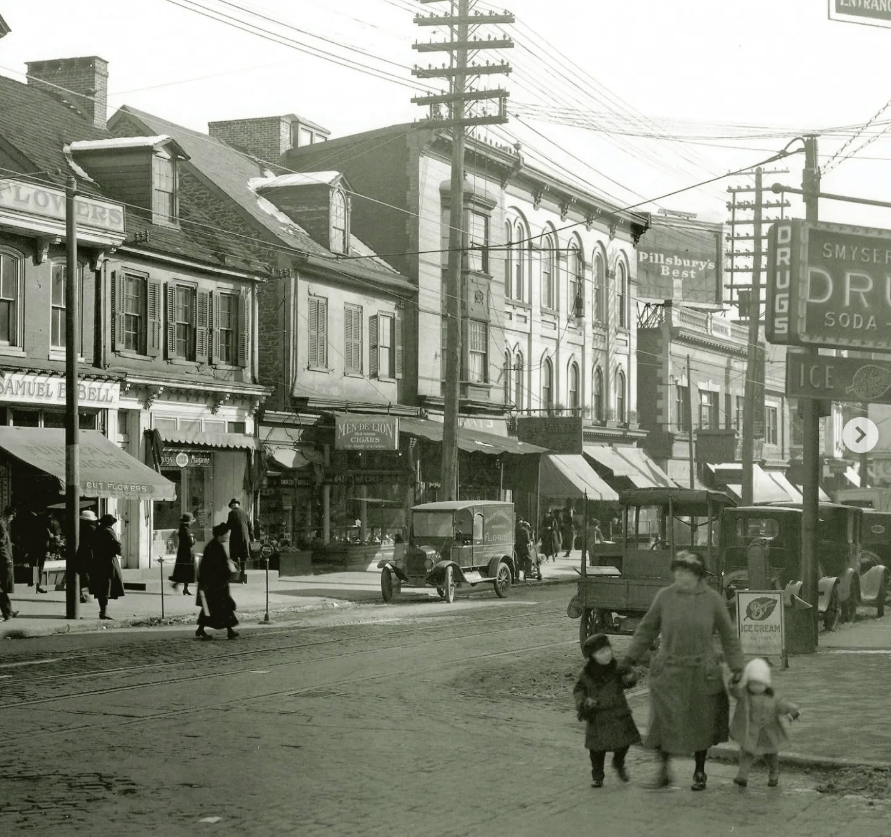
Their grandson Harry, aged 16, was also resident, while their son Joseph and his family were still next door.
In 1923 Henry was described by the Philadelphia Directory as a clerk and, by 1924, as a manager, by which time they had moved round the corner, to 64 East Wister Street. Sons Harry and William were sharing the property. Henry was now 71.
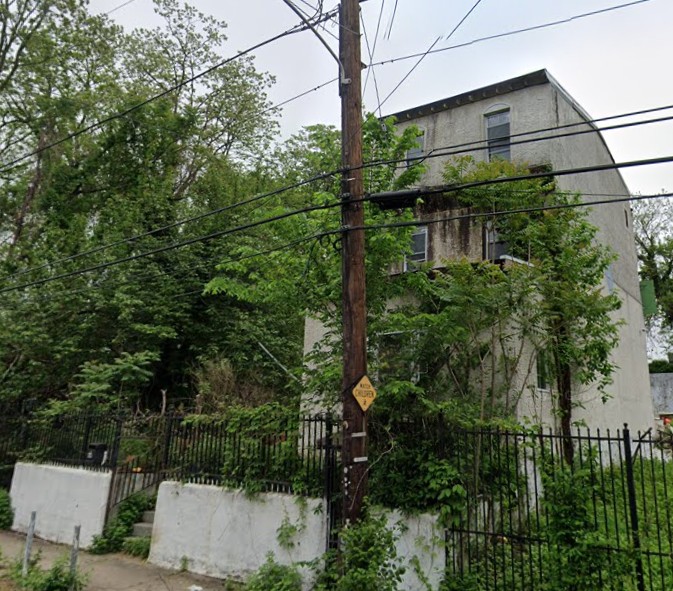
Henry and Ruth were still at 64 East Wister Street by the time of the 1930 Census. They owned the property, which was valued at $7000. They both claimed to be 78, to have arrived in the US in 1890 and to be naturalized. Both had now retired. Their son Joseph was now living at the same address.
Howard Thomas, the nephew of their daughter-in-law, was also lodging at the property. We know he stayed until 1934, because a marriage license was then granted to a Howard Thomas of 64 East Wister Street. He wished to marry Marie Joerg, 21, of Bryan Street.
Henry died shortly before the 1940 Census, on 6 January 1940, aged 87 (the death certificate claims 89). His address remained 64 East Wister Street and the cause of death was cardio-vascular disease.
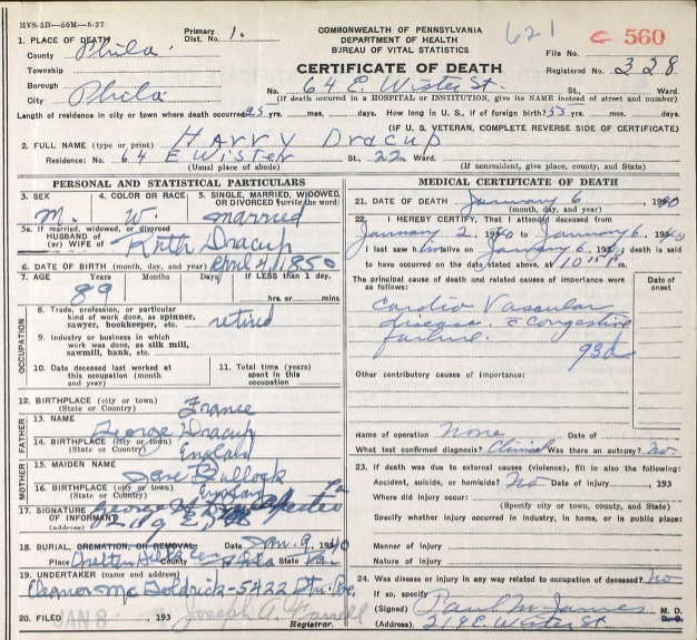
He was buried in the Chelten Hills Cemetery and a very short obituary was published in the Philadelphia Inquirer.
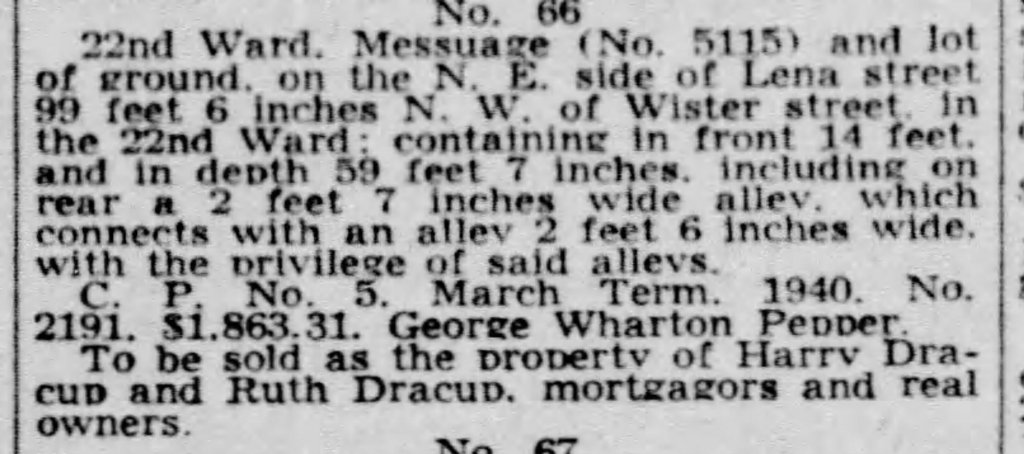
Shortly after his death, two court judgments were passed against him owing to ‘want of appearance’. A total of some $4400 was awarded to the Saving Fund Society of Germantown. The Society had been incorporated in 1854. By 1877 it had assets worth $740,000, by 1900, $4.59m and by 1940, $43.975m.
Also in May 1940, the Philadelphia Inquirer reported a sheriff’s sale of a plot of land at 5115 Lena Street owned by Henry and Ruth, recouping $1863, the purchaser being George Wharton Pepper. It seems that they had invested in the land, but that the proceeds of sale were needed to offset Henry’s debts on his death.
Ruth appeared in the 1940 Census, still living at 64 East Wister Street with two of her sons. They now valued the house at $5000. Ruth gave her age as 91 and stated that she was married rather than widowed. She also said that she had been naturalized.
She died on 18 September 1940, about eight months after Henry. The death certificate incorrectly gave her age as 85, for she was really 91. The cause of death was given as ‘partial bowel obstruction; myocardosis’. ‘Epithelioma of the forehead’ (skin cancer) is described as a contributing cause.
She was buried alongside Henry in the Chelten Hills Cemetery.
It seems to have taken Henry and Ruth some years to save for emigration, and a further decade for Henry to re-establish himself as an overseer in their adopted country.
He worked well into his seventies before he could think of retiring, when the couple were either unable or unwilling to leave Philadelphia for warmer climes. Both enjoyed long and comparatively healthy lives.
With the aid of mortgages they were ultimately able to establish themselves as property owners and even to buy additional land for investment purposes.
Nancy Dracup (1874-1948) and Alfred Fisher Wallace
As noted above, Nancy returned to England with her brother George in 1892, returning to Philadelphia on 22 October that year. They were traveling with Mary Wallace and all of her children, barring the eldest, Alfred Fisher Wallace.
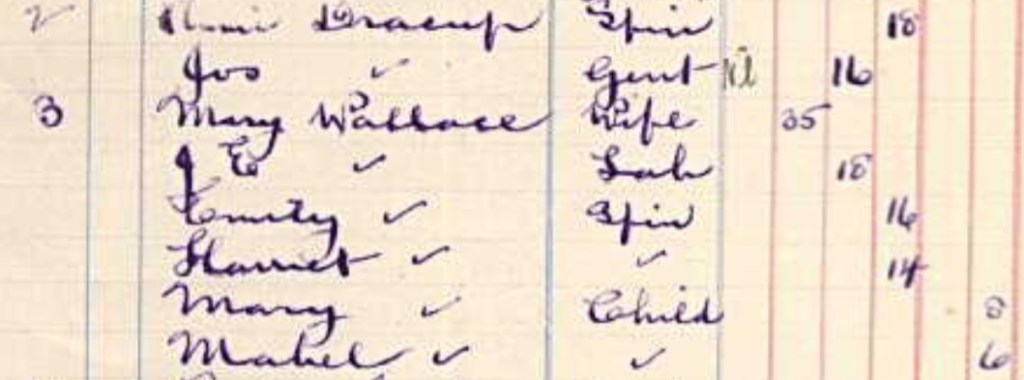
In April 1895, Nancy, now aged 20, married Alfred, a 23 year-old spinner, formerly a native of Bradford, who had been naturalized the previous year. His father, Paul Wallace, was a mill superintendent.
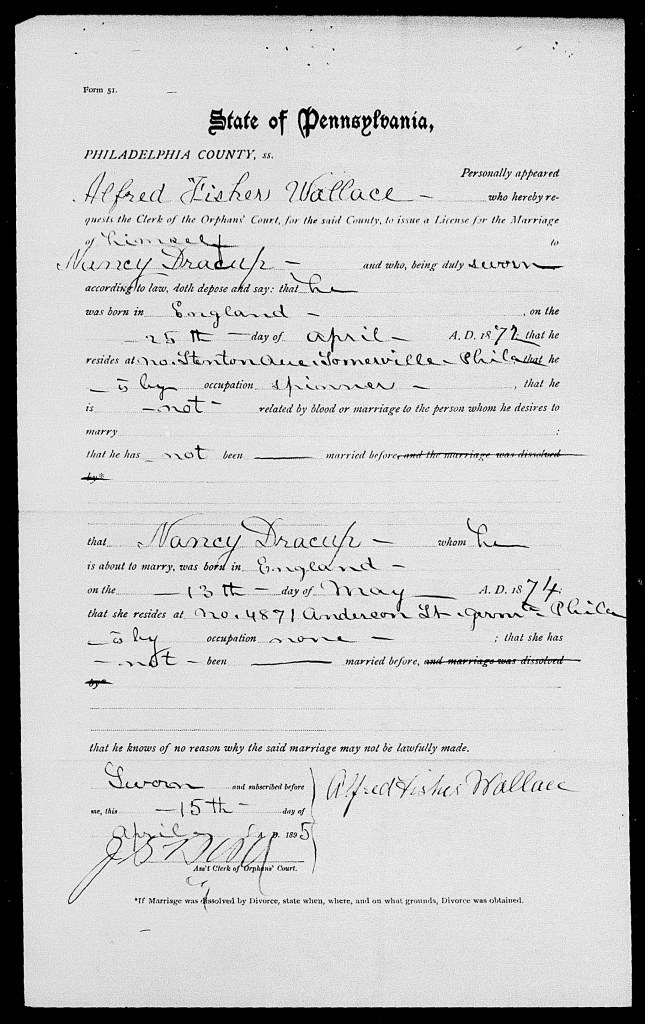
A son, Alfred Henry Wallace, was born on 7 September 1896 in Sprague Avenue, Germantown, Philadelphia but died of cholera on 16 September 1897, shortly after his first birthday. Nancy had no further children.
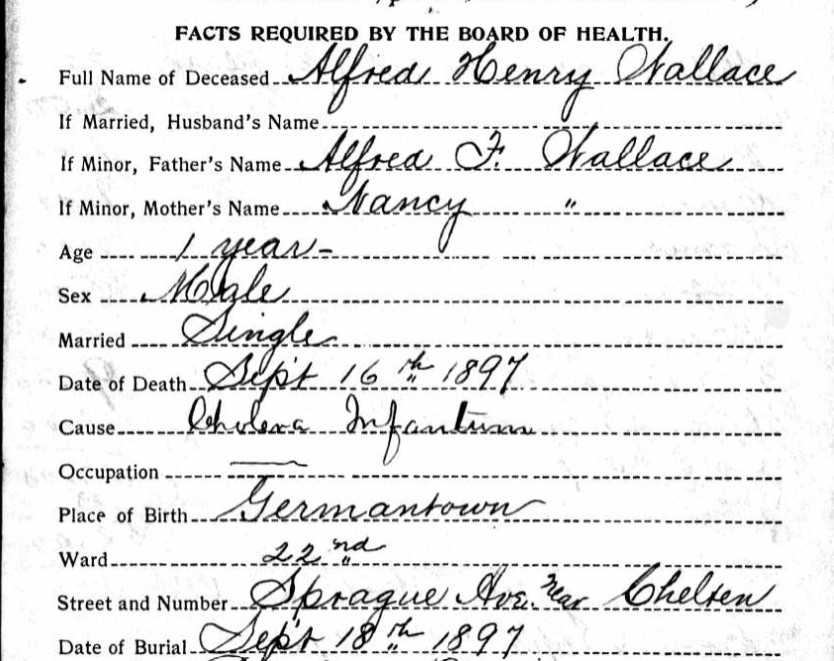
In 1898, Nancy’s brother George Harry was living on Sprague Avenue, below East Chelten Street, so it is likely that he was lodging with his sister and brother-in-law.
In 1900, Nancy was living with the rest of her family in 2152 Nedro Avenue, Philadelphia. Alfred does not show up on the 1900 Census with his family, but the Philadelphia Directory for 1900 places him at ‘Stenton Avenue c Nedro’, the same address as his father Paul.
By 1901, Alfred and Nancy Wallace were living next door to the Dracups, at 2150 Nedro Avenue, Alfred now employed as an overseer, while his father’s address was clarified to 5915 Stenton Avenue. Alfred and Nancy remained at Nedro Avenue in 1902
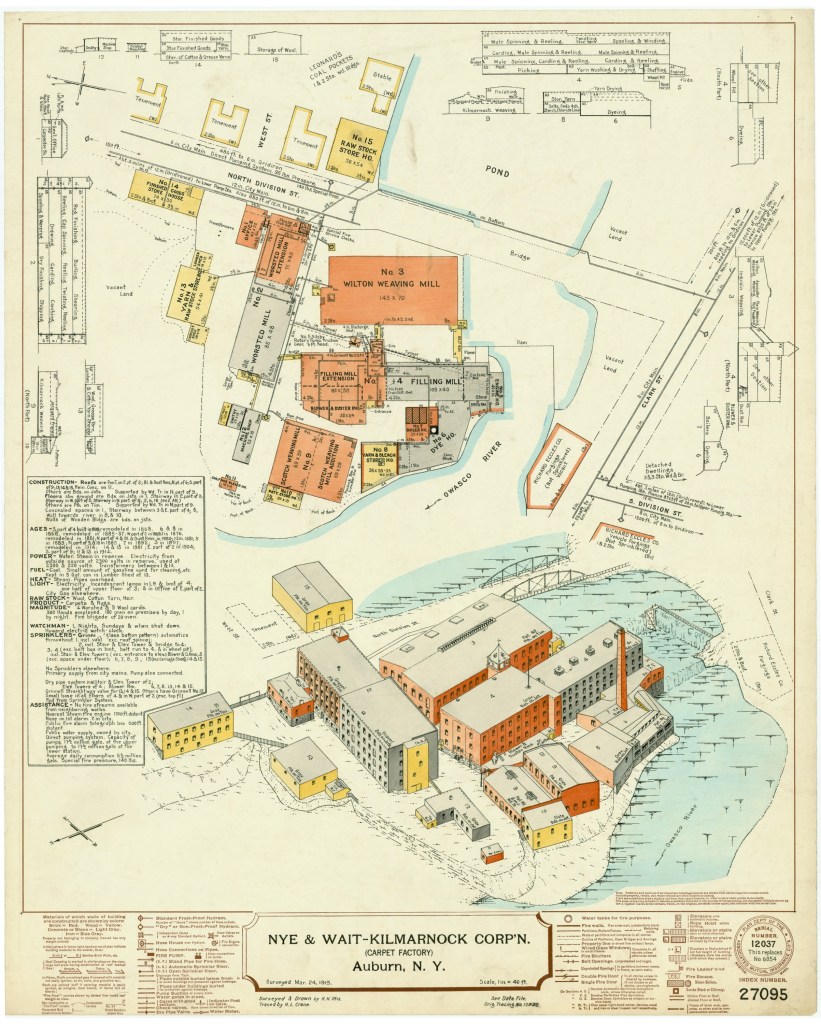
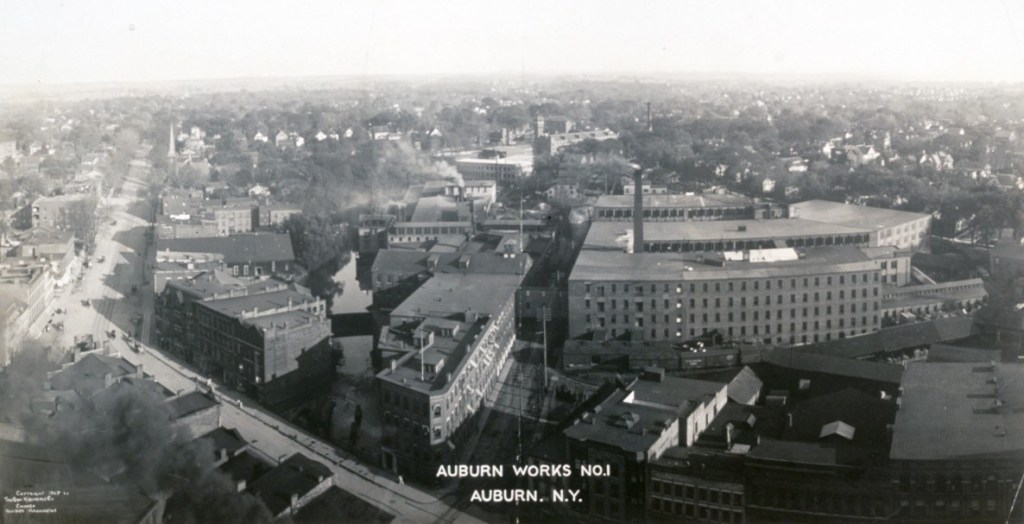
By 1905 they had moved to 105 Wall Street, Auburn, New York State, where Alfred was working for Nye & Wait. The Nye & Wait Carpet Company was formed in Auburn in 1871 by L W Nye, and William F Wait. It expanded to accommodate 150 looms, but eventually closed in 1969.
Nancy and Alfred were to stay in Auburn for the rest of their comparatively uneventful lives.
They were at 105 Wall Street in 1906 and 1907 but, by 1908, Alfred was a foreman and the couple had moved along the road to 127 Wall Street. This was their address in 1909 and 1910, the Census confirming that they rented the property.
Alfred described his employment as foreman at a worsted mill, while Nancy was at home. Oddly, she claimed to have had no children.
By 1911 they had moved to 3 Alden Avenue in Auburn, where they remained for almost a decade. At the time of the 1920 Census they were still at this address, confirming they owned the property, located in the leafy suburbs on the eastern side of Auburn. Alfred was an ‘Overseer Worsted’ in Woolen Mills.
However, the 1920 Auburn Directory indicates that they moved that year to 98 Franklin Street, perhaps a mile or so nearer the centre of Auburn. The 1925 Census shows that this house was divided into two properties, one floor housing a Mr and Mrs Titus and their son Melvyn.
By 1928 they had moved home again, this time to 76 Walnut Street, where they remained at the time of the 1930 Census. They were now renting once again, but Alfred was still employed as a foreman at a carpet company.
From 1932, the Auburn Directory describes Alfred as a ‘Superintendent’ at Nye & Waite, giving his work address as ‘Kilmarnock Corp, 11 N Division’. This must have been the name of the building at 11 North Division Street in Auburn, on the bank of the Owasco River, west of the town centre.
By 1937 Alfred had been relegated to ‘Foreman’ once more, and in 1938, the Auburn Directory describes him as a ‘custodian’, or janitor, their home address now in the apartment building at 203 Genesee Street. Alfred had finally retired from Nye & Waite.
By 1940 they were resident at a smaller property, 111 Lansing Street, which they owned. It was a semi-detached bungalow, worth $1500. Alfred was now 67 and Nancy 65, Alfred claimed to be seeking work as a foreman in textiles, but he had been out of work for a year and declared no income.
From 1943 until 1946, Alfred had returned to work, described as an ‘employee’ at a warehouse located at 26 Aurelius Avenue in Auburn. From 1947 onwards, though, he was fully retired.
From 1947 until 1950, the same position was held at the same address by a Charles Raymond Denman, whose 1950 Census record describes him as a machinist. I believe their employer was the Shoe Form Company.
Nancy died on 6 January 1948, aged 73, of a brain hemorrhage and was buried in Chelten Hills Cemetery in Philadelphia.
Alfred, now 77, appeared in the 1950 US Census, still living at 111 Lansing Street, along with Sarah Maria Denman, a widow aged 77, described as ‘maid’. She was the mother of Charles Raymond Denman, and the widow of Jesse Denman, who had died in 1945.

She is listed in the 1949 Auburn Directory as the widow of Jesse Denman, living at 11 Lansing Street (presumably a mistake), but the 1950 Directory confirms her as a live-in housekeeper, resident at 111 Lansing Street.
This arrangement continued in 1951, but the 1952 Auburn Directory shows that Alfred had moved to 15 Seminary Street and that Mrs Denman was no longer with him. He was now living at the ‘BelAire Rest Sanitarium’.
Alfred died shortly afterwards, on 24 March 1952, at the age of 79, and is buried alongside Nancy in Chelten Hills Cemetery, Philadelphia.
For much of his life, Alfred was a foreman/overseer, rising briefly to superintendent for five years in the 1930s. It seems that he needed to continue working to make ends meet until Nancy’s death in 1947.
But, throughout her life in the United States, Nancy had no employment.
These were clearly rigid demarcations. Alfred’s inability to care for himself is evident in his subsequent need for a live-in housekeeper – there were no children to undertake the role.
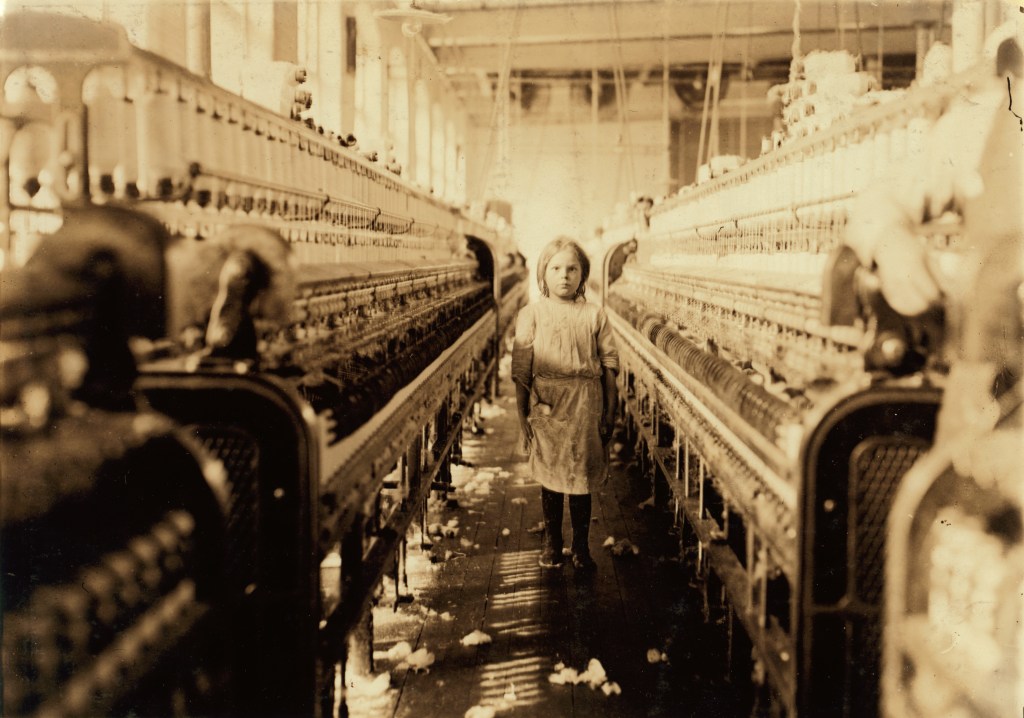
George Harry Dracup (1875-1967) and Edith nee Tisdale
As noted above, having arrived initially in the United States in 1888, George returned to England in 1892 with his elder sister and her future mother-in-law, arriving back in Philadelphia on 22 October that year.
His first entry in the Philadelphia City Directory was in 1898. In fact, there were two entries. One reads ‘Geo H, machinist, h Sprague bel E Chelten ave Gtn.’ The other says: ‘Geo H, salesman, h 4465 N Cleveland.’ There are also entries for his father and his brother James at this latter address.
It seems likely that he spent part of the year lodging with his sister and her husband on Sprague Street, but moved in to 4465 North Cleveland Streety with the rest of his family when they arrived at that address. His employers are unknown.
The 1900 Census recorded George now living with the rest of his family in Nedro Street, his employment listed as ‘weaver’. For some unknown reason his birthday is given as July 1876, instead of December 1875, and his age as 23.
On 8 November 1901, shortly before his 26th birthday, he married Edith Tisdale in South Kingstown, Rhode Island. He was working as a comber, resident in the mill village of Peace Dale and so must have been working for the Peace Dale Manufacturing Company.
This had been owned by the Hazard family since the beginning of the Nineteenth Century. The President at this time was Rowland G Hazard. His mill was unusual in that, when profits were good, the Hazards would share a proportion with their employees.
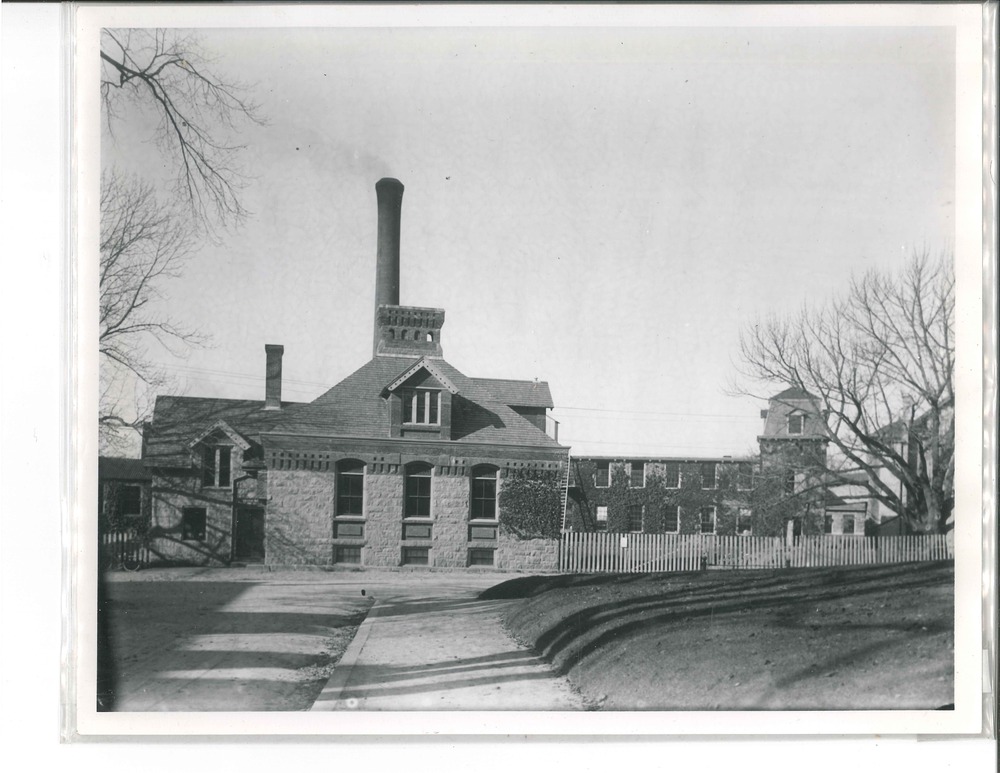
A 2% dividend was declared in 1900 and a 3% dividend in 1902. But this didn’t prevent a three-month strike in 1906, when workers objected when they were expected to operate two machines simultaneously.
Edith was 19, born in North Kingstown but resident in the Rocky Brook neighbourhood of South Kingstown. Her parents were George A Tisdale, a deceased Civil War veteran, and Mary nee Gardner, who had subsequently remarried, to a William Barker. The 1900 Census shows that Edith had been working as a server in the mill, where her stepfather was also employed as a card cleaner.
It is not clear how long this marriage lasted. George next appears in 1906 in Enfield, Connecticut, some 80 miles from South Kingstown, working for ‘HCC’ – probably the Bigelow-Hartford Carpet Mills.
He was now living at 26 Church Street. During this time, the only other employee listed at that address was Harry Greaves, an overseer for HCC. Harry was also originally from Bradford, married with two small children. This may have been a more appropriate lodging for man and wife than for a newly-separated man.
The Bigelow-Hartford Mills were located on a 23-acre site in the village of Thompsonville, on the eastern bank of the Connecticut River. Although carpet manufacture began in 1828, they were substantially rebuilt between 1883 and 1923. By the late 1920s this was the largest carpet manufacturer in the United States.
George remained in Enfield for part of 1907, but at some point that year he moved to Pittsfield, Massachusetts. This may have been the point at which he and Edith separated.
Pittsville lay midway between Albany and Springfield. Here he worked for the ‘S L Mill’ and roomed at 192 Second Street. The Pittsville Directories confirm he remained there through to 1910.
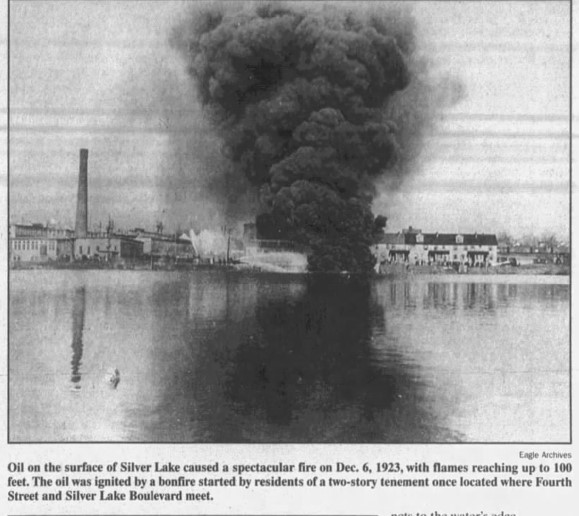
The ‘S L Mill’ was the W E Tillotson Silver Lake Worsted Mill. In December 1923 the Lake caught fire, owing to oil and other contaminants in the water. Flames were said to have reached 100 feet high. The mill was only saved by being soaked with water.
The 1910 US Census captured George still lodging at 192 Second Street. This was a boarding house kept by Ellen Rowe, a 37 year-old widow. Her father and daughter also lived in the property, alongside three male lodgers. George was now 34. His entry described him as an overseer at a worsted mill. He stated that he was married and had been for eight years.
Meanwhile, Edith was living in a house in North Frazier Street, Philadelphia, headed by Frank Cotter and his wife, Bertha, nee Himmelberger. Edith was described as Frank’s sister-in-law, married to Bertha’s brother, William H Himmelberger, a stone cutter, who was also resident, as was his father, a carpenter.

Edith and William stated that they had been married since 1908, but had no children. Edith said that she was 25 (she was 28); William was 23
They did not marry officially until two years later, on 4 September 1912, when Edith was 30 and William 25. Both gave their correct age, but both also claimed it was their first marriage. Edith therefore used her maiden name.

Nor can I find any evidence that Edith had secured a divorce from George. Presumably then, she married bigamously and lived bigamously with William Himmelberger until his death in 1937.
Meanwhile, George made a series of appearances in the Berkshire Eagle, Pittsfield’s local newspaper.
In April 1910, it was reported that:
‘George Dracup of Second Street has ordered a Merkel, two cylinder, seven horse-power motor cycle, which will be delivered in about two weeks.’
Joe Merkel had been building motorcycles since 1903. In 1908 he set up a company in Pottstown, Pennsylvania, which produced its first two cyclinder model in 1910. It carried the trademark ‘Merkel Light’ on the petrol tank, replaced by ‘Flying Merkel’ from 1911, after the Company had been taken over by a rival.
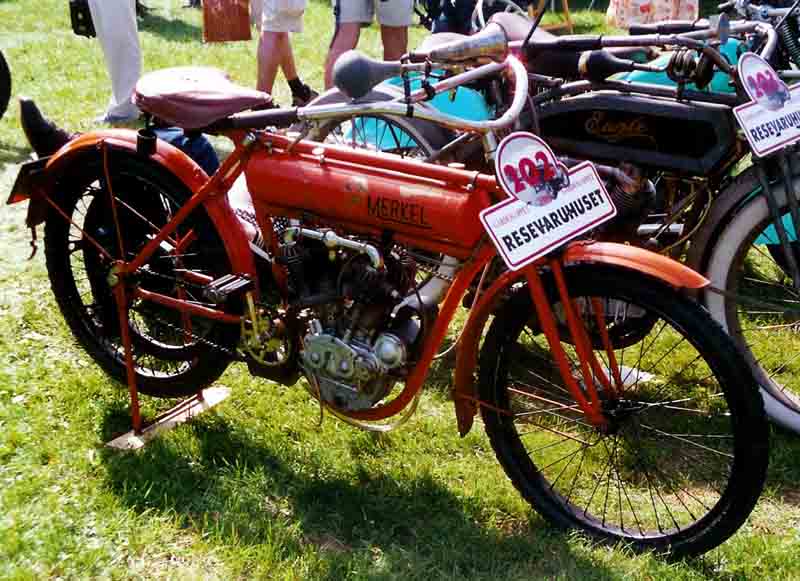
In August 1910, the Eagle mentioned that George did not take part in the motor cycle races at North Adams, Massachusetts because he had a puncture on the way.
According to the City Directory, in 1911 he was rooming at the YMCA, at 292 North Street, Pittsfield. This substantial four-storey building had only just opened.
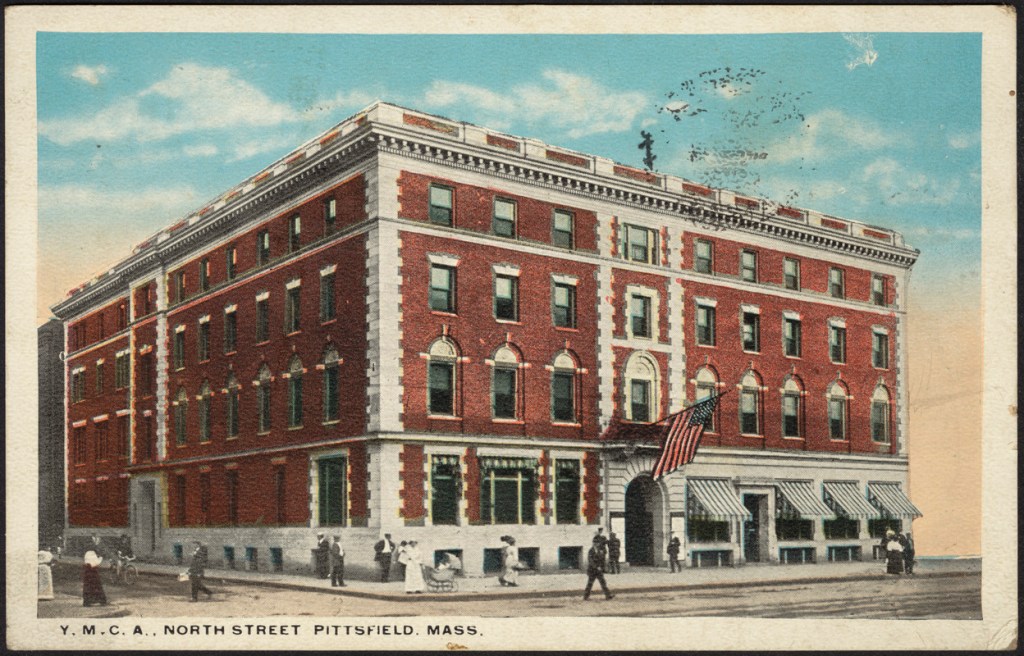
We also know he went on a trip to Worcester, Massachusetts with a man called William O’Connell in June 1911. And he spent 4 July that year with his sister Nancy in Auburn.
On 21 August 1911, the Eagle offered something slightly more newsworthy:
‘George Dracup, Superintendent of the worsted department at the Silver Lake mill, was injured yesterday afternoon at Nassau, NY, while riding upon his motorcycle. He attempted to take a curve at a good speed, but went too wide, crashing into a fence, such as are built along state roads. Mr Dracup was riding with William O’Connell at the time, and Mr O’Connell helped him to a nearby house, where he was attended by a physician. R W Baker and Joseph Wood went to Nassau in an automobile and brought Mr Dracup and his motorcycle, which was badly smashed, back to the city. Mr Dracup’s injuries were found to be of a comparatively simple nature, consisting only of bruises about the body and limbs. He is resting at his home on Maplewood avenue, but will be able to be about again soon. Dr George P Hunt is attending him.’
Four days later, we are told that he had been admitted to ‘the House of Mercy’ for treatment of his injuries but was ‘getting along nicely’.
By 21 October 1911 he had recovered, but was now resident in Worcester. That December he spent Christmas with his parents, who had moved to Saxonville.
In March 1912 he went to North Adams on business, and in May attended a large masonic gathering there, as a candidate. He is in this picture somewhere.
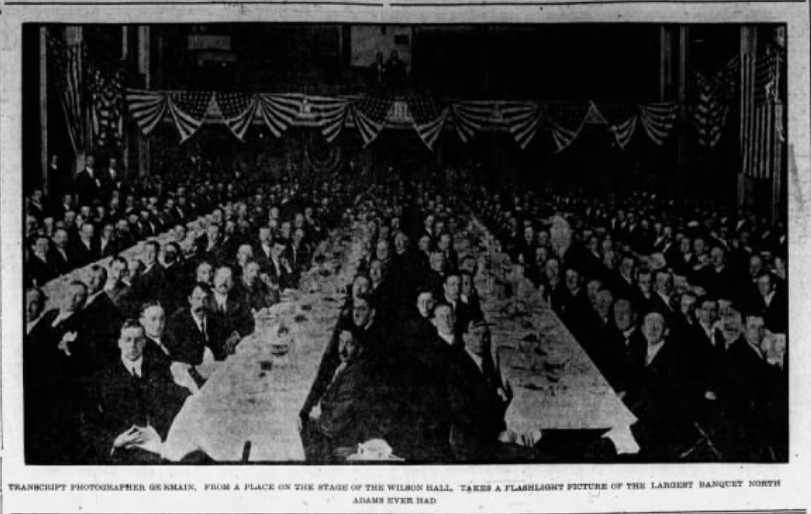
In July 1912, there was a further report:
‘George Dracup, who has been connected with the international correspondence school at North Adams as agent, and who has been visiting in this city [Pittsfield] during the past few days, left today for his home in Worcester.’
The International Correspondence School was founded in 1889 in Scranton, Pennsylvania to provide technical education, which it did through a series of instructions and question papers sent to its students by post.
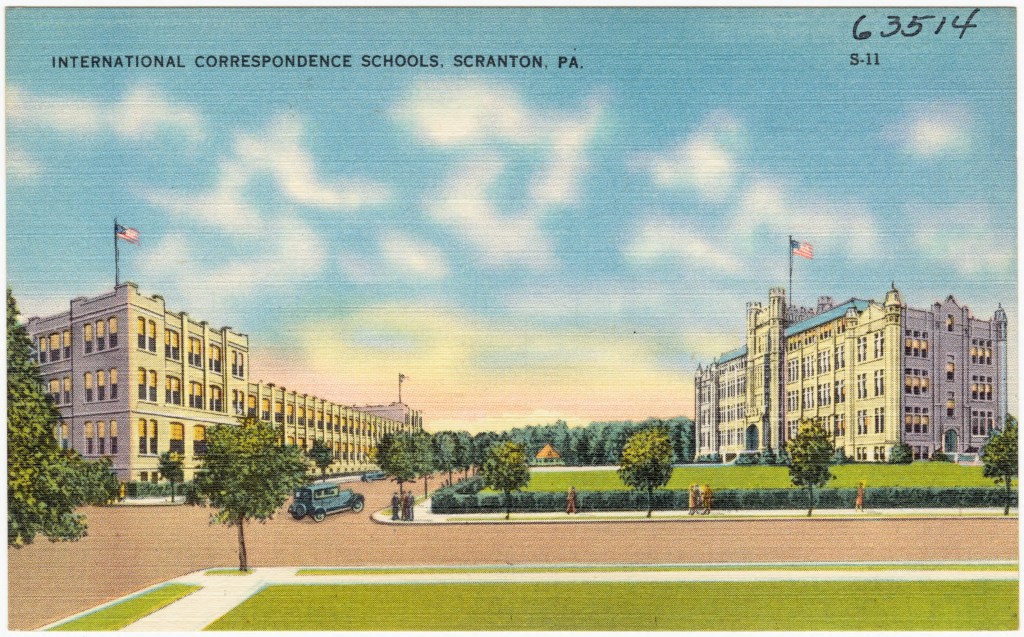
By 1894, it was enrolling 3,000 students, increasing to about 100,000 within a decade. Agents were responsible for promoting the School within a locality and increasing recruitment.
George had probably returned to Enfield, Connecticut from some point in 1913. In January 1914 he attended a ‘Crabbers’ association’ function in Thompsonville. This was seemingly a gentlemen’s club dedicated to dining and humorous after-dinner speeches.

In October 1914 he registered with the Brussels Football Club, which played in Thompsonville, had a connection with the carpet mills and had recently joined the Northern Connecticut League. But he was released only a month later.
Two years previously, the Connecticut police had planted a stoolpigeon in the carpet mills, one Leonard Kowalski, who also starred as centre for the Brussels team. At night he gathered evidence of illegal poker joints and alcohol sellers. Following a police raid, thirty men were arrested.
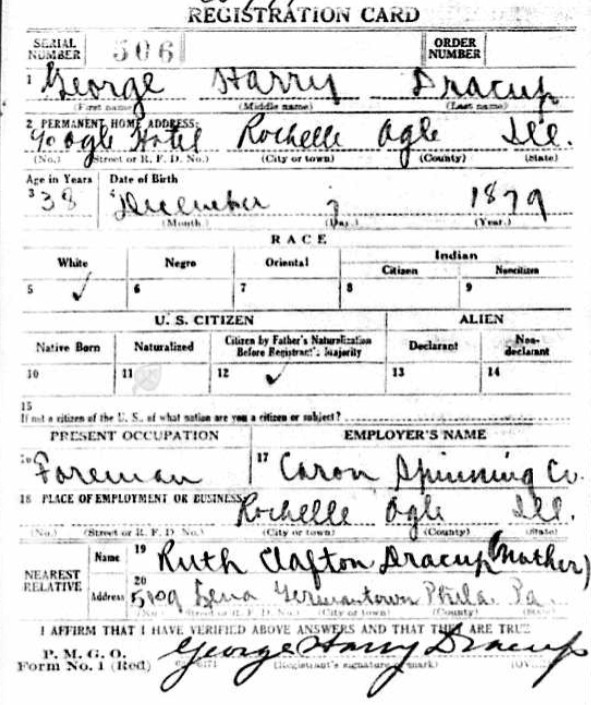
George’s trail goes cold during the War years, until his Draft Registration, which was completed in September 1918. He gave his permanent address as c/o Ogle Hotel, Rochelle, Ogle, Illinois. He was working as foreman at the Caron Spinning Company in Rochelle, some 80 miles west of Chicago.
The Caron Company was not established until May 1916, and the fact that he was staying in a Hotel suggested that he had arrived recently or was not intending to stay too long.
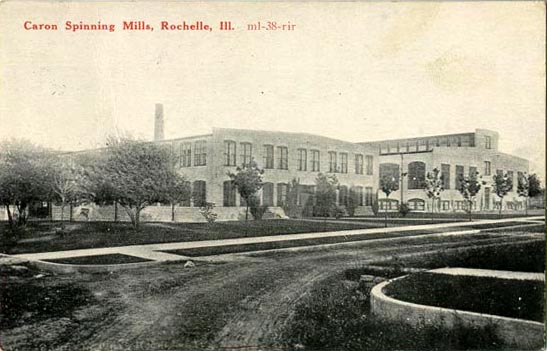
Inundated with War work, the Caron mills repeatedly advertised for more female spinners (and latterly boys) through the rest of 1916, 1917 and 1918. By September 1917, even inexperienced girls were offered $9 per week. By May 1918, night workers were promised up to $15 per week.
George gave his mother’s name as his nearest relative. He was described as of medium height and slender build, with brown eyes and brown hair. We know from the 1930 Census that he did not serve with the armed forces – he was already 43 by this point.
The 1920 and 1921 City Directories for Pittsfield show that he soon returned there, now working as a foreman for the W E Tillotson Manufacturing Company and boarding at 254 First Avenue. The house was owned by George A Robinson, a clerk at Nesbit Brothers, a grocery store run by five siblings.
The 1920 US Census places both Robinson and George at 246 First Avenue rather than number 254. It’s conceivable that they moved further along the street, but a census error or some street renumbering are more likely explanations.
George had probably returned to the Silver Lake Mill, describing his employment as foreman at a woolen mill. He claimed to be 38, single and born in Pennsylvania, when he was actually 45, married and born in Bradford.
There was also an entry for George in the 1921 Philadelphia Directory, giving his employment as ‘Wister Garage’, alongside his three brothers. His home address was listed as 16 East Wister Street, the location of the Garage itself. There is more about the Garage, below!
The 1922 Pittsfield Directory states that George was employed by W.E.T. Co, aka William E Tillotson, owner of the Silver Lake Mill, and now living in rooms at 55 Adam Street.
George Harry and Charlotte, nee Kelly
On 1 September 1922, George married Charlotte Irene Posselt, nee Kelly. The record states that he was 43 years old (he was really 46), single, born in Philadelphia, resident at 55 Adam Street, Pittsfield, and employed as a ‘textile superintendent’.
Charlotte said she was 35, divorced, this being her second marriage, living at 19 Cherry Street, Pittsfield, and employed as a ‘saleslady’ by ‘H&S Co.’
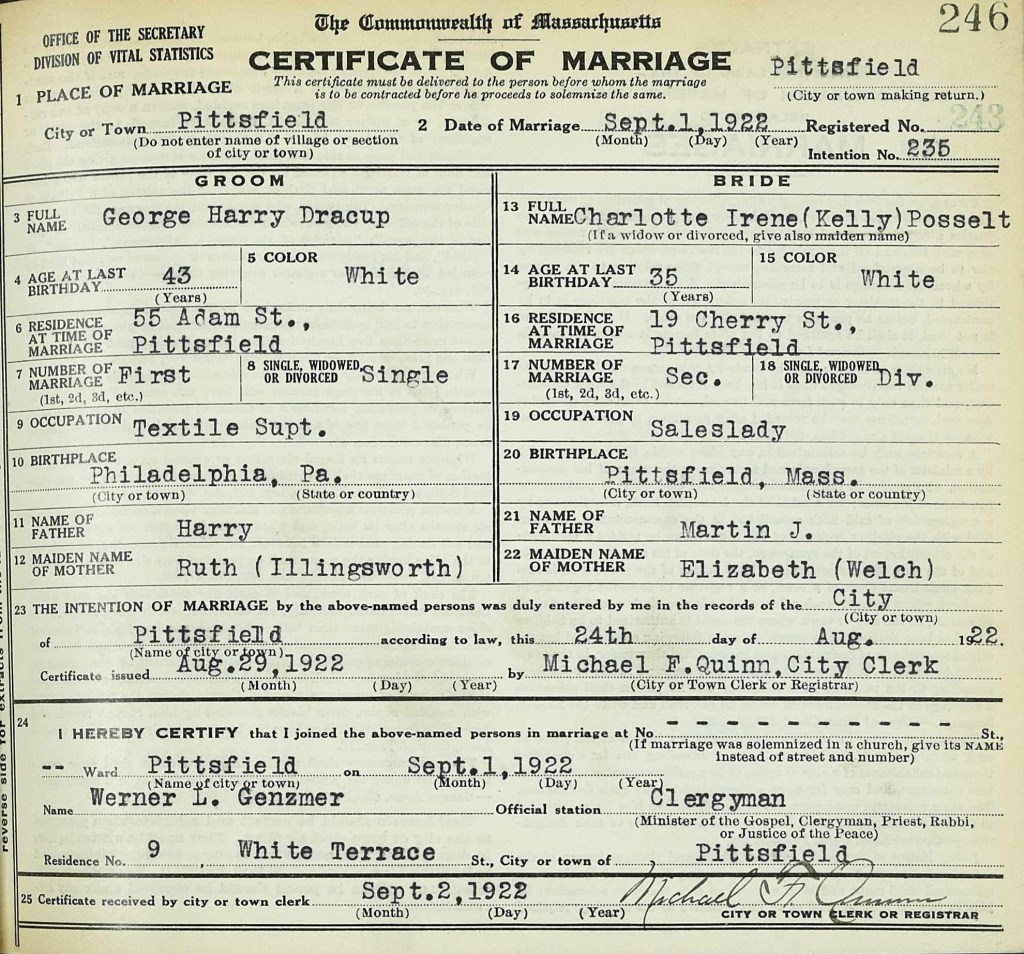
This was Holden & Stone, a department store established in Pittsfield in 1914 by Harry Holden and Frank L Stone.
Charlotte had been born in Pittsfield on 8 June 1886, to Martin Kelly, a railway brakeman, and Elizabeth, nee Welsh. She was one of 14 children, all of whom survived into adulthood, and 19 Cherry Street was the address of her widowed mother.
In October 1906, Irene had married a man variously known as Charles Francis Posselt, or John C Posselt, in Manhattan, New York.
He was the son of Emanuel Anthony Posselt, an Austrian-born publisher, resident in Philadelphia.
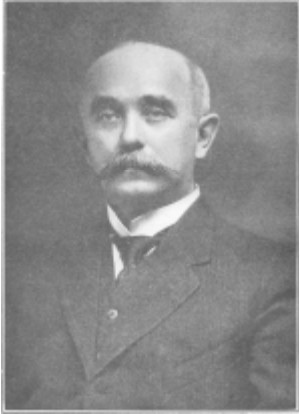
E A Posselt had been the first director of the textile division of the Pennsylvania Museum and School of Industrial Art and was a particular authority on Jacquard Looms. Coincidentally, he has featured in a previous Dracup family history post by virtue of his clear and contemporary explanations of how Jacquards operate.
Posselt’s Wikipedia entry fails to mention his son Charles, but he is clearly present in the family’s 1900 Census entry, then aged 15, when he and his family were living at 2152 21st Street in Philadelphia.

Shortly after his marriage, a newspaper advertisement from 1 January 1907 places Charles Posselt in Brooklyn, New York City, where he was working as circulation manager for a financial newspaper called ‘Bulls and Bears’ with offices at 84 New Street.
On 24 January he represented the publication at a meeting to establish an association of newspaper circulation managers in New York City. He was also at follow-up meetings in March and April 1907, but did not attend the May meeting.
The 1908 Philadelphia Directory records him living in the parental home, employed as a manager. But he is also included in the 1908 Pittsfield Directory, employed by ‘S.-G. I. Co.’, and boarding at 60 Linden Street.
In the 1909 Pittsfield Directory, he is employed by ‘G. E. Co.’ (General Electric?) and boarding at 19 Cherry Street, which just happened to be where Charlotte’s mother lived. They must still have been together at this point.
In May 1910, The Philadelphia Inquirer pictured C.F. Posselt amongst the men meeting at the annual convention of the ‘National Association of Hosiery and Underwear Manufacturers’.
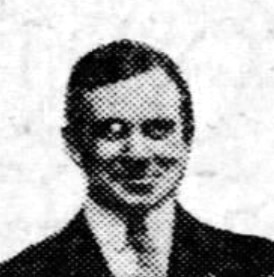
At some point, Posselt junior went to the bad. The 1915 New York Census, taken on 1 June 1915, recorded him an inmate of the Eastern New York Reformatory at Wawarsing. This is now known as the Eastern Correctional Facility.
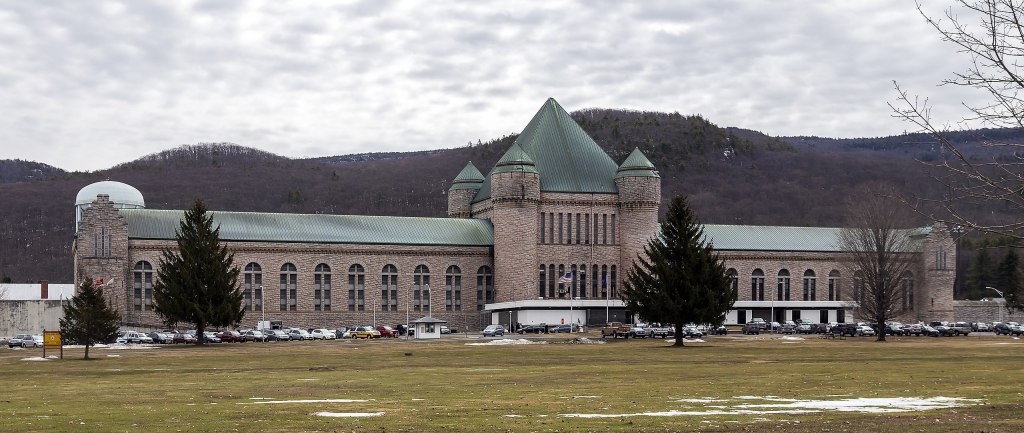
The entry gave his normal address as 109 West 101st Street. He was aged 30 and employed as an ‘advertising man’.
Whatever this first offence, he was soon back in trouble. The New York Times of Sunday 28 November 1915 reported:
‘PHANTOM DINNER FAILS.
“Lieut. Rogers” Not Known to Col. Appleton, His “Guest.”
Charles F Posselt, 46 Seventh Avenue, as he described himself at Police Headquarters, was locked up there yesterday afternoon, charged with attempted grand larceny after he had been interrupted in an effort to obtain a subscription to a program for “A farewell dinner to Colonel Appleton of the Seventh Regiment.”
Colonel Appleton was asked to identify Posselt after the latter had, according to Detective Ford of the Second Branch, introduced himself as “Lieutenant Rogers of the Seventh,” and had tried to obtain a subscription from an official of the Saxon Automobile Company at 252 West Fifty-eighth Street.
Detective Ford was in the automobile concern’s offices this afternoon when Posselt entered. When the detective heard the name of “Lieutenant Rogers” and the request for a subscription, he questioned the visitor. Not satisfied with the responses, the detective took Posselt over to the armory of the Seventh Regiment, and Colonel Appleton said he did not know the man. The Colonel further said he had no authority to ask for subscriptions. Posselt broke away from the detective outside, but was halted by a shot fired over his head.’
It seems that Posselt escaped lengthy incarceration since, in March 1916, using the name ‘John Posselt’, he obtained a license to marry one Lucy Bateman, aged 24, of 166 Newell Street. This was another bigamous marriage.

His new wife was Lucille Sealey Bateman, who had been working as a book-keeper for a tobacco company.
When Charles completed his WW1 Draft Registration Card on 12 September 1918, he used the name ‘Charles Francis Posselt’ and gave the name of his nearest relative as ‘Lucille Posselt, 166 Newell Street.
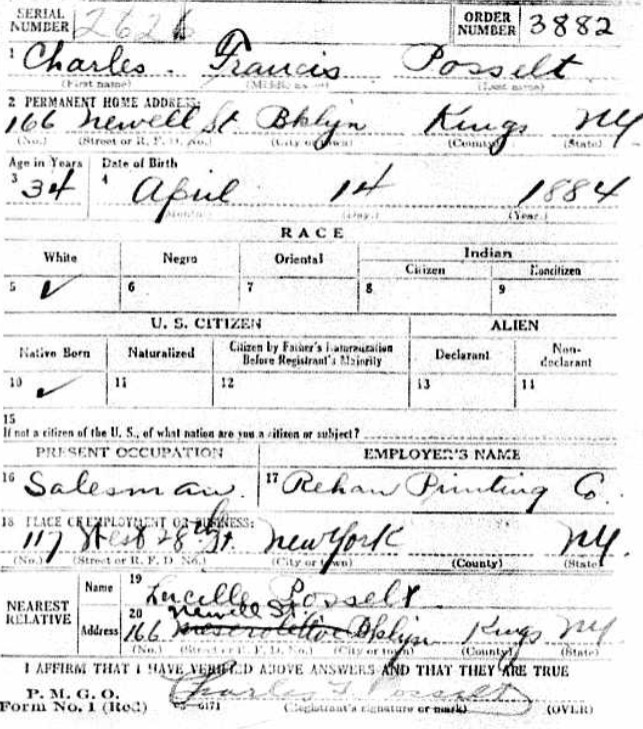
Before filling in her address he began to write ‘presently believe…’ but crossed that out. This suggests that they were already separated and that Lucy had left him.
He gave his occupation as salesman, with the Rehan Printing Company, of 117 West 28th Street. He was described as tall, possessing a medium build, blue eyes and brown hair.
By 1920, Lucy Bateman was back living with her parents at 166 Newell Street, claiming to be single, still employed as a book-keeper. Charles/John Posselt had disappeared. Lucy remarried in 1927, to Herbert Charles Hannay, a railroad fireman.
In November 1939, several years after the death of his maternal maiden aunt, Mary Elizabeth Pottinger in Burlington, Vermont, a notice was placed in the local newspaper, relating to:
‘…the estate of said deceased, Mary E Pottinger, of that share of said estate for the benefit of Charles F Posselt, a person absent and unheard of for more than fifteen years, five years of which are after the death of said Mary E Pollinger.’
Meanwhile, and also at some point in 1918, Charlotte Kelly, now Charlotte Posselt, married Herbert Ray Clarke, a 34 year-old salesman living in Union Pennsylvania. His WW1 Registration Card cites his spouse ‘Charlotte Irene Clarke of Baker House, Lewisburg, Union, Pennsylvania’.
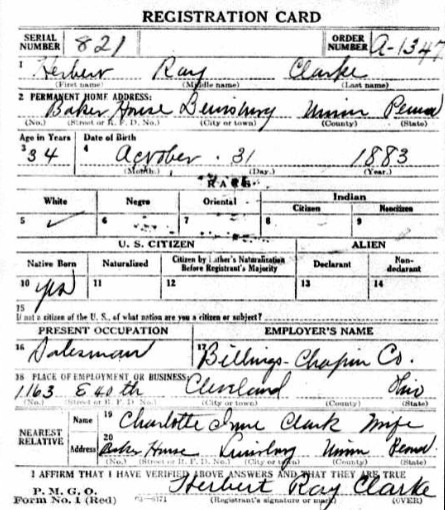
This was also a bigamous marriage, unless it was a fictitious marriage – I can’t discover a marriage record.
The 1920 US Census recorded Herbert and Charlotte Clarke living together in the Strickland Apartments, North Second Street, Lewisburg. They also had with them Herbert’s daughter, Marjorie Winslow Clarke, 14, product of his previous marriage to Florence Winslow Glover.

I have been unable to establish Ms Glover’s whereabouts, or whether that marriage had been annulled.
The marriage between Clarke and Kelly was not long-lasting, since Clarke married a third time in January 1921, to Marguerite E Bainey with whom he spent the rest of his life. I’ve been unable to find a divorce separating Clarke and Kelly.
However, shortly before her marriage to George, in March 1921, (actually her third rather than her second) Charlotte petitioned for divorce from her first husband, Charles Posselt, as follows:
‘Commonwealth of Massachusetts
Superior Court, Berkshire SS
To the Honourable the Justices of the Superior Court, next to be holden at Pittsfield within and for the County of Berkshire.
Respectfully libels and represents Charlotte I Posselt of Pittsfield in said County, that she was lawfully married to Charles F Posselt now of Philadelphia Pennsylvania at the City of New York on the twenty seventh day of May AD 1906, and thereafterwards your libellant and the said Charles F Posselt lived together as husband and wife in this Commonwealth, to wit: at said Pittsfield that your libellant has always been faithful to her marriage vows and obligations, but the said Charles F Posselt being wholly regardless of the same at said New York City on or about the first day of November AD 1914, utterly deserted your petitioner and has continued such desertion from that day to the date hereof, being more than three consecutive years next prior to the filling of this libel.
Wherefore your libellant prays that a divorce from the bonds of matrimony may be decreed between your libellant and the said Charles F Posselt and that your libellant be allowed to resume her maiden name of Charlotte I Kelly, and for such other orders and decrees as to your Honours shall seem meet, and as justice may require.
Dated the twenty-first day of March AD 1921
CHARLOTTE I POSSELT’
The records show that on 13 July 1921, an affidavit under ‘the soldiers’ and sailors’ civil relief act’ was filed. Posselt ‘called and defaulted’.
It seems then, that Posselt had spent some time serving in the armed forces, though exactly when is unclear.
This was apparently the last ever heard of Charles F Posselt.
There was a hearing, Charlotte was permitted ‘to amend the libel’ and the decree was entered on July 18th, the divorce being granted six months later on 19 January 1922.
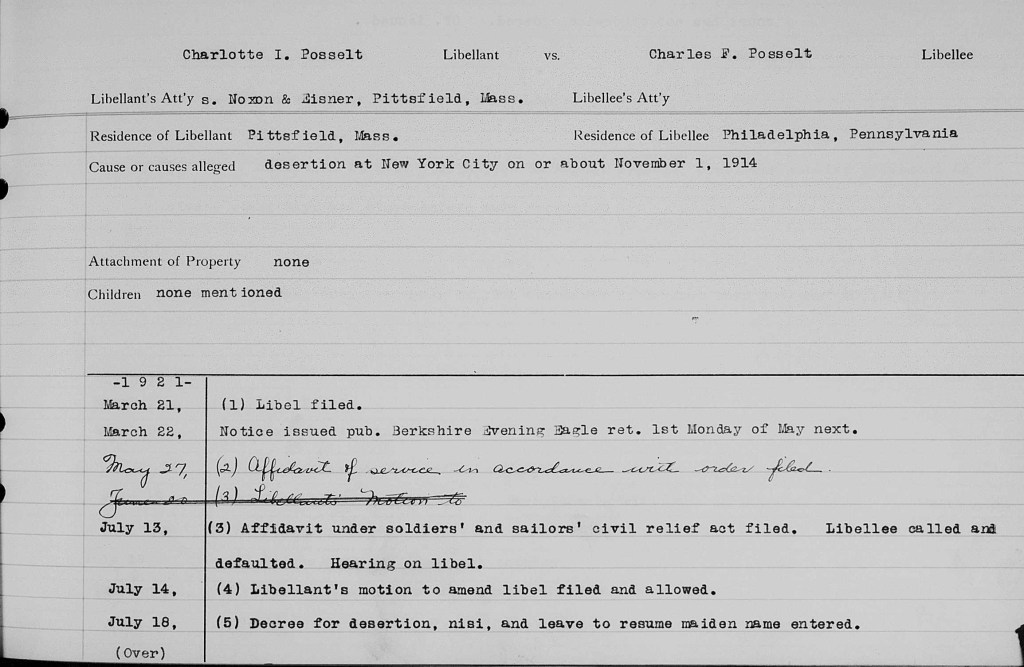
Neither party mentioned their subsequent bigamous marriages, so the way was clear for Charlotte and George to marry.
The 1923 Pittsfield Directory stated that Mrs Charles F Posselt had removed from the City. Meanwhile, George and his partner Dorothy (clearly a mistake) were resident at an apartment at White Terrace, a cul de sac off north street beside a petrol garage. George was still employed at Tillotson’s.
White Terrace was built in 1906, comprising three blocks containing 21 apartments and three stores.
The 1924 Directory corrects the entry to ‘Geo H (Charlotte)’, but otherwise the details are unchanged.
In 1926, George was still with Tillotson, but the couple had moved to 241 South Street.
In August 1927, George was involved in a car accident on the corner of Fourth and East Streets, his car colliding with another. Charlotte suffered bruising and a fractured rib.
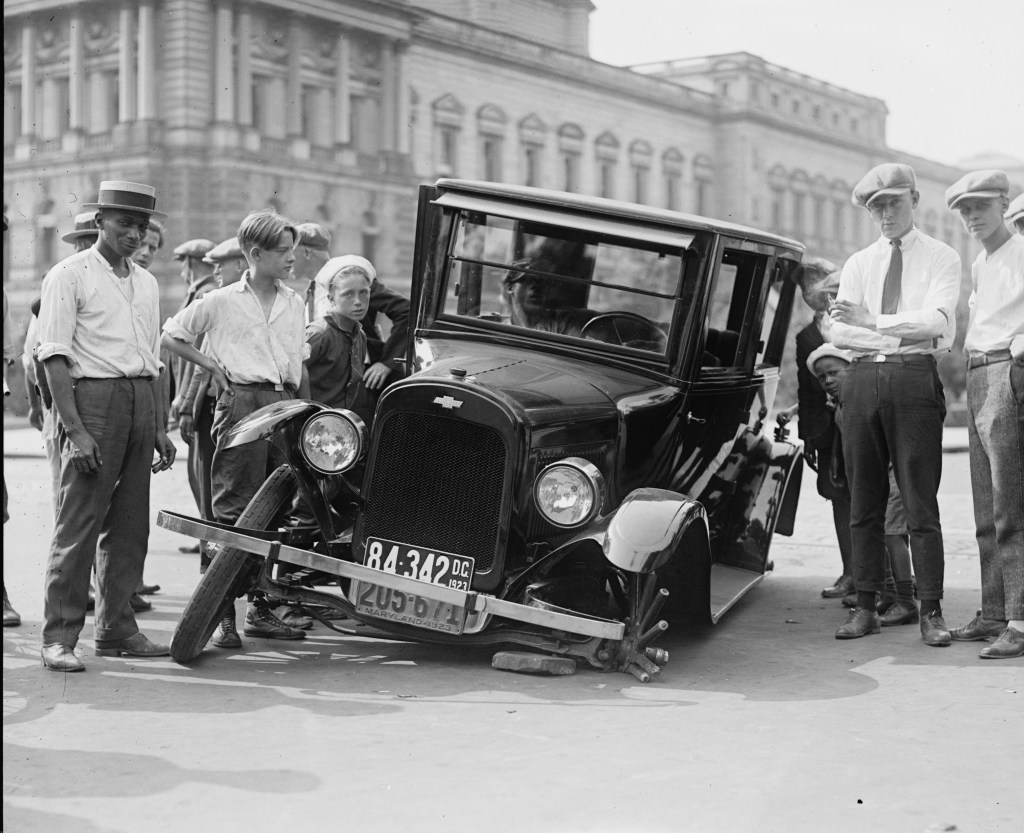
The other driver, Patrick Cimini, who was charged with dangerous driving, claimed that he was on the wrong side of the road because he was avoiding a man working on the trolley tracks. He was fined $90 and also had his license revoked.
The 1928 Directory indicates that George and Charlotte had removed to 19 Cherry Street, the home of Charlotte’s widowed mother.
By 1929, though, they had left Pittsfield to take up residence in Chester, Pennsylvania, roughly 250 miles south-west of Pittsfield, on the outskirts of Philadelphia.
The 1930 Census records them living at 919 Elsinore Place in Chester, a four bedroomed townhouse, built in 1910, which was rented. George continued working as a foreman in textiles. He admitted to 50 (he was 55), Charlotte to 42 (she was 44).
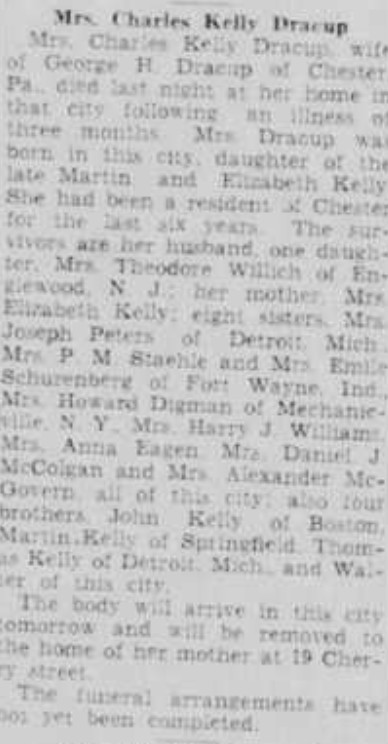
Then, tragically, on 2 September 1931, Charlotte died of breast cancer, aged just 45. She had been diagnosed and operated on in the Spring of 1930, but this had not prevented the spread of secondary cancer to her lungs.
Her obituary (which calls her ‘Mrs Charles Kelly Dracup’) mentions a daughter – Mrs Theodore Willich. This was the former Marjorie Winslow Clarke, born to Herbert Ray Clarke and his first wife in 1906. She had married Theodore C R Willich, in 1927 and, for the most part, lived in New Jersey. Charlotte had no children of her own.
George Harry and Anna, nee Manlove
George remained in Chester, still living in Elsinore Place. In 1935 he was involved in another minor car accident, hitting a boy who was roller skating on Providence Avenue.
Then, in April 1937, at the age of 61, he married his third wife. The marriage license declared him to be 54 and she 43.
She was Anna Campbell Manlove, actually 48, born in Delaware to James H Manlove and Mary Jane, nee Russell. Her father had died in 1917; her mother the previous year.
Earlier in life she had lived in Philadelphia: a newspaper report from 1905 relates that she and her sister were among a group of young people charged with operating ‘entertainments’ at nearby Woodland Beach, Delaware on the Sabbath Day.
She had married her first husband, Harry Dechant Burnett, in Philadelphia in 1908 when she was 20. A daughter, June G Burnett, was born in Philadelphia on 24 March 1914. The record states that it was Anna’s second child, the first having died.
By 1920 the family was resident in Clementon, New Jersey, where Harry worked as a bricklayer. However, by 1930, Harry, now 45, was living with his parents in Philadelphia, earning a living as a commercial traveler.
Anna and June were elsewhere, Anna supporting her daughter’s pursuit of a career in show business. Later local newspaper interviews with June reveal that Anna and Harry had also been ‘treading the boards’.
This is from The Bradenton Herald of 29 July 1973:
‘’’I made my debut at a very early age,” the petite showgirl recalled. “My parents, the vaudeville team of Burnett & Manlove, had the girl at the box- office minding me as a baby just six weeks old.”
“When I started kicking up my heels and acting up, the girl couldn’t handle me, so she brought me down and handed me to my parents on stage. It disrupted the act only for a moment, then we all got a big hand, my parents told me when I was old enough to know all about it…
…June traveled with her parents as an infant, but was placed in boarding school, the Lankenau School for Girls in Philadelphia, at the age of six.
“It was a Lutheran school and very religious, with Deaconesses and the whole bit,” June remembered. “I liked it and I studied hard. I became really interested in religion and that was when I decided I wanted to train to become a missionary. I was truly sincere about it.
“When I was eight, Mother and Dad took me into the act with them. I became ‘Baby June’. I was a red-head then and they always dressed me in red.
“I had a deep voice as a child and I used to belt out songs and it must have been pretty funny. Anyway, everyone laughed a lot and it went over well. Dad did Blackface and Mother was his ‘straight woman’…That was Harry Burnett and Anne Manlove.
“As I got to be elementary school age, I was back in boarding school but came home on weekends and saw all the vaudeville shows playing in our neighborhood on Saturdays.
“When I got into Junior High, I didn’t go back to boarding school. In public school I met a girl called Elinor Goss and organized a sister team ’Burnett & Goss’. Mother became our agent and we went on the road. I was just 14. We were getting along great until my partner fell in love with a fiddle player at one of the theaters we played and broke up the act…”
‘…She was a great manager too, the drive behind the act. By this time my parents had split up but I never lacked for love. They loved each other too, but were too much alike, and like two children in many ways. As I grew up, I helped keep them on an even keel. You would have thought I was the parent.”
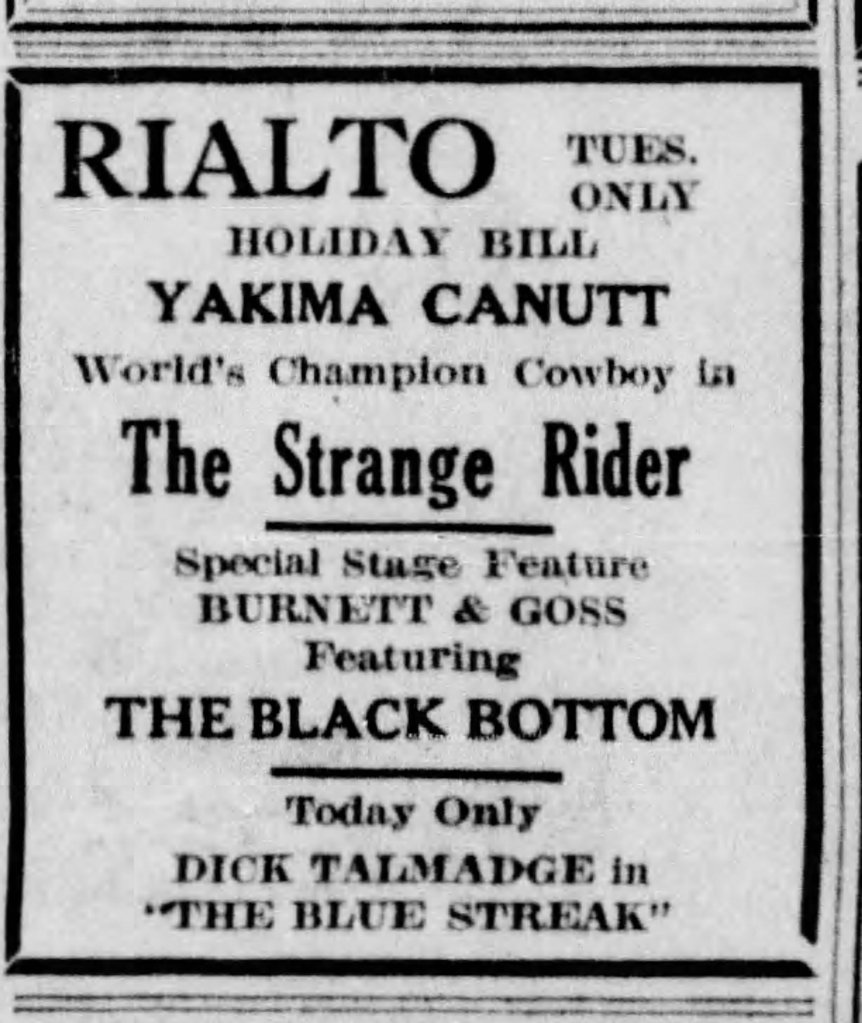
In a later 1987 feature, she added a further detail:
‘”Dad was a black-faced comic, and my mother and another lady were his straight men. They were called Burnett, Manlova and Fifi”…’
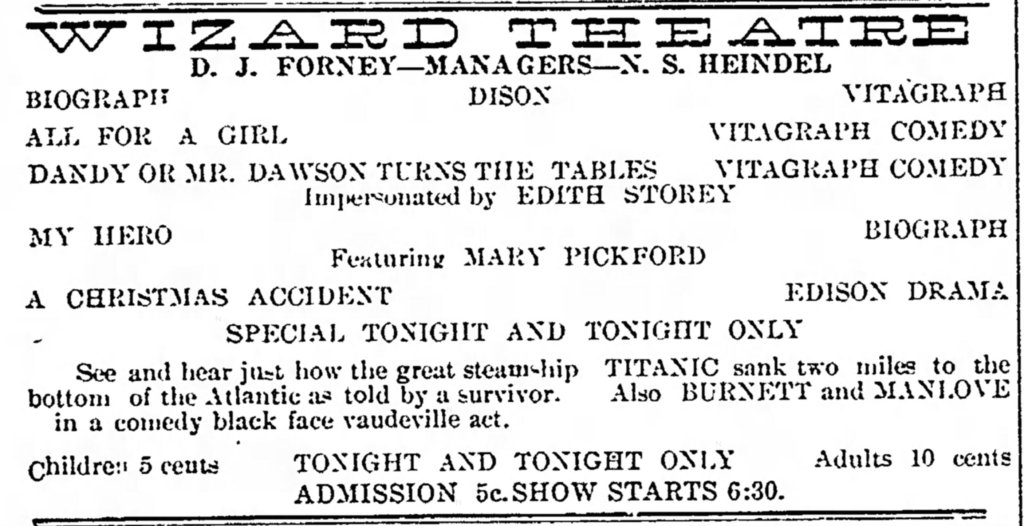
The only reference I can find is to ‘Burnett and Manlove in a comedy blackface vaudeville act’ – bottom of the bill in a show comprising mostly silent films. It took place at the Wizard Theatre, Gettysburg on 14 March 1913.
The Lankenau School for Girls was a boarding school with religious overtones connected with the Mary J Drexel Home and the Philadelphia Motherhouse, which were founded by Philadelphia philanthropist John D Lankenau (1817-1901).
They also provided a home for the elderly, a children’s hospital and a training school for ‘Lutheran deaconesses’. The School was conducted by the deaconesses.
By 1930, June was working in the ‘Two Bits Club’ in Miami, Florida, which led to her booking for a series of engagements in Havana, Cuba. There she joined a magician’s act, which toured South America. His name was Li Ho Chang.
He seems to have been a master publicist, as well as a master magician, judging by the frequency of the coverage in Miami papers. These indicate that, after concluding in Havana, he returned from a two-year tour of Latin America to begin a residency at the Olympia in Miami.
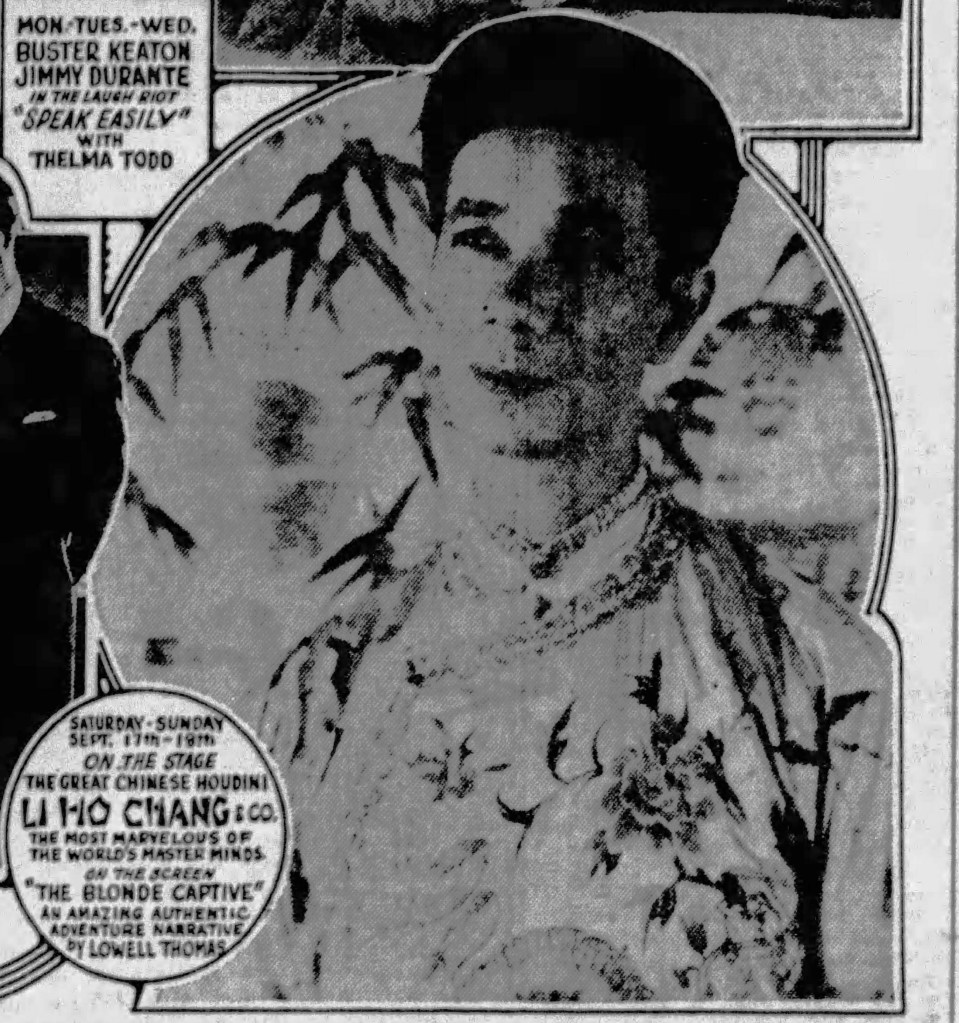
This is from The Miami Herald of 11 August 1932:
‘DUE TODAY: Li-Ho-Chang. Intellectual-looking Chinese magician. Coming from Havana where he’s just finished an engagement at the Teatro Nacional…Well known in the large cities of the North as an entertainer, Li has spent the last two years in South America. His last previous American appearance was at the Roxy in New York. While south of the equator, he sandwiched in the production of a talking picture between his theater performances…Saturday, he and his troupe of five people (including at least one beautiful Chinese girl – I saw her picture), will start a week’s engagement at the Olympia Theater…They will give a 30-minute act of Oriental magic with each show…Li apparently is an experienced showman. He travels with two tons of equipment and complete advertising material, including lithograph posters, three-sheets and movie trailers…’
I can trace some pertinent travel records for Anna and June. For example, on 22 April 1931, they arrived by plane at Miami, having departed Havana, Cuba. Then, on 10 March 1932, they sailed from New York to San Juan, Puerto Rico aboard the SS Borinquen, headed for the Palace Hotel in San Juan.
Anna seems to have given up her role as manager and chaperone once June attained her majority, around 1935.
On the 1940 Census, Anna stated that in 1935 she had been resident in rural Delaware. She may well have spent some time with her mother, who died in Smyrna, Delaware on 3 June 1936.
On 25 March 1937, her divorce from Harry Burnett was finalised, in Manatee County, Florida, on grounds of desertion. His address was that of his parental home, at 6906 Woodland Avenue, Philadelphia.
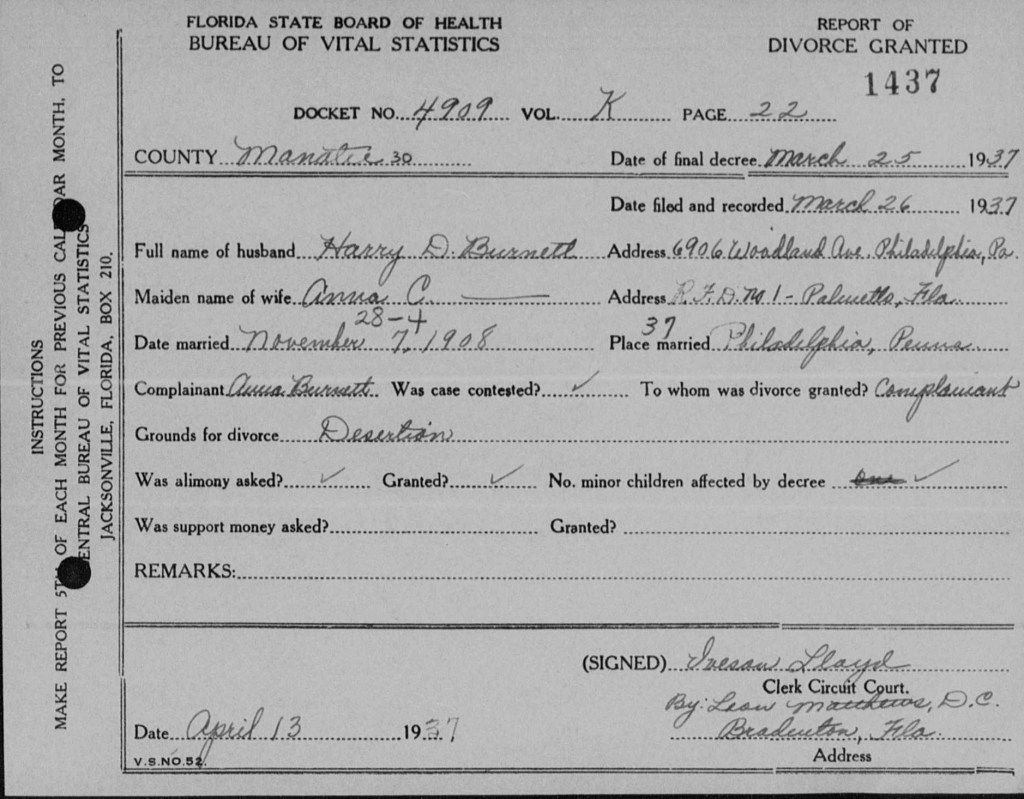
Her address was given as ‘RFD No1, Palmetto, Florida’. (She may have been residing with June, who now had a new dancing partner called Billy Walt: they had been engaged in residencies in Florida in January and February 1937, before heading up to Massachusetts and then Pennsylvania.)
Precisely one month after her divorce, on 25 April 1937, Anna married George Dracup in Philadelphia, the license being granted in Cecil County, Delaware.
On the face of it, the widowed overseer and the vaudeville straight woman made an unlikely couple – but perhaps it was a case of ‘opposites attracting’.
Meanwhile, George had acquired a step-daughter whose show business career was developing in a Hollywood direction.
On 12 November 1938, the LA Times reported:
‘June Burnett, the little redheaded entertainer at the Great White Way, is getting married, but she will not identify the man until the day of the ceremony, Tuesday…’
At some point she signed with Warner Brothers and, in 1939, had a small part jitterbugging with Dick Powell in ‘Naughty but Nice’.
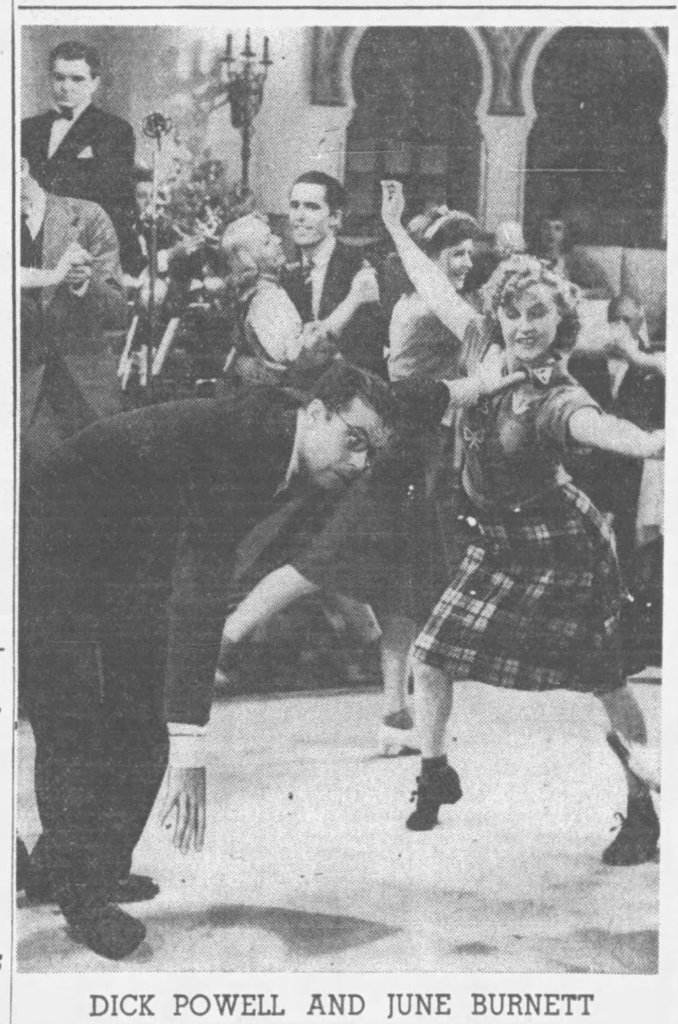
The wedding did not take place until 22 May 1939, the man in question being Frank Ewing Webb, the cartoonist best known for drawing Dippy Dawg, Goofy’s precursor. Dippy made his first appearance in Micky’s Review, a 1932 Disney short.
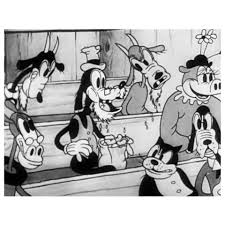
Webb seems to have lived a Hollywood lifestyle. He married first in 1925, then again in 1935, to a woman who had been their lodger in 1930. June was his third wife, at the age of only 33.
Back in Pennsylvania, in 1938 ‘George Dracup et al’ were found liable to pay the Mascot Building and Loans Association $38,791, a very large sum, but it is not clear what this related to. In 1939 George transferred property at 200 Seventh Street Chester to his nephew, also called George Harry (see below).
By the time of the 1940 US Census, he and Anna were resident at 209 East Seventh Street, owning their apartment, valued at $1500. George, now 65, was seeking work as a superintendent in a yarn mill, having been unemployed for 30 weeks that year. He had worked only eight weeks in 1939, for which he earned $200. Anna was not working.
In 1941, she and her younger married sister Bertha took a trip to Havana, Cuba, but neither husband seems to have accompanied them.
Stepdaughter June and Frank Webb had a daughter together, Terry Jane, born in February 1942.
But June initiated divorce proceedings in Miami in November 1943.
She was featured at a club called Jimmy’s-on-the-Trail, described on the bill as the ‘red hot riot of rhythm’, before moving on to the Olympia.
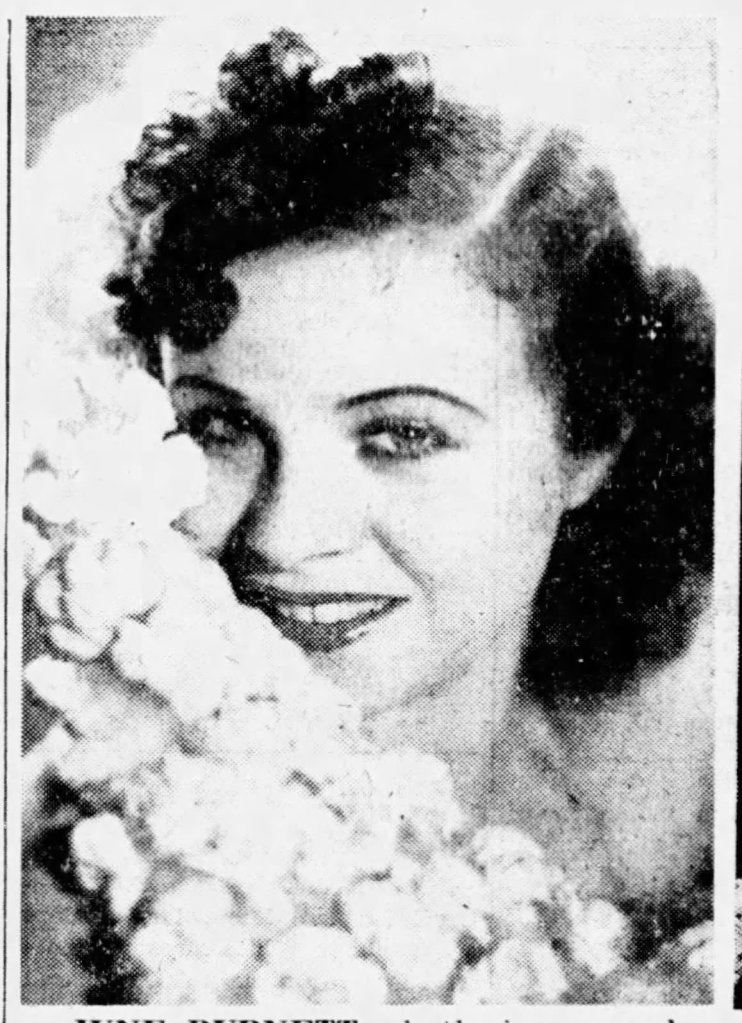
One review, from 2 December 1943, reads:
‘June Burnett, a newcomer to the area, is a petite bundle of vivacity, jive arrangements and, to put it tritely, personality. If her vocal accomplishments were in stronger ratio, she would be a better theater performer. Her limited range and volume are more suitable for a night club…’
During this period she met Robert Sheldon, who became her second husband in December 1944. He had been managing the Tropical Club in Miami Beach where June was booked to sing.
They formed a double act, ‘Sheldon and Burnett’, specialising in comedy song and dance. The first advertisement I can trace is from November 1945 in Vineland, New Jersey. They performed singly and together.
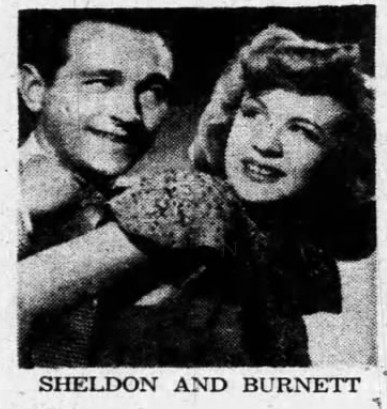
By 1948, while not on the road, they lived at 311 Sunnyside Avenue in Chester, Pennsylvania. However, they played that winter in Miami, Washington DC, Cincinnatti, Minneapolis, Wichita, Chicago and Baltimore.
By the time of the 1950 US Census, meanwhile, George and Anna were resident in the downstairs apartment at 809 East 22nd Street. George, now 74, was still working as a foreman in a worsted mill. Anna, now 62 (she claimed 58) did not work.
That September, a short item appeared in the Delaware County Daily Times about the two proud grandparents watching the theatrical debut of their granddaughter, Terry Jane, who made her acting debut alongside Edward Arnold in a play called ‘Apple of His Eye’ at Cape May, New Jersey.
In 1954, June gave birth to Robert Sheldon Junior. She and Sheldon senior were running a dance school – the June Burnett School of Dancing and Dramatic Art, at 530 Baltimore Pike, Springfield.
The 1956 City Directory places George and Anna still in Chester, but now also at 311 Sunnyside Avenue.
In May 1962, June and Robert moved with their two children to Bradenton, Florida. They bought a night club called the Mira Mar at 700 Gulf Drive North, Bradenton Beach, which opened in December 1962, and lived in an area known as San Remo Shores.
At some point, Anna went to stay in Florida with her daughter. She was admitted to Manatee Memorial Hospital in January 1964, March 1964 and again in 1965.
Meanwhile, George and Anna sold the Sunnyside Avenue property in Chester for $9000, perhaps indicating that they contemplated moving together to Florida.
However, Anna died on 10 September 1966 in the 48th Street Hospital, Philadelphia, her home address was given as 321 East 22nd Street, Chester.
The cause of death was ‘Acute Myocardial Infarction; Atherosclerotic Coronary Arteroid Occlusion and Generalized Arteriosclerosis’ – essentially a heart attack. She was 78.
Terry Jane Sheldon did not follow in her mother’s footsteps. By 1961 she had already given birth to three children. She married their father in 1967 but they divorced in 1968. She later went on to have three further children with her second partner.
After Anna’s death, George lived with his niece, Bertha Lutz, at 247 West Mowry Street Chester. She was the daughter of Anna’s elder sister Ella Manlove and her husband Harry Lutz. She was a spinster in her 50s who had inherited the house from her parents, now dead, and worked for Westinghouse Electric.
George died at Fair Acres Farm, Middletown, a nursing home, on 6 June 1967, of ‘Congestive Heart Failure and Arteriosclerotic Heart Disease’. His birthday was wrongly given as 7 December 1874 (it was 1875). He was 91.
Both Anna and George were cremated at the Philadelphia Crematorium.
June’s husband Robert Sheldon died in October 1972 and, in May 1973, she married her third husband, Ralph Peter Heese, also known as Ronnie Stevens, a singer and band leader. However, they divorced in August 1976.
June died in 1999.
James Henry Dracup (1877-1957) and Florette Myers Thomas
James Henry first appears in the Philadelphia Directory in 1898, as a weaver living in the family home at 4465 North Cleveland Street.
On Christmas Day 1899, he married Florette Myers Thomas. He was 22, she 23, and both were employed as weavers.
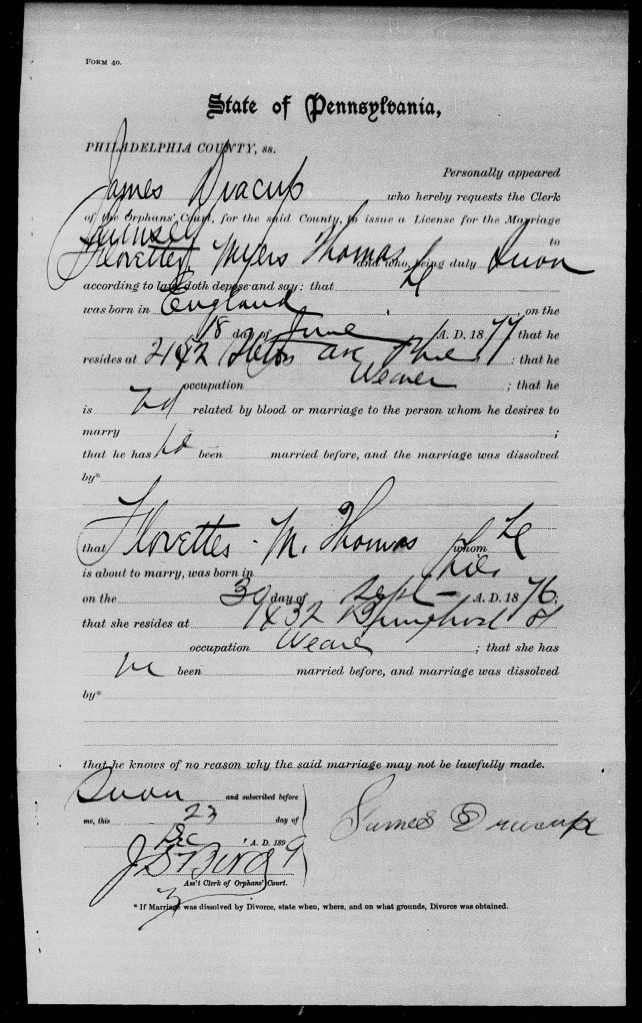
Florette had been born in Philadelphia, to English-born parents, Henry Thomas and Mary Elizabeth, nee Reese.
She had been in a previous relationship, with a man called Harry Wenner (an anglicisation of Woerner). He was the son of Emil Karl Wenner and Elizabeth Fuchs, both born in Bavaria, Germany.
I have been unable to track down a marriage certificate for Harry Wenner and Florette, but in the 1930 Census she says she was 17 at the time of her first marriage, which would place the event between October 1893 and September 1894.
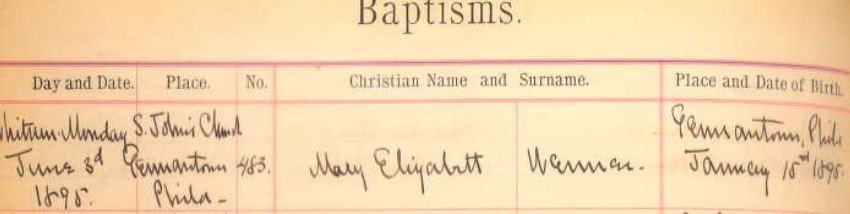
A child called Mary Elizabeth Wenner was born on 15 January 1895, when Florette was 18, and baptised on 3 June 1895 in St John’s Church, Germantown, Philadelphia. The parents’ names were given as ‘Harry Wenner’ and ‘Florence Wenner’.

But then, on 30 September 1895, Wenner was sentenced to a period in the Industrial Home Reform School at Huntingdon, Pennsylvania. He had apparently made off with several pieces of glassware and chinaware, having visited dealers and pretended that he had been sent by his father, who also worked as a dealer in such items.
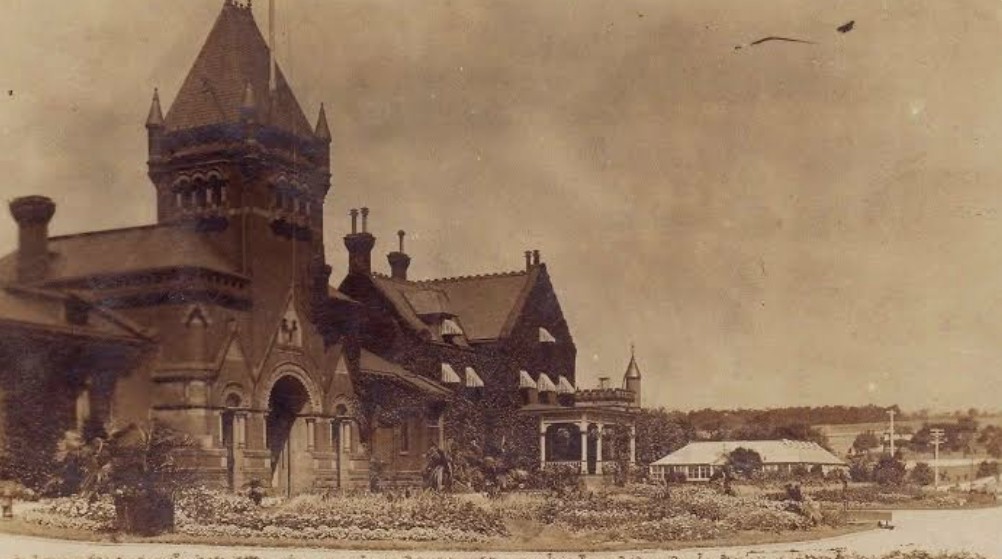
He pleaded guilty and was duly sentenced but, while waiting to be transferred to the Reformatory, he was placed in the county prison, where he promptly stole the watch of a fellow prisoner, called Edward B Brown. When Wenner arrived at the Reformatory, the missing watch was discovered in his shoe!
Was this the same Harry Wenner who is recorded in the 1900 US Census living at 830 49th Street, Philadelphia with a wife called Annie, nee Biederman, who he had married three years previously and by whom he had two children – Harry, aged two and Mary, aged three months?

If so, he had married Anna in 1897 and was now employed as a pork butcher.
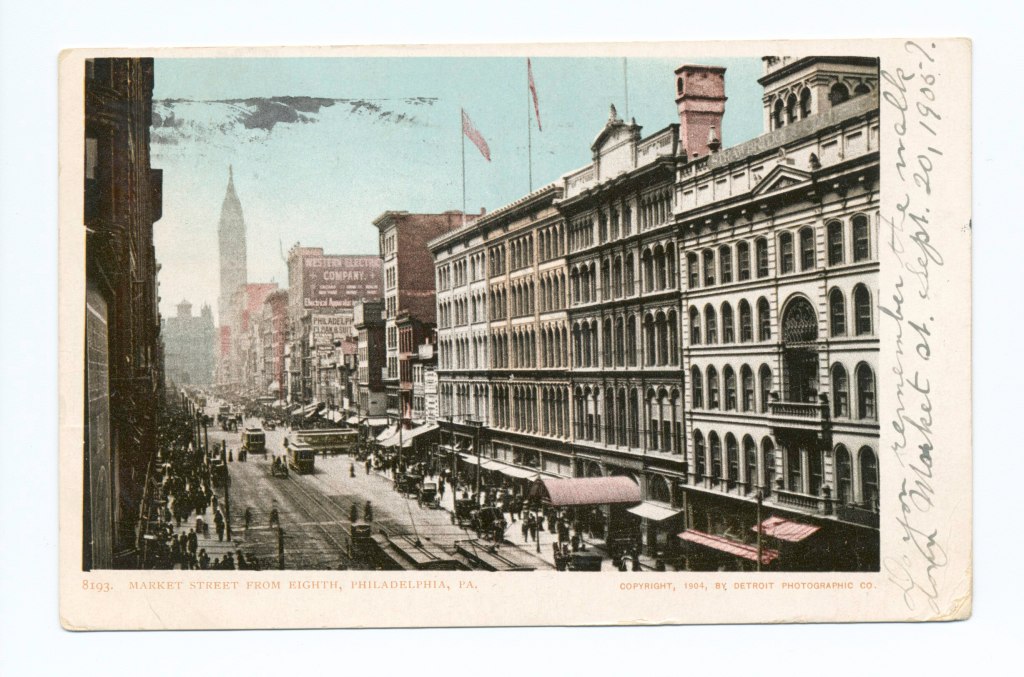
Strangely, James Henry was shown in the 1900 Census living in the family home with his parents, described as 20 years old, single and still employed as a weaver. He was actually 23, married, and older than his brother Joseph, (although Joseph is here shown as the elder).
There is no sign of Florette or her daughter, Mary Elizabeth.
The 1901 Philadelphia Directory includes James, living at 5157 Sheldon Street, still employed as a weaver.
A son, also called James Henry Dracup, was born to the couple on 29 April 1902. The baptism was on 13 July 1902, at St Luke’s Episcopal Church, Philadelphia, and the baptism record calls Florette ‘Florida Dracup’.

The four finally appear together as a family in the 1905 Census for New York State. They were resident at 17 Aurelius Avenue, Cayuga, Auburn. (This was later the street on which their uncle and aunt, Alfred Fisher Wallace and Nancy, nee Dracup, lived.)
Both James and Florette gave their ages as 27. Living with them was James’s brother Joseph, aged 24. Both men were described as Boss Combers at a carpet factory. Mary Elizabeth (Now Elizabeth Mary) was 10 and at school, while James Henry was three and at home.
There is a parallel entry in the 1905 Directory for Auburn which confirms these details, except that the two brothers are employed as ‘carders’.
But the 1906 Directory states that both have ‘removed to Philadelphia’.
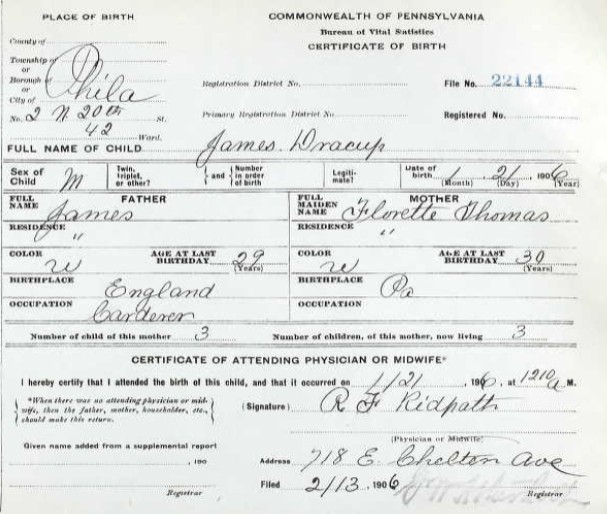
A second son, named George Harry Dracup after his uncle, was born on 21 January 1906 in Philadelphia. Curiously, he is named ‘James Dracup’ on the birth certificate, although the baptism record is correct. The place of birth was 2 North 20th Street. The certificate confirms that this was Florette’s third child and all three were still alive.
The 1907 Philadelphia Directory places James, still a weaver, at 2144 Nedro Street, while the 1908 Directory has him at 274 East Bringhurst Street, as does the 1910 edition. In 1908 he was working as a driver and in 1910 as ‘teams’ (teamster).
The 1910 Census confirms the family residence as 274 East Bringhurst Street. James was now 33, employed as a teamster doing ‘odd jobs’ and naturalized. Florette was 34, not working. Elizabeth, now 15, was employed as an operator in a textile mill, while James and George were aged 7 and 4 respectively.
The entry for Florette apparently confirms that this was her second marriage (there is a small ‘2’ next to the (M’).
We know that the family was still in Philadelphia in 1912, since this article appeared in the Courier Post of Camden, New Jersey on 12 November that year:
‘Elizabeth Dracup, the 17 year-old-daughter of Jesse Wracup [sic], 5120 Lena Street, Philadelphia, was the heroine of a fire which destroyed the Daniel Waters dye works, Wister and Lena Streets, early this morning. After awakening members of the family, the girl ran to the street in her night clothes and aroused the occupants of other houses which, adjoining the dye works, were endangered.
The fire started in the drying room on the second floor. A brick wall fell and John Leithead, battalion chief, with a score of his men, escaped by a narrow margin. The loss is placed at $50,000.
Miss Dracup had been unable to sleep and about 1 o’clock got up. Her room faces the dye house and she saw flames shoot from the second floor. She awakened her two brothers, James 10 years old, and George 7, and then aroused her parents. Sending them to the street, she awoke the family of Harry Goodyear, 5118 Lena Street, by pounding on the partition.
Clothed in a night robe, the girl went out and aroused the families of Thomas Forben, 5116 Lena Street, David Unselt, 5114 Lena Street, and Charles Kaprian 5119 Lena Street. These houses adjoin the dye works in the rear, and all were damaged by water, fire and falling masonry.
The alarm was sounded by James Webster, the night watchman. Director Porter, of Public Safety, assisted in directing the firemen. The persons driven from their homes were looked after by Rev Jeremiah Levin, Rector of the Catholic Church of St Francis of Assisi, Logan Street.
The explosion of the boilers in the dye plant and the consequent destruction of property and possibly lives was prevented by Daniel Hofnagle. Driver of Chief Water’s automobile. Hofnagle drew the fires, though in constant danger.
The origin of the fire has not been determined. The plant afforded employment for 150 men.
Michael J Hannon, of Ashmead Street, was arrested at the fire for carrying a revolver. Hannon who, the police say, had been drinking, is alleged to have pointed the revolver at spectators and threatened to shoot them. The weapon was not loaded. Hannon was given ten days in prison by Magistrate Fitzpatrick.’
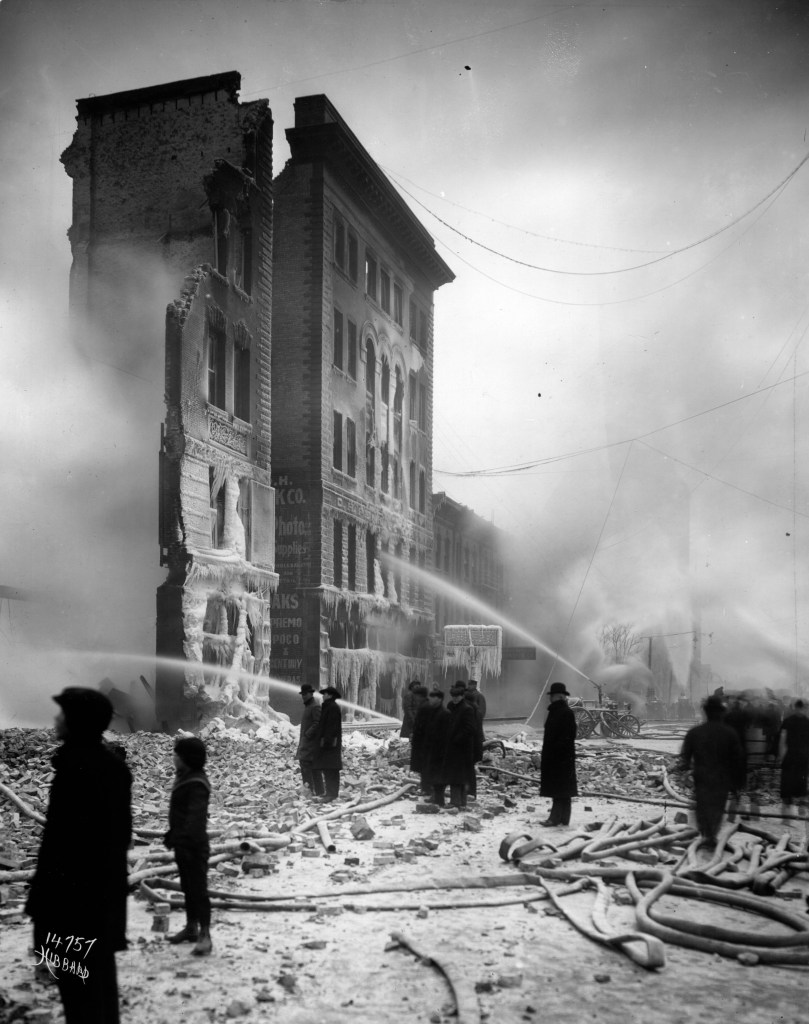
Daniel F Waters bought the dye works at 53 Wister Street in 1901. There was a strike there in 1916 which led to violence between strikers and strike breakers. Waters was a Republican, a councillor in his Ward and, in 1920, stood for Congress in the Sixth District, but lost to the incumbent by 3,000 votes.
There was a further incident just seven years later. On the evening of 4 July 1919, the nearby three-storey Calvin Knitting Mill at 5127 Lena Street, owned by John Long, was set on fire by a rocket which passed through an open window.
The fire was initially brought under control, but flared up again the following morning. Three horses were rescued from the stables at the rear of the building but the fire was thought to have caused $100,000-worth of damage.
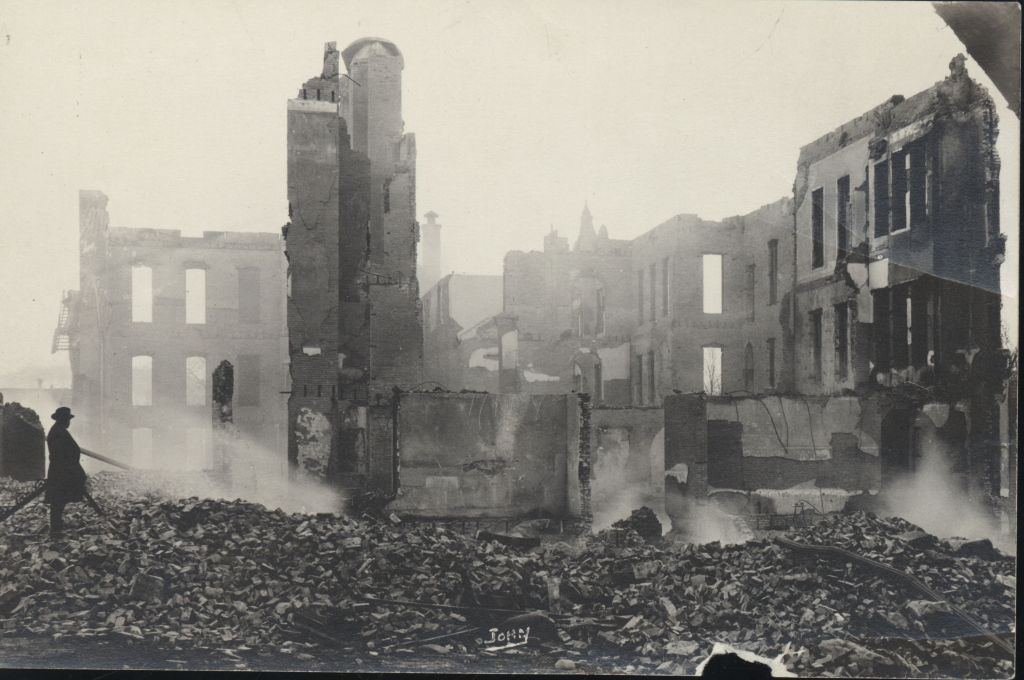
Elizabeth married between the two conflagrations, her husband being George Ludwig Hirth, a house painter. They applied for a marriage license in Elkton, Maryland in January 1915.
By 1916, James was listed in the Philadelphia Directory at 5104 Germantown Ave, but no employment was mentioned.
His WW1 Draft Registration card, completed in September 1918, gives a home address of 41 East Wister Street, Germantown. James was now working as an automobile mechanic at the Baldwin Locomotive Works in Philadelphia.
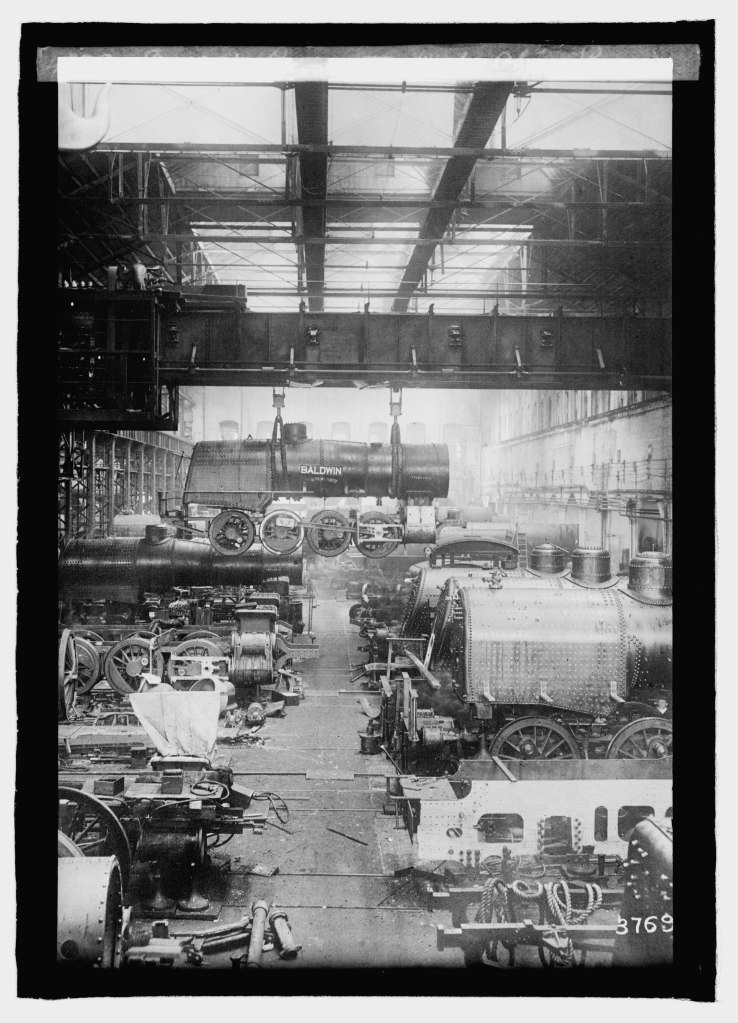
This huge enterprise was enjoying a new lease of life owing to wartime work. It built well over 5000 locomotives for the Allies and also developed a sideline manufacturing Enfield rifles, producing almost two million between 1915 and 1918.
James was now 41, described as short, of medium build, with brown eyes and black hair. He names his wife ‘Florence’ rather than Florette.
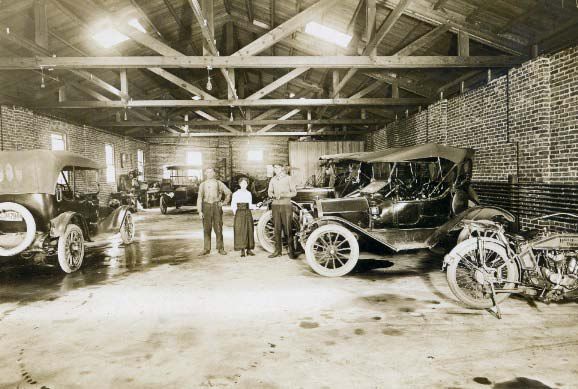
In March 1919 James was granted a building permit to erect a one storey brick garage at 16 East Wister Street for ‘Dracup Brothers’, the cost being $6000.
The 1919 Philadelphia Directory confirms that James was employed at a garage.
The 1920 US Census recorded the family still at 41 East Wister Street. James’s job was now ‘automobile machinist’. James Henry, now aged 17, was also an automobile machinist while George Harry, 13, was still at school.
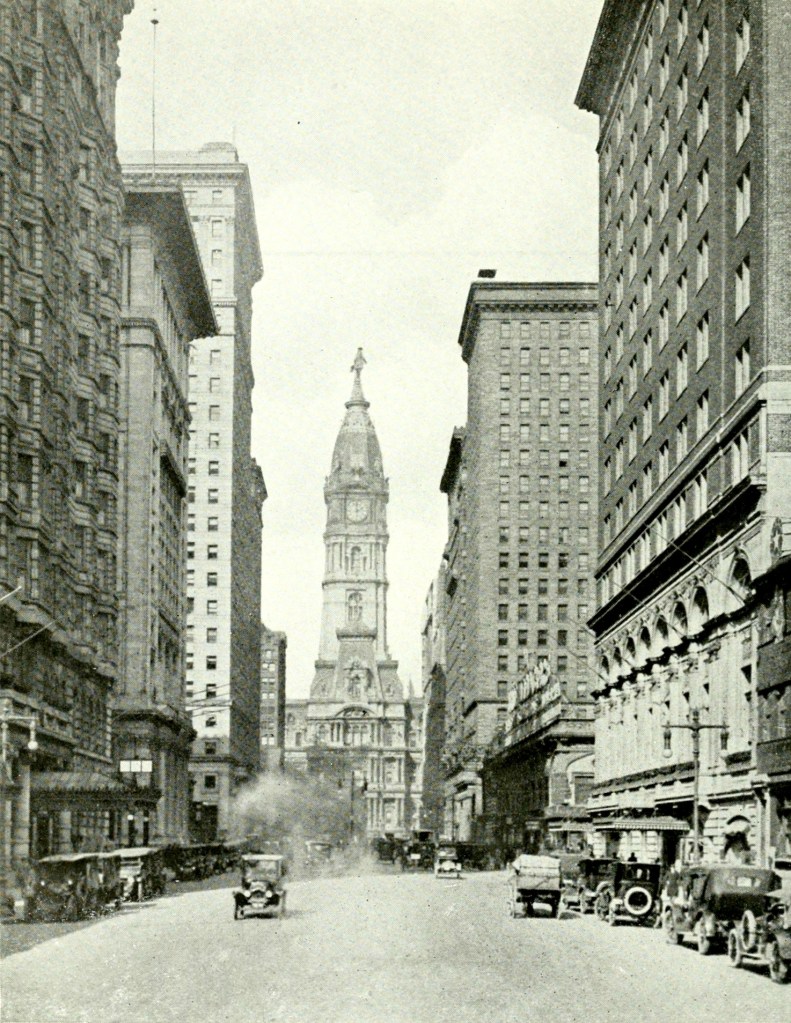
The 1921 Philadelphia Directory listed James as employed by ‘Wister Garage’, his home still 41 East Wister Street. His brothers Joseph and William (see below) were also employed by Wister Garage, as (nominally) was brother George Harry, who was listed as living at 16 East Wister Street, the address of the garage.
‘Wister Garage’ advertised frequently in the Philadelphia press between November 1919 and February 1923.
In April 1923, ‘Dracup Bros.’ were granted a building permit for an extension costing $15,000, and the 1923 Philadelphia Directory has an entry for ‘Dracup Brothers Garage’.
Tragedy struck almost immediately, just as ‘Dracup Brothers’ had reached its peak.
On 3 June 1923, James Henry junior was killed in a car accident, aged only 21. He is the third subject from this sample to be killed in their youth in a motoring accident.
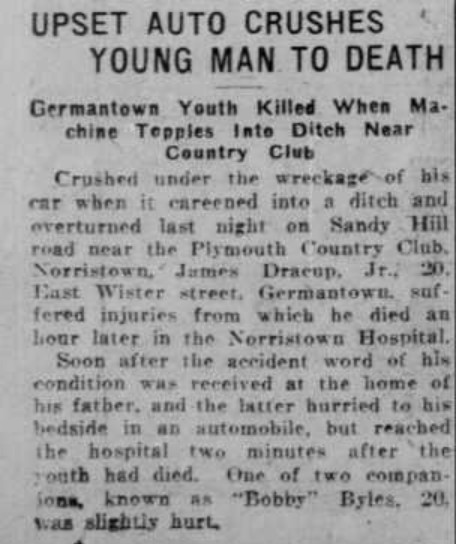
As he was driving along the Sandy Hill Road near the Plymouth Country Club (now the 1912 Club) in Norristown, at around 17:30, the radiator cap blew off, causing him to lose control.
He ran into a ditch, the car overturned and he was crushed under the wreckage, suffering a punctured lung. He was taken to the Montgomery Hospital in Norristown but died an hour later from his injuries. According to the death certificate he died at 19:35. One report says that his father rushed to his bedside but arrived minutes after his death.
On the death certificate, signed by his father, it states that James junior was an auto mechanic, aged 21 years, 1 month and 12 days, single and resident at 41 East Wister Street. His mother’s name is given as ‘Loretta M Thomas’.
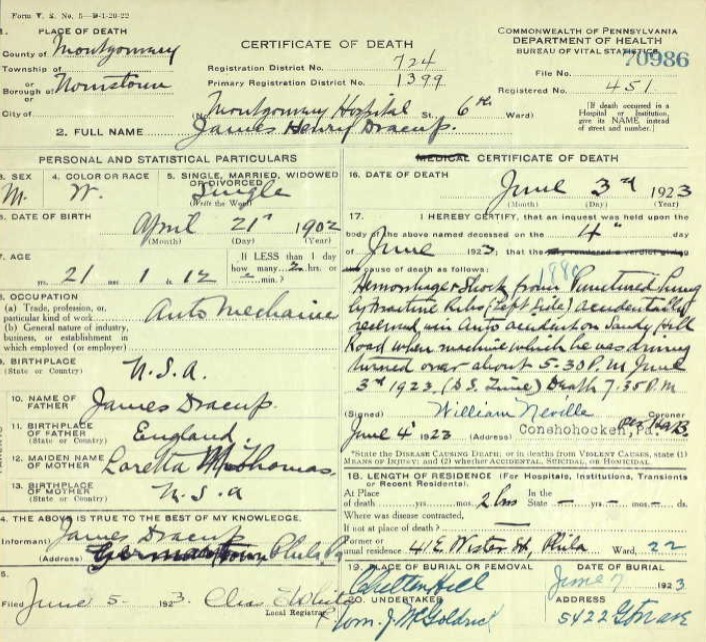
He was buried on 7 June in the Northwood Cemetery, West Oak Lane, Philadelphia.
There were two other people in the car, one unnamed, the other called ‘Bobby’ Byles. The latter was slightly injured. I think this may have been Edward Robert Biles (1904-1968).
It seems that James had a girlfriend and, moreover, that she was pregnant at the time of his death. The woman in question was Dorothy Pearl Smith, who was just approaching her 21st birthday.
She was the daughter of Joseph P. W. Smith (deceased) and Mathilde, nee Paus, known as Tillie Smith. In the 1920 Census, Tillie, Dorothy and her younger brother Harold were living together at 1041 Cambria Street, Philadelphia. Dorothy was then employed as a ‘tooth trimmer’ in a dental supplies company.

At the time of James’s death she must have been roughly three months pregnant, since her son, James Joseph Dracup, was born on 3 January 1924.
The 1924 Philadelphia Directory includes, alongside the entry for ‘Dracup Brothers’ another saying ‘Dorothy Dracup, widow of James, 4112 North Reese Street. This was now her mother’s address.
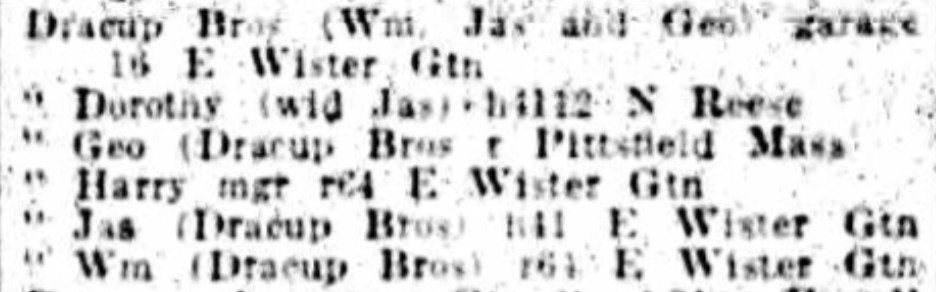
As far as I can establish, there was no marriage, so this was a convenient fiction to preserve appearances. There was an identical entry in 1925.
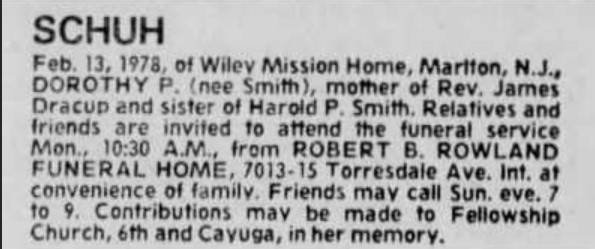
Dorothy seems to have married a man named Frank Schuh, in 1926, when he was 25 and she 24. The 1930 Census records them living in part of 3821 North Smedley Street. He was employed as a driver for a laundry, she as a telephone operator.
I cannot reliably trace him previously or subsequently. However, her obituary later refers to her as ‘Dorothy P. Schuh, (nee Smith), mother of Rev. James Dracup’.
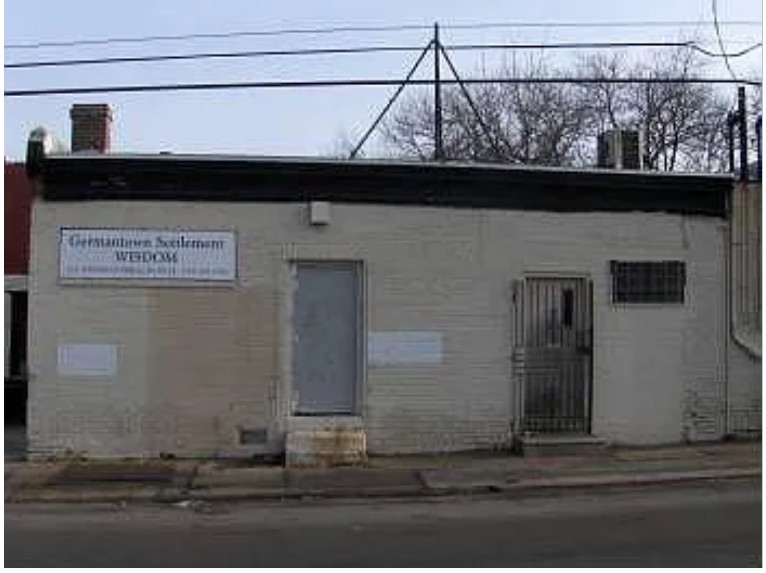
‘Dracup Bros. (Wm. Jas. & Geo.)’ were included in the 1925 Directory, but by 1930 it was ‘Dracup Bros. (Geo., Wm. & Harry)’,
George was based in Pittsfield, while William and Harry were listed as living at 64 East Wister Street.
In 1931 a legal judgement was passed against Dracup Brothers’ Garage for outstanding tax liabilities of $1626.
The building still exists but has seen far better days.
There was no entry in the 1930 Philadelphia Directory for James, but the 1930 US Census reveals that he and his surviving family had moved to 7447 East Walnut Lane.
They owned the house, valued at $6750, though these details are placed against Florette’s name, which may suggest that the property was hers.
Both stated that they were aged 52. James had been working as a carpenter for a general contractor, but was presently unemployed. It seems that he had moved on permanently from Dracup Brothers’ Garage following his son’s death.
Intriguingly, he states that he was 17 at the time of his first marriage, which would suggest that he contracted an earlier union in 1894, prior to his marriage with Florette. I can find no evidence to support this, however.

The only references to James in local newspapers during the next decade are to judgments against him for money: in 1933, $1,600 to the Home Life Building Association; and in 1941, $3,776 to the Indus Trading Company.
By 1940 he was resident in part of 64 East Wister Street, owned by his widowed mother, Ruth, now close to the end of her life (and valued at $5000).
James was now 62, Florette (calling herself Florence) admitted to 63. James was working as a ‘feeder’ in a ‘shoddy mill’, for which he’d earned $936 across the previous year. Shoddy was a fabric created out of scraps of wool and rags. Florette did not work.
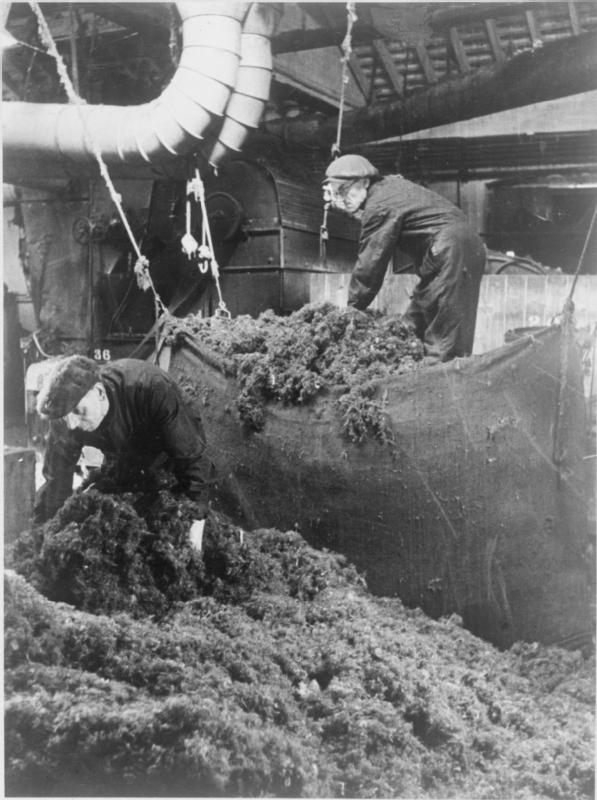
In April 1942 James completed his WW2 Draft Registration Card, stating that he was 64 years old, still resident at 64 East Wister Street, working at the Evenspun Yarn Mills, 3035 Collom Street in Philadelphia.
He was described as 5 feet 8-and-a-half inches tall, weighing 185lb, with brown eyes, brown hair and a light brown complexion. He again gave his wife’s name as ‘Florence’.
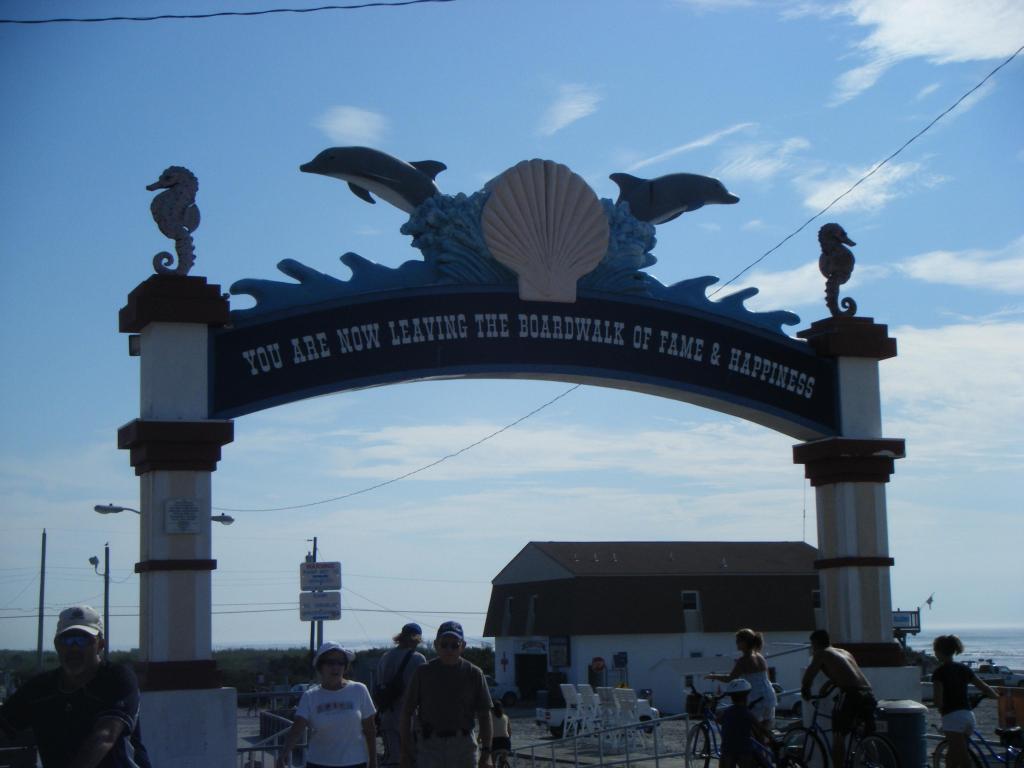
By 1950, James and Florette had retired to the coast at Wildwood in Cape May County, New Jersey. They were living in a bungalow at 3312 Hudson Avenue. James was now 72 and Florence 73.
Wildwood is some 80 miles from Philadelphia, on the Jersey Shore. Hudson Avenue is close to Back Bay in West Wildwood, an area created in the 1920s by landfill on marshland. There are several marinas. It is connected to Wildwood via a road bridge and is susceptible to flooding.

James died in Wildwood on 20 February 1957, aged 79, but was buried in Northwood Cemetery in Philadelphia.
After his death, Florette returned to Philadelphia to live with her son and daughter-in-law at 557 Gerhard Street. Her death certificate says she was also known as ‘Florence T Dracup’.
She died on 23 February 1970, aged 93, of coronary occlusion and arteriosclerosis, and was buried alongside James in Northwood Cemetery.
Mary Elizabeth Wenner (Dracup) (1895-1982), and George Hirth
Following Elizabeth’s marriage to George Hirth, a daughter, Freda Marie Hirth, was born on 19 August 1916 and a son, George Charles Hirth, on 27 September 1918.
George’s WW1 draft registration card, dating from June 1917, records the family living at 2550 South Second Street in Philadelphia. George was then employed as a ‘painter’s helper’. He was described as tall and slender with brown eyes and brown hair.
The 1920 US Census indicates that they had moved to 2531 Arizona Street. George was now a painter employed by the Navy Yard. The 1923 Philadelphia Directory confirms both this address and George’s employment but, by 1925, he is listed as an auto mechanic living at 98 East Seymour Street.
Given this location, there is a good chance he was working with Dracup Brothers in Wister Street.
By 1930 the family had moved once more, to 5144 Keyser Street. The Census states that George was still employed repairing automobiles at a public garage, while Mary worked as operator of a button hole machine. They owned their house, valued at $7,000.
However, the 1930 Philadelphia Directory indicates that George was now working as a salesman.
By 1940 the family were at 7443 Beverly Road, and George had returned to being an automobile mechanic. Freda, now 23, was working as a key punch operator and George junior, now 21, as a machinist in the radio industry. George senior had worked for 35 weeks during 1939, earning $900.
When his WW2 draft card was completed in April 1942, George was working for the Ware Brothers car dealership at 5705 Walnut Street.
Freda married George William Simonds in June 1941; George junior married Anna Havrun in May 1944.
By 1950, George senior and Mary were living with their daughter Freda and son-in-law George William in Upper Moreland, Montgomery, Pennsylvania, about 13 miles north of central Philadelphia. George, now 57, was a mechanic with an ‘auto agency’.
George died on 25 March 1966, aged 73, also while living in seaside retirement at North Wildwood, New Jersey, very close to his father-in-law’s final home. Mary died on 28 February 1982, aged 87, in the Crest Haven Nursing Home, nearby.
James Joseph Dracup (1924-2004)
James Henry’s posthumous son, James Joseph Dracup, grew up with his maternal relations.
At the time of the 1930 US Census, he could be found living with Dorothy’s mother Mathilde (Nellie) Smith, nee Paus, Nellie’s sister, Emma Paus, and her son Harold at 4112 North Reese Street, Philadelphia. As noted above, his mother Dorothy was living separately, with Frank Schuh.

By 1940, he was reunited with his mother. Dorothy, named ‘Dorothy Dracup’, was described as widowed, employed as a hosiery worker. James was 16, not yet working.
They were both still living at 4112 Reese Street, along with Dorothy’s two aunts, Emma Paus and Rose McBride, nee Paus. Her mother Mathilde had died in 1937. Her death certificate says ‘Inquest Pending’.
James’s WW2 draft card, completed in June 1942, confirmed him still at this address. Now aged 18, he was working with the I.T.E. Circuit Breaker Company, at 19th and Hamilton in Philadelphia. He was described as 5 feet 10-and-a-half inches tall, weighing 153lb, with hazel eyes, blond hair and a light complexion.
He enlisted on 27 January 1943, serving as a Private until 29 May 1943, ending his active service at Camp Swift, Texas.
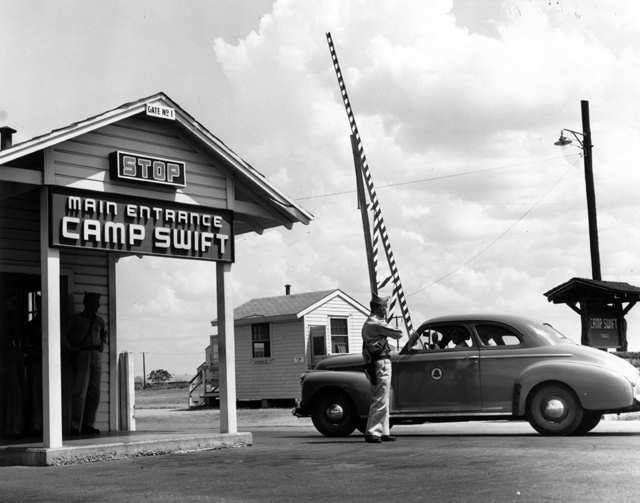
His US Veterans’ Burial Card refers to ‘Detach of Patients 1849th UFSC’ [sic]. This most probably refers to the 1849th Service Command Unit, based at the regional hospital at Camp Swift.
Following admission to hospital at Camp Swift, he was discharged from service owing to ‘pes cavus’, an abnormally high foot arch. The condition existed prior to service. Quite how he managed to pass the Army medical with such a condition in the first place is not recorded!
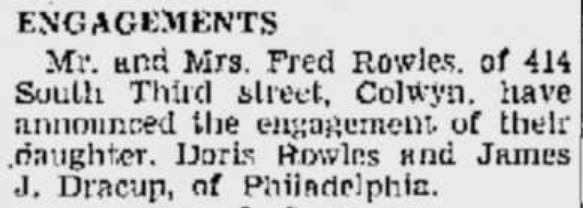
In February 1944 James became engaged to Doris Lilian Rowles, an English-born resident of Colwyn, Pennsylvania. However, in 1945, she married Arthur Nelson Thompson, who later became the Pastor of Colwyn Baptist Church.
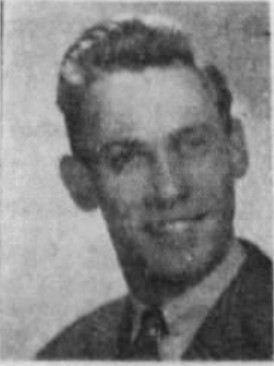
James (or Jim) attended the ‘Philadelphia College of Bible and Reformed Episcopal Seminary, Philadelphia’.
He seems to have worked subsequently as an evangelical youth worker and song leader, joining an outfit called the ‘Mount Holly Springs Bible Park and Rural Youth for Christ’ in July 1947.
At this point he began to perform ‘Gospel Magic’, defined by Wikipedia as follows:
‘Gospel magic is the use of otherwise standard stage magic tricks and illusions as object lessons to promote Christian messages. Gospel magic does not claim to invoke spirits or paranormal powers. Gospel magic is intended to present the Christian good news through “visual parables”; the trick or illusion is used to present theological points in an entertaining way with the intention that people will remember the message.’
It was pioneered by the Italian, Don Bosco (1815-1888)
In 1949, aged 25, he married Mary J Culver, aged 22, the daughter of a Philadelphia dentist. The 1950 Census shows them living together in an upstairs apartment at 4444 North 19th Street.
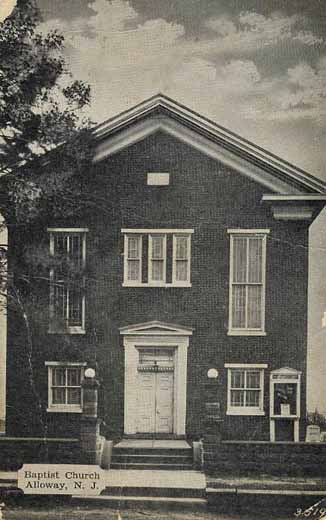
By 1951 he had been appointed pastor at the Alloway Baptist Church in Woodbury, New Jersey, but did not enter his final year at the Reformed Episcopal Seminary until September 1952. Shortly afterwards, their first daughter was born in Salem County Memorial Hospital.
In April 1953 he was elected Vice-President of the Fundamental Ministers’ Fellowship of Salem County. In October, when the couple celebrated their daughter’s first birthday, none of the Dracup family were invited; only his mother’s and wife’s relatives.
By 1954 Mrs Dracup was teaching the girls’ class at the Baptist Sunday School. She also functioned as Church Clerk. A second child, a son, was born in September 1954.
Jim was now becoming more widely known as a ‘Gospel Magic’ practitioner and occasional solo tenor.
On 1 June 1957 he transferred to the role of Pastor at the Grace Tabernacle Church, Fairmont, West Virginia, about 90 miles south of Pittsburgh. However, by January 1958, he was Pastor at Calvary Community Church, Penndel, on the north-east outskirts of Philadelphia.
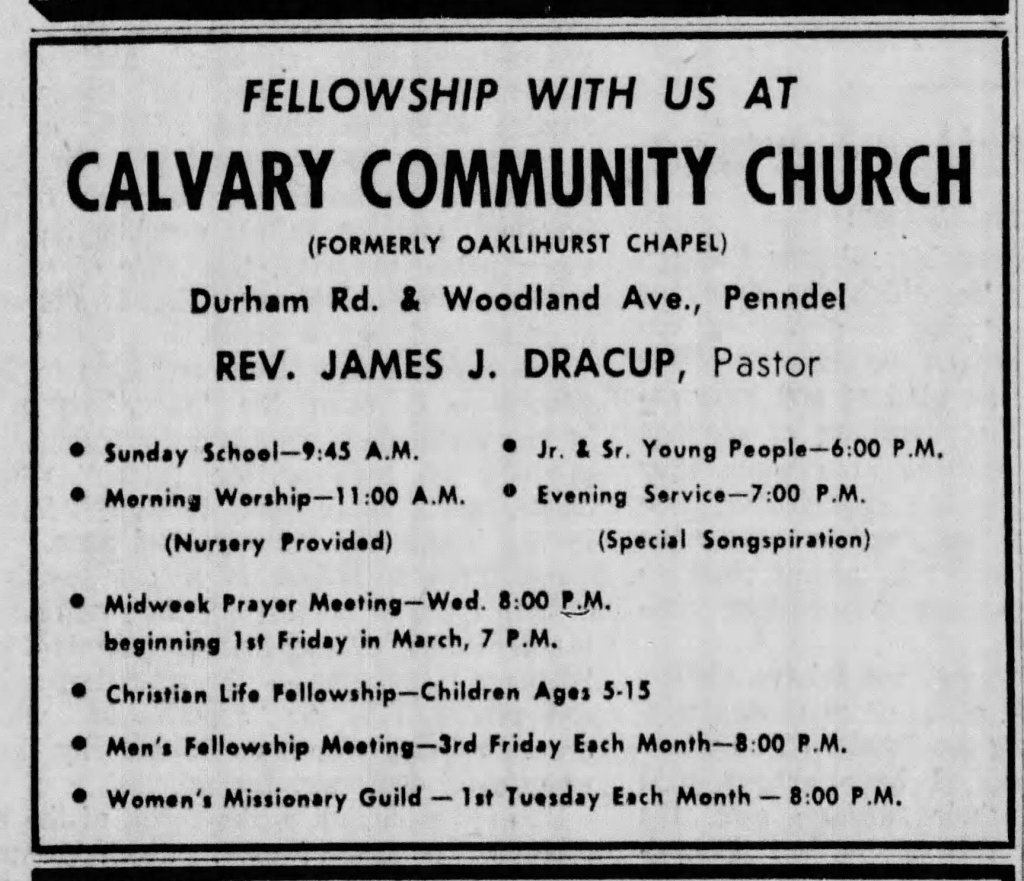
He was also pursuing further study by correspondence with the Pikes Peak Bible Seminary at Manitou Springs, Colorado (also known as the Burton College and Seminary after its founder, C J Burton).
(In 1960, the United States Office of Education included this institution in a list of ‘degree mills’ awarding bogus theological degrees.)
At some point in 1962 he gave up his pastoral role for full-time evangelical work, featuring his magician’s act. He was now a member of the Fellowship of Christian Magicians, formed in California in 1953, and the International Brotherhood of Magicians, founded in 1922.
But, later that same year, in a surprising career move, he joined the Bankers Advertising Company, Iowa City, before selling paper and printing for the Davis Printing Company, Bethayres, and finally joining the advertising staff of a local newspaper in Pennsylvania. This seems to have been a short-lived experiment, perhaps driven by financial necessity.
In 1964 he published his first book ‘A Magician Goes to Church’ – a guide to gospel magic and, for the next several years, seems to have concentrated on his magic show, describing himself as a ‘professional Gospel magician’.
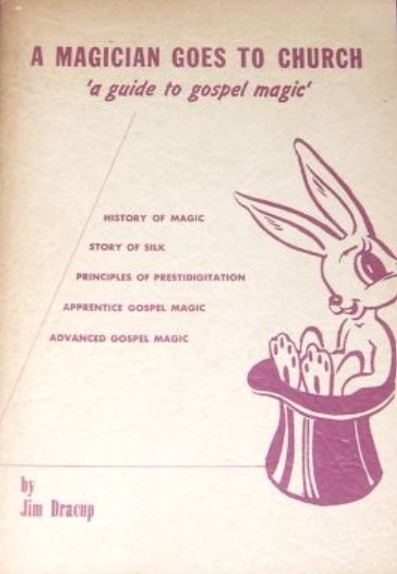
There must have been a divorce at some point because, on 11 November 1972, he married Katherine E Windle, 25 year-old daughter of William E Windle and Katie T Windle, nee Dittmar. He was now 48.
He left the details in a Niagara Falls Honeymoon Register the following day, including a home address – 6717 Cottage Street, Philadelphia.
His first wife, Mary, apparently relocated to California, taking their two children with her. She had a letter, addressed from Winchester, California, printed in the LA Times of 7 May 1973, and another on 15 October that year. By 1977 she had relocated to nearby Garden Grove.
By 1975, meanwhile, Jim had resumed a pastoral role, now at Tacony Baptist Church, Philadelphia. Twin daughters were born to Katherine in May of that year.
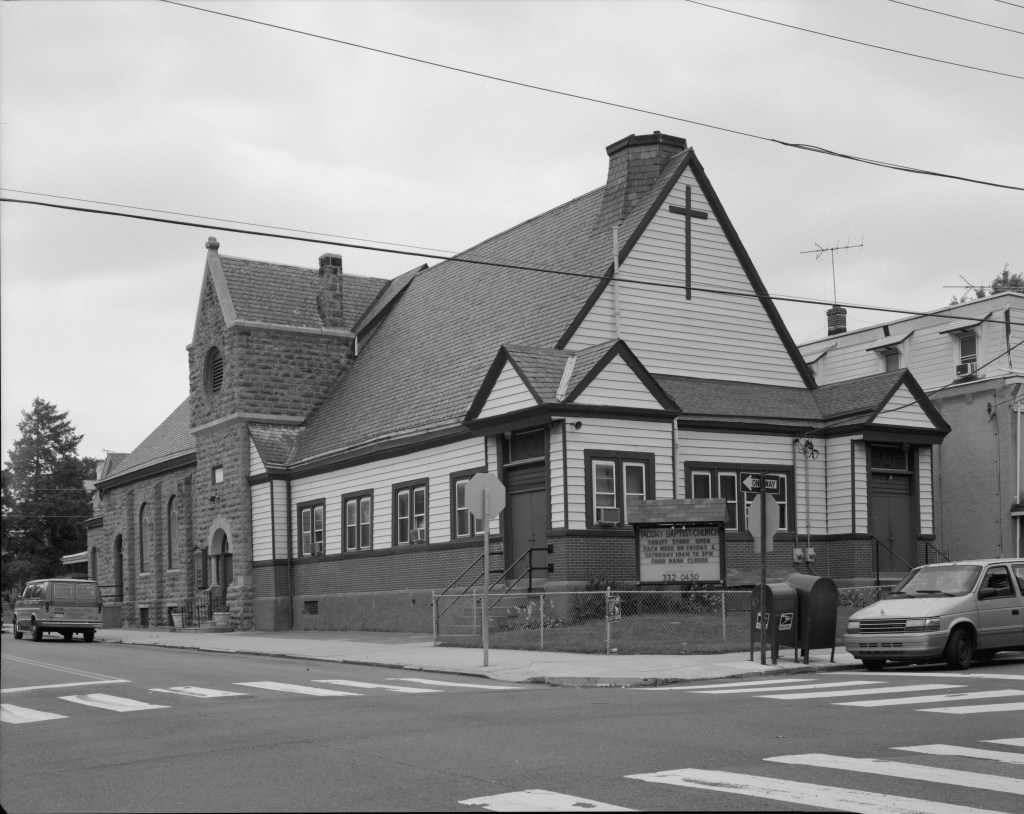
His mother Dorothy died on 13 February 1978, aged 75, at Wiley Mission Home in Marlton, New Jersey.
By 1980 Jim was Pastor at Marshall First Baptist Church, Battle Creek, Michigan, but he gave up the role a second time to write three further books: ‘Magic with an Upward Look’ (1985), Magic that Gives an Upward Lift’ (1986) and ‘Magic that Points to the Upward Life’ (1987).
He was also working on a doctorate by correspondence with Trinity College of the Bible and Theological Seminary, Evansville, Indiana.
When interviewed in April 1987, he said he was looking for a church closer to his home in Philadelphia. However, he seemed initially to return as Pastor to Battle Creek, before obtaining the post at Peckville Baptist Church in June that year. Peckville is near Scranton, Pennsylvania, some 120 miles north of Philadelphia.
In 1990 it was reported that he had earned a Doctorate in Theology from the ‘Evangelist Bible College and Seminary’ for a thesis on ‘Battling Satanic Elements’. He was also awarded a Doctorate of Divinity on the strength of his previous writings and service in the ministry, while the ‘Pacific Western University’ had offered him a position on its Board of Regents.
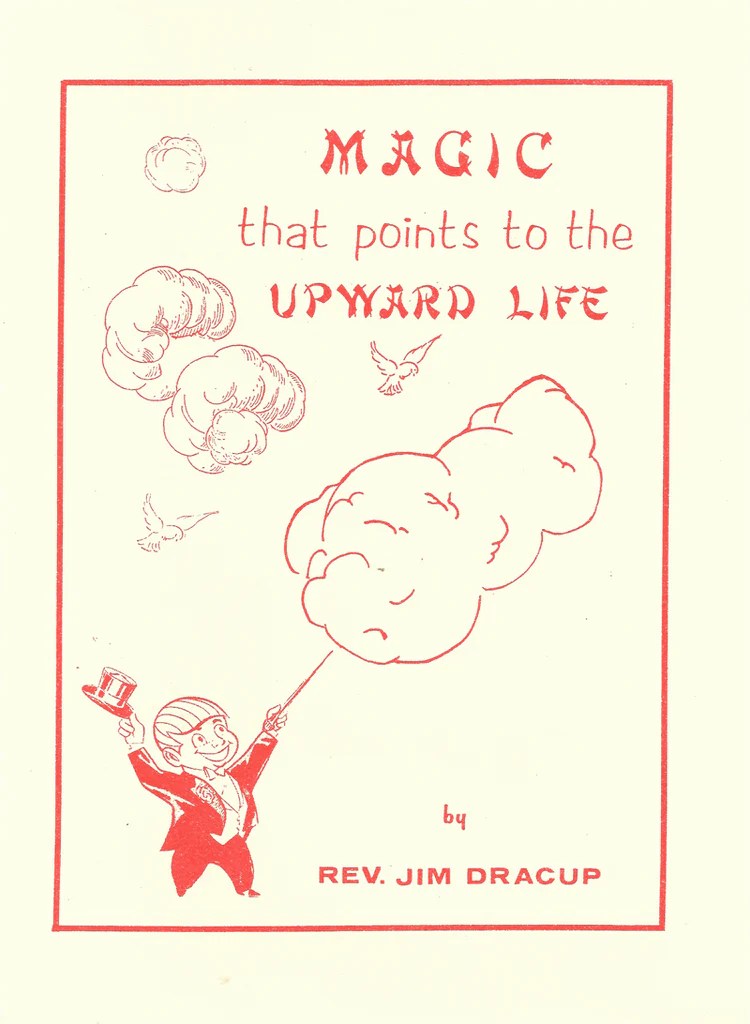
In a letter he wrote in 1998, preserved in the Fellowship of Christian Magicians online museum, he confirmed that his doctoral research wasn’t about ‘Gospel Magic’ but focused instead on ‘Satan, Satanism and the Occult’. He added that he now acted as a consultant to local police officers on such matters.
He continued as Pastor at Peckville until 1996 but, according to his letter, the congregation had fallen to just 12 people. His church was sold to another local church but, aged 72, he had too little pension to retire.
So he took on a pastoral role at a rehab centre and also at a nursing home. He was clearly frustrated by the weekly services he was expected to provide for Alzheimer’s patients.
In 1999 he became Chaplain at the Lackawanna County Health Care Centre, as well as Pastor of the First Christian Church, North Scranton.
He died on 20 April 2004, aged 80. His second wife, Katherine, died in February 2022 in Mayfield, Lackawanna, aged 74. His first wife outlived her, dying in June 2023, aged 95.
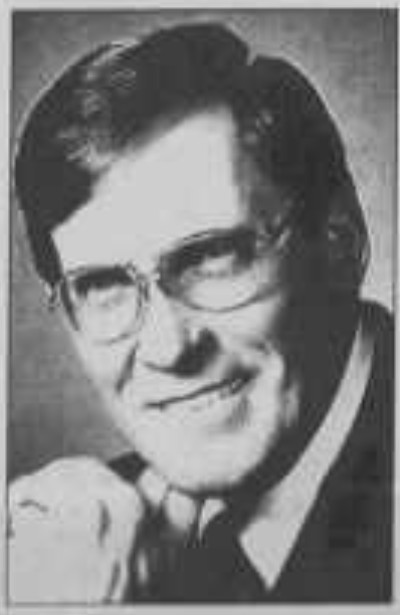
George Harry Dracup (1906-1984) and Mary Jane Lee
On 13 November 1928, James’s only surviving son, George Harry, married Mary Jane (Jenny) Lee. He was 22; she just 17, a resident of nearby Roxborough.
She had been born to Robert Dale Nelson Lee and Naomi V Lee, nee Woodward on 14 May 1911, but her father had committed suicide before her fourth birthday, shooting himself three times and wounding a woman in the right hip.
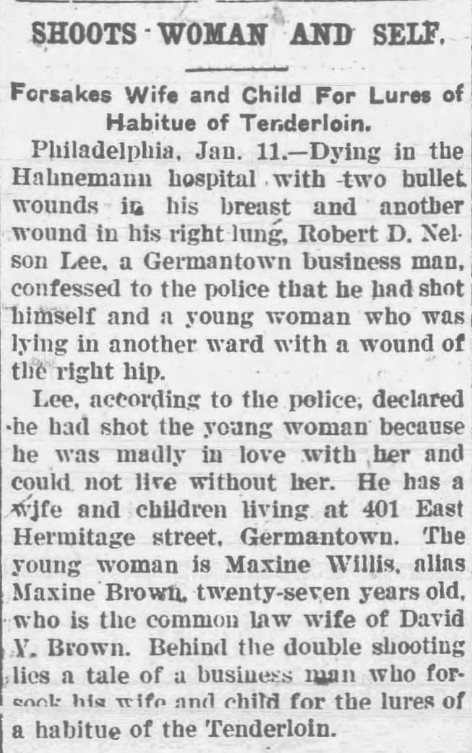
The injured woman was Maxine Willis, alias Maxine Brown, the common law wife of David Y Brown. Before dying, Lee confessed to police that he shot her because he was madly in love and couldn’t live without her.
The ‘Tenderloin’ was Philadelphia’s red light district, bounded by the Sixth, the Thirteenth, Race and Callowhill Streets.
Jenny’s mother, Naomi, nee Woodward, had remarried in 1917, to Elwood Hudders Whitworth, a paper hanger.
On the marriage papers, George gave his employment as ‘inspector’, while Jenny was described as a clerk. On the same day as her marriage, Jenny was baptised at St Luke’s Episcopal Church. Her mother-in-law, Florette, was named among her sponsors. Another was Howard Thomas, her nephew.
By 1930 they were living at the same Walnut Street address as George’s parents. George, 24, was now working as a clerk in a grocery store. Jenny was 19, but reported here as 17, her marriage said to have taken place when she was 15. Jenny’s nephew, Howard Thomas, was also living at the same address.
A daughter, Audrey Diane, had been born to George and Jenny in July 1929 at the Philadelphia Women’s Hospital. She was now eight months old.
In 1936 George was involved in a car crash. John M Anderson, 24, stopped his car to ask directions on Mount Ephraim Avenue in Camden, New Jersey, adjacent to New Camden Cemetery.
Another car crashed into his rear and all three of his passengers were cut and bruised. This incident must have recalled to George’s parents the most horrible memories of his brother’s death, some 13 years earlier.
A second child, named James Henry after George’s late brother, was born in Philadelphia in August 1937.
The 1940 US Census locates George Harry and family to 401 East Sharpnack Road, which was rented accommodation. George was working as a salesman for a bakery. He had earned $3300 in the previous year, but was putting in 75 hour weeks! Mary Jane was 28 and did not work.
Three children are listed: Audrey Diane (10), George Harry (8) and James Henry (2). The middle child’s identity is a mystery. He would have been born in 1932, but there is no birth record, he doesn’t appear in the 1950 Census and isn’t mentioned in either parent’s obituary.
A further son called George Elwood Dracup was eventually born, but not until 3 December 1945.
Their father’s WW2 Draft Card, completed in October 1940, reports the family living at the same address. George’s employer was identified as George Haasis, at 10th and Somerville Avenue, Philadelphia.
This was the Haasis Bakery. A few years earlier, in 1935, it had been at the centre of a public health scare, when 147 people fell ill after consuming cream puffs and similar products.
There were initially suspicions that cleaning fluid had been added to the pastry mix by accident, or that a disgruntled employee had doctored the products. However, salmonella was ultimately thought to have been the cause.
The draft card described George Harry as approximately 5 feet tall, weighing only 110lb, with brown eyes, brown hair and a light complexion.
On 22 April 1944, the Philadelphia Inquirer reported:
‘…the theft of $12 from a taxicab driver, George Dracup, of 401 E Sharpnack St,, by a man posing as a fare. The thief threw his arms about Mr Dracup’s throat when the cab driver halted the vehicle near 24th and Ellsworth Sts., as instructed by his ostensible passenger. The thug then compelled Dracup to turn over his receipts and fled. The cab driver not injured…’
By the time of the 1950 US Census, the family had moved to 305 Cliveden Street. George, now 45, was still employed as a cab driver, working a 45-hour week. Neither Jenny nor Audrey (now 20) were working, while James and George Elwood were at school.
There is an item in the Philadelphia Inquirer of 17 July 1954 about an argument, which refers to ‘George Dracup, 43 [he was 48] of Gerhard St. near Ridge ave, Philadelphia’:
‘It all started innocently enough when George took his dog for a walk. As he passed the property of Allan Roberts, at 419 W. Oak ave, Roberts suggested that George keep his dog a little further away from the Roberts’ property.
A mild argument ensued but, being a peaceable man, George went on his way to his summer home on Hudson ave. Once there he told his wife what had happened a few minutes before.
Mrs Dracup, apparently a determined woman, wasn’t going to let her husband lose the argument. She visited the Roberts’ place.
Once things got moving into a high gear, the glass in a door was broken and there was so much yelling a neighbor became excited. She dialed a number and excitedly urged the authorities to come quickly to the Hudson st. address.
Without stopping to ask questions, the fireman who answered the call turned on the alarm and two fire companies sped to the scene.
There was no fire, although most firemen agreed the quarrel was hot enough. The firemen called in the police, while a crowd of several hundred who had followed the apparatus chuckled and watched with interest.
Police put an end to the disturbance by taking Roberts and Mrs Dracup to the station.’
George died in January 1984 in Philadelphia and is buried alongside his wife, in the Northwood Cemetery. She died in February 2004.
Joseph Dracup (1879-1959) and Melinda Campbell
Shortly before the 1900 US Census was taken, Joseph Dracup married Melinda (sometimes Rinda) Campbell.
The ceremony took place in Philadelphia on 3 February 1900, when Melinda was 16 (though she claimed to be 17) and Joseph 21.
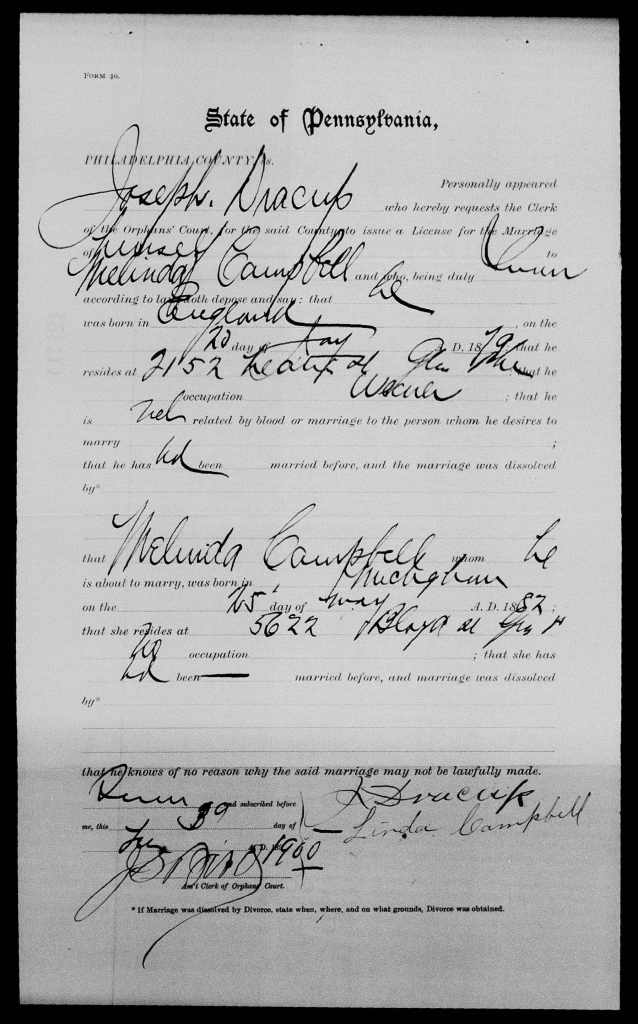
Melinda was born on 25 May 1883 in Bayfield Wisconsin to Roger W Campbell and Adeline Jane, nee Angus. Her father had died in 1890, and her mother had remarried one John Malarkey. By 1900 they were resident in Grange Street, Philadelphia.
At the time of the wedding, Joseph’s occupation was ‘weaver’, but Melinda was not working and resident at what looks like ‘5622 Floyd Street’, so not with her family.
I can’t find Melinda in the 1900 US Census, but Joseph was living at Nedro Street with his family and the census entry marks him as ‘single’.
It is conceivable, then, that the marriage had already broken down, although his brother James was in exactly the same position – presented as single despite being married and living apart from his wife.
By 1903, Joseph had moved to Providence. Rhode Island, where he was employed as a comber and boarded in Delaine Street.
The record of Joseph’s second marriage (see below) includes the statement:
‘Divorce: Joseph Dracup and Linda C Dracup; Appelate Division of the Supreme Court in S Kingstown, Rhode Island; Decree: Nov 9 1903; Grounds: Desertion.’
I could find no details of Melinda’s life between the divorce and her death, in Superior, Wisconsin on 20 March 1915. She was buried in the Greenwood Cemetery there on 22 March, under the name ‘Linda Dracup’. Her mother attended the funeral.
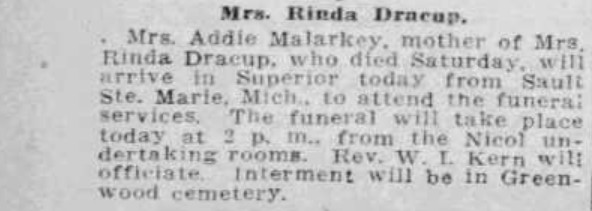
Joseph was caught by the 1905 New York State Census. He was now living in Auburn with his brother James and his young family. Like his brother, he was described as a boss comber in a carpet factory. However, the 1905 Auburn Directory says they were both ‘carders’ living at 17 Aurelius Avenue.
The 1906 Directory says Joseph had ‘removed to Philadelphia’.
Joseph Dracup and Louise Mullelly
On 15 June 1907, Joseph, now 28, married Louise M Mullelly, aged 23. He was living at 5793 Beechwood Street in Philadelphia and was employed as a weaver. She was living at 5307 Stenton Avenue and was a servant.
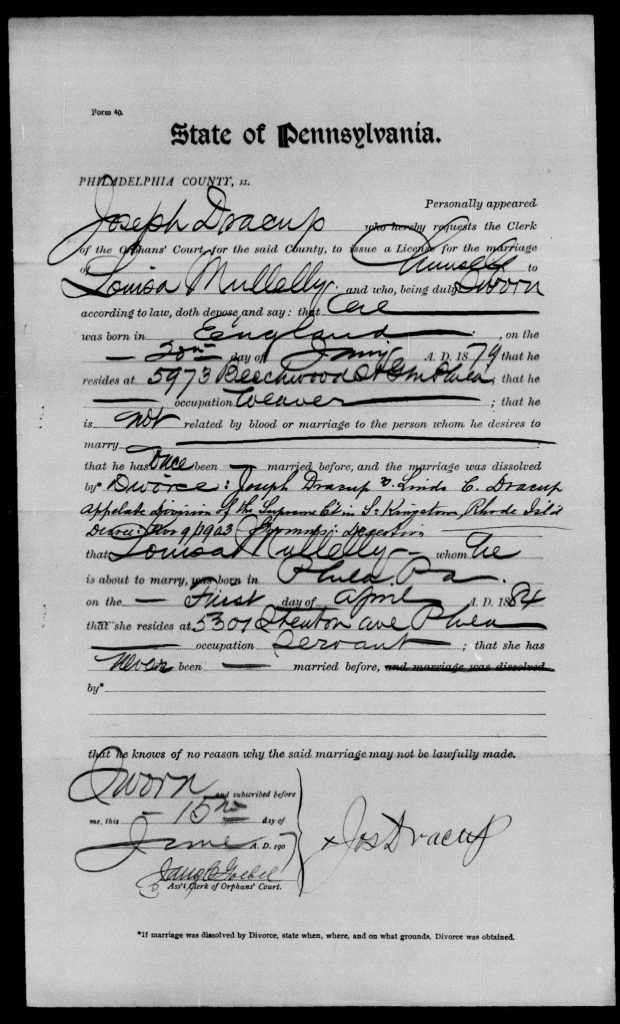
Louise was the eldest daughter of Michael Mullelly, an Irish-born blacksmith who was to die shortly after the marriage, and Winifred, nee Conway, also Irish-born. Winifred was living elsewhere in Philadelphia with several other sons and daughters.
By 1908 Joseph and Louise had moved to Worcester, Massachusetts, where Joseph was employed as a comber once again. They were now boarding with his father at 2 Homestead Avenue. He remained at the same address in 1909, but had become an assistant foreman.
By 1910, he and Louise were living in Webster, Massachusetts, some miles south of Auburn. The 1910 US Census lists them at 24 North Main Street, Webster. Joseph was now 31, his wife 26 and they had no children, living or dead. They were renting their home and Joseph was employed as a foreman at a woolen mill.
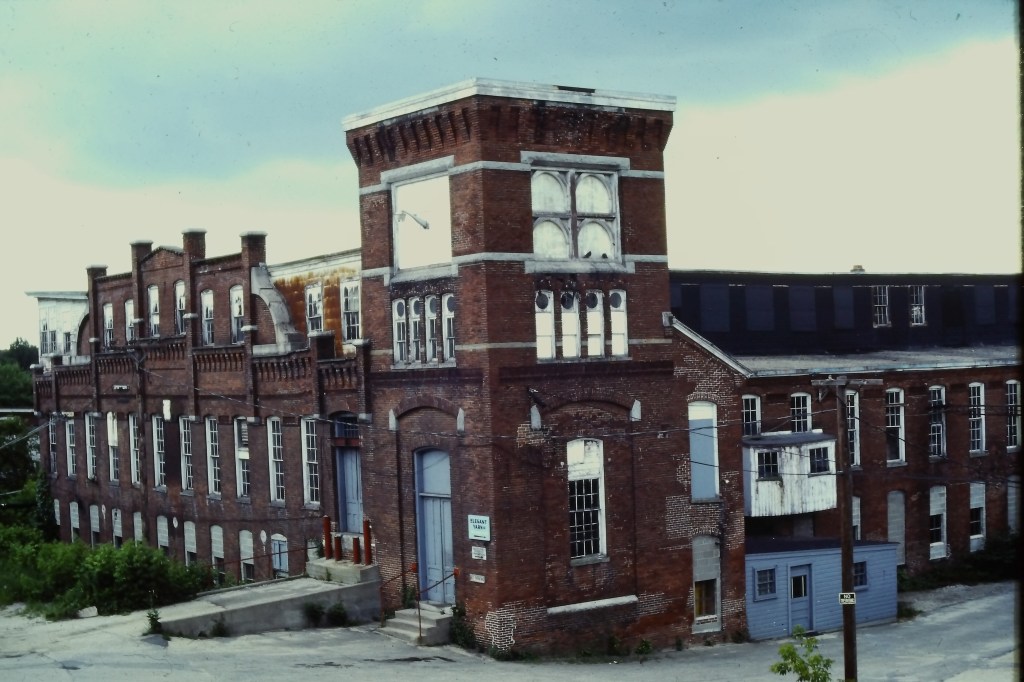
By 1912, Joseph had moved once more, working at the Saxonville Mills in Framingham, Massachusetts and living at 25 Central Street Saxonville. In March 1912 he placed an advertisement in the local paper offering ‘four Boston terrier dog pups’ for sale.
The 1914 edition of the Framingham Directory showed him still working at the same establishment, but now living at 12 Water Street, Saxonville, again with his father and mother. The 1916 edition of the Directory reported that he had moved to Philadelphia.
The 1916 Philadelphia Directory locates him at 5104 Germantown Avenue. By 1918, he was employed as a machinist, living at 5109 Lena Street, together with his brother George, alongside his father’s home at 5111 Lena Street.
His WW1 Draft Registration Card, completed on 12 September 1918, gave his address as 5111 Lena Street. It stated him to be 39 years old, working as an ‘auto machinist’ with Baldwin’s at 18th and Hamilton Street, the same company that employed his brother James. Louise was named as his nearest relative, living at the same address.
He was described as of medium height and build, with brown eyes and brown hair.
The 1919 Philadelphia Directory listed Joseph as an ‘auto mechanic’ still living at 5111 Lena Street, and the 1920 US Census also located him at this address, but he and Louise were now sharing with the Clark family, Margaret Clark being Louise’s sister, Margaret Magdalene nee Mullelly.
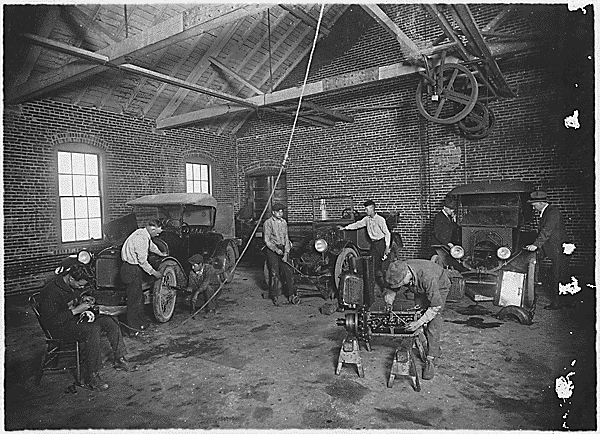
Joseph was now 40 and Louise 35. He was working as a machinist at a garage on his own account. This must have been the Wister Garage which also employed his brothers. Both Joseph’s and William’s home address was given as 5109 Lena Street.
On 14 July 1920, a son was born and given the name Joseph Francis Dracup. But it is not completely certain that Joseph was the father.
At the time of the 1920 Census, one Aloysius Farrell, aged 36, was living with his mother and four siblings in Church Lane, off Opal Street, about a mile and a half from Lena Street, employed as a chauffeur by a private family.

Joseph is listed as an auto mechanic in the 1921 and 1922 Philadelphia Directories. By 1923, though, the Wister Garage had become ‘Dracup Bros’, located at 16 East Wister Street.
It was described as a partnership between George, James and William. Joseph was apparently no longer involved, though he was still listed as an auto mechanic and still living at 5111 Lena Street.
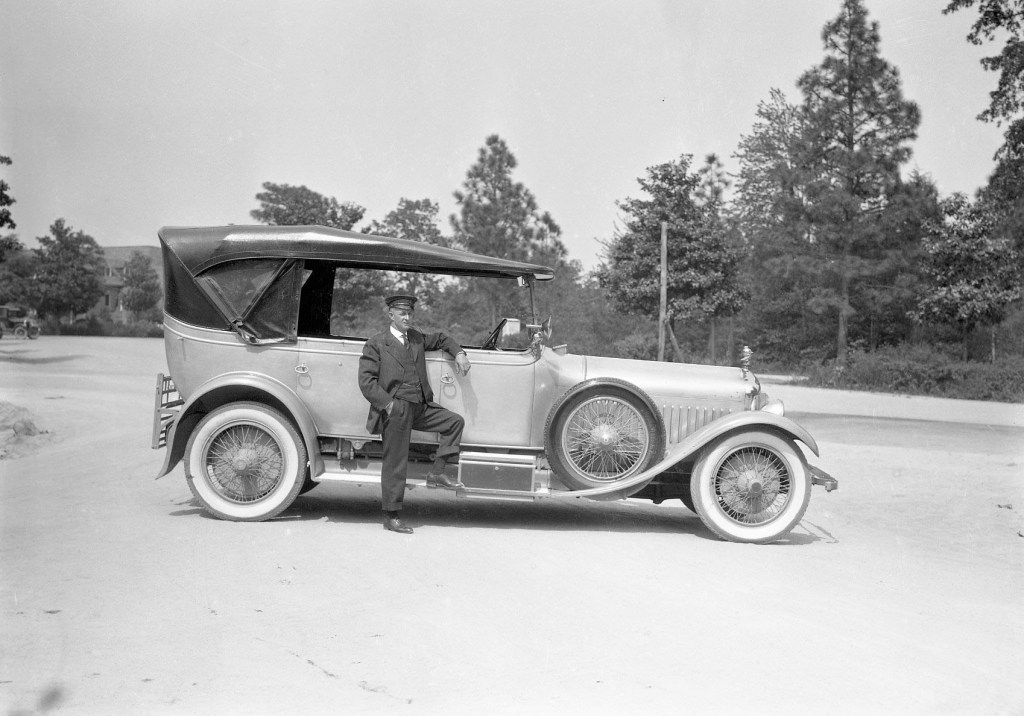
Meanwhile, Aloysius Farrell, still employed as a chauffeur, continued to reside in Church Lane according to the 1924 Philadelphia Directory.
In January 1924, Louise was granted a divorce from Joseph, so she probably married Farrell very shortly afterwards, but I have been unable to find a record.
Exactly a year later, on 19 January 1925, gave birth to a daughter, Elizabeth Farrell, in Johnsville, Warminster, Pennsylvania, pointing to the couple’s new location.
Sadly, Elizabeth died of ‘marasmus’, severe malnutrition, on 8 August 1925. She was buried in the Holy Sepulchre Cemetery.
Another child, Aloysius Francis Farrell, was born on 7 June 1926, also in Warminster, Pennsylvania. He survived.
The 1930 US Census records Louise living with Aloysius senior in a part of Warminster known as ‘the speedway tract’ – an area that had been partly leveled in 1914 to make space for a combined speedway and horse racing track. Construction began but, owing to the Depression, was never completed.
The family owned the property, said to be worth $2000. Aloysius declared that he was 44 and that his age at the time of his first marriage was 32. Louise said she was 45 and that her age at the time of her first marriage was 33.

Leaving aside the fact that she had forgotten her marriage to Joseph, this suggests that they were married as early as 1918, fully six years before Louise and Joseph divorced. Perhaps this was a falsehood designed to show that Joseph had been born in wedlock.
There were two children in the house: ‘Joseph Farrell’, now aged 9, and Aloysius Farrell aged 4. Aloysius senior was employed as a house painter. Both Joseph and Aloysius junior were listed as his sons, whereas it would have been standard practice to refer to Joseph junior as a stepson.
Joseph Francis’s birth record will shortly be published by the Pennsylvania State Archives, but is likely to show Joseph Dracup as the father, even if Aloysius Farrell was responsible.
Meanwhile, Joseph senior had returned to live with his parents, Harry and Ruth, at 64 East Wister Street. He was now 50 and described himself as widowed. He stated he was employed as an automobile mechanic in a garage, although his name was not included in the Philadelphia City Directory for 1930.
Aloysius Farrell senior died on 30 April 1934, aged 46 (the death certificate mistakenly says 48). The cause of death was ‘myocardial degeneration’, with ‘acute cardiac dilation’ as a contributory factor. He had been suffering with these conditions for 18 months.
The certificate states that he was married to Louise, was employed as a painter, and that their address was 943 Church Lane in Philadelphia. So they had returned to Philadelphia at some point after 1930. He was buried in the Holy Sepulchre Cemetery, on 4 May 1934.
There was seemingly no reconciliation between Louise and Joseph. The 1940 US Census indicates that Joseph was still living with his mother, still at 64 East Wister Street. He was now 61, still claiming to be widowed, and worked 32 hours a week as a picker in a cloth mill. He had only worked 24 weeks in 1939, for an income of $240.
Meanwhile, Louise was resident at 1220 East Chelten Avenue, two kilometres away. She stated that she was 56, also widowed, and was employed as a seamstress for a private family. However, she had been out of work for 26 weeks and had earned nothing in 1939. She cited other sources of income, however.
Joseph junior and Aloysius junior were living with Louise. Joseph, now 19, was employed as a clerk in a tax office while Aloysius was still at school.
Joseph senior’s WW2 registration card, completed in April 1942, gave his address as 339 East Wister Street. He was 63 and was working at Wister Spinning Mills, just along the road at 500 East Wister Street. He listed his brother James as his contact.
He was described as approximately five feet tall, weighing 115lb, with brown eyes, grey hair and a light complexion. He had a tattoo on his right arm and a scar on his right leg.
By 1950 Louise was living at 5008 Castor Avenue in Philadelphia, with the family of Charles Wesley Banes, who worked as a driver for the Philadelphia Enquirer.

His wife was Agnes, nee Bispels (see below). Agnes’s daughter and son-in-law were part of the same household, as was their son. Now 64, Louise was described as a ‘friend’ and a widow. She was no longer working.
Joseph senior was apparently living by himself in an apartment at 339 East Wister Street. Now 71, he described himself as ‘separated’. He too was no longer working.
Louise died on 15 December 1955, aged 71. The death certificate named her ‘Louise Mullelly Farrell’ giving her address as 5008 Castor Avenue, Philadelphia. The cause of death was kidney cancer. Joseph junior was the informant and gave the same address.
Louise was buried in the Holy Sepulchre Cemetery, Cheltenham Township, alongside Aloysius and her sister, Mary Gribbin, nee Mullelly.
Joseph senior died on 20 August 1959, at the Floyd Nursing Home, of uremia, complicated by arteriosclerosis and senility. He was 80. His home address remained 339 East Wister Street. The informant was his brother, George. Joseph was buried in the Chelten Hills Cemetery.
Joseph Francis Dracup (1920-2000)
The 1940 US Census records that Joseph had completed four years of high school, having left Germantown High School in 1939. His employment as a tax office clerk earned him $1000 in 1939.
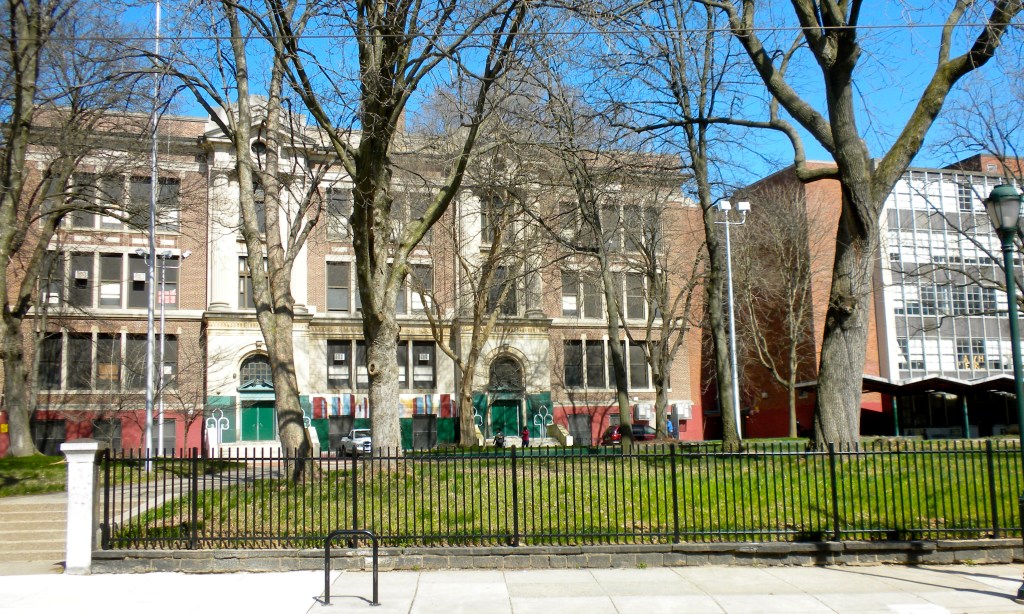
He went on to attend the College of the City of New York and Brooklyn College, though may not have graduated.
His WW2 draft registration card, completed on 16 February 1942, names him Joseph Dracup rather than Joseph Farrell. Presumably, on attaining his majority, he had decided to alter his name to his father’s.
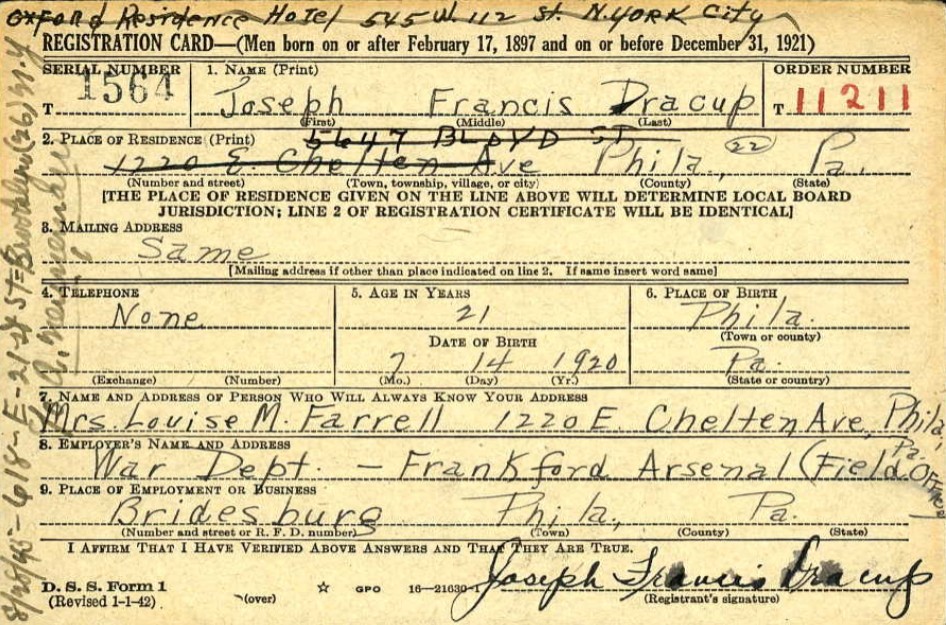
But he still gave his mother’s name as the person ‘who will always know your address’, while his own several changes of address are scrawled across the card.
At the time of registration he was employed as a Field Officer at the Frankford Arsenal, Bridesburg, Pennsylvania. Frankford was effectively a self-contained community in north-east Philadelphia with its own police, fire department and medical centre.
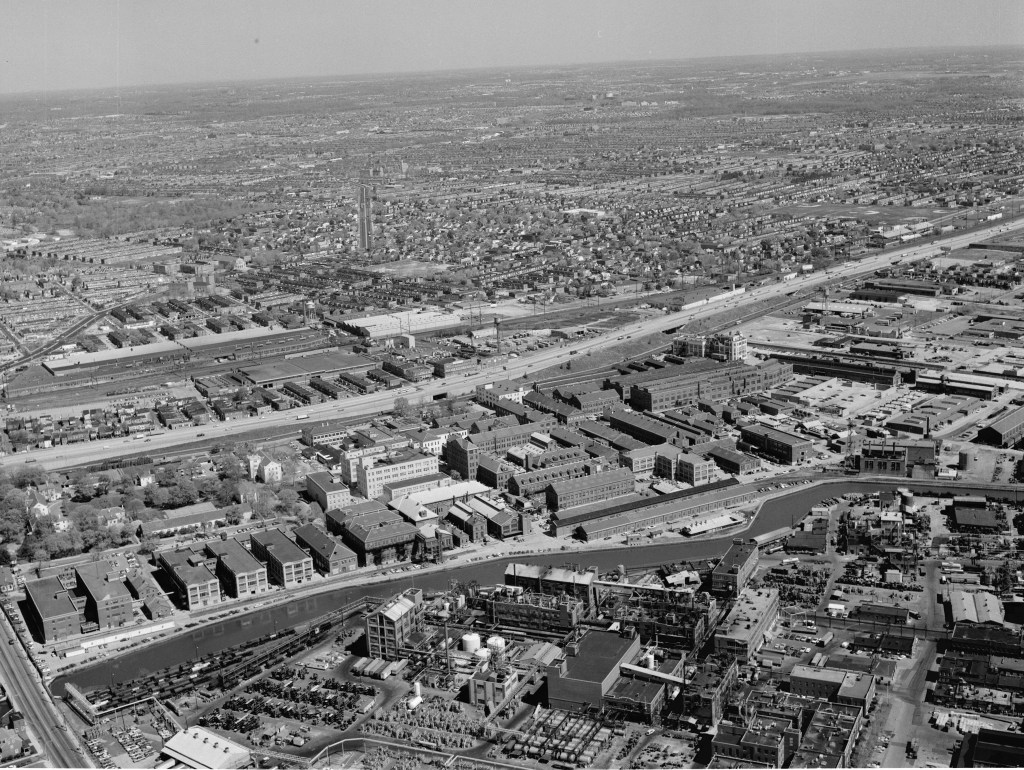
He was described as 5 feet 11 tall, weighing 150lb, with blue eyes, brown hair and a light complexion. He wore glasses.
He married Phyllis M McMahon in Manhattan on 31 January 1945 when he was 24 and she was 21. She had an unusual birth history which had strong parallels with Joseph’s own.
Her father was Philip Paul McMahon, an Irish-born chauffeur, resident in Philadelphia. Her mother was Agnes Veronica nee Bispels.
McMahon had married Agnes’s niece, Marie Bispels, in 1920, while Agnes was married to Charles Wesley Banes. Nevertheless, it was Agnes who, according to her obituary, was Phyllis’s mother.
By the time of the 1950 US Census, Joseph and Phyllis were living in an apartment at 618 East 21st Street in Brooklyn. He was now 29, she 26. Both were working 40-hour weeks, she as a typist in an insurance company; he as a mathematician with the Department of Commerce.
They had living with them an aunt by the name of Anna Nuenemann, who worked as a ‘salad lady’ at a hotel.
Phyllis’s birth mother, Agnes, died in Fort Myers Beach, Florida, in June 1962, the obituary stating that Phyllis was one of her two daughters. Phyllis’s birth father died in Philadelphia in September 1963.
At some point in the 1960s, the couple divorced. There were no children. Phyllis remarried, to Edward Drenzek, in March 1968.
When Maria nee Bispels died in December 1980, her obituary also stated that she was Phyllis’s mother.
Phyllis herself died in 2013 in Ridgefield, Connecticut, aged 89.
In 1970 or thereabouts, Joseph also remarried, in his case to Nettie, nee Rosenberg. Both were aged about 50. Nettie was New York-born, the daughter of Charles Rosenberg and Sophie, nee Mager.
In May 1942, at the age of 21, she had married Daniel Markovitz, who joined the USAAF in March 1943. Sadly, he was killed on 12 April 1945 at the Bergstrom Airfield in Austin, Texas, when he was struck by a moving aircraft.
According to a biography published by the American Association for Geodetic Surveying (AAGS), as early as 1940, Joseph junior was working as a Geodetic Computer at the United States Coast and Geodetic Survey’s (USC&GS) Philadelphia Computing Office.
Geodesy is the science of measuring and representing the geometry, gravity and spatial orientation of the planet. It is considered a branch of applied mathematics.
The USC&GS was a scientific agency of the United States Government, founded in 1807 and extant until 1970. In 1913, it was brought under the jurisdiction of the US Department of Commerce.
In December 1941 its work programme was suspended when the United States entered the Second World War. About half the Survey’s civilian workforce (around 1,000 people) joined the armed services, while the remainder supported the War effort in their civilian roles.
According to the AAGS, Joseph transferred to the New York Computing Office in 1943, working there for the next two decades. By 1962, he had been promoted to ‘Geodesist-in-charge’.
Then, in 1964, he moved to the new headquarters of the USC&GS in Rockville, Maryland, initially as ‘Assistant Chief, Triangulation Branch’. He rose to become the Survey’s Chief Geodesist, known as the ‘Chief, Control Networks Division’.

In 1965, the Department of Commerce established the Environmental Science Services Administration (ESSA) which oversaw the Survey and the US Weather Bureau. In 1970, both ESSA and the Survey were abolished and their functions integrated into the National Oceanic and Atmospheric Administration (NOAA).
In 1971, Joseph was awarded the US Department of Commerce’s Silver Medal Award for Meritorious Federal Service. He had several roles in the American Congress on Surveying and Mapping (ACSM). By the time of his retirement in 1979, he had published or co-published some 55 books and articles.
He retired in 1979 and moved with Nettie to Sun City West, Maricopa County, Arizona. In 1988, ACSM established an annual Joseph F Dracup scholarship and, when Nettie died on 13 August 1997, aged 76, he established a further memorial scholarship in her name.
Following his retirement, Joseph published a series of articles describing the history of geodetic surveying in the United States and, just before his death, completed a fuller ‘Brief History of Geodetic Surveys in the United States, 1807-2000’.
He died in Sun City on 16 January 2000. He and Nettie were interred together at the Sunland Memorial Park. There were no children.
William Dracup (1882-1927) and Harriet May Jamieson
Like his siblings, William was still in the parental home at the time of the 1900 US Census, aged 17, and not yet in work.
But on 26 June 1902, aged 20, he married Harriet May Jamieson, aged 18, in South Kingstown, Rhode Island. She was the daughter of David A Jamieson, a Scottish-born tailor, and Abby, nee Aldrich. By the time of the marriage, William was working as a comber and carder.

A son, Harry Crafton Dracup, was born in South Kingstown on 1 September 1903. The ‘Crafton’ is, presumably, a not-quite-accurate rendition of his grandmother’s middle name ‘Clafton’.
We can place the family in Montgomery, Orange County, New York in 1908, since there is a newspaper article recording their involvement in a car accident at nearby Middletown. They were traveling with the Editor of the Montgomery Standard, Lyman H Taft, his wife and his son Thomas.

Mr Taft went wide to overtake a horse and cart, but his car hit the abutment of a bridge, causing it to overturn and throw its occupants into the road. Mr and Mrs Taft seemed to have received the more serious injuries.
Mr Taft was said to be a distant relative of the President of that name.
By the time of the 1910 US Census, the family was resident at 16 Pearl Street, Webster, Massachusetts, some 20 miles south of Worcester. Their house was rented. William was now 28 and Harriet (Hattie) 25. Harry, the only child born to the couple, was 7. William was working as foreman at a woolen mill.
By 1913 they had moved to 3 Alden Avenue, Auburn, New York, where William was employed by Nye & Wait, where his uncle Afred Fisher Wallace worked.
In 1914, the Auburn directory said that William had removed to South Barre, Massachusetts.
On 18 March 1914, while at Barre, William instituted divorce proceedings against ‘Harriet M Dracup of Wakefield, Rhode Island’, on the grounds of desertion since 31 January 1911.
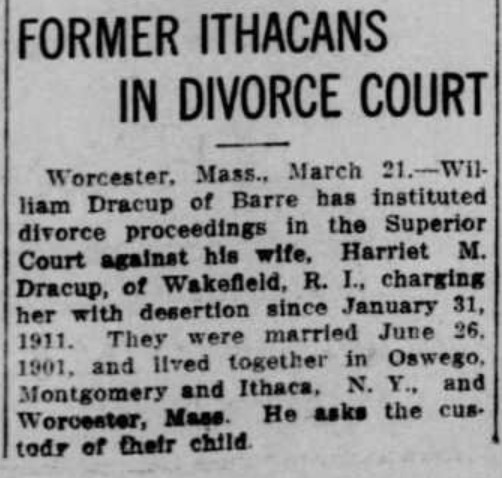
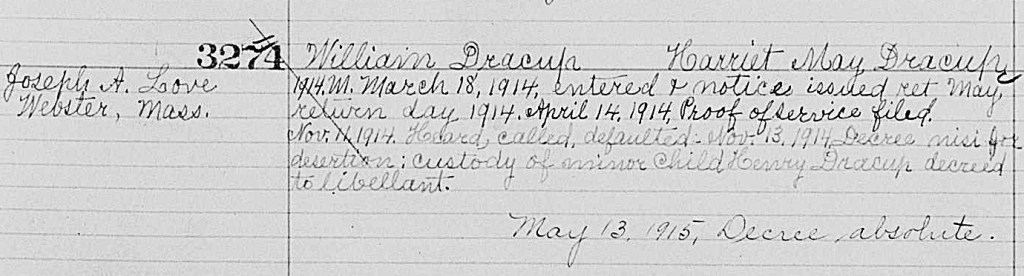
According to the newspaper report, they had lived together in Oswego, Montgomery and Ithaca in New York, and in Worcester, Massachusetts. William requested custody of his son Harry. Decree nisi and custody were both granted on 13 November 1914, and decree absolute on 13 May 1915.
On 1 November 1915, back in South Kingstown, Rhode Island, Harriet, now 31, married 30 year-old Daniel Patrick McDonnell, a locomotive fireman from Providence. His WW1 Draft Registration Card describes him as of medium height and medium build, with brown eyes, brown hair and no distinguishing features!
They lived together until Harriet’s death in 1961, aged 77.
Meanwhile, William had removed to Sherbrooke, in the Province of Quebec, Canada, about 100 miles east of Montreal. When completing his WW1 Draft Registration Card in September 1918, he described himself as an ‘overseer, combing and carding’ with the Paton Manufacturing Company.
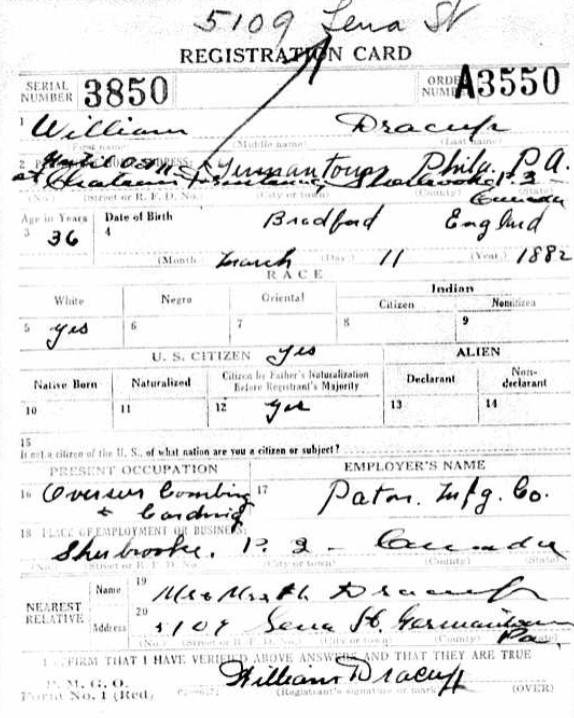
The physical description is of a man five feet five-and-a-half inches tall, having a medium build, brown eyes and dark brown hair. He gave his mother’s name as his nearest relative.
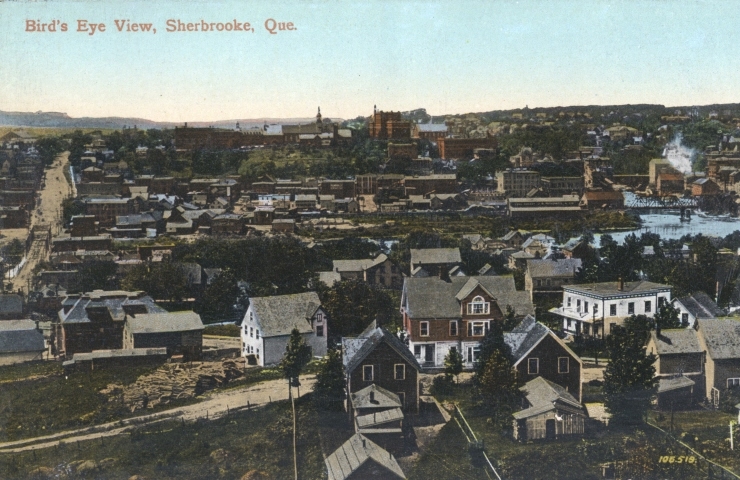
On 31 January 1920, William claimed US Citizenship by virtue of his father’s naturalization. He stated that he had left the United States on 14 August 1914 for Sherbrooke, where he was working as a comber and carder for the Paton Manufacturing Company and living at 154 Wellington Street.
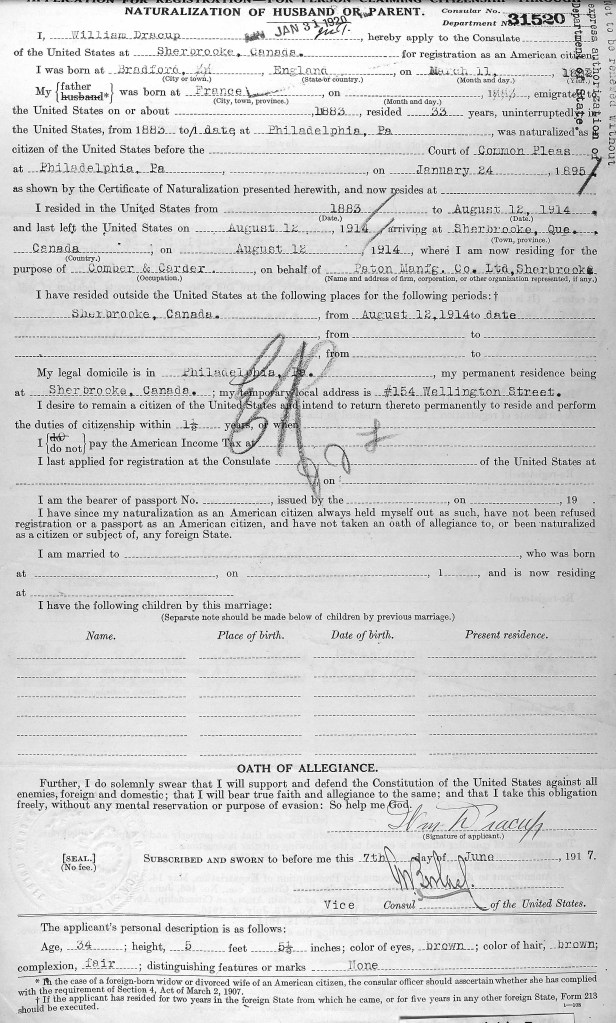
He named his legal domicile as Philadelphia and stated that he intended to return to the United States within the next 18 months.
The 1920 US Census recorded Harry Crafton living with his grandparents, Harry and Ruth, at 5111 Lena Street, Philadelphia. William was most probably still in Canada.
In the 1921 Philadelphia City Directory, William was listed as working at the Wister Garage with his brothers, and living at 5109 Lena Street. In 1922 he was described as an auto-mechanic, still resident at the same address.
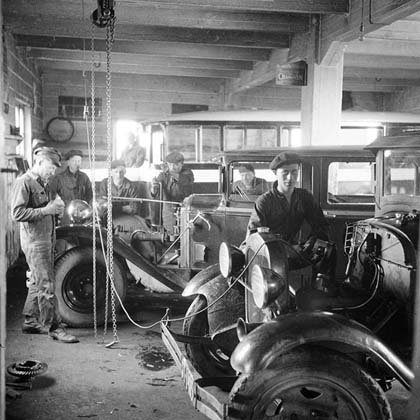
In 1923 he was still at 5109 Lena Street, one of three workers at the Dracup Brothers Garage, 16 East Wister Street. The same is true in 1924 and 1925, except that William was living at 64 East Wister Street.
William died on 29 January 1927, aged 44, at the Germantown Hospital, of Pneumonic Meningitis. His home address was still 64 East Wister Street. He was buried in the Chelten Hills Cemetery on 2 February. The death record was confirmed by his son who was living with him at the same address.
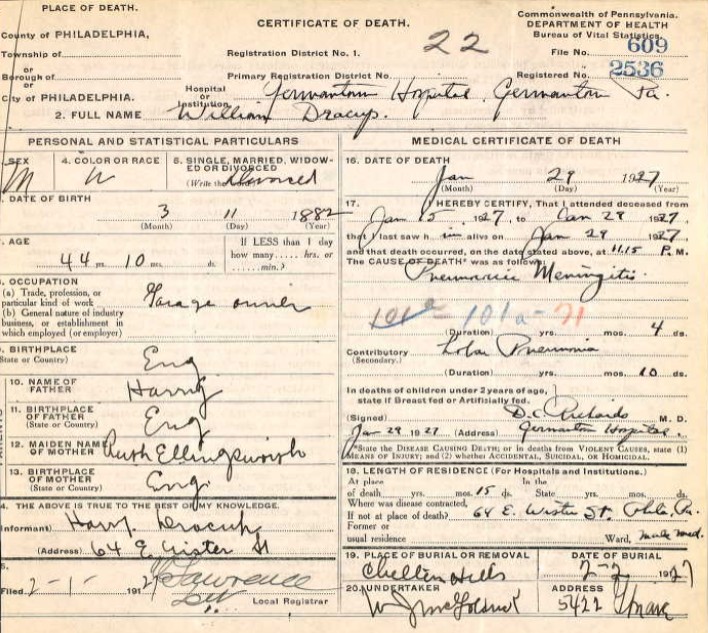
After probate, William’s estate was worth just over $10,000.
Harry Crafton Dracup (1903-1970) and Beatrice, nee Aveyard
18 months later, in June 1928, aged 24, Harry married Beatrice May Aveyard in New Jersey. She was 27, the daughter of William Aveyard and Emily nee Fieldhouse, both English-born.
In 1929 they were resident at 53 Penn Street in Camden New Jersey, Harry employed as a salesman.
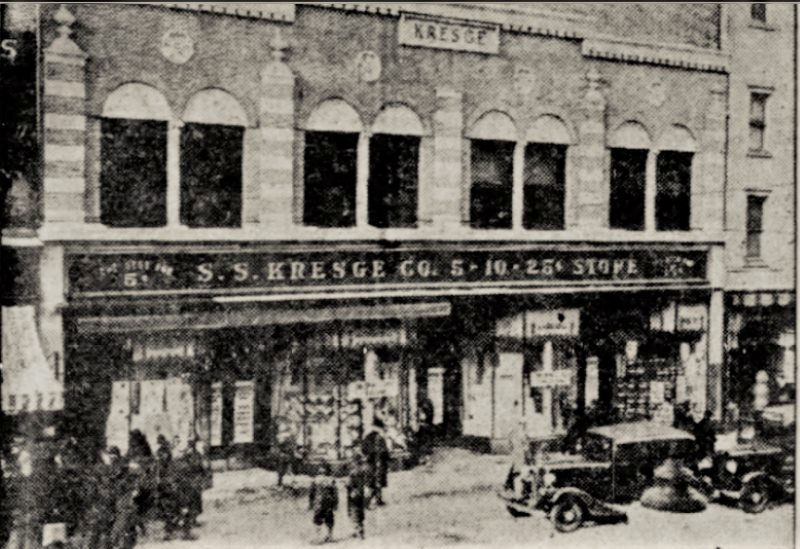
But 1930 found them removed to Alexandria, Virginia. Harry was now an assistant manager at SS Kresge and Co. and they lived at 108 South Royal Street.
The 1930 US Census confirmed them at this address, living in rooms with a Mr and Mrs Schultz. The name of Harry’s employer was again given as Kresge and Co. Beatrice was not working.
SS Kresge was a chain of discount department stores established by Sebastian Spering Kresge, a Pennsylvania businessman. The stores were renamed Kmart in 1977.
We know that the couple had returned to Camden, New Jersey by 1935. A local newspaper reports that several members of the ‘ICS Students Association’ have formed a hunting and fishing club. H C Dracup was appointed the Secretary and Chairman of the fresh water fishing committee.
This is presumably a reference to the International Correspondence School, originally established in Scranton, Pennsylvania. This was, presumably, the same institution that his uncle George Harry had been involved with some years earlier.
In June 1935 Harry took part in the recount of the city commission election, serving as one of the officers for one district. He was described as an inspector, resident at 53 Penn Street.
In October 1936, another local newspaper report mentioned Harry:
‘Francis Poor and his wife Peggy, of 317 North Front street, were arraigned in court on complaint of Harry Dracup, of 53 Penn Street, proprietor of the room they rent. Poor’s head was swathed in bandages, and his wife’s eyes were discolored, as the result of a family “disagreement” Tuesday night, it was testified. Mrs Poor was released.’
On 1 February 1937 Harry enlisted in the Naval Communication Reserve of the Fourth Naval District. A Muster Roll dated 30 June 1940 lists him with the service number 404-88-73, his rank RM3c. This meant Radioman Petty Officer 3rd class.
A further report on 31 March 1941 adds that he enlisted in Camden, New Jersey.
The Fourth Naval District covered Pennsylvania, Delaware and the southern part of New Jersey, having its headquarters in Philadelphia. The Naval Communication Reserve trained its volunteers in radio communication and radio repair, should their services be required by the Naval Communication Service in time of war, or other emergency.
In December 1937 Harry was elected President of the Greater Camden Amateur Radio Association. Amateur radio enthusiasts were widespread at this time: in 1936 there were 46,000 licensed radio amateurs across the United States.
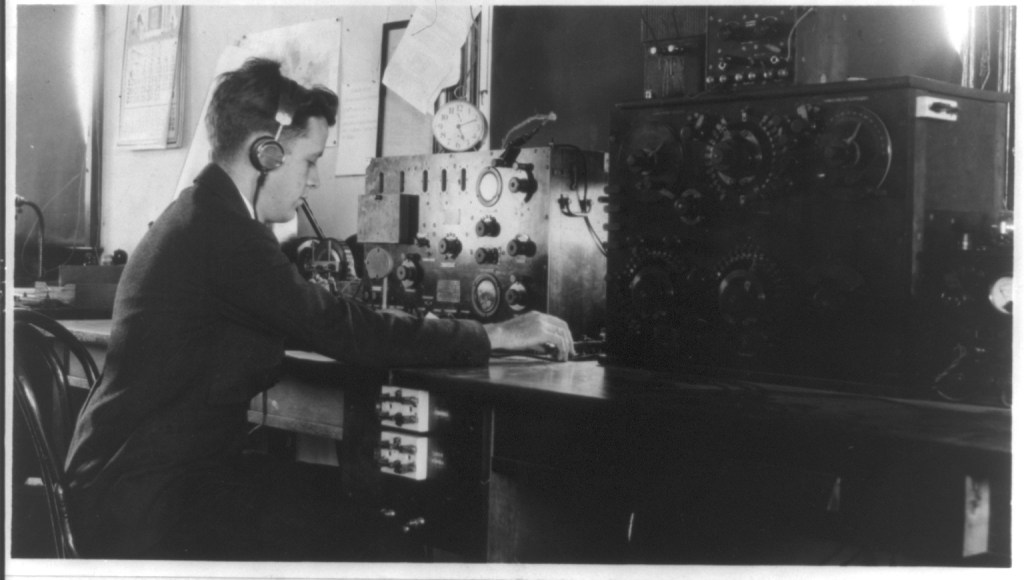
Harry’s call sign was W3GFL. He was included in the Radio Amateur Call Books for 1937 through to 1941, his address always given as 53 Penn Street, Camden.
A daughter, Ruth Emily Dracup, was born on 13 January 1940.
The 1940 US Census recorded the family resident with Beatrice’s parents, still at 53 Penn Street. Harry, who gave his age as 37, was working as a salesman for ICS Schools. He had worked for 30 weeks in 1939 earning $650. His father-in-law, William Aveyard, owned the property, valued at $1800.
Harry completed his WW2 registration card on 16 February 1942. His address was now 234 Elm Avenue, Maple Shade, New Jersey, a more suburban setting, further from central Camden.
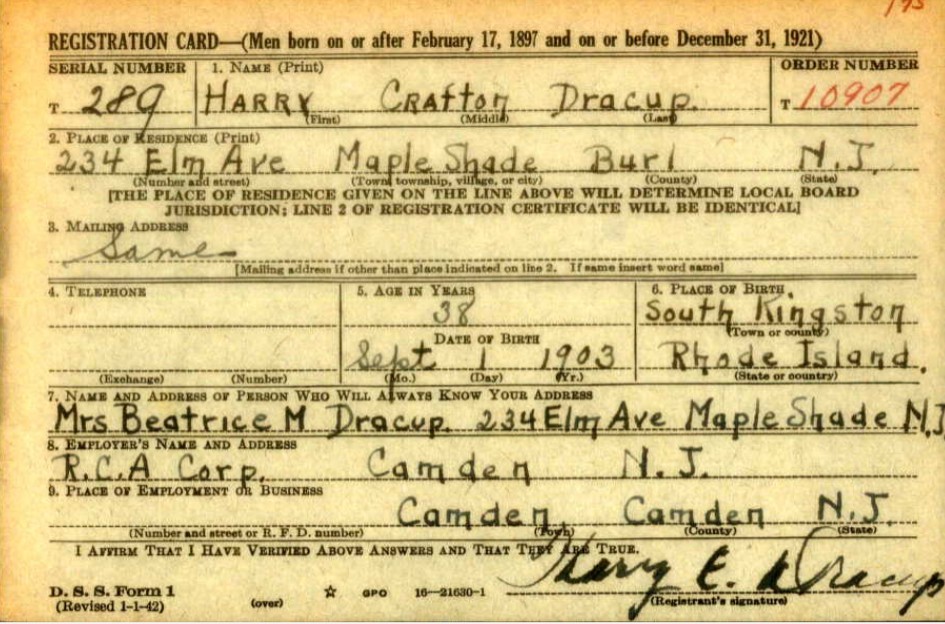
He was now employed by the RCA Corporation of Camden. Aged 38, he was described as five feet five inches tall, weighing 175lb, with brown eyes, brown hair and a ruddy complexion.
By 1950, the US Census showed Harry, Beatrice and Ruth at 402 South Washington Avenue in Moorestown, Burlington, New Jersey, still further east from central Camden.
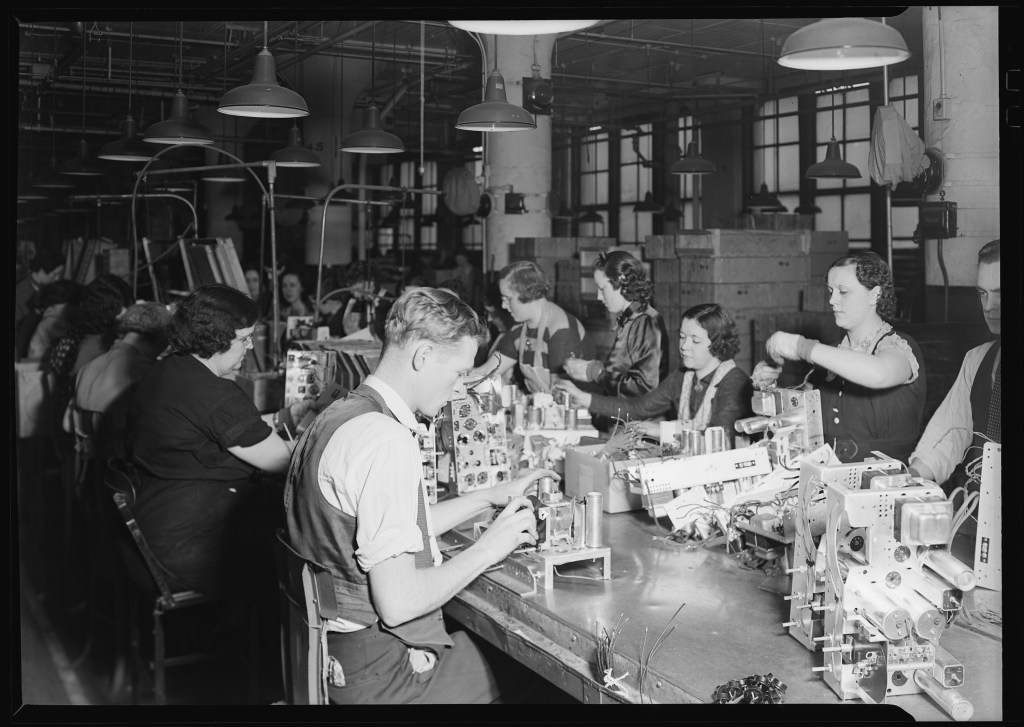
Harry was now 47, employed in ‘test engineering’ at a radio manufacturer. Beatrice, was not working, while Ruth was 10.
She was baptised on 22 November 1953 at the Grace Episcopal Church in nearby Merchantville, graduating from Moorestown High School around 1958. In June 1960 she married Frank Bradley Heim who had also attended Moorestown.
Harry died on 19 January 1970, aged 66, still resident at 402 South Washington Avenue. His obituary described him as a retired budget analyst with RCA Camden, a member of Ionic Lodge 94, F&AM, Camden, and a member of the Burlington County Radio Club.
He was buried in Locustwood Memorial Park, Cherry Hill.
Beatrice died in December 1972, aged 71, and Ruth in October 1998, aged 58.
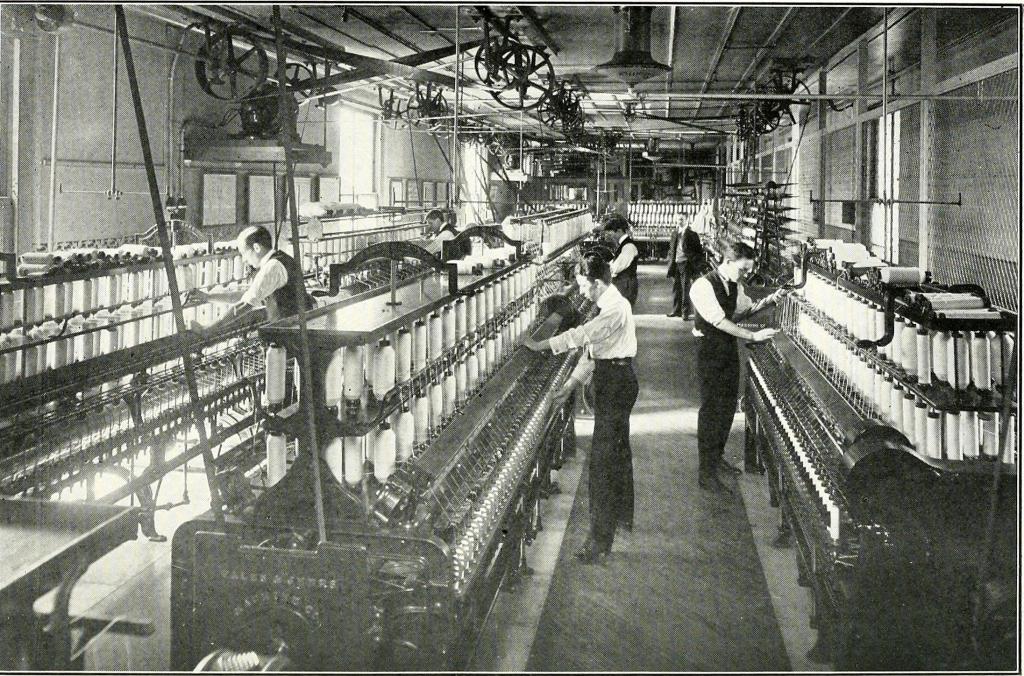
The socio-economic benefits of emigration to the USA?
This and my two preceding posts – George Dracup (1824-1896) and his English descendants, and George Dracup (1824-1896) and his American Descendants: Part One – have set out to compare the socio-economic status and progress of two sets of Dracup siblings and their families.
I wanted to explore whether those who chose to emigrate to the United States benefited economically from that decision or, if not, whether succeeding generations of their families derived such benefit, compared with their peers who remained in England.
It is clear that, for the first generation, ie those actually emigrating to the United States, the benefits were questionable. Most of the men found it difficult immediately to find work at the same level they had reached in England, often having to relocate their families several times to find and maintain remunerative employment in the textile industries.
Those who were younger when they arrived in the United States were typically more successful, but those who lived longer lives often found themselves working well into their 70s before they could afford to retire. Only a few managed to spend their final years in a ‘retirement setting’, whether by the coast or in warmer states.
Their children and grandchildren were typically more economically secure, and probably enjoyed a higher standard of living than the corresponding generations in England, but these benefits were unevenly distributed.
Three of Henry’s sons escaped a lifetime working in the mills by pursuing careers as motor mechanics, but they were still resolutely working class.
Perhaps a parallel could be drawn between this subset and the preponderance of greengrocers that emerged amongst the families of those who remained in England, (although it is noteworthy that shopkeeping was also occasionally an avenue pursued by the children of those who relocated to the United States).
A few of the grandchildren in the United States began to benefit from improved educational opportunities, relative to those of their parents and grandparents. Two acquired postgraduate degrees later in life, though they didn’t begin first degrees immediately after high school graduation. Both managed to propel themselves into the middle classes.
Broadly speaking, then, emigration proved ultimately beneficial for many, though few of these benefits were reaped by the first generation, only some by the second. It was only by the third generation that substantial, tangible improvements in socio-economic status began to accrue.
These benefits were unevenly distributed, tending to favour men much more than women, and were influenced by several variables, not least the benefits brought by spouses and their families, as well as the individual’s own drive, intellect, longevity and capacity for saving money rather than spending it.
Comparing them with their English counterparts, I found:
- excluding the first few years after emigration, rather less poverty (and probably less low level criminality as a consequence);
- more geographical mobility, though predominantly confined to the Eastern states and often driven by the need to take advantage of employment opportunities elsewhere. Perhaps the fact that they or their immediate ancestors had crossed the Atlantic made some more predisposed to accept this, especially in early adulthood. Conversely, though, others clearly preferred to anchor themselves in the same metropolis for much of their later lives;
- far greater access to and interest in cars and motorcycles and, associated with this, related employment opportunities, but also a much higher incidence of death and injury as a consequence of motoring accidents; and
- within later generations in particular, a much higher probability of marrying more than once, a far higher incidence of divorce, of bigamy and, possibly, of infidelity too. This must have affected adversely the stability of family units and the security of some children.
Among this sample, almost nobody who emigrated to the United States chose to return to England. The sole exception is Catherine Dracup, nee Glynn, who featured in my post about George’s English descendants.
TD
December 2025








Leave a Reply