

We spent the end of February 2025 in England’s Lake District, courtesy of HF Holidays.
It was a four-night guided walking holiday.
We stayed in the HF country house at Monk Coniston, which is at the northernmost tip of Coniston Water, roughly a mile north-east of the village of Coniston.
This was our first HF country house holiday since Covid. Our last experience was New Year 2020 in the Southern Yorkshire Dales.
We also enjoyed an HF Channel Island Hopping holiday which, though twice delayed by Covid, finally took place in April 2022.

We travelled up to the Lakes on the Avanti West Coast line, departing London, Euston at 11:30, arriving in Oxenholme at 14:09.
The service was very busy, with almost all seats taken.
For some reason, our coach was suffocating in almost tropical heat, so most of the passengers were stripped down as far as decency permitted. But the service ran to time.
I couldn’t secure tickets for this journey in the Great British Rail Sale, so paid £35.60 each for Advance tickets with a Two Together Rail Card. I had better luck with the homeward journey, obtaining tickets reduced to £30 apiece in the Sale.

We had a short wait at Oxenholme for the Northern Rail service to Windermere, which departed at 14:39, arriving just 17 minutes later.
There is a bus service from Windermere to Coniston, but it didn’t co-ordinate well with the trains, so we hired Ace Taxi to ferry us straight to the door, costing £33.
We were whisked quickly across country, arriving at our final destination by 15:30.
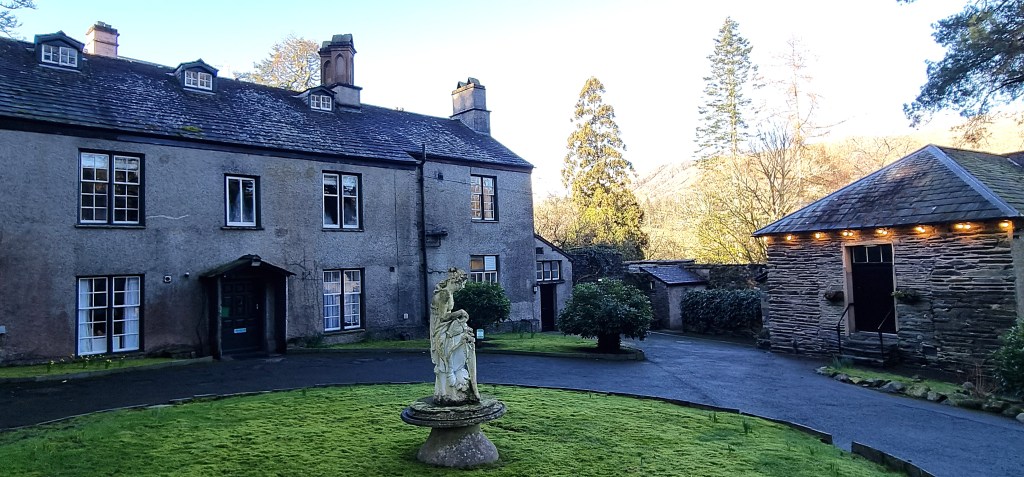
Monk Coniston
The oldest part of Monk Coniston Hall dates from the 1770s, or thereabouts. It was previously known as Waterhead House and owned by three local families in quick succession.
One Michael Knott, a scion of the third family, significantly extended the property, but incurred significant debts in the process. After his death, it was sold to the Liberal politician James Garth Marshall, who further enlarged the buildings, adding a wing around 1850.
During the next two decades, several prominent Victorians stayed here as Marshall’s guests, including Tennyson, Carlyle and Dodgson.
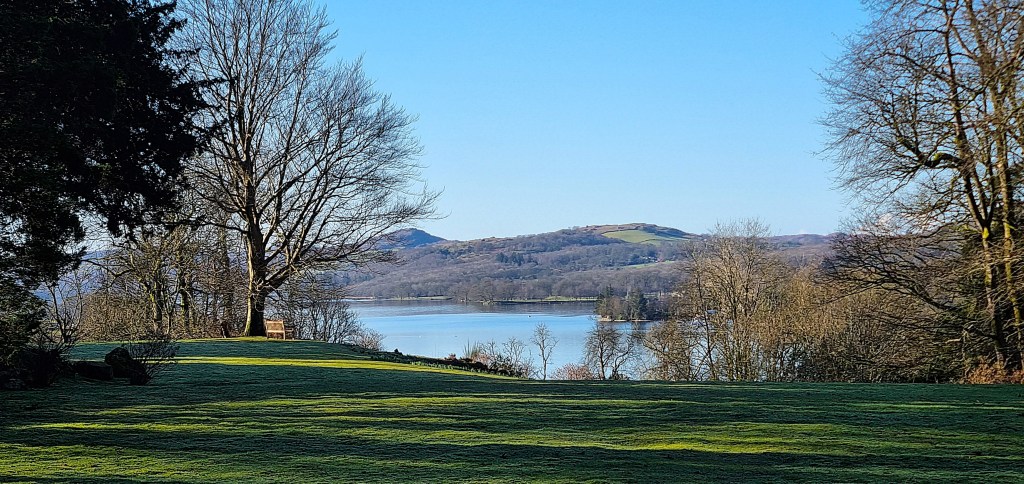
Marshall’s descendants sold the bulk of the 4,000 acre estate to the writer and illustrator Beatrix Potter (1866-1943), though she did not live in the Hall herself.
She sold half to the National Trust in 1930, bequeathing the remainder upon her death. Then, in 1945, the Trust began leasing the building to HF.
There are guest bedrooms, in three different categories – classic, premium and superior. We stayed in a classic-rated double room on the first floor of a separate outbuilding called The Counting House, which probably served originally as servants’ quarters.

It was comfortable and quiet, with plenty of storage space, equipped with a large shower rather than a bath.
The main hall has a large dining room, a lounge, a small morning room and bar, a detached ‘barn’ and beneath it, a reasonably spacious boot/drying room.
Several of these common areas are looking rather neglected, displaying considerable wear and tear.
While we were there, the lounge was closed for renovation. It would have been far more sensible to do this while the house was closed, but the requisite co-ordination between the Trust and HF was lacking.
This closure meant more use had to be made of the ‘barn’, which proved difficult to heat thoroughly in winter temperatures. The bar area was far too small to accommodate all the guests that wanted to use it.

HF country houses are renowned for the quality of their food. There are several cooked breakfast options, as well as cereal and pastries. Packed lunches include a sandwich or roll with several possible fillings and up to five ‘sundries’ – pork pies, fruit, crisps, cakes etc – chosen from a range of over 20. At dinner there are typically three choices of starter, main course and dessert.
That night’s dinner choices and next day’s lunch are requested via a form submitted at breakfast.
We found food quality still very good, though perhaps not quite as outstanding as it had been in 2020. We learned that the dinner menu is now standardised across all the HF country houses.
The ritual cream tea provided on arrival was conspicuously less generous. Several old hands noted that one could previously choose up to seven ‘sundries’ for one’s packed lunch.
It was also disappointing that the bar had no draft beer – the hand pump for the Coniston Brewing Company’s Bluebird Bitter was still in place, but dry.
HF country houses typically offer three walks daily, with different degrees of challenge. The harder walks are usually longer and/or require extra ascent/descent.
On this occasion we found ourselves selecting all three ‘level 3’ walks. This might say something about our development as walkers since we last holidayed in this fashion.
That said, several variables have to be taken into account and we might have chosen differently – particularly on Day Two – if the weather conditions had been different.
Coniston and Coniston Water
The parish of Coniston has a resident population of some 900. At its centre lies the Black Bull, once a coaching inn but now a hotel. There is also a church, a museum, a handful of shops and several cafes.
Originally an agricultural settlement, Coniston also supplied manpower for local copper and slate mines. It became a magnet for Victorian tourists once the Coniston Railway – originally designed to service the mines – was opened to passengers.
A branch line ran from here to Broughton-in-Furness, providing a connection to Barrow. The rail passenger service was withdrawn in 1958.

The rail company also bought Gondola, a steam yacht, which provided a regular service on Coniston Water from 1859 until 1936. It was rescued from dereliction in 1979 and is now operated by the National Trust, but only between March and October.
Coniston Water is the third largest body of the stuff in the Lake District by volume, after Windermere and Ullswater, but only the fifth largest by area. It is 8.7km long and up to 730m wide. The average depth is 24 metres and the maximum depth just over 56 metres.

Incidentally, the distinction between a ‘lake’ and a ‘water’ is simply a matter of nomeneclature: there are no features lacking that would disqualify Coniston from being a lake!
Remains of Bronze Age settlements have been discovered along its shores. The Romans were more focused on mining the surrounding fells. In medieval times it was fished extensively by the Cistercian monks of Furness Abbey.

The area has particularly significant connections with four luminaries:
- Writer, academic and art critic John Ruskin (1819-1900) bought Brantwood House on the shores of Coniston Water for £1500 in August 1871, living there from 1872 until his death. He also accommodated the family of an artist, Arthur Severn, who had married his (Ruskin’s) cousin. The Severns inherited the house after Ruskin’s death, but it was subsequently taken over by a charitable trust which runs it as a museum dedicated to its former owner. Ruskin is infamous for never having consummated his only marriage, allegedly because he was disgusted to discover his wife’s pubic hair!
- The aforementioned Beatrix Potter who, in 1905, used proceeds from the sale of her books to buy Hill Top Farm in Near Sawrey, between Windermere and Esthwaite Water. In 1913 she married William Heelis, a local solicitor based in Hawkshead and they moved to Castle Cottage nearby. They bought several local farms over the years, some in partnership with the National Trust, including Monk Coniston. One of Potter’s friends was Hardwicke Rawnsley (1851-1920), one of the National Trust’s founder members.
- Fellow children’s writer Arthur Ransome (1884-1967), set most of his adventure stories in and around boats, beginning with ‘Swallows and Amazons’ in 1929. He completed 12 books in the series, the last published in 1947. I must have read almost all of them as a child. Several are set in the Lake District, on an unnamed lake with features drawn from both Windermere and Coniston Water. Ransome was intimately connected with post-Revolutionary Russia, first visiting in 1913. As a foreign correspondent, he formed close relationships with both Lenin and Trotsky, amongst others, eventually marrying Trotsky’s personal secretary, Evgenia Shelepina, in 1924. He was at one time suspected of being a Soviet spy.
- Donald Campbell (1921-1967) was born at Canbury House in Kingston-upon-Thames, to Sir Malcolm Campbell, racing driver and holder of various speed records, and his second wife, Dorothy Whittall. Following his father’s death in 1948, he began to set speed records of his own. On 4 January 1967, he made an attempt on the world water speed record on Coniston Water aboard ‘Bluebird’. On his second run, having reached 328mph, Bluebird backflipped and cartwheeled, killing Campbell instantly. His teddy bear mascot, Mr Whoppit, was discovered floating in the wreckage, but his body wasn’t recovered until 2001. It was buried in the cemetery attached to St Andrew’s Church in Coniston.
Day 1: Hawkshead and Latterbarrow
We had selected a 12-mile figure-of-eight walk that passed twice through the village of Hawkshead, via Grizedale Forest, Latterbarrow and Tarn Hows.
The weather was broadly neutral – cloudy, a little gloomy, but predominantly dry, with only a couple of light showers. During the morning the cloud hung low over the fells, giving the skies a lowering quality.
We were a group of eleven, our guide making twelve. A friendly, easy-going bunch, seven of whom had walked together since the weekend, having booked a full week’s holiday.
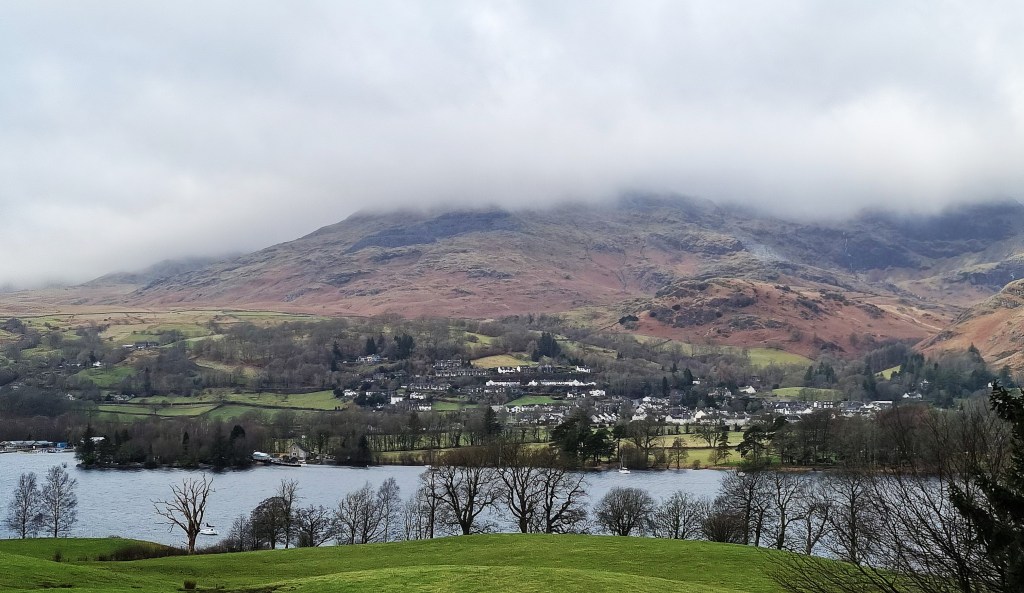
We left from the Hall on foot at 09:30, heading down to Coniston Water and then broadly eastwards, ascending through the northern part of Grizedale Forest and across Hawkshead Moor.
The Forest as a whole covers roughly 25 square kilometres, incorporating the two small villages of Grizedale and Satterthwaite.
There was formerly a country house called Grizedale Hall, but the final iteration was demolished in 1957, having served as a WW2 prisoner of war camp for German and Italian officers.
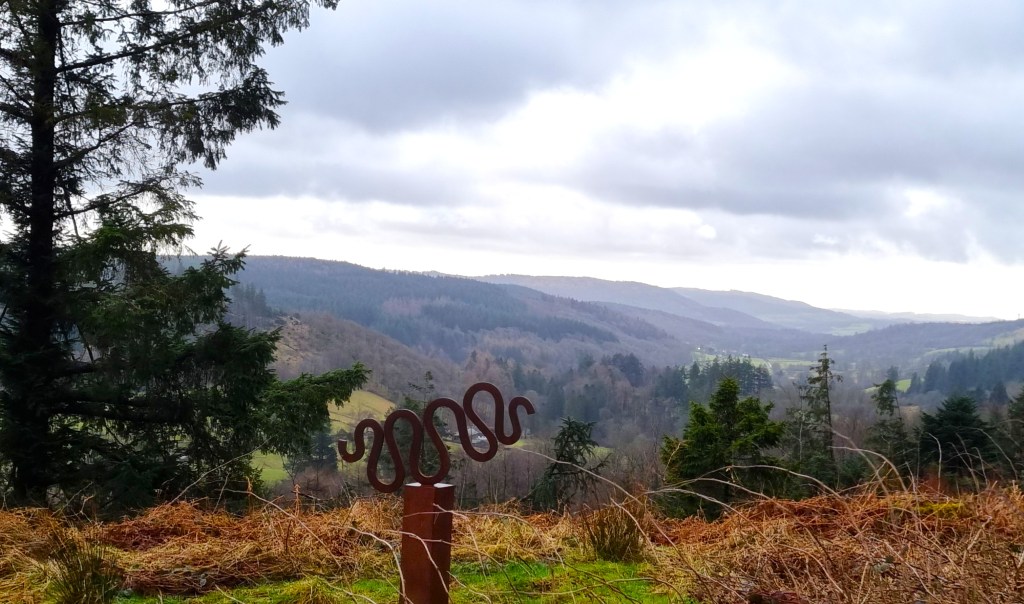
As well as numerous wild animals, including red squirrels and England’s only indigenous herd of red deer, Grizedale hosts hundreds of sculptures. There is a website but, at the time of writing, it is only partly complete. A promised index of the sculptures has not yet materialised.

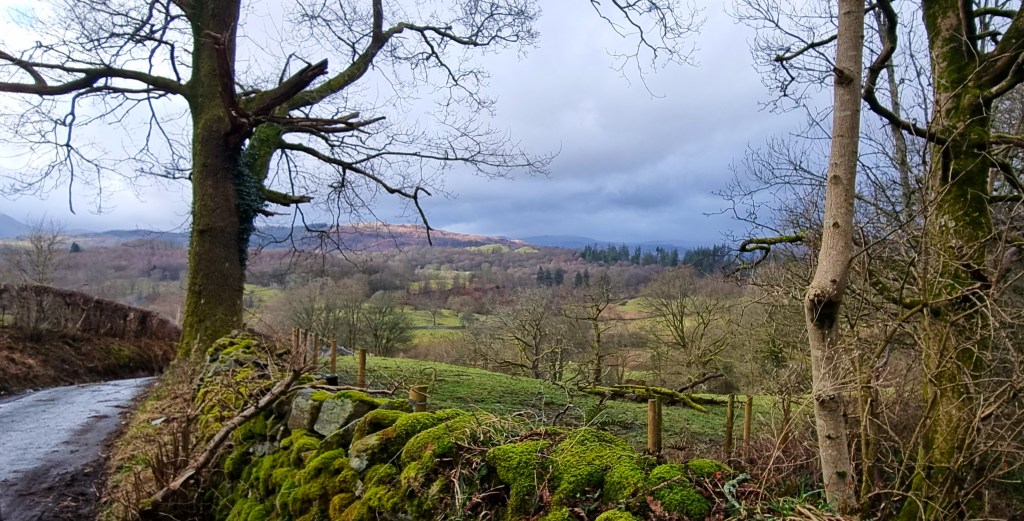
I enjoyed this moss-covered wall, with the trees behind it and, subsequently, the view down to Coniston Water across an array of old bath tubs.
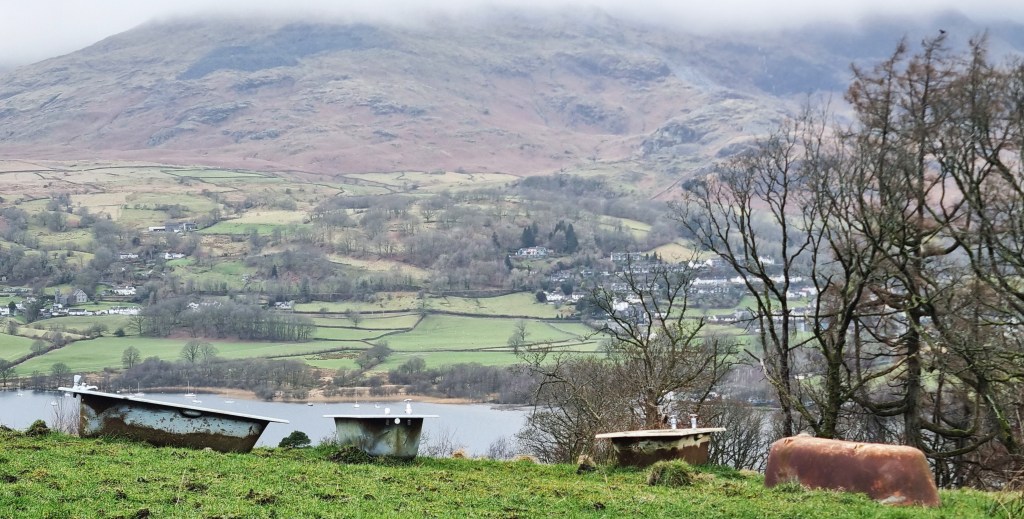
As we climbed, two or three of the group tried out their evolving navigational skills.
We were invited to admire several ‘shard fences’, constructed from interlocking slate slabs, peculiar to this part of the Lake District.
There was also this sign, reminding us to report sightings of ‘big cats’, which took us back to an encounter on the South West Coast Path – not with a big cat, thankfully, but with a man who devoted his life to spotting them.
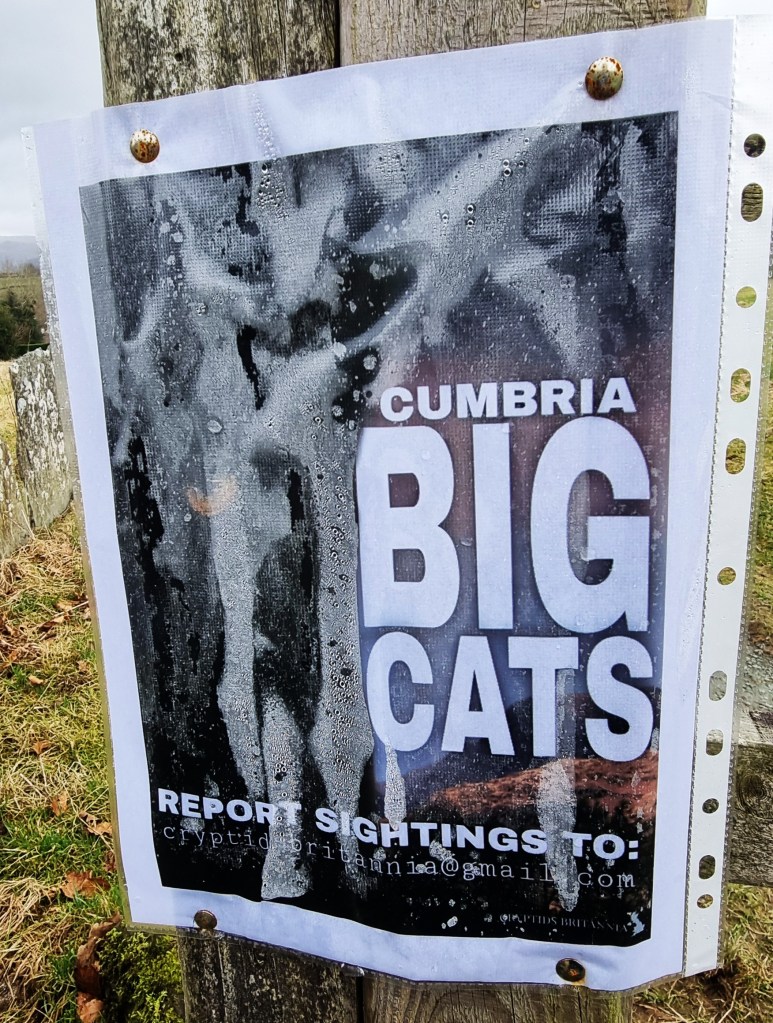
This poster seems to be the work of a teenage student called Harlem Karma, from Lancaster, who claims to have seen a ‘black leopard’ near Hawkshead while travelling on the 555 bus.
He has a You Tube channel dedicated to this and related phenomena.
Arriving in Hawkshead by around 11:50, we had twenty minutes of ‘free time’. Tracy and I sat on a bench in the churchyard of St Michael and All Angels, looking towards Windermere across the Vale of Esthwaite and various chimneys.

Earlier, at breakfast, we had cadged a cafetiere from which to fill our flasks, but the stopper got stuck as I tried to press it fully down, causing coffee to spurt out prematurely with some force. We poured what was left into our flasks but it proved barely drinkable.
Hawkshead is rather twee, full of cafes and pricy gift shops, overrun with tourists in the high season. The toilets were unnecessarily expensive.

It was also owned by Furness Abbey but, following the Dissolution of the Monasteries, it developed into a small market town.
St Michael and All Angels probably dates from the late Fifteenth or early Sixteenth Century. It was extended around 1580, owing to the influence of Edwin Sandys, Archbishop of York from 1576 until his death in 1588, who was born nearby. The Church houses his parents’ tomb.
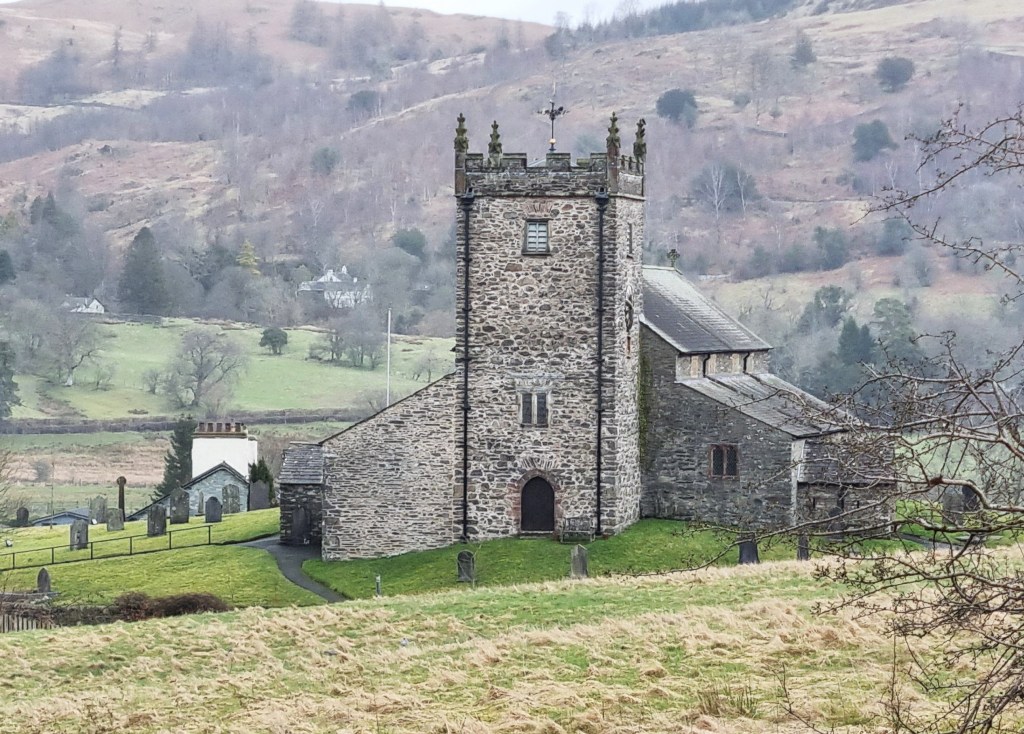
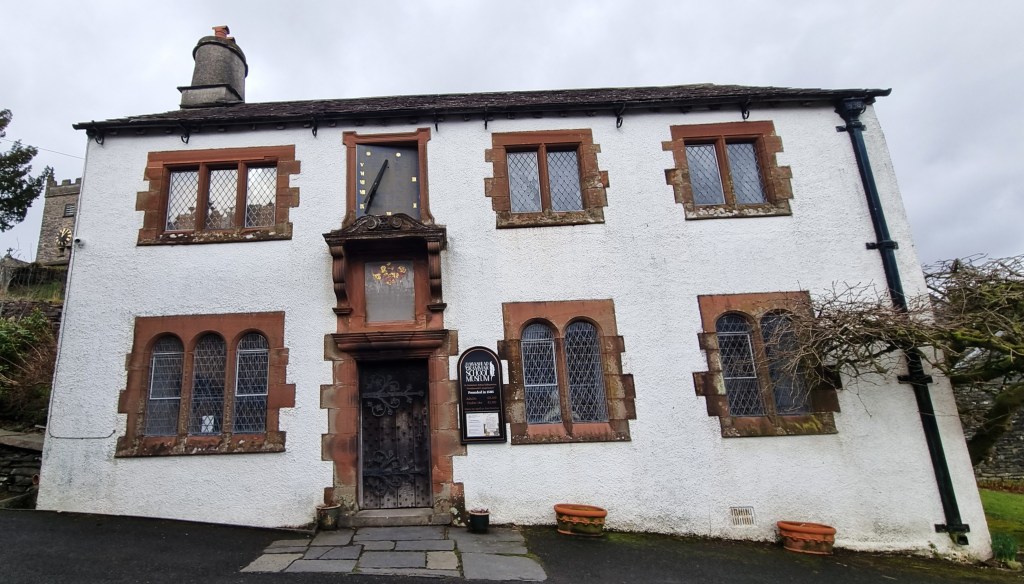
Sandys also founded Hawkshead Grammar School in 1585. It developed a strong reputation, especially in the latter part of the Eighteenth Century, when William Wordsworth (1770-1850) attended before progressing to Cambridge. The School closed in 1909 and is now a museum (though it, too, is closed in the winter months).
I was amused by Kittchen – an independent bar which supports rescue cats, does not permit dogs or children inside, and markets itself under the startling banner ‘Just pussy and pints’.

Having made our first pass through the Village, we bent our steps towards the slopes of Latterbarrow, north-east of Hawkshead, halfway to Windermere.
Latterbarrow is 244 metres high. It featured in a 1974 publication by Alfred Wainwright, ‘The Outlying Fells of Lakeland’, rather than in his series of seven ‘Pictorial Guides to the Lakeland Fells’.
This means it is not strictly one of the 214 ‘Wainwrights’, which some people devote their time to ‘bagging’ (by which they mean climbing).

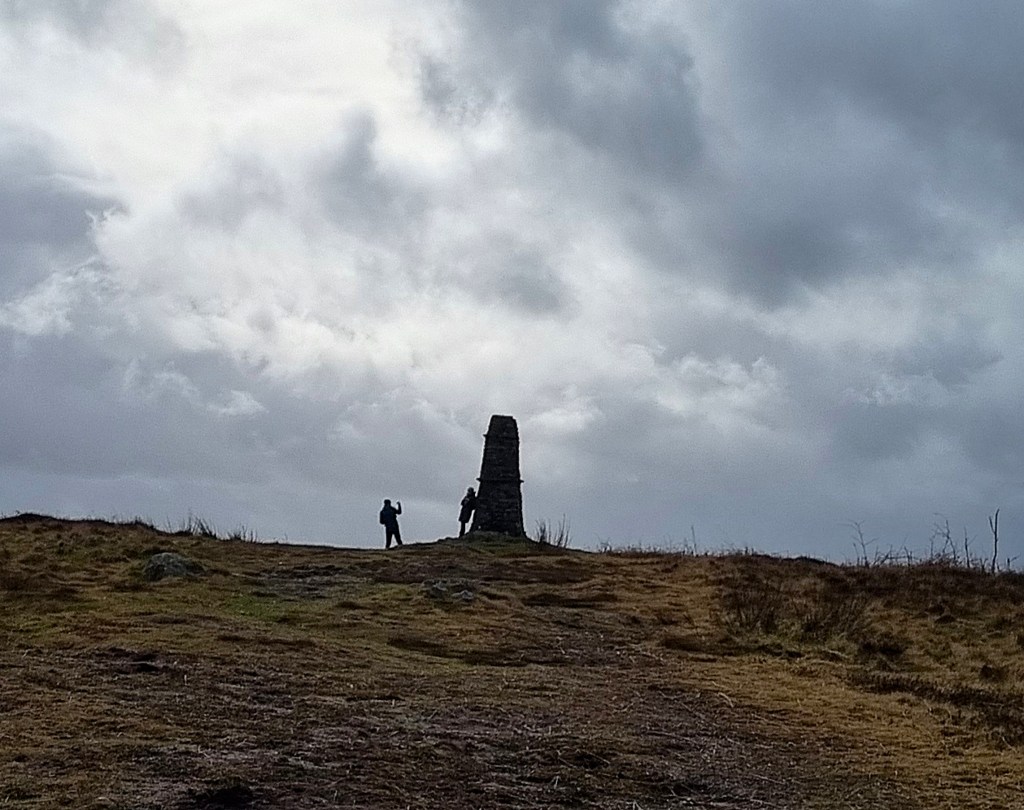
There is a small stone obelisk at the summit, which offers excellent views over Windermere and the surrounding countryside. While I took photographs, a black dog chewed enthusiastically at a discarded plastic bottle.

I claimed a spot in the lee of the obelisk for lunch, the wind being a little stiff, but our guide preferred to take us a little way down the descent instead.

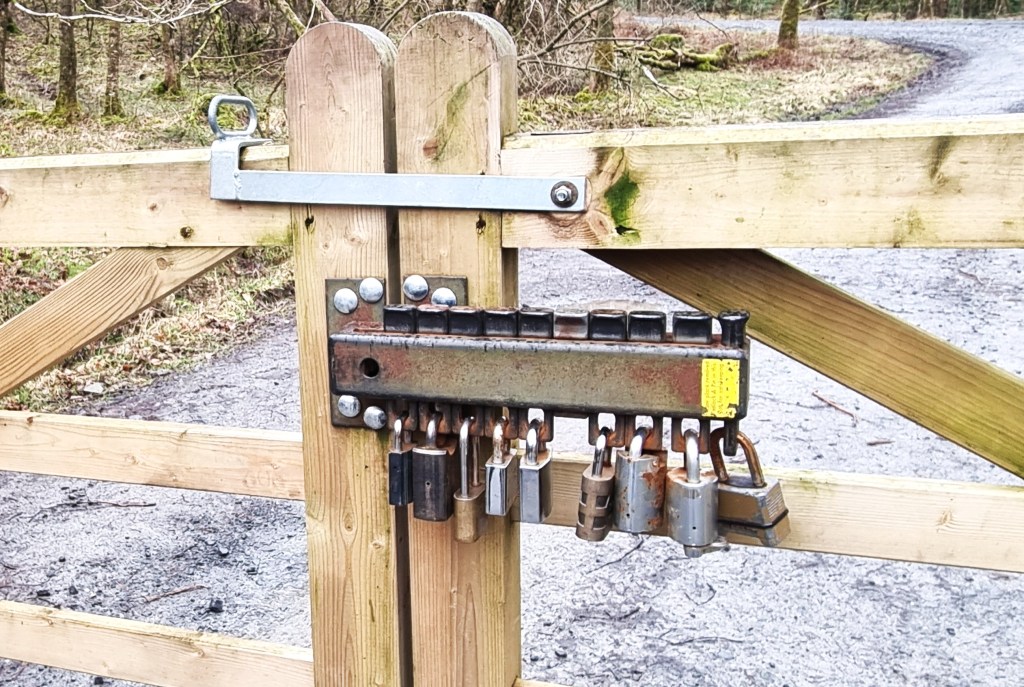
On resuming, and approaching ground level, we passed an impressive collection of nine padlocks upon a wooden gate, then swung round close to Tock How Farm before crossing to Hawkshead across fields from the north.
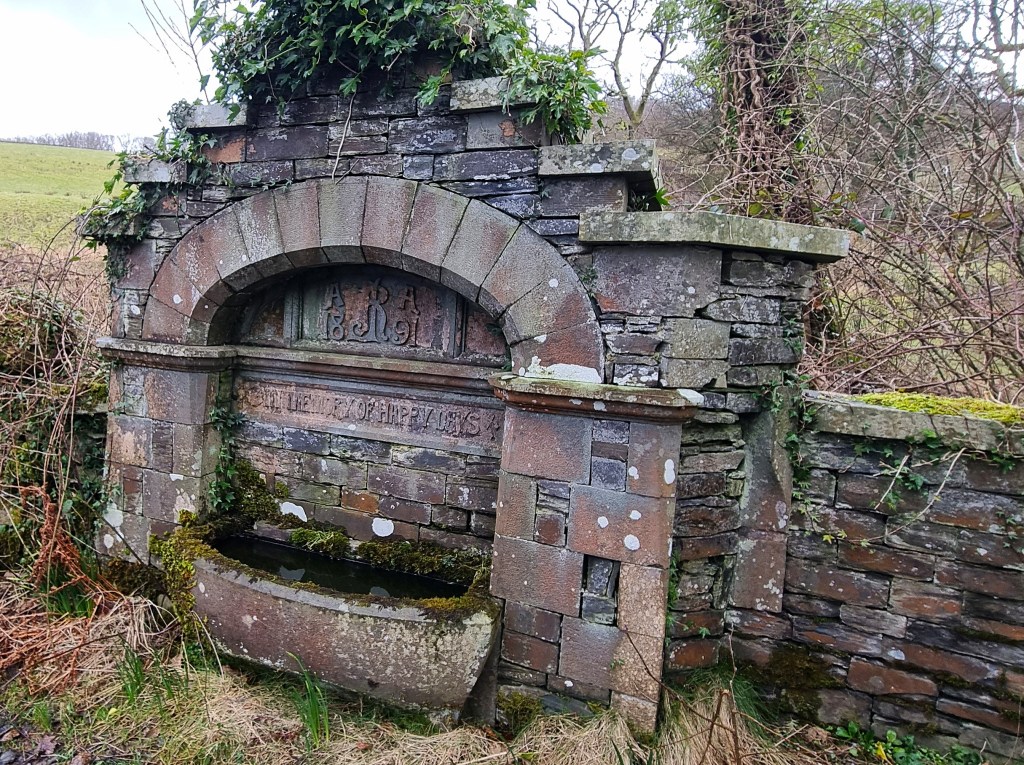
I also admired this remarkable stone trough, carrying the date ‘1891’ and inscribed ‘In memory of happy days’. I can’t discover who put it here.
As we crossed the fields, several sheep kindly posed in the foreground of my pictures.

Back in Hawkshead, most of us piled into the Minstrels Gallery Tea Room, adjacent to the Methodist Chapel, where I very much enjoyed a generous helping of chocolate and ginger flapjack with my black Americano.
The woman in charge seemed unsure at first whether we were welcome customers or a blasted nuisance. I attributed her rudeness to her blunt northern ways, probably exaggerated for our benefit.
It was a struggle to resume, but eventually we did so. Our next stop was beside the tiny Baptist Chapel at Hawkshead Hill, where our guide handed round a bag of sweets to boost our flagging energies.

Baptists began convening hereabouts in 1699 and, a decade later, this cottage was registered as a meeting place by its owner, one William Dennyson. The building was renovated in 1876.
Some thirty minutes later, we came abreast of picturesque Tarn Hows, midway between Coniston and Hawkshead.
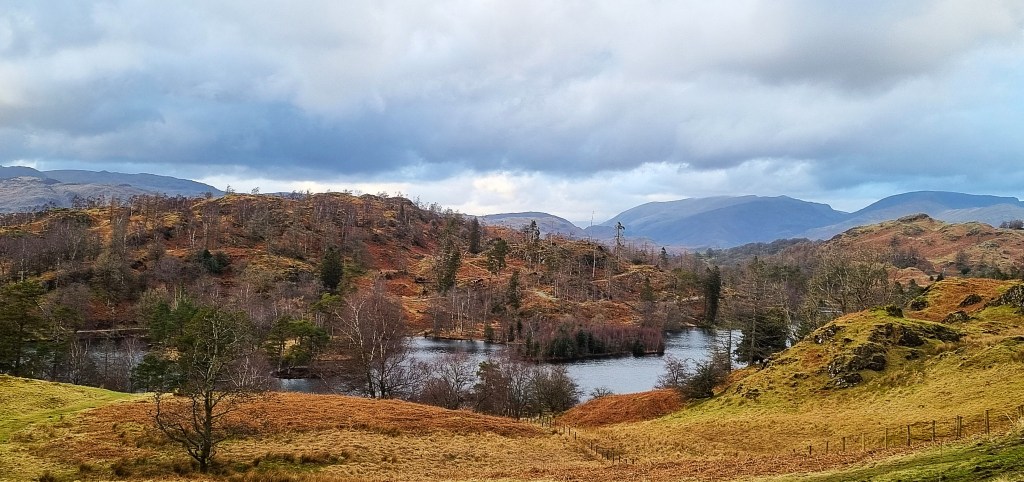
The aforementioned James Garth Marshall acquired this land as part of the Monk Coniston estate and, early last century, Tarn Hows was created out of three smaller bodies of water by building a small dam.
The area immediately acquired a reputation as a local beauty spot, much visited by tourists. It is now a Site of Special Scientific Interest owing to the plants that grow here. Belted Galloway cattle and Herdwick sheep graze about its shores.
We rested a while before completing the short walk back down to Monk Coniston, arriving at around 17:00.
After showering, we made our way to the bar for well-earned G&Ts before hearing brief outlines of the three walking options for day 2, followed by dinner from 19:00. I had opted for a starter of goat’s cheese and chive mousse, followed by roast pork belly and custard tart with cream.
We had coffee afterwards in the barn, but there was no great interest in the activity/quiz, so we retired early.
Day 2: The Langdale Valley
All three walks were in the Langdale Valley, which is renowned for its beauty. Unfortunately though, the weather was least kind to us on this day, with heavy low cloud, regular showers and even some sleety snow on top of the fells.
Langdale runs west of Ambleside, a few miles north of Coniston Water, and culminates in the Langdale Pikes. There are twin valleys, known as Great Langdale and Little Langdale respectively.
We were initially attracted by the Option 2 walk, which mainly followed the Little Langdale valley, featuring its notable waterfalls as well as Blea Tarn. However, the prospect of poor weather eventually persuaded us to opt for Option 3 instead.
This involved climbing both Side Pike and Lingmoor, descending to the village of Elterwater and following the Cumbria Way back to our starting point.
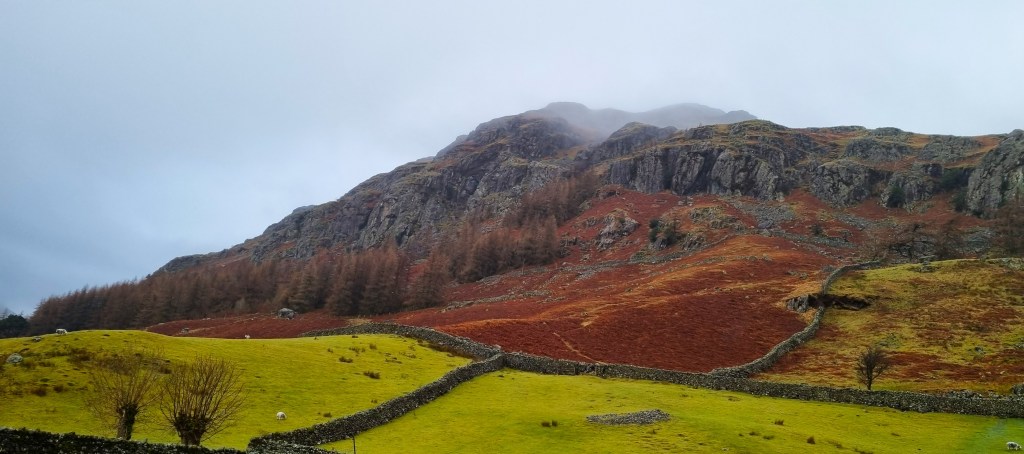
We walked down from the Hall to the B5285 where we were picked up by a small coach. This took us to the Stickle Ghyll Car Park, in Great Langdale, Side Pike rising immediately to our south.
It was very gloomy, with low hanging cloud, but not yet raining.
After crossing the extensive camping area, still only sparsely populated in late February, and navigating the sodden fields, we began the initial ascent. Two or three sizeable flocks of geese passed high above in chevron formation.
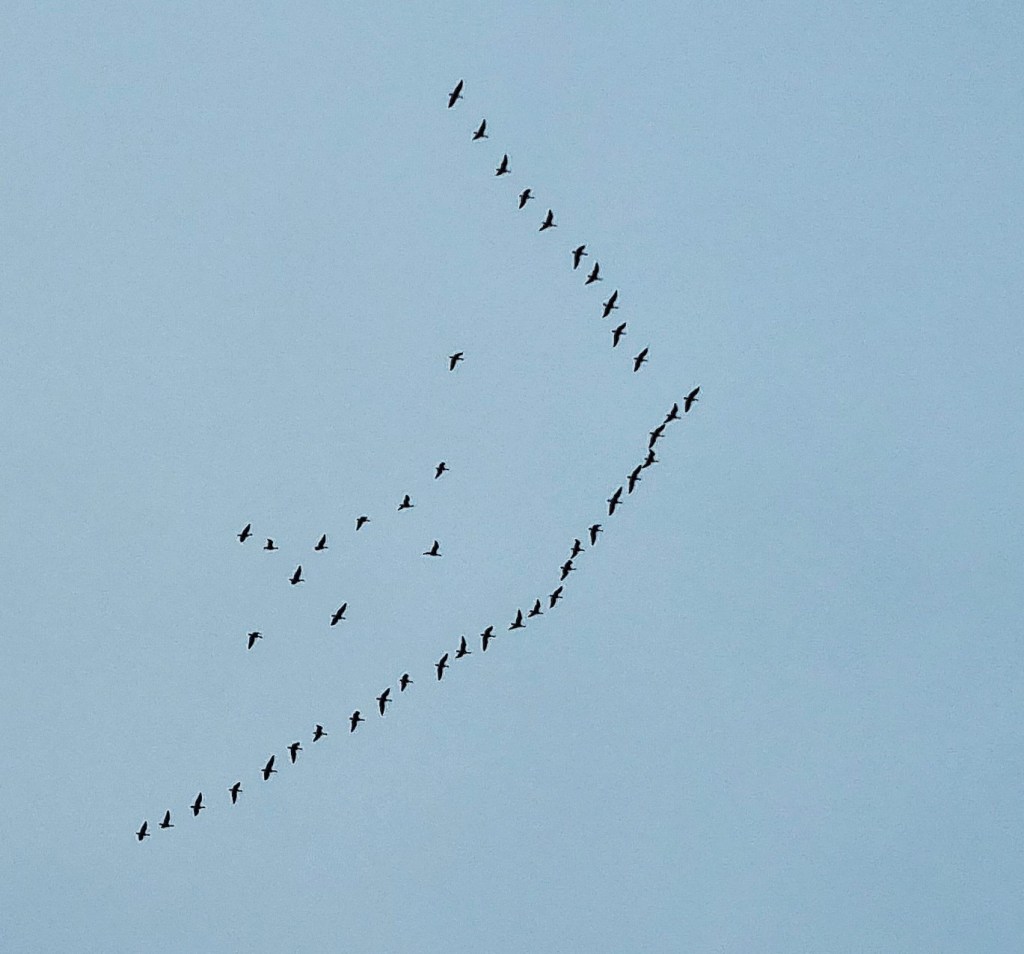
This is believed to improve their efficiency in flight. Apparently, different birds have different preferences for where they fly – whether on the left, the right or in the middle, but there is regular rotation to relieve the birds flying at the front and the two ends of the chevron, where fatigue is greatest.
After a relatively gentle climb we paused, overlooking Blea Tarn, situated in a small hanging valley between Great and Little Langdale. It is home to brown trout, perch and pike and has also been designated an SSSI.

A little further up we stopped at a stone wall for another short break, then several of us climbed up to a narrow path between sheer rock face and a large boulder. This is supposedly known hereabouts as ‘the squeeze’, ‘fat man’s dilemma’ or ‘fat man’s agony’.
During our climb, Tracy suddenly shouted ‘careful, ladies!’ This caused me to turn about, so witnessing a trio of our female colleagues, wreathed in cloud and in various states of undress as they attempted a comfort break!

The rest of us dutifully squeezed through the squeeze – and back again, before a trio of local walkers came down along the path.
As we scrambled up towards the summit, the rain began in earnest, rapidly turning to sleet which drove into our faces. We could see the snow had quickly settled on some of the higher peaks beyond.
Finally, as we reached the peak of Side Pike – 362m high – the cloud parted to reveal Blea Tarn once more, now far below.
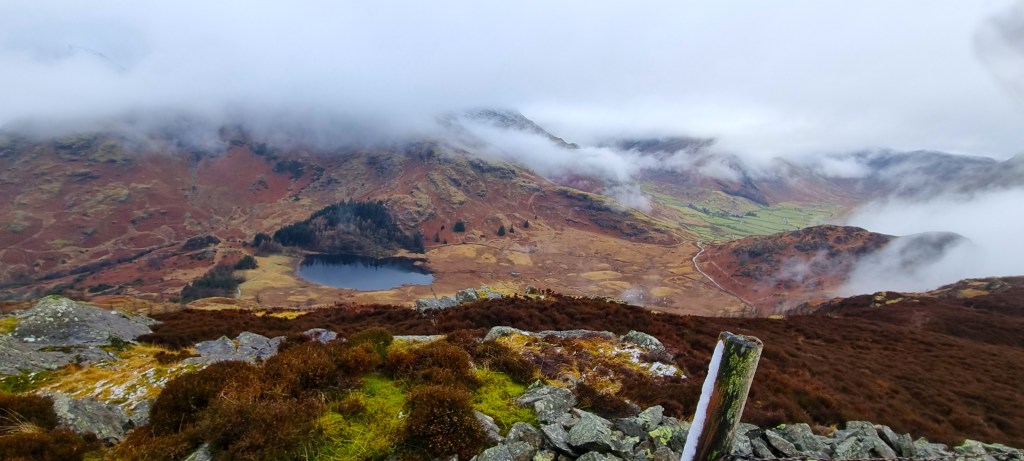
We followed the dry stone wall across to Lingmoor Fell, about 1.5km to the south-east. This is a true Wainwright, reaching a height of 469m, the summit officially known as Brown How.
Wainwright described it thus:
‘There is no better place than the top of Lingmoor Fell for appraising the geography of the Langdale district. From this viewpoint the surround of rugged heights towering above the valley head of Great Langdale is most impressive, while across Little Langdale the Coniston fells form a massive wall. In marked contrast is the low countryside extending towards Windermere, richly wooded and sparkling with the waters of many lakes.’
Unfortunately, visibility was still poor and it was still raining, so we had to imagine much of this.

Parts of Lingmoor have been quarried extensively for Westmorland green slate. We descended some way from the summit before breaking for lunch beside the second set of slate workings we passed.
Windermere now became visible in the distance. A stiff breeze began to blow away the clouds, but made it too cold to sit still for long. Twenty minutes later we were under way again, though I stayed briefly, for my own discreet comfort break behind the ruins.
As we descended towards Elterwater on the floor of the valley, we saw small shafts of sunlight breaking through the clouds and, eventually, a rainbow.
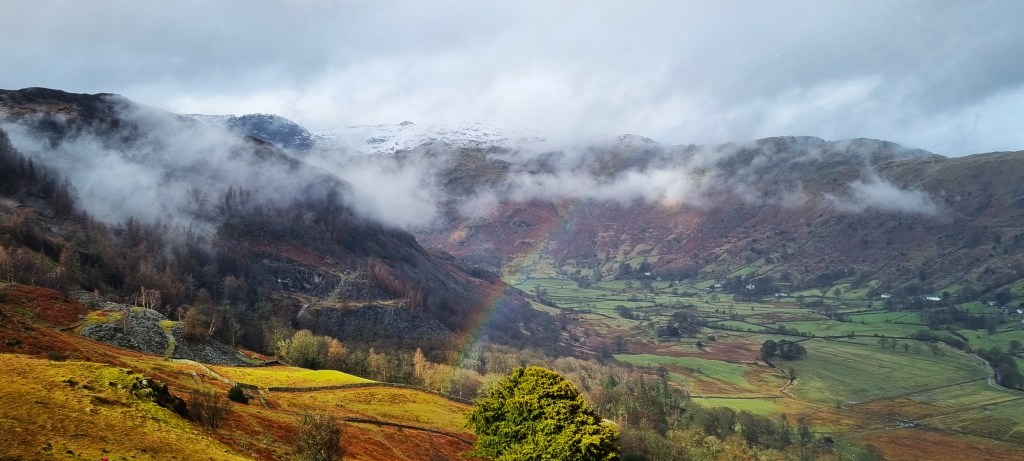
Elterwater is dominated by the huge scar of Elterwater Quarry, managed by Burlington Stone. It wants to develop a ‘new heritage experience’ here. Plans were finally approved by the Lake District National Park Authority in April 2024.
The Village, now dominated by Lakes tourism, took its name from nearby Elter Water, which probably means ‘the lake frequented by swans’.
We came to a rest for a few minutes beside Elterwater Bridge, across Great Langdale Beck.
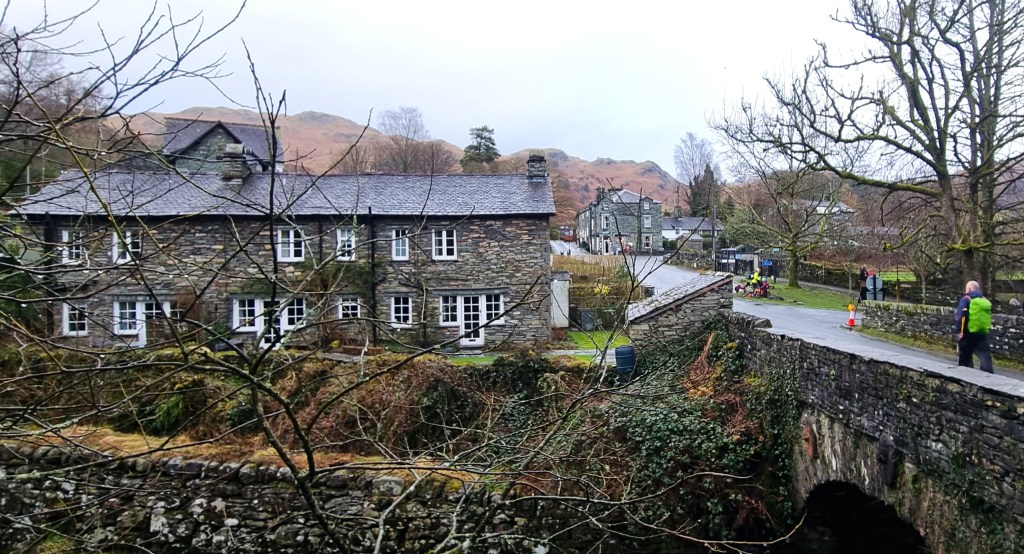
We followed the Beck for a while, as it wound its way towards Great Langdale, before continuing along a broad stone track, extensively puddled, parallel with the Cumbria Way. Our guide had decided that the latter would be unpleasantly muddy.
After what felt like a long slog, we reached our rendezvous point, adjacent to the car park from where we set out in the morning.

This is now known as Lanty Slee’s, operated by the ‘Lanty Slee Liquor Company’. They are named after Lancelot Slee (c1800-1878), an infamous smuggler and brewer of moonshine whisky who lived nearby.
We’d arrived almost an hour early for our coach back to Monk Coniston, so sat outside with a coffee, chatting, while polishing off the remains of our lunchtime picnics.
Following our now compulsory G&Ts, we listened to details of the final days’ walks before dinner. I enjoyed a Korean BBQ crispy beef bun, followed by chicken curry with mushroom pilau and naan, and finally tarte tatin with vanilla ice cream.
After dinner we joined a scratch team for the quiz, which operates across all the HF country houses simultaneously.
We performed creditably, finishing equal second in a closely-fought contest, though all four teams were within a point of each other.
Day 3: Coppermines and Coniston Fells
We woke to a cold, crisp morning with clear blue skies above.
Our walk on this final day was an ascent of the Old Man of Coniston, by way of Coppermines Valley, the descent being via Goats Water to Coniston.
We set out from the house on foot at 09:30, on a forced march across the valley floor, through woodland and along an approach road, until we reached the lower slopes alongside Coppermines Valley.

I wasn’t quite sure why we were striding out so purposefully, unless it was to beat the other human traffic up the Old Man. The group’s coherence suffered as a consequence, with several slowing markedly up these lower slopes.
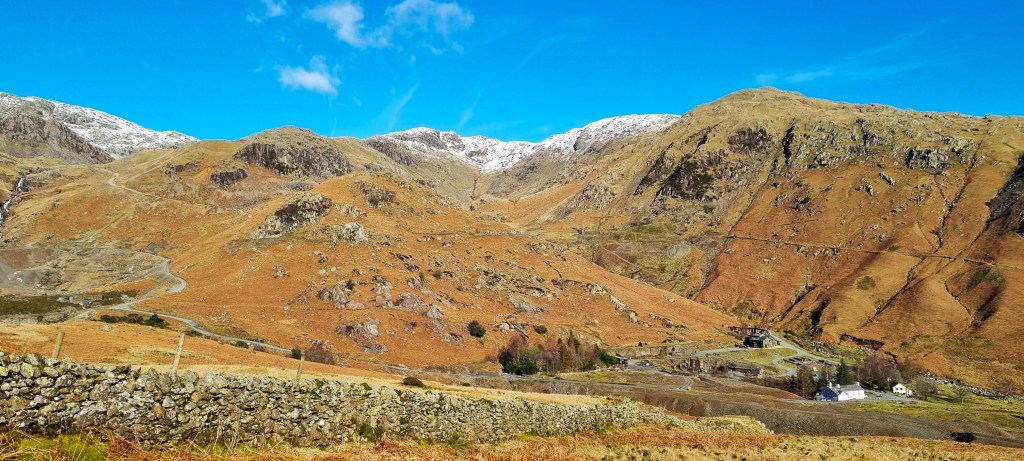
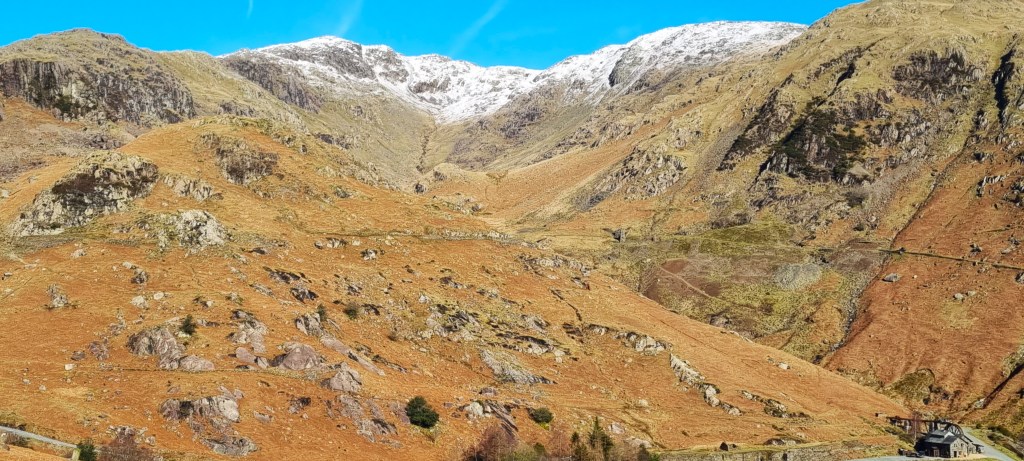
We started broadly level with the row of miners’ cottages, one of which now houses the Yorkshire Mountaineering Club Hut. As we ascended, we could see more of the workings, as well as the Coniston Coppermines Youth Hostel, which occupies the former manager’s offices.
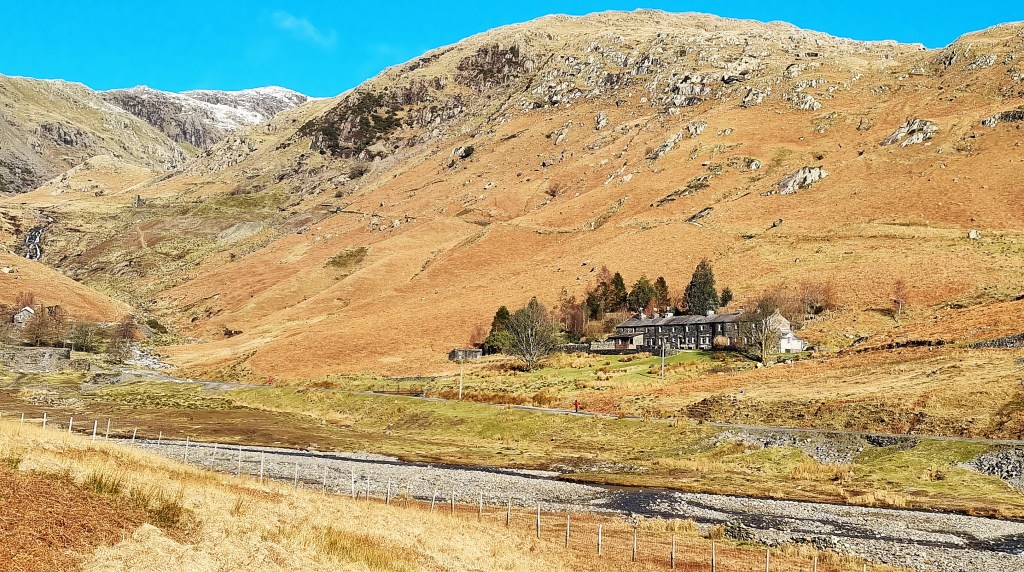
Mining has been undertaken here for centuries, probably millenia.
Queen Elizabeth I established by Royal Charter the Society of the Mines Royal in 1568, granting it a monopoly to mine for metals in several counties, including Cumberland.
The Society began working the Coniston copper mines around 1590, digging narrow tunnels by hand to a depth of about 180 feet.
Gunpowder wasn’t introduced until the latter part of the Seventeenth Century. This allowed mining to progress far more quickly, and tunnels were established at a depth of 300 feet or more.
As the depth increased, so did the risk of flooding. From the Eighteenth Century, water wheels were used to pump water out of the mines. Once the ore had been extracted, it was crushed in a stamp mill, also powered by water wheel.
Charles Roe, a Macclesfield industrialist, began mining here in 1756, forming the Macclesfield Copper Company with 14 partners in 1774. This continued operating at Coniston until 1795.
Further, deeper shafts were sunk early in the Nineteenth Century, notably under the leadership of mining engineer John Taylor (1779-1863), who expanded the workings considerably from 1824. The manager’s offices date from 1830.
In 1859 the Furness-Coniston rail link was introduced. Steam trains quickly replaced the coal barges that had been pulled along the Ulverston canal.
But output began to decline steadily from the 1880s. High maintenance and drainage costs for the deepest shafts made the enterprise far less profitable, while cheaper ore could now be imported from abroad. Mining was already limited by the end of WW1 and had all but ceased by the 1940s.
In 2016, the Heritage Lottery Fund awarded a grant to preserve the mine workings and develop them as an educational resource. The project builds on the work of the Cumbria Amenity Trust Mining History Society (CATMHS), formed in 1979.
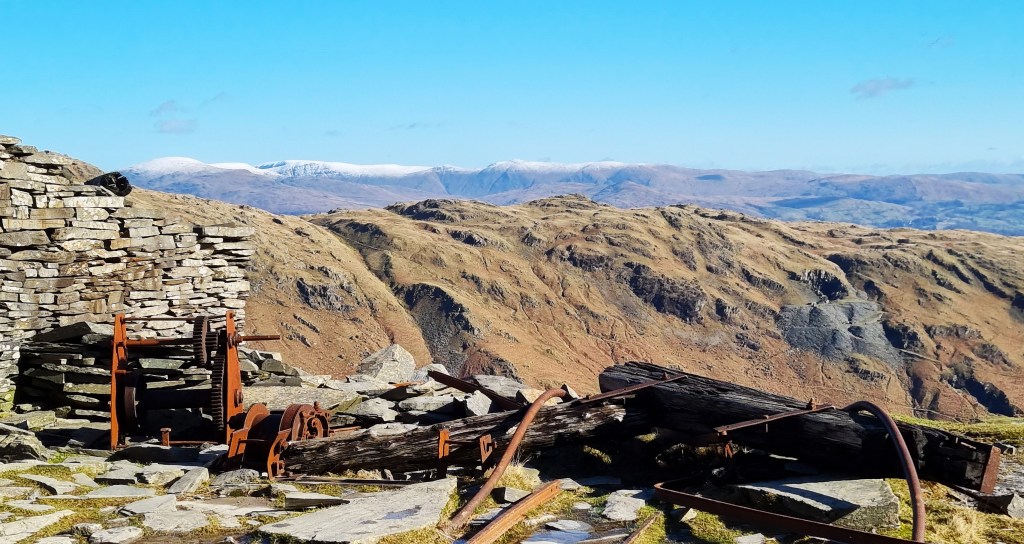
As we gained height, we could see more of Coniston Water, glinting in the sunlight below. Soon, the path was littered with pieces of slate, occasional iron hawsers draped randomly across.
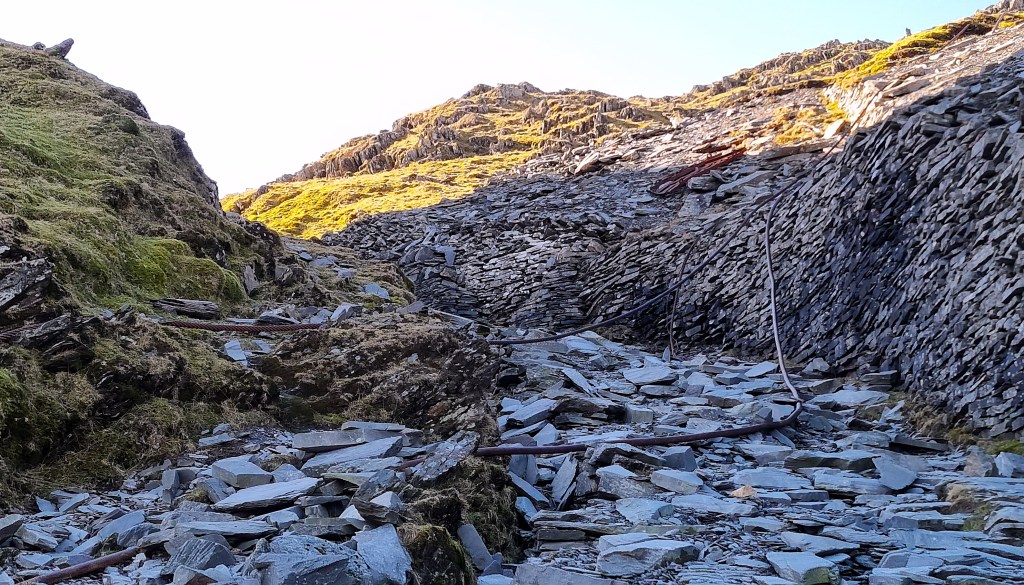
A collection of rusting machinery stood next to the remains of slate-built huts, one carrying the optimistic legend ‘office’.

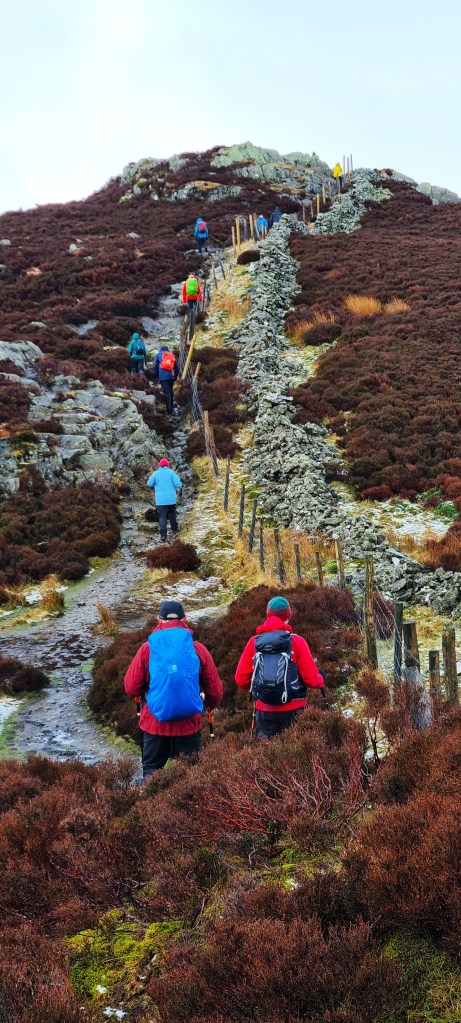
Arriving beside a small tarn, we reached the snow line. What had been a steady uphill walk soon became a scramble. Where the snow was fresh, footholds were relatively secure, but where it was trodden down, snow had compacted into ice.
I was up ahead, just behind another couple from our group using walking poles. It took us roughly 35 minutes to climb from the tarn to the summit.

The rest came up in dribs and drabs, Tracy alongside the largest group about 10-15 minutes later. I got some minor grief for not hanging back to help her, though she does usually let me have my head on ascents, whereas I’m used to her outpacing me on the descents.

Later we learned that the severity of these icy conditions hadn’t been foreseen. Our guide had contemplated abandoning the climb, but decided that to continue upwards would be far safer than attempting a descent the way we had come.

The stress of the climb was completely forgotten in contemplation of the vista from the summit. The Old Man of Coniston is roughly 803 metres high, making it the 12th most prominent summit in England.
Wainwright opined:
‘So strongly sculptured are these fine hills…and so pronounced is their appeal that the scars [of mining] detract but little from the attractiveness of the picture.’
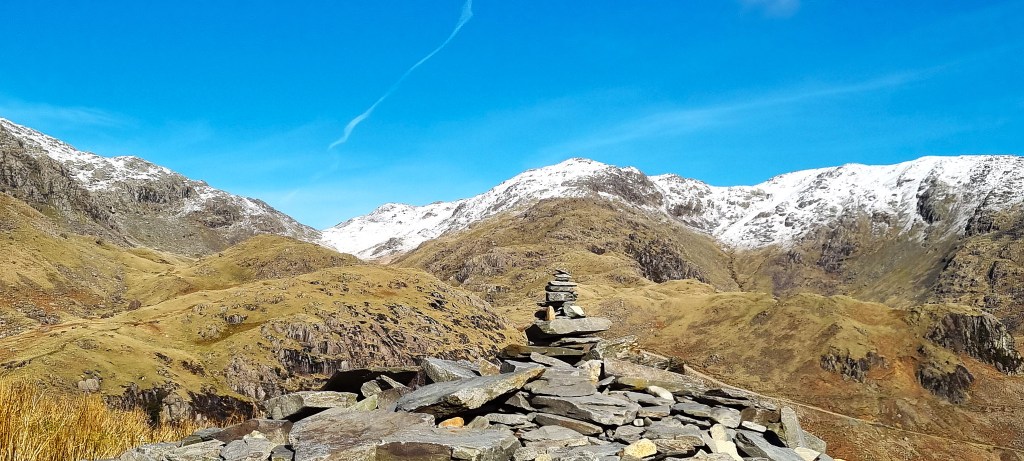
At the summit there is a small slate platform with a cairn on top. We both added small slates in memory of our former partners.

To the south we could see Morecambe Bay in the distance, beyond the northernmost tip of Coniston Water. To the north, the snow-capped fells stretched away under blue sky, interspersed with ridges of light cloud.
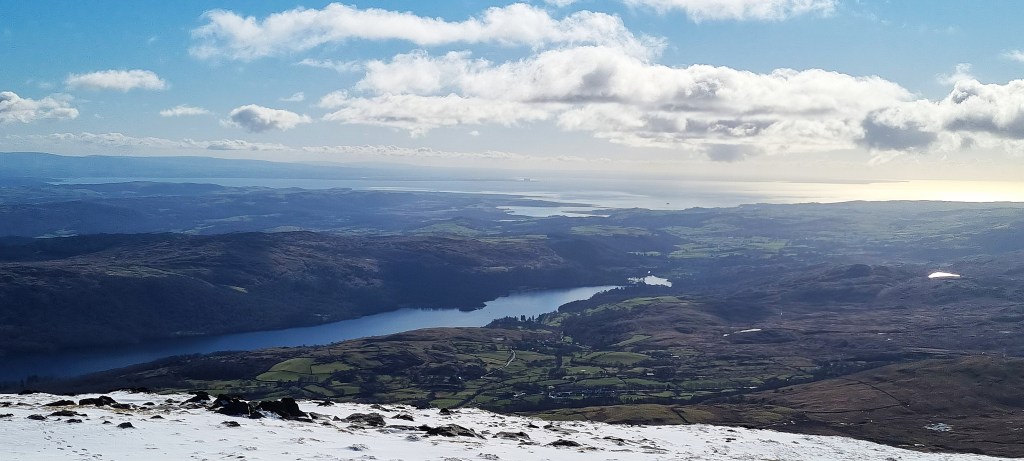
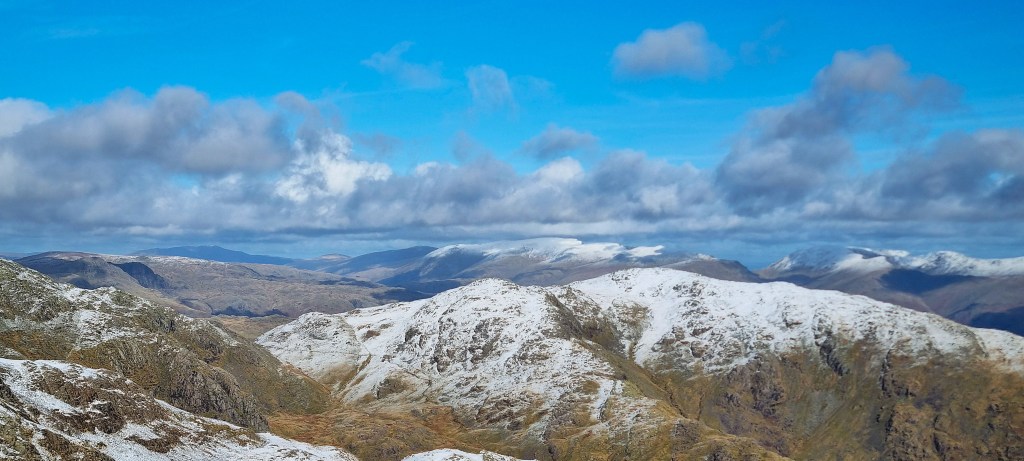
The descent was more gentle, much of the first section across virgin snow. But, lower down, the strong sunlight had almost completely melted the snow.
We stopped for lunch some way above Goat’s Water, a tarn hanging almost in mid- air, between the Old Man on one side and Dow Crag on the other. It is some 15 metres deep and said to contain trout.
It provided a beautiful setting for our picnic.
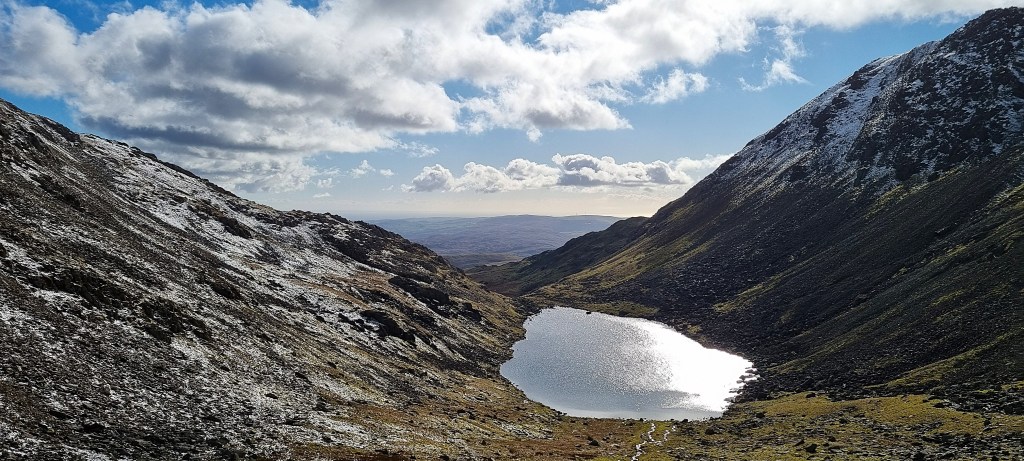
After passing the tarn, the rest of the walk was less picturesque. We reached Coniston shortly after 15:00, via the steep descent from the Walna Scar car park.
Several of our number headed into the Black Bull for a pint or two, but we wandered up past the Ruskin Museum before stopping at Herdwick’s Café for coffee and, in my case, an almond slice.

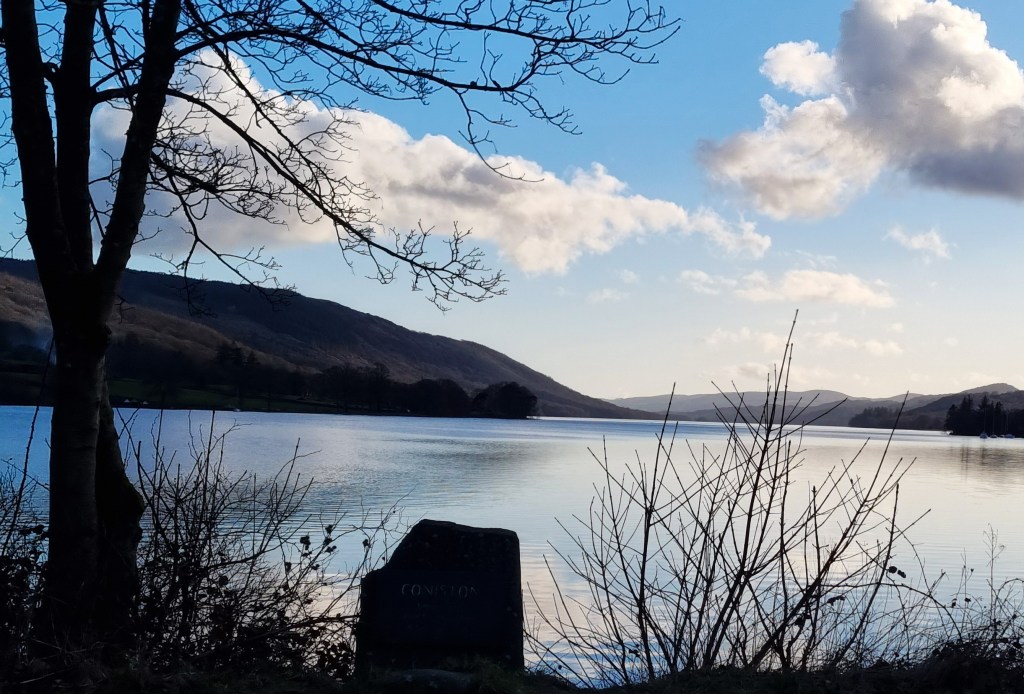
We returned to Monk Coniston, passing a memorial to Donald Campbell.
The late afternoon light enhanced the almost magical reflection of the clouds in the glassy lake.
Dinner was a lively affair, with much gentle piss-taking, not least of me! My final dinner featured mushy pea croquettes, followed by braised blade of beef with mashed potatoes and sticky toffee pudding.
We had been expecting a game of skittles in the barn but they hadn’t been set up so, after coffee, we retired early once more.

Homewards
Next morning, after breakfast, we packed at a leisurely pace, since our Ace Taxi wasn’t due until 10:00.
Almost everyone else had departed beforehand, in their own cars, excepting only the lady who had slipped and broken her arm. She waited while her car was loaded onto a truck which would drive them both back home.
Ace delivered us promptly at Windermere Station but, having arrived on the platform, we learned that our train was indefinitely delayed. Then it was cancelled.
After hastily consulting Google Maps, we climbed into a second taxi in the rank on the forecourt, paying a further £35 to be driven across to Oxenholme. Delay repay enabled us to recoup part of the cost.

We arrived in plenty of time for the Avanti West Coast service to London, which was far less crowded than Monday’s train.
We had window seats at a table, the two outer seats initially occupied by two women preparing for a legal meeting. But they soon left us and, for the rest of the journey, we had the table to ourselves. It was still a little too warm, but far cooler than the outward journey.
We reached Euston on time and made it home an hour or so later.
This had been Tracy’s first ever visit to the Lake District and she was impressed by its immense natural beauty. My previous visits were mostly in the distant past, invariably at New Year and inevitably alcohol-fuelled. It was good to renew the acquaintance.
We were most grateful to our three volunteer guides, who helped us access some of the most stunning scenery this country has to offer.

We were fortunate to walk with many pleasant, welcoming people – and, for the most part, we successfully avoided those of a more negative disposition.
Our room was equally pleasant, with every amenity we needed, saving only a bath. The quality of the food remained consistently high, though perhaps not quite reaching the same standard of excellence as previously.
Almost incredibly, and much to Tracy’s relief, I even managed to scrape through three sociable dinners with passable small talk, never once straying into potentially awkward topics such as politics, sexuality or religion!
We both enjoyed the holiday greatly.
TD
March 2025



 Eponymous
Leave a comment