

In May 2023, we travelled to Croatia for a Dalmatian Island Explorer holiday, arranged by Titan Travel in conjunction with Saga, its parent company.
Aside from our Channel Island Hopping experience of spring 2022, this was our first journey abroad since Covid restrictions were lifted.

There were some problems initially.
When we first booked the holiday, in August 2022, we selected and were allocated Cabin 13, only for our confirmation document to specify Cabin 11.
Both had been vacant at the time of booking, but we had chosen 13 because it was slightly larger, with a double bed.
I queried this with Saga’s post-sales service, who raised the issue with their IT and Production Department but, despite several further emails, a satisfactory explanation was never provided.
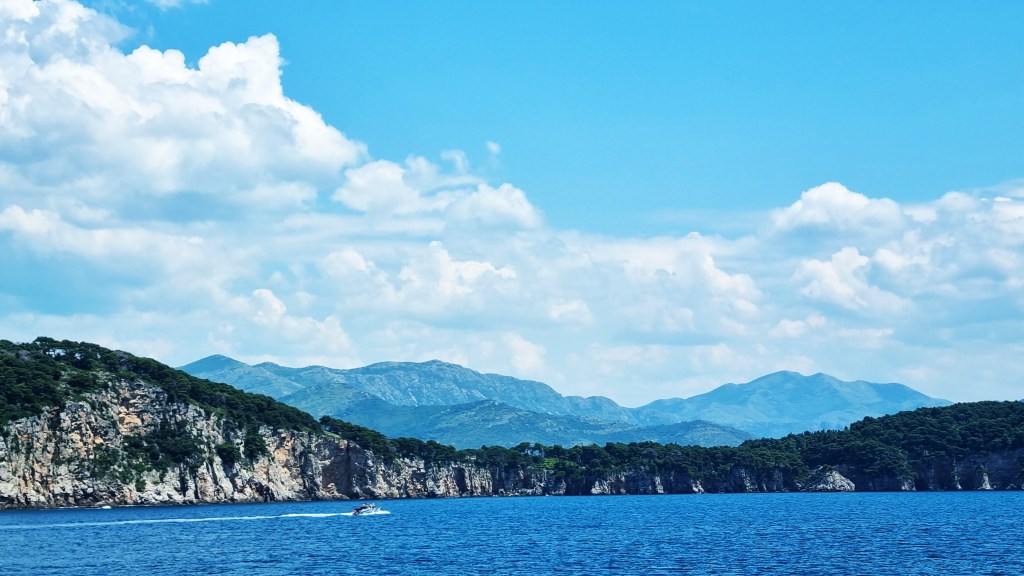
Saga provides a valuable door-to-door taxi service, both to and from the airport, but our final holiday documents, received 10 days before departure, omitted all reference to this, so we had to contact them for revised documentation.
In the event, we were collected at 03:50, the taxi driver arriving 20 minutes earlier than that. Consequently we arrived at Gatwick in much more than ample time for our 07:10 British Airways departure to Dubrovnik.
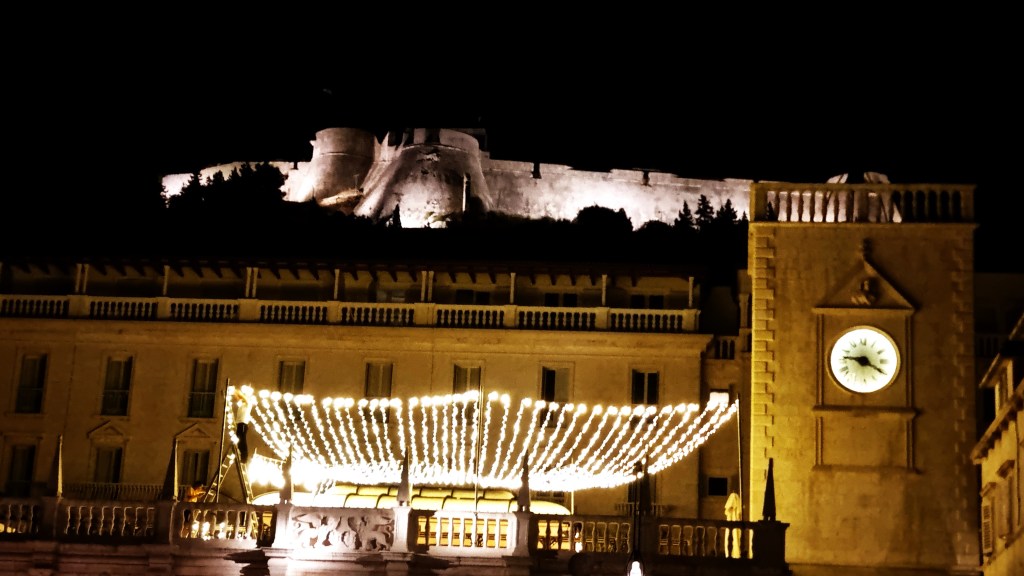
Check-in and security were quickly negotiated, so we had hours to kill over a leisurely breakfast, supplied by Prêt a Manger.
Our flight took off about half-an-hour late, trapped behind a logjam of Easyjets, but we landed in Dubrovnik only 15 minutes behind schedule and were swiftly transferred by coach to the port, at Gruz, where we boarded our ship.
MS Providenca

MS Providenca is 47 metres long, with a beam of 9 metres and a cruising speed of 9 knots. She was constructed in 2014 and refurbished in 2020.
There are 20 cabins, air conditioned and with a compact en-suite shower room, giving a maximum capacity of 40 passengers.
The cabins on the lower deck have a closed porthole; those on the middle deck a small opening window and a partly-glazed door. Our cabin was one of the latter, fairly forward on the starboard side.
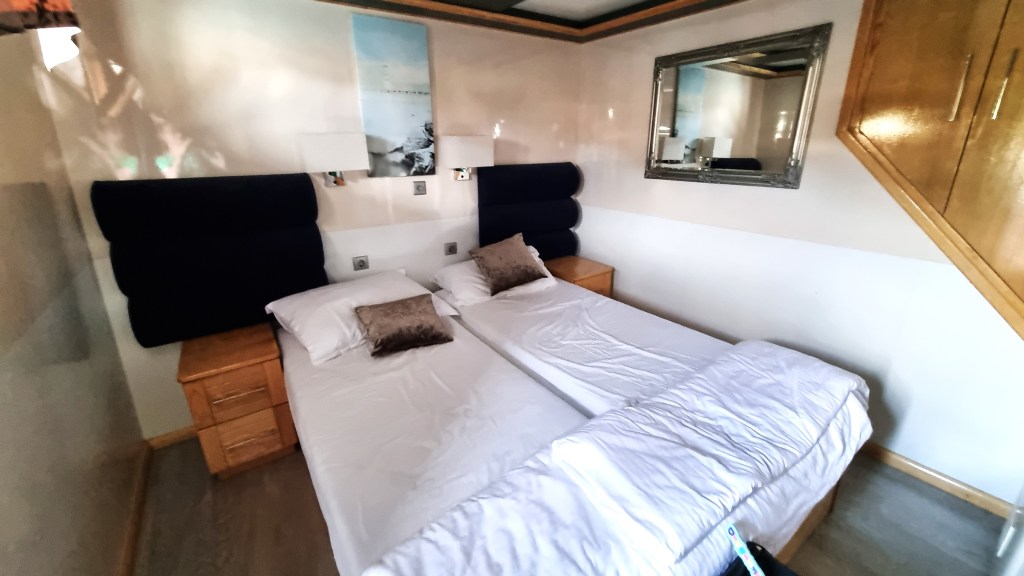
It was approximately 2.5 metres square. There were twin divans, separated by bedside cabinets. A vanity table was squeezed between the small wardrobe, beside the door, and the door to the bathroom. A triangular cupboard in the wall opposite the cabin door was just large enough to hold our empty suitcases. The bathroom contained a sink, a toilet and a very adequate shower. A hair drier was fixed above the vanity table and there was a safe in the wardrobe.
(We were not alone in failing to observe the instructions for operating the safe, which included an unfamiliar step to manually reset the previous code, and one of the crew was kept busy forcing them open.)
We had been told that our new cabin could be configured with a double bed and so there was a special request to that effect on the travel documents. When we arrived on board this had not been done, but that was swiftly rectified.
Although the single divans could be moved, the headboards remained in their previous position, however, so two of our three electric sockets were immediately behind our heads.
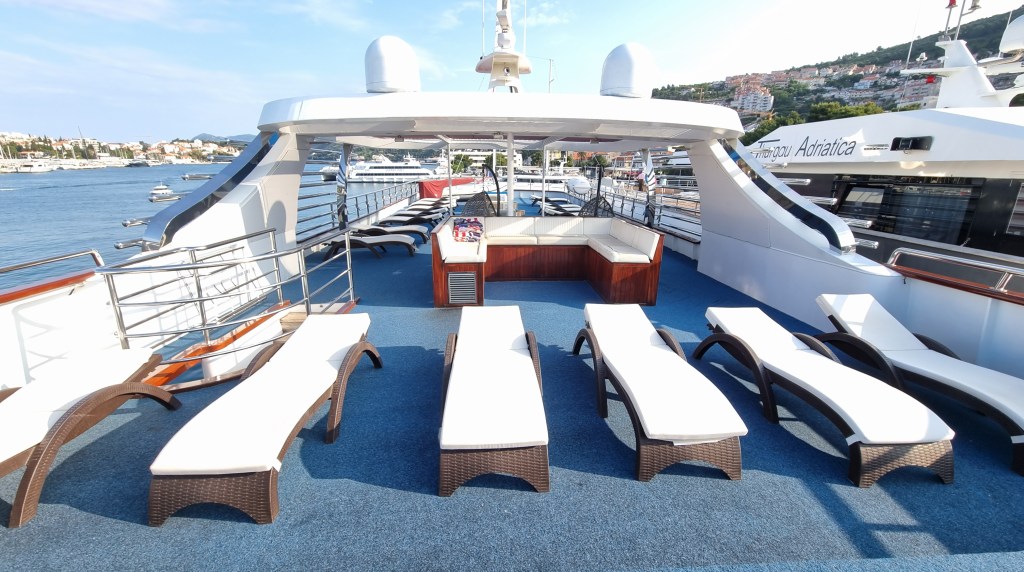
Elsewhere on board, there was a small seating area and a swimming platform to the rear of the middle deck. The upper deck supplied another open seating area in the bows, complete with jacuzzi; a large salon restaurant amidships; and, at the stern, a covered lounge area with open sides. Above, the sun deck was largely open, containing several sun loungers, a bench seat and two basket chairs.

By and large, we passengers separated into two broad groups: those who spent most of our cruising time on the sun deck and those who preferred the covered lounge.
We were in the former category, though we kept largely to a small shaded area, further protected in my case by a floppy hat, sunglasses and factor 50! From time to time, we would dodge further forward to photograph a particularly striking landscape over the bows.
The ship was operated by a youthful captain supported by two crew members. Two chefs occupied the galley. One cabin cleaner also served in the bar and helped wait at table; one bar person also doubled as waitress. A mysterious housekeeper was on board for some of the journey.
Our tour guide accompanied us throughout. Also comparatively youthful, she had left her partner and young children at home. As an undergraduate she had studied tourism rather than languages, though her English was almost faultless.
Free wifi was available in the salon and lounge, but not elsewhere.
A free bar, selling local beer, wine, liqueurs and soft drinks, was open from 11.00 to 22.00 daily. It proved highly popular and we were hard-pressed to keep up with the drinking capacity of some of our fellow guests.

Morning coffee should have been available from 07:00 daily – essential to those of us who need a strong caffeine hit to get them started – but this was rarely the case, since the person responsible for closing the bar in the evenings was also supposed to making the morning coffee.
A buffet breakfast was typically served from 08:00 to 09:00, a seated two-course lunch, with wine, from 13:00 and a seated three-course dinner, again with wine, from 19:00 onwards. On two occasions, we were freed to dine ashore, though at our own expense. On three occasions, after dinner musical entertainment was supplied.

There were some thirty passengers, including three single occupants of double cabins, so we were some way below full complement.
All of us were aged over 50. A few of us were under 70 or over 80, but the bulk of the group was septuagenarian.
We had been advised that we would require a fair degree of mobility to get about the ship and to go ashore, but a handful of passengers did not possess such mobility.
We met some very pleasant and interesting people, though there were a handful of rather more difficult or opinionated individuals who we learned to avoid.
No doubt they felt exactly the same about us!
Our itinerary
The weather was perfect for our tour, apart from a few stiff breezes here and there, so our itinerary was unaffected. We were told that the two preceding tours had been less fortunate, experiencing prolonged rain and missing out on one of the stops.
All of our travelling was done in daylight hours, typically in the mornings. We never cruised for more than five hours at a stretch and, often, these longer journeys were interrupted by a stop for swimming.
Evenings were invariably spent moored in a harbour, some busier than others.
Numerous tourist ships ply these waters and, at night, they typically moor abreast because there is insufficient space along the harbour walls. Passengers must walk through the intervening ships to reach their own.
In the morning, the ships must leave in order, the outermost first: there is often no room for more complex manoeuvres.
Sometimes then, one’s night is spent as the meat in a potentially noisy ‘ship sandwich’, though it might be even noisier on the innermost boat, next to any harbourside bars. It was often preferable to close the window and sleep to the hum of the air con.
Though of course, one could be lucky, having the outermost vessel and being on the correct side of it too! This we managed on our return to Dubrovnik.

Our itinerary was as follows, illustrated on the Google Map below:
- Day 1: Flight, transfer to ship at Gruz; cruise to Sipan, mooring for the evening and overnight at Sipanska Luka.
- Day 2: Cruise to Korcula, mooring in the afternoon at Korcula Town for a guided tour and remaining overnight.
- Day 3: Cruise to Makarska town, centerpiece of the Makarska Riviera on the mainland, remaining for two hours; cruise on to Brac, mooring at Pucisca, initially for a tour of the stonemason’s school and then overnight.

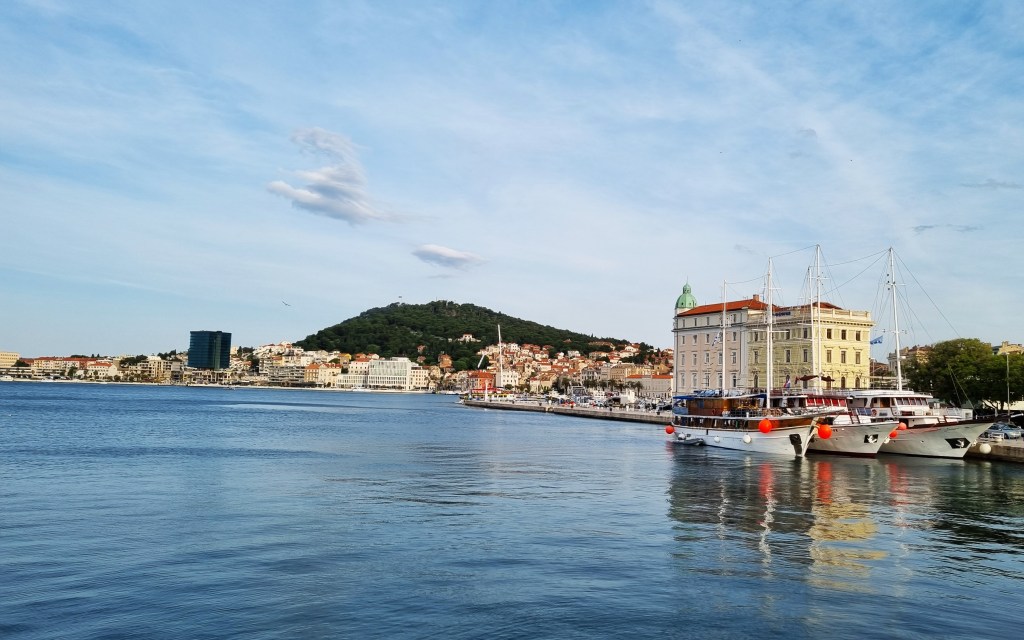
- Day 4: Cruise to the City of Split; a guided tour in the afternoon followed by free time and an opportunity to dine ashore; mooring overnight.
- Day 5: Cruise to Hvar, mooring at Hvar Town; a guided tour in the afternoon followed by a second opportunity to dine ashore; mooring overnight.
- Day 6: Cruise to Mljet, mooring at Pomena; a walk through to the two inland salt water lakes and a boat trip across to the church and Benedictine monastery on St Mary’s Island; mooring overnight.

- Day 7: Cruise to Dubrovnik; in the afternoon a coach to the old city for a guided tour followed by free time; moored in Gruz harbour overnight.
- Day 8: Transfer to Dubrovnik Airport for flight home.
For those who like to know these minor details, my reading material for this holiday was ‘A Hazard of New Fortunes’ by William Dean Howells.
Day 1: Sipan – Sipanska Luka
It was shortly after midday, Croatian time, when our coach pulled up beside the Providenca, moored just behind a wooden replica galleon called Karaka.

We went straight into a welcome meeting in the lounge area, with wine, canapés and fritule.
Fortunately, the canapés were placed on our table; unfortunately the wine was on the other side – some mingling with strangers was required!
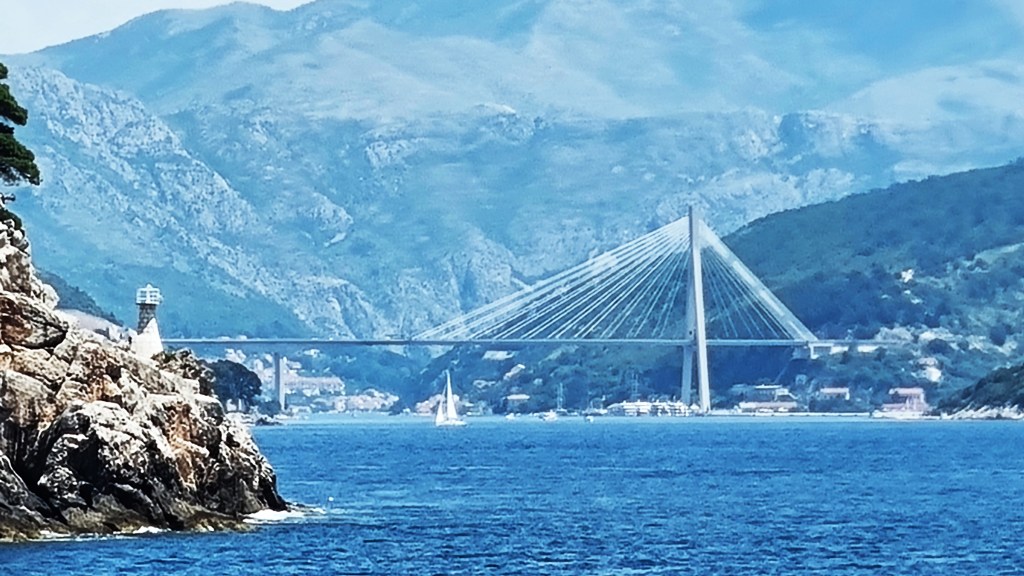
After coffee, we unpacked swiftly, then headed up to the sun deck for the best view as we pulled out slowly from the harbour, past the berths for monstrous cruise ships (presently empty) and on alongside the splendid 518 metre-long Franjo Tudman Bridge, named after the first President of Croatia.
We continued along the Dubrovnik Riviera, picking our way past the Elafiti Islands. Some authorities claim there are 13 – though only three inhabited – within this archipelago, which stretches north-westwards of Dubrovnik.
They were formerly part of the quasi-independent city state of Dubrovnik, known as Ragusa.
Kolocep, just three miles from Gruz, is the first substantial island, from whence hailed two members of Columbus’s crew on the Santa Maria.
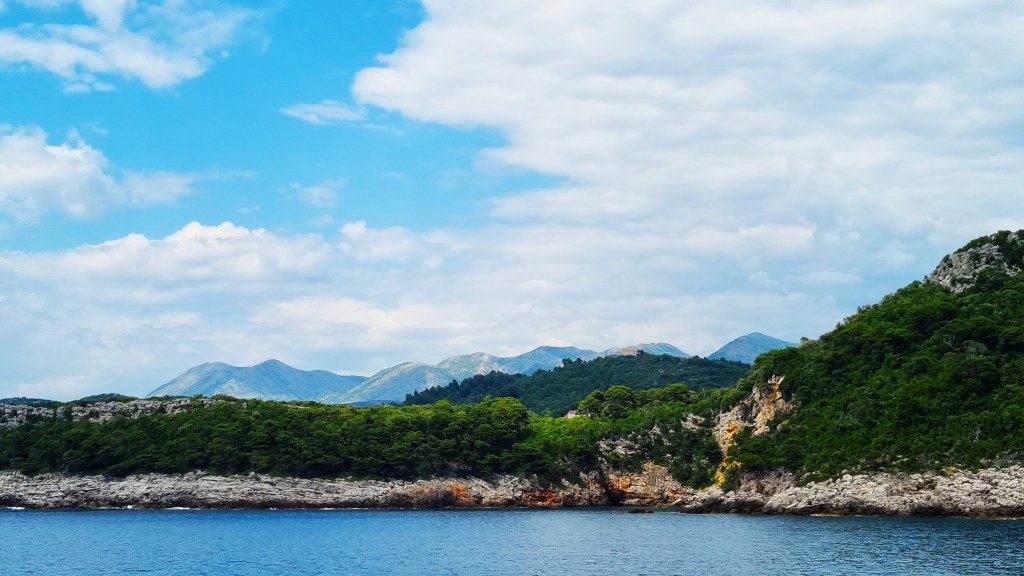
Next is Lopud which, like its neighbour, was a port and shipbuilding centre, once boasting an 80-strong merchant fleet.
Finally we reached Sipan, the largest of the Elafites, with a population of around 400. We were heading towards Sipanska Luka, one of its two ports, located on the west coast, behind a long, narrow spit of land.

As we approached this, a group of jet-skiers came upon us extremely quickly from behind, sporting around us, like playful electric dolphins.
The Sipan ferry overtook just as we were rounding the spit, passing beneath the telegraph wires, suspended high above.
We noticed a small beach on our starboard side as we inched towards the village at the head of the narrow inlet, dominated by St Stephen’s Church.
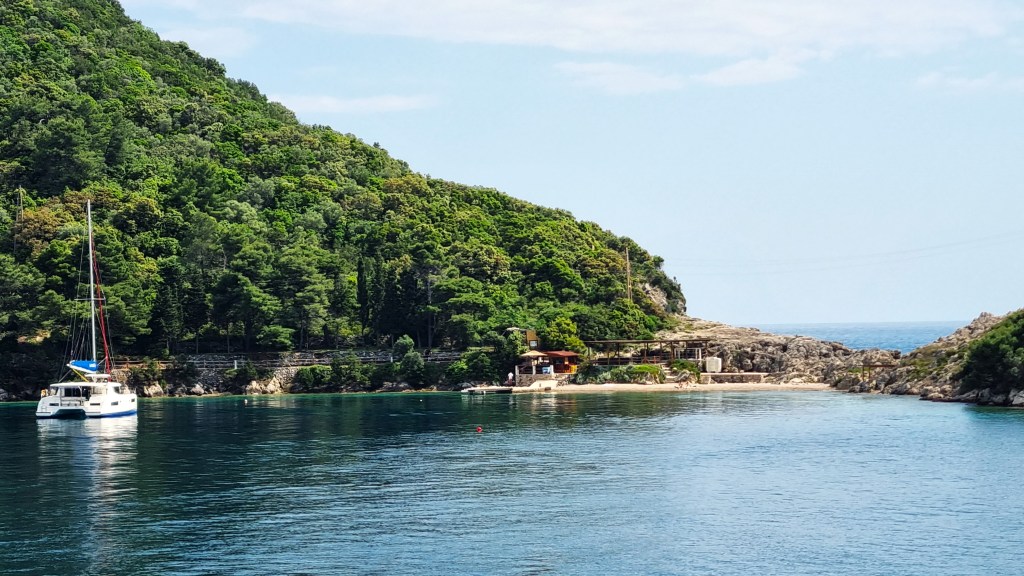
Eventually we moored with the nose of the ship just feet from an old villa, which houses the Café Bar Aramis.
Climbing ashore, we ambled round the promenade, past the few houses and bars, until we reached the beach – known as Prijesba – where we braved the naturist couple at the far end, and paddled defiantly in the shallows.

As we did so, a squadron of charter yachts passed by, one by one, to moor on the near side of the harbour. Those aboard seemed in buoyant mood, and we feared for the tranquility of the evening.
Eventually returning, we paused to photograph a neglected harbour-front villa, its balcony supported by four carved lions.

Local children spread out their wares under the trees for the tourists to buy, as cats stretched lazily in the last of the sun.
We climbed back aboard for our first dinner. Then it was out to the lounge for a drink to accompany the sunset.
But our early start soon caught up with us, and we were off to bed shortly after night fell.

Tracy sleeps through anything, but it always takes me some days to acclimatise.
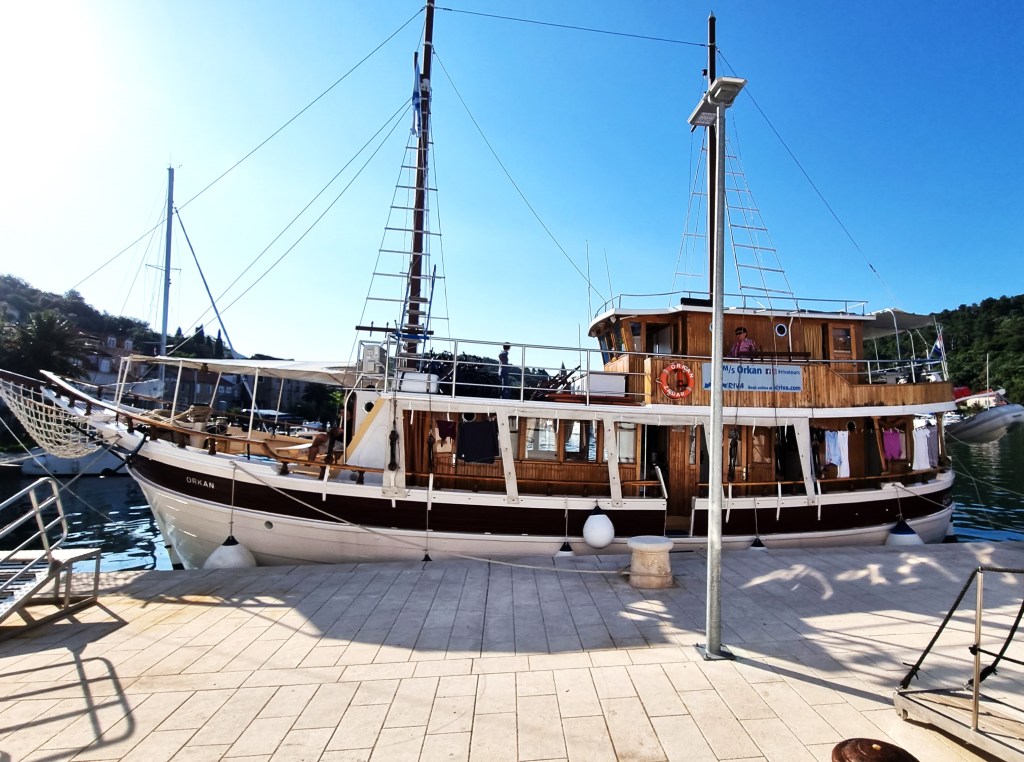
And my sleep was fitful, thanks to the yachtsmen carousing in the bar, and the late night conversations aboard MS Orkan, recently moored just across the quay.
Day 2: Korcula – Korcula Town
I awoke at 06:30 to the sound of the Orkan turning herself about.
Mercifully coffee was ready at 07:00, probably for the only time on our voyage.
We departed at 09:30, still heading in a north-westerly direction, this time towards Korcula. We positioned ourselves on the sun deck, pulling two of the sun loungers into the semi-shade on the port side.
We cruised along beside the Peljesac Peninsula to starboard and the island of Mljet to port. We would visit Mljet later in the week.

The Peninsula stretches some 65km, Croatia’s second largest, and is famed for its red wine and oysters. Behind it lies the Bay of Mali Ston. This separates it, in turn, from a narrow stretch of coastline, perhaps 25km long, belonging to Bosnia and Herzegovina.
This Neum corridor, named after Bosnia’s only coastal town, was first established after the 1699 Treaty of Karlowitz. The southern enclave of Croatia, around Dubrovnik, would be cut off from the remainder, were it not for the Peljesac Bridge, opened in 2022.
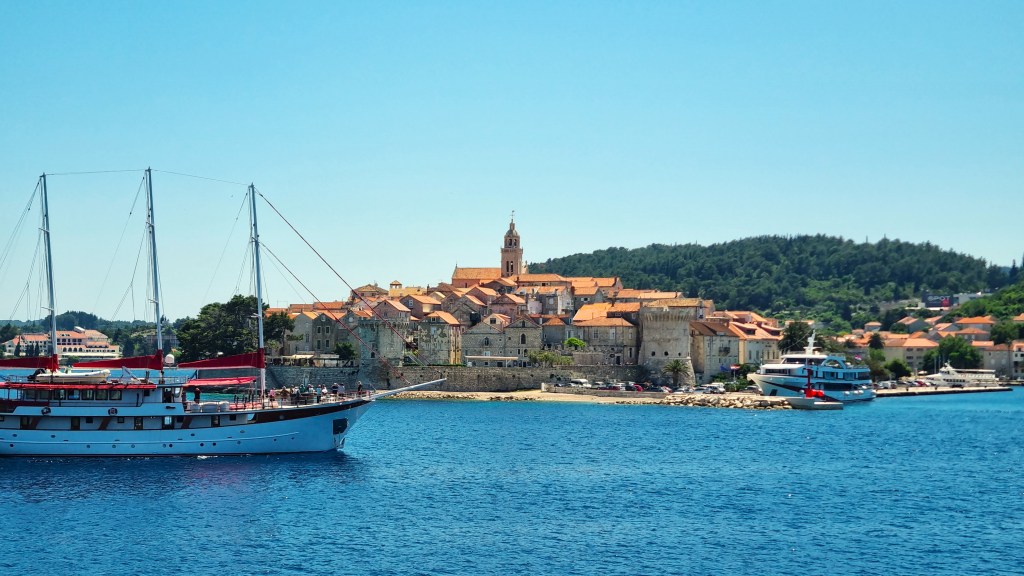
As we neared Korcula Town, at around 13:00, the amount of seaborne traffic increased noticeably, and we took our lunch while waiting our turn to inch into its harbour, alongside many similar vessels.
The island of Korcula stretches parallel to the northern end of the Peljesac Peninsula, overlapping with the island of Hvar to the north.
Korcula is many times larger than tiny Sipan, approaching 50km long. It has a population of almost 16,000, some 3,000 of them living in Korcula Town.
After its Venetian heyday, the Island was invaded by the French in 1806 and the British in 1813. They handed it on to Austria in 1815. Italy belatedly had a short turn, from 1918 to 1921.
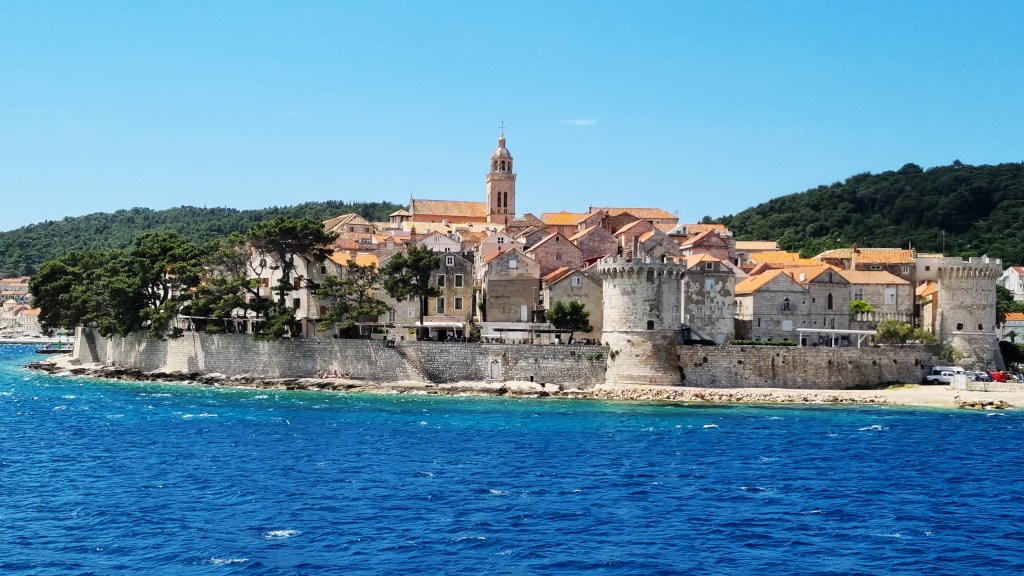
It is best known for Korcula Town, lying at its eastern end, where the gap between the Island and the Peninsula begins to narrow.
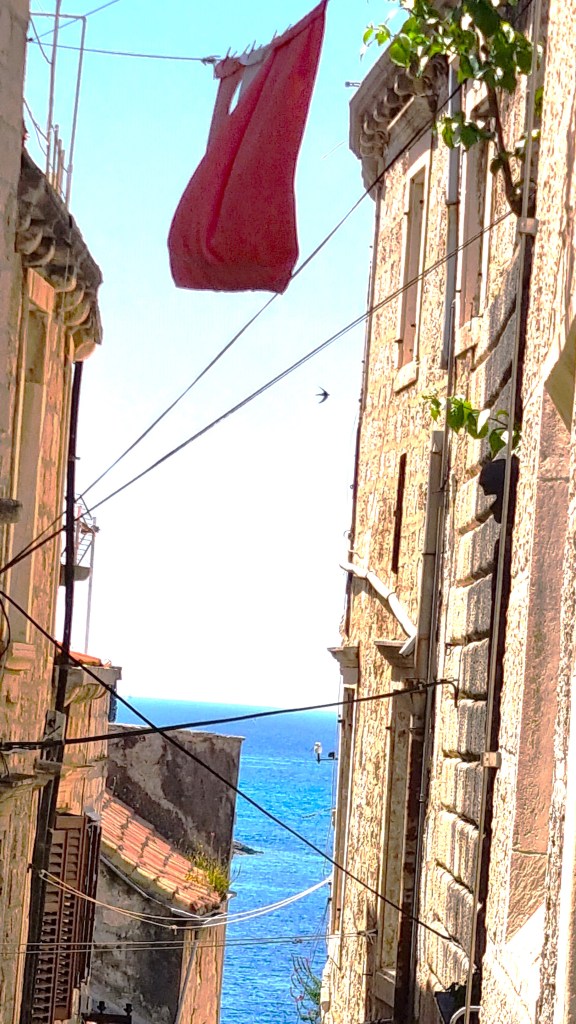
The Old Town is a mini medieval walled city, a miniature Venice but without the canals. It juts out on a headland into the sea, the narrow streets branching off its central thoroughfare in a herringbone pattern.
Largely constructed between the Fourteenth and Sixteenth Centuries, it doesn’t discourage almost certainly spurious claims that it is the birthplace of Marco Polo.
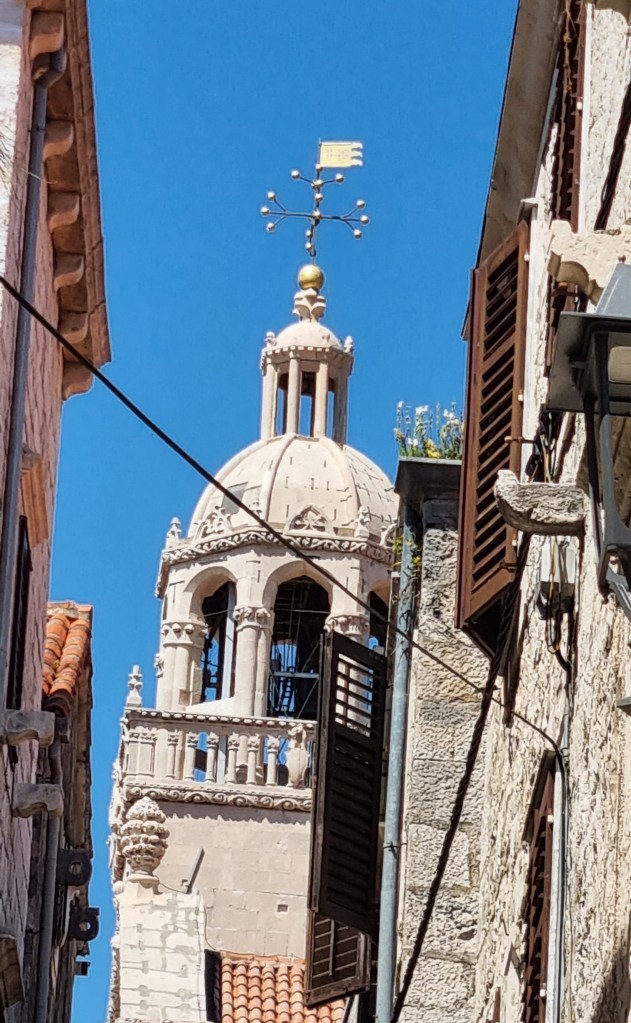
He might have been captured in a sea battle between Genoa and Venice hereabouts in 1298, but even that is uncertain, and he was most probably born in Venice.
By the time our guided tour began, the temperature had risen well into the 30s, so it was even harder hard to concentrate in my sleep-deprived state. Korcula is the sort of place where one has to look around carefully at every step, or miss delightful architectural details.

I was personally much taken with the Adam and Eve, literally squatting, on either side of the door to St Mark’s Cathedral. Their indelicate pose must have something to do with them bearing the weight of the Venetian lions above them – presumably this is elaborate late medieval symbolism.
I was also appreciative of several of Korcula’s ‘alley cats’, especially this one, unusually alert while guarding the cannon!

The tour ended, I was desperate for a siesta, retiring for that purpose to the cool of our air-conditioned cabin while Tracy read on a harbourside bench.
But, later on, we ventured back into Town together, strolling beyond the harbour, round the bay, towards the Dominican monastery of St Nicholas.
We sat for a while on another bench, watching the boats coming in and out, before returning to the ship for dinner.
Afterwards, while sipping our drinks, there was much talk of how Providenca could extract herself from the traffic jam in time for our projected 07:00 departure.
There was little doubt that I would be awake to see it!

Day 3: Brac – Puciska, via Makarska Town
I managed slightly more sleep than the night before, but was still up and about well before coffee was due.
But our departure was something of an anti-climax: the boats behind us had already left and those alongside peeled off, one after another, forming a convoy heading northwards, initially along the narrow channel between Korkula on one side and Peljesac on the other.

There was a faint mist in the air, not yet burned off by the sun, as I occupied myself in photographing the view from the stern, the ship’s flag waving in the foreground.
Soon we had rounded the northernmost tip of the Peninsula and, before long, passed the picturesque Sucuraj Lighthouse on the extreme eastern tip of Hvar. One can stay in the adjacent holiday home, but it costs 528 Euros per day in high season.

Now though, the eye was drawn, irresistibly, to the silver-grey mountains stretching the length of the Makarska Riviera, a procession of villages and small towns lying at their feet.
These are the Biokovo Mountains, whose tallest peak, Sveti Jure, towers almost 1762 metres directly above Makarska Town.
We arrived there on the dot of 11.00, the temperature now hovering respectably in the mid-20s.
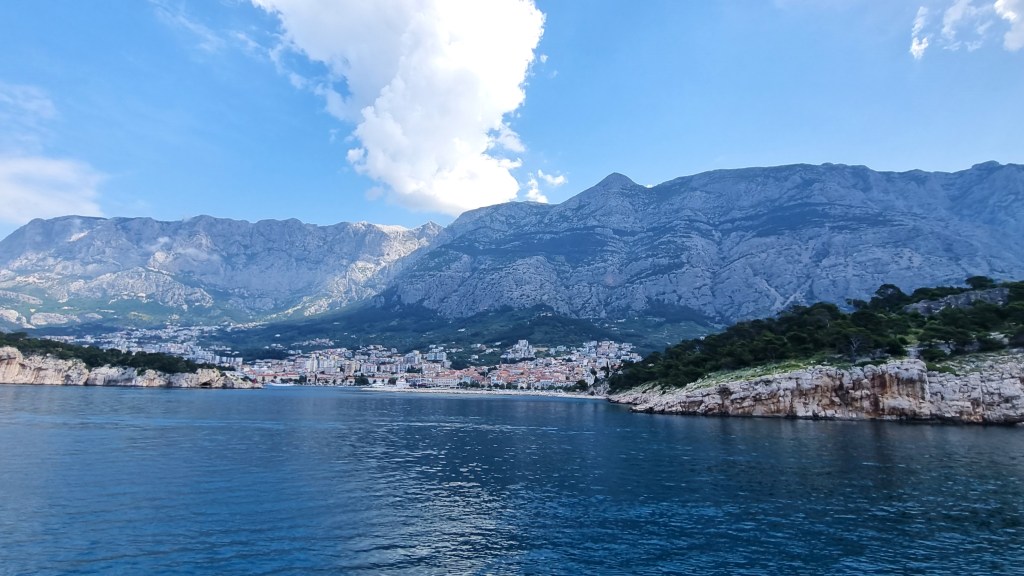
During July and August, this place is heaving with alcohol- and drug-fueled teenagers out for a good time, and is strictly to be avoided. But now it was enveloped in a pleasantly calm pre-season atmosphere.
We strolled vaguely about the main thoroughfares, before heading to the beautiful Town beach where we had another paddle, while admiring a cloud in the shape of a pound sign that hovered directly over Brac.

Afterwards we stopped for a coffee at a small café, amongst shady trees, just across from the post office.
On our way back to the ship, we encountered this handsome couple.
The statue, by Nikola Sanjek, records the days of former Yugoslavia. It depicts a Dalmatian man, practiced in the art of picking up not entirely unwilling female Western tourists (the men were disparagingly called ‘seagulls’).
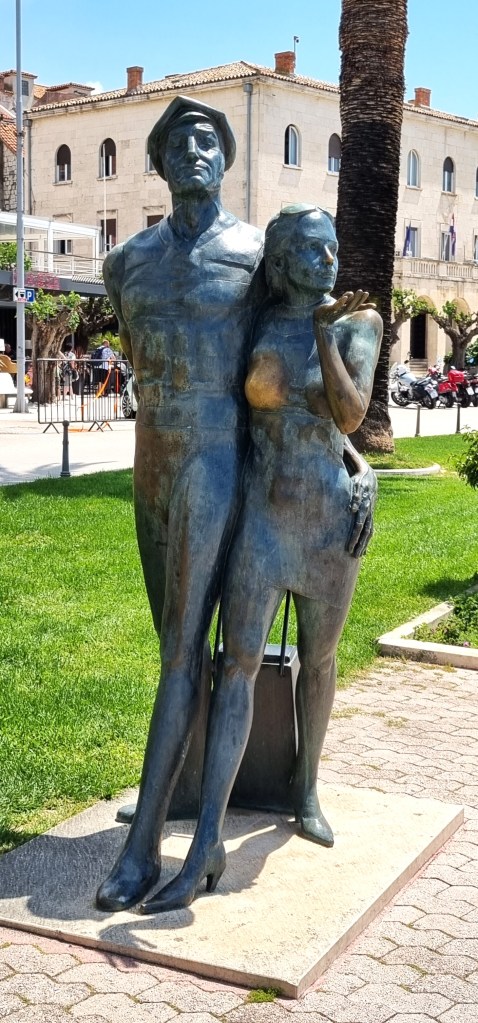
Countless passers-by have rubbed the lady’s right breast, since this is thought to bring good luck, or else good fortune in affairs of the heart – no-one appears to know quite which. I resisted the temptation.
Then it was back on board for lunch, which we took while departing Makarska for our second stop of the day.
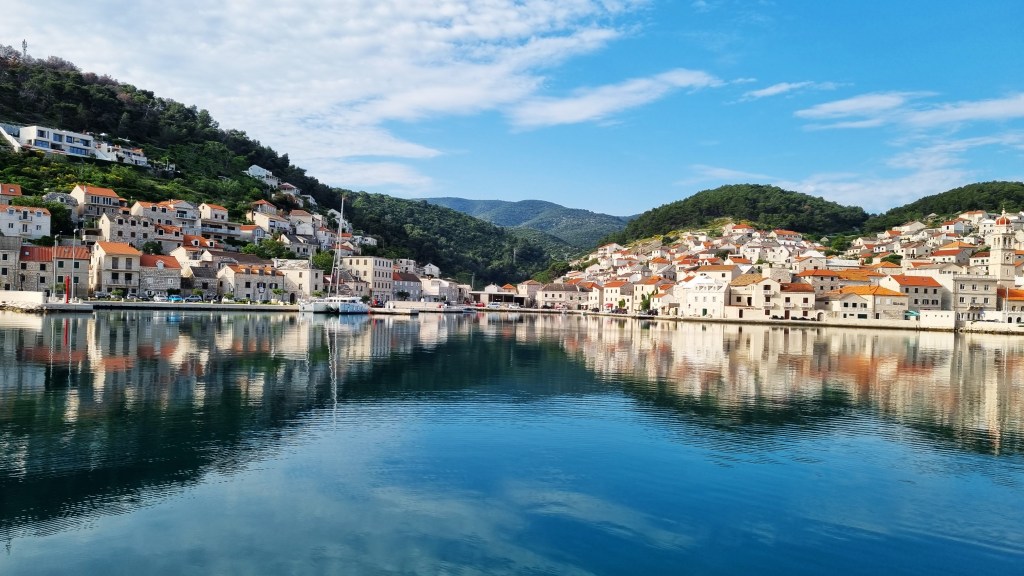
This was Pucisca, a little way along the northern coast of Brac, and an utterly different kind of place.
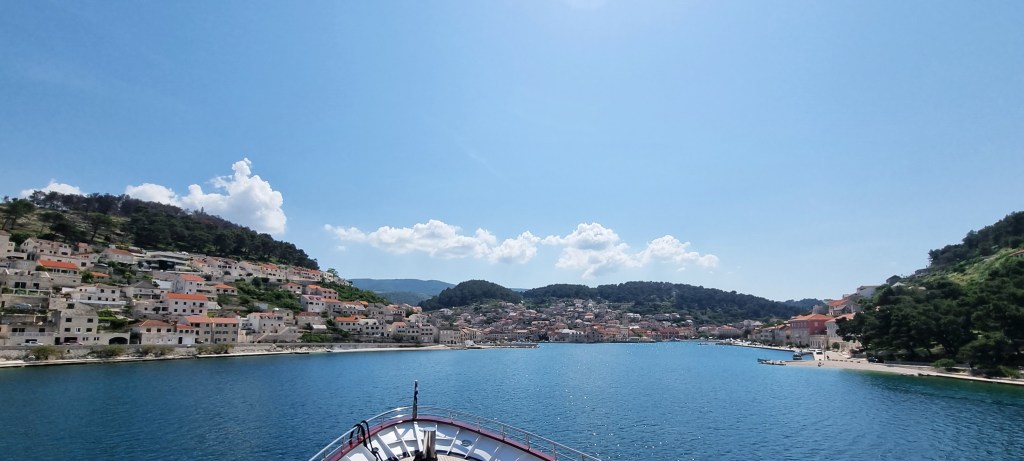
Brac is the largest Dalmatian island, with a population of about 14,000. The principal town is Supetar, further along the coast, but Brac is undoubtedly best known for Zlatni Rat, the so-called Golden Horn beach, to the west of Bol on the south side.
Not to be outdone, Pucisca is occasionally listed amongst the most beautiful villages of Europe. Like Sipanska Luka, it is built back from the sea in a deep inlet.
On the coast, before entering the inlet, one passes the local stone quarry, operated by the Croatian company Jadrankamen. In 2012, the workers here allegedly revolted against the corrupt dealings of their bosses, but all seems calm today.

Brac is noted for its white limestone, used to build Split’s Diocletian Palace (see below) but almost certainly not to build the White House in Washington DC, despite claims to the contrary.
That was most probably Virginia sandstone, painted white. However, it is believed that stone from here may have been introduced when the building was renovated in 1902, during the presidency of Theodore Roosevelt.
We moored beside the stonemason’s college, located on the harbourfront, and went inside for a brief presentation by one of the students, a Bosnian.

The college was established here in 1909. Each year, there are 50 places available on a four-year ‘stonemason technician’ course, from which students may progress to various degree courses elsewhere, and 50 more on a three-year course for aspiring stonemasons.
There are boarding facilities for 56 students, some of whom travel from neighbouring countries. Most are boys, but a few girls attend. The college is a significant beneficiary of EU funding.
Afterwards, we two headed 100m up the road to a small beach, constructed from tiny chunks of white limestone, where we had a very pleasant swim. Someone practiced their yoga positions a little further down.

After dinner, we walked in the opposite direction, round the harbour, past a few bars, a shop and a dormant night club.
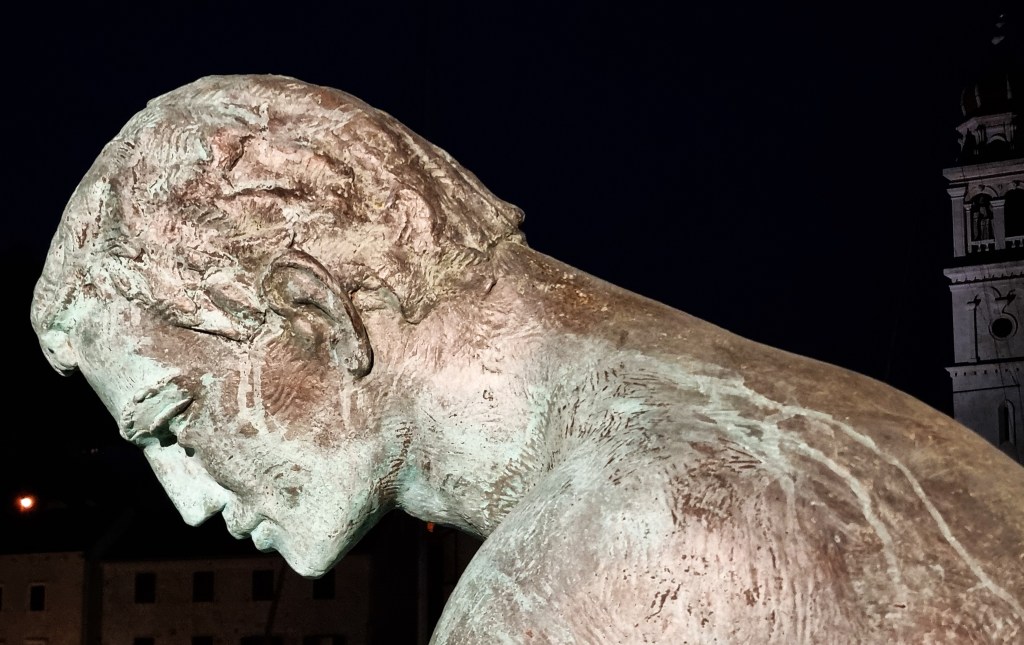
Pucisca is a pristine monument to the stonemason’s craft, with not a graffiti tag in sight. There are two statues beside the harbour: one a female swimmer; the other a man and woman grappling with a child.
We headed back to the lounge for drinks, and later enjoyed a peaceful night.
Day 4: Split
We departed Pucisca after breakfast, continuing along the north side of Brac, towards the city of Split on the mainland.

We moored for a while, a little before Split, for swimming from the back of the boat. But it was extremely cold, and I managed only ten seconds immersion before my body decided no pleasure was to be had from the experience.
Split was visible long before we arrived there, especially the numerous tower blocks in the new part of the City, which are stacked, tiny box upon tiny box, between the sea and the mountains above.

There was also a prominent Norwegian cruise ship moored in the outer reaches of the harbour.
Soon, though, we could see the bell tower of the Cathedral of St Domnius, rising from the old town in the precincts of the Diocletian Palace.

After lunch, we were taken on a short walking tour of the Palace by a guide with a monotonous voice, who insisted we use headphones. It was rather like being lulled to sleep by a droning fly.
Diocletian was Roman Emperor from 284 to 305AD, though he had been born in Dalmatia and came from a modest background.
He was the first emperor voluntarily to abdicate, and had ordered the construction here of his retirement palace, some ten years before it was needed.
He spent seven years here, monitoring the disintegration of his reforms, before he died a disappointed man – quite possibly at his own hands.
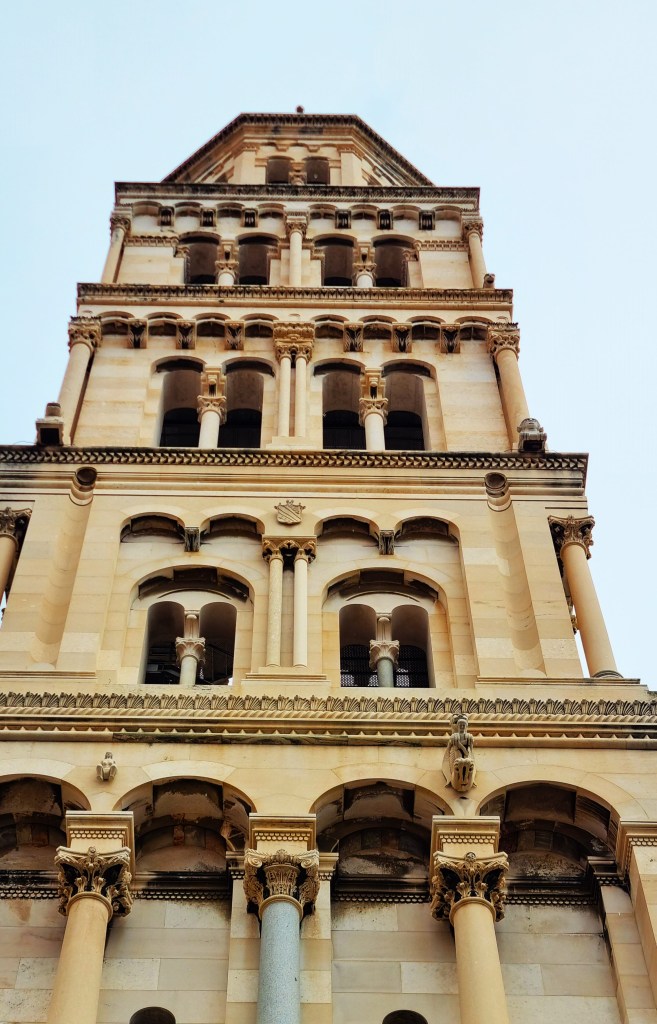
After his death, the palace remained part of the Roman court but, by the early medieval period, it had begun to be transformed into living quarters for the local populace.
The Cathedral was consecrated at the start of the Seventh Century, though part was originally Diocletian’s own mausoleum. Ironically, St Domnius had been martyred during Diocletian’s persecution of the Christians. The bell tower was added at the beginning of the Twelfth Century.
The Palace was little known in Western Europe until the ruins were surveyed by Robert Adam in the mid-18th Century. In 1979 it was made a UNESCO World Heritage site.

We had our first encounter with a duck boutique – clearly something of a fad in Croatia, since we later found another in Dubrovnik.
Those crazy Europeans…
After the tour, we went for a walk by ourselves, ostensibly to reconnoitre suitable restaurants for our evening meal.
I very much enjoyed this building, in Viennese art nouveau style, which once housed the sulphur baths and opened in 1903.

Returning to the ship, we consulted both our guide and Google, finally opting for a drink at Leopold’s Delicatessen Bar, allegedly equipped with its own brewery and a large beer garden, followed by a meal at Appetit.
We had some difficulty tracking down Leopold’s, since it has moved across town from its previous location into a small bar up a narrow alley. There is no garden.
But the beer, from Mandrill Brewery, was still available: I sampled the summer ale and a beautifully balanced session IPA.

Then on to Appetit, where we very much enjoyed our meals: a cuttlefish black risotto for Tracy and a mushroom, porcini and prawn pasta for me. Strangely, no dessert menu was forthcoming.
Meanwhile, some musicians were playing on board but, sadly, we missed them.

Day 5: Hvar – Hvar Town
Morning coffee was much delayed, as our bar staff had decided to head out clubbing in Split and slept through her morning alarm call.
She later apologised – and I forgave her, on the grounds of youth, hoping that this would increase the prospect of timely caffeine thereafter!
To reach Hvar, we passed through the narrow channel between the western tip of Brac and neighbouring Solta, site of twin commando raids in 1944.
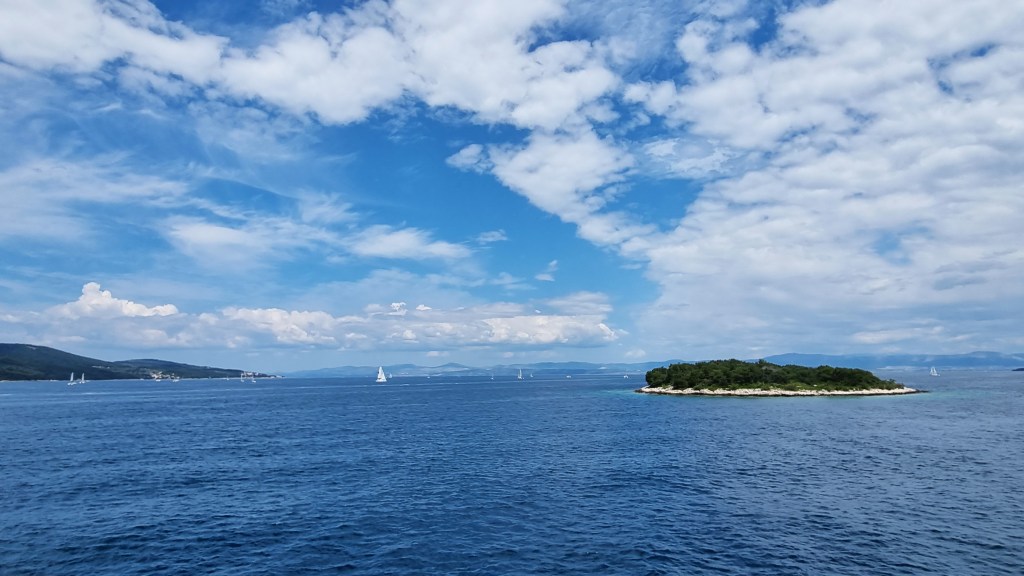
We once again stopped for a swimming session, this time off Brac and, fortunately, the water was significantly warmer. I managed to stay in for all of five minutes.
Arriving off Hvar Town, in the south-west of Hvar, we cruised between the narrow peninsula at the western tip and the small Pakleni Islands, which are said to have the best beaches hereabouts.

We had been advised that we might need to lay off the Harbour until a berth became available at 17:00 but, for some reason, this was revised and we moored at 14:00, directly alongside the waterfront cafes.
Next door, we had a 55m ship, Taleya, registered in Georgetown, sleeping 12 passengers and available for charter, for approximately $250,000 per week. Most of the passengers seemed to be teenagers!

Hvar does attract such people, unfortunately. We watched bemused as three women, dressed to the nines, emerged from the café opposite, adopting that peculiar female buttock-swaying swagger that is so beloved of minor reality TV celebrities.
Apparently, Hvar has been a playground for the rich and mostly not quite famous since 1903, when the first guidebook began to promote it as ‘Austria’s Madeira’.
But soon it was time for our next tour, this time with a far livelier lady, who showed us an abundance of Venetian lions and much else of interest, including the theatre, cathedral and Benedictine convent.

We noted the way to the Citadel above, via the steep steps, and determined to climb up for the view later, before dinner.
After the tour, we sat for a while beside Mandrac, the small inner harbour, before walked out along the promenade towards the Park. Here we sat on a bench while a small boy fell off his bike just in front of us.

It was about 18:00 when we climbed up to the Citadel, built by the Venetians in the Sixteenth Century. We took the photographs of an Indian couple, against the background of the Town below, and they kindly returned the favour.
On descending the steps, we stopped off for some local red wine in an ancient stone building called Konoba Katarina and, later, climbed a few more steps to Konoba Menego, where we dined.
We shared roast boar and stuffed peppers, plus drunken figs, and polished off our second carafe of wine. We both returned to the ship a little wobbly.
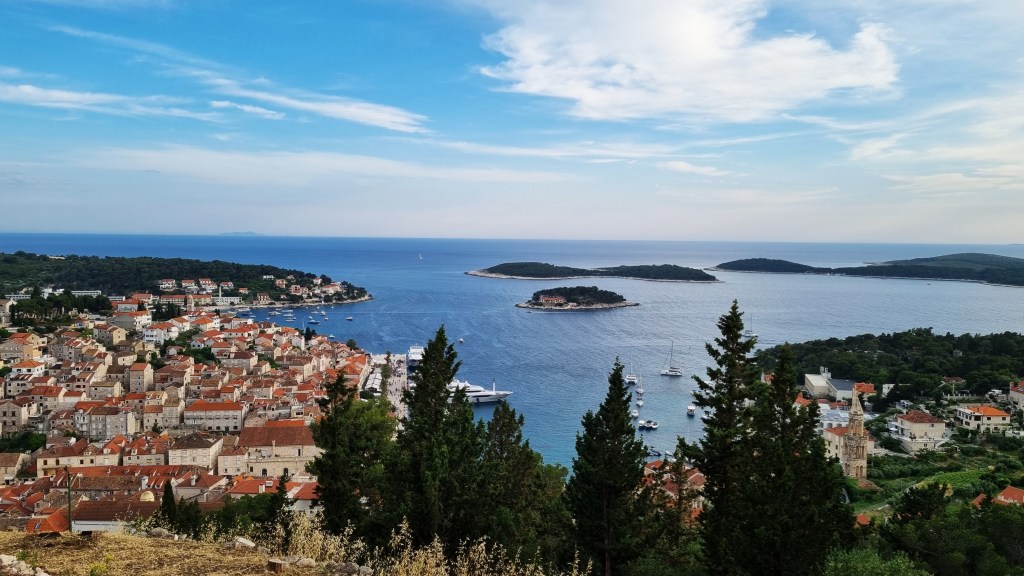
Day 6: Mljet – Pomena
We left Hvar Town at 07:30, headed for Mljet, about halfway back to Dubrovnik.
Just out of Hvar, we passed the tiny circular island of Pokonji Dol with its lighthouse, built in 1872.
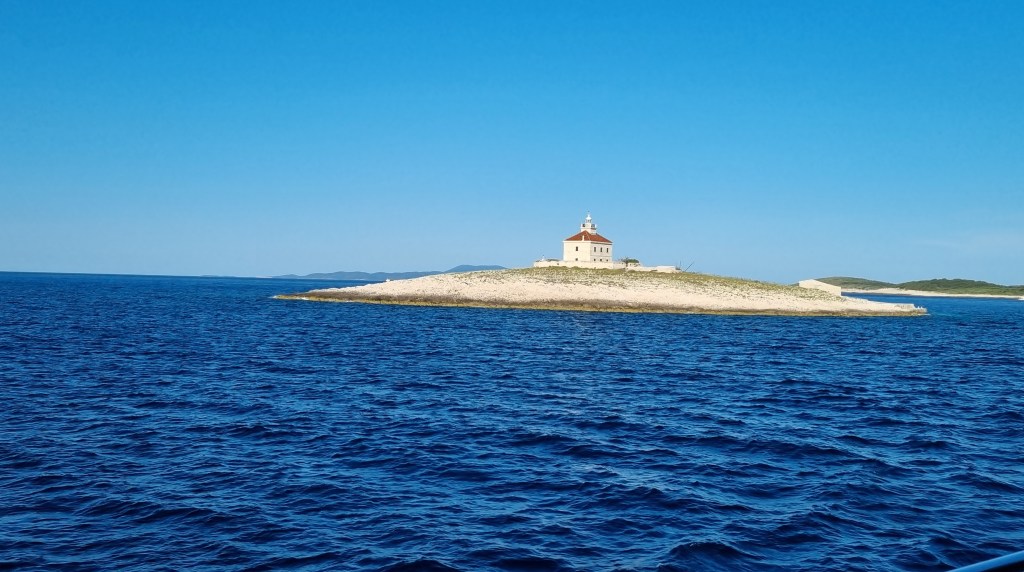
Our route lay back past Korcula Town, which we reached by about 11:30. It took a further two-and-a-half hours to reach Pomena, at the western tip of the Island.
It is an extremely picturesque location: a thin hook-shaped peninsula juts out just a little further to the west, and there is a small island – Pomestak – directly opposite the harbour.
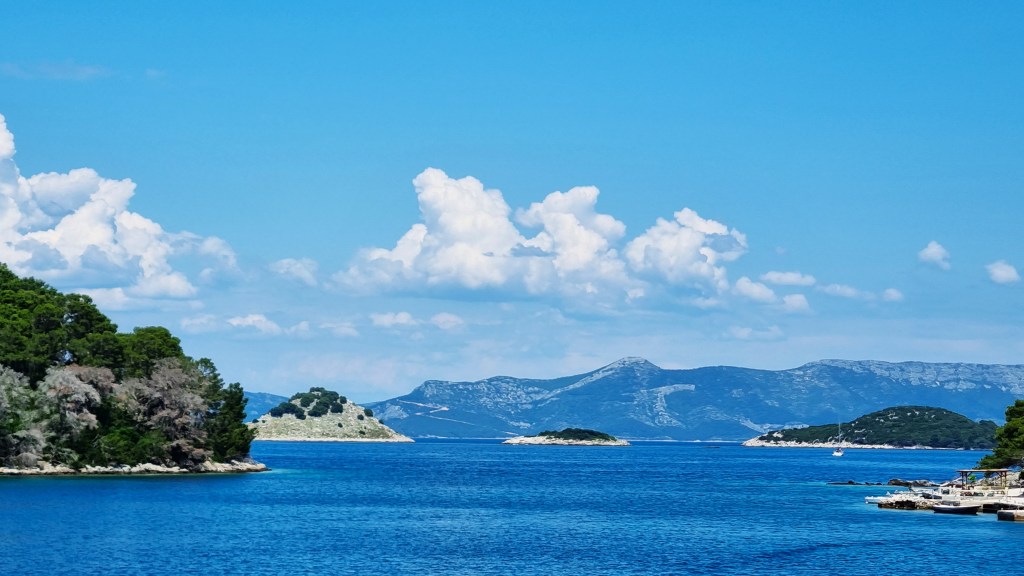
Mljet has a population of about 1,000. At the beginning of the Twentieth Century, mongooses were introduced here because the Island was infested with venomous snakes. They eradicated the snakes, but also most of the birds too.
Nevertheless, the western half of Mljet is a national park. Much of the land is wooded and surrounds two saltwater lakes, one small; the other significantly larger.
Towards the far side of the larger lake, there is the small island of St Mary’s, which houses a Benedictine Monastery, established in the Twelfth Century.
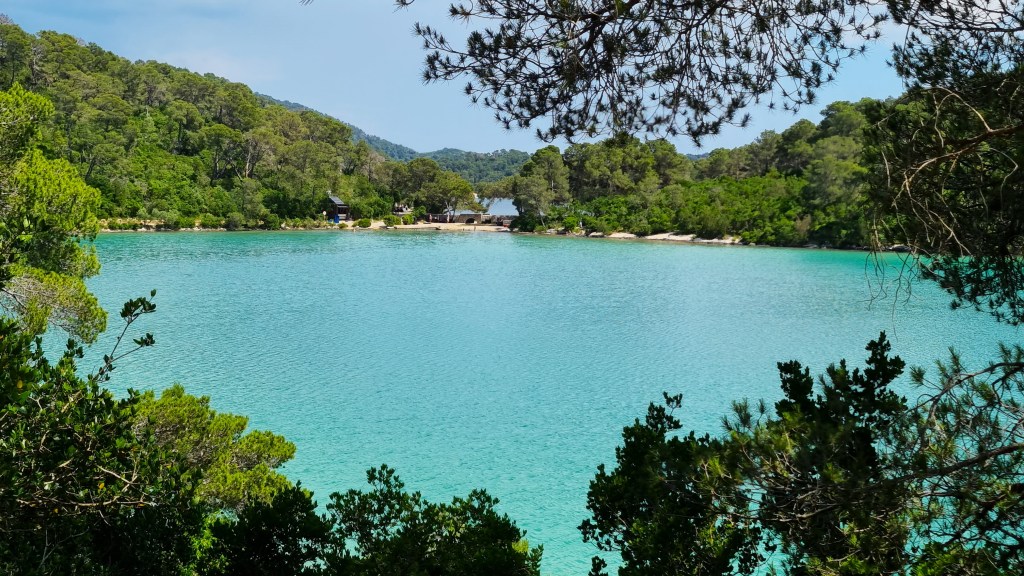
The Benedictines, who came ashore from Italy, assumed control of Mljet in 1151 and, some 40 years later, took possession of the Monastery, built for them by a generous Serbian prince. It closed at the beginning of the Nineteenth Century, only to reopen in 1998.
After we had drunk in the gentle spectacle of Pomena, we went ashore, walking to the confluence of the large and small lakes, from whence we boarded a tourist boat that carried us across to St Mary’s.
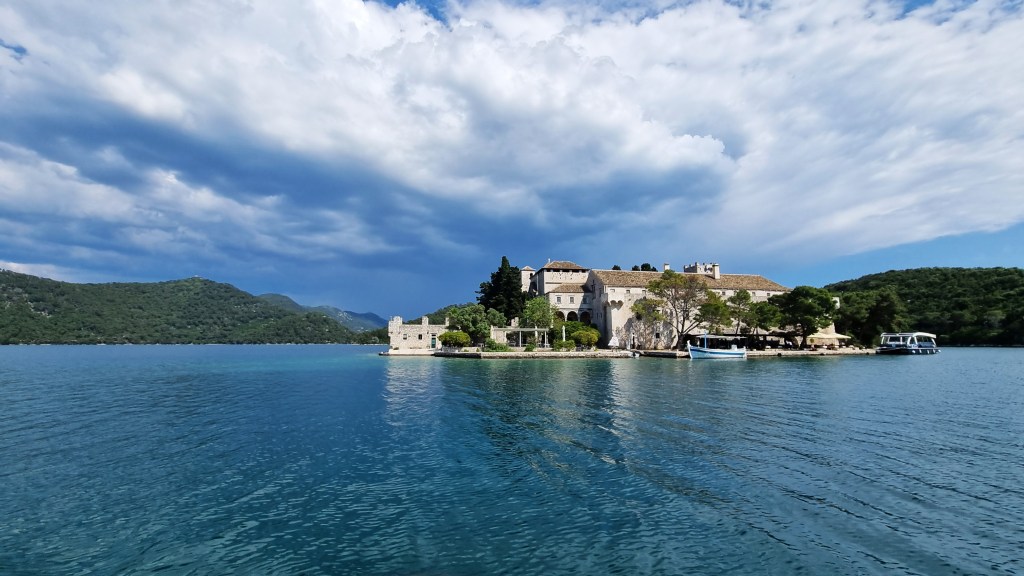
The two of us took a slow walk around the island, enjoying the tranquility and the flowers.
Catching the same boat back, we stopped for a swim in the waters of the small lake, which were warm and invigorating.
Afterwards we dried out on the small beach before walking back to the ship. We wanted ice creams but, though we could see tubs in several flavours, there was apparently no-one available to sell it to us.
Our hearts sank as we returned, because we were now sharing this unspoilt paradise with half a dozen boats.
Nevertheless, the sunset was spectacularly beautiful.

Day 7 – Dubrovnik
We left Mljet at 08:00 next morning, heading back down to our original mooring at Gruz, Dubrovnik’s harbour.
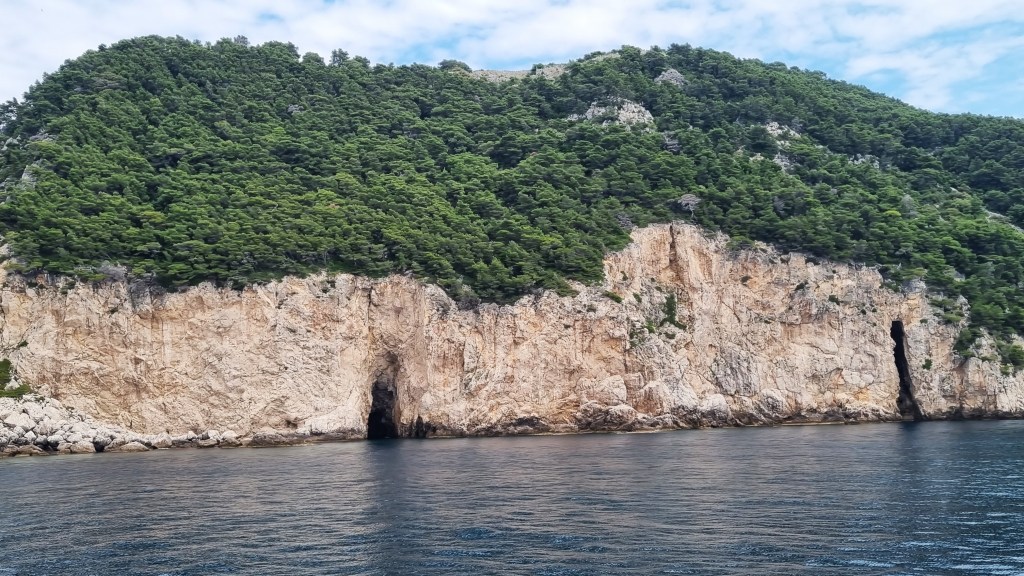
Passing down the southern coast of Kolocep, we noted the many caves eroded into the low limestone cliffs. Then we stopped in a small bay for a final swim. Tracy took a turn, but I was all swum out.
After lunch, we were picked up by a coach and driven into the old town of Dubrovnik for our final guided tour. There were headphones again, but a more interesting presentation this time.
Apparently, the authorities refuse to allow more than two cruise ships at once here, for fear of overwhelming the place. It was, literally, swarming with tourists. But very few took a walk around the city walls, since this appeared to cost almost fifty euros.
We learned more about the Ragusan Republic, a quasi-autonomous city state, which was at its peak in the Fifteenth and Sixteenth Centuries.
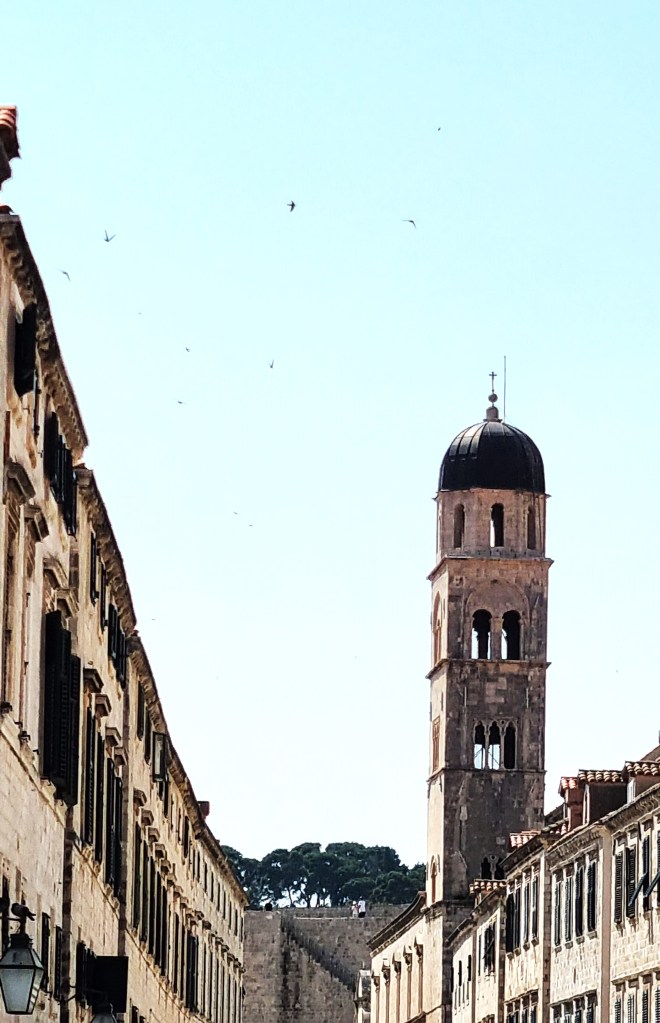
We were also reminded of the siege of Dubrovnik.
When Croatia declared independence in 1991, Serbia – under the guise of the Yugoslavian People’s Army, attacked Dubrovnik, while their ally Montenegro claimed it for itself.

An attack began on 1 October and the City was besieged for several months. Over 100 civilians were killed during this period and more than half of the buildings in the old town were damaged, despite it being a UNESCO World Heritage Site.
The siege was finally lifted in May 1992. Everything has been repaired, but the bullet holes in the walls are still visible.
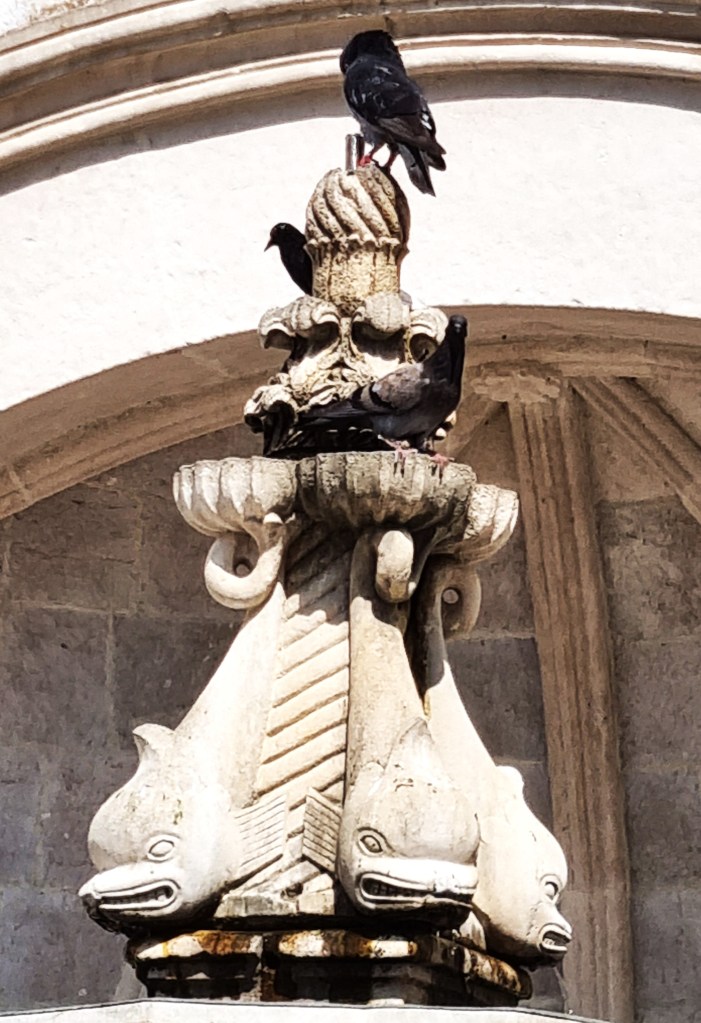
Once again, the amount of statuary was almost overwhelming, and I’m afraid I took in very little of what the guide was telling me.
Afterwards, we bought ice creams and ate them while watching the boats in the old harbour. Then we went souvenir hunting, but it was extremely difficult to find anything worthwhile.
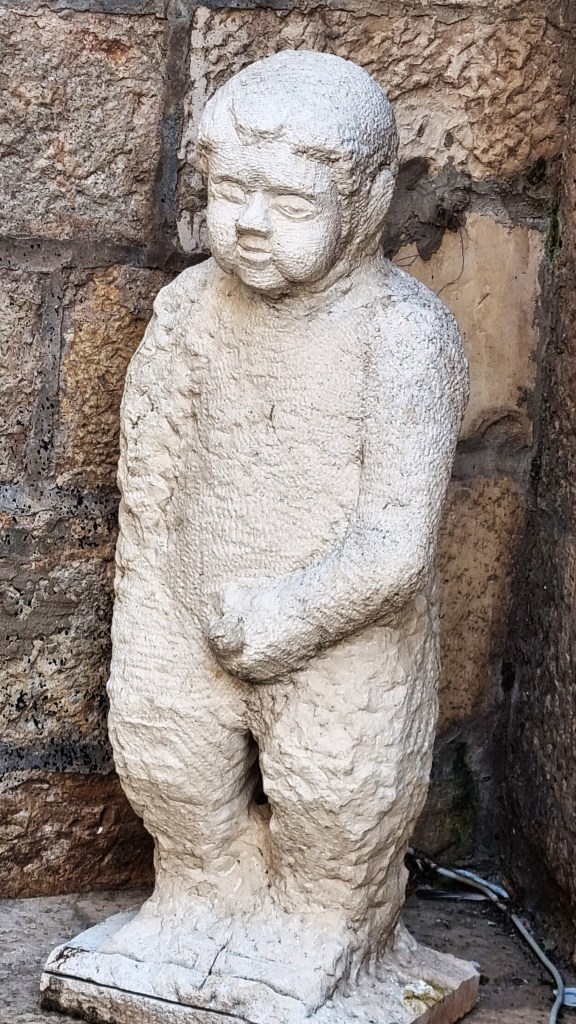
Eventually, I plumped for a miniature concert stage, built inside a small coke tin, which was grossly overpriced, but I liked it.
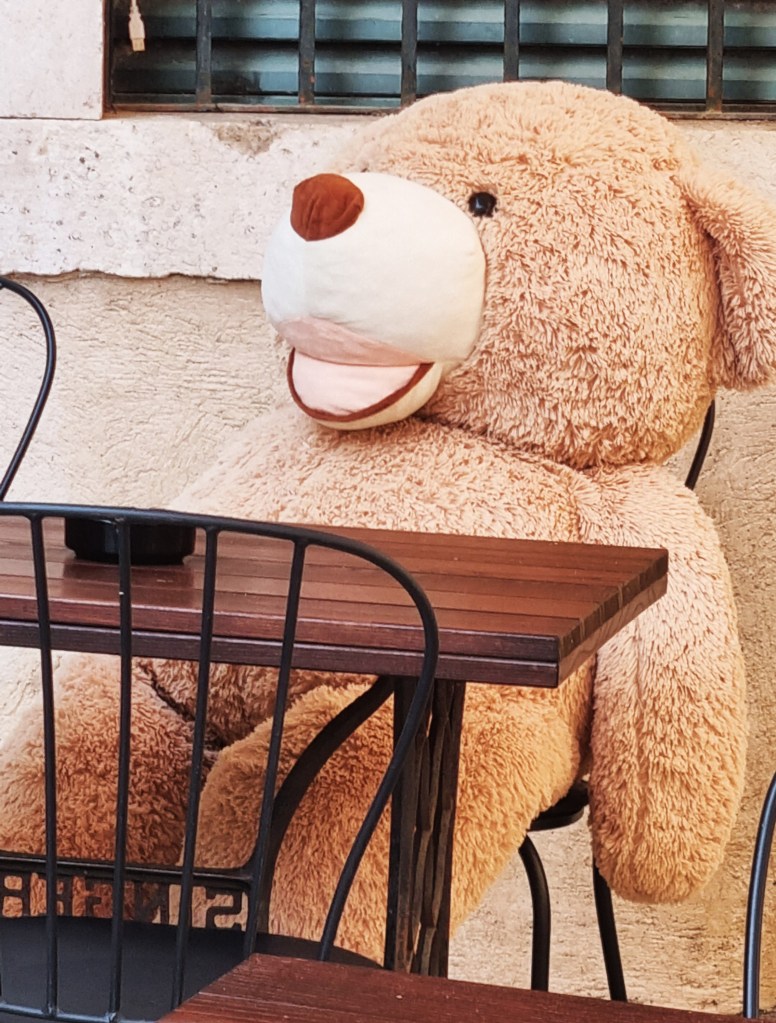
On the way back to the rendezvous spot, we came upon this poor exhausted bear.
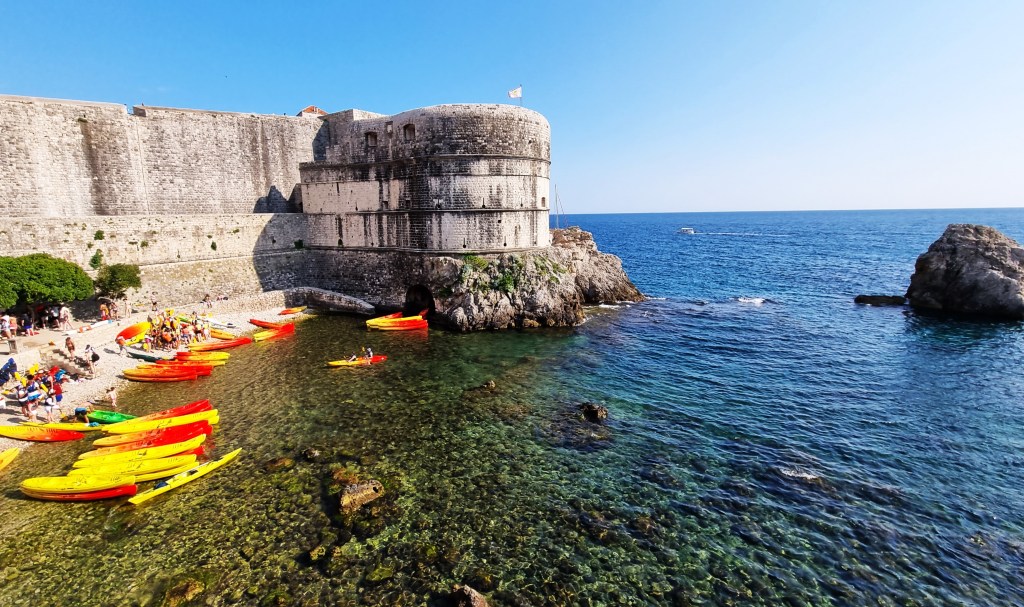
While waiting for the coach, we looked down upon the kayaks departing from the beach below. One got caught on the rocks, and the luckless paddlers were forced to listen to much well-meaning advice shouted down from above.
That evening, the captain’s dinner passed without incident, and we retired for our final night on board, having already completed most of our packing.
Day 8 – Homeward
Breakfast was taken a little earlier than normal and we were picked up for our transfer to the airport at 09:00.
Relations between the barmaid and the captain appeared to be souring – we wondered if her employment would last much longer…
We took off at 11.45 and landed at 13:35 UK time. Our taxi service had us home within 40 minutes.
It had been a splendid holiday, and a worthwhile experience to boot.
TD
June 2023



 Eponymous
Leave a comment