
It’s high time for the tenth study in my Ouroboros cycle.
This series will ultimately explore twelve pieces of music that are important to me, the twelfth and final choice linking back to the first.
Indeed, each piece of music must link in some way with its immediate predecessor, but I haven’t planned the cycle in advance, so decisions are taken ‘on the hoof’, reflecting my predilections at that particular point.
This month I find myself returning, somewhat earlier than I expected, to Parisian soukous,
Since that’s exactly where I began this cycle, I might find it difficult now to rove elsewhere in November and December. We’ll see.
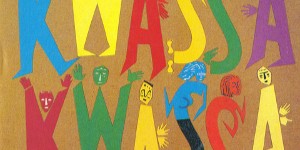
My choice this time is nominally ‘Cantique’ from Kanda Bongo Man’s 1989 album ‘Kwassa Kwassa’. The choice is nominal because I might easily have selected several other tracks from this album, which is a corker.
This is less an homage to Kanda Bongo Man and more a celebration of his superb lead guitarist, Diblo Dibala. For me, ‘Cantique’ perfectly showcases the KBM-Diblo partnership at the zenith of their powers.
I have already paid tribute to some truly outstanding guitarists in this series: Syran M’Benza, Barthelemy Attiso and Duane Allman (not forgetting Dicky Betts). ‘Machine Gun’ is easily their equal. Taken together these are four of my five all-time favourites!
I’m sure we’ll get to the fifth shortly, too.
The connection between this and my previous choice is both percussive and obvious: ‘Different Drum’ and Kanda Bongo Man!
KBM’s backstory
In researching this piece, I have discovered that much of KBM’s early life is veiled in mystery. Moreover, certain oft-repeated ‘facts’ are rarely substantiated and may only be hearsay. Writing an accurate biography of the man is like trying to pin down jelly.
He was born Kanda Bongo (or was it Bongo Kanda, or even Denis Kanda Bongo?) on 8 June (or was it 1 January?) 1955, in Inongo, the capital of Mai-Ndombe Province.
Inongo sits on the eastern shores of Lake Mai-Ndombe, roughly 400 km north-east of Kinshasa. It is the principal settlement on the Lake, which is 150km long and 50km wide. Though only mid-sized, with a population of some 50-60,000, it has city status and its own airport.
KBM’s father and/or his grandfather may have been drummers and percussionists but, then again, maybe not. His mother is never mentioned.
According to the man himself, he left Inongo with his family at the age of 12 and grew up in Kinshasa. They lived in an area called Bandalungwa, where he and other teenagers had their own band, called ‘Tao Tao’ which used to play in David’s Bar. (They are not to be confused with ‘Orchestre Tao-Tao de Paris’, which was formed in 1973 in Amiens, France.)
Several sources mention that Jean Bokelo Isenge, aka Johnny Bokelo, was KBM’s uncle. Born near Leopoldville in 1938, he was a celebrated Congolese guitarist, composer and bandleader, best-known for his hit ‘Tambola na Mokili’ and for composing ‘Sandoka’.
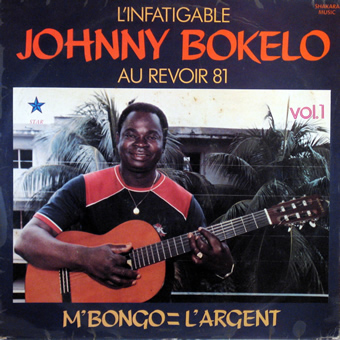
Bokelo, who died in 1995, was definitely the younger brother of Paul Ebengo Isenge, known as Dewayon (1934-1990). It follows that, if Bokelo was KBM’s uncle, so was Dewayon! Yet I can find no sources that confirm this relationship.
Dewayon is often cited as a mentor to both Bokelo and the legendary Franco Luambo (1938-1989), both four years his junior.
Franco is reputed to have learned his first chords on an acoustic guitar borrowed from Dewayon. By 1953, Dewayon had a band called Watam in which Franco played, and Dewayon later joined TPOK Jazz.
Johnny Bokelo (and hence Dewayon) are reputed to have had several more musical siblings, forming a veritable family dynasty.
I have been unable to verify whether they all had the same parentage, in which case they, too, would be KBM’s uncles. The list includes: Mpoku Lukunda; Jean-José Lohota; Mpia Mongongo (Porthos); Mbo Mayau; Alberto Bosaba; and Roy Makengo Maviuzi.
Leaving this avuncular overload to one side, we know KBM left school in 1973 and, at the age of 18, joined Kinshasa band, Orchestre Makoso Bika.
Here is a recording from 1974, under the name Orchestre Makoso, of ‘Kombo Ngai’ and ‘Bika Bakei’, with a youthful KBM on vocals. The lead guitarist is Kayembe Zeus, the rhythm guitarist is Pierre Bissikita Kisangala.
Some sources claim that KBM also joined Orchestre Bella Bella as early as 1973, but I can find no hard evidence to support this.
Bella Bella had been formed in 1969 by two brothers, Maxim and Emile Soki. Emile departed around 1972, to form the parallel Orchestre Bella Mambo, but he returned to Bella Bella in 1973.
Bella Mambo later resurfaced as ‘Orchestre Bella Mambo Rénové’. KBM was credited as writing their 1976 single ‘Pasi Ya Kanda’. The following year he composed twin singles for Orchestre Bana Mambo Cheri, namely ‘Lambia’ and ‘Amani’.
By 1977, Emile Soki had mental health problems that led to his final departure from Bella Bella. Maxime continued under that name, recruiting several new members, including KBM and Diblo, who were both briefly with Bella Bella in 1979.
KBM left for Paris later that year.
Diblo’s Backstory
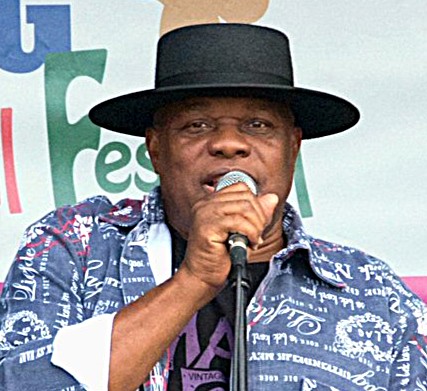
Diblo Dibala’s real name is Yancomba Dibala. He was born on 9 August 1954 in Kisangani, the capital of Tshopo Province, located on the Congo River in the north-east of the DRC.
His family moved to Kinshasa when he was a child and he attended school there, starting to play guitar from the age of 12. Some sources claim that, in 1969, at the age of 15, he won a talent contest in which he had to compete with Franco Luambo’s guitar playing. The prize was to play with TPOK Jazz.
This may be true, although the single recording of Diblo with TPOK Jazz didn’t emerge until five years later, in 1974. This was ‘Elidjo Motema’ composed by Bouessa Mbemba. Perhaps Diblo was unable to claim his prize until he reached adulthood.
That may have a grain of truth, since, according to Diblo’s own testimony, Simaro asked him to remain with TPOK Jazz, but his family refused permission.
His first professional band was Ifanza Tofio (formerly known as Stukas Flammes).
He subsequently joined Vox Africa, which toured throughout the Congo for a couple of months, after which he left them because he wasn’t paid.
Then he joined Orchestre Bella Mambo Renové, which was where he first encountered KBM, progressing with him to Bana Mambo and the final iteration of Bella Bella.
In 1979 he departed for Belgium where he worked as a dishwasher, busked and formed a band called ‘Bana Mons’. He had to rent a guitar for a while, having sold his own to pay the air fare to Belgium.
The emerging Parisian soukous scene
The term ‘soukous’ derived originally from the French verb ‘secouer’, meaning ‘to shake’, ‘to jolt’, ‘to judder’, only gradually acquiring its present spelling.
It denotes a variant of traditional Congolese rumba, characterised by a faster tempo and more prominent guitar solos, often hitting the high notes. The Wikipedia entry will tell you that:
‘The music typically utilises a 12/8 time signature and major chords articulated in arpeggiated forms. Soukous lead guitarists are renowned for their speed, precision, and nimble fingerwork, often navigating the higher registers of the fretboard. The bassline, inspired by hand-drum percussion patterns, is the genre’s rhythmic foundation and is typically characterised by a 16th-note cadence. Emerging prominently during Mobutu Sese Seko’s reign in Zaire, the assertive bass style of soukous emulated regimented motions of military marches (marche militaire). This distinctive bass approach involves toggling between lower and higher registers, achieved through a plucking method that employs both the thumb and index finger.’
Debate about the role of different musicians in the birth of soukous still rages, certain facts hotly disputed. But the majority view remains that Franco Luambo and his TPOK Jazz were pivotal.
By 1970, soukous had become the predominant musical form across much of Africa, as well as amongst the Congolese diaspora in Europe and North America.
In Congo, Mobutu’s ‘Authenticité’ programme led to the country being renamed the Republic of Zaire. He was determined to harness soukous as a powerful means of establishing a vibrant national identity.
Simultaneously, this created ‘push’ and ‘pull’ factors for musicians, some being pulled into the Authenticité project; others joining a first wave of musical emigrés leaving Zaire for Paris and Brussels.
But this ‘push’ effect was dwarfed by a much larger exodus in the late 1970s, as Zaire fell into a serious economic decline, compounded by rampant inflation and endemic corruption.
People at home had far less money to spend on seeing their idols perform while, for musicians, the cost of instruments and recording studios grew increasingly prohibitive. Recording equipment rapidly grew obsolete, the studios ultimately falling into disrepair.
Many soukous musicians reasoned that they could only continue their chosen career by moving abroad. Several departed for neighbouring countries; others chose Europe.
For the latter, Paris soon became the most attractive destination. Those, like Diblo, who removed to Belgium soon found themselves in a backwater.
In Paris, a new soukous musical economy was forming around a loose network of session musicians, some of them highly experienced, others determined to make their mark.
New arrivals from Kinshasa would stay with friends, sleeping on sofas and in spare rooms, wherever a bed could be found. They picked up unskilled work to pay their rent, spending their evenings in the handful of clubs where soukous musicians could play and be seen.
KBM has described how he worked for a while in a factory, manufacturing windows. Evening performances were often unpaid, or he might earn food, or even cake!
When an artist became sufficiently prominent in this soukous musicians’ network, receiving credit for playing on the recordings of established stars, he could begin to contemplate recording his own compositions under his own name.
For most of the musicians were effectively self-employed. The person whose name adorned the front of the album would get all the royalties from sales, while the supporting musicians would receive only a one-off fee.
With an album ready to be committed to vinyl, tape (and soon CD), a lead musician would assemble around him the others he needed to record it.
These positions would quite likely be reversed at the next recording session, another session musician taking the lead and the erstwhile star performing on his album for a fee.
The more prominent a lead musician, the more likely it was that others would want to play with him. Whereas an established star could have his pick of musicians; those still working their way up had to be less choosy.
It was possible to break into this network if one had talent and influence; far more difficult to get a job merely by hanging around studios or clubs.
Some musicians developed a valuable sideline by acting as arranger or producer for their peers. Others, like KBM, were determined to reach a position where they could arrange, produce and publish their own work.
It is useful to bear this system in mind as we chart the gradual ascendancy of KBM and Diblo over the course of the 1980s.
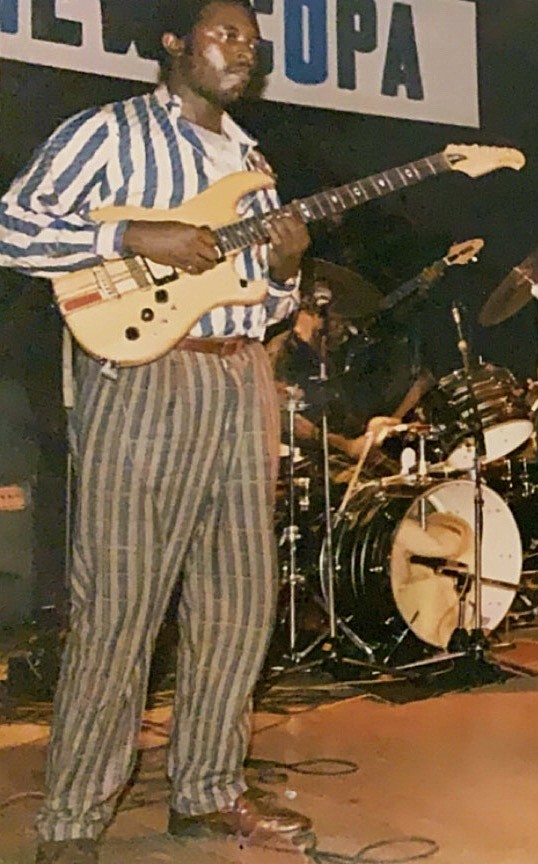
KBM and Diblo begin recording together in Paris
Both KBM and Diblo were initially on the fringes of this session musician’s network, needing a break to cement their reputations.
That came in 1980, when they obtained a first recording deal with a new label, called Afro-Rythmes, owned by David Ouattara Moumouni, originally from Burkina Faso.
Afro-Rhythmes was one of the earliest African record labels in Paris, tied to Ouattara’s African record shop at 65, Passage Brady in the 10th Arrondissement.
Ouattara used Studio Caroline, a small recording studio in the 20th Arrondissement, close to Porte des Lilas, owned and run by Jacky Reggan, previously a singer and studio engineer.
Caroline opened in the summer of 1980 and one of Ouattara’s earliest bookings, towards the end of that year, was for KBM and Diblo.
Studio Caroline was a small basement, unable to accommodate a full band. Drum and bass lines were typically recorded first, followed by the guitars, keyboards, percussion and backing vocals, the singer typically coming in last of all.
For the first KBM/Diblo album, ‘Iyole’, the backing was limited to guitar, bass, drums and percussion. Aside from the two principals, the other credits were: mi-solo guitar, Aime Kobo; rhythm guitar, Miguel; bass guitar, Narcisse; drums and percussion, Domingo-Salsero.
Whereas Kobo and Domingo-Salsero are known quantities, the identities of Miguel and Narcisse are seemingly lost in history.
‘Iyole’ was produced by Ouattara and mixed by Reggan, neither of whom understood much about how Congolese soukous was supposed to sound. But their ignorance was instrumental in creating the new sound of Parisian soukous.
The Congolese variety typically starts with a lengthy opening section in which the lyrics predominate, ultimately followed by an up tempo ‘sebene’ in which guitars and drums finally break loose.
But in this emerging Parisian style, the song would begin in a high tempo, the guitars introduced early, alongside the lyrics, sustaining that level of energy all the way through to the close.
According to Diblo, their new sound was largely down to Outtara. Originally, ‘Iyole’ was cut according to the standard Congolese template but, after the recording, Outtara cut out the slow parts, because he thought them too plodding, deciding that no-one would understand the lyrics.
Both KBM and Diblo were initially furious, until they realised they had a hit on their hands.
‘Iyole’ became wildly successful, particularly amongst those listeners who no longer bothered much with Lingala, or who had never learned it.
Outtara’s and Reggan’s reputations were made.
Reggan said later:
‘’Iyolé’ is why I started to work on a lot of African productions. People started to call me the ‘sorcier mundélé,’ the white sorcerer, and come to the studio. At first it was people from Paris, but after a while I’d have people coming from across Africa every weekend. They came specifically to Paris – they didn’t know the Eiffel Tower, but they knew Studio Caroline and the white sorcerer.’
The title track is remarkable because of Diblo’s virtuoso performance, his guitar announcing itself in the first bars. He lays down some scintillating sequences at the top of the fretboard, KBM encouraging him relentlessly to ever greater efforts.
Diblo was already well on the way to earning his soubriquet ‘Machine Gun’.
The pair followed up with ‘Djessy/Dyna’ later the same year, this time with bass player Shaba Kahamba (aka Emmanuel Kamba, who had played with Bella Bella) and once again Aime Kobo on mi-solo and Domingo Salsero on drums. This was solid, if not spectacular.
One night, while the band were playing live, the only white man in the audience was Donald ‘Jumbo’ Van Renen, originally a South African, who had settled in London in 1971.
He had worked for Virgin Records, latterly with their Front Line reggae imprint. He subsequently promoted concerts by several South African musicians and the Zimbabwean, Thomas Mapfumo.
After the gig, Van Renen asked to speak with KBM, remarking that the guitars were reminiscent of the Soweto sound. He offered to promote the band in London and left behind his business card.
Van Renen sent DJ John Peel ‘Iyole’ and, on 15 February 1983, he featured another track, ‘Mazina’, on his show. (Why he didn’t choose ‘Iyole’ escapes me.)
There is a photograph, published in Folk Roots Magazine, of KBM meeting Thomas Brooman and a besuited Alan James, both working for WOMAD.
Later, Van Renen is said to have introduced KBM to Peter Gabriel himself, then organising a scaled back second WOMAD Festival, scheduled to take place at the ICA in London that July.
KBM and his band played the Festival on both Saturday 9 and Sunday 10 July. He has subsequently acknowledged that his involvement with WOMAD exposed his music to the international ‘world music’ market for the first time.
A year later, in May 1984, the band performed at The Venue in Victoria Street, London, as part of an African Nights series, and in July at a one-day WOMAD event, combined with the Ashton Court Festival, near Bristol.
KBM and Diblo released their third album that year: ‘Amour Fou/Ekipe’, with Ray Lema on synthesiser. As well as Lema and Domingo Salsero, this also featured Deponj L’Affir on rhythm guitar (who I’ve been unable to identify) and Andre Du Soleil on bass (who once played with Orchestre Super Boboto de Brazzaville).
It was the first release on KBM’s independent ‘Bongo Man’ record label.
In 1985, Ben Mandelson was appointed manager of Globestyle Records, the world music label subsidiary of Ace Records. Globestyle specialised in reissues.
According to Mandelson, he came upon Outtara’s shop while walking through Passage Brady, noticed the first two KBM albums and asked if Globestyle might license them for release in England.
They were issued as a single album on Globestyle in 1985 with the title ‘Non Stop. Non Stop’, which I duly bought. It was my first exposure to Kanda Bongo Man.
A fourth album, ‘Malinga/J.T.’ was released in Paris that same year. It was recorded at Studio Laguna and, for the first time, KBM had credit for mixing, arranging and producing the tracks.
Rigo Starr and Ti Jean both appear on this album. The bass player is Miguel Yamba, from Angola, who had a long career backing many prominent soukous artists, later playing with Loketo and Matchatcha, while the synthesiser is in the hands of classically-trained Philippe Guez, also much in demand as a session musician.
Also in 1985, Diblo released his own solo album, ‘Ami, Eh! Bougez’, which features KBM amongst the vocalists, as well as Philippe Guez on synths.
In 1986, KBM finally produced an eponymous album. For ‘Kanda Bongo Man’, he secured the enviable talents of Pablo Lubadika Porthos and Lokassa Ya Mbongo amongst others. Rigo Starr was retained and Ti Jean swapped out for Ringo Yaya Pezo,
Then in 1987, came the sixth album, ‘Lisa/Sai’, which had the subtitle ‘On danse le Kouassa Kouassa on y va?’. Ti Jean was back, but there was no Rigo Starr. Philippe Guez was replaced by Rateau Mobio Venance. KBM arranged and produced.
These two albums, ‘Kanda Bongo Man’ and ‘Lisa/Sai’ contain all the tracks that would later form ‘Kwassa Kwassa’. The latter (if not the former) was definitely recorded at Studio Harry Son, in Pantin on the outskirts of Paris, and mixed by Francis Perreard.
Together, they embody the best work by KBM and his band to date, showing a marked progression from the first four albums. The band is tighter while the interplay between KBM and Diblo is firing on all cylinders.
But, as is so often the case, the seeds of destruction were already sown. Was Diblo beginning to resent playing second fiddle to KBM?
Back in 1983, Diblo had played on Aurlus Mabele’s album, ‘Nicoletta, Fille de Antilles’. In 1986, he joined Mabele again, first for the album ‘Africa Mousso (Femme D’Afrique)’, then for ‘Maracas D’Or’, which was billed as by Mabele, but presenting his group, Loketo.
In fact, Loketo emerged as a flexible project, a band that would back both Mabele and Diblo on their solo projects but also occasionally produce a record under their own name. This was now a more attractive proposition to Diblo than continuing with KBM.
Lisa/Sai proved his swansong.
What is Kwassa Kwassa?
The subtitle ‘On danse le Kouassa Kouassa on y va?’ tied the Lisa/Sai album firmly to this new dance craze.
The term, which later adopted the spelling ‘Kwassa Kwassa’ is derived from the French phrase ‘quoi ça?’, meaning ‘what’s that?’
The dance is said to have been created by one man: a Kinshasa mechanic called Jeannora. The legs shake, the hips swaying backwards and forwards while the hands follow, possibly imitating the use of a gear stick.
‘Kwassa Kwassa’ caught on amongst the soukous crowd and was popularised by several bands. Empire Bakuba, featuring Pepe Kalle, were arguably the first to utilise it, but it soon came to be most closely identified with KBM, who integrated it into every performance.
Before long, the audience would greet the band by chanting the phrase.
After a while, it came to be applied to the variety of soukous they played, with its exuberant high energy beat, a strong, pumping bass line, the rhythm guitar weaving intricate patterns behind while the lead launches into a series of sparkling arpeggios up front.
Hannibal Records
Next to enter the story are Hannibal Records, founded by Joe Boyd in 1980. Boyd was an American who had moved to London in 1964 to set up the UK branch of Elektra Records. He later worked in the studio with several leading folk and folk rock artists including, famously, Nick Drake.
In November 1980, Boyd set up Hannibal Records, with its US sub-label, Carthage. Hannibal was initially based at Island Records, with which it had a distribution deal. The first UK releases were albums by Kate and Anna McGarrigle, Geoff Muldaur and Defunkt.
There are two alternative versions of the meeting between Boyd and KBM, both given currency by Boyd himself.
According to the first version, Boyd caught one of the band’s London performances at some point in 1987, later remarking that he was ‘just knocked out’. He subsequently contacted KBM in Paris, drawing up a licensing agreement under which Hannibal would release his music in the UK and United States.
According to the second version, KBM came over to England to learn more about the music scene here. His host was the music journalist Chris Stapleton, the African music specialist with Blues and Soul magazine.
KBM and Stapleton went together to a Bhundu Boys gig, possibly with Boyd as well. Either way, Boyd agreed the deal with KBM next day, at Stapleton’s flat.
Stapleton later supplied the liner notes for another 1987 production, the compilation album ‘Heartbeat Soukous’ on Earthworks (which opens with KBM’s ‘Belle Amie’).
Intriguingly, Boyd has written:
‘What I loved about Kanda and his music was how out of step he was with the latest sounds emanating from Kinshasa, Paris and Abidjan; he couldn’t afford horns but eschewed the now-ubiquitous synths and keyboards, recording with a classic three-guitar, bass, drums and percussion line-up, adding a pair of dancers and an animateur for the tours.’
The relationship with Hannibal led to the release of three albums and, in 1989, a North American tour.
The first Hannibal release was ‘Amour Fou/Crazy Love’, which appeared on vinyl and cassette in 1987. and on CD the following year. It contained ‘Malinga’, ‘Ekipe’, ‘J.T.’, Amour Fou’, ‘E’mame’ and ‘Bayembi’, so covering most of the ‘Amour Fou’ and ‘Malinga’ albums.
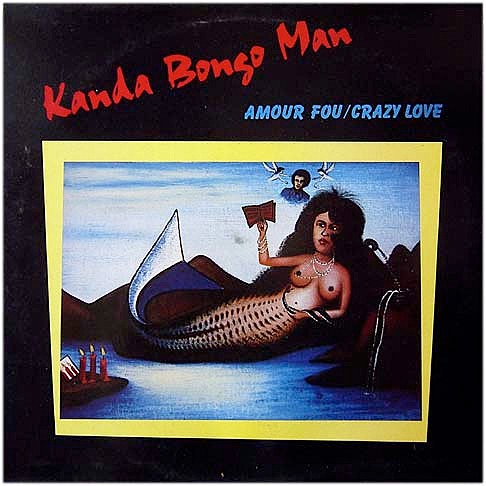
It was adorned by a picture of a mermaid by ‘Bodo’. The sleeve notes say:
‘Kanda Bongo Man has the hottest Zairean (Congolese) band in Paris. The “soukous” sound of Kinshasa has come to dominate all of Central and Eastern Africa and Kanda Bongo Man and his long time associate on lead guitar, Diblo, are two if its greatest stars. Kanda and his band are renowned from Stockholm to Barcelona and from Conakry to Nairobi for the non-stop energy and the briliant flowing melody of their songs. In Diblo, the band has one of Africa’s greatest lead guitar players. This record is compiled from two short LPs Kanda issued on his own label in France.
The cover painting is a Zairean ‘naif’ by Samba. The mermaid is a symbol in Zairean art for the river crocodile who lures men to their deaths. The painter Bodo is one of the leading painters in Zaire and his paintings have been exhibited throughout the world.’
Of course I bought that one too!
KBM were now growing increasingly popular in the UK but I always seemed to miss their infrequent performances. Where was I when they played the Town and Country Club in February 1988?
The preview in ‘The Independent’ read:
‘An understandable, but pointless, kind of London reverse racism has allowed some distinctly fourth division African musicians to be elevated to cultdom, simply because their music is deemed ‘ethnic’ and therefore Authentic. Energy and high-life exuberance come to replace subtlety and complexity and, ultimately, no musical cause – black or white – is furthered as a result of this critical dishonesty.
No such reservations can be held against Kanda Bongo Man, however, who has the hottest Zairean band in Paris. He plays a scintillating, high register brand of ‘Soukous’ pop, the hallmark of which is the shimmery guitar lead of Diblo, Bongo Man’s long-time collaborator. Two true stars.’
A month later, the same paper reported that KBM, arriving at a London hotel, found that his reservation had been cancelled because the receptionist assumed that a booking in the name ‘Mr K. Bongo Man’ must be a practical joke!
The band was back at the Town and Country in January 1989. Just before this gig, KBM told a journalist:
‘I love playing in London; it all started for me in London’
also revealing that he had not returned to Kinshasa since departing a decade earlier.
By March 1989, KBM was embarked on the Boyd-inspired US tour. Initially, crowd numbers were low, but some of the later reviews are exuberant.
Linda Shockley, in the Albuquerque Journal ended her report thus:
‘The Kanda Bongo Man, himself, is like a chunky cherub who moves like the reflection of a prism in sunlight – swift, colourful, easy and compelling. No-one can steal thunder like he does – unless it’s Evelyn and Isabelle, on vocals and “floorshow”…
With the song “Liza”, nine dancers from the audience, at Kanda’s invitation, clamored onstage and stayed until “Liza” ended. All the tunes, like EPs, ran at least 15 minutes, inviting dancers and audience alike to stay with it. It’s fun-loving, hard-driving music. It’s swinging, hopping and bumping. And it escalates. While the sound couldn’t have been any more expansive, the dance floor could have used some added inches.
But then, after an hour-and-a-half set, Kanda Bongo Man was over. No encore, nothing. Just an unforgiving silence where this groundswell of sound had been.
There was nothing else to do but make the drive home.
And then to bed.’
By June 1989, Hannibal’s second release, ‘Kwassa Kwassa’ was already available in the UK. The reviewer in the Amesbury Journal, one Roger Elliott, said:
‘In my humble opinion Zairean Soukous is the best dance music there is, and Kanda Bongo Man on [sic] of its finest exponents. This sparkling compilation is taken from his two most recent albums and is full of Kanda’s sweet, melodic vocals, infectious Rhumba rhythms, and above all some of the most fleet fingered guitar work known to mankind. The man responsible for most of this goes by the name Diblo, if you like African music or you just like to dance, Kwassa Kwassa is a compulsory purchase.’
‘Kwassa Kwassa’ was released in the United States in September 1989, coincidentally coinciding with a visit by Diblo with Loketo.
More about the band members
Aside from KBM and Diblo, the band that recorded ‘Cantique’ comprised:
- Lokassa Y M’Bongo (1946-2023) on rhythm guitar. He played in Africa Fiesta National and then Afrisa under Tabu Ley, before briefly joining Sam Mangwana in the African All Stars. He lived in Togo for a while, before coming to France in 1984, where he was immediately much in demand as a session musician. In 1985 he recorded an album ‘Adiza’ with a large ensemble including Daly Kimoko on guitar and Ballou Canta on vocals. Ibrahim Sylla was producer. (The opening track, ‘Marie José’, is a wonderfully infectious song and a particular personal favourite.) M’Bongo, Kimoko and Canta were later to form the nucleus of the Soukous Stars.
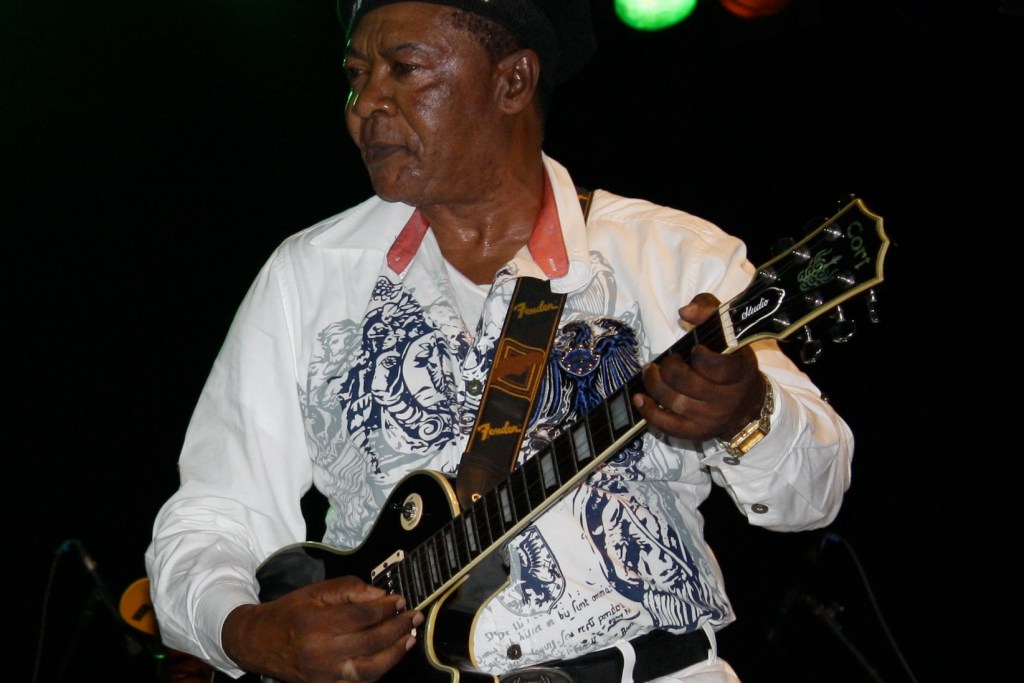
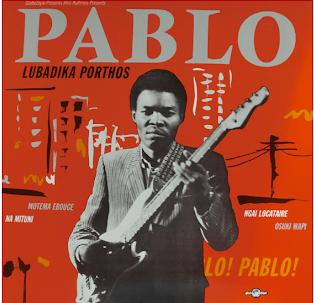
- Pablo Lubadika Porthos (1952-2010) on bass guitar. He began playing with Syran M’Benza in Orchestre Lovy Du Zaire and Orchestre Kara de Kinshasa. He was also with the African All Stars and played on Mangwana’s classic album ‘Maria Tebbo’. He played rhythm guitar for Pamelo Mounk’a (including on another huge personal favourite: ‘L’argent Appelle L’argent’) and featured on the albums of numerous other stars including Bopol, Quatre Etoiles, Aurlus Mabele and Kaba Mane. He found time to record his own albums too, such as ‘Pablo! Pablo’, and he later played on Madilu System’s ‘Ya Jean’, which was where Ouroboros began!
- Ti Jean Arcon was originally from the French Antilles, probably Guadeloupe. He played with a band called Abyssia Diblo and later on the Aurlus Mabele albums ‘Nicoletta, Fille de Antilles’ and ‘Africa Mousso (Femme D’Afrique)’ with Diblo, as well as recording two albums for Theo Blaise Kounkou, but his recorded credits end in 1995, and little is recorded of his life.
- Rateau Mobio Venance was from Ivory Coast, and had played in an Afro-Antillean group called Bozambo with Georges Ouédraogo, a drummer from Burkina Faso. Other members were from Martinique, Guadeloupe and Senegal. The group recorded three albums before breaking up in 1978. More recently, Venance had been employed by Mory Kante and Tshala Muana amongst others.
Cantique
As I’ve said, ‘Cantique’ is one of several outstanding tracks on this album. I could easily have chosen ‘Sai’, ‘Bedy’ or ‘Belle Ami’.
There is a certain irony in the fact that I have opted for the one song with a religious theme. Several of KBM’s albums seem to include a song giving praise to God. ‘Cantique’ is a French word, meaning ‘hymn’.
There are relatively few lyrics, the most significant of them being (in Lingala with a little French thrown in):
‘Limbisa ngai mabe nasala na mokili oyo,
Nafukamili yo Papa, esengo eleki nyoso na mokili se yo
Yela ngai na butu, yela ngai na ndoto, sauve moi.’
Roughly translated, I believe that means:
‘Forgive me the wrongs that I have done in this world,
I kneel before you Father; your joy surpasses all
Come to me in the night; come to me in a dream; save me.’
There are also occasional pleas which translate as:
‘Where are you?’ Give me your blessings’.
KBM’s honeyed, light tenor voice is ideally suited to crooning this theme.
But ‘Cantique’ is predominantly a showcase for Diblo’s prodigious talents. The display is less frenetic than in ‘Iyole’, more controlled, but that somehow increases the intensity.
This apparent paradox, of a tight structure enhancing the sonorous, swelling notes that it struggles to contain, has some parallels with ‘Different Drum’.
The first part of the song is driven forward by Lokassa’s lilting rhythm guitar and Ti Jean’s galloping percussion, while Venance plays a wavering theme on synthesiser.
Diblo holds back until the short hymn has been repeated then, at exactly 1:30, he enters the fray, with a simple two-part phrase, clear and bell-like, which is repeated eight times in succession.
Then, somewhere around 2:05, there is the ‘hair stands on the nape of my neck’ moment, when he introduces a second, shorter theme with a hoarser timbre, repeating it five times.
After which KBM repeats his own refrain before Diblo is let loose again, repeating then improvising around the original phrases, but in slightly restrained fashion.
Then a third round of singing and at 4:15 Diblo takes off for his own final flight, accompanied initially by the synthesiser, imitating a breathy French accordion.
The first two-part theme gets seven repetitions, though one is abbreviated. (Is it an error, or did they deliberately introduce one tiny imperfection?) Then we’re returned to that second theme at around 4:45, though it is repeated only three times before the outro, which takes us all the way to 5:15.
With the synthesiser and the hymn, we have strayed some distance from old school Parisian soukous, but still I love this track, which has a hard, bright, diamantine quality all its own.
Afterword
In 1997, Kanda Bongo Man was briefly appointed Deputy Minister of Culture in Zaire, within the Laurent Kabila Government. He returned to his homeland from London, where he’d been living, but found that he couldn’t survive without making music. So he swiftly resigned, returning again to the UK.
He still lives here, in Manchester, and he performs frequently in and around London. On 20th December 2025, he is playing at the Horton Arts Centre in Epsom. But, if I go, I know I’ll be disappointed.
There’ll be no Diblo. And I want to remember them exactly as they were, circa 1987.
TD
November 2025



 Eponymous
Leave a comment