
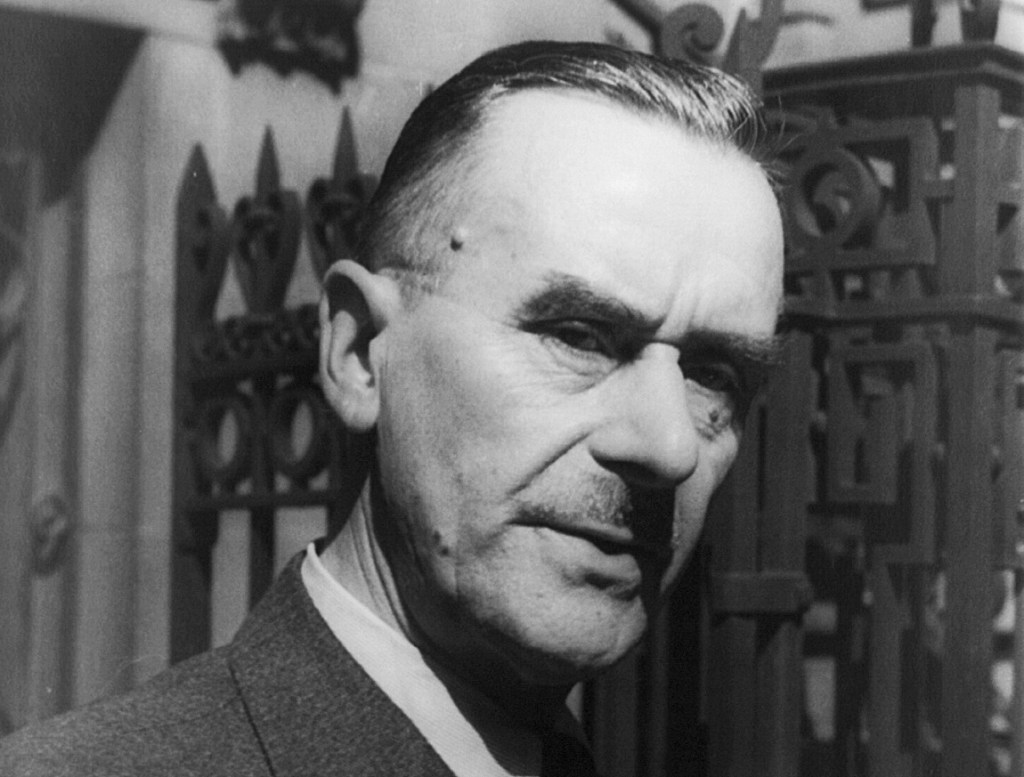
Paul Thomas Mann (1875-1955) was born in Lübeck, Germany. His father was a wealthy Lutheran grain merchant; his mother, a Brazilian-born Roman Catholic with German and Portuguese ancestry.
When his father died in 1891, the family moved to Munich, where Mann lived until 1933. In 1905 he married Katia Pringsheim, daughter of a Jewish mathematician and from an even wealthier family than his own. They were to have six children between 1905 and 1919.
His first full novel, ‘Buddenbrooks’, was published in 1901. He wrote eight in all, the most important being ‘The Magic Mountain (1924), as well as several highly-rated novellas, including ‘Tönio Kroger’, ‘Death in Venice’ and ‘Mario and the Magician’.
‘Felix Krull’ was his final novel, unfinished at his death.
Under a deal with Alfred A. Knopf Publishers, agreed in 1924, all of Mann’s novels were rendered into English by the American translator, Helen Tracy Lowe-Porter (1876-1963). But my edition of ‘Felix Krull’ was translated by Denver Lindley (1904-1982).
Mann was awarded the Nobel Prize for Literature in 1929 but, in 1933, he was forced to move to Switzerland, to escape Nazi persecution for his political views.
In 1939 he emigrated to the United States, living in Los Angeles from 1942 to 1952. During WW2 his monthly anti-Nazi addresses were broadcast to his homeland by the BBC German Service.
Ironically, Mann was hauled up before the House Un-American Activities Committee, becoming a prominent victim of McCarthyism. So he returned to Switzerland in 1952, where he lived until his death.
He had begun to plan ‘Felix Krull’ as early as 1905, eventually writing Volume One in three phases: most of Book One between 1910 and 1911 (after which he paused to write ‘Death in Venice’); half of Book Two between 1911 and 1912 (after which he began to write ‘The Magic Mountain’); and the remainder of Book Two and Book Three between 1950 and his death.
Mann had intended that there would be a Volume Two, dealing with Krull’s escapades in South America.
One of the prompts that encouraged him to return to the novel after a hiatus of almost 40 years was the experience of falling in love, aged 75, with a young waiter at a Zurich hotel.
The surviving text relates Felix’s early life and adventures, initially with his family in the Rhineland until his father’s death, then in Frankfurt, where he escapes conscription by feigning illness, and thirdly in Paris, where he works as lift-boy and waiter in a Parisian Hotel.
Here he has an affair with a middle-aged lady writer whose jewellery he has purloined, attracts the attentions of a Scottish aristocrat who would like to ‘adopt’ him in return for sexual favours, and fascinates a young Englishwoman who falls passionately in love with him.
Then he meets the Marquis de Venosta. He agrees to impersonate the Marquis on a year-long trip arranged by the former’s parents, who wish to separate him from an unsuitable partner. By sending Krull off in his place, the Marquis can continue to live with her in Paris.
Krull embarks for Lisbon, meeting a learned palaeontologist, Professor Kuckuck, on the journey. Having toured Kuckuck’s Lisbon museum, Krull visits his home, where he sets out to woo the womenfolk. This causes him to postpone his voyage to South America, his excuse for which (when communicating with the Marquis’s parents) is that this has enabled him to enjoy an audience with the King.
Having finally broken through the daughter’s defences, he is surprised in the act by her mother, who makes love to him instead
…At which point the novel ends, rather suddenly.
Krull’s skill lies in his capacity to impersonate whichever character his interlocutors wish him to be. He is a ‘Lebenskünstler’, an ‘artist in living’, capable of holding down a role anywhere in the social heirarchy. And he proves hugely attractive to men and women, young and old alike.
Krull is clearly fascinated by the theatrical. There are two set pieces in the book where he forms part of the audience, at a circus and a bullfight respectively. Mann brings all his literary power to bear on describing these events, which have a powerful impact on our antihero.
This entertaining narrative is well worth taking for a spin. But ‘Buddenbrooks’ is more holistic and ‘The Magic Mountain’ far more powerful so, if you’ve not read those, maybe do that first!
TD
December 2025









 Eponymous
Leave a comment