
This extended family history post is a companion piece to George Dracup (1824-1896) and his English descendants (September 2024).
The George Dracup in question and his wife, Jane, nee Bullock (1824-1886) may have had up to twelve children, but only eight definitely reached adulthood.
Of those, four sons opted to remain in England, while four further children – two sons and two daughters – migrated to the United States.
The earlier post explored the lives of George, Jane and George’s siblings, before concentrating on those of the four English-domiciled sons, their wives and immediate families.
This parallel post considers the two sons and two daughters who migrated to the United States, their wives, children and grandchildren.
The four in question are: Albert Bullock Dracup (1845-1913), Henry Dracup (1853-1914), Mary Dracup (1857-1916) and Martha Jane Dracup (1859-1937).
A secondary objective has been to compare these two parallel Dracup family groups, separated by the Atlantic Ocean.
I wanted to test the hypothesis that those who emigrated were comparatively more ambitious and driven than those who stayed behind. Did they ‘better themselves’ or were they set back by having to start all over again in a different country?
Because of the sheer length of this post, I have divided it into two parts.
- Part One deals with the predominantly female lines through Mary, Martha Jane and Albert Bullock Dracup (who had five children, four of them daughters), as well as their descendants;
- Part Two will cover Henry Dracup and his descendants, and concludes with a brief comparative review of the lifestyles, interests and preoccupations of those of George and Jane’s descendants who chose to stay in England and those who migrated to the United States.
This PDF chart shows the principal characters in this post and the relationships between them. It is not a full family tree.
As with the companion post, I have sought to draw together all the material I can find in the public domain, especially relevant coverage in contemporary newspapers.
I have tried to present these lives objectively, each in their unique historical, social and economic context, always letting the facts speak for themselves.
I have tried not to be too judgmental.
Our ancestors were no angels, and I believe it is important not to gloss over the seamier side of their lives. That said, I understand that direct descendants might sometimes prefer certain unpalatable facts to be lost in the mists of time.
I’m always happy to discuss anything I write with the living descendants of my subjects, especially if they consider I’ve been unfair. I’m also grateful for any further information they are willing to share with others, especially photographs of the people concerned.
Should you wish to contact me, please leave a comment or use the contact form on my ‘About’ page.
Mary Dracup (1857-1916) and Samuel Wilkinson (1855-1927)
The subsequent sections deal with the lives of Mary nee Dracup and Samuel Wilkinson and their two children, John Henry and Florence Daisy Wilkinson
Mary was George and Jane’s fifth child and their eldest daughter. Both she and her sister Martha Jane were relatively late arrivals in the United States and, in Mary’s case, lived there for only a decade before her death.
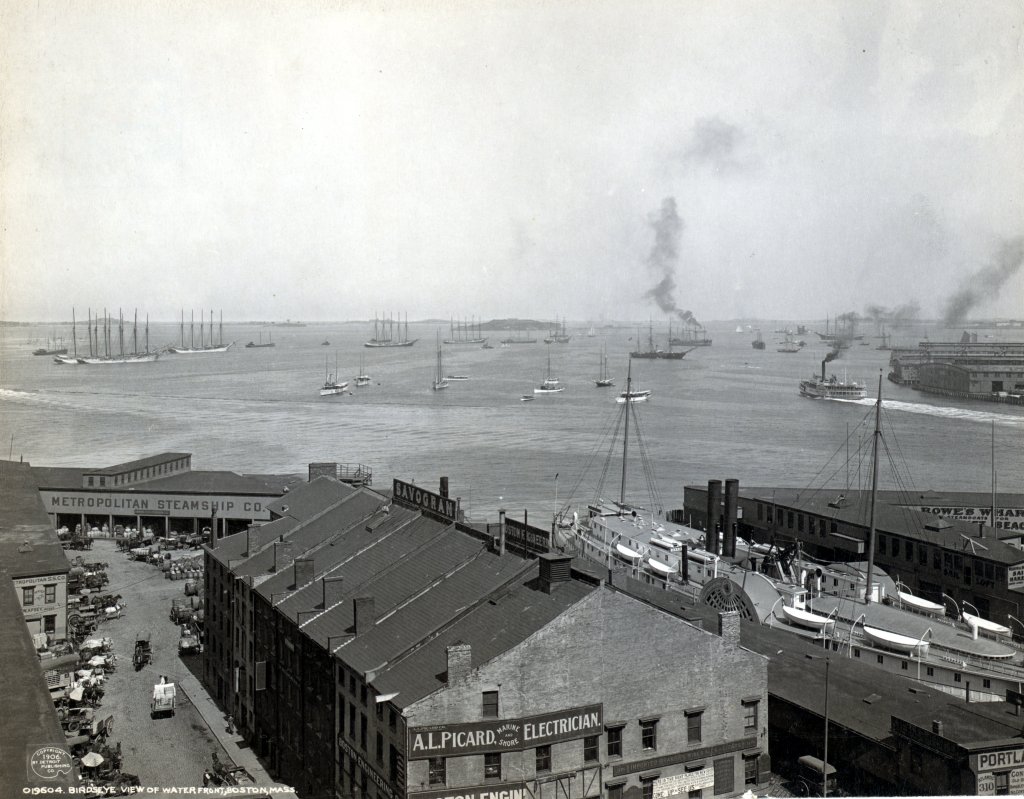
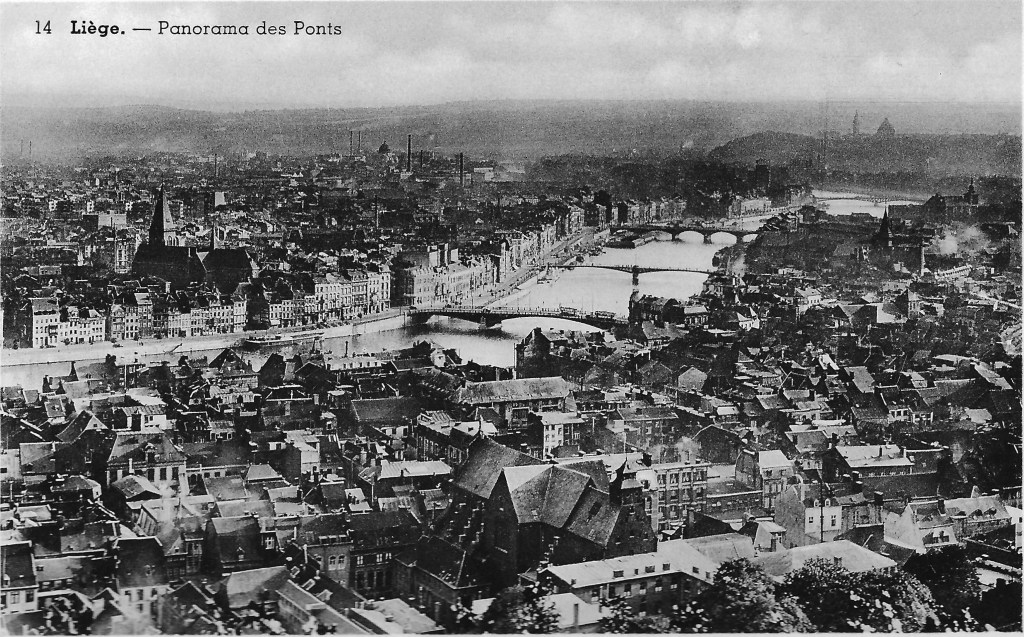
Like most of her siblings, she was born in Belgium while her father was employed there as a dyer. Her birth date is given as 30 June 1857 and her birthplace was Liege. (For more about the family’s time in Belgium, please read the companion post.)
Her parents returned to England temporarily to have her baptised in Great Horton’s Wesleyan Methodist Chapel on 27 October.

The family returned to England permanently at some point between 1 February 1860 and 7 April 1861. But, at the time of the 1861 Census, which was taken on 7 April, Mary did not reside with her parents and siblings.
They were at 45 Ebor Street, Bradford, just off Little Horton Lane, but three year-old Mary was living with her maternal uncle Henry Bullock and his wife Margaret, at 14 Milne Street, off the Listerhills Road.
Her maternal grandmother, Jemima Bullock, was residing with them, though she was to die only a few months later. An aunt, Margaret’s sister, was also living at the same address.
By the time of the 1871 Census, this household had shrunk to just two people. Henry Bullock, now about 40, was living alone with Mary, aged 14, his wife Margaret having died some six months beforehand in September 1870.

Although Henry was Mary’s uncle, such a domestic arrangement might have been considered indecorous, if not downright immoral.
By this point Mary’s three elder brothers had moved from the parental home to work in Scotland, leaving only the four younger boys and Martha Jane in Bradford. Both sisters were working as worsted spinners.
On the face of it, there should now have been room for Mary in the family home, but perhaps her wage wouldn’t have covered her keep.
We do not know how long they lived together. In any event, both were eventually married to different partners within a few weeks of each other, but not until 1877.
Henry was united with Martha Ann McDonald in July 1877. She was 41; he 47. She had been born Martha Ann Aspinall and had married a James McDonald in 1859.
But, by 1871, she was living in Halifax with her mother and sister, while he was living in Liverpool with another woman, purporting to be married. The pair eventually did marry, but not until 1881. This suggests that Martha Ann’s marriage to Bullock was strictly bigamous.
Meanwhile Mary, now aged 20, married Samuel Wilkinson, a 22 year-old wool comber, on 26 August 1877. He was the third son of Joseph Wilkinson, an overlooker of worsted spinners.
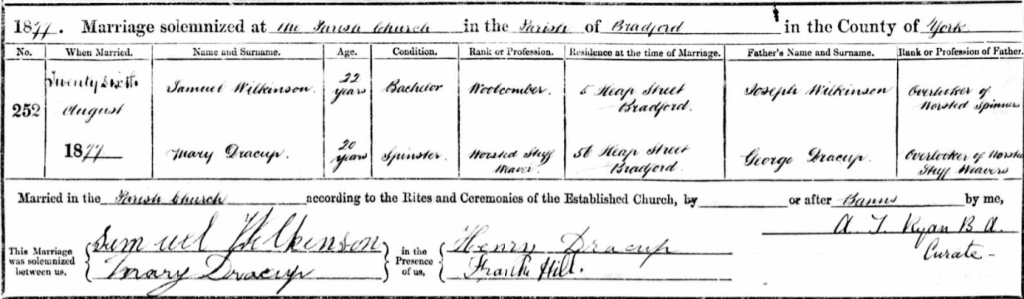
The wedding certificate shows that Mary was then resident at 56 Heap Street, Bradford, while Samuel was living at 5 Heap Street. They married in Bradford Parish Church.

Heap Street is now a mere stub, just behind what was once St Mary’s Roman Catholic Church, which had only just been built when the couple were living nearby.
On 11 August 1877, just over two weeks after the wedding, Mary gave birth to a son called Herbert Wilkinson at 56 Heap Street. No father is registered, but the mother is described as:
‘Mary Dracup, now the wife of Samuel Wilkinson, a machine woolcomber.’
The birth was registered by Mary herself on 28 August.

This entry, alongside the timing of the marriage, so soon before Mary’s confinement, raises the distinct possibility that Samuel wasn’t the father. Could it have been Henry Bullock?
Sadly, Herbert died in December 1877, aged just four months. His name is included in the death index as ‘Herbert Wilkinson D[racup?] Wilkinson’. I have been unable to find a death certificate.
A second son, John Henry Wilkinson, was born on 5 December 1878. The birth was recorded at 75 Young Street, Manningham. Samuel was acknowledged as the father and described as a wool combing overlooker.

By 1881 the family had moved to 20 Sellars Fold, just off the Great Horton Road. This is also now a stub, having been redeveloped.
Samuel was still employed as a wool combing overlooker, while Mary continued as a worsted weaver. John Henry Wilkinson, now aged 2, completed the family.
Two further children were born in quick succession. A daughter, Mary Maria Wilkinson was born in May 1884 but died that October. A year later, in October 1885, Florence Daisy Wilkinson was born
By 1891, the family were residing at 40 Binbrook Street in Manningham. Samuel remained an overlooker, while Mary had become a silk weaver. John Henry, now 12, was already employed as a worsted spinner. Florence Daisy was now 6.

They remained at this address in the 1901 Census. Samuel was now a straightforward woolcomber rather than an overlooker, while both Mary and Florence, now aged 16, were stuff weavers.
Meanwhile, their son John Henry Wilkinson had married Rose Eleanor Fitzgerald in April 1898. He was 19 and she 18, the daughter of Thomas Francis Fitzgerald, a stonemason born in Ireland, and Mary, nee Loader, originally from Dorset.
A son, called Samuel Wilkinson after his grandfather, was born five months later, on 5 September, 1898. The birth was registered at the home of Samuel and Mary – 40 Binbrook Street in Manningham. (John Henry was later to claim, incorrectly, that Samuel was not born until 3 December 1903)

At the time of the 1901 Census, John Henry and Rose were living opposite his parents, at 41 Binbrook Street. John Henry was employed as a dyer’s labourer, while Rose – unusually for a woman – was a woolcomber.
Three year-old Samuel junior was not living with his parents, but in the home of one of Rose’s half-brothers, called Edwin Williams. This was some distance away, at 78 Girlington Road.
The arrangement was probably made because both parents were full-time workers, unable to care for Samuel. Rose’s mother was also resident alongside the boy, but was soon to die.

Arrival in the United States
We know that John Henry Wilkinson departed Liverpool aboard the White Star steamship SS Cymric, bound for Boston, Massachusetts, on 1 September 1904. He stated that he was 27 and employed as a ‘mill hand’. According to his later naturalisation record, he arrived in Boston on 10 September.
It is unclear whether he deserted her and his six-year-old son, or if he intended them to follow him across the Atlantic.
The 1910 US Census entry states that his parents, Samuel and Mary and his sister Florence all arrived in the United States in 1906.
Samuel definitely reached Boston on 20 May 1906, also aboard the SS Cymric. He described himself as a 48 year-old overlooker (‘labourer’ is crossed out). He had a ticket for his final destination, declared as Lowell, Massachusetts, and $15 besides.
He declared that he was going to join his sister-in-law ‘Mary Kennedy’ (see below) at 55 Washington Street, Lowell.
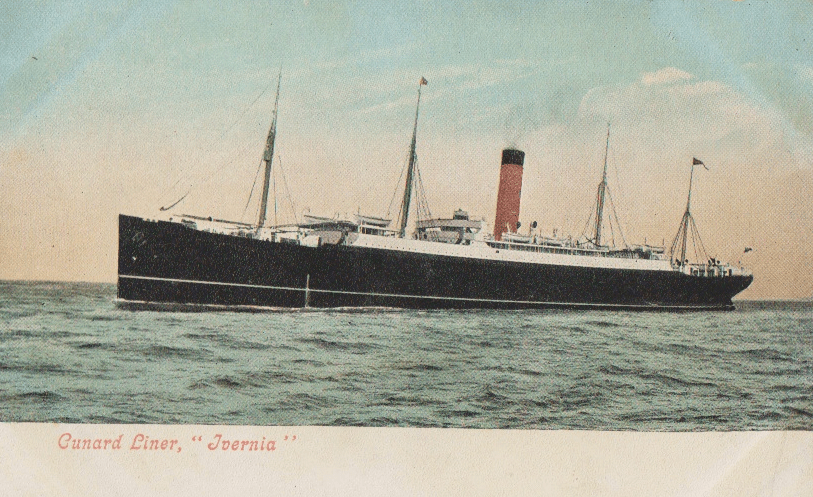
Mary and Florence arrived together aboard the SS Ivernia on 22 November 1906, six months later. There was an opportunity for Rose and Samuel junior to have travelled with her in-laws, but that seems not to have happened.
John Henry seems to have returned to England briefly, possibly to persuade his wife and child to join him.
Someone giving their name as ‘Thomas Henry Wilkinson, aged 30, from Bradford, was aboard the SS Cymric in October 1907, ultimately bound for Lowell. However, he was traveling alone.
He gave as his nearest relative in the UK ‘Uncle John Didcup’ [sic] at 552 Manchester Road Bradford – the address of John Henry’s maternal Uncle, William Dracup, Dancing Master.
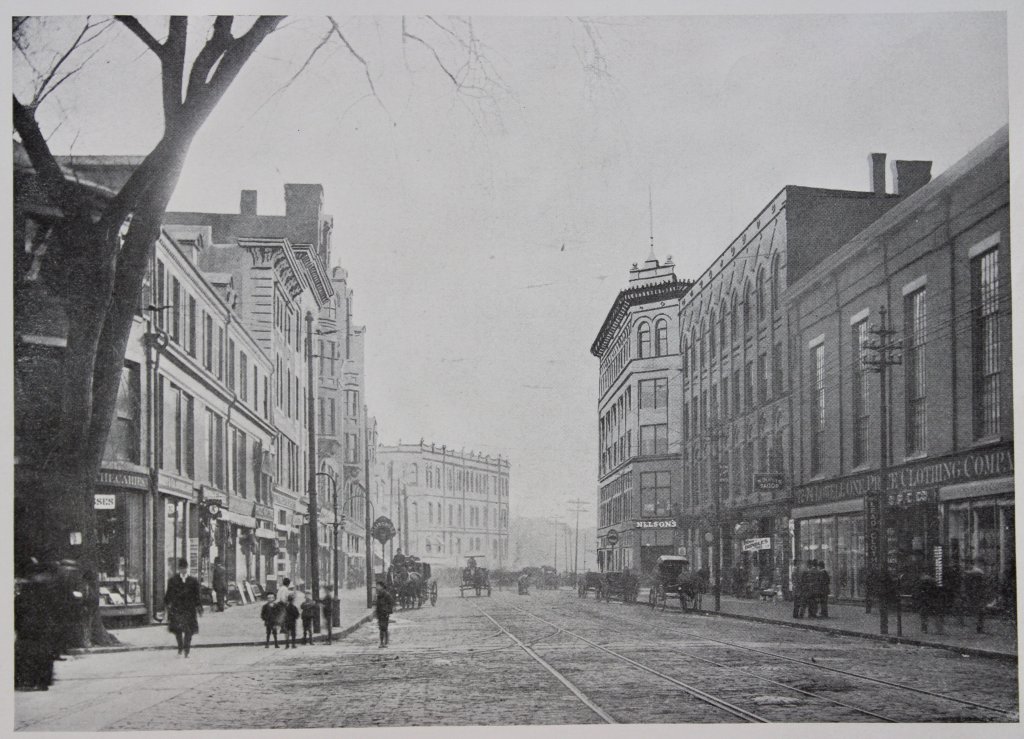
He stated that he had been in Lowell before, in 1905, giving as his nearest relative there, ‘Mr Wilkinson, at 147 ‘Meadow Croft St’. He is described as 5 feet 4 inches tall, with a dark complexion, dark hair and brown eyes.
Samuel and Mary first appear in the 1908 edition of the Lowell City Directory, resident at 147 Meadowcroft Street. The house still exists, positioned between two railway lines in South Lowell, fairly close to the Concord River.
No employment was listed for Samuel in either the 1908 or the 1909 editions of the Directory, suggesting that he struggled initially to find employment.
By 1909, John Henry was registered at Meadowcroft Street and was working in a bleachery. The 1910 Directory indicates that he had removed to Boston, but this must have been a temporary arrangement.
By the time of the 1910 Census, the family were still living at the same address in Meadowcroft Street. Both Samuel and Mary gave their ages as 53 (Samuel was actually 54). Both their children were also resident.
Samuel was employed as a labourer in a ‘plush mill’, but also declared that he had been unemployed for ten weeks in the previous year. His employer was probably the Massachusetts Mohair Plush Company, founded in 1891, which had an extensive mill on Western Avenue in Lowell.

John Henry declared himself 30, single and gave his year of immigration as 1907 – all incorrect. He had been employed as a labourer in a worsted mill, but was presently unemployed – and had been for half of 1909.
Florence stated that she was 25 and single. She was employed as a worsted weaver and had only been out of work for five weeks in 1909.
They also had a lodger called Hezekiah Whittaker, aged 46. He had been resident in Shipley where he too worked as a wool comber, but was now also a labourer in a worsted mill. He too had arrived in 1906.
The 1911 Lowell Directory describes Samuel as a labourer, living at 85 Liberty Street. In the 1913 and 1914 editions he remained a labourer, now residing at 532 Gorham Street. I could not find further entries after 1914.
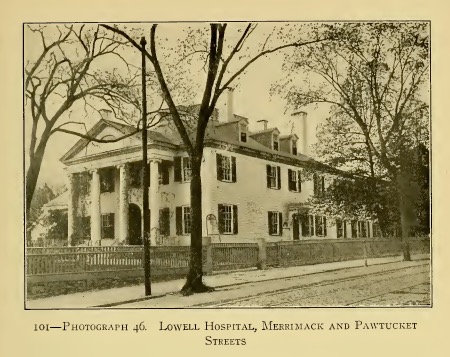
Mary died on 3 December 1916, aged 59, in Lowell General Hospital, from septic pneumonia following an operation for an inguinal hernia. Her home address was given merely as ‘North Chelmsford’.

Her death was reported by her husband and she was subsequently buried in the Riverside Cemetery, North Chelmsford.
SamueI moved to Tewksbury, immediately to the south-east of Lowell, at the end of 1923. He died on 31 December 1927, aged 72, from a brain hemorrhage. He was still working as a mill hand.
He had clearly struggled to find gainful employment after emigrating and ultimately had to resort to unskilled labour. For whatever reason, he could not secure a position as a woolcomber, let alone as an overlooker.
It is hard to escape the conclusion that, in the case of Mary and Samuel, life in the United States must have been a disappointment.
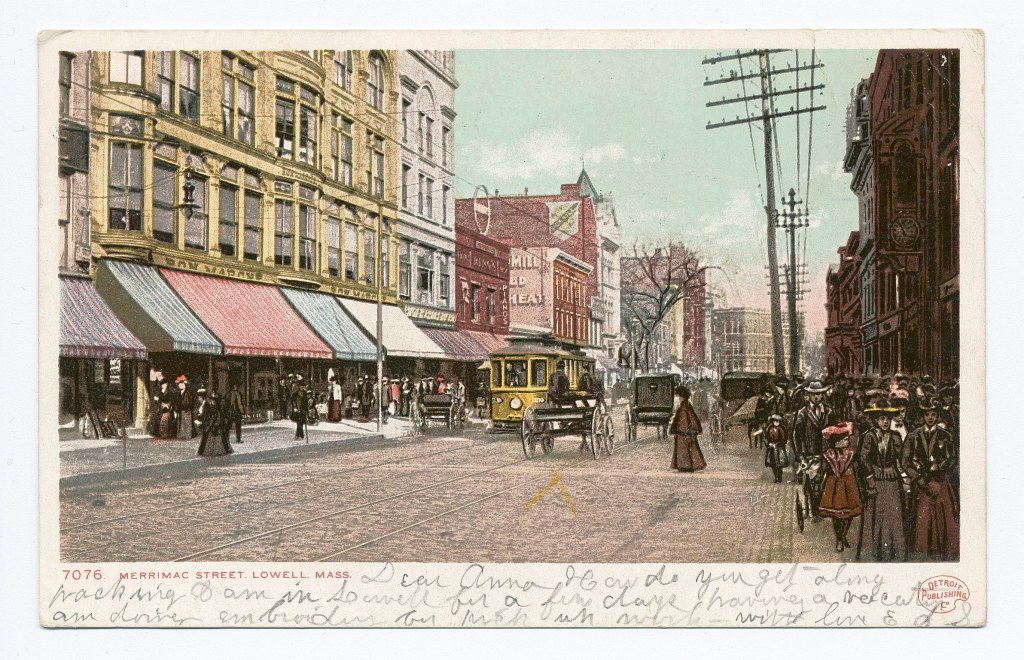
John Henry Wilkinson (1878-1949)
We left John Henry in 1910 when he was still living with his parents and sister. By 1911, he was employed as a cook, living in rooms at 452 Gorham Street, the same road where his parents moved shortly afterwards.
In 1913 he may be the John Wilkinson, a labourer, boarding at 24 Webster Street. He does not appear in the Lowell Directories for the period from 1914 to 1920.
However, his World War I Draft Registration Card, dated 12 September 1918, gave his permanent address as 26 Gorham Street. His occupation at this time was ‘Trucker’ and he worked for the US Cartridge Company, Lawrence Street, Lowell.

The US Cartridge Company had been founded in 1869 by Benjamin Franklin Butler (1818-1893). Naturally, wartime demand led to massive expansion and the workforce increased to 8,000, making it the largest employer in Lowell.
In September 1915 several hundred employees went on strike to improve working conditions. The Company initially tried to lock out the strikers, employing scab labour instead, but sheer pressure of work forced it to capitulate to its workers’ demands after only a few weeks.
The Registration Card describes John as of medium height and stout build, with brown eyes, black hair and a compound fracture of his right hand.
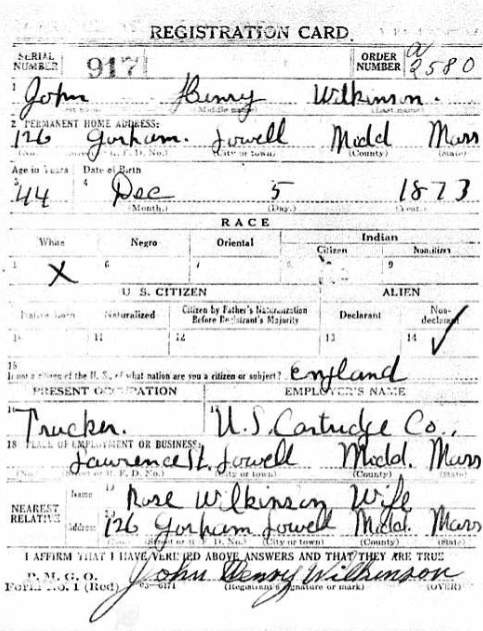
He names his nearest relative as: ‘Rose Wilkinson, Wife’, living at the same address. I can find no evidence to show that Rose ever traveled to the United States, or was reunited with her husband.
The 1911 UK Census records Rose Wilkinson serving as housekeeper to a man named Joseph Laycock, aged 35, single, employed as a stonebreaker by Bradford Corporation. Their address was 20 Coll Place, Odsal Top, Bankfoot, Bradford.
Rose stated that she was married, and had been for 12 years. Samuel Wilkinson junior, now 12, lived at the same address and was employed as a doffer in a worsted spinning factory. A doffer removed full bobbins of worsted fibre from spinning machines, replacing them with empty ones instead.
There is also a 1921 Census entry for Joseph Laycock, then described as a 45 year-old labourer with the City of Bradford Corporation and his wife, Rose Ellen Laycock, aged 41. They were now resident at 86 Rupert Street, Bradford.

The name of the person responsible for making the return was originally entered as ‘Rose Wilkinson’ but this has been crossed through and replaced with ‘Joseph Laycock’. I have been unable to find a record of the marriage, which was probably fictional.
Because, when Rose died on 10 December 1921, aged 41, the death was registered under the surname ‘Wilkinson’. The certificate states that she was the ‘widow of John Henry Wilkinson, a machine wool comber’. The cause of death was given as ‘1. Uterine cancer; 2. Exhaustion’.

We can only guess why Rose initially refused to emigrate with her husband. Despite John Henry’s claims to the contrary, it seems highly unlikely that Rose ever left Joseph Laycock to join her estranged husband in Massachusetts.
For completeness and before returning across the Atlantic, I should add that Joseph Laycock died of a brain tumour just six months after Rose, on 18 May 1922.
Her son, Samuel Wilkinson junior, had married Beatrice Maria Precious in October 1920. Beatrice had been widowed in the First World War, although that earlier marriage may have been bigamous. She had two children by this first husband and two more with Samuel before dying in 1930.
Samuel promptly married a second wife, Annie Carter, in July 1930, but she also died in 1949. Samuel survived until 1965.

Back in the USA, I cannot definitively trace John Henry’s whereabouts between September 1918 and November 1925. However, it seems fairly likely that he was the John H Wilkinson who features in the directories for Newark, New Jersey, working there as a machinist.
On 1 November 1925, now aged 46 and no doubt aware of Rose’s death, he remarried in Lowell, Massachusetts.
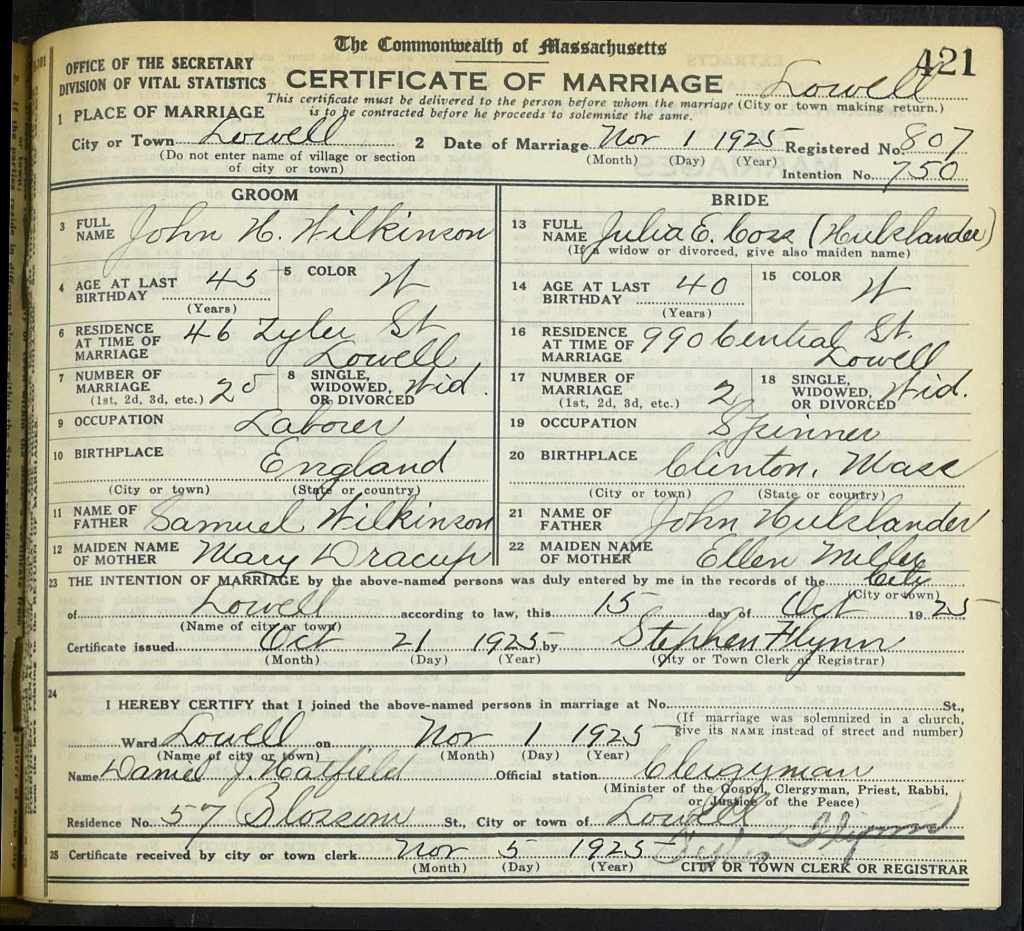
His second wife was Julia Ellen Coss (nee Hulsander), a widow aged 39. She had been born in 1886, in Clinton, Massachusetts, to John Hulsander, a labourer and Ellen, nee Miller.
She gave her address as 990 Central Street, Lowell and she was working as a spinner. John Henry was employed as a labourer and resident at 46 Tyler Street in Lowell.
In 1903, in Lowell, aged 17, Julia had married Clifford F Coss, a 21 year-old weaver. They had one child, John William Coss, born in 1905.
But, by the time of the 1910 Census, Clifford Coss had returned alone to his parental home. There is no sign of Julia or John William. In June 1914, Coss, by now employed as a furniture salesman, died of alcoholism, aged only 32.
I have been unable to establish what happened to his wife and son in the intervening period. John William Coss resurfaces in the 1930 Census as a soldier serving in Honolulu, Hawaii. He married in 1933 and settled in Newark, New Jersey.
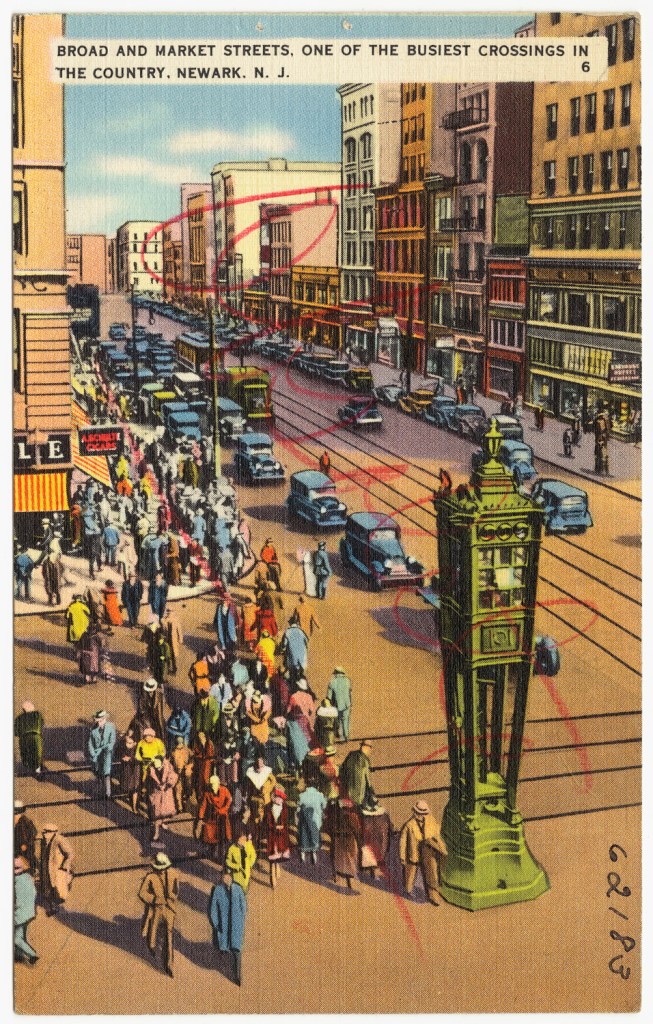
In 1929 and 1930, the Newark City Directories record John Henry Wilkinson as an employee of Hahne and Co, living in rooms at 11 Baldwin Street. Hahne’s Department Store, founded by Julius Hahne in 1858, was located at 609 Broad Street.

And this is confirmed by the 1930 US Census. John Henry – now 56 – and Julia, 44, were living at 11 Baldwin Street in Newark. Both claimed, falsely, that this was their first marriage, both agreeing that they had been married for four years.
John Henry also claimed falsely that he was naturalised. He had been working as a porter at Hahne’s, but was presently unemployed. Julia was working as a matron.
During the 1930s they seem to have moved to a few different locations in Newark, John still mostly employed as a porter.

By the time of the 1940 Census, they were renting at 352 Fairmount Avenue. John, now aged 62, was occasionally employed as a labourer. He seems to have worked 32 weeks in that year, earning just $428. Julia, now aged 53, had also earned $480 from 12 weeks’ unspecified work.
By 1942, they had moved into 63 Jacob Street, both effectively retired. When John finally submitted his Petition for Naturalization that year, it described him as 5 feet 5 inches tall, weighing 180 pounds, with a dark complexion, brown eyes and brown hair. Both arms were tattooed.
He died in Newark in August 1949; Julia in March 1960.
Florence Daisy Wilkinson (1885-1958)
We left Florence in 1910 living with her parents in Lowell and working as a weaver in a worsted mill. She is included in the Lowell City Directories for 1913 and 1914, still a weaver, now boarding with her parents.
But, on 16 October 1913, and now 28, she married 29 year-old Fred Hainsworth, an English-born overlooker.
In the 1920 Census both declared that they had become naturalised US citizens in 1911. Fred’s ‘declaration of intention’, dating from 1907, states that he was born in Halifax, Yorkshire, on 28 May 1884, and that he had arrived in the United States in November 1905.
He is described as five feet eight inches tall, weighing 150 pounds, with brown hair and blue eyes.
I have been unable to find similar documentation for Florence.
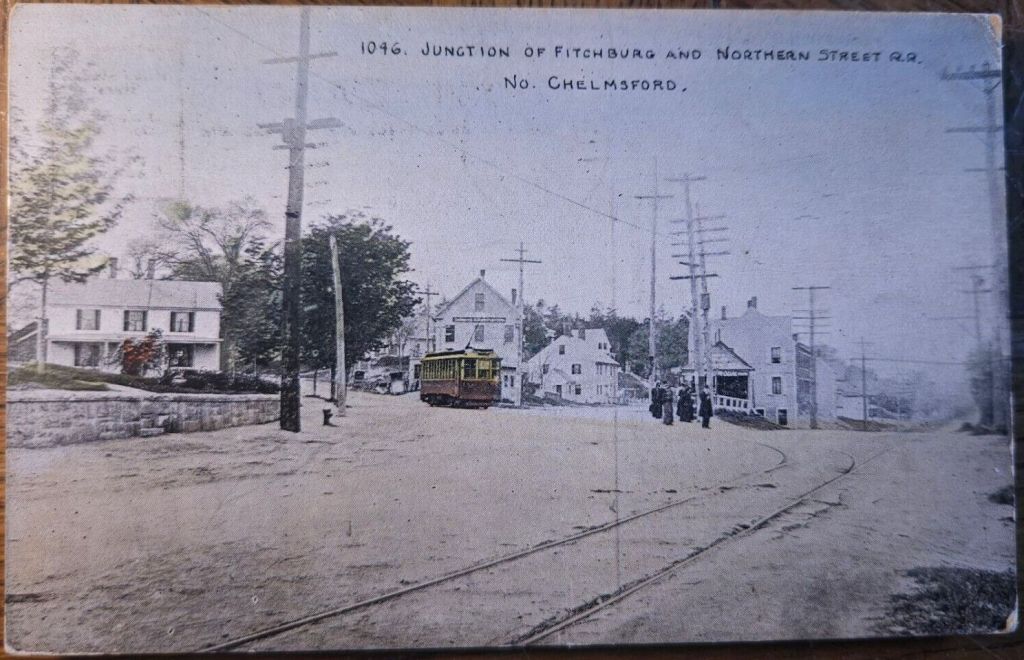
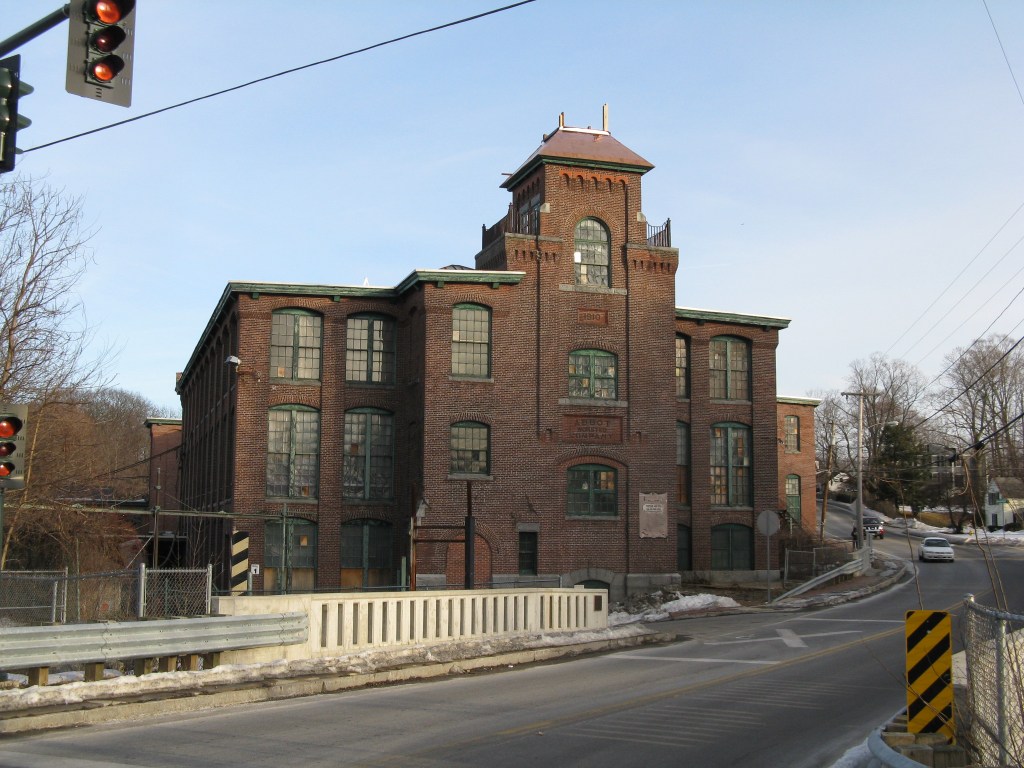
His WW1 Registration Card shows that in 1917 he was then a worsted spinning overseer working for the US Worsted Company at the Silesia Mills in North Chelmsford.
He is described as medium height and medium build. His hair remained brown and his eyes were now brown too! He had also lost the tip of the middle finger on his left hand.
By 1920, the family was living in Tyngsborough, Middlesex, Massachusetts, where they were to remain for the rest of their lives. Tyngsborough is a small town on the banks of the Merrimack River, a few miles to the north of Lowell, close to the border with New Hampshire.

Fred was still an overseer at a woolen mill and they had two children: James, aged 5 and Mona, new-born. On this record, Florence stated that she had arrived in the United States in 1904.
By 1930 they were aged 46 and 45 respectively. They owned their own home, valued at $1500. Fred continued as an overseer at a woolen mill and, on this occasion, Florence stated her immigration year as 1906. Their children were now aged 16 and 10.
In 1940 they still valued their home at $1500. Fred, now 56, was no longer an overseer, but a presser in a worsted mill. His annual income was $1072, and he had worked all year.
James, now 25, had married in 1939 and was living in Chelmsford. He was employed as a finisher in a woolen mill. Their daughter Mona, aged 21, still lived at home.
Fred’s WW2 Registration Card shows that he was working for the Abbott Worsted Company in Forge Village, as was James. Forge Village developed around the mill from its founding in 1858.
He now weighed 165 pounds. His eyes had returned to blue, but he now had grey hair and a ruddy complexion. He had also lost his left index finger, rather than the tip of his middle finger.
By 1950 Fred had returned to an overseer’s role, presumably still with Abbott, while Mona, now 30, was seeking work as a twister in a wool factory.
In 1952, or thereabouts, she married a carpenter employed by Abbott. Sadly though, he died in 1960, aged only 44.
Her mother, Florence, died in 1958, aged 73 and Fred in 1968, aged 82. They are buried together in the Riverside Cemetery, North Chelmsford.
James died in 1993, Mona in 1998.
Florence and Fred, aside from his finger injury, apparently led uneventful and relatively stable lives, Florence becoming notably more prosperous than Mary, Samuel or John Henry. She was the only one of the four to benefit materially from the decision to emigrate.

Martha Jane Dracup (1859-1937) and Thorburn Kennedy (1852-1894)
The subsequent sections deal with the lives of Martha Jane, nee Dracup and Thorburn Kennedy, and their children: William Henry, Fred, Ernest, Margaret and John. It also covers the Mahons – Peter senior, John and Peter junior – who were almost part of the family.
Martha Jane was probably born in the autumn of 1858, also in Liege, Belgium.
Unlike her elder sister, Mary, she lived as a small child with the rest of the family, at 45 Ebor Street in Bradford. She continued in the family home in 1871, by which time she was already employed as a worsted spinner, aged 13.
Her marriage preceded that of her older sister. It took place on 15 October 1876, at St Peter’s Bradford, when she was probably only just 18 and still employed as a worsted weaver.
Her husband was 22 year-old Thorburn Kennedy (called Thorbury Kennedy on the Marriage Certificate). He had been born on 16 May 1852, in Byker, a suburb of Newcastle-upon-Tyne, the youngest son of James Kennedy, a labourer and sometime iron fettler, and Margaret, nee Thorburn.
He was employed as a compositor and, at the time of the marriage, was residing at 35 Royd Street, off Park Lane in Little Horton. Martha Jane was living at Number 45.
By 1881 the young couple were living with Martha’s parents at 9, Mill Lane, Eccleshill. However, Martha is described in the Census return as a ‘Visitor’ suggesting this was a temporary arrangement.
Thorburn is also called ‘Timothy’ in this return, and his employment is described as ‘painter’. They have one son, William Henry, aged one.
He had been preceded by a daughter, Annie, born in the summer of 1877, but she had survived only a few months, dying in December 1877, at almost the same time as her Aunt Mary’s first child, Herbert.
William Henry was born on 9 November 1879 at 96 Ryan Street, which runs parallel with the Manchester Road. Thorburn was employed as a compositor at the time of the birth, remaining and remained so when William was christened in January 1880.

So, if he had lost his job as a compositor by spring 1881, that had happened in 1880 or in early 1881. Possibly the family had been forced to economise, moving in with Martha’s family and sending Martha back to work as a weaver to cover any shortfall in Thorburn’s salary. It was only a temporary setback, however.
When their second son, Fred, was baptised on 20 September 1882, Martha Jane was baptised alongside him. The record states that Thorburn was once again a compositor and that the family was living at an address in Marshall Street, off Crowther Street, also in the vicinity of the Manchester Road.

Ernest, their third child, was born on 1 September 1884, at 9 Grant Mount, off the Roundhay Road in Leeds. The baptism took place on 8 July 1885 but, for some reason, it is recorded alongside much later baptisms dating from 1896.
Their fourth child, and only daughter, Margaret, was born on 16 February 1886, at 9 Roundhay Street in Leeds (which may be the same property, now with a slightly different address).
Their final child, John, was born on 8 January 1890 and baptised on 26 March. The family had now returned to Bradford and were living at 206 St Stephen’s Road in West Bowling.
The following year, the 1891 Census found them residing at 14 Boynton Street, Bradford, a road that runs parallel with Ryan Street, a little further from the Manchester Road.
Thorburn, now aged 37, was properly named and continued to work as a compositor. Martha, now 33, had no employment, so was free to care for their five children: William Henry (11), Fred (8), Ernest (6), Margaret (5) and John (1).
Martha’s father George, now a 68 year-old widower, was also living with them.
Thorburn died at 21 Boynton Street on 28 July 1894, aged only 42. The cause of death was ‘General Tuberculosis’ and the death was registered by his eldest son William Henry, then just 14, rather than by his wife.

I have written previously about the lives of Victorian compositors, in an earlier post about Edmund Dracup and his family. They had a reputation for poor health, partly because the job attracted men who were too infirm for manual labour, and partly because of the insanitary conditions in which they worked.
A contemporary article in the British Medical Journal argued that the large number of deaths from consumption among compositors was almost entirely due to the excessive use of gas lighting! This was subsequently reported in the Bradford Daily Telegraph.
My previous post cites a contemporary estimate that 70% of the compositors who died in 1870 were suffering from consumption or another chest disease. Over half the obituaries recorded at that time by the Scottish Typographical Association also gave consumption as the cause of death.

By the time of the 1901 Census, Martha and her family were living at 51 Loughbrigg Street in West Bowling, close to their previous homes on Boynton Street. Martha, now 47, had been widowed for some seven years. She had no external employment, but four of her five children were working.

William, now 21, was following in his late father’s footsteps as a printer/compositor; Fred, 18, was a cart driver; Ernest, 16, and Margaret, 15, were both worsted spinners.
There was also a boarder, Peter Mahon, a widower aged 38, employed as a machine woolcomber, and his two sons, John aged 9 and Peter aged 7.
Peter Mahon senior had been married to Annie, nee Higgins, but she had died four years previously, in 1897. An infant daughter, Mary, had also died in 1894.
No doubt Martha assisted with the care of Peter’s two sons. Whether she and Peter also enjoyed a sexual relationship is not recorded, though Peter’s decision to follow her to the United States would suggest that they were close.
They emigrate
The business of emigrating to the United States and reassembling there as a family was complex.
As far as I can establish from surviving records, the chronology was as follows:
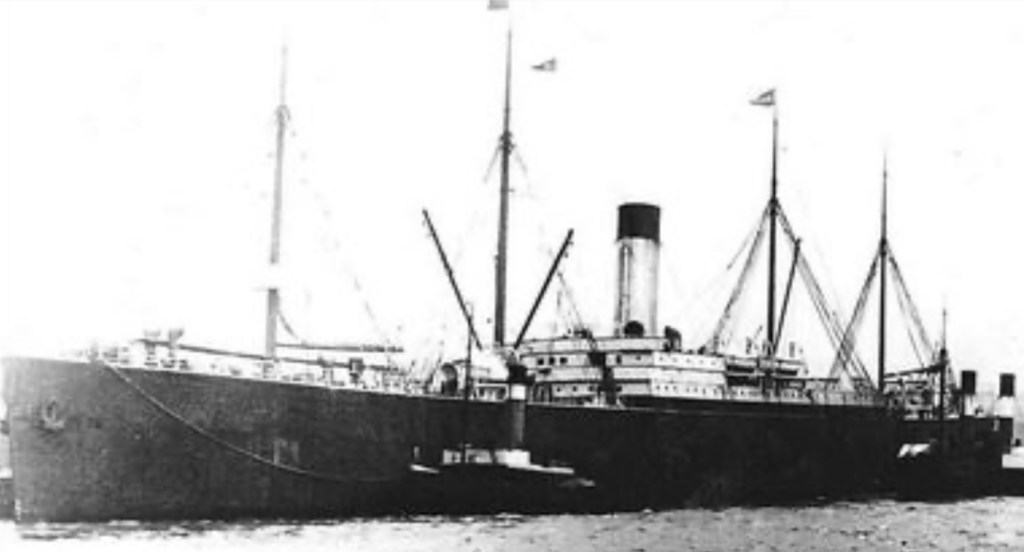
- Second son Fred arrived by joining the crew of the Cestrian, which departed Liverpool on 15 July 1904. According to the record, a substantial number of the crew were paid a shilling and promptly deserted when the ship arrived in Boston, Massachusetts on 3 August. This must have been a ‘worked passage’. The City Directory shows that, by 1905, Fred was boarding at 27 Kirk Street in Lowell, Massachusetts, employed as a machinist. Fred promptly married on Christmas Eve 1906, at the age of 22. His wife was 19 year-old Annie Goodman, an English-born mill operative. She had departed Liverpool on the SS Ivernia on 23 May 1905, in possession of $17:40 and her US contact was her friend ‘Mrs Kennedy [sic], of 27 Kirk Street, Lowell’. This despite the fact that her widowed mother and four siblings had already arrived in Boston aboard the SS Cymric on 8 May. Perhaps she hadn’t received their letter before she set off. The 1908 Lowell City Directory places Fred as a machinist boarding at 16 Gold Street.
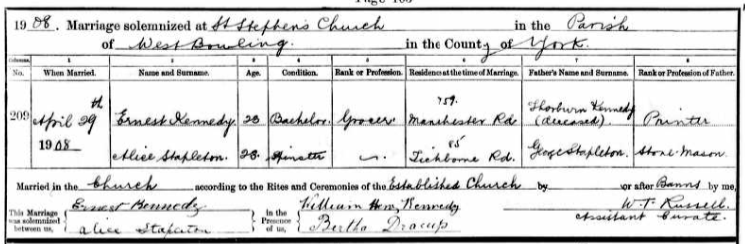
- Third son Ernest travelled aboard the SS Ivernia from Liverpool, sailing on 14 February 1905. He had just $13 in his possession. He gave two contacts: his cousin Herbert Fearnley (see below) and Fred, at 27 Kirk Street. The 1908 Lowell City Directory places Ernest as a clerk working at 214 Hale Street and also boarding at 16 Gold Street. But Ernest travelled back to Bradford to marry Alice H Stapleton, a 23 year-old stonemason’s daughter, on 29 April 1908. The certificate describes him as a grocer, resident at 759 Manchester Road. The witnesses were his Aunt Bertha and his brother William Henry. The couple were back in time for the 1910 US Census, where Alice records that she emigrated to the United States in the year of their marriage.
- Martha Jane traveled across the Atlantic with her two younger children – Margaret and John – also aboard the SS Ivernia, departing Liverpool on 7 November 1905. Martha gave her employment as book-keeper, while Margaret said she was a servant and John a labourer. Martha had $16 in her possession. They too gave as a contact, son Fred at 27 Kirk Street. By 1908, the Lowell City Directory has Margaret working as a spinner and boarding at 16 Gold Street. Martha was also at this address, described as ‘widow of Thoburn’.
- Eldest son William Henry arrived with his wife, Florence nee Garbutt, whom he had married in 1905, and their infant son, Thorburn, also aboard the SS Ivernia, departing Liverpool on 5 October 1909. William, now 29, described himself as a compositor and had $40 in his possession. He gave as his contact his mother, Martha, at 16 Gold Street, Lowell. There is a description of William: he was 5 feet 4-and-a-half inches tall, with a fresh complexion, brown hair, hazel eyes and a red moustache.


Additionally, Peter Mahon and his son Peter junior arrived aboard the SS Cymric, having sailed from Liverpool on 10 May 1907. (His son John also made the crossing but I’ve been unable to pinpoint exactly when.) He had $22 with him and he gave as his contact his friend William Kennedy, at 16 Gold Street (although William seems not to have departed England at this point). The 1908 Lowell Directory mentions ‘Peter Mann’, a woolcomber, boarding at 16 Gold Street.
The 1910 US Census serves as a snapshot of all the key protagonists, now transported to Massachusetts.
Martha was still at 16 Gold Street, along with: William Henry, his wife Florence and their son Thorburn; Margaret; John; and both of Peter Mahon’s two sons. Now aged 52, Martha confirmed that she had given birth to six children, five of which had survived. She had no employment and their home was rented.
William Henry, now 30, was a compositor in a printing office. Margaret, aged 24, was a spinner in a woolen mill, while John, 20, was a second hand at a woolen mill. John Mahon, 18, and Peter Mahon junior, 16, were also spinners at (probably the same) woolen mill.
Peter Mahon senior was no longer boarding with Martha, suggesting there had been a rift of some kind. He was lodging at a boarding house, 38 Suffolk Street, roughly 15 minutes’ walk from Gold Street. He was employed as a comber at a woolen mill, but had spent 12 weeks of the year without work.
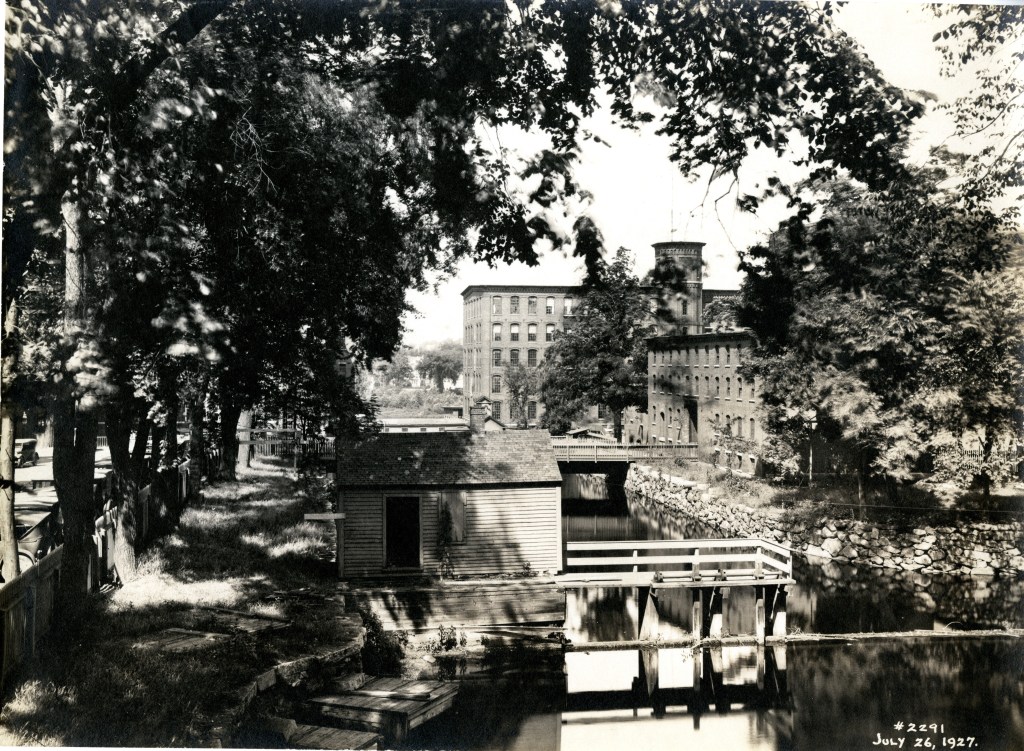
Fred, now 28, was living with his mother-in-law, alongside Annie, their baby daughter Florence and three of Annie’s siblings. They were located at 81 Barker Street in Methuen, Essex, Massachusetts, some miles north-east of Lowell, close to the New Hampshire border. Fred worked as a machinist in a cotton mill; Annie as a spooler.
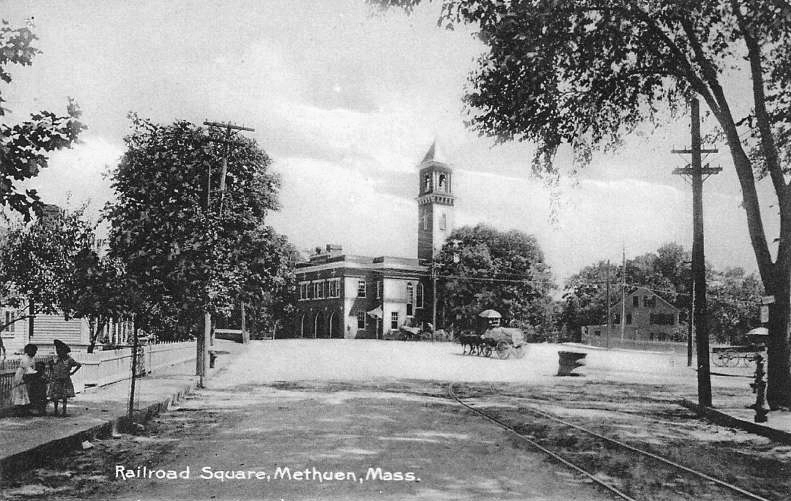
Ernest was at 265 Thorndike Street in Lowell with his wife Alice. The Census entry states that he was 30, but he was actually only 26. He was employed as a clerk in a store, while Florence was a mill operative. Their property was rented.
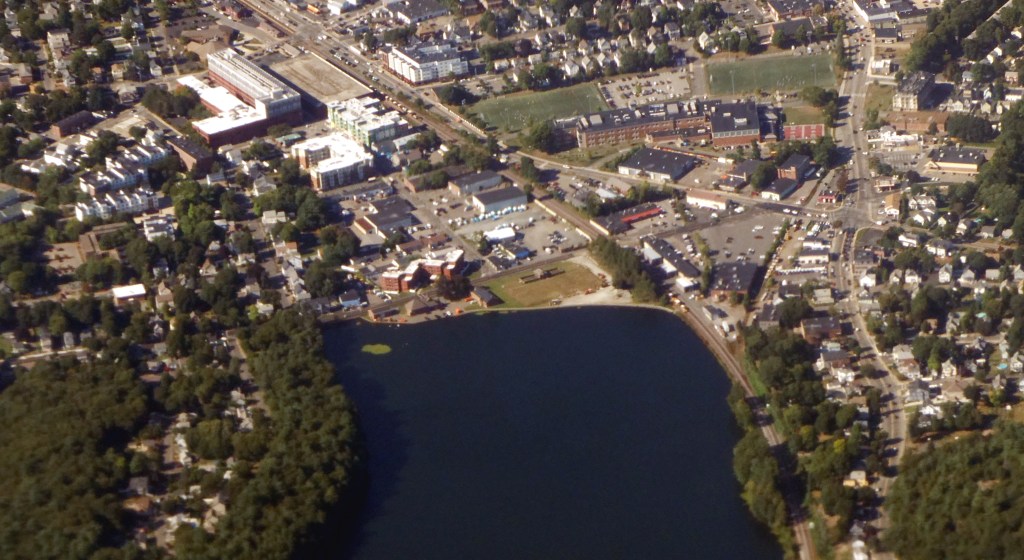
By 1912 Martha Jane and the rump of her family had removed from Gold Street to 11 Oxford Street, just along the north bank of the Merrimack River from Lowell General Hospital.
The house still stands. Number 11 is the upper floor of a two-family property, with Number 9 on the lower floor. It was probably newly-built when they moved in.

Tragedy struck when Peter Mahon junior died of tuberculosis on 29 May 1912, aged only 18. His address was given as 11 Oxford Street and he was working as a worsted mill operative. Martha had presumably been caring for him as his health deteriorated, but the death was reported by his father, who gives his own address as simply ‘Lowell’.
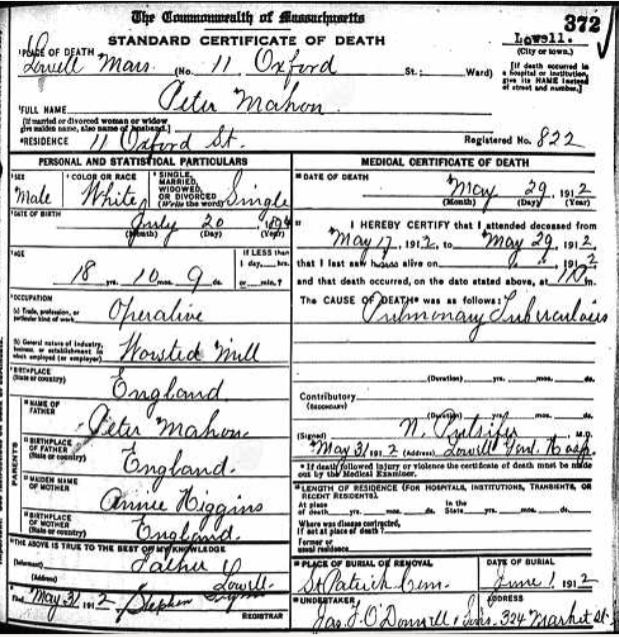
According to the 1912 Mortality Statistics for the US as a whole, Pulmonary Tuberculosis caused 4,189 deaths in Massachusetts that year, 353 of them young people aged 10-19.
Worse still, Peter senior died only two weeks later on June 12 1912 in Lowell General Hospital. He was 50 and the cause of death was given as gastroenteritis. His home address remained the boarding house at 38 Suffolk Street, but his employment was given as mill operative, so he had been unable to retain his position as a woolcomber.
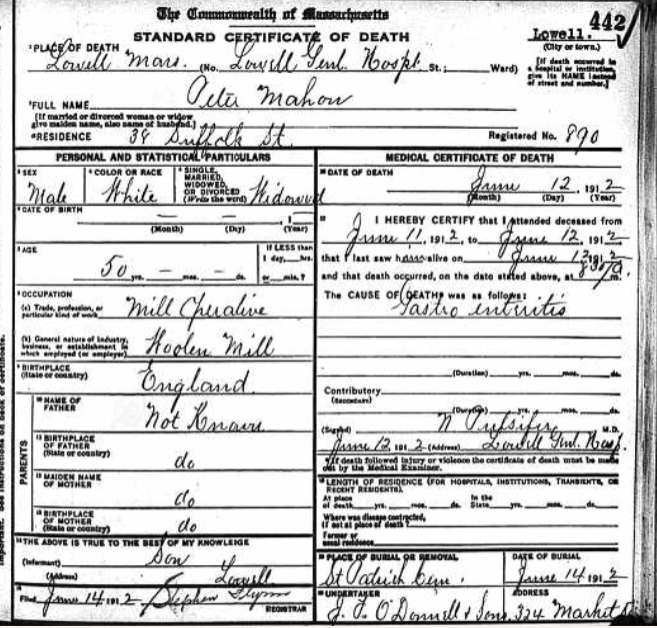
His death was reported by John Mahon, now the only surviving member of the Mahon family, who was most likely still resident with Martha. (We can definitely place him at 11 Oxford Street by 1915, but not beforehand.)
The 1912 Mortality Statistics indicate that gastroenteritis was predominantly a cause of death for infants. Whereas diarrhea and enteritis killed 381 people aged over two in Massachusetts that year, some 3,300 children under 2 succumbed.
One wonders whether Peter senior had other underlying conditions that hastened his demise.
Both Peter Mahons were buried in St Patrick’s Cemetery.

There is evidence of a close relationship between Martha Jane and Peter Mahon senior. But something clearly prevented that relationship from developing into matrimony. Perhaps Martha simply had no financial imperative to marry Mahon, given the support she received from her children. Perhaps there were other factors that damaged his prospects.
Interestingly, the 1913 Lowell City Directory shows that, for a while in 1913, Martha’s nephew William Dracup – her brother Henry’s younger son (see Part Two) – was living with his aunt at 11 Oxford Street.
Martha continued to appear in the Lowell City Directory, the entry reading ‘Martha J widow Thorburn r 11 Oxford’. At the time of the 1920 Census, she was sharing with her two younger children, Margaret and John. By the 1930 Census, only Margaret remained. Martha was now 72 and she owned her property, valued at $3500. She remained an alien.
Martha died in Lowell in 1932, aged 74, having outlived her husband by 38 years and seen all five of her surviving children become firmly established in Massachusetts. Turning to their lives in order of seniority…

William Henry Kennedy and Florence, nee Garbutt
The 1913 Directory shows that William Henry and family were now occupying 9 Oxford Street, immediately below his mother’s home. William was listed as a printer working for the Courier-Citizen at 67 Middle Street, Lowell.
The Courier-Citizen Company had been formed in 1894, following a convoluted history of local mergers. As well as newspapers, the Courier-Citizen also published books and periodicals, as well as operating a general printing and bookbinding business. By 1900 the printing department was one of the largest north of Boston.
The family remained at 9 Oxford Street throughout the war years. A daughter, Margaret Eileen Kennedy, was born on 16 December 1913. On his draft registration card, completed in September 1918, William confirmed he was still with the Courier-Citizen Company, employed as a compositor. It described him as short, of medium build, with brown eyes and dark brown hair.
The 1920 Census confirmed the family still at 9 Oxford Street, and that they rented the property. William, now 40, was still a compositor. He, Florence and their son Thorburn had been naturalised in 1918.

By 1924 at the latest, they had moved to a house at 200 Oliver Street in Malden, in the north-eastern outskirts of Boston, some 20 miles south-east of Lowell.
They were still at that address for the 1930 Census, stating that their home was worth $4000 and owned rather than rented. William was employed as a compositor at a printer’s shop. Florence, now 49, was not employed; neither were Thorburn, 21, nor Margaret Eileen, 16.

In 1936, Thorburn married Ruth Christie Weyant, a native of Poughkeepsie, New York, some six years his junior, the daughter of a mechanic and garage proprietor. In 1935 Thorburn was listed in the Malden Directory as a steelworker, but by 1937 he had become a salesman.
They were still at 200 Oliver Street in 1939 but, by 1940, William and his extended family had moved to 8 Mountain Avenue, closer to central Malden. They owned the house, worth $3500. Now aged 60, William was working as a newspaper proofreader with the Boston Globe, earning $2600. Florence, now 59, was occupied at home.

Thorburn, 32, lived with them, together with his wife and their two children, Leslie Ann, 5, and Thorburn Scott, 6 months. Thorburn senior was employed as a traveling salesman for a roofing company, earning $1560.
Margaret Eileen, 25, was also still living at home, working as a hairdresser in a beauty parlour, earning $836.
Thorburn and his family remained at 8 Mountain Avenue for only a short period. By the time he completed his WW2 draft card, in October 1940, they had moved to 17 Forest Road in Wakefield, Massachusetts, a few miles to the north of Malden. He gave his employer’s name as Robert C Bolton of Medford, Massachusetts.
Pi.1415926535
Meanwhile, his father’s WW2 draft card, completed in April 1942, reveals that his parents and sister had returned to their former home at 200 Oliver Street, Malden. William remained with the Boston Globe. He was now described as five feet three-and-a-half inches tall, weighing 120lb, bald, with brown eyes and a dark complexion. He had a scar below his nose and wore glasses.
In March 1944, daughter Margaret became engaged to Sylvester W (Jock) Cosman. At the time of their engagement Margaret was working as an instructor at Wilfred Academy in Boston (a hairdressing and beauty school) while Sylvester was a USAAF cadet. His home address was also in Oliver Street, Malden.
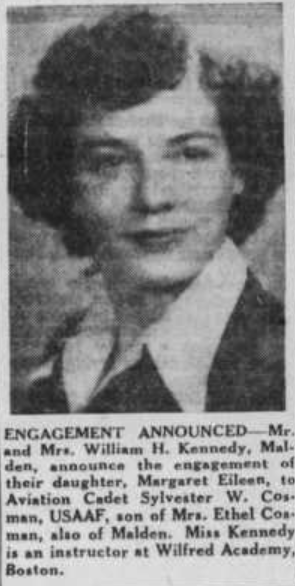
They had married by the end of 1944, Sylvester now a Lieutenant serving with the 5th Air Force in the Pacific.
By the time of the 1950 Census, only William and Florence remained at 200 Oliver Street. Though now aged 70, William was still working as a proofreader.
Thorburn and Ruth continued to reside in Wakefield with their two children, though no employment is given for either. Margaret and Sylvester had moved to a nearby ground floor apartment at 121 Oliver Street, together with their three year-old daughter Gail. Sylvester was now employed as an instructor in an apprentice school at the Boston Naval Shipyard. Margaret later returned to teaching.
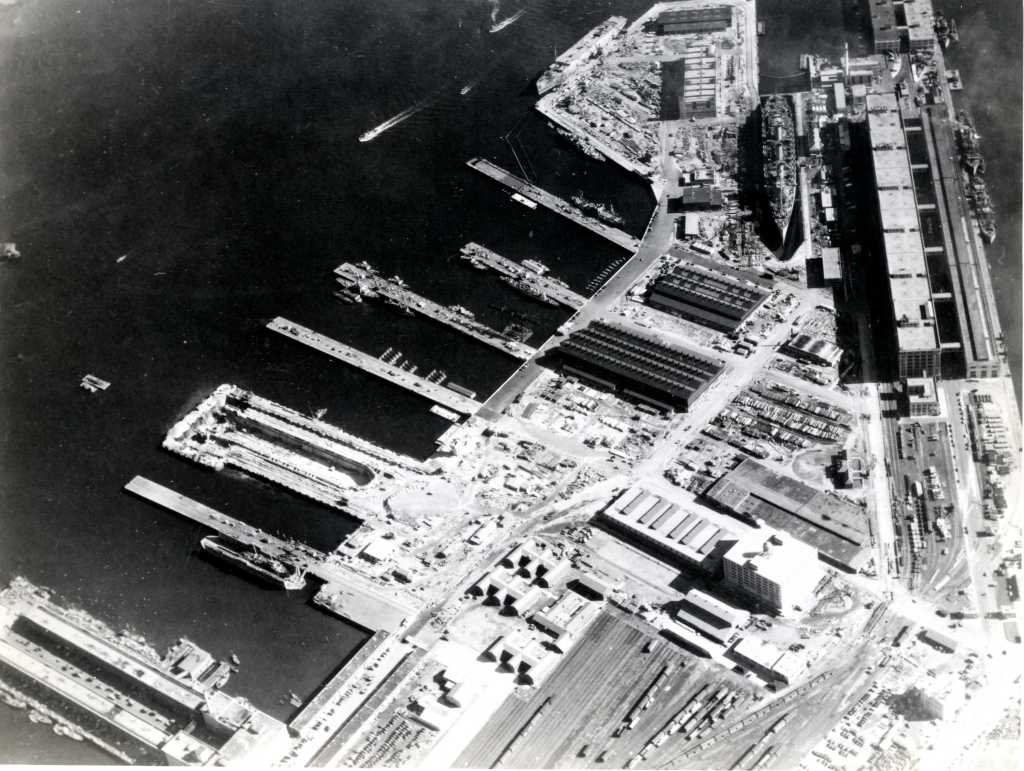
William died in October 1953. His obituary says that he was an active member of St Luke’s Episcopal Church. In his younger days he belonged to the ‘Sons of St George Cricket Club’. (Ironically for a proofreader’s obituary in the paper for which he worked, there are at least two spelling mistakes.)

Florence died in 1966, Thorburn junior in 1992 and Margaret in 2003.
Fred Kennedy and Annie, nee Goodman
Fred and Annie had returned to Lowell by 1920 and were living at 30 Waterford Street, adjoining Oxford Street. The couple owned their home. Fred worked as a machinist in a machine shop, while Annie was a twister in a plush mill. Florence Hazel, their daughter, was now 10. Both parents had been naturalised in 1910.
During 1921 and 1922, Fred and his brother Ernest ran the Kennedy Brothers Garage at 19 Varnum Avenue. Fred seems to have continued alone in 1923 and 1924.
By 1925 the family had moved to 113 Varnum Avenue, beside the north bank of the Merrimack. Oxford Street lay just behind. Fred was now a car salesman, his business located at 463 Merrimack Street, at what is now known as Wheeler Block.
They were still living in Varnum Avenue in 1930, owning one floor of a substantial detached house worth $5000 and possessing a radio set. Now 43, Fred was still a car salesman. Annie wasn’t working but daughter Florence was a presser in a shoe shop. Fred’s mother-in-law was also living with them.
Florence had married Eric Van Tassell Judd in 1934. The Judd’s family home had been in Varnum Avenue, just a few doors away from the Kennedys. In 1927, Eric turns up as a clerk in Springfield but, by 1932, he was in Lowell, living at home and listing his employment as ‘navigator’.
The 1935 Lowell Directory says ‘removed to Auburn’ but, by 1937, he and Hazel were apparently running a store, ‘Judd & Kennedy’ on the corner of Lee and Main Streets in Tewksbury, just to the south-east of Lowell.
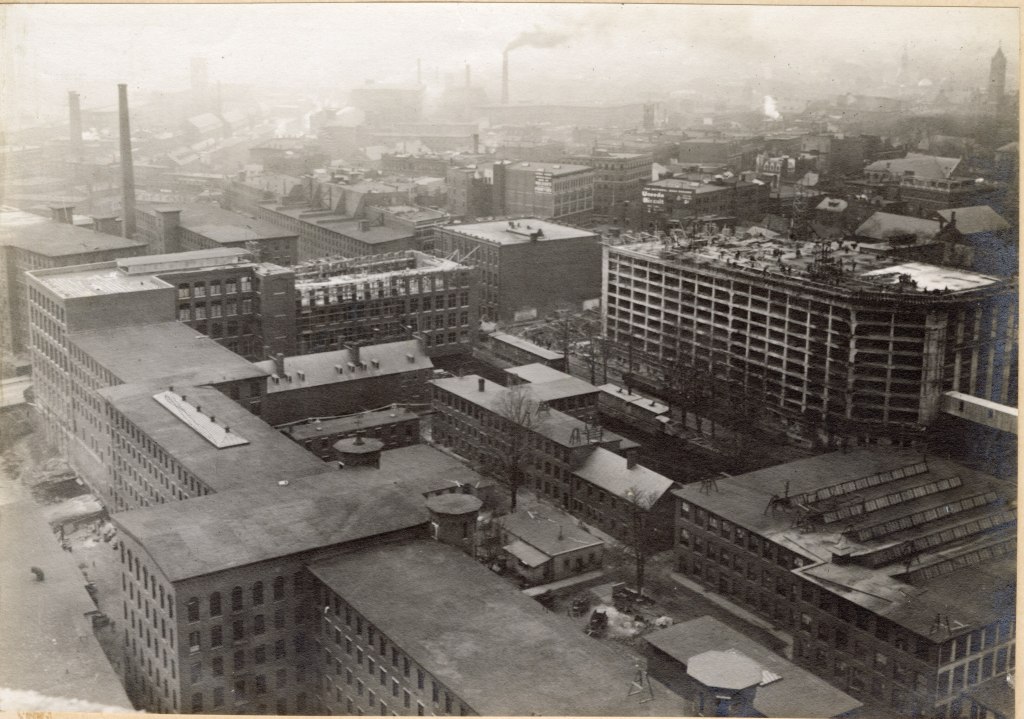
Despite the birth of their daughter, Mary Jane, in 1938, they were apparently estranged by 1940.
By February 1942, when he completed his WW2 Draft Card, Judd was living at 645 Salem Road, Billerica, and employed by the Submarine Signal Company. He married his second wife, a Chelmsford telephone operator, that same year.
By 1940, the Kennedy family had moved to Main Street, Tewksbury. They owned their home, which was worth $7000. Fred had seemingly taken over ‘Judd & Kennedy’, renaming it ‘Red Roof Spa’. Fred employed Annie as his clerk.

Florence Hazel, now 30, was also living with them, along with Mary Jane, still describing herself as married.
By 1942, Hazel had taken over from her mother as clerk at the ‘Red Roof Spa’. She seems never to have remarried.
Annie died in 1946, aged 58. By 1950, Fred was living in a Tewksbury apartment with his daughter and grand-daughter. He was 67 and retired. Florence, now 40, was working as a waitress at the State Hospital. Fred died in 1956, aged 74; Florence died in 1968 aged 59.
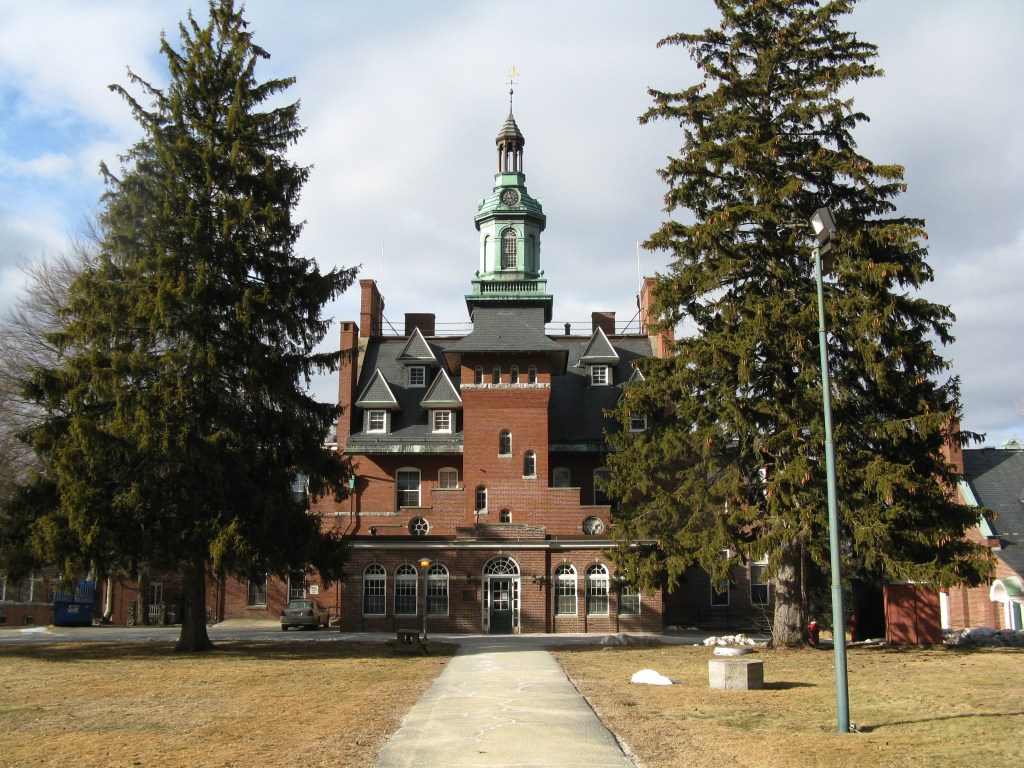
Ernest Kennedy and Alice nee Stapleton
In 1917, the Lowell Directory records Ernest and Alice living at 169 Hale Street, close to Ernest’s clerical work, at 214 Hale Street. But, by 1918, they had moved to 43 Starbird Street, which almost backed on to 11 Oxford Street.
Ernest’s WW1 draft registration card, dated September 1918, confirms this address, but also states that he was now employed as a machinist at the ‘Merrimack Utilization Company, Warren Street, Lowell’. This was initially formed to process and sell cotton waste but later became part of the much larger Merrimack Manufacturing Company, which produced textiles.

Ernest was described as short, with a slender build, brown hair and what seems to read ‘dark blue’ eyes.
The 1920 Census still has them at 43 Starbird Street, confirming that they owned the property. Ernest, now aged 35, was employed as a section hand at a waste factory – presumably still the Merrimack Utilization Company. Both Ernest and Alice had been naturalised in 1918.
During 1921 and 1922, Ernest was employed at the Kennedy Brothers garage with brother Fred, but by 1924 he had reverted to being a machinist and was living back at 11 Oxford Road. From 1925 to 1927, he was a labourer living at 5 Oxford Road, but by 1929 he had become a grocer and moved that year to 10 Courtland Street.
The 1930 Census places him next door, at 12 Courtland Street, still very close to Oxford Street but slightly further from the River. Ernest, now 45, owned the house, worth $3500. He was working as a retail merchant, specialising in groceries.

He and Alice now had a son, Stanley, aged 7. An earlier son, Fred, was born in 1915 but had died immediately.
Throughout the remainder of the 1930s, the Lowell Directories confirm Ernest still in the grocery business and still at the same address. The 1940 Census reports him, now aged 55, still living at 12 Courtland Street with Alice and Stanley, now aged 17. Ernest was working as manager of a retail grocery store. Stanley, simply described as ‘new worker’, was most probably helping him out.
Ernest’s WW2 draft card described him as five feet two inches tall, weighing 165 pounds, with blue eyes, grey hair and a light complexion.
Stanley’s card, completed two months later in June 1942, shows he was then working for ‘C J Dodge’. He was described as five feet eight inches tall, weighing 195 pounds, with blue eyes, black hair and a ruddy complexion.
Stanley enlisted in the army in May 1943 and, the following month, married Shirley Leboeuf, a Lowell native, in Nottaway, Virginia. He was 20; she 18. He was probably training at nearby Fort Pickett. He later served as a Technician, 5th Grade and, after the War, they had three sons, in 1946, 1947 and 1951 respectively.
By 1950, the family remained at 12 Courtland Street, but Stanley had now become head of the household. He was proprietor of a taxi business, Shirley worked as a stitcher in a clothing factory and Ernest manned the phones for the taxi company.
Ernest died in 1954, aged 69, while Alice lived until 1966 and Stanley until 1977.
Margaret Kennedy
Margaret undoubtedly suffered as the only daughter in the family, serving primarily as her mother’s companion and not marrying, even after Martha’s death.
Up to 1927, she appeared regularly in the Lowell City Directory as a spinner and then, from the mid-1930s onwards, as a winder.
In 1920 she was living at 11 Oxford Street with her mother and her brother John. She was already aged 34 and employed as a spinner in a plush mill. By 1930 she was living alone with her mother and was unemployed.
By 1940, and following her mother’s death, she was living again with her brother John and his family. Now 55, she was winding yarn at the Mohair Plush Company, earning $750 per year.

Established by the Bliss brothers in 1891, who established a 100-loom mill on Western Avenue in Lowell. Mohair was widely used in furniture upholstery and in car and train seats.
By 1950, she was still living with John and his family. Now 64, she continued to work as a winder, probably with the same company. The Lowell Directory shows her still resident with her brother in 1960. She died in 1979 in Tewksbury, Massachusetts.

John Kennedy and Mary, nee Nagle
The Lowell Directory refers to John as ‘second hand’ up to 1918, but his WW1 draft registration card, which is undated but was probably completed in 1918, says he was working as a machinist with the Massachusetts Mohair Plush Company.
He claimed exemption from the draft on the grounds that he had his mother to support. He was described as short, slender with light hair and blue eyes.
In the 1920 Census, John had recovered his status as second hand and was living with his mother and sister at 11 Oxford Street. But, in 1921, he married Mary Nagle, a twister in a Lowell cotton mill. He was 30 and she was 21. A daughter, Isabel Rita, was born in January 1922.
By 1930, John, now 40, and Mary, 30, had taken over 9 Oxford Street which they were renting, quite possibly from Martha. John was now foreman in a woolen mill and Mary a doffer, probably in the same mill.
By 1940, John and his family had moved upstairs, to his mother’s former home at 11 Oxford Street. John, now, 50, worked as a ‘section hand’ for the Mohair Plush Company, earning $1500 a year. Isabel, now 18, had just started working as a Yarn Inspector at the same Company.
His WW2 Draft Card reports him as being five feet three inches tall, weighing 140 pounds, with blue eyes, brown hair and a light complexion.
By 1950, and having now moved back downstairs to 9 Oxford Street, John was a foreman at the Plush Manufacturing Company, presumably the same employer as in 1940.
The upstairs property at 11 Oxford Street was now occupied by Isabel and her husband, Francis Davidson, who had married in 1944. Although Boston-born, he had been living in Lowell. Francis worked as a salesman, Isabelle as a saleslady in a department store.
They had divorced by 1952, both remarrying by 1955.
By 1958, John and Mary were living with John’s sister Margaret at 137 Chelmsford Street, before moving by 1960 to an apartment at 50 Summer Street. John died in 1969, aged 79, his wife Mary having predeceased him by about eight months.
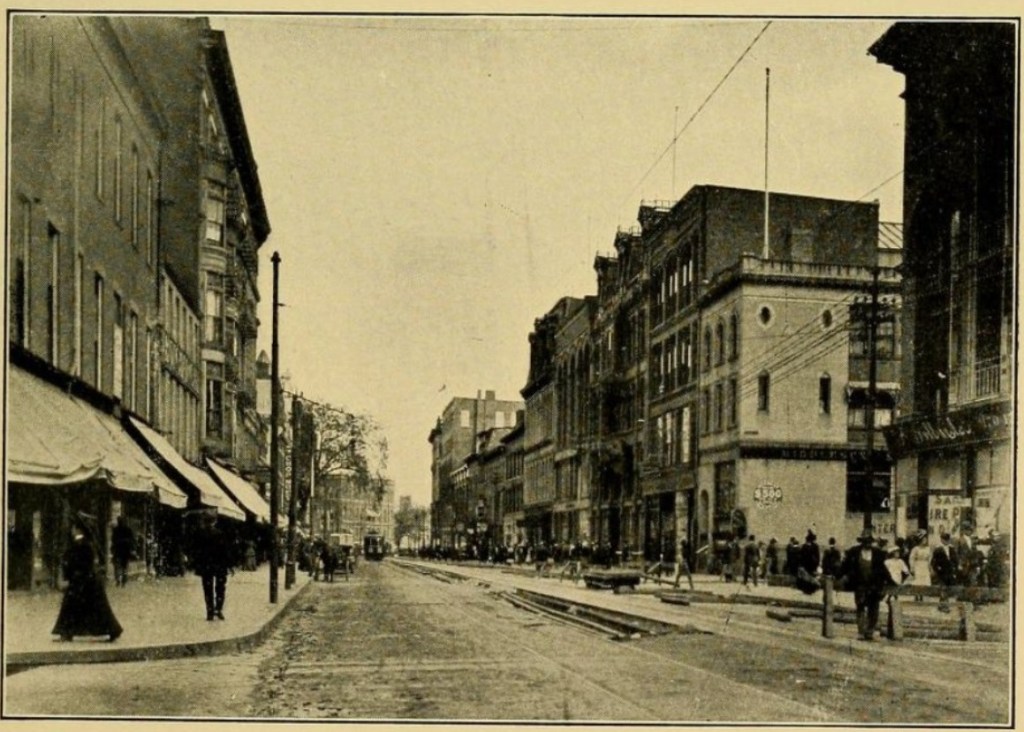
John Mahon and Rosa nee Sheerin
John Mahon was recorded as resident at 11 Oxford Street in 1915 and 1917. In 1915 he was employed as a ‘shipper’; in 1917 as an overseer.
His WW1 Draft Registration Card confirmed that he was then employed by the ‘Mirramack Mitigation Company’ of Warren Street Lowell. This must be the same outfit that then employed Ernest.
It described him as of medium height, slender build, with blue eyes and dark hair. When he registered, on 5 June 1917, he was still single, but on 28 August that year he married Rosanna Sheerin, a twister in a woolen mill.
The 1920 Census shows them renting rooms at Ernest’s home, 43 Starbird Street. John, now aged 27, was an overseer at a waste factory – presumably the Miramack Utilization Company. A daughter, Dorothy, had been born in 1918. Sadly, she was to die as a teenager in 1935. A second daughter, Ann, was born in September 1930.
The 1930 Census locates them at 2 Oxford Street, which they rented. John, now 38, was foreman at a cotton mill. He gave his immigration year as 1919, adding that he was naturalised.
They remained at the same address in 1940, John working as an overseer at the Merrimack Manufacturing Company with an income of $1690.
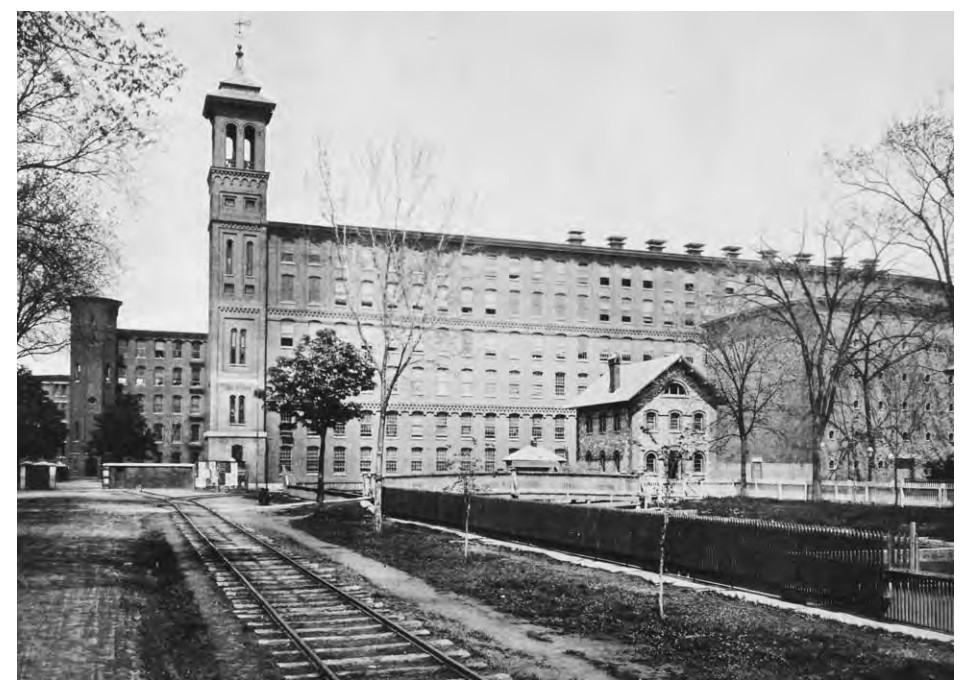
By 1950, the family was back in Starbird Street, now at Number 23. John was working as a shipper with a wholesale bedding company. His daughter Anne, 19, was a bookkeeper at a department store.
Rosanna died in 1960 and John in 1968. Anne died in 2014.
Although their fortunes were mixed, there is some evidence here to suggest that Martha Jane’s children, particularly her three elder sons – William Henry, Fred and Ernest – came to enjoy some degree of prosperity in the United States.
Those who escaped the mills of Lowell tended to do better than those who remained in their employ.
But their lives were also limited, narrow and comparatively uneventful, almost entirely confined to the town of Lowell and its immediate surroundings.
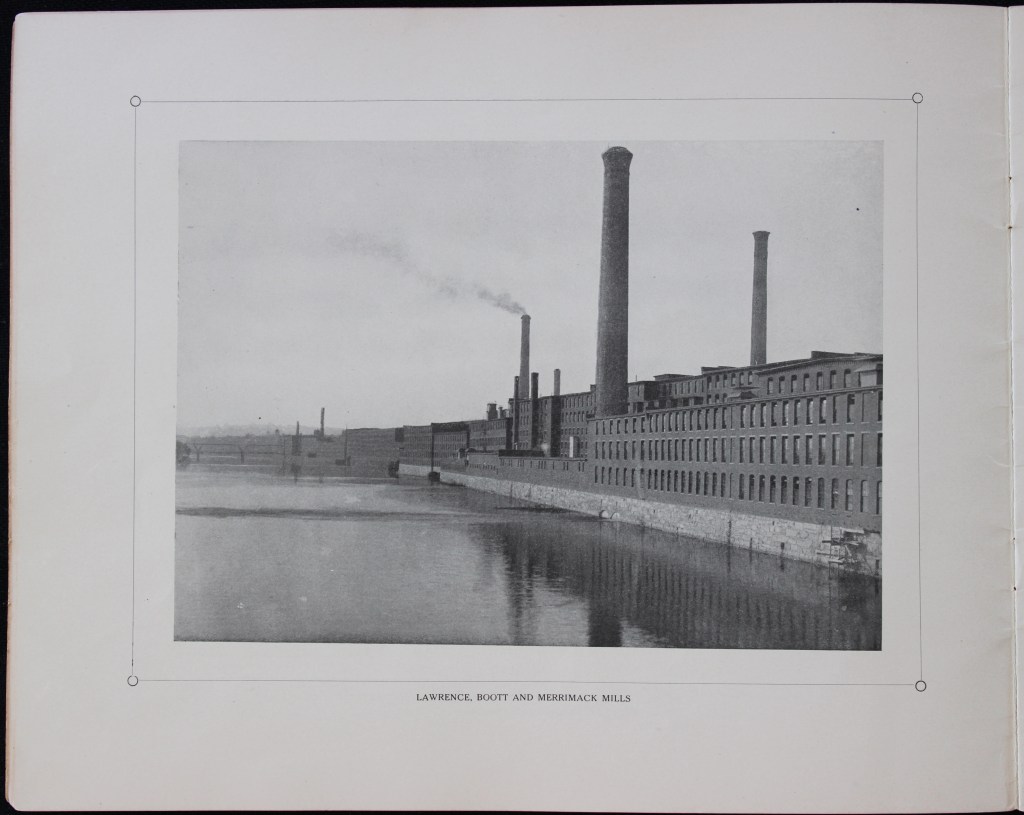
Albert Bullock Dracup (1844-1913) and Martha White (1846-1896)
The subsequent sections deal with Albert Bullock and Martha Dracup and their children: John William Bullock, Mary Jane Bullock, Ellen Bullock, Clara Bullock and Alice.
As discussed in my previous post, Albert was born on April 18 1845 at Brick Lane, Manningham. His mother was definitely Jane Bullock, but no father was named on the birth certificate and his birth was registered under the name ‘Albert Bullock’.
George Dracup may have been his father, but the birth took place almost five years before Jane married George, so Albert was definitely born out of wedlock. He later called himself Albert Dracup in all census records, but he married under the name ‘Albert Bullock’ and no father was named on the wedding certificate.
Strictly speaking, then, Albert’s descendants are not ‘authentic’ Dracups, but I think the balance of probabilities supports the argument that George was Albert’s father, so making the distinction technical rather than genetic.
Albert married Martha White on 9 September 1866 in the Parish Church, Bradford. He was 21, employed as an overlooker, she was a 20 year-old weaver, the eldest daughter of Job White, a woolwasher, and Mary, nee Bradley.

The 1871 Census places them at 79 College Street, Old Machar, Aberdeen, Scotland. Also living at the same address were Albert’s (legitimate) brothers, William and Henry.
Albert and Martha had already had their first child, a daughter, Mary Jane Bullock, born on 25 April 1870 at the same address.
Four further children were born over the next decade, all of them registered under the surname ‘Bullock’:
- Ellen Bullock (the birth certificate records Helen Bullock) born on 20 October 1871 at what looks like ’21 Barrowmill Cottages’ in Aberdeen.

- Clara Bullock, born on 28 June 1873 in Cartmell Street, Bradford.

- John William Bullock, born on 5 Sep 1876 at 24 Montague Street, Horton, Bradford. (The father’s name on the certificate was originally written ‘Albert Dracup’, but this has been crossed out and replaced with ‘Albert Bullock’.)

- Alice Bullock, born on 27th February 1879 at 267 Girlington Road, Manningham.

By 1881, Albert and family were resident at 18 Mark Street in Bowling, Bradford. They were recorded with the surname ‘Dracup’. Both now aged 35, Albert remained a worsted spinning overlooker while Martha looked after the children, aged 10, 9, 7, 4 and 2 respectively.
Immigration records show that the family traveled together to the United States, departing Liverpool on 3 July 1890 aboard the SS Samaria. Albert and Martha both claimed to be 40 years old (Albert was 45; Martha 44).

Their children’s ages were also slightly wrong Mary Jane was said to be 21 (she was 20), Ellen 18 (she was), Clara 16 (she was 17), John 11 (he was 13) and Alice 9 (she was 11).
On arrival in Boston, Massachusetts, they stated that all but Alice were employed as weavers and that they were headed for Rhode Island.
It is evident, then, that Albert and his family arrived in the United States some fifteen years before either of his sisters, making his home initially in Rhode Island and later in Massachusetts and Connecticut, but neither sister seems to have used him to facilitate their own families’ emigrations.
Perhaps their relationships weren’t sufficiently close, given that Albert was almost a generation older. Maybe they regarded him as illegitimate and preferred to keep him and his family at arm’s length.
Albert is recorded in the Directory for Providence, Rhode Island in 1891-1892, at the address ‘house rear 41 O’Neil’. O’Neil Street lies in the north-western suburbs of Providence. There must have been precious little space for the family of seven, and the former overlooker was reduced to working as a spinner.
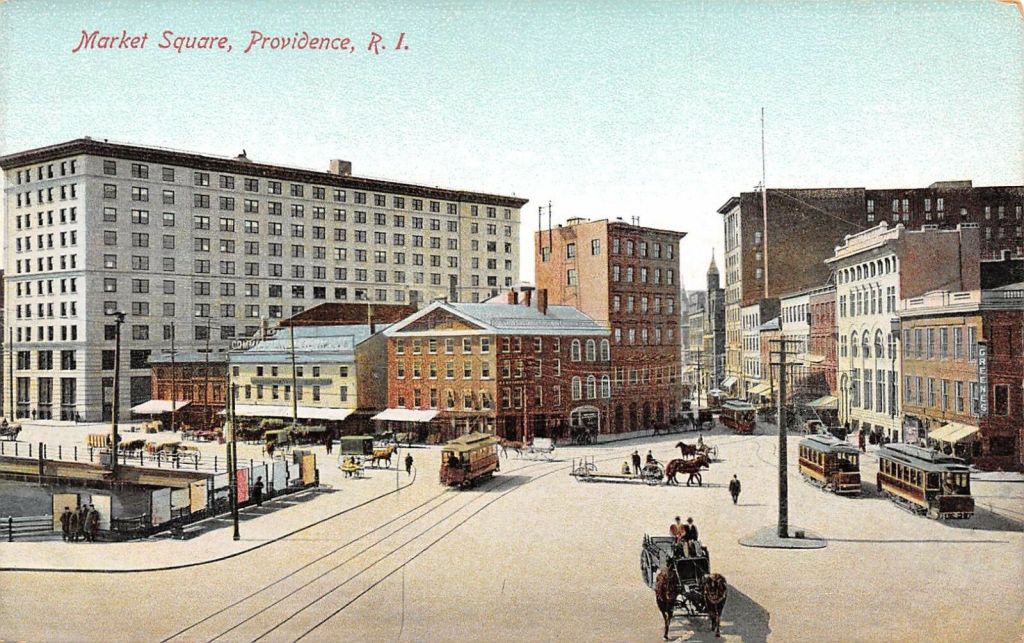
On 22 April 1891, Albert’s eldest daughter, Mary Jane, married Herbert P Fearnley. He is described on the marriage record as ‘Engineer (Stationary)’. Fearnley was from Bradford and had arrived in the United States at exactly the same time, so was presumably Mary Jane’s ‘intended’ prior to their emigration.
She was already heavily pregnant with their first child, who must have been conceived in September 1890, very shortly after they arrived in the United States. Clara Ellen Fearnley was born on 20 June 1891, at 420 Branch Avenue, Providence.
Tragically, she only survived until 15 August 1892. She died at ‘R Worsted Mill’, suggesting that Clara had resorted to taking the baby to her place of work. The causes of death were gastro-enteritis and ‘cerebral congestion’.
According to the 1892 edition of the Providence Directory, Albert was still working as a spinner but the family now had a house to themselves at 7 Houghton Street, still in the same suburban area.
In December of that year it was the second daughter Ellen’s turn to marry. Her husband was Frank Terry, a 27 year-old woolsorter who hailed from Bingley, Yorkshire. He had arrived in the United States two years before before Albert and family, in June 1888.
Their first son, William Albert Terry, was born a few months after the marriage, on 2 April 1893, at 643 Douglas Avenue, Providence.
By 1894, the remainder of the family had moved to Westford, Massachusetts, some miles west of Lowell. Albert was now employed as a labourer.
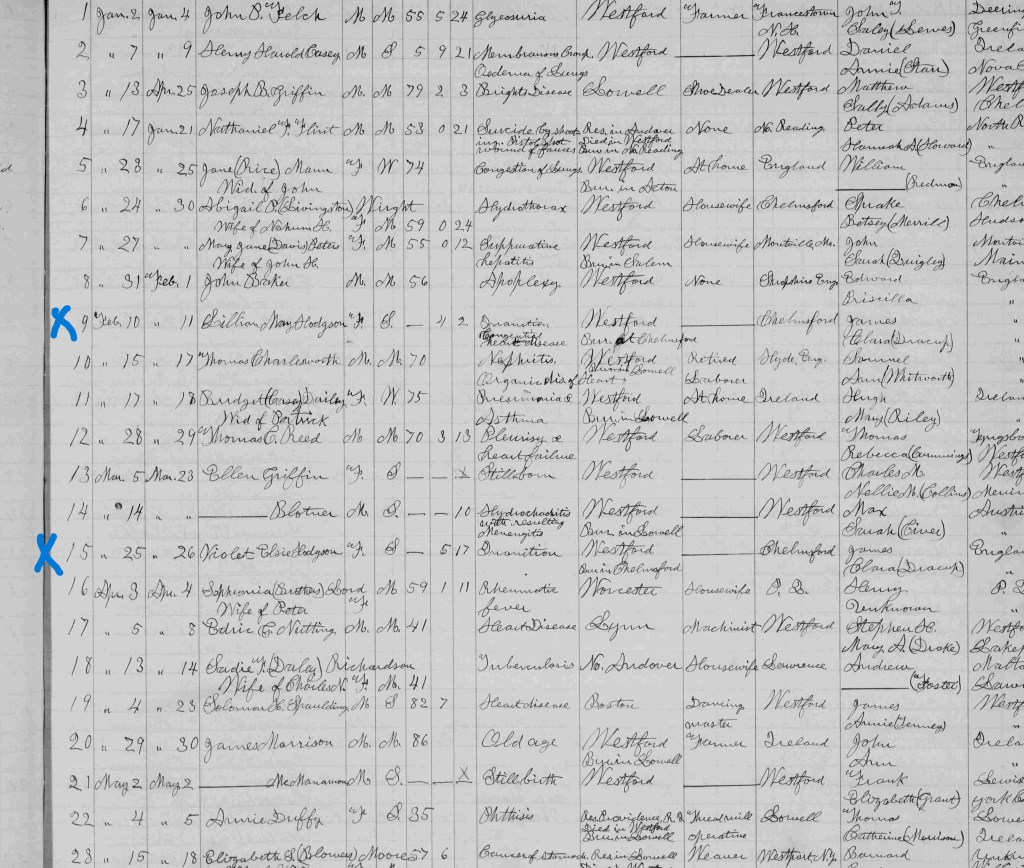
Third daughter Clara was married in December 1894, in North Chelmsford, Lowell, to James Hodgson, a 25 year-old overseer, Bradford-born, who had been in the United States since December 1887.
She gave birth to twins, Violet Elsie and Lillian May Hodgson, on 8 October 1895. Tragically, both died the following year, Lillian on February 10, of ‘inanition’ and ‘congenital heart disease’, and Violet on 25 March, of ‘inanition’.
Both Albert and his son John William were recorded in the 1895 Lowell Directory, employed as ‘operatives’. They were living on the corner of Clare and Sargent Streets. They were now close to the Merrimack River, on the opposite bank to where Albert’s sister Martha would later settle.
By 1896, the family had moved to 21 Oliver Street in the same vicinity. Although Albert was still an operative, John William was now a clerk, employed at 144 Merrimack Street. This was the location of A.G. Pollard’s Department Store.

These early years in the United States were clearly difficult and, sadly, Albert’s wife Martha died on 14 March 1896, at 21 Oliver Street, of pneumonia and asthma. She was only just 50.
She was buried in the Edson Cemetery, a privilege she shares with novelist Jack Kerouac.

Both Albert and John William retained the same employment into 1897, but the family had moved to 86 West Street, on the north side of the Merrimack River, in the area known as Centralville. Albert remained at the same address in 1898, still working as an operative, but John William had removed to Boston.
However, John William returned to Lowell to marry Eva Scott, a 21-year old velvet cutter, on 28 June 1899. Eva had been born in Dewsbury, Yorkshire but, by 1891, had been boarding in Bradford with her widowed mother. She had arrived in Boston aged 14, in 1892.
By the time of the 1900 Census, Albert’s household was reduced to three. They were living at the rear of 9 South Whipple Street, this time in the southern suburbs of Lowell.
Apart from Albert, claiming to be 48 (when he was actually 55), there was only his youngest child, Alice, now aged 21, and Hannah Mitchell, a boarder, aged 18, employed as a woolen spinner.
Albert had spent three months unemployed that year, but was now working as a railroad hand, while Alice had been eight months unemployed, but was presently a woolen twister.
The 1901 Lowell Directory shows that Albert soon returned to more familiar employment, at a carpet mill. He remained there in 1902, while Alice was employed at the US Bunting Company.
But the 1903 Directory states that both Albert and Alice had removed to Gilbertville, a village midway between Worcester and Springfield, Massachusetts.

We know from newspaper evidence, that Albert had finally managed to obtain employment as an overseer, responsible for a section of the spinning room at the George H Gilbert Manufacturing Company, located in Number 4 Mill, Gilbertville.

Alice was married on 26 November 1903, in nearby Hardwick, to James Noble, a 25 year-old teamster born and bred there. Alice recorded her employment as housekeeper.
Albert gave up his role in Gilbertville in January 1908, according to a short item published in the Evening Herald of Fall River, Massachusetts that year.

Shortly afterwards, The Press of Stafford Springs, Connecticut reported that he had taken over as head of the spinning department at the Stafford Worsted Company.

But, in the 1910 Census, Albert appears as a boarder, living in a house on Assuntuck Street, Thompsonville Village, Hartford, Connecticut. He stated his age as only 45 (he was 65) and gave his employment as foreman at a carpet factory. He was probably now employed by the Hartford Carpet Company.

Albert died on 14 August 1913, aged 68. He had been suffering from chronic arteriosclerosis, but the cause of death was acute bacillary dysentery, which he seems to have contracted at the Tewksbury State Infirmary, after he was admitted on 16 June 1913.

Although hospitals had made great strides in infection control, illnesses such as typhoid and dysentery were regularly contracted in United States hospitals, killing many patients.
Prior to hospitalisation, he had been visiting his youngest daughter, Alice, and her husband in Methuen, Massachusetts. He was still employed as an overseer, though exactly where is not specified.
Albert was also buried in the Edson Cemetery, on 18 August 1913.
He had to struggle hard to overcome the disadvantage of emigrating in middle age, grafting for well over a decade alongside much younger, more inexperienced men before he could find a position comparable with those he had held in England.
His wife died prematurely and his own health suffered. In his latter years, he clearly felt it necessary to pretend to be far younger than he was.
John William Bullock Dracup (1876-1951) and Eva, nee Scott (1878-1951)
John William, 23, and Eva, 22 were identified in the 1900 US Census as living in part of 8 Newton Street in the Sixth Precinct of Boston.
We have dated John William’s arrival in Boston to 1898, though he doesn’t appear in the Boston Directories for either 1898 or 1899.
He was employed as a ‘floorman’ with the BERw, which I take to mean the Boston Elevated Railway, while Eva remained at home.

The Boston Elevated Railway Company was formed in 1894 and had soon taken over Boston streetcar and subway interests besides. The first section of elevated track was completed in 1901.
The Boston City Directory confirms John William in this role from 1900 to 1902.
A first child, Victor Scott Dracup, was born on 4 April 1901 at 8 Newton Street. By 1892 they had moved to 491 Washington Street.
The family reappear in the 1905 New York State Census, living in the village of Rifton.
John William, now aged 28, was working as an overseer, probably at the Rifton Carpet Mills, located on the Wallkill River, owned by J. W. Dimick.
But he didn’t retain his overseer status for long. On 21 May 1909, twin daughters Eva and Elaine were born in Darby, Pennsylvania. The family’s address was given as 15 Woodbine Avenue, and John William’s employment was simply ‘spinner’.
The 1910 Census confirms this address, adding that John William was working as a ‘ring frame spinner’.
The ring frame had been developed in Rhode Island in the 1820s.

In a ring spinning frame, bobbins are rotated at speed, each bobbin surrounded by a metal ring. These rings are connected to a ring rail which moves up and down to distribute thread upon the bobbins.
Each ring has a clip that is free to rotate around it, called a traveler, and this guides the yarn on to the bobbin. As the bobbins rotate, the travelers move rapidly around their rings, causing the yarn to be wound on to the bobbin.
John William’s WW1 Registration Card shows that, by 1918, the family had moved again, to 3 Glade Street, Worcester, Massachusetts. He was now employed as a weaver by the Worcester Woolen Company.

He was described as tall, of medium build, with light blue eyes and dark brown hair. He was also ‘hard of hearing’.
The 1920 Census shows the family still at this address, renting the middle floor of a substantial three-floored house. When answering the 1910 Census, John William said he was still an alien. Here, he claimed falsely that both he and Eva were naturalised in 1902. (They did not apply until 1943.)
Now aged 43, he was described as a weaver at a carpet factory. Eva senior was 41 and not working, Victor, now 18, was employed as a belt-maker, while Eva junior and Elaine, both 10, were at school.
On 24 June 1922, Victor married Clara Marie Bowley in Camden, New Jersey. Victor’s address was given as Darby, Pennsylvania, suggesting that the family had returned there by this point. Clara was a native of East Camden but the couple decided to settle in Philadelphia.
A son, called Victor Herbert, was born there, prematurely, on 4 April 1927 at the Greatheart Maternity Hospital, part of the Temple University Hospital, but survived only four days. Their home address at the time was at 23 Harrison Avenue, in Elton, New Jersey.
In April 1930, a second child, Doris Irene, was born in Camden, New Jersey. Their home address was now 302 Penn Street, just across the Delaware River from Central Philadelphia. Their home was rented and Victor was working as a rug weaver.
Victor briefly owned a grocery business located at 1001, East Price Street in Philadelphia, but had sold it by 1932.
Meanwhile, John William and Eva senior remained in Darby, Pennsylvania, essentially a western suburb of Philadelphia. Their address was 400 Poplar Street and they owned the house, valued at $3600.

Both confirmed that they remained aliens. John William, now 54, was working as a watchman in a yarn mill. Eva, 20, was a filing clerk in a mercantile agency, while Elaine, also 20, was a typist in a law firm.
By 1940 they had moved to 900 Lawrence Avenue in Darby, which they owned. It was valued at $1500. John, 63, was unemployed. Eva, 30, was a key puncher but had been out of work for six months that year, and Elaine, also 30, was a stenographer.
At the same point, Victor and family were at 3008 North Howard Street in Philadelphia. Now 39, he had returned to working as a weaver in a rug mill. Clara, his wife, was also employed as an inspector in a rug mill. They still rented their home.
In 1943, John William and Eva were both finally naturalised. They were still at the same address. He was described as 5 feet 9 inches tall, weighing 145lb, with a light complexion, blue eyes and light coloured hair; she was 5 feet tall, weighing 95lb, with a light complexion, blue eyes and grey hair.
Early in 1948, and now in their 70s, they retired to a corner bungalow at 416, 29th Street South, St Petersburg, Florida. An item in the Tampa Bay Times of 30 June 1949 says they celebrated their Golden Wedding Anniversary with a reception for 24 guests at their home. There are separate headshot photographs of the happy couple.

The 1950 Census indicates that they were still at this address. Their neighbours at Number 98 were Joseph S Hajik, a railroad electrician, and his wife Elma.
Meanwhile, Victor and his family were still at 3008 North Howard Street, though Victor had been promoted to foreman. His obituary later revealed that he was employed by the Downs Carpet Company, from which he eventually retired in 1967. Clara was working as a mender, probably also for Downs, and Doris in a phone company office.
Eva and Elaine had rooms on 44th Street in Philadelphia. Both remained single. Strangely, for twins, one gave her age as 32, the other 31! Eva worked as a key punch operator for a motion picture company; Elaine as proprietor of a ‘public stenographer’.

Then, on 22 February 1951, the Tampa Bay Times reported:
‘An elderly man and wife were found dead in their Southside bungalow yesterday afternoon – victims of an accidental gassing.
Dead were Eva and John Dracup, both about 74 years old. They were found in the bedroom of their home at 416 29th Street South.
The couple was discovered after a neighbor, Mrs J S Hajik of 2851 Fifth Avenue South, reported to police that gas was coming from the home. Police also found a cat dead from fumes in the house.
Patrolman Ralph Meiners answered the call and found the couple in a rear bedroom with a kitchen stove oven turned partially on. Windows in the home were closed.
A bottle of spirits of ammonia was found near the couple, and Meiners theorized they began feeling ill from effects of inhaling the gas and attempted to use the medicine.
Mrs Hajik told Meiners that the Dracups had purchased the kitchen stove new on Friday, and Mrs Dracup was not familiar with its controls.
Coroner Joe E Carpenter termed the deaths accidental and said no inquest would be held.
The Dracups are survived by two daughters, Eva and Elaine Dracup, and a son, Victor Dracup, all of Philadelphia. Cooksey’s is in charge of arrangements.’

The following day another article appeared, reporting that the Fire Department emergency car carrying resuscitator equipment was involved in a collision on the way to the bungalow.
We shall never know whether these these deaths were truly accidental. The purchase of a new stove and the spirits of ammonia definitely point in that direction, but choosing to keep all the windows closed on a balmy Florida night is rather more questionable.
In October 1951, an ‘E.Dracup’ of 1524 Chestnut Street Philadelphia advertised the property for sale in the Philadelphia Inquirer, asking $9,000.
Neither Eva junior nor Elaine ever married. Eva junior died of viral encephalitis in 1955. Victor died in 1976 and Elaine in 1991.
Mary Jane Bullock Dracup (1870-1940) and Herbert P Fearnley (1868-1925)
Following the tragic death of their first child, Clara Ellen Fearnley, Mary Jane and Herbert had three further children: Herbert J Fearnley Jr in 1893, Albert Henry Fearnley in 1895 and Ethel Fearnley in 1899.
Though Herbert junior and Albert Henry were both born in Providence, Ethel was born in Boston and they were resident at 82 Fremont Street. In 1893, Herbert had been a labourer, in 1895 he was an electrician and in 1899 a machinist.

By 1900, the Fearnleys were living in half of 28 Newton Street Boston, just down the road from John William and Eva Dracup at Number 8. Herbert, now 31, was described as a ‘machinist (electrician)’. Mary Jane looked after the three children, aged 7, 5 and 3 respectively.
Herbert became naturalised in October 1903, at which time he was described as an electrician living at 178 Bigelow Street in Boston.
In the summer of 1904, Herbert, Mary Jane and their youngest daughter Ethel returned to England, but were back in Boston by early September.
By 1907 they had moved to 1 Parkman Street, a much more central location, and they were still there at the time of the 1910 Census. Herbert, now 42 (but listed as 46), was a machinist at a ‘car stables’. Herbert junior, 17, was a printer, while Albert Henry, 15, was an errand boy at a clothing store and Ethel, 11, was still at school.

In February 1911, the Boston Evening Transcript reported that:
‘Peter Landay has conveyed to Mary J B Fearnley title to an estate situated in Newton Street, Brighton, consisting of a three storey building and 2848 square feet of land.’
Newton Street was close to Bigelow Street in the western suburbs, close to the Charles River. The 1911 list of Boston residents accordingly places Herbert at 18 Newton Street. In 1913 the family had moved across the road to 27 Newton Street.

On 30 May 1917, Herbert junior married Mary Agnes Bright, a 21 year-old stenographer. Herbert’s WW1 Registration Card shows they were living at 205 Parsons Street, not far from Newton Street, while Herbert was employed by the Atlantic Printing Company, at 201 South Street.
Herbert junior was described as tall, slender, with blue eyes and light brown hair. He suffered from paralysis of the foot and ‘walked lame’. Consequently he did not serve in the War.
By 1920, Herbert junior, 26, and Mary Agnes, 24, were still at 205 Parsons Street, Herbert now described as a compositor in a printing office.
Herbert senior, 52, was still living at 27 Newton Street, which the family owned, and was described as a machinist in a factory. Mary Jane, 49, was not working, Albert Henry, 24, was also a machinist working on cars; Ethel, 20, was a stenographer in a book company.
Albert Henry’s WW1 draft registration card describes him as a machinist at the ‘Rivett Lathe and Grinder Co. Faneuil, Massachusetts’. During the War, this company employed as many as 200 workers but, in 1920, tried to double its size, causing it to enter receivership in 1921. It shrank significantly, but ultimately survived.
Albert Henry’s card further reveals that he had served for two years voluntarily as a private with the 5th Infantry. He was described as 5 feet 8 inches tall, of medium build with blue eyes and light hair. I can find no further details of war service, although the 1930 Census confirms that he was a WW1 veteran.
By 1923, the Boston City Directory places the family in Brooks Street. Herbert senior and Albert Henry were at 30 Brooks Street. Herbert remained a machinist, while Albert Henry was a student. Meanwhile, Herbert junior was at 28 Brooks Street, working as a compositor at 259 Washington Street.
By 1924, these arrangements were unchanged except that Albert Henry was now working as a ‘sub carrier PO’. But, by, January 1925, he had begun serving with the Boston Fire Department, aboard Fire Engine 34. He was listed as a probationer, earning $1500, his address 30 Brooks Street.
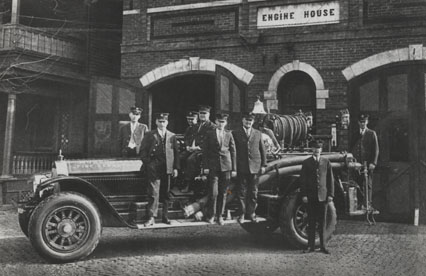
Herbert senior died of ‘lobar pneumonia’ and influenza on 12 November 1925, his 57th birthday. At the time of his death, he was living at 47 Copeland Street in the Watertown area and was also employed by the Rivett Lathe and Grinder Company, Albert Henry’s former employer. He was buried in the Ridgelawn Cemetery.

A newspaper dated 9 October 1926 reports that Albert Henry had transferred from Engine 4 to Engine 41. He was listed in the 1927 records as a hoseman, earning $1800, his address now 34 Harriet Street.
That year he also married Elizabeth Walsh, the youngest daughter of a large Irish immigrant family.

In April 1928 the Boston Globe reported that Albert was one of three firemen overcome by smoke at a large blaze in Harvard Avenue, Allston. He was released after a night in hospital.
Later that year he was promoted to assistant apparatus operator and was listed in 1929 as an apparatus operator with Engine Company 29, earning $2000 per year. It seems that he primarily worked in what was known as District 11, covering the Brighton area.
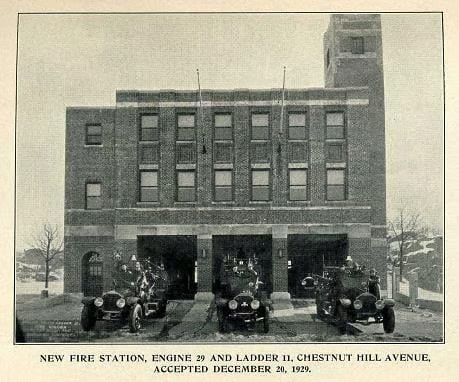
Engine 29 is still based at 153 Chestnut Hill Avenue. The Station was opened on 20 December 1929, having moved from an earlier location further along the same road.
The 1930 Census shows his widowed mother, Mary Jane, now aged 59, still living at 47 Copeland Street with Ethel, now 30, who had been working as a stenographer for a steel manufacturer, but was presently unemployed. They owned their home, valued at $3800.
Herbert junior was nearby, at 39 Copeland Street with Mary Agnes and three children: George 9, Dorothy 8 and Mildred, 5. They also owned their home, also valued at $3800. Herbert was now a printer on a newspaper.
Albert Henry, 35, and Elizabeth, 29, were renting at 79 Surrey Street. He was still a fireman. The 1931 listings confirm that he was still with Engine 29, now earning $2200 annually. This situation was unchanged in 1933, except that his earnings had fallen to $1870. in 1934 he was boarding at 8 Madeline Road. By 1935, his previous salary had been restored and he had moved to 20 Sanderson Place.

Ethel Fearnley died on 3 May 1935, at the age of just 35 and was buried in the Ridgelawn Cemetery.
And, only two months later, on 15 June 1935, Herbert junior also died. He was 42. The 1935 Boston City Directory gave his work address as 1 Norway Street. This was the address of the Christian Science Publishing Company, publishers of the Christian Science Monitor, first published in 1908. His home address remained 39 Copeland Street. He too is buried in the Ridgelawn Cemetery.
Herbert junior’s wife Mary was left with five children aged from 2 to 14. By 1940 she was working as a clerk for Needham Sand and Gravel Inc., still living at 39 Copeland Street, and by 1943, she was a stenographer for J H McNamara Inc. then, from 1947, a book-keeper with the same Company.
By 1962 she had returned to Needham Sand and Gravel, now as a book-keeper. By 1969, she was an Accounts Manager with J H McNamara and had moved to the town of Hudson, where she died in 1979.
Her mother-in-law, Mary Jane, died on 15 October 1940, having outlived her husband and three of her four children. She was 70. She is also buried in the Ridgelawn Cemetery.
By 1940, Albert Henry, now 45 and Mary Jane’s sole surviving child, was living at 24 Sanderson Place, valued at $3000 which the family owned. In addition to Elizabeth, now 39, there were four children: Albert Henry junior 10, William 7, Warren 5 and Doris 2.
Albert Henry had worked half the previous year for an income of $1800, but was presently unemployed. (The records show that he left the Fire Service on 1 June 1939.)
His WW2 Registration Card, undated but completed in 1942, confirms that he had already retired from the Boston Fire Department. Now aged 47, he was described as five feet nine inches tall, weighing 148lb, with blue eyes, brown hair and a light complexion. He had a scar on his forehead over his left eye.
By 1943, he had taken up employment as inspector for the Atwell-Ediphone Service Company, where he remained until 1949. The Ediphone was an early dictaphone.

By 1950 he and his family were still living in Sanderson Place. Neither parent was working. Albert Henry died in August 1964, aged 69. Elizabeth died in December 1971.
Ellen Bullock Dracup (b 1871) and Frank Terry (1865-1945)
Shortly after the birth of their first child, William Albert, the Terry family must have moved away from Providence, since their second, Ernest Edward Terry, was born on 25 October 1894 in Bordentown, Burlington, New Jersey, on the banks of the Delaware River, south east of Trenton and some 250 miles from Providence.
However, they had returned to Providence by the time their third son, Gordon Stanley, was born on 17 August 1897.
The 1897 City Directory places them at 44 Seaman Street but, by the time of Gordon’s birth, they had removed to 26 Crandall Street, nearby. Frank was still a woolsorter.
They remained at 26 Crandall Street for the 1900 Census, sharing the building with a second family. Frank was now 34, Ellen 28 and their three sons were aged 7, 5 and 2 respectively.
Their final child, a daughter, Lillian May Terry, was born on 24 August 1901, by which time the family were at 1006 Branch Avenue. During this period they moved home regularly: the City Directories put them at 46 Seaman Street in 1904, and at 786 River Avenue from 1906 to 1909.

By 1910 they were sharing 470 Branch Avenue. Frank had spent six weeks out of work, but remained a woolsorter. Seventeen year-old William and fifteen year-old Ernest were also both employed at a woolen mill, as a ‘roper’ and a ‘bander’ respectively.
By 1912 they had removed to 162 Veazie Street and by 1914 to 280 Veazie Street.
But tragedy struck on 6 September 1913, when third son Gordon Stanley died, aged only 16. He was killed in Smith Street, following an ‘accidental collision between an auto-wagon and an electric car’. He had been working as a clerk. He was interred at the North Burial Ground.
The 1915 Rhode Island Census records the remainder of the family still in Veazie Street. Frank was out of work at the time of the Census, as was William (now 21), normally an apprentice machinist. Ernest was working as an apprentice jeweler.
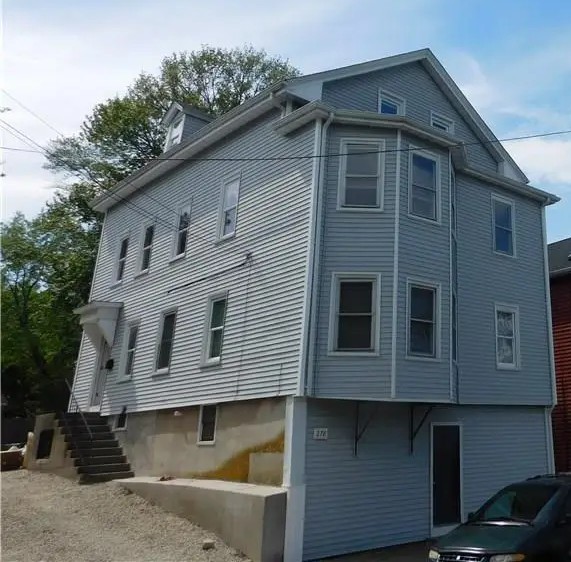
In 1916, the family were living at 280 Veazie Street, while William, now working as a clerk, was boarding at Number 278. His WW1 Draft Registration Card confirmed him at this address, but gave his employment as ‘machinist (foreman)’, working for Brown and Sharpe.
He was described as tall and slender with blue eyes and light coloured hair. He did not serve in the armed forces.
Ernest’s Card confirms that he too was living at 278 Veazie Street, employed as a toolmaker by B. A. Ballou Company, Peck Street, Providence, a jewellery manufacturing company. He was described as of medium height with a slender build, blue eyes and dark brown hair.
We know from a later application for a military headstone that Ernest served in the US Navy from 28 November 1917 until 17 August 1919, as Machinist’s Mate, 2nd Class.
On 15 October 1919, Ernest married Emily Rollinson Hoyle, a 21 year-old clerk, born in Providence. Her parents were both English-born, hailing from Huddersfield. Ernest was still employed as a jeweller’s toolmaker.
The 1920 Census records Frank and Ellen also now resident at 278 Veazie Street, confirming that their home was rented. Frank remained a woolsorter. William was also at 278, employed as a machinist, as was Lillian, now 18, working as a book-keeper.
Ernest was residing with his in-laws on Vicksberg Street, described as a toolmaker in a machine shop, while Emily worked as a timekeeper, possibly in the same establishment.
By 1922, Ernest and Emily had moved to 119 Donelson Street, while Frank and Ellen remained at 278 Veazie Street. In 1924, Frank, William and Lillian are all confirmed at 278 Veazie Street.
Meanwhile, Ernest and Emily had left for a new life in California. From 1926, they lived at 6180 Baker Street in Oakland. Ernest was working as a machinist with MCMCo.
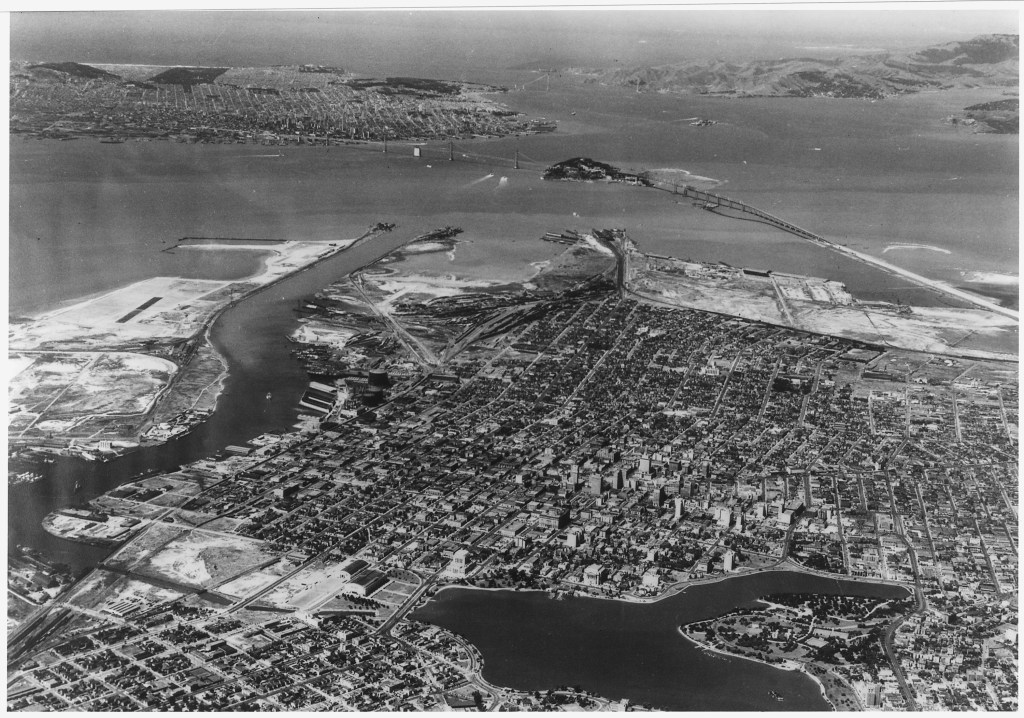
That year, Lillian married Floyd Carl Henrickson, who seems to have tried a variety of jobs. In 1917 he was an unemployed clerk, in 1920 a silversmith, and in 1925 a purchasing agent. He had served in the Coastguard during the War.
At some point in the mid-1920s, Frank, Ellen and William moved to Warren, Rhode Island, some miles south of Providence. The 1930 Census finds them renting part of 35 Vernon Street in Warren. Frank, now 64, was still employed as a wool sorter, while William, 37, was foreman in a machine shop.

In California, Ernest and Emily remained at 6180 Baker Street, Oakland, a property they owned, valued at $3,200. Ernest was a toolmaker with a machine company and he and Emily had two children: Barbara and Gordon Stanley, the latter named after his late Uncle.
Lillian and Floyd were still in Providence, renting a house in Linwood Avenue. Floyd was now a manufacturer engaged in coil winding, and Lillian acted as his secretary.
In 1931 or thereabouts, William married Mary Etta Emmett, a book-keeper who had been living with her parents in Pawtucket. She was 31, he 38. She gave birth to a daughter, Lois Mary, on 17 July 1931. They were based in Pawtucket for a while, living at 70 Mulberry Street.
By the mid-1930s, Frank and Ellen had returned to Providence. And, from 1937 were living at 86 Sinclair Avenue. The 1940 Census locates them at that address. Frank, now 74, had retired. Ellen was 68. Both had become naturalised.

Elsewhere, William and Etta were now located in Sonamsett Avenue, Warren. They rented their property. He was working as a machinist at a torpedo station earning $2080 for a 40-hour week. Their daughter Lois was now eight.
William’s WW2 Draft Registration Card confirms his address as 12 Sonamsett Avenue, Warren and his employer as the US Naval Torpedo Station at Newport, Rhode Island. He was described as 5’11” tall, weighing 145lb, with blue eyes, grey hair a ruddy complexion and a scar on his left forearm.

Ernest and Emily remained at the same Oakland address. However, they now valued their property at $2500, significantly less than in 1930. Ernest earned a salary of $1760 as a toolmaker in a machinery company, he had worked 44 weeks in the year and over a 40-hour week. Their children were now aged 18 and 12 respectively and both attended school.
Ernest’s WW2 Draft Registration Card showed they had recently moved, to 1249 Portland Avenue, Albany, Alameda, California and he was now employed by the Marchant Calculating Machine Company located at Emeryville. He was described as 5’7” tall, weighing 135lb, with blue eyes, brown hair and a light brown complexion. He had a scar on his left ring finger.
Lillian and Floyd were at 69 Welfare Avenue, Cranston, a suburb of Providence. They owned their home, which was valued at $8000. Floyd, now 42, was proprietor of a radio manufacturing company while Lillian did not work.
Frank died on 15 May 1945, a month short of his 80th birthday. The death certificate gives his home address as 69 Welfare Avenue, so Frank and Ellen had moved in with their daughter and son-in-law. This must have been fairly recent, since the 1944 City Directory places them still at Sinclair Avenue.
The cause of death was described as ‘suicidal hanging, asphyxia’, adding that a rope was used shortly after midnight. No other conditions were listed and there was, seemingly, no inquest. He was cremated at the Forest Hills Cemetery.

Further tragedy was to follow, when one of those strange coincidences of family history occurred.
Ernest and Emily’s son, Gordon Stanley Terry, completed a late WW2 Registration Card in 1946 when he was aged 18 and a student. It described him as 5’11” tall, 145lb, with hazel eyes, brown hair and a ruddy complexion.

He was killed in a car accident on the night of February 1, 1949, meeting the same end as his eponymous uncle some 36 years beforehand. He was 20, four years older than his uncle.
According to press reports, four young people died when their 1939 sedan, speeding down Los Angeles Avenue, Berkeley, hit the curb near the intersection with Contra Costa Avenue before crashing into a tree.
One report said they were driving at 50mph; another at 90 mph. Two sisters, 18 and 20, and another 20 year-old man, the driver, were killed. They had just picked up the younger sister from her job at the Oakland Theater, where she worked as a ‘candy counter cashier’.
The coverage states that Gordon Stanley and the younger sister were both students at City College of San Francisco. He had been preparing to attend the University of California at Davis, resuming his studies after wartime service in Japan as a paratrooper with the 11th Airborne Division.
However, this would have been impossible unless he served under age: he is more likely to have served post-war, when the 11th Airborne formed part of the occupation force in southern Japan.

According to the 1950 Census, his mother Ellen, now widowed, was living with her eldest son, William and his family at 12 Sonamsett Avenue, Warren. Ellen was now 79. William, 57, was a machinist at a naval air station, while Mary worked as a ‘mangler operator’ at a handkerchief shop and their daughter Lois was a secretary with a rubber company.
I have been unable to confirm a definite death date for Ellen, though she may be buried with son William and daughter-in-law Mary at Swan Point Cemetery in Providence. According to the records, Mary died on 4 November 1957 of coronary thrombosis and William died of the same cause just two days later. She was 57; he was 64.
The 1950 Census also shows Ernest and Emily still in Albany, Alameda, though now at 1259 Portland Avenue. Ernest, now 55, continued at the same company while Emily, now 52, did not work. Their daughter Barbara had married in 1944 and lived in Contra Costa, California.
Ernest died in 1972 and Emily in 1996. Ernest’s obituary says that he was a member of the First Baptist Church and a retired employee of Smith-Corona-March. Emily outlived her daughter Barbara who died in 1989.
In the 1950 Census, Lillian and Floyd were located at Lake Worth, Palm Beach, Florida. Floyd, aged 52, was not working, or seeking work, while Lillian was a book-keeper at a fishing pier. Floyd died in 1957, aged 60. His obituary says he had been working as a school patrolman.
Lillian remarried in April 1968, to English-born David Edgar Evans. He died in 1972 and she in 1973.

Clara Bullock Dracup (1873-1961) and James Hodgson (1869-1943)
After the premature deaths of their first two daughters, Clara and James Hodgson had two further daughters: Violet Mildred Hodgson was born on 2 September 1897 in Westford, Middlesex, Massachusetts and Marion Elsie Hodgson was born on 13 July 1900 in Auburn, New York, shortly after the 1900 Census was taken.

That Census places the family at 31 North Division Street in Auburn. James, now 30, had lost his role as an overseer and was working as a spinner.
By 1905 the family had moved to Rifton, roughly midway between Albany and New York. But, by 1908, they had made their way to Providence, Rhode Island. The city directory for that year places them at 29 Rangeley Avenue and indicates that James had recovered his status as an overseer.
By 1910 they were at 56 Bancroft Street in Providence, James, now 40, still an overseer at a worsted mill. Clara, 36, was not working, while her daughters were aged 12 and 9 respectively.
By 1915, they were resident at 15 Pocasset Avenue. James was now an overseer at a cotton mill and had been naturalised. Violet, 17, was working as a book-keeper at a cotton mill, but neither Clara nor Marion were employed.
Marion married George Everett Morrison, a 21 year-old machinist from Litchfield, Connecticut on 2 December 1918. She was then 18 and working as a telephone operator.
Violet married Clarence D’Orsay Loomis on 18 June 1919. She was 21 and also a telephone operator, he a 28 year-old motorman, born in Cumberland, Rhode Island, whose father was also an overseer. He had returned from France in December 1918, having served with Rhode Island Battery A of the 103rd Field Artillery, part of 82nd Division.
The 1920 Census records James and Clara now at 53 Bancroft Street in Providence, a home they rented. James said he had submitted his naturalisation papers, but Clara remained an alien. James was an overseer at a woolen mill but Clara was not working.
Violet and Clarence were living at the same address. Meanwhile, Marion and George were living at 28 Daniel Avenue in Providence, which they rented, and Marion had given up work. In fact a daughter, Dorothy May Morrison, had been born on 5 February 1920 but does not appear in their household at the time of the census.

James was naturalised in 1924, his ‘declaration of intention’ form, dated 10 July 1924 stating that he was aged 54, employed as an overseer, 5 feet 4 inches tall, weighing 150lb, with a fair complexion, brown hair and grey eyes. His home address was then 28 Woonasquatucket Avenue, Providence.
His Petition for Naturalization was submitted on 19 August 1926, by which point his address had changed to 24 Messer Street, Providence. His son-in-law Clarence Loomis was one of his witnesses, giving his employment as ‘chauffeur’ and his address as 22 Marshall Street Providence. James was admitted to US citizenship on 18 December 1926.
The 1925 Providence City Directory confirms his residence at 28 Woonasquatucket Avenue, as does the 1926 Directory, which was indexed by street rather than by surname. However, the 1927 Directory has him at neither address and he is not included in the 1928 Directory.
There is a James Hodgson in the 1928 and 1929 Directories for Pittsfield Massachusetts who could be the same man, but I cannot trace an entry in the 1930 US Census.
Neither can I find a 1930 Census entry for Violet and Clarence, although City Directory entries confirm that, from 1928 to 1930, they were resident at 463 Killingly Street in Providence, prior to removing to Johnston, Rhode Island in 1931. Clarence remained a taxi driver.
There is a 1930 Census entry for Marion and George, who had relocated to 5916 Vickery Boulevard in Houston, Texas, a home which they rented. George, now 32, was an assistant superintendent in a ‘grocery house’, while Marion, 29, was not employed and their daughter, Dorothy, was now aged 10. They seem to have remained in Dallas until at least 1933, but had returned to Providence by 1935.
Manwhile James Hodgson reappears in the Providence City Directory for 1932, living at 37 Whittier Avenue. They remained at that address in the Directories for 1934 and 1937 but, by 1938, had moved to 52 Cumerford Street.

By the time of the 1940 Census they had moved again, to 480 Hartford Avenue. James said he was 59 (he was 61) and remained an overseer at a worsted mill. Their home was rented and he had earned $1920 that year. Clara also said she was 59 (57) and was not working.
Their daughter Marion, aged 39, was living with them, stating that she was divorced.

Seventeen-year-old Dorothy was living in as a maid in the house of a Providence lawyer, Mason B Merchant.
Marion’s former husband, George Morrison, was lodging in Dallas, where he said he had worked as a car salesman for 16 weeks that year, but had earned no income. He seems to have married a Sadie Calvary of Sherman, Texas in October 1936, when he was 39 and she was 26.
However, by 1940, Sadie was also divorced, working as a waitress in a café and lodging in Waco, Texas.
By 1940, Violet and Clarence Loomis were located at 5 Fairview Street, Providence, a home they rented. Clarence, now 49, had been unemployed for some time, but had worked for 12 weeks that year as a salesman in a furniture store. Violet, 35, was working full-time as a telephone operator in a hotel, earning $900 that year.
Clarence Loomis’s WW2 Registration Card, completed in April 1942, gave his employer’s name as Atlantic Mills in Providence. He was 51, 5 feet 10-and-a-half, weighing 160lb, with blue eyes, brown hair and a medium complexion.
Clarence died soon afterwards, on 9 July 1943, aged 53, and James Hodgson succumbed just three months later, on 11 October 1943, aged 74, of chronic myocarditis. His residence at the time was 121 Union Avenue and he was apparently still working.

The 1950 Census recorded the two widows living together at 80 Hamilton Street in Providence. Violet, aged 52, was listed as the head of the household. She was now a full-time telephone operator for a telephone company. Clara, now 76, was not working.
Meanwhile, Marion had seemingly remarried George Morrison in Carter, Oklahoma in May 1947. She was now 46; he 49. The 1950 Census recorded them lodging in Bexar, Texas, from where George operated as a traveling salesman in the petroleum business.

Clara is listed in Providence City Directories until 1956, when she was living at 80 Congress Avenue. Violet is also recorded at that address until 1957 but thereafter disappeared, possibly remarrying.
Clara must have moved to live with her daughter Marion in Texas, for she died in Bexar, Texas on 27 September 1961, aged 88, having lived there for four years. She was buried back in Providence. George Morrison died of a heart attack on 29 September 1961, just two days later. He was 63.
Marion, who reported both deaths, lived until 1990.
Alice Dracup (1879-1954) and James Noble (1878-1943)
Following their marriage in November 1903 in Gilbertville, near Hardwick, Massachusetts, Alice and James had four children in rapid succession.
James Noble junior was born at Gilbertville on 27 June 1904, but died three months later on 28 September, the cause of death again being given as ‘inanition’.
So three of Albert’s four daughters lost their first children as babies, Clara losing twins. Only Ellen’s first child survived.
A second son, Alfred Noble, was born in Gilbertville on 10 January 1906. James was described as a ‘hostler’ (ie an ostler) on this record whereas, at the time of James junior’s birth he had been a labourer and, at the time of his marriage a teamster.
A daughter, Edith Mae Noble, was born in Gilbertville on 11 October 1907, her father’s job reverting to labourer, and a son, Ernest Noble, on 21 December 1909, at 73 Ashland Avenue in the town of Methuen, some 70 miles east of Gilbertville and 20 miles north of Boston. James was once again a ‘hostler’.
The 1910 US Census confirmed them at this address, James now described as a contract labourer.
The family next spent a short period in Lawrence, Massachusetts. A son, William Noble, was born there on 20 April 1911, but died on 9 July, of cholera.
A final child, Ruth Mary Noble, was born on 10 April 1918 in Gilbertville, where James was again working as a ‘teamster’.
On his First World War Registration Card, completed in September 1918, James gave his address as Church Street, Gilbertville, his employment teamster for the George H Gilbert Manufacturing Company. He was described as of medium height and slender build with grey eyes and dark brown hair.
Their son Alfred died at Gilbertville on 28 December 1918, just shy of his thirteenth birthday, of influenza and broncho-pneumonia.
So the 1920 Census recorded a family of five, still living in Church Street, Gilbertville. James was now 41; Edith 40, while Edith was 12, Ernest 10 and Ruth two. James was still employed as a teamster, at a ‘yard’ and confirmed that he was naturalised.
By 1924, the family had moved to nearby Ware, Massachusetts, again living on Church Street, James working for ‘G&Co.’ which was probably still George H Gilbert.
In 1926, Edith Mae married George Henry McEwan at Monson, Massachusetts. They also settled in Ware, where George worked for A D Ellis and Co.
By the time of the 1930 Census, James and his family had moved to 1 Broad Street in Hardwick, a home they rented. James, now 51, worked as a teamster in a ‘mill yard’. Alice, now 50, stated that she was naturalised. Ernest, now 20, was employed as a ‘helper’ by a trucking business, while Ruth was 11 and so still at school.
George and Edith Mae McEwan seem to be excluded from the 1930 Census, although the City Directory for Ware places them at 46 Bridge Street in both 1929 and 1931.
By 1931, the entry for the Nobles in the Ware Directory records James as still with ‘G&Co.’ and Ernest working as a truck driver. This remained the position in 1934.
In 1935, Ernest, now 26, married 18 year-old Rachel M Nimtz, the daughter of a local fireman. By 1940, they were living on Church Street in Gilbertville and had two small children. Ernest remained a truck driver and had earned 900 dollars in the previous year.
Ernest’s WW2 Draft Card, completed on 16 October 1940, confirmed his address as 11 Church Street, Gilbertville and his employer as the Gilbertville Trucking Company. He was 5 feet 10 inches tall, weighed 140lb, with grey eyes, brown hair and a light complexion.
Meanwhile, Edith Mae and George were living at Bridge Street in Monson, Massachusetts, in rented accommodation, some 20 miles south of Gilbertville. George was employed as a finisher in a textile mill. He had worked 27 weeks in the previous year, earning $700. Edith was at home and they had a 4 year-old daughter, Shirley.

George’s WW2 Draft Card states that he worked for A D Ellis and Company. He was 5 feet 8 tall, weighing 145lb, with blue eyes, brown hair and a light complexion.
The 1940 Census places James and Nancy also back in Church Street, Gilbertville, at Number 53, still renting their accommodation, James was now 61, and had been employed by the WPA (Works Progress Administration).
The WPA was a federal government agency, established as part of Roosevelt’s New Deal, which employed millions of unemployed workers to complete public works projects, such as roads and bridges.
Ruth, aged 22, worked as a labourer in a shoe shop.
James’s WW2 Registration Card does not give a specific address but says he was unemployed, owing to illness. He was described as five feet seven inches tall, weighing 150lb, with brown eyes, black and grey hair and a ruddy complexion. He had lost the top of a finger on his right hand.
The card was completed on 27 April 1942 and James was dead by May 1943. His obituary states that he died after a long illness. He was 64.
Ruth Mary married Maurice Leo Sansoucy in Palmer, Massachusetts in 1949. His WW2 Draft Card, completed on 10 July 1944, aged 18, places him as a resident of Boston, working for the Boston Paper Board Company. He was 5 feet 3 tall, weighed 130lb, with brown eyes, brown hair and a dark complexion.
He enlisted on 1 November 1944 and, by December 1945, was serving in Tokyo, Japan. He was discharged on 30 January 1946.
The 1950 US Census records Alice, now widowed and aged 72, living with Ruth and Maurice Sansoucy in North Street, Ware, Massachusetts. Maurice, 33, was a grinder in a valve factory, while Ruth, 31, was a packer in a shoe factory.
Elsewhere, Ernest, aged 40, was living with his family in Main Street, Hardwick. He worked as a truck driver in the construction industry. Rachel was at home and they now had four children aged 14, 12, 5 and a few months old.
Edith Mae and George were still living in Monson. George, now 44, operated a gigger machine in a woolen factory, while Edith, 40, weighed wool in a woolen factory. Daughter Shirley was aged 14.
Alice died on 17 November 1954, aged 77, at 19 Winthrop Street in Springfield Massachusetts, so may have been living independently of all three children.
Ruth Mary Sansoucy died in 1983, Edith Mae McEwan in 1994 and Ernest Noble in 2002.
None of Albert Bullock Dracup’s children achieved undisputed prosperity in the United States. John William managed to retire to Florida but, whether by accident or design, didn’t live too long to enjoy his retirement.
The prosperity of the four daughters was heavily dependent on the employment and longevity of their husbands, none of whom really escaped the working class. Their early married lives were too often blighted by the loss of small children.
It is worthy of note that, alongside extremely high levels of infant mortality, this history includes one definite suicide, two possible suicides and two early deaths in traffic accidents.
There were limited and often isolated signs of further social progress in that next generation, and more often in the next generation but one: the grandchildren of those who had emigrated.
Too often, emigration set back that first generation, which often had to struggle hard to establish themselves in a new country.
Life was better for their children and grandchildren, perhaps typically better than for their peers who had remained in England, but this seems largely a consequence of the higher standard of living these generations enjoyed in the United States.
TD
November 2025









 Eponymous
Leave a comment