
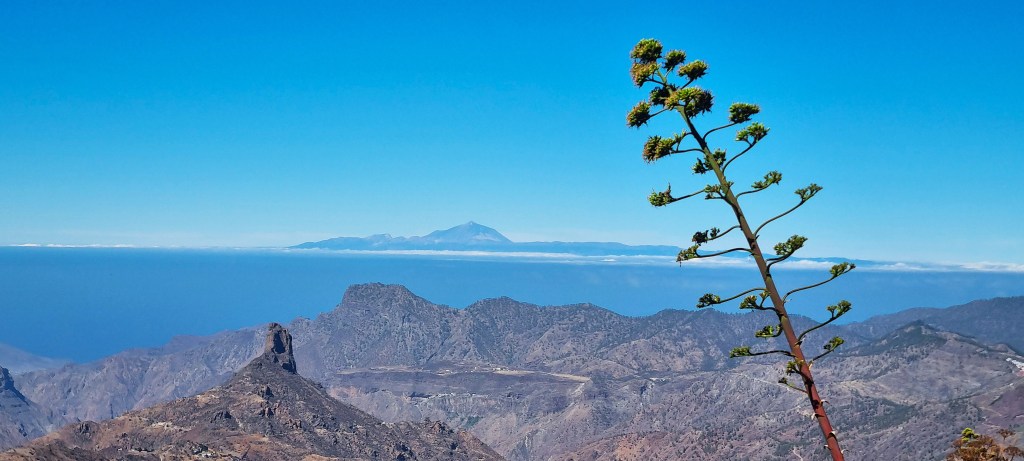
Our choice of holiday in Autumn 2025 fell to me.
I was seeking a happy medium, roughly midway between our full-on, energy-sapping experience in the Swiss Alps and last year’s ‘rest and relaxation’ experiment in Cefalu, Sicily.
Eventually I decided on a Saga holiday, Walking in Gran Canaria, a week long, departing in early October. It offered five walks, all between 5m and 14km long.
The level of demand was initially described as:
‘Grade 3: This grade is ideal for those who enjoy a variation in walking levels from easy to moderate. You’ll be walking mainly on good paths at a low altitude, with occasional more demanding ascents and descents. Walking regularly in preparation prior to the tour is recommended due to 5 to 9 miles of walking in the space of 2.5 to 4 hours per day.’
But the holiday documents we received explained that this had been upgraded to:
‘Grade 4: Experienced, frequent walkers with a strong level of fitness can expect a more challenging walk of 10-13 miles a day with varied terrain including potential rocky paths. At a moderate altitude from 3000 to 6000 ft, there will be longer and steeper ascents and descents during your 4 to 6 hours per day including rest stops.’
Following complaints from a few customers on the February 2025 holiday, Saga had decided that, whereas the duration of these walks was consistent with Grade 3, the degree of difficulty was nearer Grade 4.
Since we are both fit, experienced walkers, this wasn’t problematic, but it did suggest that we might spend longer walking and less time relaxing than I had originally anticipated.
This proved the case. The revised grading is, in my opinion, more accurate. Partly as a consequence, no doubt, we were a party of just 14, whereas 28 guests had signed up in February. All of us had the requisite level of fitness, though our level of experience varied.
We were five couples and four solo travellers, eight women and six men, our ages ranging from the mid-50s to the late 70s.
Our walking programme was as follows:
- Wednesday: Juncal cliff and beach (aborted); Maipes necropolis;
- Thursday: Caldera de Bandama;
- Friday: Rest day (Las Palmas);
- Saturday: Pico de las Nieves;
- Sunday: Camino de Santiago; and
- Monday: Tabaibal de la Punta.
Further details are set out below.

Outward journey
We woke at 04:00, in good time for our taxi to Gatwick South Terminal, having checked in to our 07:25 British Airways flight the evening before.
After negotiating the automated baggage drop and security, we enjoyed a breakfast of coffee and pastries at Gail’s, but were summoned to our departure gate at 06:35.
Boarding took place much later and we finally took off just after 08:00.
A delay of some 30-60 minutes now seems the default at both Gatwick and Heathrow. Perhaps it is time to introduce a more rigorous ‘delay repay’ service for airline travel.
It seems that air traffic control deems late take-off acceptable, especially if the landing is still estimated to be approximately on time, though this logic is questionable. I am sure most customers would prefer to get under way on time, on the understanding that, if the destination airport does not have sufficient capacity to accommodate an earlier landing, some circling will be required as a last resort.
We arrived at Las Palmas Airport on schedule, at 11:55. We passed through security quickly, the new EU regime having not yet begun, and were quickly reunited with our baggage (though others had to wait far longer).
Assembling beside our host in the arrivals lobby, we were soon aboard a minibus that took roughly 45 minutes to reach our destination, the Hotel Occidental Roca Negra in Agaete, part of the Barcelo chain.
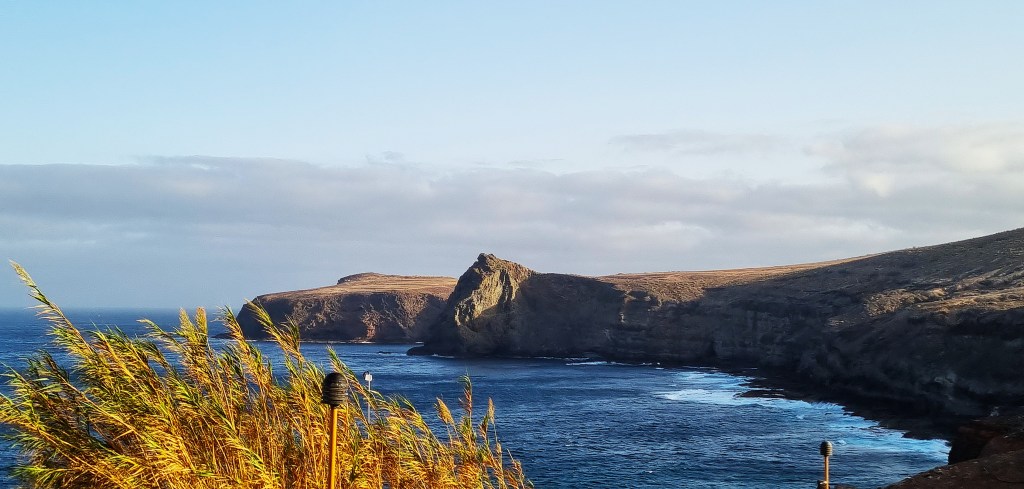
Hotel Occidental Roca Negra
Reception were a little tardy in allocating our rooms, but our Saga host help by distributing sparkling wine while we waited.
Our room keys were small wooden discs, fastened to our wrists with pink cord bracelets. Once fastened, the receptionists removed the surplus cord with scissors.
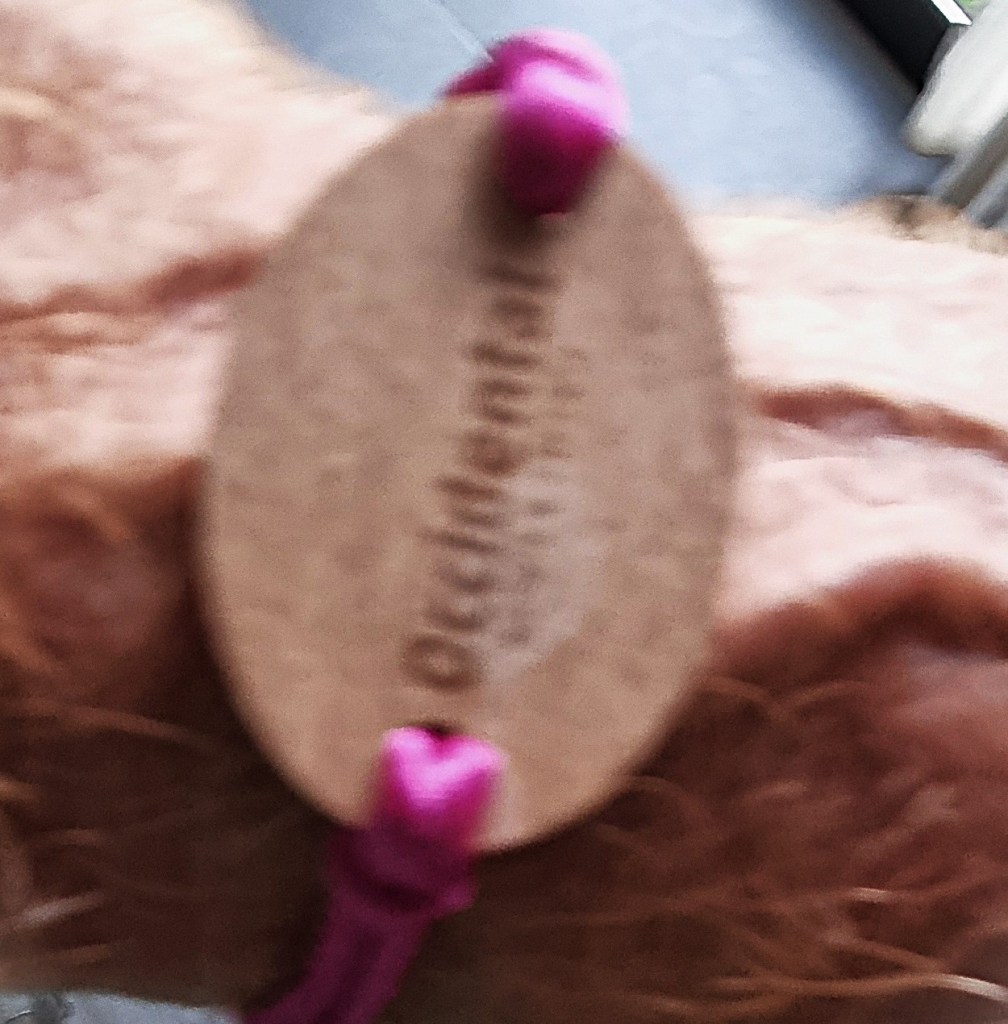
This is evidently the Hotel’s cunning solution to guests losing their key cards. There were also discs with yellow and white cords, so the pink may have distinguished our ‘all inclusive’ status.
I found my bracelet a little demeaning, occasionally uncomfortable, and both of ours failed before the week was out. On returning to Reception, the disc’s functionality was tested against a small black box and, if genuinely broken, instantly replaced.
We were given Room 418, on the 4th floor, the highest residential floor on the same level as Reception. It was about 3.5m wide but extremely long: the Hotel quotes a room area of 43 square metres.
The bathroom contained a discrete toilet cubicle, though its door did not fasten. The large shower’s back screen, frosted to shoulder height, doubled as a window between the bathroom and the living area. The sink and its surrounds were spacious, with a fitted hairdryer.
There was a built-in wardrobe in the entrance lobby, just beyond the bathroom’s sliding door. It offered ample hanging space but relatively few shelves. There were no drawers or cupboards in the room, apart from the unit by the window containing the fridge and safe.
Our safe should have been left open. When Tracy tried to open it, three failed efforts triggered a piercing alarm, so she had to hotfoot it to Reception. A technician arrived promptly to reset the mechanism.
The bed, comprising two adjacent single beds, was spacious and comfortable, with two harder and two softer pillows supplied. A table stood on each side of the bed in front of a power point. The television, which we never used, was wall-mounted opposite the bed.

Further on, a large lime-green sofa converted into a sofa bed if required. Opposite stood a small coffee table, a desk, chair and desk light. There were ample power points behind the desk.
Opposite the unit containing the fridge, the safe and a tea-making area complete with kettle, sat a large metallic basket chair suspended from a frame. Judging by the rust, this had previously stood on the balcony – indeed some rooms had identical chairs standing on theirs.
The balcony was spacious, carpeted with fake grass and supplied with a plastic table and two chairs. There was no place to dry clothes. We tied our wet things to the chairs, to prevent them being swept away by the breeze.
Opening the door to the balcony disabled the air conditioning, which was quiet and efficient. We preferred to sleep with the door open and the air-conditioning off. A card was issued to trigger the electricity supply and there was no need to remove it.

We took breakfast and dinner in the El Juncal buffet restaurant. Breakfast options included cereals, fruit, pastries and cooked breakfasts.
My typical daily breakfast comprised: muesli with oats, walnuts, dates, apricots and a selection of fresh fruit; a buttered croissant plus miscellaneous pastries; and a couple of slices of bread with butter, ham, cheese and chorizo.
I would have preferred my coffee freshly made, but tea and coffee were supplied exclusively by machine.
Dinners were also buffet-style, adopting a daily theme. A salad-based starter was followed by a main course, dessert and, if required, cheese. One’s main course was invariably a smorgasbord rather than a coherent meal, but the quality was good. Dessert options were far more limited, however.
The Hotel’s ‘all-inclusive’ offer was extremely generous. On days when we were not walking, a variety of lunch options were available from the pool bar, appropriately named ‘Breezes’, as well as afternoon snacks and ice creams.
On walking days we were supplied with a packed lunch including a small filled roll, a couple of pastries or biscuits, two pieces of fruit, a small bottle of water and a fruit drink.
Alcoholic and non-alcoholic drinks were available from the pool bar between 11:00 and 18:45, then from the 5th floor Rocktop Agaete bar from 19:00 until 22:45. These times were slightly different on Saturdays and Sundays and in the final days of our holiday, when the Hotel switched from summer season to winter season. Wine and beer with dinner were also included.
As well as local beers, wines and a few spirits, several cocktails were also available. Tracy began to work through the free cocktail menu during our late afternoons by the pool, while drying off after our post-walk swim.
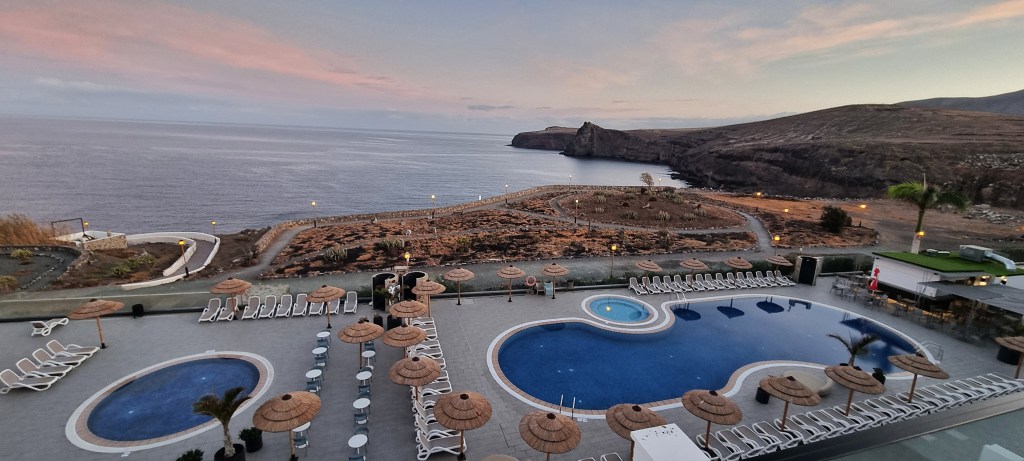
The swimming pool was large and never crowded, with ample sun loungers and umbrellas. There was also an indoor spa and wellness centre. We were all given a voucher entitling us to a free 30-minute session.
Our guides
Saga provides extensive resort-based support. In addition to our Welcome Pack, our host provided a welcome meeting, an orientation walk around the local town (see below), a drinks reception, a feedback session and even a quiz.
He also dined with us every evening: our group was given two large tables and we were invited to congregate at 19:30. The group inclined towards two sittings as the attractions of the Rocktop bar grew more obvious, but we couldn’t manage another drink between our pool bar sessions and wine with dinner!
Such was the level of interaction, even discounting exchanges during our walks, that we all came to know each other fairly well. Single travellers need have no fear of neglect. On the other hand, more introverted holidaymakers may find it hard to fade unobtrusively into the background.
We were very fortunate to have as our host Manu, a native of Huelva. A keen ‘twitcher’, he has more than twenty years experience of organising walking and birdwatching tours.
After studying Environmental Sciences at the University of Huelva, he co-founded an ecotourism company called Platalea SCA, then worked for several years as a tour leader for Andalucia Wildlife Guides.
He now operates through his company Wild Doñana, founded in 2012, which specialises in tours of Western Andalucia.
In his spare time, he is President of the Real Club Recreativo de Huelva fans’ association, President of ATENA-Doñana, the nature tourism association for Doñana National Park, Secretary of the Spanish Ecotourism Association (AEE) and Founding Director of both the association of Spanish professional nature guides and the association of Andalusian professional nature guides.
Though not directly employed by Saga, he manages a portfolio of their Spanish special interest holidays, including this one. During this week he was operating well below his pay grade in acting as our rep.
Our official Canary Islands tour guide was Guillermo. He had studied Environmental Sciences at the University of Huelva alongside Manu, progressing to a Masters in Occupational Risk Prevention.

Having moved to Gran Canaria some 15 years ago, he worked for Gran Canaria Sightseeing as an ecotourism guide specialising in birdwatching.
Now a self-employed tour guide, he has extensive knowledge and infectious enthusiasm for the Gran Canarian natural environment, embracing vulcanology, geology, archaeology, history, plants and wildlife.
Guillermo recently won a contract to develop an environmental education programme for the Maspalomas Dunes Nature Reserve.
I found him likeable and endlessly informative.

Our Mountain Guide was Sonia. She had studied for a chemistry degree with UNED, Spain’s national university of distance education and had worked as a lab technician prior to becoming a guide.
She is a member of the Spanish mountain guides’ association (AEGM), qualified as a guide and sports technician in mid-mountain terrain.
As far as I can establish, it is not a legal requirement for walking groups in the Canary Islands to be accompanied by a qualified mountain guide, though it is recommended practice, primarily on grounds of safety.

Sonia interpreted her responsibilities broadly, providing valuable first aid skills, but also offering advice on how to use poles, how to adjust and wear rucksacks, what one might carry inside them and how that ought to be packed.
This might have been useful for novices but, for those with greater experience, more a case of casting pearls before swine. It would have been better, perhaps, to cut us some slack over minor infringements, focusing instead on any explicitly unsafe practice.
I’m afraid I rebelled a little, loosening my lower strap when I preferred it that way and removing my chest strap when I found it too constricting. The poles stayed in my bag.
I was conscious of being in Sonia’s bad books but, fortunately, I managed to avoid an ‘I told you so’ moment by remaining on my feet throughout.

Gran Canaria
The Canary Islands archipelago comprises seven main islands. They sit close to the coast of North-West Africa, adjacent to the border between Morocco and Western Sahara.
Their total area is 7,447 square kilometres and the total population in July 2025 was 2.26 million, over 80% living on either Gran Canaria or Tenerife.
The Canary Islands form an autonomous region of Spain, the regional government shared between Las Palmas de Gran Canaria and Santa Cruz de Tenerife. The Canarian Parliament, 60-strong, always meets in Santa Cruz.
Each island also has its own ‘cabildo insular’ which controls its services, and is also divided into municipalities, each with its own mayor.

The Canarian economy is heavily reliant on tourism, which accounts for approximately one third of GDP. The total number of visitors in 2024 was almost 17.8 million.
The name ‘Islas Canarias’ is most likely derived from the Latin ‘Canariae’. Pliny the Elder claimed that the islands were inhabited by hordes of enormous dogs, though he might have been referring to the incidence of seals. Others have hypothesised that the name refers to a Moroccan Berber tribe.
Gran Canaria is located between Tenerife, to the west, and the lower stretches of Fuerteventura to the east. It is the third largest Canary Island, with an area of 1,560 square kilometres, and has the second largest population: almost 863,000 in 2023.
It is divided into 21 municipalities, Las Palmas being by far the largest by population. During 2024, almost four million international tourists visited Gran Canaria, as well as 550,000 Spaniards. About one million of the former were from Britain; approximately the same number were German.
Roughly round in shape and volcanic in origin, with a 50km diameter, its mountainous interior reaches a height of almost 2000m.
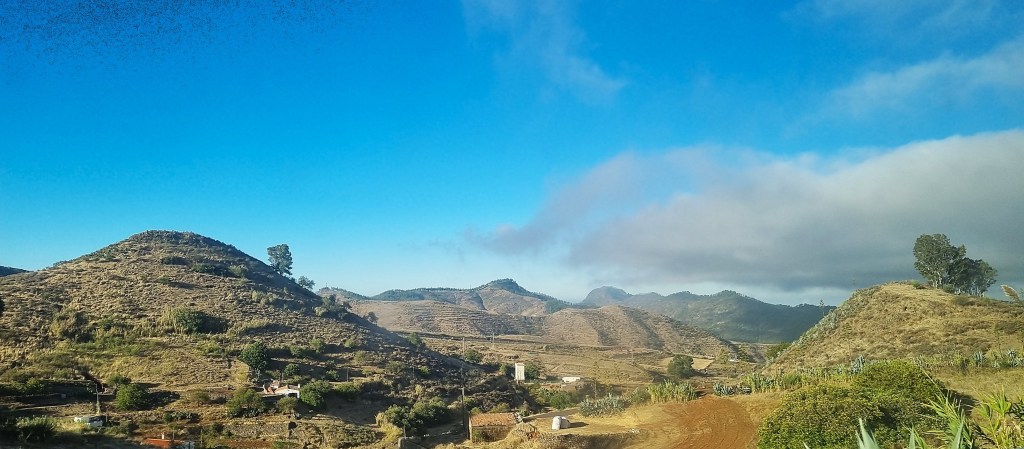
There have been 15 volcanic eruptions across the Canary Islands since 1490, none of them on Gran Canaria. The last known eruption here was at Bandama, some two thousand years ago.
The origins of Gran Canaria’s indigenous population are becoming clearer. They were Berbers, (also known as Amazigh or Imazighen), from North Africa.
They probably came here in two waves, the first approximately 2,500 years ago; the second in the First Century BC, possibly as a consequence of Roman interest in their home territory. They brought with them sheep, goats, pigs and crops.
They may have sailed here by themselves, or have been transported by another, more maritime civilisation, such as the Phoenicians or the Romans. One theory is that the Romans deported Berber rebels here.
Several of the Canary Islands were settled by the Berbers but, subsequently, there seems to have been little interaction between the communities on each.
They typically lived in caves, often natural but occasionally man-made. They settled initially near the coast, typically inhabiting a group of caves rather than solitary dwellings. Gran Canaria is unique amongst the islands in also supplying evidence of stone houses, both isolated and grouped together.

They followed a system of inheritance through the female line, had a rigid social hierarchy descending from the king and his family down to most servile artisans, and worshipped the sun and moon.

The indigenous population thrived, largely independent of external influence, until early in the Fourteenth Century.
In 1341, King Alfonso IV of Portugal sponsored a three-ship expedition which mapped the archipelago, returning with four indigenous captives. This prompted a succession of further expeditions, sponsored by various states, or by popes filled with missionary zeal.
The Castilian conquest of the Islands began in 1402 and was completed by 1496. The initial phases were largely conducted by noblemen operating independently of the Crown. They were granted rights to the land they conquered, provided that they swore allegiance to the King.
Only in the latter stages did the Crown take the lead, ultimately subjugating Gran Canaria by 1483, La Palma by 1493 and Tenerife by 1496.

In Gran Canaria, a Castilian expeditionary force landed at La Isleta on 24 June 1478, while the indigenous islanders were preoccupied with their summer solstice celebrations. The Castilians managed to establish the fortified settlement that developed into Las Palmas, winning control over the north-east segment of the Island.
This led the indigenous people to retreat into the mountainous interior, their stout resistance bolstered by Castilian in-fighting, as well as persistent shortages of men and supplies.
In August 1480, Pedro de Vera Mendoza (c.1430-1505) arrived to take up the post of Governor of Gran Canaria. A year later, his forces killed the celebrated warrior Doramas, which led to the subjugation of the north-west.
Then, in 1482, the Castilians captured the indigenous king, Tenesor Semidan, who subsequently converted to Christianity, leading many of his people to collaborate with their erstwhile enemies.
Semidan was baptised as Fernando Guanarteme and signed a treaty with Ferdinand and Isabella, later helping the Castilians to suppress the inhabitants of Tenerife. His reputation is contested: some revile him as a traitor; others judge him a pragmatic diplomat whose actions saved many lives.

Early in 1483, de Vera Mendoza pushed into Gran Canaria’s interior, besieging the remaining indigenous warriors, led by their new king Bentejui.
Following Semidan’s mediation, on 29 April, his daughter Guayarmina, now considered queen of the indigenous peoples, surrendered. According to legend, Bentejui jumped from the cliff, preferring death to surrender.
A few years later, in 1492, Christopher Columbus stopped at the embryonic port of Las Palmas on his first voyage to the Americas, and it later became an important source of supplies for Spanish galleons heading to and from the New World.
The Castilians established extensive sugar cane plantations, often worked by African and indigenous slaves. By the late Sixteenth Century, the growing wealth of Gran Canaria made it increasingly susceptible to attack by other nations, as well as by pirates.
In 1595, during an expedition against various targets on the Spanish Main, an English fleet under Drake, Hawkins and Baskerville mounted an unplanned attack on Gran Canaria. Twenty-one ships were engaged in the Battle of Las Palmas, but the Spanish defence was stout and, after several days, the British were forced to withdraw with four ships badly damaged.
In 1599, a fleet of 74 Dutch ships carrying 12,000 men successfully attacked Las Palmas, by now a town of 3,500 inhabitants. The Gran Canaria government was moved to Santa Brigida, some 15km away.
Intent on taking over the Island, the Dutch forces were ambushed by a Canarian militia some 500 strong and forced to retreat. Returning to Las Palmas, they sacked much of it, burning many buildings before returning to their ships.
As rival sugar plantations were established in the Caribbean, Gran Canaria’s economic fortunes began to decline. Moreover, vast tracts of forest had been cut down to supply fuel for sugar refining.
By the mid-Sixteenth Century, wine had begun to eclipse sugar cane as the Island’s main export, but trade was restricted by the ensuing European wars, not fully recovering until the Seventeenth Century.
By this point, England was the principal export market for sweet, fortified Canarian wines. Although the bulk of the production was on Tenerife, Gran Canaria managed to export almost 1.7 million litres between 1600 and 1625. The winemaking industry remained influential throughout the Seventeenth Century, until it was hit by a plague of locusts!

Although La Palmas continued to derive wealth from its position on transatlantic trade routes, Gran Canaria as a whole was beginning to struggle economically.
In 1678, following concern about overpopulation, Spain issued a Royal Decree, known as ‘El Tributo de Sangre’, which required five Canarian families to accompany every 100 tons of Canarian produce exported to the Americas. This policy remained in force until 1764.
Throughout the Eighteenth and Nineteenth Century, hundreds of thousands more Canarians emigrated to the Americas to escape poverty at home. The descendants of these emigrants, whether in the United States, Puerto Rico, Cuba, the Dominican Republic or Venezuela, are known as ‘Isleños’.
Meanwhile, the Canary Islands became a Spanish province in 1833, with its capital in Tenerife.

In 1883, the contract for the construction of the port of Las Palmas was awarded to a British company, Swanston. This handily coincided with the earliest cultivation of bananas for export. The first shipment reached the UK in 1878 and, within five years, there were 235 shipments annually.
Shipping required fuel and a Welshman, Alfred Lewis Jones, established the Grand Canary Coaling Company in 1886. Tourism also began in the late Nineteenth Century, particularly for those who believed the warm climate would be beneficial to their health.
The shipping companies began to add cabins to accommodate them and the Hotel Santa Catalina was opened in Las Palmas in 1890.
British expatriates were amongst the founders of the Real Club de Golf de Las Palmas in 1891, the oldest golf club in Spain. The Anglican Holy Trinity Church was also consecrated in 1891. There is still a British Club in Las Palmas, founded by a group of expatriates in 1908. By 1910, the English community in Las Palmas numbered 437.

During the First World War, Spain was neutral, but the Allies imposed a naval blockade on the Canary Islands to prevent German warships from using its harbours.
In 1927, when the Province of the Canary Islands was divided in two, Las Palmas became the capital of one province, covering Lanzarote, Fuerteventura and Gran Canaria.
Gran Canaria’s airport opened in 1930. In 1936, Franco was appointed General Commandant of the Canary Islands, following the election of the left-leaning Populist Front in Spain. During the preparations for a military coup, Franco was appointed to take charge of rebel nationalist forces in Morocco. A plane was chartered to take him there but it landed in Gran Canaria and he was based in Tenerife.

He was only able to board the plane because of the apparently accidental death of the military commander of Gran Canaria. Soon afterwards, on July 17, Franco declared a state of war and the Canary Islands fell almost immediately to his forces.
During the first months of the Civil War, there was extreme repression across the Islands, with an estimated 900 disappearances and 123 executions. There were 337 documented disappearances in Gran Canaria alone.
Excavations continue to find the remains of the disappeared, including 27 day labourers from Agaete who vanished in 1937. They are believed to have been thrown into a pit at Jinamar.

There were at least two concentration camps on Gran Canaria, initially at La Isleta and subsequently at El Lazareto de Gando, near the Airport. Information about what happened there is still hard to discover.
During the Second World War, Spain was again nominally neutral. But the British Consul in Las Palmas had cause to object that so many German U-boats entered the port to resupply. Between May and July 1941 this happened on six occasions.
In response, the British developed a plan to sabotage German and Italian vessels using the port, codenamed Operation Warden. It did not go ahead. There was also a contingency plan to invade and occupy the Canary Islands, codenamed Operation Pilgrim.
Since the War, tourism has increased rapidly. In 1950 an estimated 15,000 tourists visited the Canary Islands. That had risen to 69,000 by 1960, 821,000 by 1970, 2.5m by 1980, 4.9m by 1990 and 10m by 2000.

Agaete
Prior to our welcome meeting, we slipped down to the town of Agaete for water supplies, later taking part in an orientation walk.
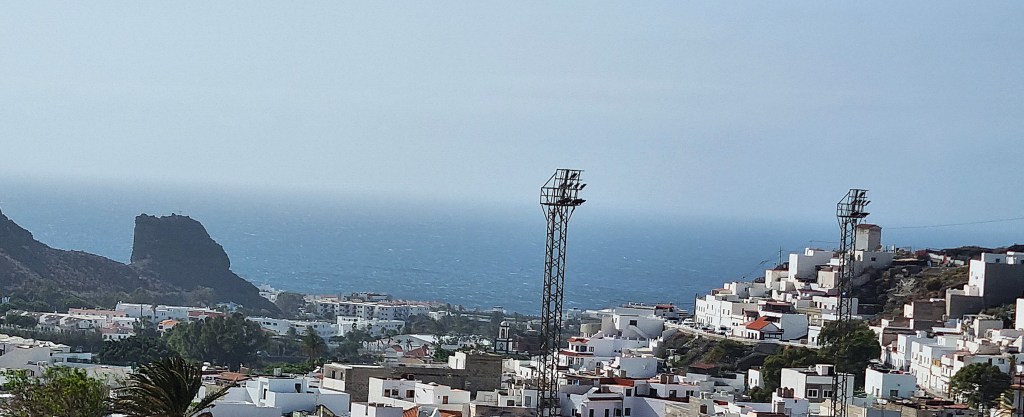
As we descended a second time, our attention was drawn to a lizard basking on the rocks. Gran Canaria Giant Lizards grow up to 80cm long and are a protected species. They have the capacity to cast off their tails when attacked: a cunning distraction technique to enable the rest of the lizard to escape!

Giant lizards are preyed upon by the non-venomous California king snake, an invasive species first discovered here in 1998. Large numbers of snakes are trapped every year in an effort to conserve the lizards and other native species.
In 1481, Pedro de Vera Mendoza ordered the construction of a small fort near Agaete, on top of an earlier indigenous fortification. The Casa Fuerte enabled him to protect the harbour, Puerto de las Nievas, which was instrumental in suppressing opposition across the northern part of the Island.
After the conquest, command of the area was conferred on Alonso Fernandez de Lugo, who was subsequently engaged in the conquests of La Palma and Tenerife.
Meanwhile, in Agaete, power transferred to Anton Cerezo, a Genoese merchant who arrived shortly after the conquest. In 1494, he and his half-brother, Francisco Palomar, purchased the Agaete Estate from de Lugo. They planted vineyards and ran a sugar mill, trading with several northern European ports, especially in Flanders.
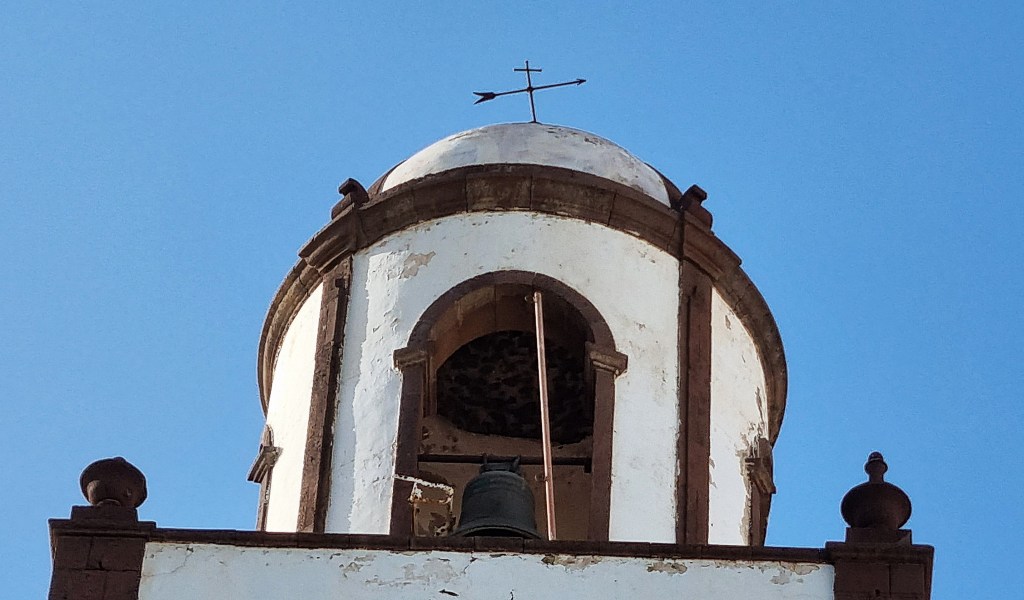
Cerezo is best remembered for the commissioning of the Triptych of Our Lady of the Snows, attributed to the Flemish artist Joos van Cleve (c.1485-1540), which he had placed in the chapel of the same name, built in 1513.
(According to legend, during the reign of Pope Liberius (310-366), snow fell on the night of August 5 on the summit of Rome’s Esquiline Hill. The Basilica of Santa Maria Maggiore was built to commemorate the event and is sometimes referred to as ‘Our Lady of the Snows’.)
In fact there were two triptychs, the other placed in the town’s Church of Our Lady of the Conception, built around 1515. But both the church and the second triptych were destroyed by fire in 1874. The present church replaced its predecessor.

Each year, on 4 August, the townspeople celebrate the Fiesta de La Rama. At 05:00, a firework, La Diana, announces the start of the festivities. Townspeople dance through the streets waving branches (‘rama’ means ‘branch’).
Some beat the sea with these branches, recalling an ancient indigenous rite in which the people prayed for rain and good harvests, but they are ultimately offered to Our Lady of the Snows, so reconciling the Catholic and pagan elements of the festival. The Town has a small museum dedicated to the Festival.
The fortunes of Agaete followed those of the Island in that, after the sugar boom, it became reliant for a while on exporting wine, but then entered a period of comparative decline.
At the beginning of the Nineteenth Century, it became one of very few European locations in which coffee is grown. Arabica bushes were imported from South America, via Tenerife.
Finca la Laja is often claimed to be Europe’s only coffee plantation, (but there is at least one more, located north of La Herradura in Granada, Spain). Coffee from Agaete is said be rich, with notes of chocolate, fruit and liquorice. Some 5,000 kilos are produced annually.
Agaete also hosts a botanical garden, Huerto de las Flores, created by the De Armas family later in the Nineteenth Century. They were collected during their frequent trips abroad and include many rare and exotic species.
Olivia M Stone, the English traveller who published her guide to ‘Tenerife and its Six Satellites’ in 1887, stayed with Don Antonio Armas. She visited the garden, recalling:
‘A heavy shower of rain came on, but the thick foliage of the trees sheltered us completely. Oranges, mangoes and guavas were dropping off the trees, and we trod upon them as we walked, while bananas, aguacatas and all kinds of fruits were growing in abundance. The garden was, in fact, a wilderness of luxuriant vegetation.’
She also noted that the De Armas family were bounteous suppliers of alms to the poor, but bemoaned the fact that they left behind fleas, twenty-one of which she had to pick off her stockings afterwards!
However, she concluded of Agaete:
‘…there is every probability that it may become a celebrated watering place.’
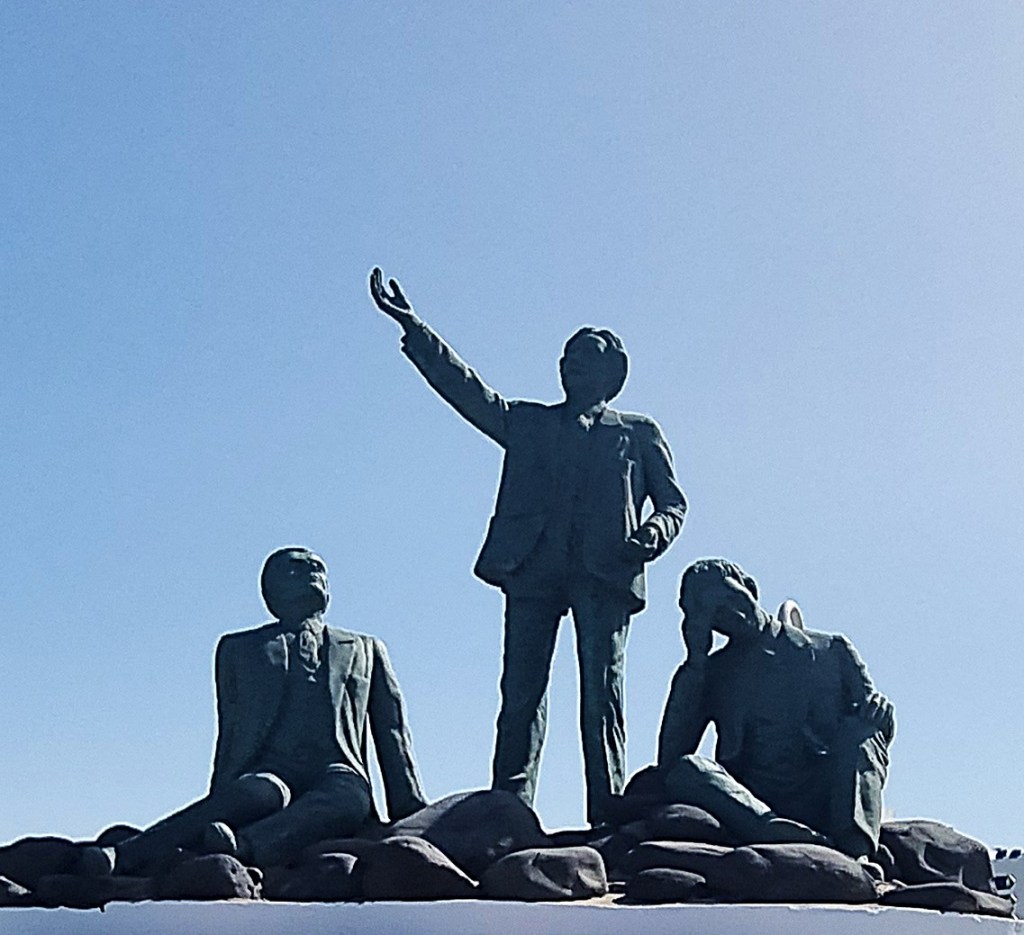
Early in the Twentieth Century, Francisco de Armas hosted poetry gatherings in the Huerto de las Flores, attended by authors such as Tomas Morales (1884-1921), Alonso Quesada (1886-1925) and Saulo Toron (1885-1974).
All three are captured by a bronze statue on the seafront sculpted in 1999 by Agaete artist José de Armas Medina (1913-1996), son of Francisco de Armas.
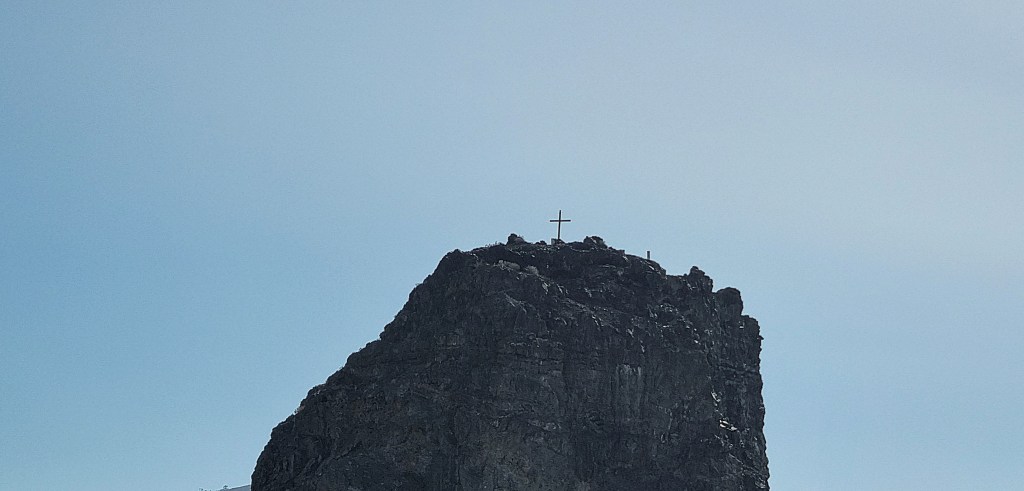
Squatting just above the Town there is a small mountain called the Roque de las Nieves, crowned by a three-metre crucifix. It was placed there on 31 December 1900, in response to Pope Leo XIII’s idea that crosses should be erected in prominent locations to mark the arrival of the Twentieth Century.
The three Las Salinas sea pools lie further along, not too far from the Hotel. They were originally salt pans, used as such from the early Seventeenth until the mid-Twentieth Century. They are said to be linked by underwater volcanic tunnels.
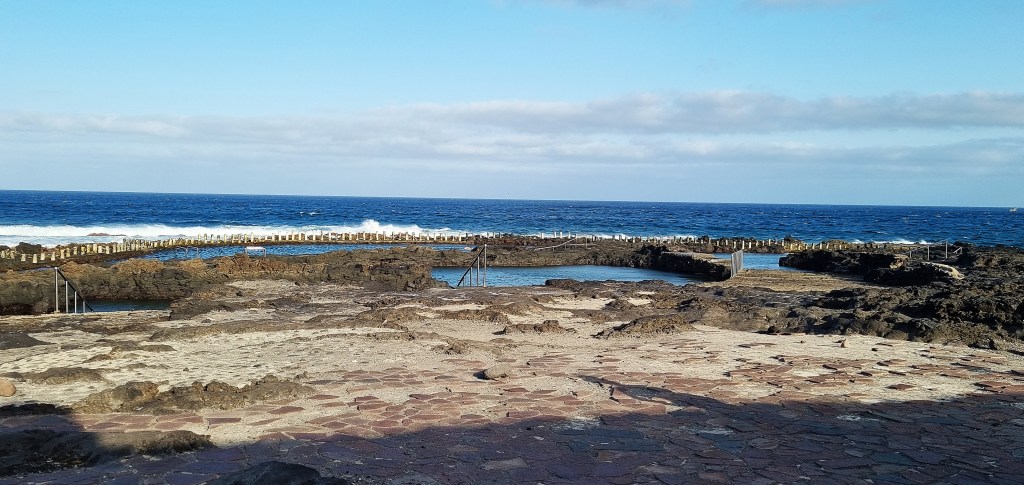
We enjoyed a swim on our free afternoon. The Atlantic waves were boisterous, so only the inner pool was useable. Tracy stayed in for a while, while I swam from one set of steps to the other, just to say I had.
From the old Puerto de las Nieves, there is a fine view of El Dedo de Dios, a rocky ‘finger of God’, in the form of a sea stack 30 metres high, whose digit snapped off in tropical storm Delta, one Monday evening in November 2005.
There is a commemoration of this event upon a nearby wall.

The name ‘El Dedo de Dios’ is attributed to one Domingo Doreste, known as Fray Lesco (1868-1940), a writer and journalist, who published a tourist guide of Gran Canaria in 1933.
In December 1976 a pair of German brothers tried to climb the ‘finger of God’, but one was smashed by waves against the rocks and killed. The second was ultimately rescued after spending the night in a cave.
Years later, the surviving brother managed to climb the stack, placing a small steel cross on the summit in memory of his brother. It was recovered by divers when the amputation took place. A team of divers also rescued the lost digit but, eventually, a local commission of experts advised against reconstruction.

Agatha Christie visited the area in 1927, setting her story ‘The Companion’ here.
Two middle aged ladies, Miss Barton and Miss Durrant, are on holiday. Miss Durrant goes swimming at Las Nieves but gets into difficulties. Miss Barton swims out to help her, apparently to no avail, but one witness insists that Miss Barton held Miss Durrant’s head under the water.
It turns out that Miss Barton is in fact Miss Durrant, and she has killed Miss Barton. Miss Durrant, masquerading as Miss Barton, subsequently fakes her own suicide, apparently drowning herself in Cornwall, and escapes to Australia.

These days, the express Fred Olsen ferry departs from the new Puerto de las Nieves for Tenerife every two hours. The crossing takes 80 minutes and there is a 75% discount for passengers who reside in the Canary Islands.

Wednesday: Juncal and Maipes
Our first acclimatising walk began from the Hotel on Wednesday afternoon.
We were expecting to ascend Moriscas Mountain to the Roque viewpoint, returning to the Hotel via Juncal Beach.
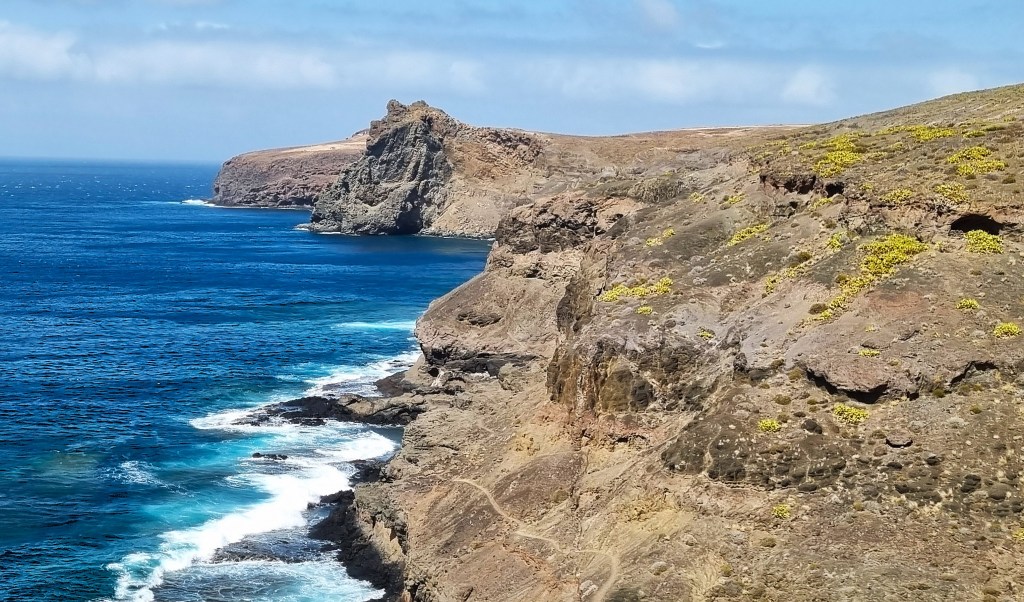
But it was simultaneously hot and extremely windy: far too windy to risk walking on the exposed slopes or to descend to the Beach, so we turned about, striding through the Town to the necropolis at Meipes.
Leaving the Hotel at 14:00, heading north along the coast, we successfully crossed the ravine that culminates in Playa La Caleta, reached by a long, twisting flight of stairs. The grey-black volcanic rubble was occasionally dotted with scrubby bushes, cactuses and prickly pears. It has slow, hard going in the gusting gale.

Eventually we reached a cave that supplied welcome shade from the heat and shelter from the wind. This is La Cueva del Moro (‘The Moorish Cave’) which forms part of a cave complex known as Morro de las Moriscas.
The cave is located some 90 metres above sea level. Its arched entrance is about three metres wide and two metres high, partly obscured by undergrowth. Inside, what one might call the vestibule is a sizeable cave, a good five metres wide and five deep. Large holes excavated in its walls were used as food silos.
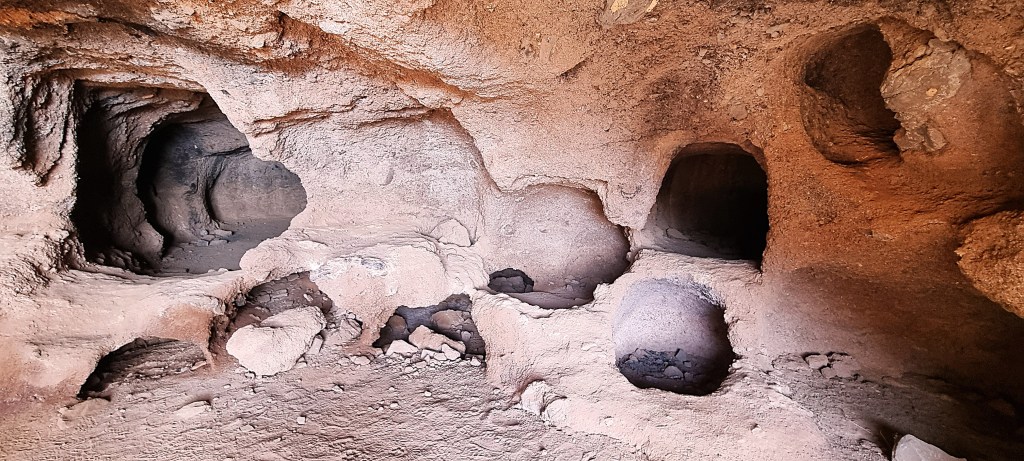
Towards one side there is a deeper excavation in which two cave paintings were discovered in 1963, both featuring stylised human figures painted in faint ochre. There is a third painting in the vestibule near the entrance. None is easily visible to the naked eye.
Some have suggested that the inner cave had religious significance, or was perhaps the residence of a chief. But some are not convinced that the paintings pre-date the conquest.
Outside, our guides decided to halt the descent to Juncal Beach, known for its calm waters. A decade ago it was the nesting place of a pair of rare Barbary Falcons, but presumably those birds have flown.
We retraced our steps, hoping for a quick look at the necropolis before it closed at 17:00.

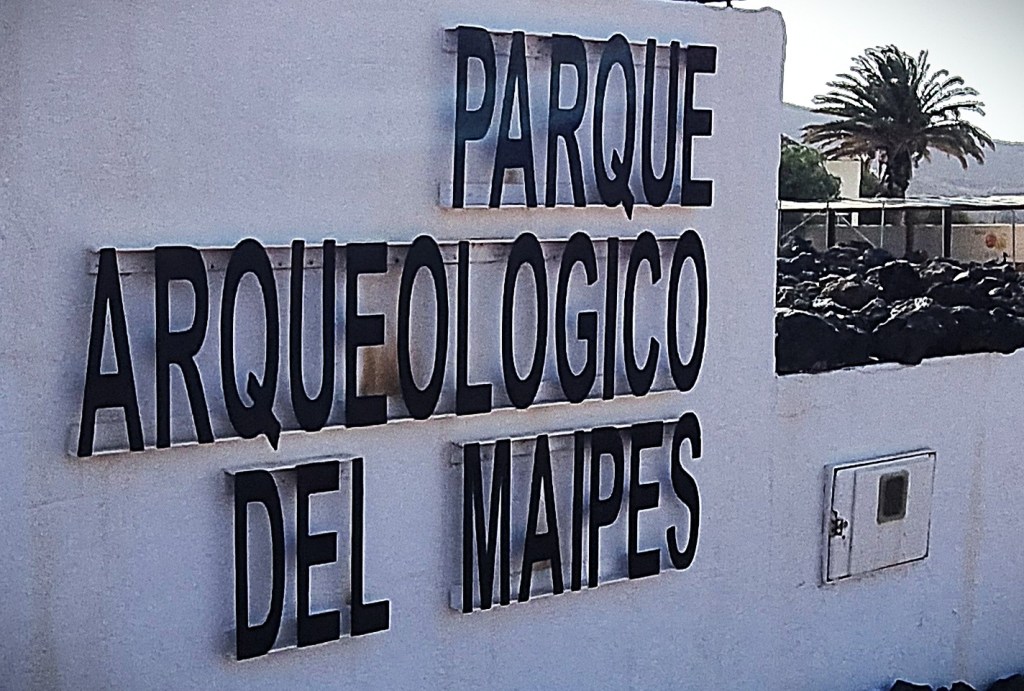
Maipes is an area of volcanic stones containing almost 700 tombs, the second largest necropolis in the Canary Islands. The name ‘Maipes’ means ‘bad land’, referring to the flow of volcanic lava which covered this area some 3,000 years ago.
These tombs were mostly made between the Eighth and Tenth Centuries, though the newest probably date from the Fifteenth Century, not long before the conquest. They typically resemble a truncated cone, either round or elliptical, with a maximum diameter of 8m and a maximum height of 3m. Each tomb contained a pit, lined with stone slabs, in which the body was placed. A few accommodated two bodies.

The social status of the deceased is indicated by the size of the tomb and the complexity of the stonework on top. Most of the tombs were ‘topped out’ with a variety of coloured stones, red and yellow predominating. The floor beneath the body might be covered with plants and herbs, goatskin or sheepskin.
The largest tomb contained a young woman’s body. There are eight tombs lying outside the boundary of the necropolis which may have belonged to social outcasts or foreigners.
On the way back we passed the football ground belonging to Club Deportivo Villa Marinera de Agaete, founded in 1925.
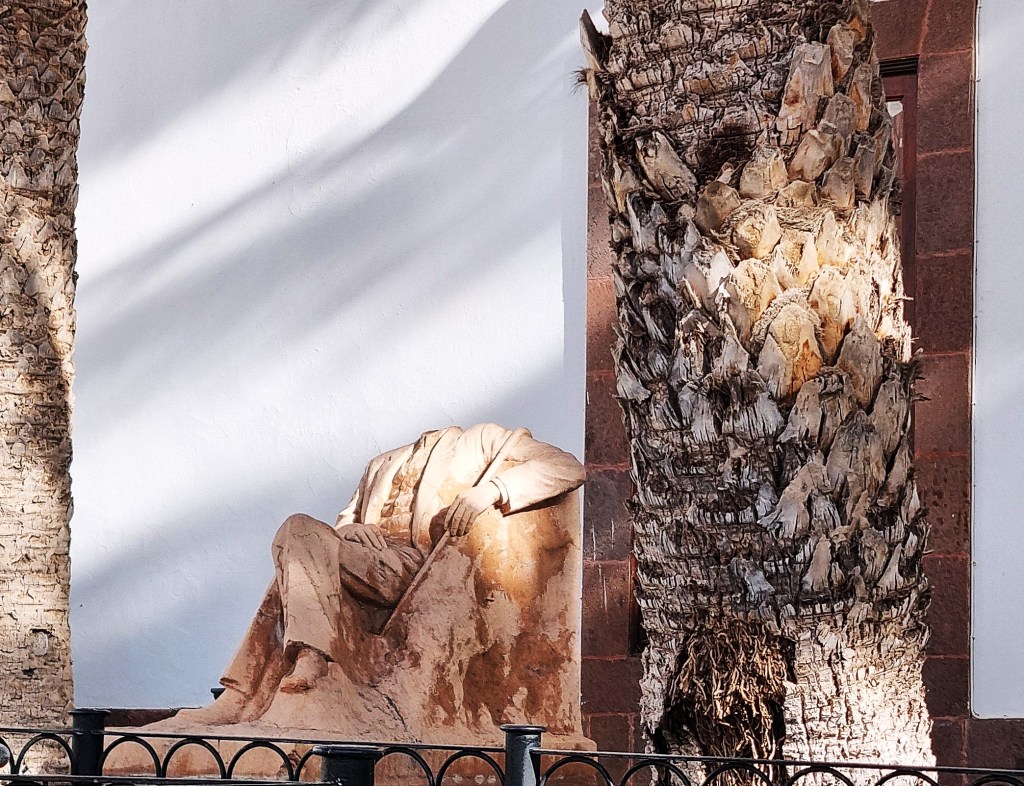
We paused outside the Armas house, where Olivia Stone had stayed, noting that the statue of Francisco de Armas outside, sculpted his son José in 1957, was headless. This was apparently an act of vandalism, committed by someone with a grudge against the family.
After a swim we repaired to the pool bar, where Tracy began her week with a Margarita.
Thursday: Caldera de Bandama
Climbing aboard a minibus at 09:00, we drove to the Caldera de Bandama in the north-east of the island, between Las Palmas and Telde, Gran Canaria’s second largest town.
On the way we stopped for coffee and comfort breaks at a dilapidated roadside bar. Local men propped up the inner sanctum, while cyclists collected outside. The proprietor was friendly and hospitable, and we were soon enjoying our Black Americanos, which cost less than 2 Euros apiece.
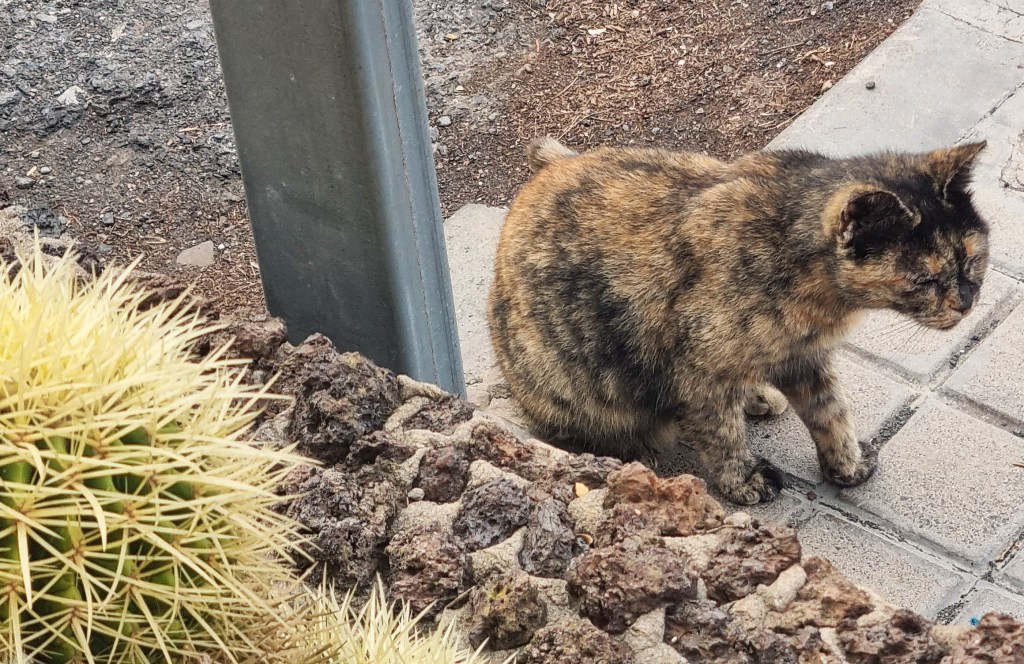
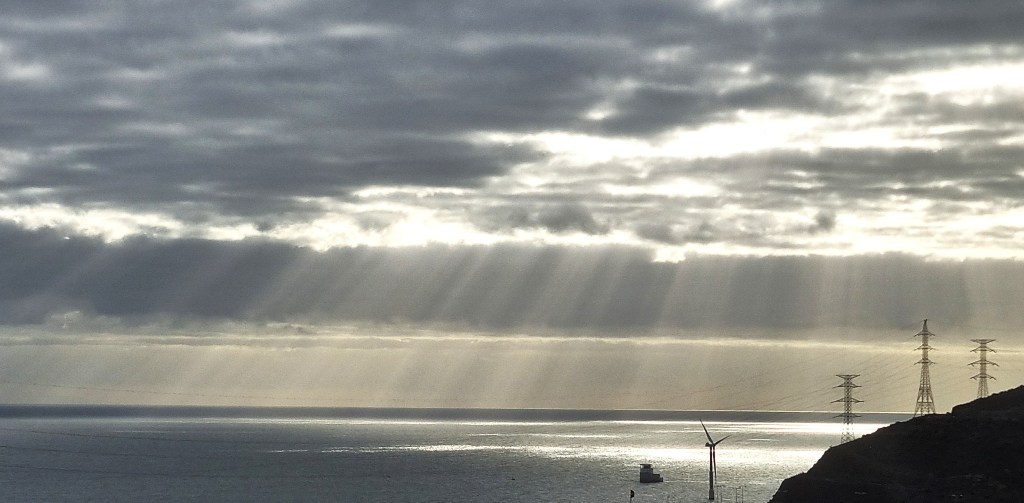
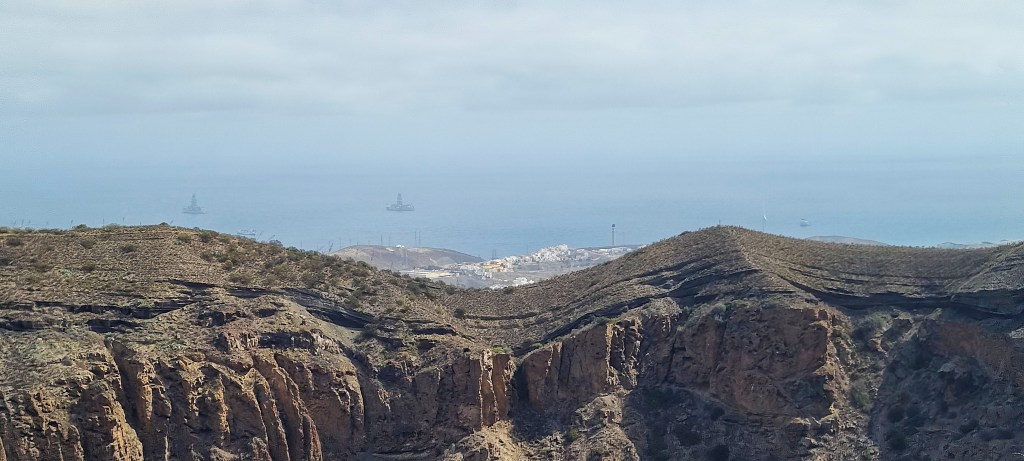
Arriving at Bandama slightly before 10:30, we were entertained by two local cats before starting our walk along a road with a distant view of the sea, streaked silver and grey, beneath the clouds.

We began our clockwise walk around the crater, a circumference of some 3.5km. It is roughly one kilometre across, reaching a maximum height of about 570 metres at Pico de Bandama. The bottom is typically some 200m below the rim.
According to the Smithsonian Institution Global Volcanism Program, this is not strictly a ‘caldera’, with a cauldron-like hollow formed after a volcanic eruption, but a ‘maar’, a crater caused when groundwater, beneath the earth’s surface, comes into contact with magma.
Most maars have a low rim and typically fill with water forming a natural lake. However, these lakes can dry out and, in some cases, the rock is too porous for a lake to form.
This particular maar was created approximately 2,000 years ago, in the most recent volcanic activity upon Gran Canaria.
Looking down, beyond the crater, we could see a collection of circular yellow buildings alongside a couple of sports courts. I remarked that it looked like a private school and its identity would be revealed when I came to write this blog!
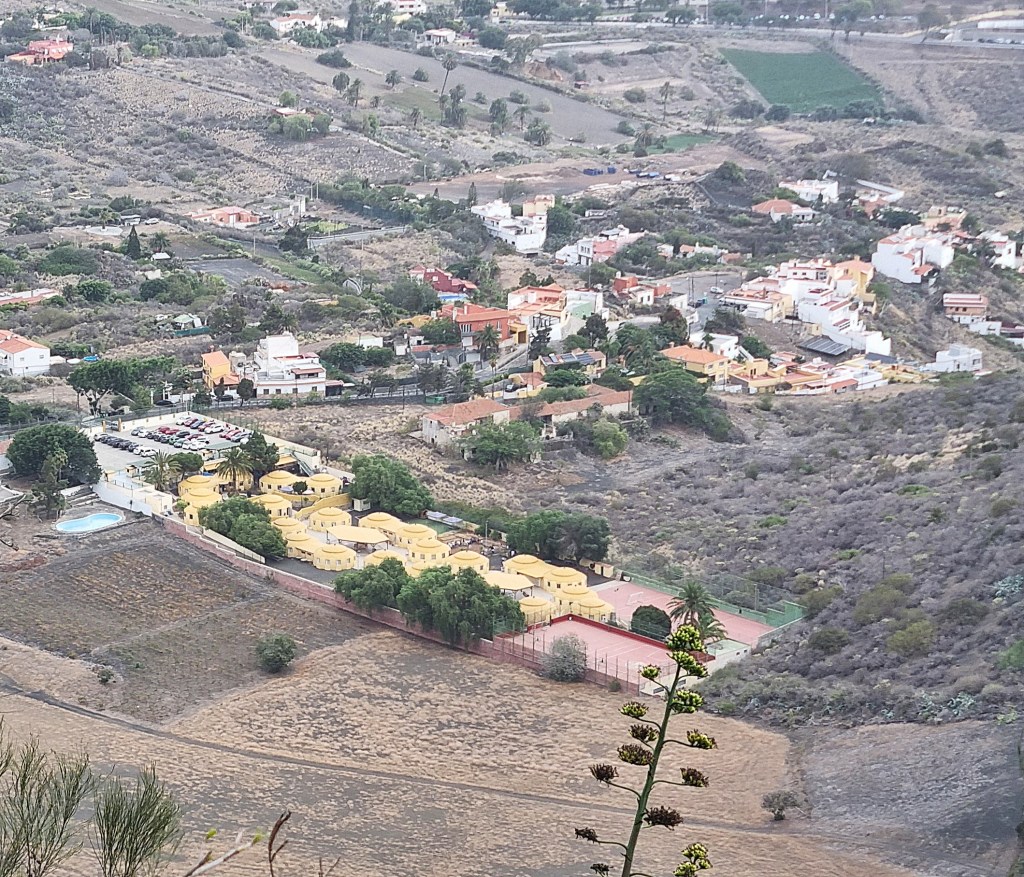
It turns out to be the Juan Ramon Jimenez Teaching Co-operative, developed by a group of parents in the late 70s. The present building was built a decade later. The school is private, but also state-funded, offering pre-school, primary and secondary education to age 16. The families whose children attend the school constitute the co-operative. A general assembly, which meets at least once a year, is the School’s principal decision-making body. It appoints a Governing Council to manage the day-to-day running of the school and there is also a School Board with teacher, parent and student representatives.

Our guide pointed out the Pico de Bandama viewpoint, which we did not visit. A military observation bunker, constructed in 1942, lies beneath the visitor centre. It was built when the Spanish were concerned that the Allies planned to invade. After the War the bunker was sealed, until uncovered in the 1980s by workers erecting the visitors’ centre.
La Cueva de los Canarios, a cave on the northern interior slope of the caldera, includes a group of residential caves and a granary. There is a single point of access through a hole below the level of the caves.

Their inaccessibility provided protection against enemies, but they also had some cultural or religious significance. Several lines of Lybico-Berber script were found carved into the rock, possibly with magical significance.
We completed our circuit by climbing up parallel with the Bandama golf course, which looked astonishingly green alongside the rock of the caldera. This is now the home of the Real Club de Golf de Las Palmas, which moved here in 1957.

We were permitted to use the toilets of the Tasca La Caldera restaurant, promising to return for a drink later, then went round the corner to a viewpoint for our picnic lunch.
Afterwards, Sonia took the opportunity to show us what was in her rucksack, promptly upending it and finding the mobile phone she’d lost a week earlier!
Then we began the descent down into the caldera. Most of us went all the way down, a couple stopping at the viewpoint a third of the way to the bottom.
The caldera has its own microclimate and is often a couple of degrees warmer than the rim above. There is a bush down here that doesn’t grow anywhere else: the Dama de Bandama (parolinia grabiuscula), a brassica, up to 1.5 metres tall, flowering from March to April.

The first settler of the caldera floor was a Flemish merchant, one Daniel Van Damme (1554-1609), (from which ‘Bandama’ is derived). He was born in Antwerp but, after he was orphaned, his grandfather sent him to Gran Canaria.
He became a shoemaker and worked for a blacksmith. He was denounced to the Inquisition, spending several months in prison before marrying and having seven children.
He had a range of commercial interests, including the export of wine and sugar to Flanders, and bought several vineyards in the vicinity. His settlement in the caldera was known as Casas del Fondo (‘Houses at the Bottom’) and he established a vineyard here, also planting almond and sumac trees.
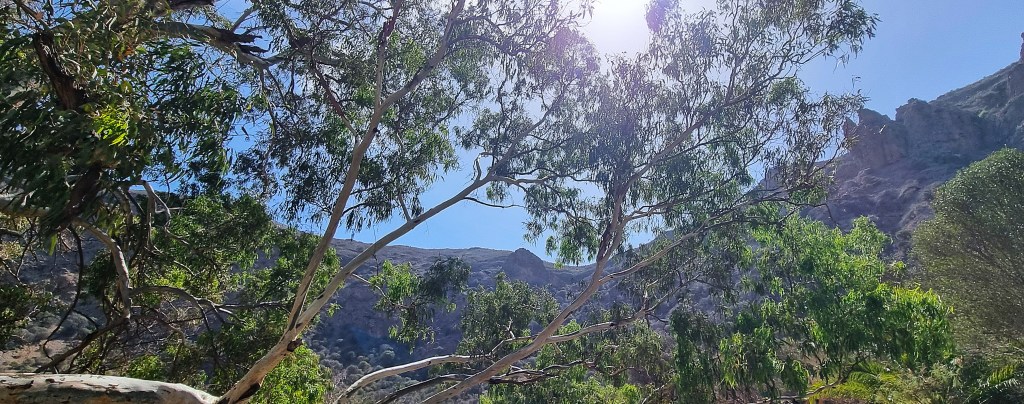
We explored the remains of the wine press, munching our apples in the shade of a nearby tree, before walking the short distance to the house of Agustin Hernandez Torres, the last inhabitant of the caldera, who died in 2024 at the age of 97.
He arrived here in 1936, at the age of 9, whereupon he, his parents and eight siblings worked as subsistence farmers. His only time elsewhere was when he was posted to Fuerteventura for 18 months’ military service. He was later appointed guardian of the site, walking daily up and down the path into the caldera until retiring at the age of 93.

His home, now described as an ‘ethnographic museum’, is testament to the rustic simplicity of this man’s life, his narrow bed and primitive kitchen; religious pictures and calendars pinned up on the walls; a furled umbrella beside the door.

During the ascent I explained to Guillermo how my interest in volcanoes had been sparked by researching the background to Bob Dylan’s song ‘Black Diamond Bay’. We discussed how a volcanic eruption might spark an earthquake that caused an island to sink.
Having exhausted the subject, I set off in earnest, overtaking some of my party on the way, including a lady sitting at the viewpoint who looked a little out of sorts. Arriving beside Sonia, I made her aware and she sped down to the rescue.
I arrived beside Tracy almost at the top. We returned to the bar/restaurant for our beers, before our bus picked us up at 15:45.
Later, after a swim, she was ready for a Kir Royal, but the bar was out of Cassis, so she moved on to an Americano, containing Campari and Vermouth.
Friday: Half day in Las Palmas
Our shuttle bus to Las Palmas dropped us opposite the Plaza de las Ranas in the old town, which we explored for the next three hours.
Vegueta, on one side of the dual carriageway, contains several of the principal old buildings; Triana, on the other side, is primarily a shopping district with occasional Art Nouveau highlights.
We began with the Cathedral of Santa Ana, seat of the Diocese of the Canary Islands. Construction began around 1497, proceeded in fits and starts under several different architects.
The original appointee was Don Diego Alonso Mo[n]taude, a Castilian, whose design was inspired by Seville Cathedral. In 1504 Pedro de Llerena, from Seville, finalised the floor plan and began work on the facade.
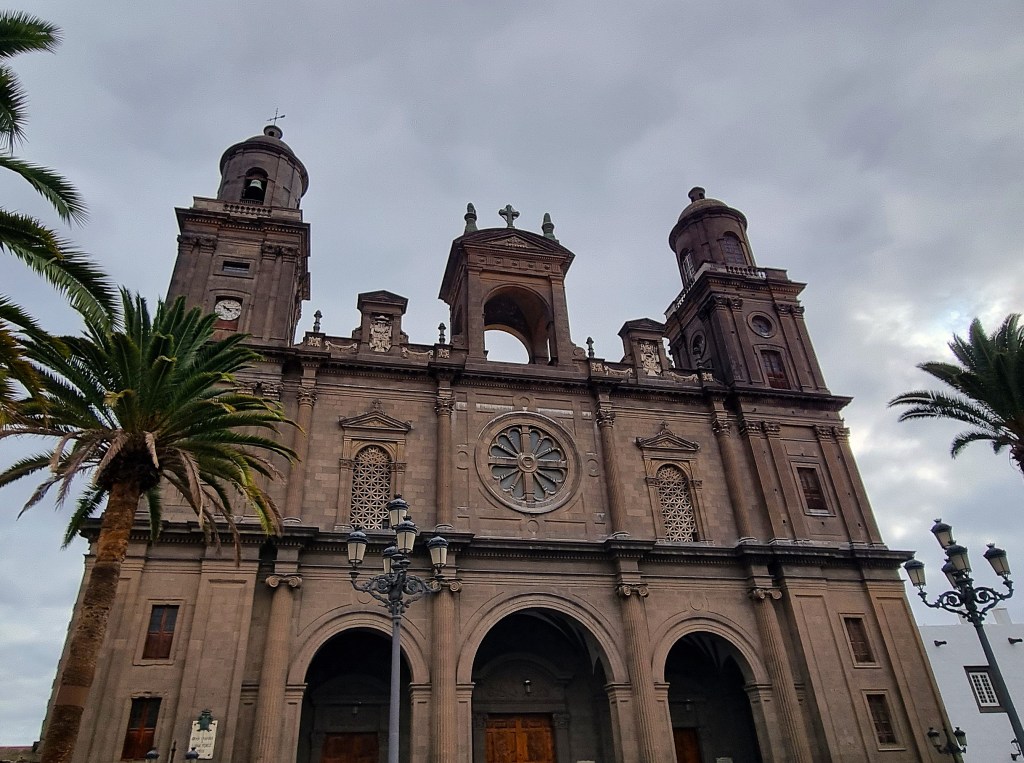
Work was suspended from 1520 until 1533, when Juan de Palacios from Santander took over, followed by Martin de Narea. All work was halted in 1570 owing to a lack of funds.
A second phase of work began two centuries later, from 1780, during which the building was completed by Canon Diego Nicolas Eduardo, an architect-priest who had recently arrived from Tenerife.
The interior contains some of the best religious wood carvings by Gran Canaria’s most famous sculptor, Jose Lujan Perez (1756-1815).
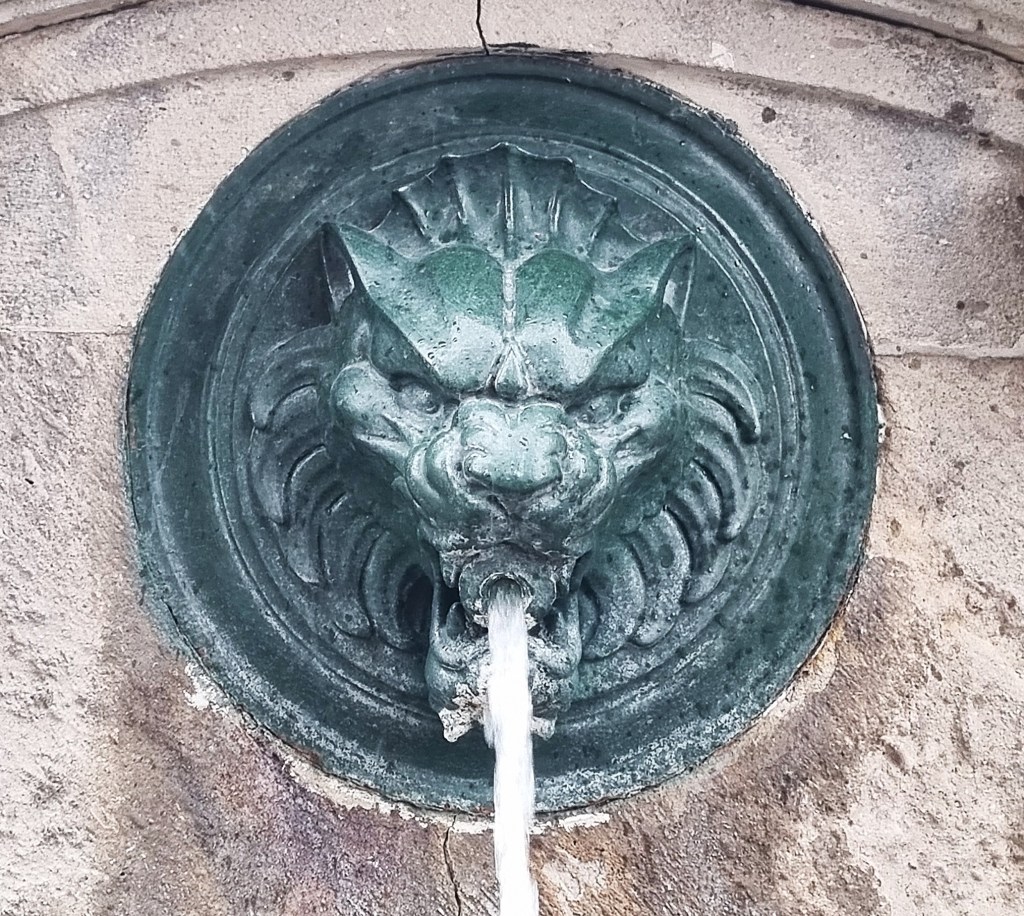
In the plaza outside there are eight cast iron dogs, placed here in 1895, as well as this rather striking water fountain.
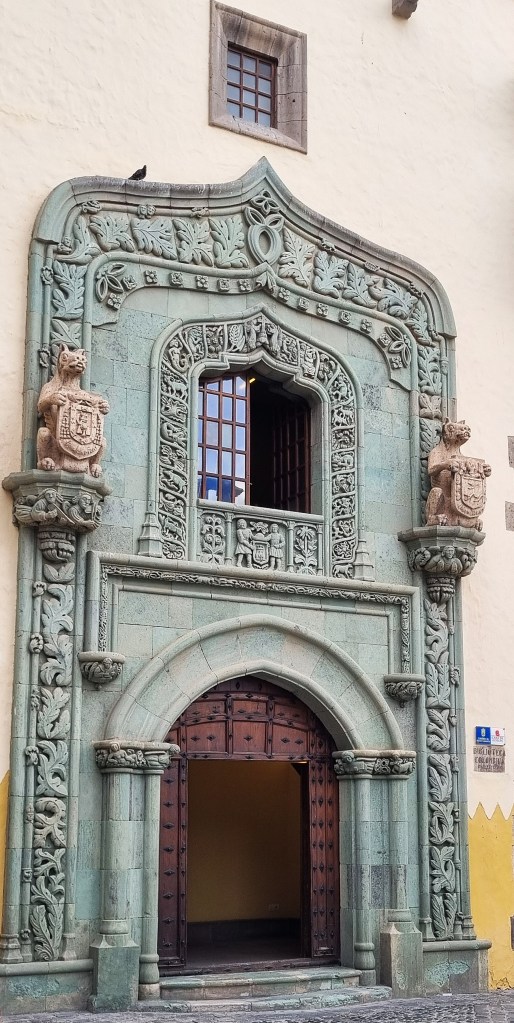
Behind the Cathedral sits the Casa de Colon. Now a museum, it incorporates the former house of the Governor of Gran Canaria, where Columbus is reputed have sought assistance with the repair of his ship, La Pinta, in 1492.
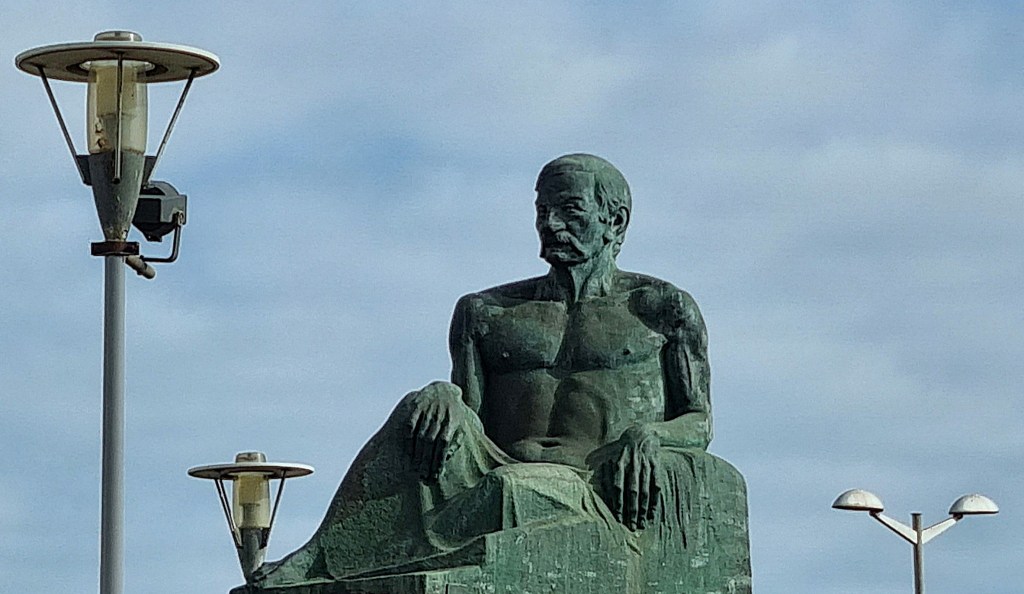
I liked this statue of the rather austere Nestor Alamo Hernandez (1906-1994), author, songwriter and inaugural Museum Director. He was at one time appointed the Official Chronicler of Gran Canaria.

Our next port of call was the market building, the Mercado de Vergueta, built in 1856 but officially opened in 1858. Some of the stallholders have created visually stunning displays of fruit and vegetables, tempting photographers and shoppers alike.

Crossing over into Triana, we admired the imposing statue of Benito Perez Galdos, by Manuel Bethencourt Santana (1931-2012) who was born to Canarian emigrants in Cuba, but returned to the Canary Islands in 1948.
The Perez Galdos Theatre, just behind, opened in 1890 as the Tirso de Molina Theatre, but was renamed in 1902, following the successful premiere of Galdos’s play ‘Electra’ in 1901. The play generated liberal enthusiasm and conservative opposition in equal measure, because it opposed the excessive authority of the clergy, religious fanaticism and superstition.
The Theatre was almost destroyed by fire in 1918 and didn’t reopen until 1928.
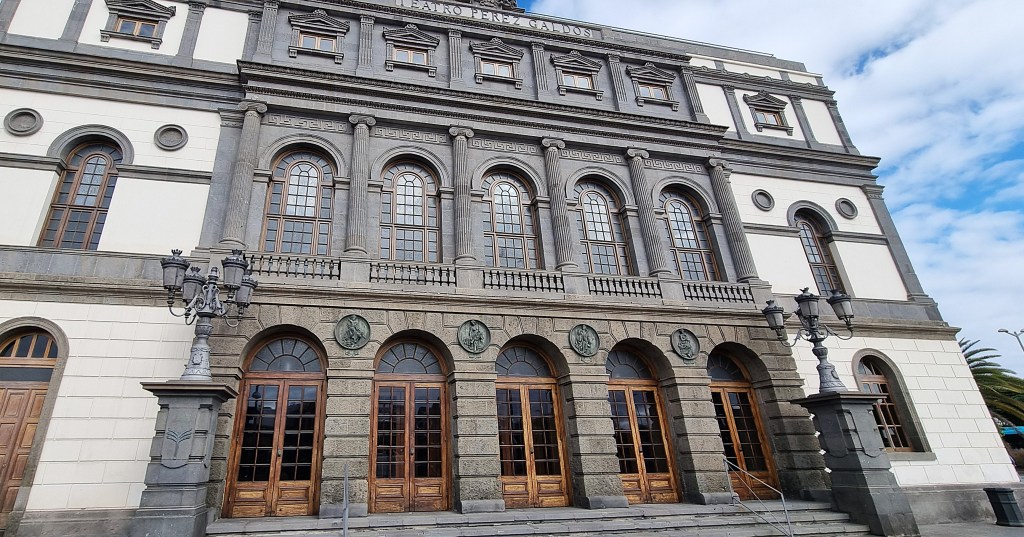
Galdos himself was the most prominent Spanish author since Cervantes, essentially a Spanish Dickens. He was born here in Las Palmas in 1843, the youngest son of a senior military officer. In 1868 he translated The Pickwick Papers into Spanish, publishing his own first novel in 1870.
He is perhaps best known, in English translation at least, for ‘Fortunata y Jacinta’, a realist magnum opus published in 1887. Between 1912 and 1916, he was nominated several times for the Nobel Prize, losing out to the likes of Rabindranath Tagore and Romain Rolland. He died in 1920.

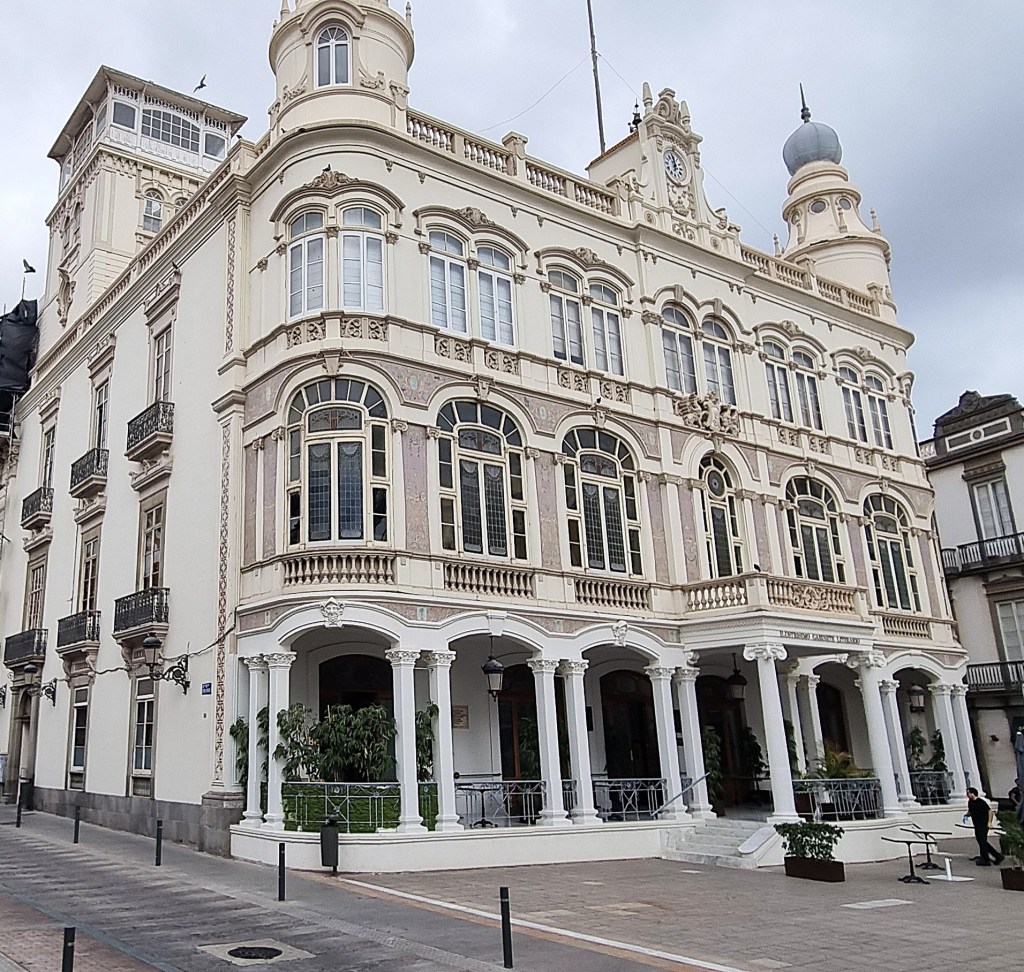
We sauntered along the busy shopping streets to the Parque San Telmo, stopping at the El Modernista, an octagonal art nouveau kiosk, for our morning coffee. This dates from 1923 and was designed by Rafael Massanet y Faus (1890-1966) who, in 1918, had been appointed chief architect for Las Palmas.
This is the Gabinete Literario, home of a literary and cultural society founded in 1844. It was formerly the Cairasco Theatre, the Island’s first, named in honour of Canarian poet Bartolomé Cairasco de Figueroa (1538-1610), whose home formerly occupied the site.
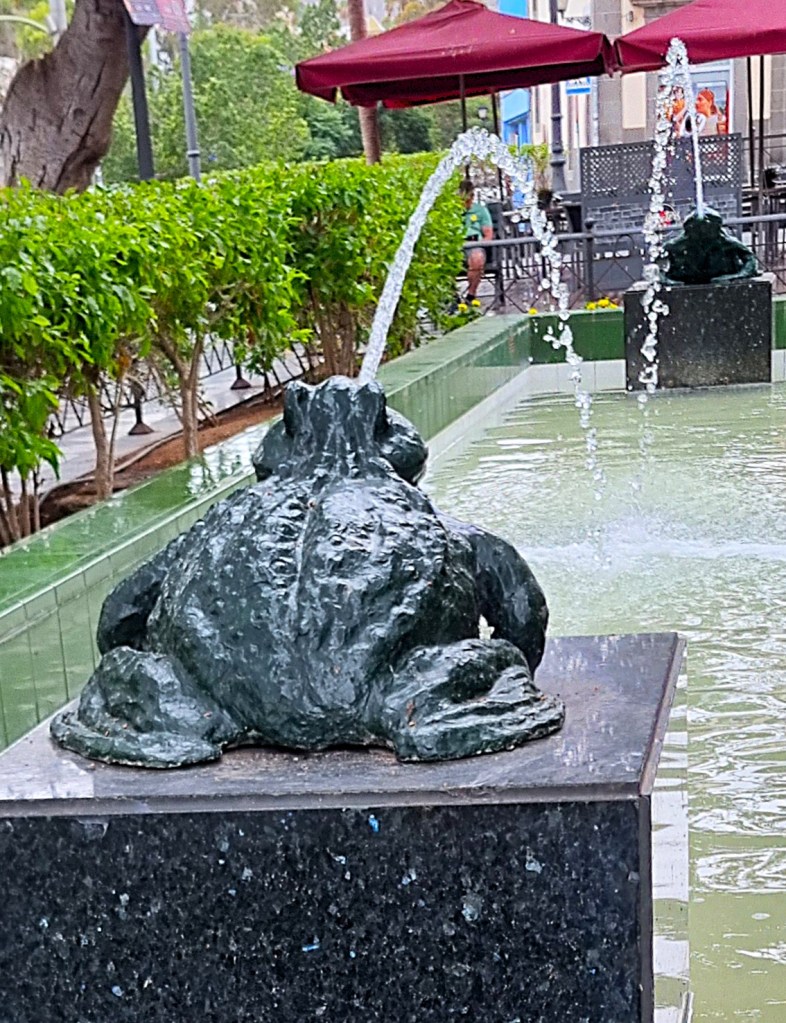
Returning to the Plaza de Las Ranas, (or, more strictly, the Plaza Hurtado de Mendoza), I enjoyed the twin frogs which supply its unofficial name. The Plaza was designed in 1823 and named in honour of a former Mayor of Las Palmas. The bronze frogs, weighing 40 kilos apiece, were commissioned from the sculptor Juan Correa.
This more ornate fountain is the Plaza del Espiritu Santu, designed by Manuel Ponce de Leon (1812-1880), circa 1868. Four plaster female figures were originally seated on the empty plinths, representing the muses for music, architecture, painting and sculpture respectively. They were destroyed in a storm.
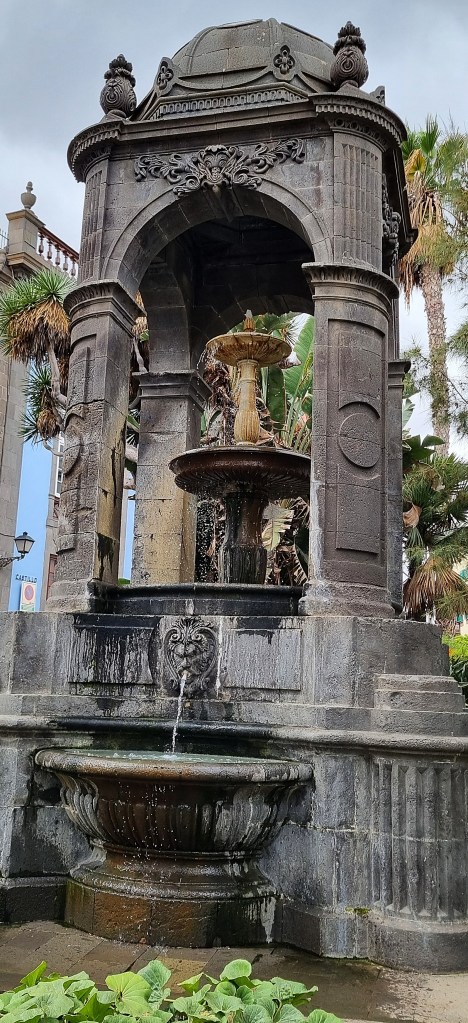
We had to wait an eternity here for a middle-aged couple to complete their portfolio of selfies.
But our time was almost up. After a final visit to the Market (for the handy public conveniences) we boarded our bus and returned to the Hotel in time for a late lunch.
Following an afternoon at leisure beside Las Salinas and the Hotel swimming pool, Tracy downed a Pina Colada and we went upstairs to enjoy the sunset before dinner.

Saturday: Pico de Las Nieves
We were admitted to breakfast before the official opening time since our coach was due to depart at 08:30.
We stopped for a comfort and coffee break at a Telde shopping centre, where I discovered that ordering coffee (rather than Americano) generates a Cortado.
The barista wouldn’t make them in our recyclable cups and, on trying to decant mine, I developed the trembles, causing spillage. This disturbed both the barista and Tracy, though for different reasons.
The coach ascended steadily through a series of hairpin bends, dropping us near the Caldera de los Marteles viewpoint.
Guillermo immediately whipped out his handy three-dimensional model to explain our location and what we were seeing.

This caldera is some 550 metres in diameter and 80 metres deep, the bottom used as farmland.
Leaving the road, we began a gentle ascent, entering an area of pine forest.
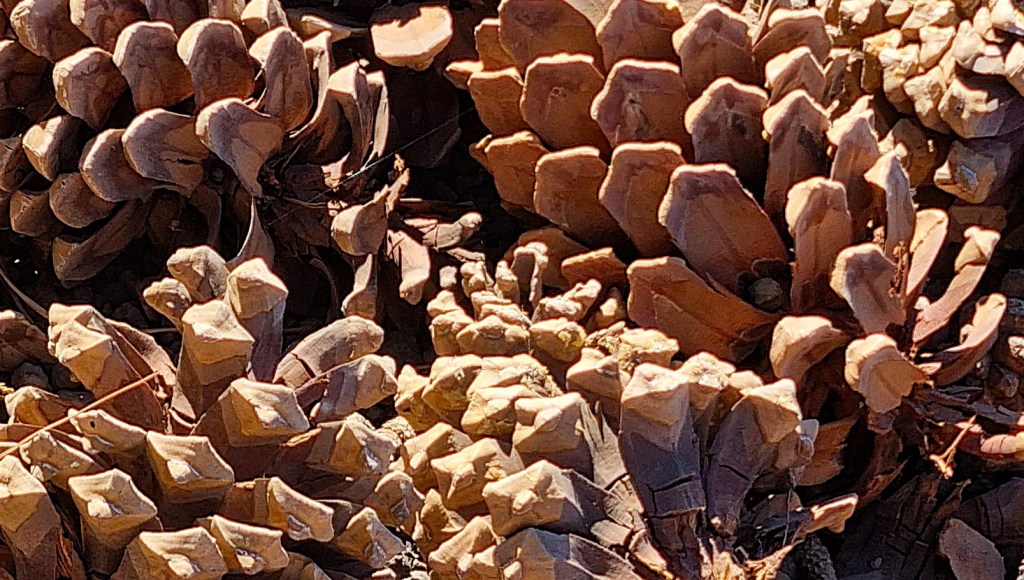
Reforestation is a big priority in Gran Canaria.
Prior to the Spanish conquest, the forests here were extensive. Estimates vary, but some suggest that pine forests alone covered 100,000 hectares of land.
Much of it was chopped down for firewood, used to boil down sugar cane juice into sugar.
In 1823 there were plans to cut down the last surviving forests sparked a peasants’ revolt, but it was crushed and the ringleaders executed.
By the 1950s, only 56,000 hectares remained: 40,000 hectares of pine and 16,000 hectares of laurel. Reforestation began, but initially utilised Californian rather than Canarian pine, which affected the ecosystem and was more vulnerable to forest fires.
The Canarian variety is both drought-tolerant and particularly fire-resistant, capable of resprouting through buds lying dormant beneath its bark.
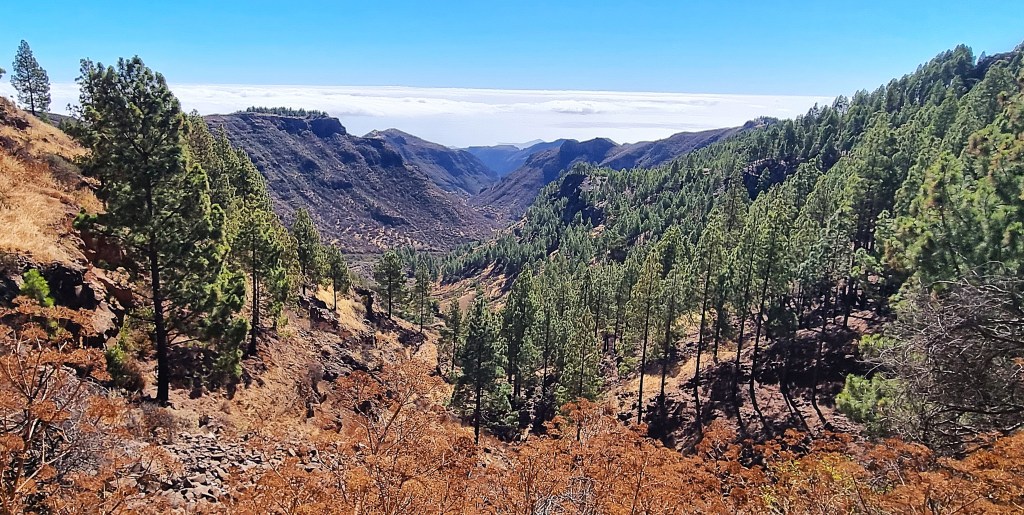
Progress has been steady, if unspectacular, and there have been regular setbacks, not least the forest fires of 2019 which damaged 10,000 hectares, including substantial areas of pine forest.
Our guides were on the lookout for the elusive Blue Chaffinch, which typically lives in the pine forest, above 1,000metres, feeding on pine seeds. The male has blue plumage and two white bands on its wings; the female is grey-brown and normally lays two eggs.
A conservation plan was introduced in 2013. The estimated population has increased to some 430 birds, but this is still an endangered species.
We began to overtake the backmarkers of a group in front. Our leaders were at pains to prevent this overlap, holding us back for a while. When we came to the clearing selected for our ‘banana break’, they had already snaffled the shadiest spots.
Just prior to departure, I departed for a comfort break, only to find myself standing directly below a makeshift crucifix. There was no indication of who or what it commemorated, but it seemed highly inappropriate to urinate in its vicinity, so I moved on a little further.

At Cruz de Socorro we joined part of the GR131 walking route, which begins at Playa del Burrero on the east coast and ends at Puerto de las Nieves in the north-west, some 63 km in all.
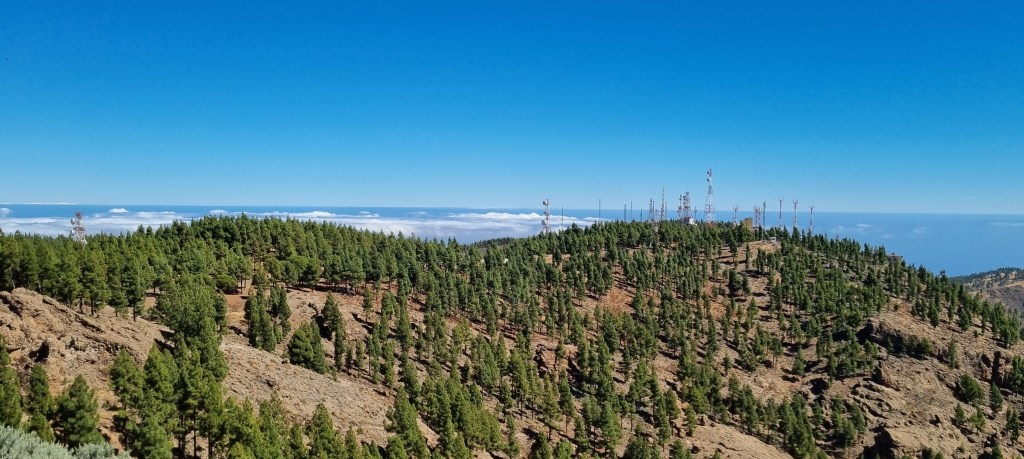
Soon we were climbing towards a nest of red and white telecommunications masts, followed by a military radar station. After passing several small satellite dishes, attached to small, square brick buildings, we settled down to lunch beside a large well-like construction.

This is Pozo de los Canonigos, first constructed in 1699. When snow fell on the mountain, workers would collect it in baskets, taking it to this well and others like it. The snow was tamped into wooden boxes until it became ice and these ice blocks were stored in rows, separated by wads of straw.
When summer came, the blocks, weighing some 40kg, were transported by donkey down to Las Palmas, where there was a cold storage room.
Here the ice was chipped into smaller blocks. Members of the Catholic clergy were entitled to a kilo of ice per day. It was also sold in an ice cream parlour close to the Cathedral, while some was allocated to the hospital, to help control patients’ fever.
The process became redundant when Las Palmas acquired an ice factory in 1866.
After lunch, we made the short trek to the viewpoint at Pico de Las Nieves. The mountains name is most probably attributable to those ice wells. It is 1,940 metres high, but not quite the highest point on the Island. That is a rocky outcrop nearby, known as Morro de la Agujereada, which is a few metres taller.
Our progress was threatened by the inexpert manoeuvring of several cars, mostly piloted by brash young men, struggling to get in and out of the small car park. The cars mostly disgorged brash young women who were intent on their Instagram selfies. A vendor sat placidly by his stall, monitoring all these comings and goings.
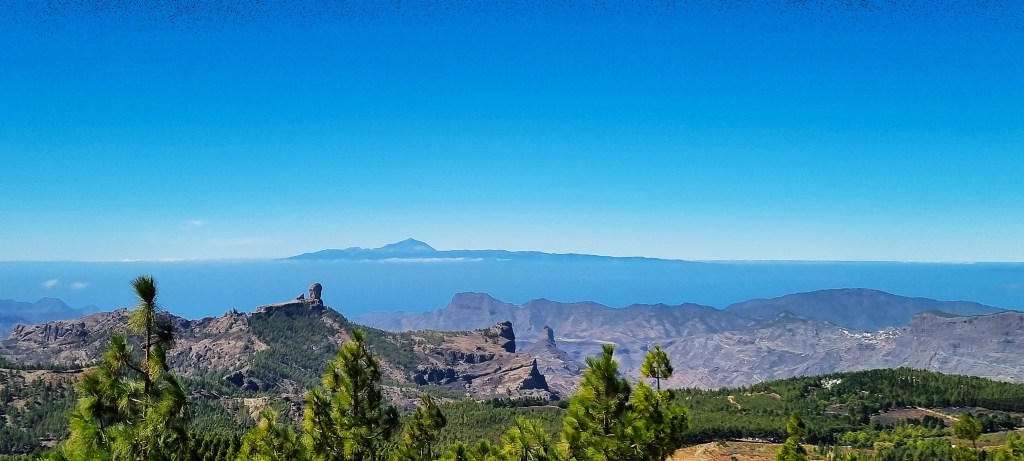
We climbed up to the higher viewpoint, but soon descended again, dividing our attention between the splendid sight of Mount Teide on Tenerife and the antics of a family of canaries.

We were assembled for a group photograph, Manu having persuaded one of the young women to point a camera in our direction. Afterwards, he remarked that the men would have observed her substantial attributes.
Which of course we had but, being English rather than Iberian, and mostly with our partners present, could not possibly admit.
Having arrived here so promptly, it was decided we would rejoin the GR131 for the 2.3km descent to Llanos de la Pez, from where we would be starting Sunday’s walk. More fruitless Blue Chaffinch spotting ensued: we heard their calls but they did not reveal themselves.
At Llanos de La Pez we found hosts of day trippers picnicking, and a fair few campers besides.
The Llanos de la Pez Recreational Area is the most popular on Gran Canaria and one of the largest, with capacity for 1,150 people. ‘Pez’ refers to a pitch, extracted from pine resin, which was used to caulk ships. It became a significant export, accelerating the deforestation in this area.
Subsequently, and until the 1950s, it was used to grow crops and graze livestock. Now all that remains are the ruins of shepherds’ huts and threshing floors amongst the replanted pines.
Back at the Hotel, Tracy’s cocktail of the day was a Manhattan, combining whisky and vermouth, while Saturday night’s dinner had a Canarian theme.
I was convulsed with laughter by a surreal conversation with the lady opposite, who explained that she was a fan of Mo Salah:
‘Oh yes; I like a good Mo’, she concluded.
‘How about Mo Farah?’ I suggested.
‘No…I find him a little bit too excitable…
I like a low-key Mo’.

Sunday: Camino de Santiago (Llanos de la Pez to Montañón Negro)
Today we would be walking a section of the Camino de Santiago de Gran Canaria, a 67km coast-to-coast route from Maspalomas Lighthouse in the south to Galdar in the north.
We would be following the rim of a collapsed caldera, the Caldera de Tejeda, walking via the Ventana de Nublo viewpoint and Cruz de Tejeda, concluding near Montañón Negro.
It was another early breakfast and 08:30 departure. Our first stop was the Parador de Cruz de Tejeda, for coffee. We would be returning here later for our picnic lunch.
The Parador is one of a state-owned chain of luxury hotels distributed throughout Spain, the first designated in 1928. There are 98 of them distributed throughout Spain (and one franchise in Portugal), five of which are in the Canary Islands. This is the only one in Gran Canaria.
There was some difficulty over securing our coffee since, it being Sunday, the cafe did not open until 11.00. The dining room offered an alternative supply, but they were a little put out because they were catering for a big wedding. They managed to squeeze us in eventually, though, providing definitely the best Americanos we’d had all week.
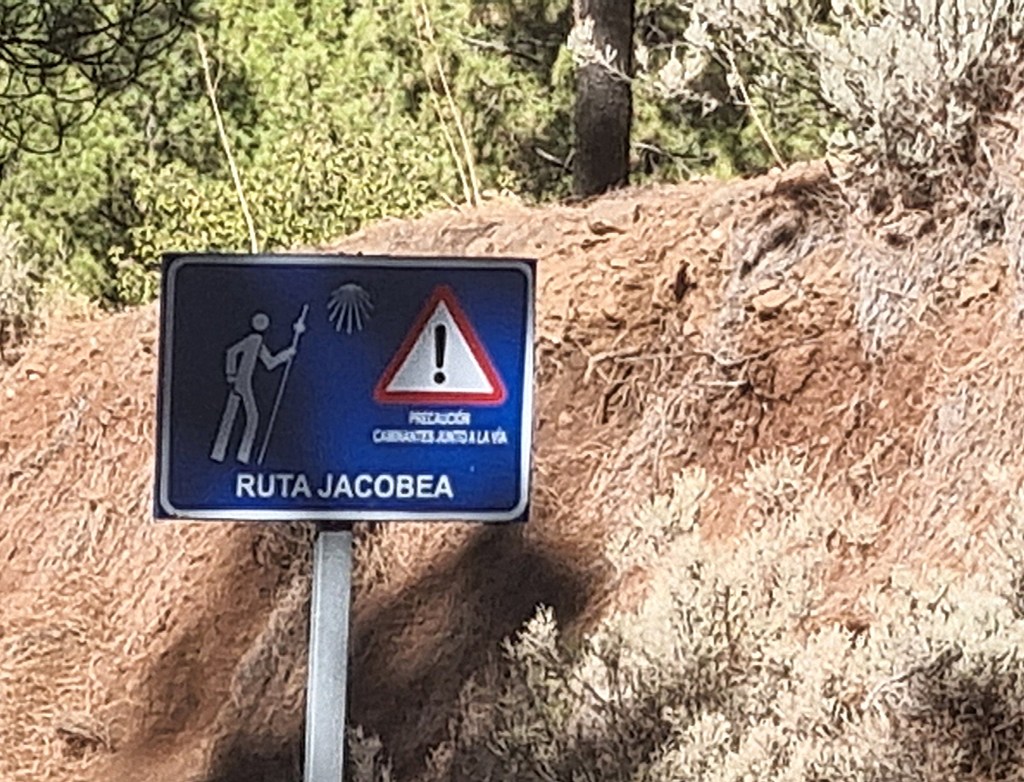
We reboarded our coach which took us to our starting point at Llanos de la Pez. where we soon spotted a Camino de Santiago sign, referring to the ‘Ruta Jacobea’ or ‘Way of St James’.
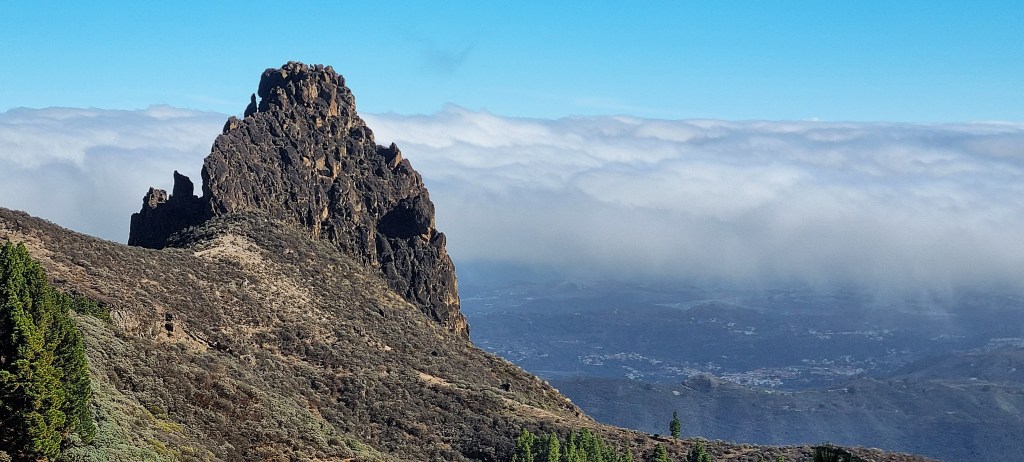
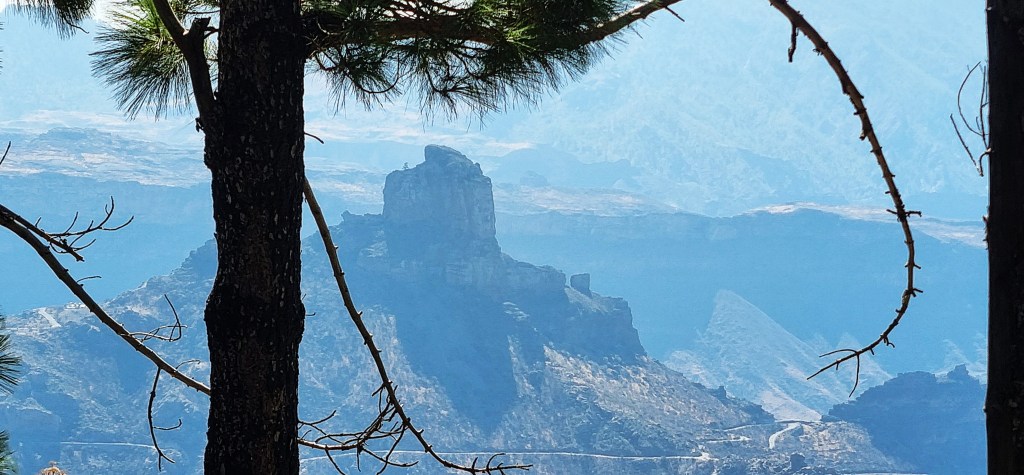
Almost from the outset, we could see Tenerife floating on the sea, with the Roque Nublo (meaning ‘the rock in the clouds’) in the foreground. This is the third highest point in Gran Canaria, at 1813 metres.
The rock itself is just 80 metres tall. It was a place of worship to the indigenous people, who used it for rituals and ceremonies, possibly including sacrifice, though the archaeological evidence for that is scant.
The smaller rock next door is ‘El Fraile’, (‘The Friar’).

Nestor Alamo Hernandez featured Roque Nublo in his 1936 song ‘Sombra del Nublo’, which has since become anthemic for Gran Canarians:
‘Sombra del Nublo
altar de mi tierra amada,
hay nieve y sol en la cumbre
cumbre de mi Gran Canaria.’

The Caldera de Tejeda is 28km long by 18km wide, but roughly half of the perimeter is no longer standing. It was created some 14.5 million years ago, in the first wave of volcanic activity on Gran Canaria.
Roque Bentayga was also visible, standing at 1,404 metres. The origin of the name ‘Bentayga’ is still widely disputed. Here there is stronger evidence that this was a so-called ‘almogaren’ – a sacred place where religious ceremonies took place at specific points in the year.
There is a flat platform carved into the rock, containing a series of basins and channels.
Roque Bentayga was essentially an observatory from which to monitor solar and lunar movement, enabling priests to predict the most auspicious points in the cycle.
For example, one of the basins is at the exact spot illuminated by the first rays of the sun during the spring and autumn equinoxes. From here, there is also alignment between the moon and Roque Nublo when the moon is at its lowest point in the sky.
Immediately beneath Bentayga there is a cave complex used by those who maintained the site and officiated at the ceremonies. There are approximately 100 caves, including silos and burial chambers, suggesting that this site had particular prominence.
During the Spanish conquest, Pedro de Vera Mendoza tried to besiege the indigenous forces here, but they defended stoutly, killing several of his troops.
There were some awkward sections during this walk, the volcanic gravel and loose stones causing slippage on the steeper descents. We were several times urged to ‘walk like crabs’. Sonia predicted five fallers during the course of the day, though I counted only three.
We arrived before the cross at Cruz de Tejeda at 13:15. Tejeda was the birthplace of the sculptor Abraham Cardenes Guerra (1907-1971), but he had nothing to do with this cross. The principal sculptor was Santiago Santana Diaz (1909-1996).

This place is often considered the geographical centre of Gran Canaria and it was certainly very busy. A large convention of motorcyclists had convened.
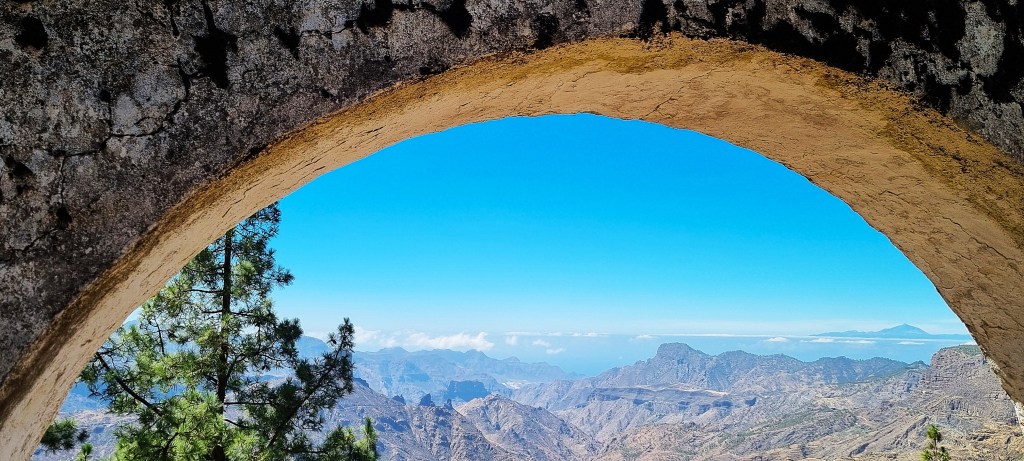
We had our lunch in a courtyard next to the Parador, on stone benches beneath arched apertures in the wall. It was picturesque, though the wasps were a nuisance.
Immediately after lunch we attacked a sharp climb up a steep hill, but the signs were misleading and we took a wrong turning. The ‘about turn’ meant that the faster climbers were now at the back, which made progress rather more problematic than it should have been.
Shortly before 15:00, we had our only injury of the week: a scraped elbow following a fall that was swiftly and expertly dealt with. Shortly afterwards we came to a halt for one of Guillermo’s fascinating addresses, before completing the final slog up beside Montañón Negro.

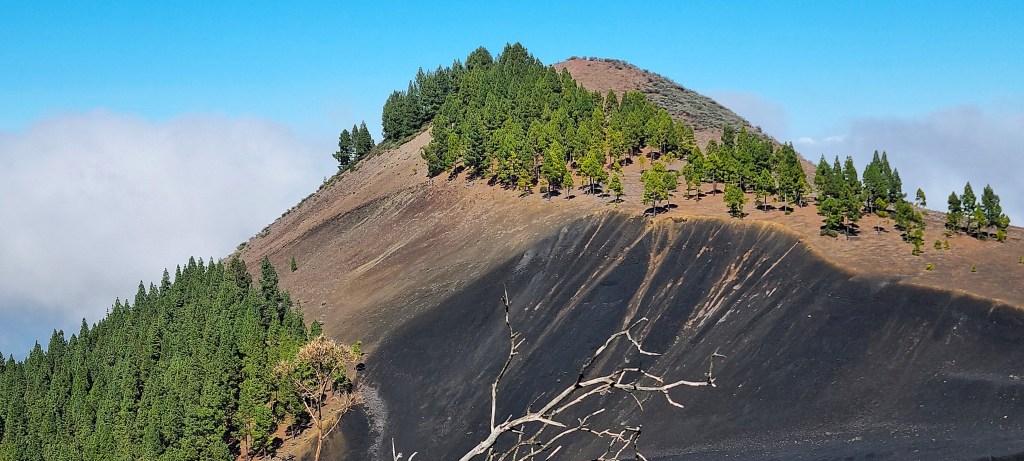
This was one of the last volcanoes to be created, some 3,500 years ago, standing at 1669 metres. The dark shade is caused by the rock fragments thrown up when the cone was formed. This material was formerly quarried, but the site is now protected.
After our late afternoon swim, Tracy downed two Mojitos containing white rum.
Belatedly, at dinner, we learned that it was the National Day of Spain. This commemorates the discovery of the Americas by Columbus in 1492. It was established by Royal Decree in October 1892, on the fourth centenary of that event.
Monday: Tabaibal de la Punta
Our bus departed at 09:00, heading south west along the coast to Playa de la Aldea.
La Aldea de St Nicolas it the westernmost municipality on the Island, where agriculture is the dominant employment and tourism comparatively limited.
We began with a stroll along the rather swish promenade, where workmen were revarnishing the wooden benches.
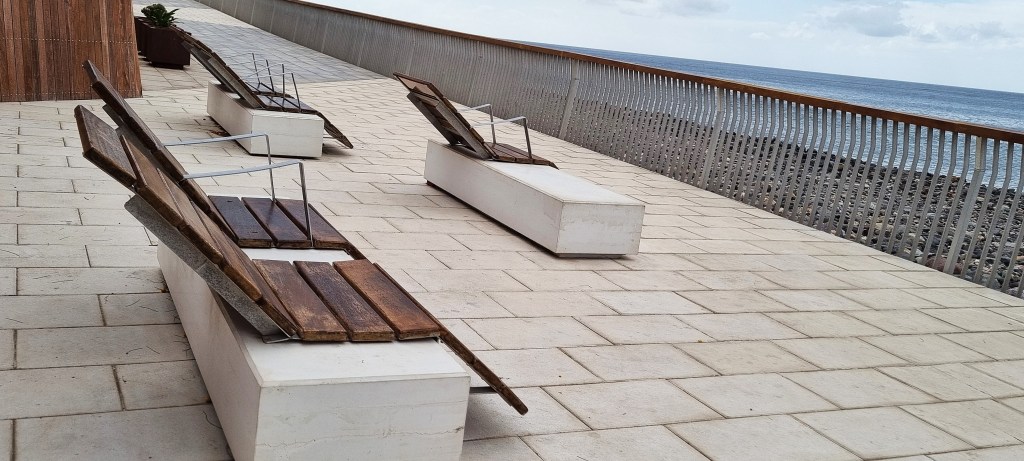
The promenade stops above a raised bed containing the coat of arms of St Nicolas de Aldea. Its four quadrants represent the Spanish monarchy; the Catholic Church; the coastal location and its reliance on maritime trade; and 1927, the year Aldea became a municipality.
Just beyond there is a small coastal lagoon, about the size of a swimming pool, fed by the high tides and (very occasional) run-off from the Aldea ravine. Its maximum depth is 1.5m. This ‘marciega’ (literally meaning ‘blind sea’) is known as El Charco.
The Fiesta del Charco takes places here on 11 September each year. It revives an ancient indigenous fishing method called ‘embarbascado’, which involves pouring plant sap from native species of Euphorbia into the water, so sedating the fish that are trapped in the lagoon, making them far easier to catch by hand.
Thousands of local people stand around the pool, behind a marked line. They must not touch the water until the mayor lights a firework, around five in the afternoon. Then everyone jumps in, racing to catch the largest fish, typically a mullet, sometimes with the aid of a basket.
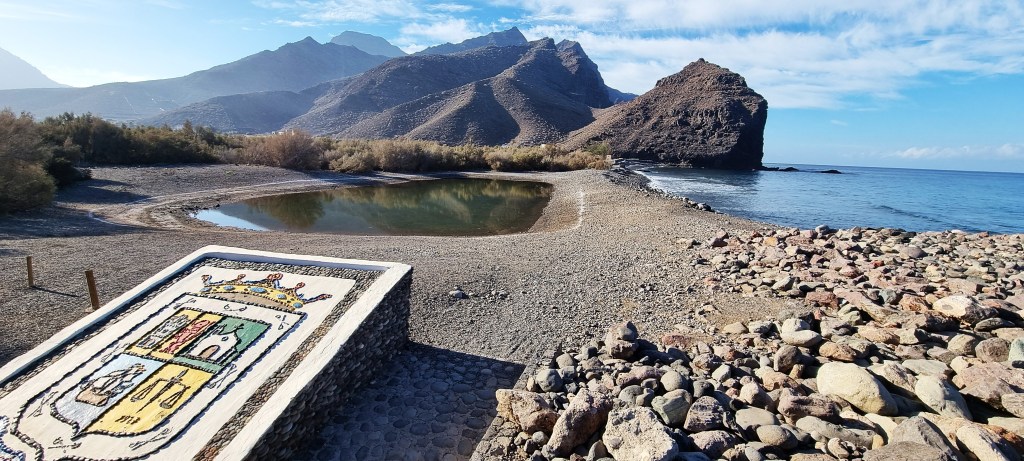
Nearby there is a small cave where Franciscan friars from Majorca are reputed to have established a tiny hermitage, around 1350, in honour of St Nicolas of Tolentino (1245-1305), an ascetic priest who spent 30 years in Tolentino caring for the poor, sick and elderly. This was part of a missionary effort to convert the indigenous pagans to Christianity.
The feast day of St Nicolas is 10 September, the day immediately before the Fiesta del Charco. But which came first? Probably El Charco, but perhaps the Church encouraged its celebration on 11 September so that it could be incorporated into the saintly festivities.
For El Charco is suspected of having orgiastic tendencies, typically culminating in a welter of fishy fornication. Nine months later, any illegitimate offspring were particularly honoured.
It stood for everything that the Catholic Church stood against. And, over time, the local clergy must have grown complacent, if not quite complicit.
In 1766, Bishop Francisco Javier Delgado Venegas (1714-1781), having witnessed the festivities, was so horrified that he issued a telling episcopal decree.

Roughly translated, it reads:
‘That, being informed of the disorder that has always existed in this place when the pool, which is where they say the sea is muddy, men and women almost naked entering and mingling in it, forgetting the obligations of a Christian, that modesty and shame, natural to every rational being, sinning mortally in such depraved amusement, not only all those who enter the pool, but also those who, knowing themselves to be vulnerable and in imminent danger of falling into some temptation; therefore it being necessary to give a measure that cuts off this abuse, so harmful to good morals, his Holiness orders the penalty of excommunication, ipso facto, incurring a fine of four ducats which shall be taken and applied immediately to the fabric of this church, and fifteen days in gaol; that no woman shall enter the pool…together with the men; and that men, under the same penalties, shall not do so in front of women by undressing completely…’
These days the fiesta is far tamer, but still a mass participation event. In 2025, some 8,000 people took part and it was broadcast live on television.
There are now three days of festivities, collectively in honour of St Nicolas: on 9 September a local version of ‘la rama’; on 10 September, a pilgrimage to the Church; and on 11 September the Fiesta del Charco.
While we listened to Guillermo’s narrative, one of the varnishers came across to show us his video of the 2025 event.
There is a statue nearby by local self-taught artist, Ignacio Martin Suarez.
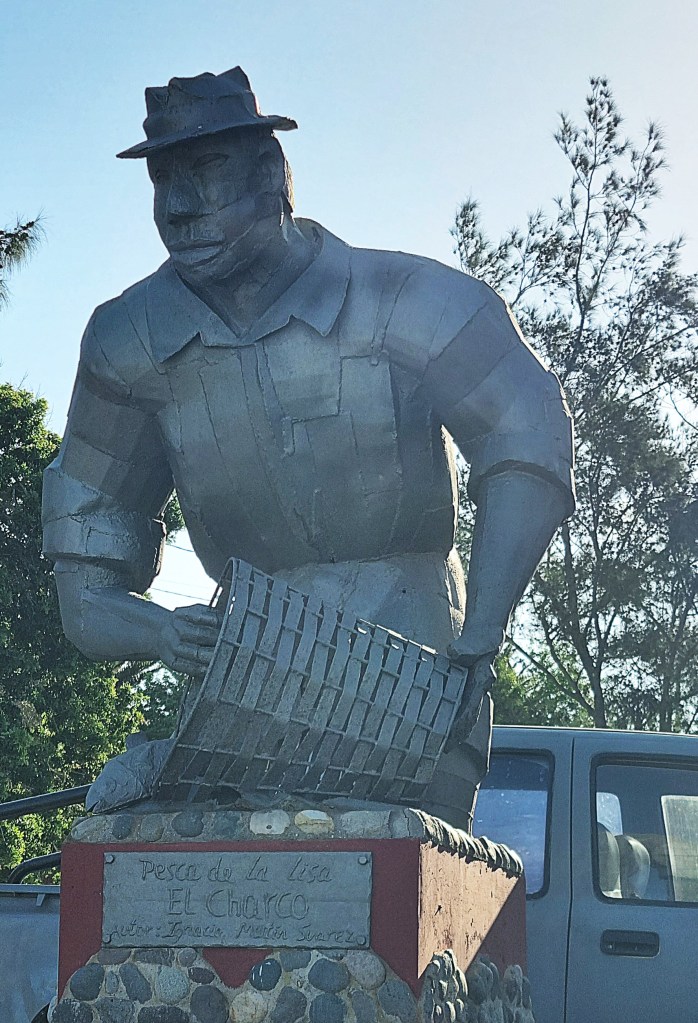
Full of folklore, we retraced our steps and began to climb up to the cliffs behind the small harbour. Soon we passed a woman with a land rover in which she had apparently camped overnight. She was commissioned to take a group photograph and then we moved on.
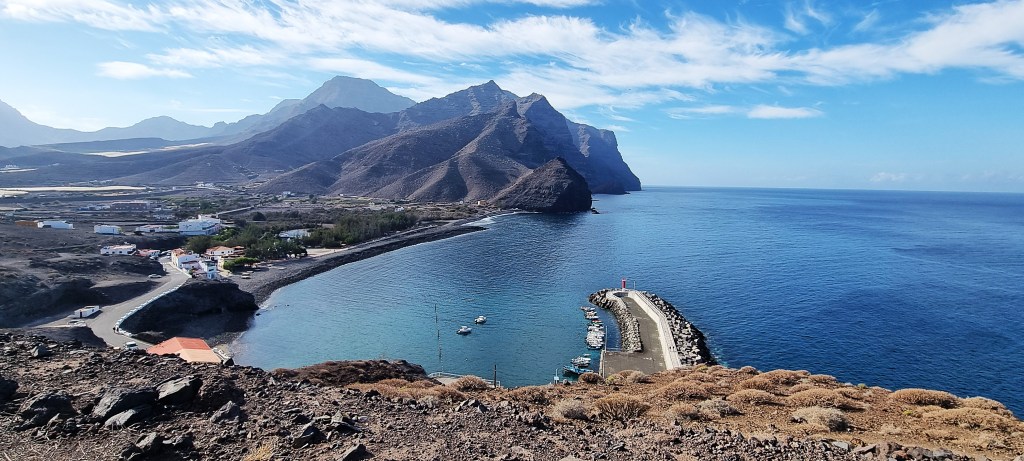
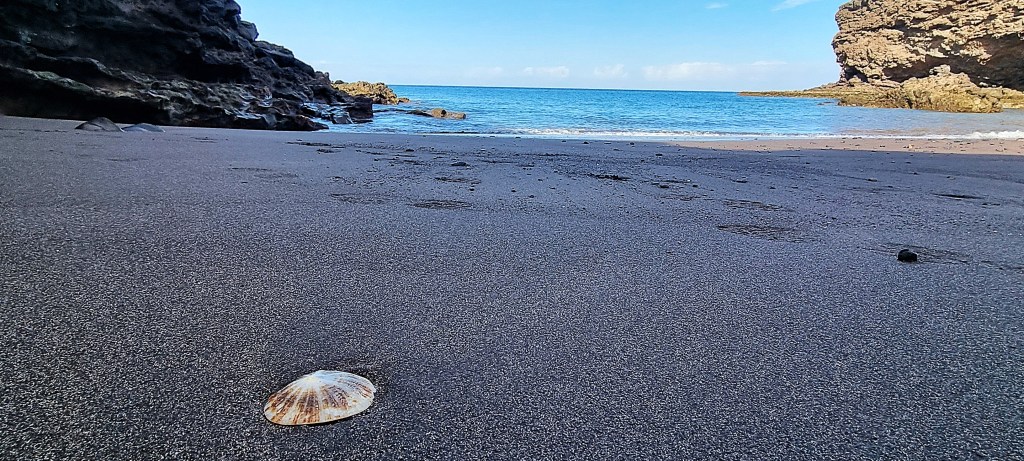
We arrived at Playa de el Puerto, accessed by a narrow, rocky ravine stretching hundreds of metres down to the sea. There is a small sandy beach, identified by a carved triangle of rock, beneath which sits a solitary, graffiti-tagged lifebelt.
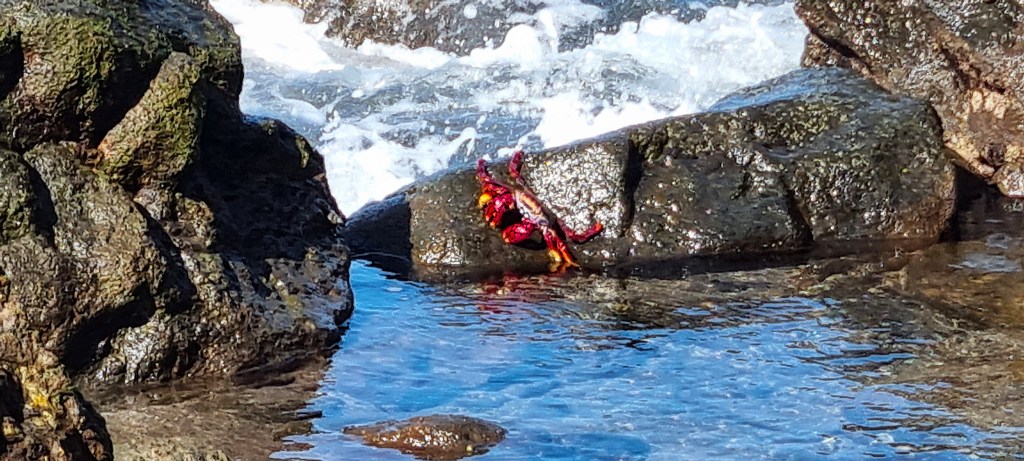
Colourful moorish red crabs (grapsus adscensionis) were squatting on the rocks. Sonia went through some yoga poses; Manu walked on his hands; we sat idly by.
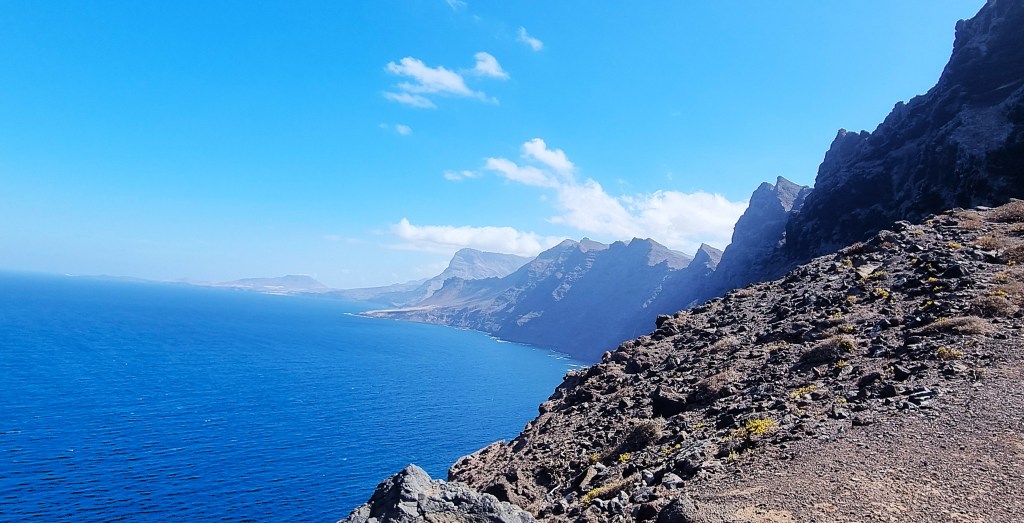
Leaving the beach behind we climbed on, round the coast, eventually reaching a viewpoint from where we could see the ‘dragon’s tail’, the jagged line of cliffs we had so often admired from Agaete. This was the Degollada de El Perchel.
We returned to Playa de la Aldea for our picnic lunch. We sat on a shady rainbow-coloured bench on the promenade. I was concerned that we had deprived one aged resident of his favourite lunchtime spot – he staggered off in the opposite direction leaning heavily on his cane.
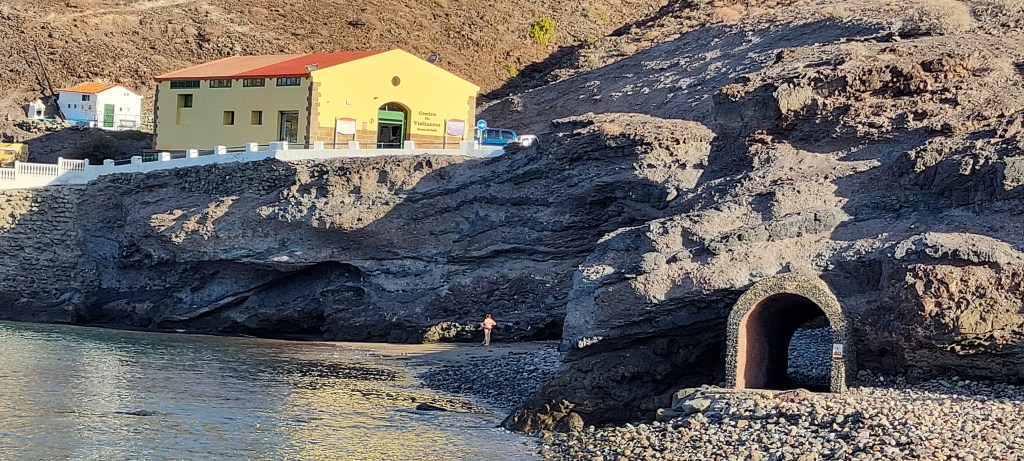
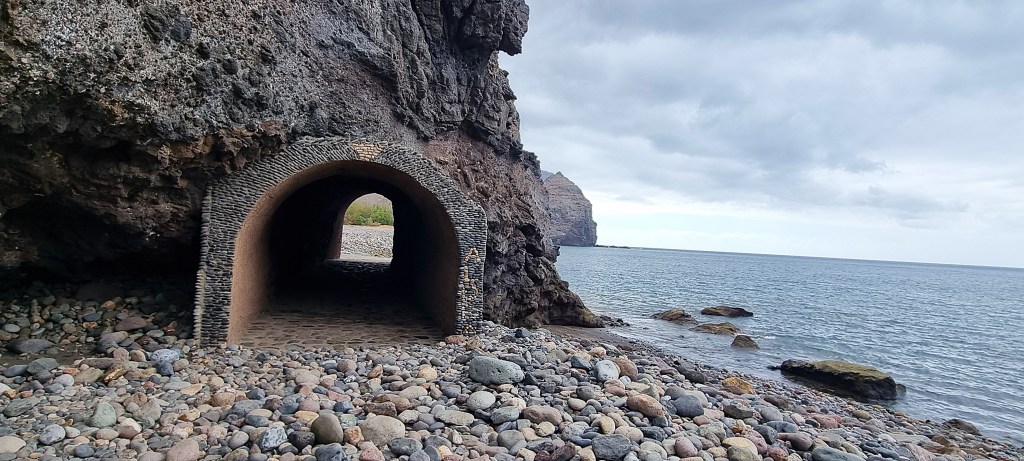
Having changed in the toilets, we made our way through an arch to the rocky beach close to the harbour where a resident cat was being fed.
The sky clouded over, while we enjoyed a swim.
A notice informed us that a party of English corsairs attacked this very beach in 1744, but were sent packing by local volunteers. Later, in 1940, twin gun emplacements were built at either end, also defending against potential British invasion.
Meanwhile, outside the local bar, some of our number had acquired an injured dog. Sonia took charge of him, hoping she had found a companion for her existing hound. But he turned out to have owners to whom he was later returned.
After a swim in the almost empty pool, Tracy had her final cocktail, a Tequila Sunrise, then headed off for her free spa treatment, while I drank another beer.
After dinner, I reluctantly assembled for the quiz, in which our team came third and last. It was a slightly anti-climactic end to a wonderful week.

Homeward
Next day we left the Hotel at 09:30. The queue at the Airport was long and slow-moving, since one woman was undertaking the baggage drop service.
But we had enough time for a coffee, took off and landed on time, picked up our cases promptly and travelled home by train.
We had worked far harder than I had expected, but it was a richly rewarding experience, shared with a fine group of people. We were privileged to enjoy close contact with a Gran Canaria that few English tourists ever see.
TD
October 2025



 Eponymous
Leave a comment