
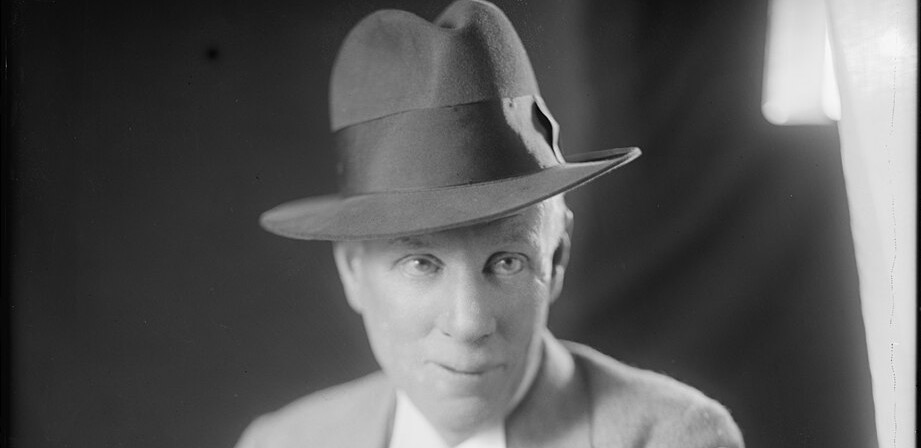
Harry Sinclair Lewis (1885-1951) was born in rural Minnesota, the youngest child of a doctor. When he was six, his mother died and his father remarried.
Lewis attended Yale, graduating in 1908, after which he worked as editor for a variety of newspapers and publishers. His first serious novel appeared in 1914 but success eluded him until ‘Main Street’, published in 1920, made him a fortune.
He followed up with several more celebrated novels, such as ‘Babbitt’ (1922), ‘Arrowsmith’ (1925), ‘Elmer Gantry’ (1927) and ‘Dodsworth’ (1929), before becoming the first American to be awarded the Nobel Prize for Literature in 1930.
Two years earlier, he had divorced his first wife, Grace Hegger, before immediately remarrying. He and his second wife, the journalist and radio broadcaster Dorothy Thompson, bought a second home in Vermont.
Lewis’s post-Nobel Prize fiction was not quite up to the standard of his earlier work. ‘It Can’t Happen Here’, published in 1935, is no exception.
After his death from alcoholism, Lewis’s literary reputation suffered, relative to contemporaries like F. Scott Fitzgerald, for example, and it has never really recovered.
‘It Can’t Happen Here’ is a dystopian novel that imagines late 1930s America in the grip of a totalitarian government which ruthlessly suppresses all opposition. Although led by a populist Democratic President, one Berzelius Windrip, it develops along similar lines to Nazi Germany.
The novel follows the fortunes of Doremus Jessup, an elderly Vermont newspaper editor, who voices his opposition to the new regime.
He is replaced as editor, but kept on for a while to teach his replacement the ropes. He is closely monitored by Shad Ledue, an officer in the Government militia, the Minute Men, who was formerly his handyman.
Following the murder of his son-in-law by a Minute Man firing squad, at the behest of Effingham Swan, a ruthless military judge, Jessup joins the resistance, helping dissidents to escape into Canada.
He is eventually caught, tortured and incarcerated in a vicious concentration camp, alongside several of his contemporaries.
While he is imprisoned, his daughter Mary trains as a military pilot and, unlikely as it seems, manages to assassinate Effingham Swan by colliding with his plane, killing herself in the process.
And Shad Ledue, who has been pursuing Jessup’s other daughter, Sissy, falls out with his superiors and also winds up in the concentration camp, whereupon the other prisoners promptly murder him.
With the aid of a guard, bribed by Lorinda, his mistress, who is also active in the resistance, Jessup finally manages to escape to Canada. He rejoins the resistance and is posted to Minnesota.
Windrip has been overthrown, exiled to France, and replaced by Lee Sarason, his Svengali-like Secretary of State, but Sarason is murdered and a third man, a soldier, Dewey Haik, replaces him.
Haik tries to restore order by declaring war against Mexico, reasoning that the country needs a common enemy to keep it united, but civil war is already breaking out.
One inspiration for Windrip was the politician Huey Long (1893-1935), a populist Democrat opponent of Roosevelt’s who was assassinated in 1935, before he could challenge for the Presidency.
But, more recently, readers have been struck by the similarities with President Trump. I read the Penguin Modern Classics edition which was released on the day Trump was inaugurated in 2017. The novel is no less redolent of the activities of Trump’s second Administration.
Lewis reputedly wrote this novel at lightning speed, and it shows. The quality is inconsistent, with several chapters distinctly third rate. The final part of the novel, after Jessup’s imprisonment, has greater momentum and is rather more gripping than what went before.
Such an important topic deserved a far better treatment than Lewis manages to supply. This has curiosity value but your time would be better spent with the far stronger novels that Lewis wrote in the 1920s.
Despite his now lacklustre reputation, those are well worth reading.
TD
October 2025









 Eponymous
Leave a comment