
This post brings us two-thirds of the way round my year-long Ouroboros cycle.
It should eventually comprise twelve monthly posts, each exploring a piece of music that has become personally important.
Put another way, these are highlights from the soundtrack of my life.
I’ve not pre-planned the cycle, so it is emerging with a degree of spontaneity. But I have made it a rule that there must be a link – however tenuous – between each choice and its immediate predecessor.
My choices to date have been:
- January: ‘Ya Jean (Remix)’ by Madilu System;
- February: ‘Autorail’ by Orchestre Baobab;
- March: ‘Sweet Fanta Diallo’ by Alpha Blondy;
- April: ‘Blue Sky’ by the Allman Brothers Band;
- May: ‘Saturday Night’ by the Blue Nile;
- June: ‘Ev’ry Time We Say Goodbye’ by Ella Fitzgerald; and
- July: ‘Thinking of You’ by Sister Sledge
From Sister Sledge, we switch to Bob Dylan’s ‘Black Diamond Bay’, the penultimate track on his seventeenth album, ‘Desire’, released on 5 January 1976.
There are precious few connections between Sister Sledge and Bob Dylan. However, Niles Rodgers, who wrote and produced ‘Thinking of You’, also produced Dylan’s version of ‘Ring of Fire’.
It featured on the soundtrack of ‘Feeling Minnesota’ (1996), starring Keanu Reeves and Cameron Diaz. The critics’ consensus on Rotten Tomatoes is:
‘Clumsily derivative, shoddily assembled, and fundamentally miscast, Feeling Minnesota sets out for romantic comedy and gets irrevocably lost along the way.’
As far as I’m aware, Bob Dylan has never covered a Sister Sledge song – or vice versa!

The Origins of ‘Desire’
The period leading up to the release of ‘Desire’ had been particularly fertile for Dylan.
Almost exactly a year earlier he had released ‘Blood on the Tracks’. Though initial reviews were mixed, this has subsequently been judged amongst his best albums. It reached Number 1 on the Billboard 200 album chart and Number 4 on the UK album chart.
Then, in June 1975, he released ‘The Basement Tapes’. Sixteen of these 24 songs had been recorded in 1967 by Dylan with the Band; eight, dating from 1967-1975, featured the Band without Dylan. This reached Number 7 on the Billboard chart and Number 8 in the UK. Critical reception was overwhelmingly positive.
In Autumn 1975 the Rolling Thunder Revue got under way. This 57-venue concert tour, which mostly visited smaller venues, was divided into two stages.
The first stage targeted New England and Canada, beginning on 30 October in Plymouth, Massachusetts and culminating on December 8 at Madison Square Garden.
This final show was a benefit concert for Rubin Carter (1937-2014), subject of the song ‘Hurricane’. This featured on ‘Desire’, but was also released as a stand-alone single on 21 November, following some last-minute revision to avoid lawsuits.
Dylan also performed the song at Trenton State Prison, where Carter was being held, and a second benefit followed on 25 January 1976, at the Huston Astrodome.
The Revue’s second phase began in Spring 1976, shortly after ‘Desire’ was released. It targeted venues in the southern and south-western states, starting in Florida and ending in Utah.
Both ‘Desire’ and the Rolling Thunder Revue emerged, almost simultaneously, from the same gestation period, twin offspring of a single creative process.
Dylan had arrived in Greenwich Village towards the end of June 1975 and was living in a borrowed apartment on Huston Street. He was frequenting bars and venues, revisiting old haunts, renewing old relationships and forming new ones besides.
By all accounts, he was restless. Though he still loved his first wife, Sara (nee Noznisky), he suspected their ten-year marriage was coming to an end. (They eventually divorced in 1977.) He was missing the company of his five children.
He quickly cemented a friendship with the songwriter Jacques Levy (1935-2004), meeting him on Bleeker Street then inviting him up to the borrowed apartment. They began to work together on ideas for several songs that Dylan had been developing.
Some six years Dylan’s senior, Levy had qualified as a clinical psychologist and subsequently directed several experimental theatre productions, including the initial staging of ‘Oh Calcutta!’
He had been recommended to Dylan by Roger Mc Guinn of the Byrds. Levy and McGuinn had originally tried to write a musical together. It was called ‘Gene Tryp’, the anagrammatic offspring of Ibsen’s ‘Peer Gynt’.
They also wrote a handful of songs together for the Byrds’ untitled double album, released in 1970. They included ‘Chestnut Mare’, which became a UK hit single in 1971. McGuinn and Levy had continued their songwriting partnership thereafter.
Larry Sloman (b. 1950), author of ‘On the Road with Bob Dylan’, said of Levy:
‘Jacques looked like an academic. He had a neatly-trimmed beard, and dressed age-appropriate in a flannel shirt. He was a droll guy, with a sarcastic New Yorker streak that fitted well with Dylan. The songs Jacques wrote with him were epic in scope, and you could see a theatrical mind at work. They gave Bob a role to play in narrative songs which he threw himself into.’
Roger McGuinn recalled:
‘Jacques would do inside-rhymes, an advanced form of lyric-writing. He liked the style of songs from the 30s and 40s, with a preface before they started. You can see that in Chestnut Mare. He was jovial, and lyrics came to him easily. I can just imagine him and Bob laughing about scenarios.’
Following their initial ad hoc writing session, and probably after a first chaotic recording session for ‘Desire’ on 14 July, Dylan and Levy retired to the Long Island seaside resort of East Hampton for a two-week songwriting blitz. The venue was Dylan’s summer house on exclusive Lilypond Lane.
Levy is credited as co-writer for seven of the songs on ‘Desire’: ‘Hurricane’, ‘Isis’, ‘Mozambique’, ‘Oh Sister’, ‘Joey’, ‘Romance in Durango’ and ‘Black Diamond Bay’. Opinions differ over whether Levy or Dylan was the dominant contributor.
In January 2021 Levy’s Estate filed a legal claim to proceeds from the sale of Dylan’s song catalogue. Under Levy’s contract, he had been guaranteed 35% of the royalties from these seven songs. The court ruled that he did not qualify for additional income from the sale of the catalogue.
That first recording session had featured members of the Dave Mason Band as well as several session musicians. Two weeks later, on 28 July, Dylan returned to the studio with some 20 musicians, including Eric Clapton, and four more guitarists besides.
The general opinion seemed to be that this was an embarrassment of riches. The session was largely unsuccessful and there were technical issues with the recordings obtained that limited their suitability for remixing and overdubbing.
In a third session on 29 July, the number of musicians was whittled down, but still only one useable take was recorded.
Finally, on the evenings of 30 and 31 July 1975, a small core group of musicians managed to record the remaining tracks. Five different takes of ‘Black Diamond Bay’ were captured on 30 July.
The Musicians
Aside from Dylan, this core group contained four principal musicians:
- Emmylou Harris (b. 1947) came originally from Birmingham, Alabama, later moving to North Carolina and Virginia. She began a drama course at the University of North Carolina but, by 1969, had arrived in Greenwich Village intending to make it as a folk singer. She recorded her first album in 1970 then, after a series of false starts, was spotted singing country at a club in Washington DC by members of the Flying Burrito Brothers. This drew her to the attention of Gram Parsons, formerly of the Byrds and the Burritos, but now pursuing a solo career. She recorded harmony vocals for his solo album, ‘GP’, performing the same role in his touring band, the Grievous Angels. While working on Parsons’ next album, also called ‘Grievous Angel’, he died of a drugs and alcohol overdose. Harris formed her own band and, continuing in the country idiom, had released ‘Pieces of the Sky’ in February 1975. Dylan reportedly told Columbia executive producer Don de Vito that he needed a female vocalist. According to Harris:
‘I got a call that Dylan wants you to sing, but that wasn’t true because he just wanted a girl singer. I mean we basically shook hands and started recording. I didn’t know the songs, the lyrics were in front of me, and the band would start playing and he would kind of poke me when he wanted me to jump in. Somehow I watched his mouth with one eye and the lyrics with the other. You couldn’t fix anything. What happened in a moment was on the record.’

- Dylan had first encountered Scarlet Rivera (b.1950) on 30 June. He had noticed her while driving. She was walking along 13th Street in the East Village, carrying her violin case to a rehearsal. Rivera had been born Donna Shea, in Joliet, Illinois. She had won a scholarship to Southern Illinois University, but had left to study at the Mannes School of Music in New York, driven by a desire to make the violin more relevant to contemporary music. She’d had some limited success, working with a Cuban band and in a play featuring the music of Ornette Coleman, but was otherwise unknown. Dylan invited her to his rehearsal studio, where she accompanied him while he sang several pieces, including some of his embryonic new songs. That evening they both attended a performance by Muddy Waters. Called up on stage by Waters, Dylan announced Rivera as his violinist and even had her play a solo. Afterwards, Waters, his band, Dylan and Rivera drove to Brooklyn to visit blues legend Victoria Spivy. After driving her back, Dylan gave her his number, but she waited instead for him to call. This he eventually did, inviting her to the studio session on 14 July. Rivera recalled:
‘It was very intimidating but I quietly took my place and listened carefully to each track as Bob ran them down before recording. I didn’t stay in the main room, but had to go into an isolation booth to play. I quietly came up with all my parts on the spot for each song, without instruction from anyone. I listened and tuned into Bob and let the feeling guide me each step I took…I tuned in and wove around and with him. I was totally unaware that others had tried and failed to play along with his harmonica. I’m glad I didn’t know, because it helped me stay in the moment with him. I would later be told I played like a lead guitarist – by lead guitarists!’

- Rob Stoner was born Robert Rothstein in 1948. By the time he graduated from Columbia University in 1969, he was already working as a session bass guitarist. His big breakthrough was playing on Don McLean’s ‘American Pie’ album, released in October 1971. He first met Dylan at a 1972 performance by John Herald, formerly a member of bluegrass trio the Greenbriar Boys, for whom Dylan had opened early in his career. In 1973 Stoner signed up with CBS records as a country singer. Dylan heard Stoner in an LA club in 1974 and they’d talked about working together, but hadn’t done so up till now. According to Stoner:
‘He’d been stumped trying to make it work, having spent a week or so attempting to record the songs with a large, unwieldy group. A motley bunch of superstars, like Clapton and Dave Mason – all kinds of people were hanging out in the studio and it was a disorganised mess. I got a call saying “Bob wants you to come down and troubleshoot this thing.” So, I went to the studio and listened to it, without playing, for a whole night. Then, at the end of the evening, Bob and his producer took me aside and asked me what I thought.
I said “Look, this sucks. You’re not gonna get anywhere doing this.” They asked me what I would do, so I told them the only way to immortalise the tunes would be in a very intimate fashion, with the smallest group we could possibly get away with using. Then they would get the sound they were looking for. I told them to send everybody home then comeback fresh tomorrow night, with just the guys I recommended. They went for it.’
- Howie Wyeth (1944-1996) was born Howard Pyle Wyeth in Jersey City. He had learned to play drums at the age of four, later studying percussion with Alan Abel of the Philadelphia Orchestra before taking a degree in music at Syracuse University. He moved to New York City in 1969, and in 1970 played drums on the album ‘Life’ by Jimmy Curtiss. That same year, he featured on piano, organ and drums, as well as producing ‘The Teachers’ by James Moody. In 1973, a harmonica player called Paul Caruso, previously a friend of Jimi Hendrix, introduced him to John Herald. He and Stoner met when Wyeth played organ and piano on Herald’s solo album. He joined a ‘bar band’ that Stoner had formed, called Rockin’ Rob and the Rebels, which performed regularly, mostly playing Presley and Chuck Berry covers, but never recorded. Wyeth was brought into the recording sessions at Stoner’s suggestion. For a while he was on tenterhooks, for Dylan had also called leading Nashville session drummer Kenny Buttrey, with whom he’d worked before. Wyeth only had the session confirmed an hour before it was due to start.
This is how Stoner recalled the critical session at which ‘Black Diamond Bay was recorded:
‘We reconvened July 30th at 7pm with a minimal instrumentation of violin, bass & drums…During that twelve hour session, we completed ten tracks…We would have kept going except that our cars would have been towed at 8am. There was no alcohol or drugs at the studio, only coffee and sandwiches; the excitement of our rapid progress at immortalising the material provided enough adrenaline to power us through the session.
Scarlet and I had no charts, but we’d already heard a few of the songs at the previous session so we were able to improvise decent accompaniments. There were no overdubs, Dylan wanted it live and spontaneous. Every time we finished a satisfactory track all the way through, it became the finished album version. This was most challenging for BD because he and co-writer Jacques Levy were furiously scribbling lyric changes from take to take.
This was also tough for Emmylou, reading from handwritten scrawl on Bob’s yellow legal pad. She did not have much studio experience yet and was upset that Bob’s process was so spontaneous. She expressed her dissatisfaction to me when we shared a ride home at sunrise. Eventually, she persuaded Dylan to let her have a private overdub session to fix and tighten up the things she was unhappy with. None of the repairs she attempted were used on the final mixes. We preferred the spontaneity of her original performances and there was also too much leakage from her July 30 vocals coming through Bob’s mic.’
Interestingly, this throws up a second connection between ‘Thinking of You’ and ‘Black Diamond Bay’ – the immense and (possibly underrated) value of spontaneity in recorded musical performance.
The Music
‘Black Diamond Bay’ is roughly seven-and-a-half minutes long. There is a musical introduction which lasts about 50 seconds and also a musical outro some 55 seconds long. The song itself consists of seven verses, of twelve lines apiece.
The recording fades in on a Dylan harmonica break, almost instantly picked up by the violin, which begins an interplay between the two. It feels as if we have joined the band some time after it began to play.
I imagine that, even for the most skilled musicians, it might not be straightforward to strike up that bouncy, lolloping rhythm from a standing start. The song has never featured in Dylan’s live repertoire, which might suggest that the challenges of playing it live are insurmountable.
In fact it may have been performed just once, on 25 May 1976, when possibly coupled with ‘Romance in Durango’ for the first encore in Salt Lake City, Utah, at the close of the Rolling Thunder Revue. But there is only a single report of this, and no recording.
Almost miraculously, the Stoner/Wyeth rhythm section sustains this jaunty cadence throughout. There is no bridge or chorus.
To my untutored ear the bassline sounds fairly straightforward, but I’m sure it’s far harder to play. Meanwhile, Wyeth concentrates primarily upon the snare, repeating a ‘boom-titty-boom-cha’ motif. Wyeth credited engineer Don Meehan with the crisp snare tone he obtained, attributing it to Meehan’s prior experience as a bassist.
This lolloping jauntiness generates a certain levity, serving to emphasise the persistent irony of the lyrics: it becomes hard to take the words seriously, even though they deal with premature loss of life, through suicide and a calamitous natural disaster.
Somehow, the musical accompaniment, when combined with the ‘cinematic’ lyrics, manages to conjure up a cartoonish, comic book effect. This isn’t quite parody, but we’re not too far away from it.
At the same time, Dylan’s harmonica, Rivera’s violin and Harris’s harmonising all seem faintly tinged with melancholy, conveying the faintest whiff of bluegrass. But there is no opportunity for the lugubrious to dominate, because everything is swept along by the incessantly sprightly rhythm.
And, before too long, the melody reinforces this light-hearted mood, by repeating a ‘fiddle-diddle-diddle-dee’ pattern. This is given added emphasis as Harris immediately echoes Dylan’s renditions.
So, with ‘fiddle-diddle-diddle-dee’ superimposed over ‘boom-titty-boom-cha’, we have a combination that might even be verging on the clownish, were it not for the fascinating narrative that Dylan delivers over the top.
Someone who is thoroughly steeped in European and American folk traditions might find it possible to identify the various musical sources that Dylan has mined to obtain this soundscape.
For those of us without such expertise, ‘Black Diamond Bay’ sounds like very little else, with the possible exception of a few of the other songs on ‘Desire’.
In a medium that is almost invariably derivative, it is probably unique.
The Relevance of Joseph Conrad
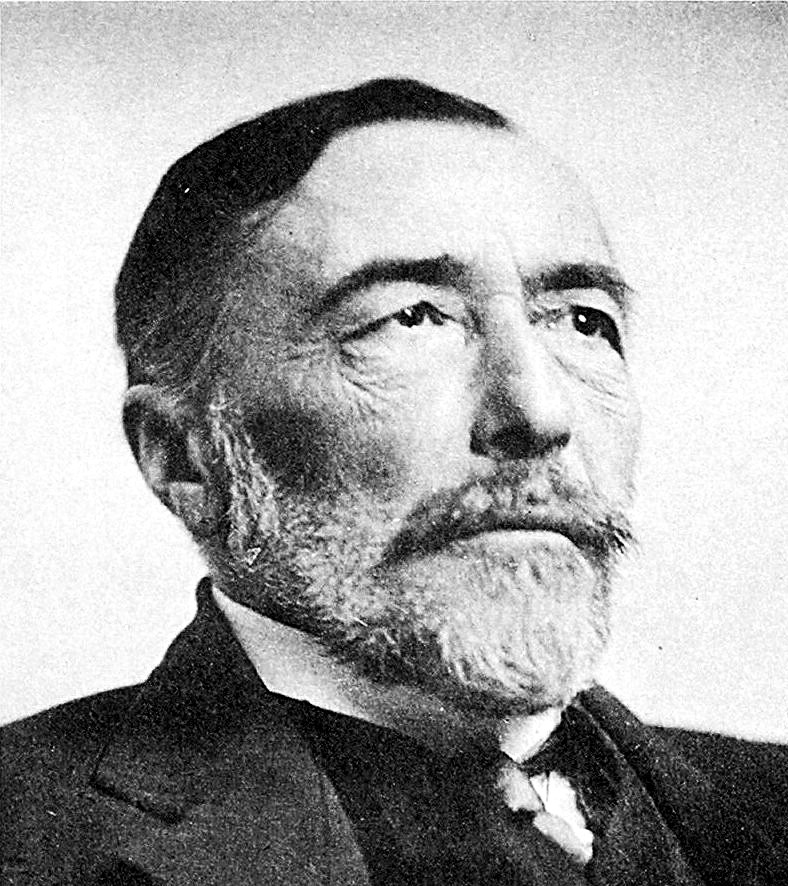
Joseph Conrad (1857-1924) is a fascinating and important novelist, not least because he was a non-native speaker of English.
He left Poland in 1874, for Marseilles, anticipating a maritime career aboard French merchant ships. But he joined the British merchant fleet in 1878, which required him to learn English at the age of 21.
He served in British merchant ships until January 1894, including one short period as captain of the barque ‘Otago’, for a single voyage from Sydney to Mauritius.
He had begun his first novel in 1889, but did not publish it until 1895.
Had he produced only the outstanding novella ‘Heart of Darkness’ (1899), Conrad’s literary reputation would have been assured. But he also published several excellent full-scale novels, ‘Nostromo’ (1904) and ‘The Secret Agent’ (1907) foremost amongst them.
‘Victory – An Island Tale’ (1915) is almost their match, though not quite. It was influential in the composition of ‘Black Diamond Bay’, probably upon Dylan more then Levy.
In January 1976, Allen Ginsberg, himself involved in the Rolling Thunder Review, told Rolling Stone magazine:
‘Like he’s been reading Joseph Conrad recently. ‘Victory’ in particular. I found out when we were talking about the narrative quality of some of the newer songs – ‘Hurricane’ and ‘Joey’ and ‘Isis’. Bob related the way those songs developed to what he’d been learning about narrative and characterisation from Conrad. The way characterisation and mood shape narrative.’
Some years afterwards, when Levy was interviewed, he suggested that, although he too was familiar with Conrad, when writing ‘Black Diamond Bay’ he also had in mind Caribbean islands he had visited, such as Haiti and Martinique.
He also cited as his principal literary influence Graham Greene’s ‘ The Comedians’ (1966), which is set in Haiti. That novel features the Hotel Trianon, in Port-au-Prince. There is a swimming pool suicide and a lover who is married to the Uruguayan Ambassador.
‘Victory’ concerns Axel Heyst, a wanderer, who finds himself in Surabaya, a port in the Dutch colony of Java. He forms a relationship with one Captain Morrison and they together establish a coal company. Heyst takes on the role of manager, living on the remote island of Samburan.
When Morrison dies, the company is bankrupted, but Heyst continues on Samburan with his servant, Wang.
While visiting Surabaya, he encounters Lena, who plays in an all-female orchestra. She is being mistreated by the male conductor and his wife, as well as by Schomberg, the owner of the hotel where the orchestra plays. Heyst removes Lena to Samburan with the help of Mrs Schomberg.
Schomberg informs a trio of adventurers – Jones, Ricardo and Pedro – that Heyst is hiding great wealth on Samburan. They travel there, whereupon Ricardo falls in love with Lena.
But she is accidentally killed when Jones tries to murder Ricardo, realising that he is being double-crossed.
In despair, Heyst commits suicide. Jones finally disposes of Ricardo but is himself drowned, while Pedro is shot by Wang.
The novel begins:
‘There is, as every schoolboy knows in this scientific age, a very close chemical relation between coal and diamonds. It is the reason, I believe, why some people allude to coal as “black diamonds.” Both these commodities represent wealth; but coal is a much less portable form of property.’
And this is from the opening of Chapter 4:
‘A few of us who were sufficiently interested went to Davidson for details. These were not many. He told us that he passed to the north of Samburan on purpose to see what was going on. At first, it looked as if that side of the island had been altogether abandoned. That was what he expected. Presently, above the dense mass of vegetation that Samburan presents to view, he saw the head of the flagstaff without a flag. Then, while steaming across the slight indentation which for a time was known officially as Black Diamond Bay, he made out with his glass the white figure on the coaling-wharf. It could be no-one but Heyst.’
The opening chapter also introduces us to Heyst and his neighbouring volcano:
Everyone in that part of the world knew of him, dwelling on his little island. An island is but the top of a mountain. Axel Heyst, perched on it immovably, was surrounded, instead of the imponderable stormy and transparent ocean of air merging into infinity, by a tepid, shallow sea; a passionless offshoot of the great waters which embrace the continents of this globe. His most frequent visitors were shadows, the shadows of clouds, relieving the monotony of the inanimate, brooding sunshine of the tropics. His nearest neighbour – I am speaking now of things showing some sort of animation – was an indolent volcano which smoked faintly all day with its head just above the northern horizon, and at night levelled at him, from amongst the clear stars, a dull red glow, expanding and collapsing spasmodically like the end of a gigantic cigar puffed at intermittently in the dark.’
Samburan is marked out for the trio of adventurers by this volcano, which is deeply symbolic of the destructive forces that will ultimately be unleashed to consume Heyst.
If you need any further convincing, a picture of Joseph Conrad is included on the record sleeve of ‘Desire’: a sketch of Conrad at Zakopane, Poland, in 1914.
But it is important not to over-emphasise the connection between ‘Victory’ and ‘Black Diamond Bay’. Several overly-creative attempts have been made to tease out infeasibly close parallels between the texts.
It is sufficient to acknowledge the generic influence, and to leave it that.

Historical and Mythical Parallels
‘Black Diamond Bay’ describes a cataclysmic double natural disaster which eradicates a small island, as well as all trace of everyone living upon it (apart from two shoes and a hat).
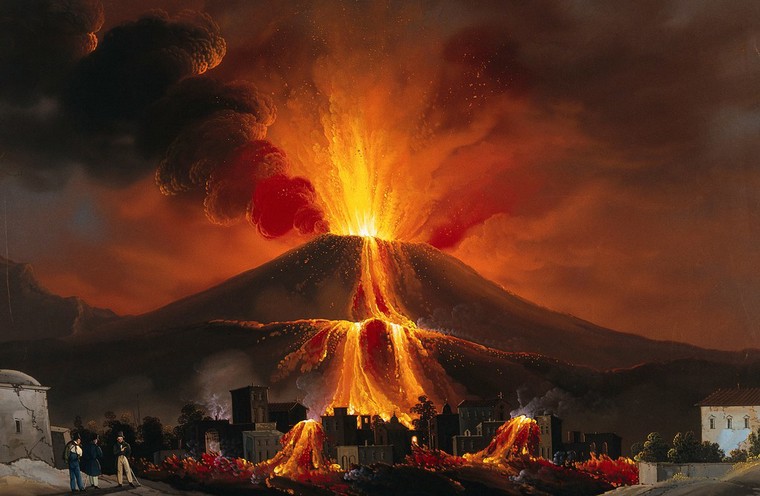
The island’s volcano erupts, sending molten lava pouring down its mountainous sides. The eruption is followed by an earthquake that completely destroys the island, submerging it beneath the waves.
Volcanoes and earthquakes are both caused by movement between the tectonic plates that constitute the earth’s outer layer. Several plates form this outer shell, known as the lithosphere, but they do not fit together well, resulting in several gaps and overlaps.
Volcanoes may result when two plates collide, or when one slides beneath the other. Pressure builds up which ultimately forces magma – molten rock and dissolved gases – through fissures in the earth’s surface.
It is not unheard of for an earthquake to follow a volcanic eruption, most likely because of changes in pressure following the expulsion of magma. But it would be unusual for an eruption to cause a catastrophic earthquake, as opposed to relatively minor tremors.
The best-known factual event of this kind is the destruction of the island of Krakatoa in 1883. Krakatoa was located in the Sunda Strait, between Java and Sumatra. It was 9km long by 5km wide and contained three volcanoes.
On 27 August 1883, there were four huge explosions and two-thirds of the island was destroyed. The third explosion is thought to have been the loudest sound in human history, estimated at 180 decibels.
Krakatoa itself was uninhabited, but the disaster wiped out all 3,000 inhabitants of the nearby island of Sebesi, some 12km away. There were more than 36,000 fatalities all told.
Turning to mythical parallels, by far the best known is Atlantis.
This fictional island empire was originally introduced as an allegory by Plato (c.428-347BC) in his Dialogues though, to provide verisimilitude, he attributed his narrative to one Solon, who had lived a couple of centuries beforehand. Plato’s Atlantis ultimately fell foul of the gods because of the unbridled ambition, greed and corruption of its people.
It didn’t take too long for geographers, historians and philosophers to begin suggesting that Atlantis was, in fact, real. There were advocates for its existence within the Greek, Roman, Jewish and Christian traditions.
After the Renaissance these ancient ideas received fresh impetus, as thinkers began to associate Atlantis with the New World. The connection implicit in More’s ‘Utopia’ (1516) was further developed by Francis Bacon in ‘New Atlantis’ published just after his death in 1626. Meanwhile, Jesuit scholar Athanasius Kircher (1601-1680) argued that Atlantis was a small continent sitting in the middle of the Atlantic Ocean.
Others began to suggest a connection between Aztec and Mayan ruins and the destruction of Atlantis. This notion had acquired some traction by the mid-19th Century and was further advanced by Ignatius L Donnelly (1831-1901), who published ‘Atlantis: the Antediluvian World’ in 1882. It set out his under-evidenced theory that Atlantis was the location of the Garden of Eden and had been destroyed in the Great Flood.
These ideas were taken up by Helena Blavatsky and the Theosophists, who made the connection between Atlantis and racial evolution. Blavatsky’s writings were influential in occultist circles and also amongst the forerunners of the Nazi party.
By the beginning of the Twentieth Century, the myth of Atlantis had gained a strong foothold in the arts, literature and music. To this day it remains prevalent in popular culture.
There are many similar myths, such as the Arthurian legend of Lyonesse, a kingdom stretching from Cornwall to the Isles of Scilly that was swallowed by a giant wave, probably because its inhabitants had committed a terrible, but unspecified, crime.
So, in creating an imaginary island destroyed by ‘Acts of God’, Dylan was tapping into a rich seam of mythical belief which, nevertheless, has some foundation in fact.

Cinematographic Influence, Locations and Characters
Dylanographers have often explored, whether in relation to ‘Black Diamond Bay’ or other ‘narrative songs’ of this period, their apparent film-like quality.
The lyrics switch rapidly from scene to scene, zooming in on the activities of a particular character, before panning across to the next. These scenes are edited together to form a coherent narrative, though the sequence may not be strictly chronological.
Additionally, in ‘Black Diamond Bay’, with the sole exception of the ‘yellow fog’ (see below) the imagery is exclusively monochrome, as if we were watching a film from the 1930s or 1940s.
Many of the characters are virtually cliches from a certain type of film, dealing with the entanglements of Western expatriates in exotic, often tropical locations: the intriguing woman with a mysterious past and a penchant for male attire; the suicidal Greek; the obsessive gambler; the Soviet Ambassador. The hotel is often a stock feature of such films.
We might be viewing the 1940 black and white film of ‘Victory’ – starring Fredric March as Heyst, Betty Field as Alma and Cedric Hardwicke as Mr Jones – or maybe we’re in the company of Lauren Bacall, or Peter Lorre or maybe Sidney Greenstreet.
Except that we know these events took place between 1962 (when Cronkite began presenting the news) and 1975, when Dylan recorded this song.
All the action in verses one to six takes place in what seems a rather grand hotel, most likely dating from the colonial era. It boasts a marble floor, a spiral staircase, bedrooms with chandeliers and even a small casino, or ‘gambling room’.
The first ten lines of each verse mostly describe the interactions between the characters in this hotel; the final two lines of each verse describe wider conditions as disaster approaches.
The hotel is situated upon Black Diamond Bay, which is itself located on a small island with a volcano.
It may owe something to Schomberg’s Surabaya hotel in ‘Victory’ (there is no substantive description in the novel itself) and to that novel’s Black Diamond Bay, which sits upon the fictional island of Samburan, somewhere in the same vicinity. But neither of these had its own volcano.
On the other hand, there are clear Francophone influences, since three of the characters – the desk clerk, the dealer and the stranger – use a mixture of French and English phrases. This might suggest Levy’s reference to Haiti or Martinique.
Then again, the desk clerk wears a fez which, when combined with his French, might suggest Morocco rather than the Caribbean or the Malay Peninsula.
Suffice to say that several different geographical influences have been drawn together to create an imaginary location. The place is ultimately irrelevant to those of us not caught up in its destruction: indeed that is the rather shocking implication of the final verse
The action in that final verse takes place elsewhere, in Los Angeles, USA. An external observer, who uses the first person pronoun, has learned of the disaster as mediated to him through the evening news programme on CBS television. But it makes little impression.
Returning to the events upon the island, there are eight active characters and a ninth is mentioned:
- The Woman: Presumably an expatriate, definitely a hotel guest. She wears some male attire and is mysterious, in that her recent past is unknown and she no longer resembles her passport picture. She is attractive to several of the male characters; she mistakes the identity of one for another; she smiles, laughs and cries; she fears danger and pleads for help. Although inherently mysterious, we know more about her than any of the others.
- The Greek: Clearly an expatriate and a hotel guest. He is bent upon suicide throughout, though it takes him some time to steel himself. Ironically, the woman’s interruption provides the final spur.
- The desk clerk: Most likely a native of the island. Wears a fez, uses a mixture of English and French, sleeps at his desk. He is bothered about the lightning-induced power cut but seems relaxed about the volcanic eruption.
- The soldier: he acts tough with the woman, possibly wanting a relationship with her, but, when the volcano erupts, he crouches in the corner with the tiny man, contemplating ‘forbidden love’.
- The tiny man: initially engaged in trading a ring with the soldier, he too is crouching and contemplating ‘forbidden love’, ultimately taking the initiative by biting the soldier’s ear.
- The gambler: Presumably an expatriate and a hotel guest. He seemingly invites the woman into the gambling room, but is otherwise focused exclusively on betting. After losing persistently, he finally wins big.
- The dealer: Probably native to the island as he, too, speaks a mixture of English and French. Seems in no hurry to allow the gambler to continue the game. Ultimately comments ironically about the gambler’s inability to profit from his winnings.
- A stranger: Also uses a mixture of English and French, so may be native to the island; declares his love to the woman although they are unknown to each other.
- The Soviet Ambassador is mentioned, but all we know is that he must be a hotel guest and resembles the Greek.

A Note on Chronology
The chronology of events is confused.
As the song begins, dawn is approaching. The last ship sails away from the island while the moon fades in the sky. The morning light breaks and a yellow fog lifts. Shortly after dawn, while the light breaks, the Greek requests a pen and a rope.
Then there is a lightning strike that causes a power cut [third verse]. Since the loss of artificial light plunges everything into darkness it must already be night again, an entire day having passed.
But then the sun goes down [fourth verse], so it is night once more, suggesting that we have now reached the end of a second day. Only after this sunset does the Greek finally commit suicide.
Afterwards, the volcano erupts, sending lava flowing down the mountain.
It is unclear over what duration these events are supposed to unfold. Maybe it is a single day and having the lightning create darkness while it is still daylight can be attributed to poetic license.
As the island slowly sinks into the sea, (apparently caused by an earthquake) the floor of the hotel caves in and the basement boiler explodes. A fire continues burning and smoke drifts away.
Ultimately, the island has disappeared. Nothing is left apart from a few items of human apparel.
When the commentator reacts to the disaster in the final verse, enough time has elapsed for others to have learned of the island’s disappearance, and for that news to have been relayed to the far distant United States.
Themes
The seven verses, each with twelve lines, follow a consistent rhyme scheme:
A-B-C-C-B-D-E-F-E-G-G-G
The final rhyme – G – is identical through all seven verses. Each verse ends with the repetition of ‘Black Diamond Bay’.
Each pair of opening lines contains an internal rhyme. In sequence these are: ‘veranda/ and a’; ‘breaks open/rope and’; ‘the fan/tiny man’; ‘laugh/aftermath’; ‘quick/kicked’; ‘sank/bank’; and ‘night/Cronkite’.
The disaster is apocalyptic, ultimately causing the complete disappearance of an island into the sea and, by inference, the death of all its inhabitants. It is almost as if they had never existed, except that two pieces of evidence survive – a hat and a pair of shoes. The wider world barely notices their departure.
Most of the activities engaged in by the cast of characters in their final hours are ultimately pointless, a complete waste of effort.
The Greek commits suicide, but he will die soon anyway. Even his handwritten ‘do not disturb’ sign is ignored. The loser wins big in the gambling room, but will no longer need the money. The soldier buys a ring he will not need either. The woman tries to escape in a taxi, but the last ship has already sailed.
We are presented here with the ultimate futility of human existence. Why do we bother with anything, any activity or relationship, when we’re all going to die in the end?
A second major theme is miscommunication and the avoidance of communication. The woman avoids a conversation with the occupant of the gambling room; the Greek avoids a conversation with her, twice; the Greek wishes to avoid being given a pen that no longer writes; the woman ignores the ‘do not disturb’ sign on the Greek’s door; the desk clerk needs to check he has heard the Greek’s request correctly; the dealer unaccountably asks the gambler to wait, using cod French, when asked to open another deck; the soldier and the woman are possibly at cross-purposes over the ring; the soldier and the tiny man fail to declare their mutual interest in forbidden love; and the subject in the final verse opines that ‘there’s really nothing anyone can say’.
A third theme relates to personal identity and how it may be subjective or shift with time and place. It is developed primarily in relation to the woman, but there is also the (apparent) physical similarity between the Greek and the Soviet Ambassador, the love declared for the woman by a complete stranger, and even the sudden transformation of the relationship between the soldier and the tiny man, from mercantile to amatory.
And finally, there is the theme of apathy and disregard: how we can be completely unaffected by the sorry plight of people who live far away; how little the insular American public cares about what is going on abroad, even when it is mediated to them on the national evening news. This has particular relevance now, given the heavily isolationist ‘America First ‘ stance adopted by the Trump Government.

Verse by Verse Analysis
This exegesis is rather tongue-in-cheek. I’m no Dylanographer, but it’s fun to impersonate their style!
I’ve tried to keep all my points valid, though it is all too easy to drift off into random associations.
First verse
‘Up on the white veranda
She wears a necktie and a Panama hat
Her passport shows a face
From another time and place
She looks nothin’ like that
And all the remnants of her recent past
Are scattered in the wild wind
She walks across the marble floor
Where a voice from the gambling room is callin’ her to come on in
She smiles, walks the other way
As the last ship sails and the moon fades away
From Black Diamond Bay.’
The woman is the first character to appear. We are invited to consider her as she appears upon a white veranda, above, sporting two items of male apparel. Her face is now completely different to her passport photograph, which was taken elsewhere and long ago.
The two lines:
‘And all the remnants of her recent past
Are scattered in the wild wind’
suggest a diary torn into pieces and discarded, perhaps deliberately, so that it becomes impossible to reconstruct the events recorded on its pages. Like the ‘yellow fog (see below), this ‘wild wind’ appears metaphorical, rather than a description of weather conditions upon the island.
The woman acts mysteriously, crossing the marble floor, then smiling to herself and reversing her steps when the voice (of the gambler?) invites her to enter the casino. She clearly does not wish to spend time in his company.
As this is happening, the moon fades, so dawn has broken. The last ship departs, so there is no longer any means of escaping the impending disaster: all these people are doomed, but they don’t yet know it.
Second verse
‘As the mornin’ light breaks open, the Greek comes down
And he asks for a rope and a pen that will write
“Pardon, monsieur,” the desk clerk says
Carefully removes his fez
“Am I hearin’ you right?”
And as the yellow fog is liftin’
The Greek is quickly headin’ for the second floor
She passes him on the spiral staircase
Thinkin’ he’s the Soviet Ambassador
She starts to speak, but he walks away
As the storm clouds rise and the palm branches sway
On Black Diamond Bay.’
The phrase ‘As the mornin’ light breaks open’ is slightly contrived, but necessary to secure the internal rhyme.
Similarly, the desk clerk has to remove a ‘fez’ to secure the rhyme with ‘says’. Why he feels it necessary to remove his hat carefully while clarifying the Greek’s request is otherwise a mystery.
The presence of yellow fog, seemingly more appropriate to a chilly city street than a (presumably tropical) island, has been explained as a reference to T.S. Eliot’s ‘The Love Song of J. Alfred Prufrock’:
‘The yellow fog that rubs its back upon the window-panes,
The yellow smoke that rubs its muzzle on the window-panes,
Licked its tongue into the corners of the evening,
Lingered upon the pools that stand in drains,
Let fall upon its back the soot that falls from chimneys,
Slipped by the terrace, made a sudden leap,
And seeing that it was a soft October night,
Curled once about the house, and fell asleep.’
This is evening fog in a temperate, urban, autumnal landscape, animated in the form of a cat. I haven’t seen a convincing explanation of why Dylan drops it in here, nor of why the fog is lifting.
Perhaps it is an obscure allusion to the inner mental state of the Greek. More likely, it is a casual but largely meaningless literary allusion.
Having obtained his rope and pen, the Greek rapidly ascends the spiral staircase to his second floor room. The woman passes him, so she must be on the way down the staircase now. Maybe the hotel bedrooms are below the veranda, the marble floor and the gambling room.
She mistakes the hurrying Greek for the Soviet ambassador, which seems, on the face of it, a surprising error. She may well be familiar with the Soviet Ambassador, because she starts to address him. Perhaps she has had too much to drink. It seems unlikely that the metaphorical yellow fog is to blame.
The Greek walks away from her, just as she walked away from the voice in the gambling room. He seems intent upon suicide. Meanwhile, the storm clouds are gathering outside and a real wind begins to stir the palm trees.
Third verse
‘A soldier sits beneath the fan
Doin’ business with a tiny man who sells him a ring
Lightning strikes, the lights blow out
The desk clerk wakes and begins to shout
“Can you see anything?”
Then the Greek appears on the second floor
In his bare feet with a rope around his neck
While a loser in the gambling room lights up a candle
Says, “Open up another deck”
But the dealer says, “Attendez-vous, s’il vous plait”
As the rain beats down and the cranes fly away
From Black Diamond Bay.’
The reference to the soldier positioning himself beneath a fan reminds us that this is a tropical location. The tiny man is trading with the soldier, who buys a ring that he will never need. Is he already intending to offer it to the woman?
The purchase completed, lightning strikes the hotel, extinguishing the lights.
It must now be night-time, since the strike plunges everything into darkness. This is supported by the fact that the desk clerk has been asleep, presumably at his desk.
He awakes in the blackout, only to shout ‘Can you see anything?’ This is ironic since the darkness must severely restrict visibility.
In a double irony, the Greek is immediately declared to be visible too, despite the darkness and the fact that he is upstairs, on the second floor. Moreover he is sufficiently visible for observers to notice that he is not wearing shoes and has a rope around his neck (a neat parallel of the woman’s ‘neck-tie’).
He must be outside his room at this point, possibly standing on his balcony. Neither the desk clerk nor anyone else makes any effort to intervene.
Intent on suicide, the Greek has abandoned the struggle for existence, but his decision must be driven by something other than the impending disaster. We are given no clue as to what has brought him to this pass.
Meanwhile, unlike the Greek, the gambler still strives to change his fortunes. He remains in the gambling room and lights a candle, demanding that the dealer open another deck of cards, so he may continue the game. He must be playing alone, against the bank.
The dealer asks him to wait in faulty French (he doesn’t need the first ‘vous’). It’s not at all clear why the loser must wait, since there is precious little time left, but perhaps the dealer wants to restrict his chances of winning.
Outside, rain is now falling heavily and the resident cranes depart the island, no doubt instinctively aware that disaster is imminent. The humans are trapped, however.
Fourth verse
‘The desk clerk heard the woman laugh
As he looked around the aftermath and the soldier got tough
He tried to grab the woman’s hand
Said, “Here’s a ring, it cost a grand”
She said, “That ain’t enough”
Then she ran upstairs to pack her bags
While a horse-drawn taxi waited at the curb
She passed the door that the Greek had locked
Where a handwritten sign read, “Do Not Disturb”
She knocked upon it anyway
As the sun went down and the music did play
On Black Diamond Bay.’
From this point onwards the narrative shifts from the present tense to the past.
The internal rhyme here – ‘laugh/aftermath’ is a little laboured, but probably works slightly better in an American accent.
This action must take place in the darkness after the lightning strike. Presumably, the desk clerk attempts to observe the aftermath of that, so ‘looked around’ continues the irony set up in the previous verse. The fact that he only ‘heard the woman laugh’ rather than see her do so, suggests that visibility remains limited.
This laugh is unexplained, but may have been directed at the soldier who, as a consequence, ‘got tough’. He tries to catch hold of her hand, possibly to place the ring on her finger. Is he proposing a relationship, or offering her payment for transport from the hotel?
The soldier claims he paid ‘a grand’ for the ring, which is highly unlikely. Her response may suggest that the soldier can’t afford a relationship with her, or else that the sum is insufficient to buy his escape. The latter is accurate of course, since no sum of money can save him now.
The woman runs upstairs to pack, having asked a horse-drawn taxi to wait for her below, so she is clearly intent upon leaving. At this point the volcano hasn’t erupted, so her abrupt departure must be attributable to the power cut, to her intuition, or to another, undeclared issue.
On the way to her room she passes the Greek’s door, locked and displaying the ‘do not disturb’ sign he has written. She completely disregards the sign, presumably because she believes the danger she anticipates should trump its injunction.
But why has she selected the Greek? Does she still believe he’s the Soviet Ambassador?
‘And the music did play’ is there solely for the rhyme, the redundant ‘did’ clumsily provides the extra syllable required. There has been no reference to music before – though perhaps we are supposed to associate this with musicians playing aboard the Titanic, or another sinking ship.
Fifth verse
‘“I’ve got to talk to someone quick!”
But the Greek said, “Go away,” and he kicked the chair to the floor
He hung there from the chandelier
She cried, “Help, there’s danger near
Please open up the door!”
Then the volcano erupted
And the lava flowed down from the mountain high above
The soldier and the tiny man were crouched in the corner
Thinking of forbidden love
But the desk clerk said, “It happens every day”
As the stars fell down and the fields burned away
On Black Diamond Bay.’
It’s immediately clear that the woman isn’t knocking to interrupt the Greek’s suicide, of which she is completely unaware. She says she has to talk to someone quickly, which finally spurs the Greek to kick away his chair, so he is hanging from the chandelier.
Unaware that he is now helpless to assist her, she asks for his help because there is some imminent danger. Is this the impending natural disaster or is it something completely different? Probably the latter, since it is otherwise doubtful what help a chat with the Greek (or even the Soviet Ambassador) would have provided.
There is a neat parallel between ‘Open up the door’ in this verse and ‘Open up another deck’ in the third verse. The irony is heavy, in that the Greek is already dying, so completely unable to provide any assistance whatsoever.
It is only at this point that the volcano erupts, sending lava flowing down, but there is as yet no warning of the earthquake to follow.
Having completed their trade for the ring, the soldier and the tiny man are once more together, crouching in the corner. The next line presumably implies that they are both contemplating a homosexual act, though quite why is anyone’s guess. Is there the merest hint of Pompeii here?
The desk clerk’s comment may apply either to the volcano erupting or to the incidence of homosexual affairs.
He seems completely relaxed, but the reference to stars falling is apocalyptic, while the burning fields suggest that the lava has descended the mountain, reaching agricultural land below.
Sixth verse
‘As the island slowly sank
The loser finally broke the bank in the gambling room
The dealer said, “It’s too late now
You can take your money, but I don’t know how
You’ll spend it in the tomb”
The tiny man bit the soldier’s ear
As the floor caved in and the boiler in the basement blew
While she’s out on the balcony, where a stranger tells her
“My darling, je vous aime beaucoup”
She sheds a tear and then begins to pray
As the fire burns on and the smoke drifts away
From Black Diamond Bay.’
The island has begun to sink beneath the sea, so the earthquake has struck. Although complete destruction is imminent, the process is slow.
It is at this point that the gambler breaks the bank, though he is still a ‘loser’ because he, like everyone else, is doomed. The dealer allows him to take the money, knowing that he will be unable to spend it. The reference to ‘the tomb’ is contrived for the purpose of the rhyme – none will enjoy the luxury of a burial service.
The tiny man is belatedly engaged in playful sexual foreplay with the soldier when the hotel’s floor collapses and the boiler explodes. Meanwhile, the woman is now on the balcony, rather than the veranda, as a stranger addresses her.
He calls her ‘my darling’ and tells her in French that he loves her very much. ‘Je vous aime’ rather than ‘je t’aime’ because she remains a complete stranger to him.
She begins to cry and then to pray, but to no avail. The fire from the volcano continues to burn and will only be extinguished when the island finally slides beneath the sea.
Seventh verse
‘I was sittin’ home alone one night in L.A.
Watchin’ old Cronkite on the seven o’clock news
It seems there was an earthquake that
Left nothin’ but a Panama hat
And a pair of old Greek shoes
Didn’t seem like much was happenin’,
So I turned it off and went to grab another beer
Seems like every time you turn around
There’s another hard-luck story that you’re gonna hear
And there’s really nothin’ anyone can say
And I never did plan to go anyway
To Black Diamond Bay.’
The final framing verse has a very different location. The narrator/singer, now using the first person, is at home, on his own, in Los Angeles, watching the seven o’clock evening news. ‘Old Cronkite’ is Walter Cronkite (1916-2009), the anchor on CBS news from 1962 to 1981.
A news item confirms that an earthquake followed the volcanic eruption. The island has vanished and Black Diamond Bay no longer exists. The only surviving artefacts are the woman’s hat and the Greek’s shoes. They alone prove that these individuals once existed. They now exist no longer.
As for the other characters we have encountered – the desk clerk, the gambler, the soldier – it is as if they had never been. It is as if Black Diamond Bay, the hotel and all its guests were merely a fiction (which, of course, they are.)
But surely Black Diamond Bay must have been real because its destruction is being reported on the news? Except that the news is also a fiction, even though it purports to be real.
The singer dismisses this and the other news stories as insignificant, turns off the television and drinks a beer. It’s not his first of the evening.
He reflects on the frequency of ‘hard luck stories’ such as this. It is as if, by hearing them so often, we become inured to the impact on the people concerned. They are not individuals to us, with unique lives, ambitions, fears, but simply those who have had the misfortune to become victims.
He concludes that ‘there’s really nothin’ anyone can say’ in response to such disasters and the death that results. They have an inevitability about them. No words will restore the island, or the dead people back to life.
In any case, they are completely irrelevant to him personally because he had no intention of visiting Black Diamond Bay.

Personal significance
Unlike some of my earlier choices, I have only vague memories of hearing this song for the first time. It was almost certainly while listening to Radio Caroline, since I can clearly recall them playing other tracks from ‘Desire’ frequently in 1976, especially ‘Hurricane’, and ‘Joey’.
I vaguely recall a trip I made to Llangrannog, in Ceredigion, Wales, possibly in the summer of 1979. I know I was travelling with Jeff K-S and Chris B to the latter’s farm. As I recall, Chris drove in front, while I travelled with Jeff who followed him as he sped down the narrow winding country lanes.
I think Jeff had tapes of both ‘Desire’ and ‘Blood on the Tracks’ in his car, and that we listened to both on the journey down.
Jeff and I slept in a caravan some way from the farm. I can’t remember too much else from that trip, now almost half a century ago. Except that they very nearly launched me into the Bay while I was sitting in Chris’s canoe on the beach!
Did we also spend some time aboard a small cabin cruiser while they discussed piloting it across the Irish Sea? I seem to be able to remember none of the pleasure; only the fear!
I lost touch with them both a long time ago.
Later, Black Diamond Bay would regularly feature in the upper reaches of my New Year’s Eve ‘Top 20’ (It became a family tradition for the three of us to compile our annual charts, playing them in turn on the evening of December 31st, while we waited for Hootenanny to kick in.)
No matter how many times I hear it, the tune remains infernally catchy, always playing in my head for days afterwards.
I still enjoy the narrative, though it doesn’t really stand up to forensic scrutiny. But it’s a great song, not a great poem.
Provided one accepts the tale as impressionistic and pregnant with imagery, rather than an accurate record of events that might actually have happened, it will never disappoint.
Various forms of obsessive human behaviour – suicide, sexual desire and conquest, compulsive gambling – are played out against an apocalyptic background which serves to highlight the pettiness and pointlessness of so much human activity.
Ultimately, ‘Black Diamond Bay’ is pointing out that the joke is on us, by virtue of the human condition.
Elizabeth Nelson wrote on Pitchfork:
’Black Diamond Bay,’…is remarkably tuneful, ruefully ominous, and utterly batshit. I have been listening to it for two decades, and I still have no clue what is happening. There is a Greek man, a woman in a Panama hat, a soldier, a tiny man, a volcano. Portends of suicide and disaster percolate: scheming gamblers and sunken islands, betrayals and broken bonds, the kind of Book of Revelation stuff Dylan would get into full-time soon enough. Through some mysterious alchemy, its incoherence yields real beauty, abetted by an incredibly committed performance from his ace backing band…Try to grasp the details of ‘Black Diamond Bay,’ or just let the imagery carry you away. Like everything on Desire, it’s all misdirection and magic anyway.’
TD
August 2025







 Eponymous
Leave a comment