

We’ve reached the seventh in this sequence of twelve posts, each exploring a musical composition with particular personal significance.
Each musical choice is linked in some fashion with its immediate predecessor. I hope to end in December (or thereabouts) with a piece of music that has some sort of connection with my first selection, back in January.
This has been the sequence to date:
- January: ‘Ya Jean (Remix)’ by Madilu System
- February: ‘Autorail’ by Orchestre Baobab
This time I have chosen ‘Thinking of You’ by Sister Sledge.
One connection between that and ‘Ev’ry Time’ is that, like Ella Fitzgerald, the four Sledge Sisters gained valuable early experience from singing in a Methodist Episcopal Church.
‘Thinking of You’ was included on the seminal 1979 album ‘We Are Family’ and, like all the tracks on that album, was written and produced by Nile Rodgers and Bernard Edwards, fresh from their huge initial success with Chic.
It featured as a B-side, backing ‘Lost in Music’, but wasn’t released as a single in its own right until June 1984, when it reached Number 11 in the UK singles chart. It also made Number 17 in 1993.
The song has been remastered at least twice, in 1995 and 2006. Several remixes, of variable quality, have also been released and the record has been sampled by numerous artists.
I wanted to feature a disco choice in this series, because dancing has given me great pleasure over the years. I’ve tried to choose something broadly representative of the genre; a track that dates from the period when disco was at its peak, but that has also aged well.
The Sister Sledge story is fascinating in its own right. They struggled for several years to have a major hit, made one truly outstanding album, then almost immediately began a slow, inexorable decline.
Ultimately, sibling rivalry brought about the inevitable split, followed by decades of recriminations and a legal battle over who owned the rights to the Sister Sledge name. But that part of their history lies outside the scope of this post.
As for ‘We Are Family’, the chemistry that evolved between the group and their producers is equally fascinating.
These four talented and yet deeply religious young women had struggled for years to make a real breakthrough. They believed in hard work, dedication and effort ultimately paying off. Rodgers and Edwards weren’t quite an instant success, but they’d achieved superstardom far more quickly. They also favoured spontaneity over intensive rehearsal.
The four sisters hadn’t been completely averse to exploiting their undoubted sex appeal, but they would only go so far, striving always to project a wholesome family image, through how they looked and what they sang.
Rodgers and Edwards embraced their family values, which became the underlying theme of the entire project, but they also deliberately pushed the girls beyond their comfort zone, sometimes increasing the level of lyrical suggestiveness, and invariably deploying the relentlessly funky, quintessentially sexy Chic disco groove.

Sister Sledge’s Origins
I want to begin by exploring in some depth how Sister Sledge became like they were.
The four principal singers – Debbie, Joni, Kim and Kathy – were born to Edwin Sledge (1922-1996), and Florez, nee Williams (1928-2007) between 1954 and 1959.
Edwin and Florez had both been in the entertainment industry.
He was a tap dancer, part of a duo called ‘Fred & Sledge’ that seems to have surfaced initially in San Francisco, circa 1944.
Variety offered the following assessment in July 1948:
‘FRED & SLEDGE
Dancing, 5. Mins, Apollo, N. Y.
A Negro male tap team clad in dark suits and flaring red ties, Fred and Sledge is an average turn which differs little from similar dancing acts. Boys open with some brisk footwork, then contribute a novelty vocal. They do a bit of individual challenge stuff, and blend later for some fast stepping to win an okay reception at this Harlem vaudeville house. Team impresses as a satisfactory unit for theatres and niteries using sepia talent, but aren’t quite ripe for the deluxe spots.’
Despite that faint praise, Sledge appeared on Broadway, as part of the original cast of ‘Kiss Me Kate’, which opened at the New Century Theatre in December 1948.
(Since ‘Kiss Me Kate’ was also written by Cole Porter, there is a second, supplementary connection with ‘Ev’ry Time’.)
Fred and Sledge appeared on US television on a handful of occasions in the early 1950s, but then seemed to vanish from view.
Florez Kathy Williams was a dancer and chorus girl from Youngstown, Ohio. She was the daughter of Viola Beatrice nee Hairston (1908-1987) and a labourer called Floyd Marmon (1906-1949).
Her mother, Viola, was a coloratura soprano who sang lyric opera, performing regularly at concerts in her home city of Winston-Salem, North Carolina.
She had attended Bethune-Cookman College, a private institution associated with the Methodist church, as a personal protege of its founder, Mary McCloud Bethune. She had also been to the Juilliard School.
She later married James Carl Williams (1906-1959), hence her daughter’s surname.
Florez performed with choreographer Joe Noble’s dancers and also with Lorraine Knight’s. She is reputed to have had bit parts in films, but I’ve been unable to confirm any appearances.
She fell pregnant while appearing in a show called Creole Follies at the New Town Tavern, a night club in Delair, New Jersey. Her daughter, Norma Carol Blackmon (or Blackman), was born in January 1948, when Florez was barely 20. Norma’s surname suggests that Edwin was not her biological father.
Florez did not marry Edwin until 1954, at which point they moved to West Philadelphia where the four remaining daughters were born.
But Florez and Edwin divorced in 1964, when their youngest daughter was only five. He had at least one further child with a woman called Ruby L Hayes, who he later married, eventually becoming a Baptist minister in Texas. He seems to have had little further contact with his family in Philadelphia.
Viola, their grandmother, was a strong influence on the young children from the outset. She taught them to sing and harmonise, and apparently had them performing at social events as early as 1960, when they ranged from 2 to 6 years old. They became known as ‘Mrs Williams’ Grandchildren’.
At the same time, they began singing in church services, notably at the Williams Temple Christian Methodist Episcopalian Church, on Lindbergh Boulevard, though some sources also mention the Second Macedonia Baptist Church.
They made their first television appearance on ‘The Al Alberts Showcase’ a local Philadelphia talent show.
After Edwin’s departure, Florez raised her daughters as a single mother, with extended support from her mother and her eldest daughter. She worked as a waitress, dining room manager and night club hostess, occasionally juggling up to three jobs.
One employer reputedly gave her the Chevrolet Impala convertible that the family used as a makeshift tour bus.
All four girls graduated from Olney High School in Philadelphia, and went on to Temple University, also in Philadelphia.
The four principals
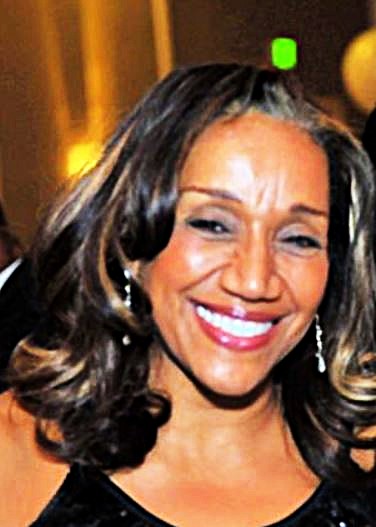
Before describing the group’s early career, it may be helpful to have a potted biography of each of the four sisters. These are relatively slim, since they have allowed few details into the public domain:
- Debra Edwina (‘Debbie’) Sledge, the eldest, was born on 9 July 1954. She attended Temple’s Tyler School of Art, where her first husband, Bernard Young, also studied. He is presently a professor of art education at Arizona State University. They had six children together, the eldest born in 1977. During the late 1970s she spent time away from Sister Sledge on ‘maternity leave’, and was occasionally replaced by elder sibling Norma Carol. She married her second husband, Dutchman Jeroen de Bruine, in 1993, and has three further stepchildren as a consequence. They met at a gig in the Netherlands, when he was invited from the audience to dance with the group on stage. She continues to tour and record as ‘Sister Sledge featuring Sledgendary’, which also features her daughter Camille and her son David.
- Joan Elise (‘Joni’) Sledge was born on 13 September 1956. At Temple University she studied communications, directed a stage play and appeared in other productions. She occasionally took lead vocals when the group were in their prime (eg ‘Lost in Music’) and took over from Kathy when she left. In 1992 she married Thaddeus E White III and they had a son, Thaddeus E White IV, who also plays in ‘Sledgendary’. She died on 10 March 2017, aged 60, owing to complications associated with a pre-existing condition (that I can find nowhere specified).
- Kim Sledge was born on 21 August 1957. At Temple she majored in Pan-African Studies and Economics. She later undertook legal studies. In 1979 she married Bernard Hopewell, Executive Director of the YMCA in Chester, Pennsylvania. But this seems to have been relatively short-lived, and she later married a doctor, Mark Allen. They have three adult children. In 2000 she was ordained a minister by the International Fellowship of Christian Ministries, based in Florida. She left ‘Sledgendary’ in 2020.
- Kathy Sledge was born on 6 January 1959. At Temple she studied community and therapeutic recreation for children, but did not graduate. In 1981 she married musician and record producer Philip Lightfoot, a former drummer in the Sister Sledge band, and they have two children together, born in 1983 and 1985 respectively. Kathy left the group in 1989 saying she wanted a solo career. Her debut solo album ‘Heart’ was released in 1992. In 2014 she was sued by her sisters for using the ‘Sister Sledge’ name, the suit ultimately being settled out of court in 2021. She now appears as ‘Sister Sledge featuring Kathy Sledge’.
The long quest for a major hit
Sister Sledge turned professional in 1971, releasing their first single ‘Time Will Tell’ on the Philadelphia-based Money Back label. It was written and produced by Marty Bryant, who also worked with the Stylistics.
It is said that elder sister Norma Carol was instrumental in getting them this record deal, through the influence of her then boyfriend who was drumming for the Stylistics. I think that must have been Earl Young.
By May 1972 the foursome were appearing regularly at local Philadelphia venues, initially under the name ‘Sisters Sledge’. They signed with ATCO (an abbreviation of Atlantic Corporation), which began life as a sub-label of Atlantic Records dedicated to soul, blues and jazz.
Some sources state that Atlantic were recommended to sign them by Philadelphia-based writers Phil Hurtt and Tony Bell, who had already agreed their own publishing deal with the label. They were familiar with Sister Sledge because Hurtt’s wife had befriended Florez while they both worked as hostesses at the Playmate Supper Club.
Other sources indicate that Buddy Allen, manager of the Detroit Spinners, was instrumental in obtaining their Atlantic recording contract. For a time, from the mid-70s onward, he also managed Sister Sledge.
In effect, their ‘audition’ consisted of some session work at Sigma Studios, where they were employed as backing vocalists for various artists associated with Gamble and Huff.
Then in March 1973 they released a second single, ‘The Weatherman’, written by Hurtt and Bell and produced by members of The Young Professionals, (aka Hurtt, Bell and Le Baron Taylor, Vice President of A&R at Atlantic). It was recorded at Sigma with backing from members of MFSB.
Their third single was ‘Mama Never Told Me’, released in August 1973, written and produced by the same team. Two years later, in 1975, it became a moderate hit in the UK, reaching Number 20 in the UK singles chart on 13 July (while the Bay City Rollers were at Number 1).
In the summer of 1974 they were booked into Club Harlem, Atlantic City, which prided itself as the principal showcase for black musical talent on the eastern seaboard. They were booked to play the smaller lounge, but were later moved into the main hall, playing up to five shows a night and sharing the bill with the Detroit Spinners.
That August they also opened for The Pointer Sisters, which must have led to some interesting comparisons.
The only contemporary review I can find says:
‘It’s a heck of a spot to be on the same bill as the Pointer Sisters, but the Sisters Sledge [sic] proved capable and promise a bright future.’
Soon afterwards they travelled to Africa to play at ‘Zaire 74’, the three-day music festival that preceded The Rumble in the Jungle. They opened the third day, which also featured The Pointer Sisters and was headlined by James Brown.
They were last minute replacements, having been called up alongside Etta James, the Pointer Sisters and Bill Withers, because Aretha Franklin, Stevie Wonder, Jonny Nash, Marvin Gaye and the O’Jays all had to cancel.
They apparently incorporated introductions and lyrics in French, which went down particularly well with the Francophone audience. They also tried valiantly to teach James Brown some elementary French.
When power was lost during their performance, they filled in by dancing the steps normally reserved for their rendition of Aretha Franklin’s ‘Spirit in the Dark’.
They had to wait a further year for their first minor US hit, ‘Love, Don’t You Go Through No Changes on Me’, released in November 1974. This just squeezed into the Billboard Top 100. It was written by Patrick Grant (aka Haras Fyre) and his girlfriend Gwen Guthrie. The producers were Tony Silvester and Bert de Coteaux. Silvester had been a member of The Main Ingredient, while De Coteaux had worked with them as producer and arranger.
This time round, Atlantic’s press and publicity department pulled out all the promotional stops. One media story concluded:
‘At Atlantic word has gone out from Senior Vice President, Henry Allen, for his promotional staff to spare no energy in getting their record around to the nation’s disc jockeys when it is released.
“I wouldn’t want to deny the nation’s music lovers the pleasure of hearing what I consider the finest, and newest, quartet around,” he said.’
The song was a big hit in Japan, which led to them being invited to the 4th Tokyo Music Festival in July 1975, where they won one of two Silver Prizes and $2,000. (The $10,000 Grand Prize was won by Maureen McGovern.)
Sister Sledge’s first album ‘Circle of Love’ was released on 23 January 1975. Fyre and Guthrie wrote six further tracks on the album, while Silvester and de Coteaux were retained as producers. It was recorded at the Media Sound Studios in New York.
The following month they opened for the Temptations in their first big Philadelphia show, at the Latin Casino. The Entertainment Editor of the Courier-Post posted a mixed review. He felt they needed more stage experience, as well as a more distinctive sound and image.
By this time they were citing as key influences Stevie Wonder, Gladys Knight and Minnie Riperton. They credited their elder sister ‘Carole’ with developing their style, adding that, although she had sung with some local groups, she had decided against a show business career. (Though she did later appear occasionally as a substitute for Debbie, she mostly taught remedial reading in Philadelphia schools.)
In April 1975 Sister Sledge visited the UK as part of the Super Soul Tour, alongside the Detroit Spinners, Ben E King and Jimmy Castor. Two months later they appeared on ‘Top of the Pops’, and their Super Soul concert at the Hammersmith Odeon featured on ‘The Old Grey Whistle Test’.
Another US single, the title track from the album, was released in March 1975, followed in October by a stand-alone single, ‘Love Has Found Me’, written by Kathy Sledge with Don Freeman. De Couteaux and Silvester produced.
There was limited positive publicity, but no major breakthrough, so they returned to the life of perpetual support act, opening for the Detroit Spinners and the Four Tops.
By February 1976 they had already begun recording a second album. Some of their (increasingly limited) media coverage began to describe them as ‘still looking for their big break’.
Various efforts were made to turn things around. They were moved from ATCO to Cotillion Records, a subsidiary label distributed by Atlantic, and teamed with a new producer, Bobby Eli. He had been lead guitarist with MFSB and later co-wrote ‘Zoom’ for Fat Larry’s Band.
A single, ‘Thank You for Today’, was released in June 1976, written by Bobby Eli and Lee Phillips. That was followed by ‘Cream of the Crop’ in November 1976, written by Bobby Eli and Len Barry. Neither was particularly successful.
The second album, ‘Together’, was finally completed in Germany early in 1977. Cotillion had sent them over to Munich, to work with producers Michael Kunze and Sylvester Levay. They were behind Eurodisco band Silver Convention and responsible for their hits ‘Fly, Robin, Fly’ and ‘Get Up and Boogie’. (Silver Convention also represented Germany in the 1977 Eurovision Song Contest, finishing eighth.)
Kathy Sledge wrote two of the songs for the album and Joni one.
A contemporary review from The Palm Beach Post says:
‘The results are certainly interesting: Sister Sledge’s vocals show far more personality and spunk than the disembodied Silver Convention. On the other hand, that group’s charms at its best derived from its very stance of hypnotic alienation, and the blend of Munich coldness and Philadelphia warmth sometimes emerges lukewarm. But some of the songs are fine, and everyone interested in a still-developed [sic] talent would do well to give ‘Together’ a listen.’
The album was released in August 1977. Singles from it were: ‘Blockbuster Boy’ and ‘Baby It’s the Rain’, both written by Levay and Kunze. The first reached Number 61 on the US R&B chart; the second tanked.
The European experiment clearly hadn’t worked, so Cotillion next tried Muscle Shoals. In 1978 Sledge recorded the double A-side, ‘I’ve Seen Better Days/’Do it to the Max’. This was produced by Brad Shapiro, who had previously worked with Wilson Pickett and Millie Jackson.
It sank more or less without trace, though is now occasionally cited as a forgotten classic.
Despite all these false starts, it seemed that Atlantic Records still had faith in Sister Sledge, believing they could make the breakthrough that had so far eluded them.
But there was mounting frustration inside the group, the girls beginning to wonder whether they should instead pursue alternative careers.

Cue Nile Rodgers and Bernard Edwards
Nile Rogers had been born in New York in 1952 to a 14 year-old mother and an itinerant percussionist who died in 1970. His mother married his white, Jewish stepfather in 1959. Both were addicted to heroin, as was his biological father. Rodgers himself began using drugs at 13, but preferred cocaine and alcohol.
He intended to follow in his father’s footsteps as a percussionist, but switched to flute because there was a vacancy in the school orchestra, then to clarinet and finally to guitar.
He was recruited into the Black Panthers and became a session musician, touring with the Sesame Street Band and then joining the Apollo Theatre house band.
In 1970 he met Bernard Edwards, also born in 1952, in North Carolina. He had moved to New York aged 10 and, though he initially played saxophone, soon took up electric bass.
After jamming together extensively, they formed the Big Apple Band. In 1972 they served as backing band for the vocal group New York City, who had a hit with ‘I’m Doin’ Fine Now’ and, off the back of that, toured as support for the Jackson 5.
For a while they were known as The Boys, and recruited Tony Thompson, who had been Labelle’s drummer. Following the emergence of another Big Apple Band, the trio altered their name to Chic. They added a teenaged keyboard player, Raymond Jones, and recruited singer Norma Jean Wright.
Early in 1977, the five of them recorded ‘Dance, Dance, Dance (Yowsah, Yowsah, Yowsah)’ at the Power Station recording studios, with engineer Bob Clearmountain and Luther Vandross on backing vocals. Rodgers and Edwards co-wrote and co-produced with Kenny Lehman.
This wasn’t instant fame. Rodgers and Edwards had been out of permanent work for a couple of years and were desperately short of money. Moreover, their single had been rejected by at least two record companies before Atlantic picked it up.
Their eponymous debut album was released on Atlantic at the end of 1977, featuring the full 8 minutes and 21 seconds of ‘Dance, Dance, Dance’, alongside ‘Everybody Dance’ which became their second single, released in April 1978.
A second album, ‘C’est Chic’ followed in August 1978. It was again recorded at Power Station and was even more successful, featuring both ‘Le Freak’ and ‘I Want Your Love’.

We Are Family
Rodgers and Edwards had just produced a solo album by their erstwhile lead singer, Norma Jean Wright, but that was their sole experience of working with other artists.
Even so, Atlantic were convinced that the Chic production magic would usefully reinvigorate other acts in their stable.
Chic were flavour of the month, so they could have their choice of artists. It may or may not be apocryphal that they were even offered the Rolling Stones!
But they preferred to work with artists who wouldn’t be guaranteed a hit. Then they, as producers, would get a bigger share of the credit.
They were inspired to select Sister Sledge by Jerry L. Greenberg, the youthful President of Atlantic Records.
As Rodgers recalled:
‘That’s why we came up with ‘We Are Family’. Everything he said about them gave us a picture of them. You’ve got to remember, we’ve never even met them. All of the content on that record came from that one day with the president. I was fascinated and enthralled by the concept of people who loved music who could be in the midst of the whole disco era.’
That final sentence is interesting. Rodgers clearly saw Sister Sledge as music lovers, most likely with broad experience and a broad musical repertoire, but not yet a disco act.
So, in the second half of 1978, Rodgers and Edwards teamed up with Sister Sledge to produce the disco album ‘We Are Family’.
The girls had heard and liked the Norma Jean Wright production, but they’d had so many setbacks and disappointments that they tempered their expectations.
By all accounts, they found the recording process difficult. They were used to intensive rehearsal, their watchwords discipline and efficiency. They would typically build each song from its foundations, progressively refining both music and lyrics, developing it to perfection.
But Rodgers and Edwards demanded lyrical spontaneity, albeit within their own tightly prescriptive musical framework.
So, when Sister Sledge entered the studio, they found that most of the music had already been laid down. Chic’s vocalists, working alongside Luther Vandross, had even sketched in the backing vocals.
But, when it came to the lyrics, Rodgers and Edwards would write quickly, under pressure, even while other tracks were being recorded. And they wouldn’t show the girls the songs until immediately before they were due to record them.
Kathy Sledge has said:
‘They wouldn’t show us what they were doing because they said they wanted spontaneity. Everything with them was: “We want the spontaneity.”
“But we want to learn the part.”
“But we want the spontaneity.”
“But we want to know what we’re singing.”
And then they’d sing the melody. But they weren’t really people who could sing, so it was fun, but frustrating.’
There were also tensions over the harmonies, mainly because Debbie Sledge was used to working those out for her sisters, but now found herself arguing the toss with Bernard Edwards. Rodgers tried to mediate.
On the final day of recording, they were given ‘We Are Family’ which the pair said they had written about the Sledges.
It would be perfectly possible to argue, as some critics have, that the rich, variegated Sister Sledge sound was subjugated, almost completely, to fit the Chic formula – that their spiritually driven, sophisticated rhythm and blues was straitjacketed to fit the successful disco template.
Rodgers once declared:
‘Pound for pound, I think ‘We Are Family’ is our best album hands down.’
One could interpret that in different ways, of course. Does it mean that ‘We Are Family’ encapsulated the signature Chic sound even more successfully than their own records? Or, alternatively, that Sister Sledge’s uniquely powerful contribution elevated this album above all their other work as producers?
It seems to me the perfect example of two distinct but related musical traditions being deliberately forced into collision, so that the resulting fusion generates a new whole, far greater than the sum of its parts.
Three of the tracks were huge hits for Sister Sledge, in order of release:
- ‘He’s The Greatest Dancer’ (February 1979) reached Number 9 in the US and Number 6 in the UK. Rodgers and Edwards had originally planned to record it with Chic, while Sister Sledge would take ‘I Want Your Love’. There was allegedly some resistance amongst the elder sisters to the lyric ‘My crème de la crème, please take me home’, which they found just a little too forward. But the writers prevailed.
- ‘We Are Family’ (April 1979), reached Number 2 in the US and Number 8 in the UK. The title track, which began as a paean to sisterly love, was soon adopted as an anthem by those advocating all forms of inclusion and integration, regardless of race, gender, ability or sexuality. It was also adopted by the Pittsburgh Pirates baseball team, on their way to the 1979 World Series, which no doubt helped its US chart position.
- ‘Lost in Music’ (August 1979), reached Number 17 in the UK that year, Number 4 in 1984 and Number 14 in 1993. The lead vocal was taken by Joni Sledge, who described recording it as ‘like singing in a trance’. The girls worried that it was too repetitive, but repetition was of course integral to the Chic groove.
Nile Rodgers had an interesting take on their collaboration with Sister Sledge:
‘Kathy Sledge and I have been friends right from the moment go.
She was 16 years old, she was very, very religious and we had written lyrics that were of the time, for them. They didn’t even know what we were talking about when we wrote the lyric ‘Halston, Gucci, Fiorucci’. First time anybody had ever name checked fashion designers…
…We did that because we wanted Sister Sledge to be part of this new black movement which was called the Buppie movement, the black urban professions. We wanted Chic and Sister Sledge and everybody who was attached to us to be a part of that movement. So of course, they would know about fashion, of course they would understand the finer things.
…It was an aspirational type of attitude that we had. After the black power days of the 60s and early 70s now we were going to collect our bounty after having demonstrated and having so many of our brothers and sisters killed or beaten or jailed or what have you. Now was the time to celebrate what we believed was a victory. And the victory music and the victory dance was disco.’

‘Thinking of You’
‘Thinking of You’ was originally the final track on side one of ‘We Are Family’, occupying 4 minutes and 20 seconds.
It subsequently appeared as the B-side of ‘Lost in Music’, but was not released as an A-side in its own right until June 1984, when it was almost six years old.
And, as far as I can establish from discographies, it was only released in the UK and Europe, as both a 7-inch and a 12-inch single, but not in the United States.
Having taken so long to scale the heights and reach their peak, Sister Sledge had already begun their decline.
After ‘We Are Family’, their next album, ‘Love Somebody Today’, also written and produced by Rodgers and Edwards, had been released in March 1980. It proved only moderately successful, spawning three singles that failed to threaten the upper reaches of the charts.
In 1981, they had recorded ‘All American Girls’ with Narada Michael Walden. They co-produced this intentionally ‘post-disco’ album, while Kathy and Joni wrote the songs. But nothing made it into the top half of the Billboard chart.
In 1982, they self-produced ‘The Sisters’, their sixth studio album. Their cover of ‘My Guy’ reached Number 69 on the charts.
In 1983, ’Bet Cha Say That to All the Girls’, produced by George Duke, was not a great success.
But the belated release of ‘Thinking of You’ in the UK and Ireland in June 1984 sparked a mini-resurgence, in Europe at least.
It was followed in September 1984 by a re-release of ‘Lost in Music’ which made it to Number 4 in the UK singles chart. Then in 1985, ‘Frankie’ from their new album ‘When the Boys Meet the Girls’, reached Number 1 and was the fifth best-selling single of that year.
What is so good about ‘Thinking of You’?
The lyrics are none too special, fairly simplistic and with one or two glaring faults.
‘Everybody, let me tell you ’bout my love
Brought to you by an angel from above
Fully equipped with a lifetime guarantee
Once you try it, I am sure that you’ll see
[Pre-chorus](Without love) Without love, there’s no reason to live
(Without you) And what would I do with the love I give?
(All my lovin’) To you, I’ll be giving
And I promise, this I’ll do, as long as I’m living
[Chorus]
I’m thinking of you and the things you do to me
That makes me love you, now I’m living in ecstasy
Hey, it’s you and the things you do to me
That makes me love you, now I’m living in ecstasy
All the time he makes me glad that I’m alive
But together, we will survive
What do you think brought the sun out today?
My baby, yeah, help me sing.
[Pre-chorus][Chorus]
That ‘Everybody’ at the start of the opening stanza causes all kinds of problems. The stanza would make better sense if addressed to the object of the singer’s love, but it simply doesn’t make sense when addressed to ‘Everybody’ instead.
Later on, the line ‘But together, we will survive’ is also pretty lame, but ‘alive’ had rather boxed them into a corner rhyme-wise.
Musically though, the song is delicious, from Rodgers’ opening staccato guitar notes, backed by Sammy Figueroa’s bongos (and maybe some rimshots from Tony Thompson). Together, they have a full twenty seconds before they’re joined by the lush strings, so redolent of the ‘Philly sound’.
We’re almost half a minute in before Edwards’ bass introduces itself with a double ‘parp’. We don’t hear him again until Kathy Sledge starts singing, a few seconds later.
There’s something indefinably sexy about her voice. It’s slightly breathy, but there’s more than a touch of hoarseness on the louder, higher notes. She sounds like a woman in love.
At roughly 2 minutes 30 seconds, there’s a 30-second section that makes the hairs stand up on the back of my neck.
There’s a break in the lyrics, allowing Rodgers, Figueroa/Thompson and the strings to reprise their opening segment, but this time the strings are involved from the outset.
Towards the end, there’s another ‘parp’ from Edwards’ bass, the backing vocals mimic a choir of angels and, over the top, Kathy Sledge croons:
‘I’m in love again
And it feels so so good’
It’s a truly magical musical moment, but I thought I was alone in appreciating it, until I discovered that Alex Petridis, the Guardian’s head rock and pop music critic, feels much the same way.
Just before St Valentine’s Day 2015, various Guardian writers were asked to write about their favourite love songs.
Here’s part of Petridis’s contribution:
‘We tend to think of love songs as being all about the lyrics. Sister Sledge’s Thinking of You is an incredible record – the sound of the Chic Organization at their vertigo-inducing zenith, when everything they made seemed simultaneously faultless and effortless – but, to be perfectly honest, the lyrics aren’t all that: not bad, not clunky, but certainly nothing to match the beautiful setup in Jimmy Webb’s Wichita Lineman, no line you’d pick out as particularly incisive or poetic. But Thinking of You has something else. Thinking of You has a moment that literally sounds like falling in love.
It happens at 2:53, just after the track breaks down to nothing more than Nile Rodgers’ buoyant guitar line, a flicker of percussion and the string section, playing the verse’s melody: the latter sounds surprisingly tense and dramatic compared to Kathy Sledge’s understated vocal. Then the strings relax into a gorgeous shimmer, Bernard Edwards hits a single note on the bass, wordless, weirdly distant, spectral backing vocals appear and Kathy Sledge sings “I’m in love again, and it feels so, so good” in a voice that somehow manages to sound languid and sexy and airy and gleeful all at once. And then the chorus kicks back in again.
I sometimes think it might be my favourite moment in all of pop.’
It’s one of mine, too.
The remainder of the song is a reprise of the pre-chorus and chorus, with Kathy Sledge riffing over the top.
When she sings:
‘Just keep on doing what you’re doing to me
Oh, yeah, yeah,
It’s ecstasy.’
We know she’s not talking about holding hands! And she finishes with a series of triumphant high notes, that embody pure unadulterated joy, if not quite full-on Donna Summeresque ecstasy.
For she was an intensely religious nineteen year-old.
Personal Significance
Disco was really important to me, though in the early days I scarcely looked the part, my long ginger hair automatically classifying me a hippy.
From 1976 onwards I was a regular at the Adelaide Wine Bar in St Albans. It was a bit of a dive, but they served drinks after pub closing time and played dance music meanwhile.
Particular favourites at that time included: ‘Play That Funky Music – Wild Cherry; ‘Carwash’ – Rose Royce; ‘Boogie Nights’ – Heatwave; Stargard – ‘Theme from ‘Which Way is Up’; and ‘Best of My Love’ – The Emotions.
Sometimes we’d get spruced up for a posher venue out of town: maybe Scamps in Hemel or even the Cali in Dunstable. Beforehand, in our bathrooms, we’d all be tuned in to ‘Soul Spectrum’ on Capital Radio.
Arriving at UEA in October 1978, I found myself living in J Block, part of the Fifers Lane Residences. Just down the corridor I met ‘Jiving Jerry Hewitt’ from nearby Watford. He and his disco first introduced me to the newly released 12-inch version of ‘Le Freak’.
For me, that took disco to another level. ‘Le Freak’ was a very strong candidate for this slot, but it just lost out to ‘Thinking of You’.
I first heard that the following year, when it featured as the B-side to ‘Lost in Music’. It wasn’t ‘love at first listen’ but it grew on me over the ensuing years.
By the time of its eventual release in 1984, I was living in London, in a vermin-infested flat on the Harringay ladder, a newly-recruited civil servant, working at the Department of Education and Science.
Where did I do my London dancing? Sometimes at the Lyceum and, occasionally, at the Electric Ballroom. I’ve forgotten the other venues.
‘Thinking of You’ has been a favourite now for 40 years. Given the chance, and after enough to drink, it will still pull me up on the dance floor, even today. Do I prefer the 1995 or the 2006 remaster? I can’t quite decide.
I understand it’s Kathy Sledge’s favourite too:
‘I love We Are Family, who doesn’t? But Thinking of You is sexy. It’s fun. It’s a real sing-along song, and it makes you feel good.’
TD
August 2025









 Eponymous
Leave a comment