
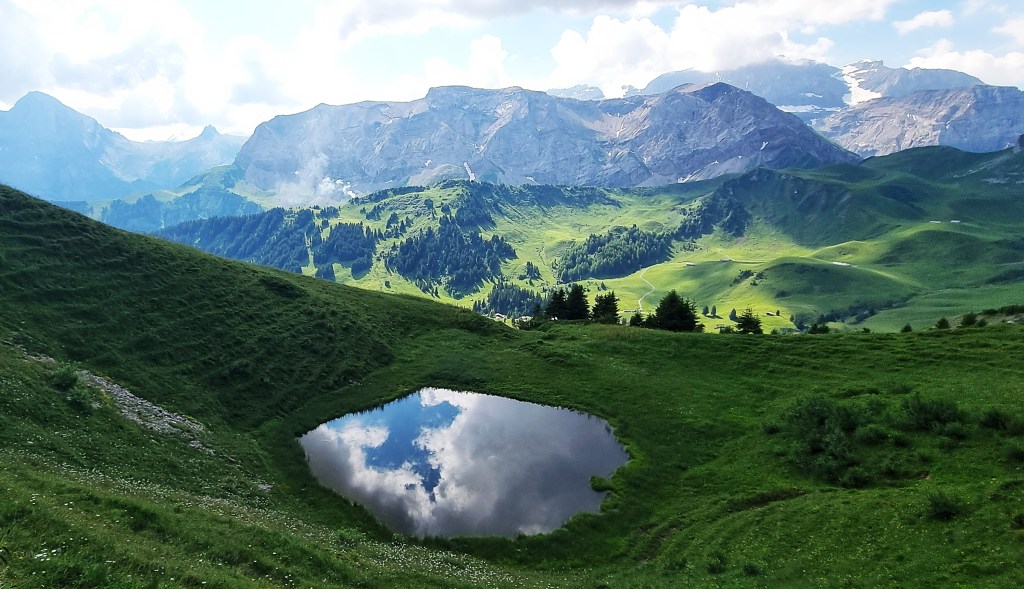
Tracy chose this seven-night guided walking holiday with HF Holidays, a company we have used often.
The holiday runs several times across the summer season. We had booked on to the first iteration of 2025, hoping to catch Alpine spring flowers in their prime.

Arrival
We woke at 05:00. Our taxi arrived promptly and, half an hour later, deposited us at Heathrow Terminal 2. It was now 06:30 on Sunday 29 June.
We eventually got to grips with Swissair’s automated check-in system, having established that it prefers reference numbers to passports.
After dropping off our cases and negotiating security, we regrouped with breakfast in the Big Smoke Taphouse and Kitchen, tucked away near the departure gates.
Big Smoke pubs and their beers are familiar to us, but neither was ready for a tipple. I had a ‘No Fuss Breakfast’ with a black Americano; Tracy chose Eggs Benedict and a pot of English breakfast tea.
Attempting to restore confidence in my ability to use new-fangled technology, I submitted our order via the online system. Amazingly, the correct order arrived promptly.
Having boarded our plane, we were told that take-off had been delayed by 45 minutes. Sadly, this now seems increasingly common at both Heathrow and Gatwick.
But the captain was confident that, owing to the prevailing winds, we would still arrive on time in Zurich.
The seats in front were occupied by a patrol of American Boy Scouts who seemed to be changing at Zurich on to a Miami-bound plane.
They were attempting mental long multiplication, but struggling, so I offered some gentle assistance. They were abashed, seemingly awed into respectful silence, but perhaps they couldn’t comprehend my Limey accent!
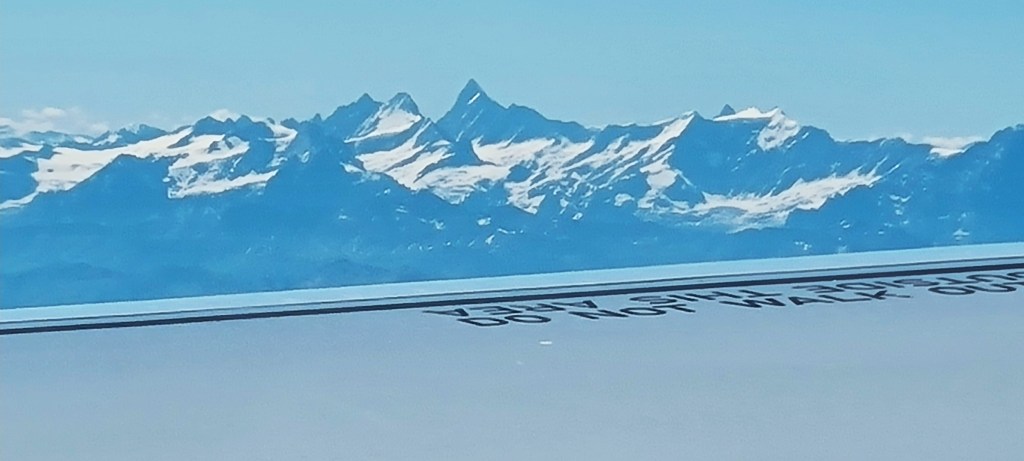
I took photos of the approaching Alps across the aircraft’s wing.
Once on the ground, the queue for non-EU passport holders was lengthy and slow-moving.
We found we could use the machines alongside to check our passports, take our fingerprints and photograph our faces. But it was unclear how this would shorten the process, if at all.
We dutifully waited in line.
Apparently, the system is not yet operational, though due to be implemented in October 2025. We have potentially saved time on a future journey by undertaking the process now.
The digital record is valid for three years, but one will still have to provide either a photo or a fingerprint each time one enters or exits the Schengen area.
Moreover, further change is promised in 2026, including the introduction of a fee. It was to have been seven euros, but now the EU wants to increase it to twenty!
Our passports finally stamped by human customs officers, we collected our bags and assembled in the arrivals lobby. There were ten of us altogether, some having arrived on a flight from Manchester. Two further members of the group were travelling to our base under their own steam.
We climbed aboard a small coach, a luggage trailer attached behind, that was to ferry us from Zurich to our destination in Adelboden.
Zurich was baking in a premature European heatwave, the temperature hovering in the mid-30s, so we were glad to have access to some air conditioning, and to be heading to the mountains.

The distance from Zurich is around 190km. We travelled via the A1 and A6, which took almost two-and-a-half hours, even at motorway speeds.
Marianne, one of our two guides, had collected us from the Airport. She tried valiantly to divert us with snippets of Swiss-inspired music and culture.
It was mid-afternoon before we reached Adelboden.

The Hotel Steinmattli
Our base for the week was the Hotel Steinmattli, a comfortable 4-star, chalet-style building with 63 bedrooms. Some of the rooms had recently been refurbished; others hadn’t.
We were allocated Room 10, on the ground floor, which looked out upon a small garden and then west along the Adelboden Valley.

The room was reasonably large, its two twin beds placed side by side. There was a desk with a television upon it, two armchairs, a coffee table and some sort of imitation fire (which I used as an extra storage shelf).
The television should have supplied ‘a range of English channels’, but these were absent and could not be retuned. That was no great loss. The wi-fi was reliable, but there were too few sockets and charging points.
We appreciated the ample wardrobe and shelf space, as well as the bathroom, which had a decent shower mounted above the bath.
Our terrace held two plastic chairs and a plastic table and, helpfully, the door also opened as a window.

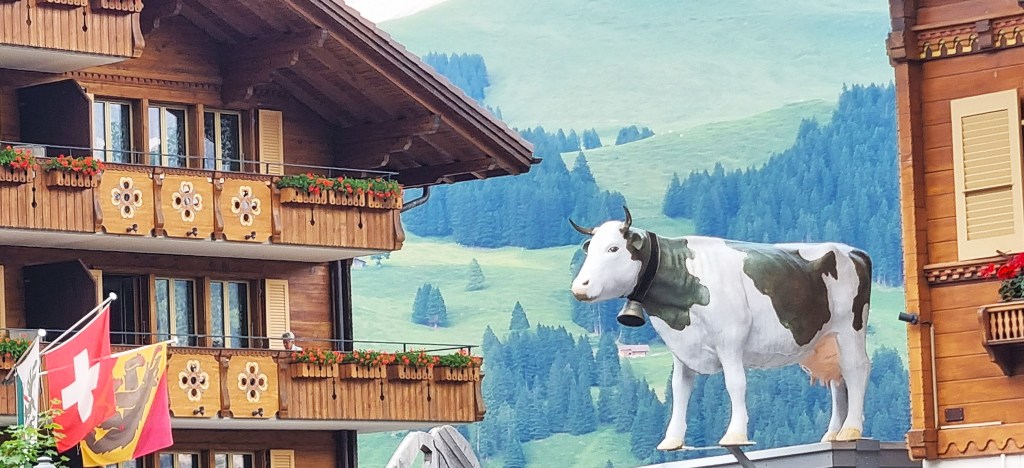
The Hotel had a substantial lounge bar located beyond reception, its decor heavily redolent of cows. There was just one beer on draft though, after my first night freebie, we typically confined ourselves to a G&T apiece and, later, a glass of red wine with dinner.
Tracy asked the manager if he could recommend any peculiarly Swiss aperitifs. He couldn’t, but suggested that we should try schnapps as a ‘digestif’.
We did so on the evening before our rest day, Tracy opting for Apple and Pear while I sampled ‘Aqua Vita’ (herbs). I rather enjoyed mine…
The large dining room was situated downstairs (as was the ski room where we could dry wet boots).

Breakfast was an ample buffet, including: a choice of cereals, fruit and nuts; pastries; bread with ham or cheese; and a cooked option. The HF trip notes had mentioned ‘excellent coffee’. It was good, though perhaps not outstanding, and supplied exclusively by machine.
One could order a packed lunch for 15 Swiss Francs. This included two sandwiches, which one made oneself from the available breakfast items, plus a piece of fruit, a muesli bar and water.
After the first day, when we purchased one apiece, we shared one packed lunch between us, taking one large sandwich each. We supplemented this with additional fruit and a Tunnocks substitute purchased from the nearby Co-op.
On most evenings we had a four-course dinner. We were served the starter of our choice, then invited to visit the salad bar before the main course and dessert of our choice were delivered.
There was a buffet on Saturday and on Wednesday a ‘Fondue Chinoise’, basically meat and/or vegetables which one cooks oneself in a saucepan of boiling broth.
Aside from the latter, which was a little underwhelming, the quality of food was consistently excellent. The Hotel’s policy was to serve comparatively small meals, but to offer a second helping if required. This was designed to minimise waste.
We never needed a second helping.
Our group sat at a single long table, at which we selected different seats nightly. Martin, the second guide, was staying elsewhere in Adelboden. Annoyingly, HF were unwilling to pay for him to attend our final meal, so we each chipped in 5 Swiss francs.
The speed of service was mixed. We later discovered that the chef wanted the waiting staff to identify guests according to where they sat on that particular night, using a numbering system. This confused some, who had been used to a different method.
There were other guests staying at the Hotel, including a small group of Ramblers, with whom we did not fraternise. One elderly female Rambler complained as we assembled for our first walk that we were blocking the Hotel entrance.
She might simply have said ‘Excuse me.’

Adelboden
Late in the afternoon of our first day, Marianne led us on an orientation walk around Adelboden.
The Village is part of the Frutigen-Niedersimmental district of the Canton of Bern. The wider area is called the Bernese Oberland: essentially the southernmost, Alpine region of the Canton.
The area boasts two significant lakes – Lake Thun and Lake Brienz – both fed by the Aare, a tributary of the Rhine. Numerous side valleys extend from the principal Aare valley, each with its smattering of alpine villages.
Several of the highest mountains in the Bernese Alps are not too far distant, notably Finsterraahhorn (4,274m), Jungfrau (4,158m) and Mönch (4,110m). The Eiger (3,967m) is slightly smaller but more (in)famous.
Tourism took hold here in the late Eighteenth Century, especially beside the two lakes and at Interlaken which, as you can tell from the name, lies between them.
As the Nineteenth Century progressed, visitors gradually pushed further into the surrounding valleys, including the Entschlige valley in which Adelboden sits, at 1,350m above sea level.
The population of the municipal area, which covers some 34 square miles, is roughly 3,300. Some 40% of the land is agricultural, while a further 18% is forested.
Approximately 60% of inhabitants were born here and ninety-five percent speak German as their first language. There are 24 hotels and 3,800 properties classified as ‘vacation homes’.
The name first appeared in print at the beginning of the Fifteenth Century. Adelboden’s church was built shortly afterwards, in 1433.

The population, some 500 strong, had petitioned for their own place of worship but had been unsuccessful, so twelve local elders decided to proceed independently.
An outer wall still contains a fresco of the Last Judgement by an unknown artist, dated 1471. One of the four bells hanging in the tower dates from 1485. Another, cast in 1597, now sits in the churchyard.

Catholicism was dominant here until the Reformation took hold in the 1520s, at which point the priest fled across the mountains to Fribourg, which remained Catholic.
The interior features illustrations of biblical verses painted by local artist Stephan Allenbach (c.1707-1779) in 1775.
There are also three stained glass windows by Augusto Giacometti (1877-1947) which were installed in 1937.
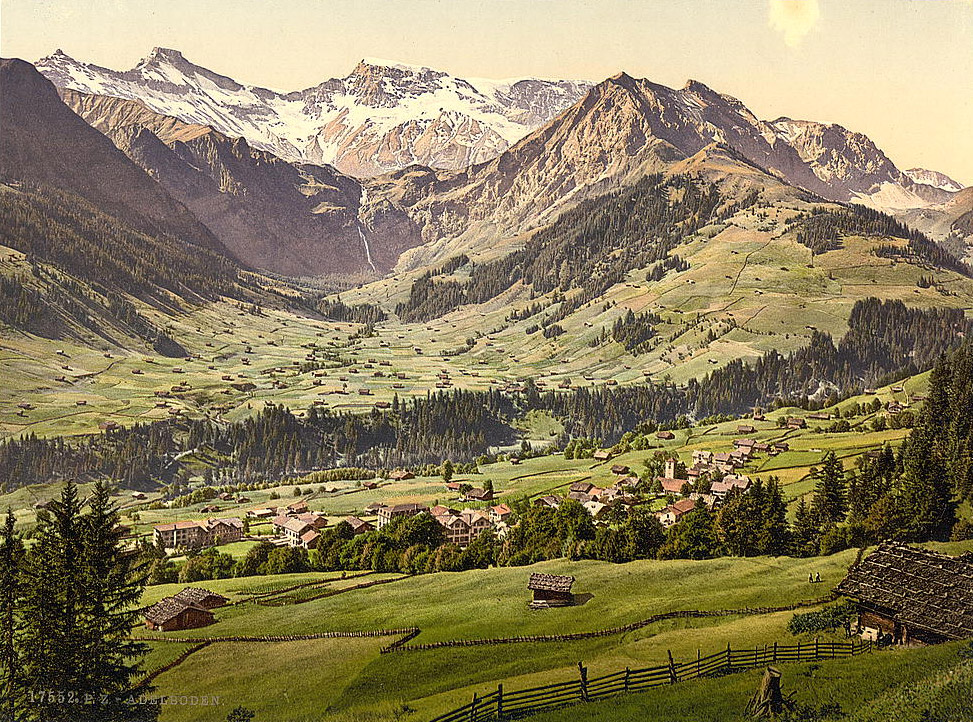
Adelboden’s first guest house, which opened in 1870, remains the oldest hotel in the area. Tourism grew rapidly when a new road was built alongside the River. In 1903, Sir Henry Lunn (1859-1939) selected Adelboden as one of the first destinations for his winter sports holidays.
A large hotel called the Nevada Palace was built here in 1911 by the Belgian Richert brothers. Though successful for many years, it burned down in 1996 and was demolished. A project to build a replacement failed in 2010 when Kuwaiti investors withdrew their funds.

During the Second World War, Switzerland was neutral. Adelboden was selected as an internment camp for Allied servicemen who had found their way to Switzerland. It was thought that the location would discourage escape.
Most of them were American airmen who had crash-landed, though some were airmen from other Allied countries and a few escapees from German PoW camps also made it to Switzerland.
Peacetime hotels and guest houses, including the Nevada Palace, were used to house the internees. They were not mistreated, but those who attempted escape might be transferred to penal camps where the regime could be far more more brutal.
A gated archway leading into the churchyard carries the legend:
‘These gates were presented by interned American airmen and escaped prisoners of war of the British Commonwealth in memory of many pleasant months spent in Adelboden, 1943-1945.’
One imagines that time spent here might have been judged pleasant, when compared with fighting in the War. On the other hand, many of these internees were intensely bored.
Adelboden is the home of ‘Our Chalet’, one of five centres attached to the World Association of Girl Guides and Girl Scouts. It opened in 1932 and still provides a year-round programme of activities and conferences.
Since the mid 1950s, Adelboden has also hosted alpine ski races on the Chuenisbargli course. Slaloms were held until 1961; giant slaloms were introduced in 1958, and continue to this day.
Publicity for the 2026 events is already prominently displayed and, in the village square, there is a concrete block containing the footprints of several past winners.

Other highlights include a small cinema, a beautiful 50 metre open air swimming pool (see below) and the well-appointed Co-op supermarket.
One more little-known fact: the novelist Rafael Sabatini (1875-1950) died here and is buried in the Village cemetery.
Otherwise, there is relatively little to say about Adelboden.
At one point I was tasked with giving a short presentation about it. So I asked Perplexity AI to supply all the scandal and salaciousness. It failed utterly.
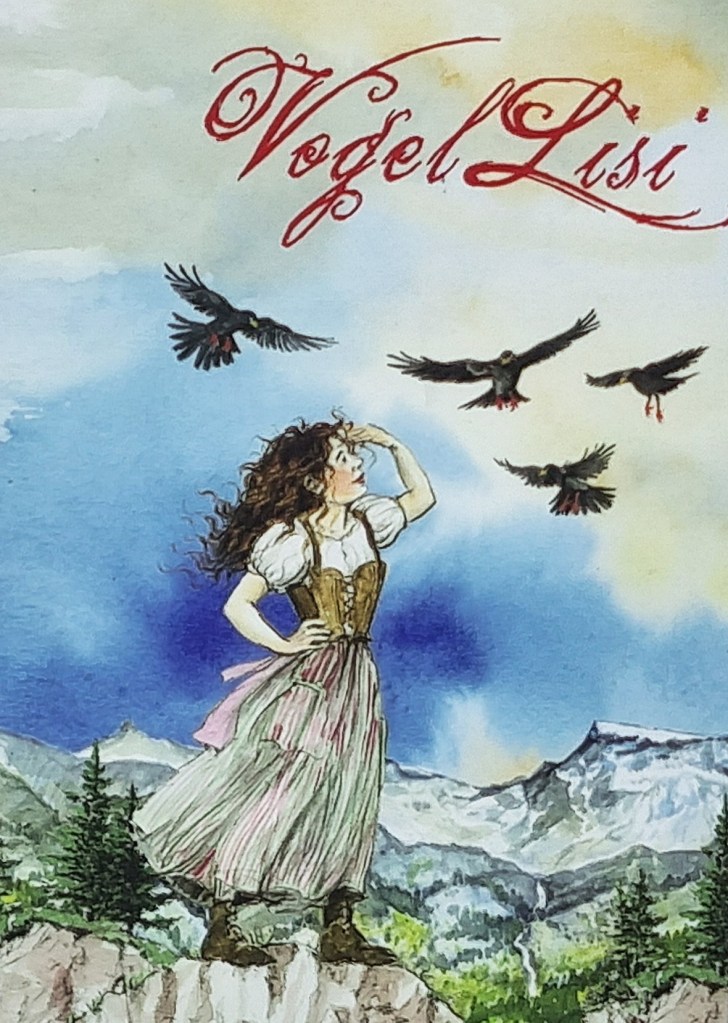
Indeed, Adelboden has found it necessary to invent a myth to help market itself. This is centred on a bird-loving young woman called ‘Vogellisi’.
There are statues and images of her all over Adelboden, and several products also carry her brand.
It turns out that historical sources of this myth are lacking, indeed completely non-existent. Vogellisi is entirely a modern creation.
Different versions of her life story have been manufactured. One insists that she was permanently accompanied by an eagle (or was it a raven?) but, when she fell to her death, the bird immediately snuffed it too.
One local writer, Annemarie Stahli, set her version early in the Twentieth Century. According to her, Vogellisi, who understood the language of birds and was also a skilled alpine herbalist, had to to care for herself and her sick mother following the death of her father in a slate mining accident.
There is a strong suspicion that the myth arose from a song, written in the 1950s. It might have been composed and performed by the Duo Maissen – Paul and Bert – but then again, it might not. This might have happened in Adelboden, or perhaps in Gstaad, or possibly somewhere else entirely.
The subject was allegedly an attractive female photographer called Lisa, a real person who made a living by selling photographic prints of partygoers and guests cavorting in local night clubs. She was reputedly a carefree, fun-loving woman who engaged in serial sexual relationships.
It is described as a ‘pick-up song’, which is not something we’re familiar with in England. I’m not sure whether they’re still part of Swiss ‘dating culture’ either: one suspects they may belong to a more patriarchal past.
A (no doubt heavily bowdlerised) version of this song is now belted out at every opportunity, especially when susceptible tourists are present.
I shall not trouble you with the lyrics.
Our Group and our walking programme
Our group comprised two solo women, four solo men and three male/female couples. So seven men and five women altogether.
It was a well-balanced, friendly group, with no primadonnas. All were between their mid-fifties and their mid-seventies. Three came from outside the UK – one couple from the United States and one man from New Zealand.
We quickly formed a WhatsApp group to share information and photographs.
Each day the group divided between an easier walk and a harder option. With the exception of the first day, when seven chose the former, the same six people consistently selected the easier walk; the other six the harder.
The easier walks were rated 2 on HF’s scale, which they define as:
‘Good paths but walks are a bit longer [than those rated 1]. Some walks, particularly in mountain areas, may have sections over rough or steeper terrain. ‘
The harder walks were rated ‘4’, which means:
‘Long distances in remote countryside and on rough terrain. You can expect some sustained ascents and descents; there may be occasional sections of scree and steep ground.’
Tracy and I always opted for the harder walks, so the details below deal exclusively with those.
Our guides, Martin and Marianne, intended to alternate between easier and harder options but, owing to a variety of circumstances, the harder walk was led by Martin on four of our five outings.
There was some dispute over the accuracy of the official data about ascent and descent, because some people measured different outcomes on their smart watches. It was suspected that some of the ascent and descent figures included height gained or lost via gondola.

Our programme, including those disputed figures for ascent, was as follows:
- Day 2 (Monday): The Hörnliweg, Schwandfeldspitz and Schermtanne (distance 14.5km, total ascent 720m);
- Day 3 (Tuesday): Hahnenmoos Pass, ridges above Geils (distance 15.5km, total ascent 720m);
- Day 4 (Wednesday): Kandersteg, Oeschinensee and high mountain alps (distance 11km, total ascent 380m);
- Day 5 (Thursday): Rest day;
- Day 6 (Friday): Engstligen Valley, Hinterberg, Engstligenalp and Falls (distance 14.5km, total ascent 780m);
- Day 7 (Saturday): Elsigenalp and Elsighorn (distance 8.33km, total ascent 534m).
We were briefed each evening before dinner and were able to reflect overnight on our choices.

Day 2: The Hörnliweg, Schwandfeldspitz and Schermtanne
There were several bursts of thunder overnight, which disturbed my sleep, so our 06:30 alarm found me distinctly grumpy. Breakfast and coffee restored me enough to opt for the harder walk.
Despite the overnight storms there was little freshness and the sun was already growing warm. A few small clouds were scudding gently in a predominantly blue sky.
We were under way well before 09:00, walking part-way through the Village before picking up the Hörnliweg, a broad track ascending fairly gently through pasture, passing occasional chalets and farms.
This is the most popular short hike in the area, but we saw few other walkers.
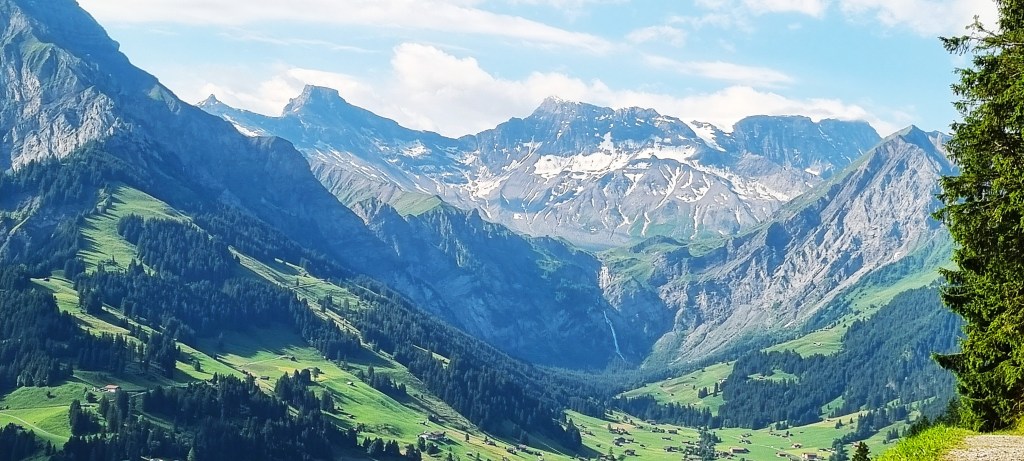
Across the valley we could see that the higher mountain slopes still held pockets of snow, although the thaw had advanced further than normal for the end of June.
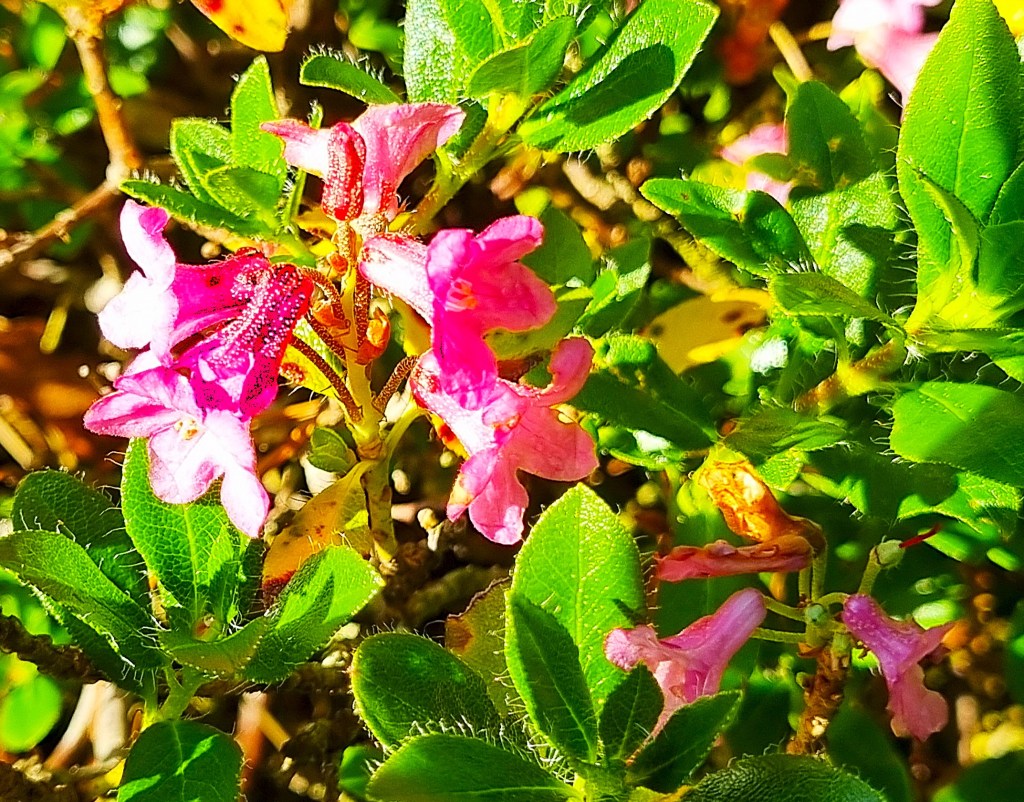
We soon arrived at the small Höreli Alpine Garden, perched on the valley slopes at 1,500m above sea level. It is thought to contain at least 500 varieties of flowers and herbs, of which 400 are marked. We wandered between the flower beds for a while, taking pictures.
On resuming our ascent, now on a narrower track passing close to patches of woodland, we spotted a black alpine salamander which had been sunning itself on the path.

They grow to a maximum of 15cm and have a life expectancy in excess of ten years. Their young are born live, rather than within eggs, and they exude poisonous neurotoxins which help protect them against predators.
We passed signposts marking the way to Tschenten Alp. A steep climb culminated in a large metal sculpture by Hans Bernhard Luginbühl (1929-2011) called ‘Mondsäge I’.

Other Luginbühl sculptures may be found in Zurich, Muttenz and Lucerne Station. He was also celebrated for his ‘burning ceremonies’, during which large wooden sculptures were consumed by flames.
On New Year’s Eve 1999, he burned down a sculpture, 24 metres long and 10 metres high, positioned on the Gurten, a mountain overlooking Bern.
Just a few metres away there is a giant swing, on which several of us posed for a photograph. I can tell you nothing more about this swing.

At the summit there is a gondola ride back down to Adelboden and a restaurant with marvellous views. We sat on the restaurant terrace while sampling Rivella Blue, a drink made from milk whey.
The original Rivella Red was invented in 1952 by a law student, Robert Barth. The lower calorie Blue was introduced in 1958, initially in the Netherlands, since the Dutch were interested in a product specifically for diabetics.

Rivella Green, with green tea extract, was added in 1990 and Rivella Yellow, with soy milk in place of whey, in 2008. Other flavours have been introduced from time to time, some since discontinued.
Rivella is the second most popular soft drink in Switzerland, after Coca Cola. The Company began sponsoring the national skiing team in 1977.
Later we switched to a shaded area where we demolished our picnics.
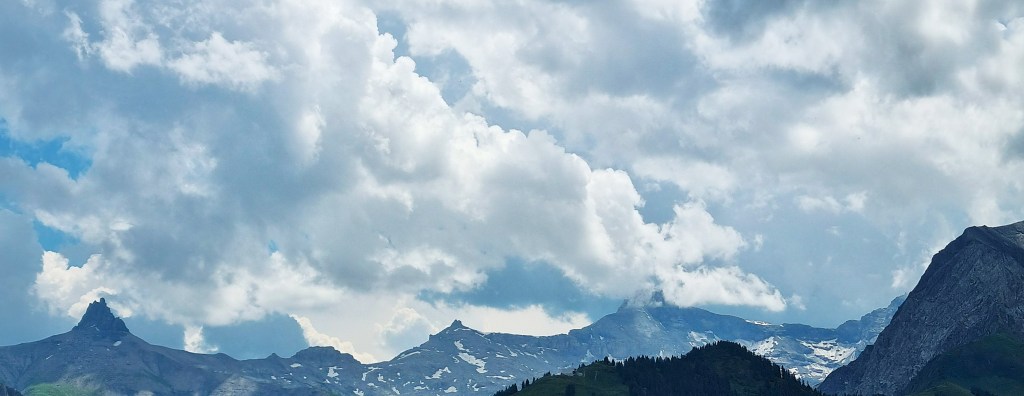
Resuming, we climbed first to a higher ridge called the Schwandfeldspitz, at 2025m, before walking the loop back to Adelboden. The clouds were now quickly rolling in over the mountains.
Some way along, we passed the other group, heading in the opposite direction, towards the Schermtanne Cafe.
We stopped instead at a small museum dedicated to local forestry in an area known as the Senggi-Schopf. The forest hereabouts has been protected since 1617.
Several boards explain how Adelboden is also protected by the forest, culminating in a working model that shows how the trees deflect rockfalls and protect against avalanches. I was much taken with the model trees.

Unfortunately, while we were immersed in the museum it began to rain outside. The rain grew progressively stronger as we descended the final 200 metres into the Village, converting for a while into hailstones before growing even more torrential.
Some of us got very wet indeed, since there was no time in which to change into full waterproof gear before the deluge was upon us.
The weather had closed in for the rest of the day so, having deposited our boots in the ski room, we retired to dry off our clothes as best we could.
Leaving aside this unpleasant sting in the tail, it had been a relatively easy introduction to our walking week.
Day 3: Hahnenmoos Pass and ridges above Geils
We had an undisturbed night, thankfully, and the morning was slightly cooler and cloudier as we congregated outside the Hotel after breakfast.
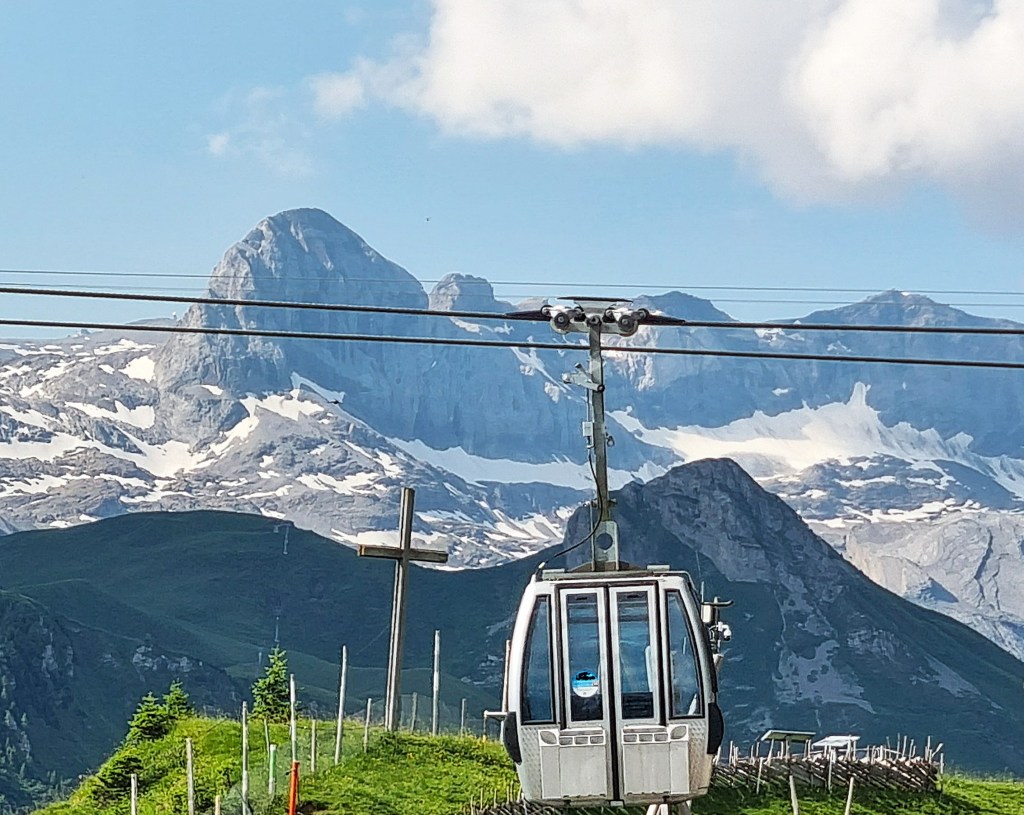
Both groups began with our first journey on a gondola, using the free pass we had been given for the duration of our holiday.
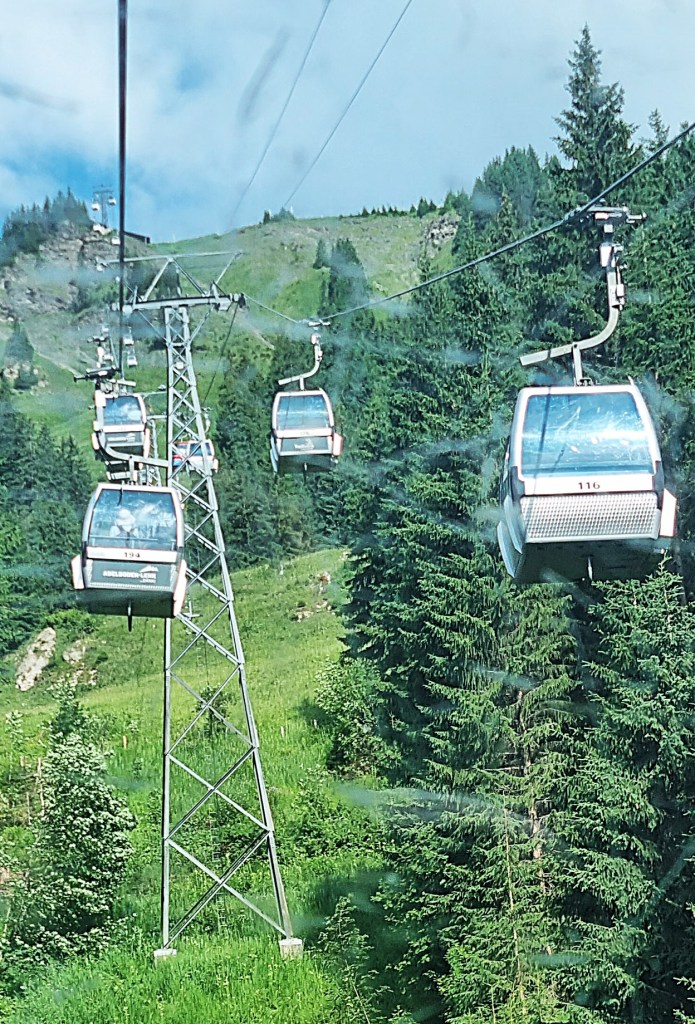
A gondola lift is propelled by a cable connecting two or more stations, often supported by intervening pylons. The cable is driven round two terminal pulleys, one at each station.
The passenger cabins, or gondolas, typically accommodate from two to fifteen people. The cabins are slowed at the terminals, so allowing passengers to climb in or out.
The first enclosed cable car passenger service was introduced in 1908 in Bolzano in the South Tyrol. The first large cabin gondola lift followed in 1930, located near Freiburg in Germany.
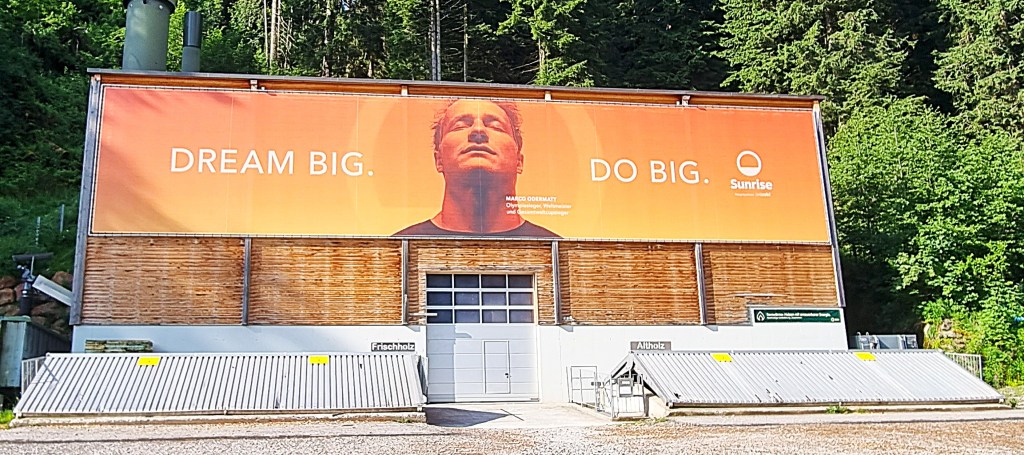
Before reaching the station, we passed some typical Swiss advertising featuring the bull neck of Marco Odermatt, an alpine skiing champion who won the Super-G event at the 2025 World Championships.
Our upward journey took us through stops at Oey and Bergläger, until we finally alighted at Sillerenbühl, which appears to have rechristened itself ‘Vogellisiberg’.

There are several child-centred activities, including a ‘Vogellisi Trail’, which descends to Bergläger, below, an adventure playground and, for those aged 8 and over, the opportunity to ride a scooter down the mountain via one of seven different routes.
There are 10 ‘rules of conduct’ for scooterists, including:
‘I always have both hands on the handlebars’,
‘I always give way to pedestrians’, and
‘I am personally insured against accidents and acknowledge that Bergbahnen Adelboden-Lenk AG rejects any liability.’

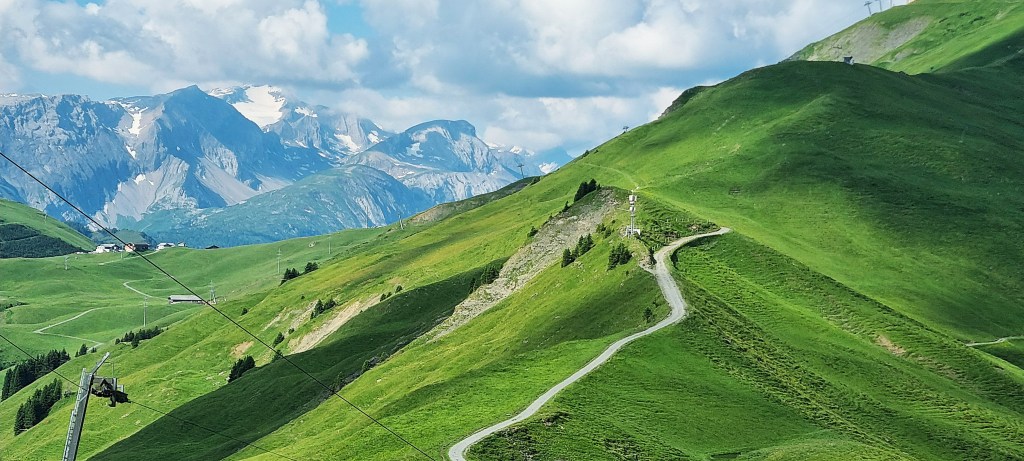
We began by walking the roughly hour-long ‘Flower Trail’ to Hahnenmoos, the weather now improving rapidly, giving ideal walking conditions.
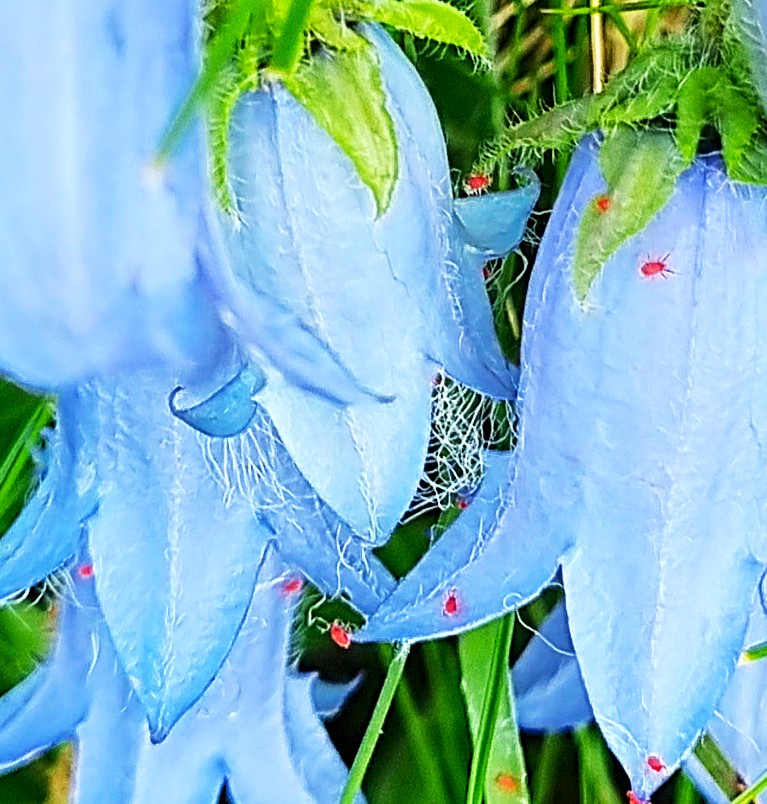
I took several beautiful photographs on this section. Not least this study of tiny red spiders which had made their home on a bunch of ‘Swiss bluebells’.
We arrived at a cluster of buildings where swifts were nesting in the eaves, above.
This is a favourite spot from which to launch model gliders. We paid a brief visit to a hangar-cum-workshop where several models were undergoing repairs, then watched some aerobatics before transferring to the nearby cafe for coffee and cake. Here we were joined by the other group.
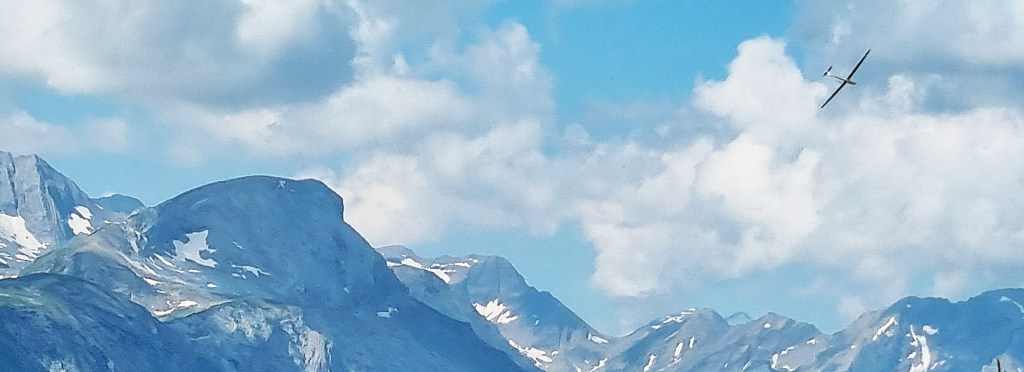
We continued through a more remote section, heading towards Luegli (2080m), before turning our steps back towards Adelboden. Whereas the other group were taking a lower path, our route led along a higher ridge, towards Hüendersädel.

We were strongly encouraged to use poles but, although I went as far as taking mine out of my rucksack, I found them an unnecessary encumbrance.
I soon found myself outpacing the rest of the group, Tracy later informing me that they had paused for some impromptu yodelling practice.

I took a picture of a common yellow swallowtail butterfly perching on a warm rock. They are frequent visitors to alpine meadows. The male of the species reputedly has a penchant for ‘hilltopping’ – waiting around near summits for passing females.
After a while the ridge began to descend. Having waited five minutes for the others, I began to suspect that I might have missed a turning, so started to double back. At which point I heard their merry chatter.
We descended to a small hanging meadow occupied by cows, where we stopped for our picnic beside a rocky outcrop.

After lunch we worked our way past more posing cows, then across an area strewn with large boulders before closing in on a small family-run cafe – the Alphütte Bütschi – whose owner was also a cheese-maker.
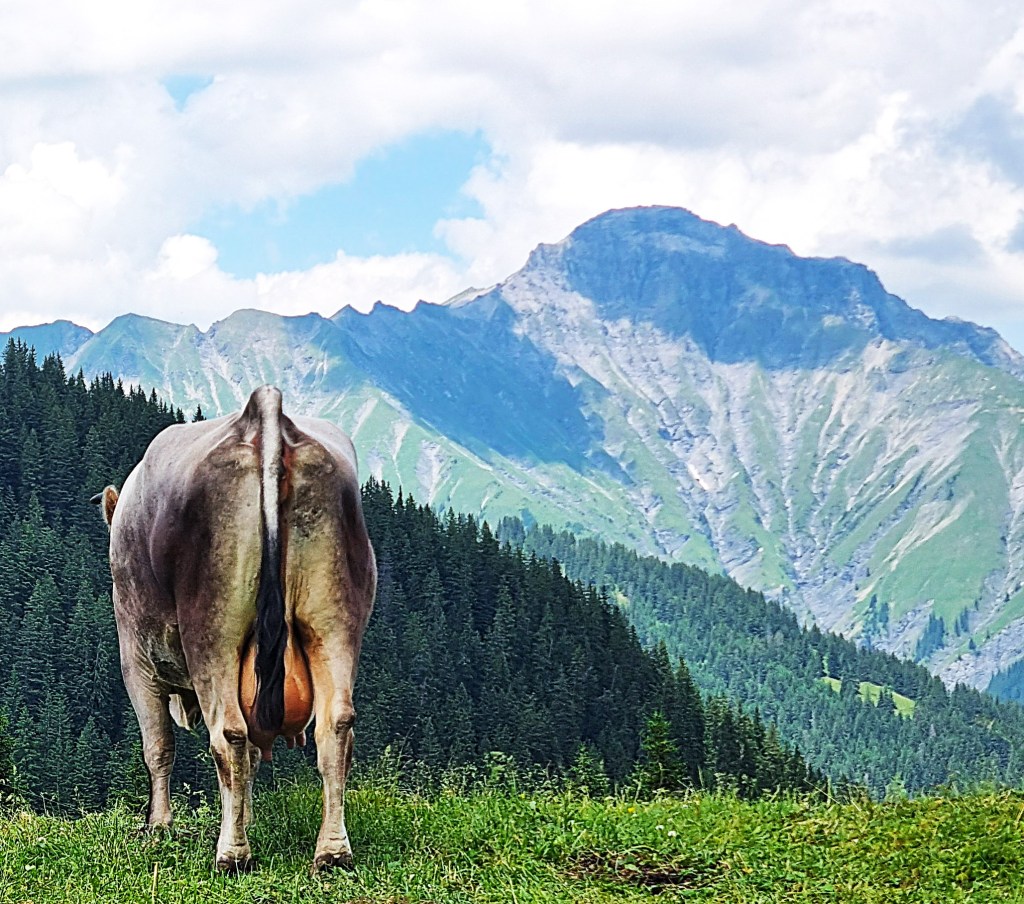
The cows are kept up here at 1823m above sea level over the summer, each producing up to 140 litres of milk per day. The family made and sold roughly 90 large cheeses a year. We sampled both the older and the newer vintage.
We divided into groups to go inside, to learn more about the cheese-making process. Sadly, our ice-creams were not made here, but they were cool and refreshing.
I admired these planted boots and their backdrop.

We were envious that the other group had managed to spot and photograph an Alpine Marmot. These large ground squirrels are herbivores and hibernate in winter. They can reach up to 70cm in length and up to 8kg in weight. The origin of the name is unclear
Eventually departing, we faced a stiff initial climb up towards the Troneggrat ridge, now close beside the Engstligen Waterfall (see below).
We passed a goat with two small kids.

It was a long trek back to the Bergläger cable car station, which we reached around 16:45. On arriving back in Adelboden, Marianne guided us straight to the Alte Taverne for drinks.
The place is not at all old, since it was created from several houses in nearby Simmental, arriving here in the early 1960s as part of the Nevada Palace.
Afterwards, Marianne was doubtful whether she could perform the pre-dinner briefing without assistance. She managed splendidly, though I was called upon at one point to steer a discussion about high and low points of the day.

Day 4: Kandersteg, Oeschinensee and high mountain alps
The day started brightly, with a £75 win on the Premium Bonds!
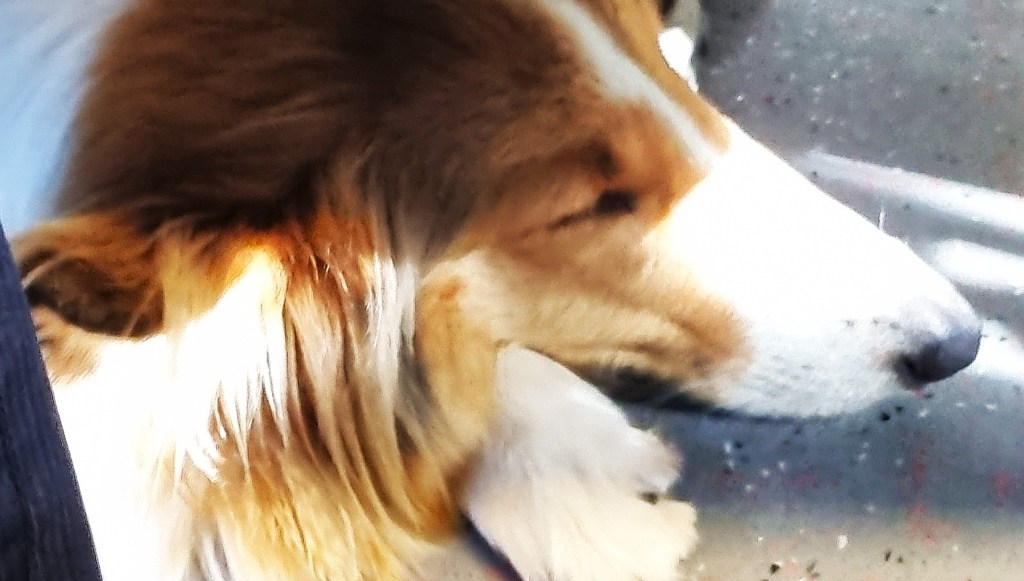
We walked through the Village to the bus station, where we joined a busy service, brimming with girl guides. A dog lay curled up underneath the seat in front.
The bus initially took us north to Frutigen, the administrative centre of the Frutigen-Niedersimmental district. It has a population of almost 7,000 and a railway station connecting it with Bern and Thun.
At Frutigen, we turned south to Kandersteg, in the Kandertal, the adjacent valley. The Kander river converges with the Engstlige at Frutigen.
Kandersteg is a village of 1,200 people surrounded by high mountains, the highest being the Blüemlisalphorn (3,663m) to the east. The first ascent was in 1860 by Leslie Stephen (1832-1904), Virginia Woolf’s father.
We walked through part of the village to the Oeschinensee cable car, where we found large groups of young people and a long queue for the ladies’ toilet. As usual, the gents’ was far less busy so, eventually, some ladies opted for the latter.
Heading round to the entry point, we were surprised to discover that our group ticket failed to open the gates. Apparently a new system was to blame, and we were eventually allowed through to climb into the gondolas.
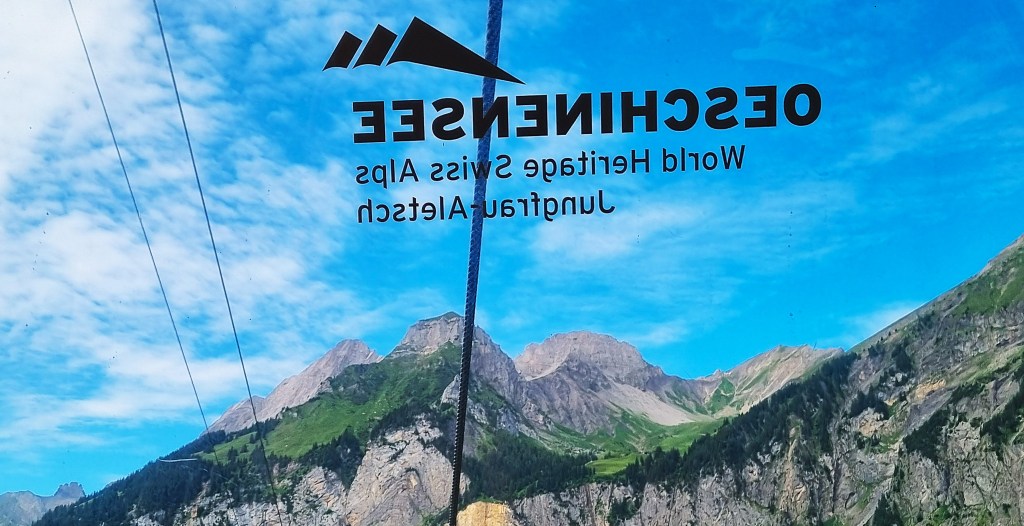
Once at the top we walked some way along a trail, heading towards the Oeschinen Lake, until our group turned left, starting a stiff ascent to a more vertiginous path.
The Oeschinensee lies 1,578m above sea level and is approximately 1.5km long and 1.0km wide. Its maximum depth is 56m, though this may vary by up to 12m according to the season. It is generally frozen over between December and May and is inhabited by rainbow trout, Canadian lake trout and Arctic char.
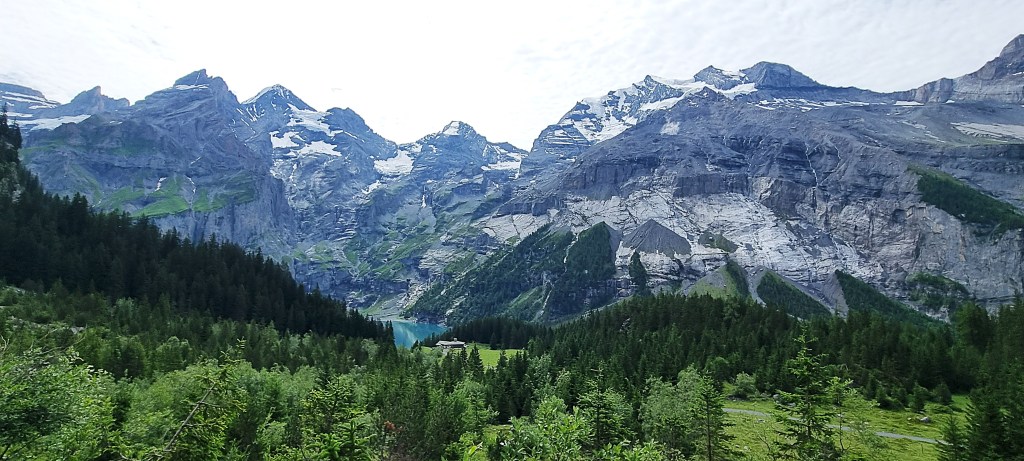
It was created by a landslide some 2,300 years ago, which may have been caused by an earthquake. One can no longer walk all the way round since paths on the southern shore have been closed owing to the danger of rockfalls.
Fortunately our route was relatively quiet: the ascent would have been far more difficult had it been crowded.
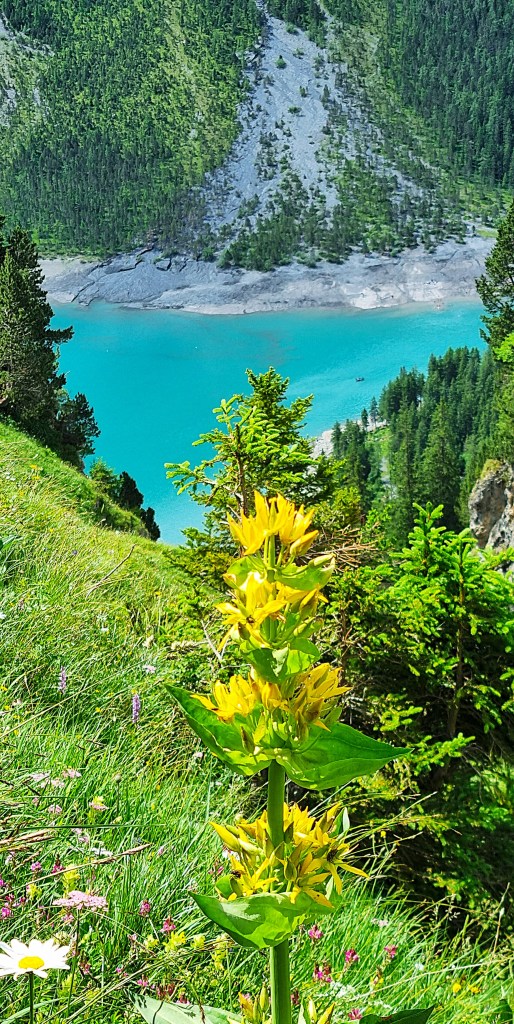
After half an hour we emerged into a small clearing which provided the first good views of the Lake, far below. For me, the colour was redolent of Lake Louise.

The modern day curse of the selfie began to assert itself amongst the young people surrounding us.
I was fascinated by this tiny rowing boat, like an insect far below.

Fifteen minutes later we reached a larger clearing, provided with a couple of benches.
A group of three young people – perhaps Japanese, perhaps Korean – seemed to be struggling to pose a photograph. It was all very complicated.
A girl wearing a flowery dress and a bespectacled young man seemed to be positioning a second girl in jeans and a hat, who had apparently plucked a bunch of flowers from the verge nearby. The man spent some time talking earnestly into his phone.
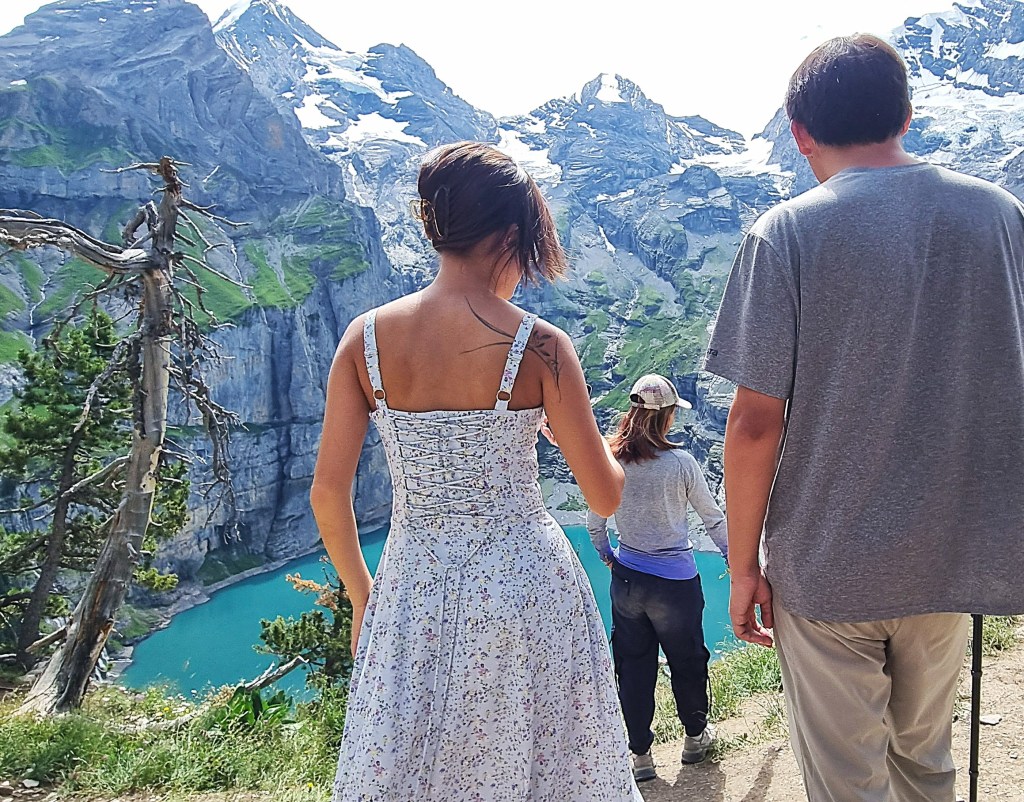
We thought she should have left the flowers alone, for others to enjoy.
Another swallowtail butterfly drifted past as I was focused on the Lake below.
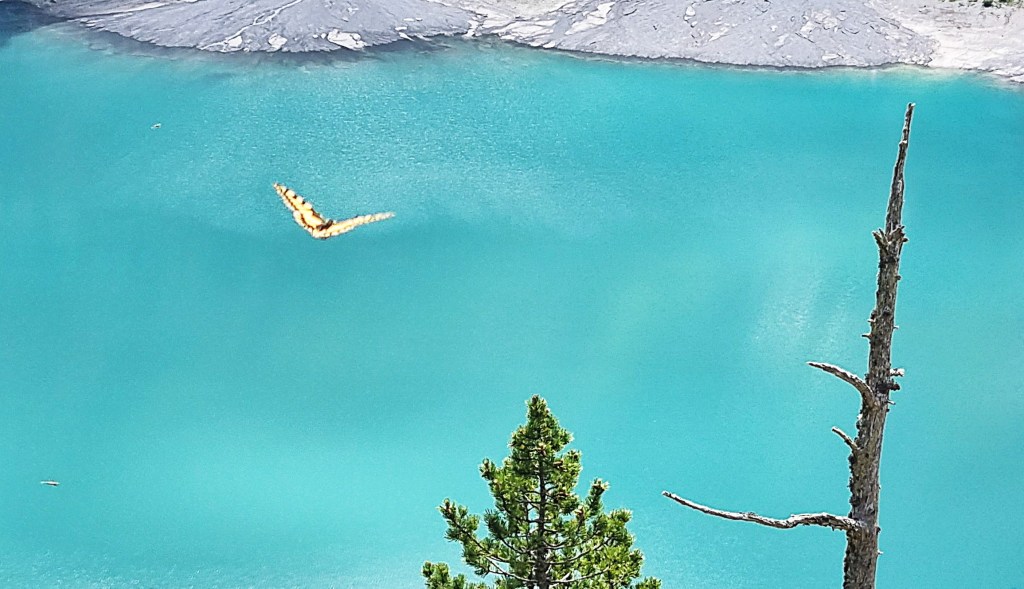
We continued round to the head of the Lake, before beginning a long, rocky and somewhat slippery descent.
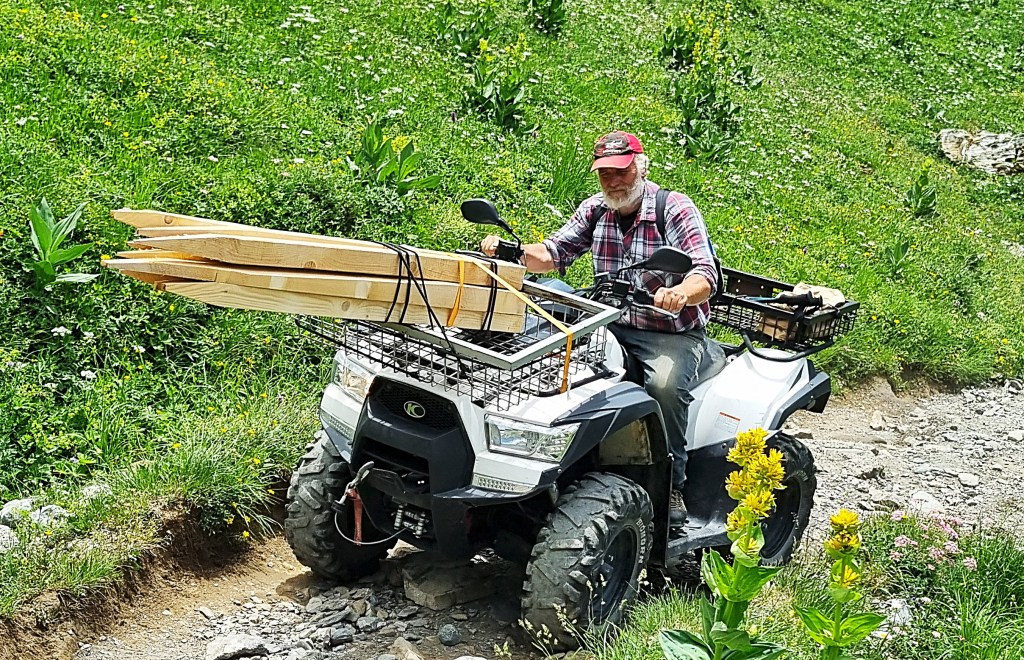
A farmer drove up on a quad bike, carrying a package of sharpened stakes.
We eventually arriving at a small cafe, the Berghaus Unterbärgli. Slipping just beyond it, we sat on the rocks to eat our picnics. While we did so, some further posing got underway on a rock directly in front of us.

We bought a coffee crème at the Cafe, used its toilet then began the final descent to the lake shore, passing the ubiquitous cows.
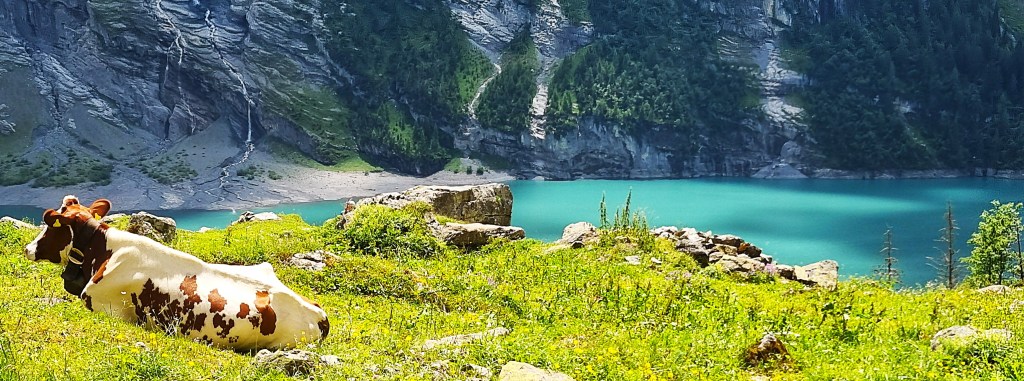
Arriving at a beach of sorts, four of us changed for a dip, enjoying the refreshing coolness of the waters while several young people stared at us in some amazement.
Were they astonished at our temerity, or amused that we should expose our elderly and imperfect bodies to the scrutiny of others? Who knows.
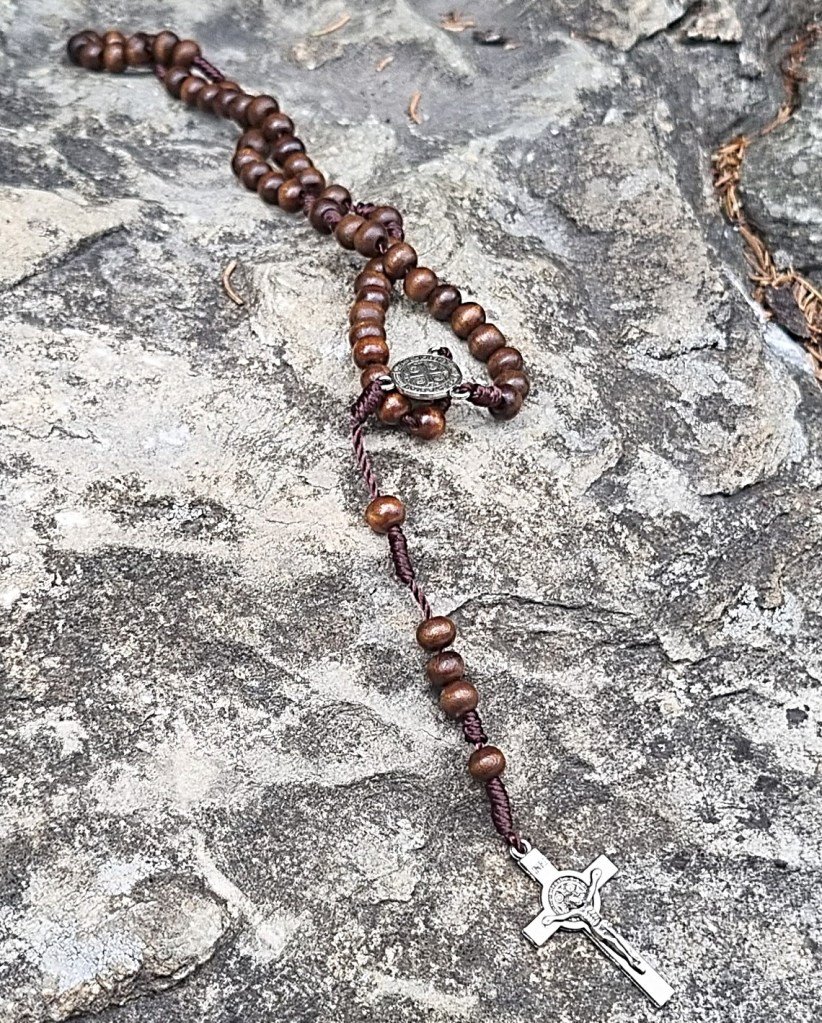
Drying ourselves, we found some rosary beads left on a nearby rock.
The descent to Kandersteg was lengthy and tedious. As we arrived, rain seemed imminent.
We had been promised splendid desserts at a local hotel, but they no longer served them. So Tracy and I bought ice cream from a nearby kiosk but, as we did so, the heavens opened.
Fortunately this also coincided with the arrival of our minibus.
On the way back, we stopped for a ‘surprise’, which turned out to be the Hohstalde pedestrian suspension bridge across the Engstlige River. This is 153m across and 38m above the ground. It was constructed in 2006.

We walked across in single file, spaced 10m apart, taking care neither to run nor to bounce, both of which are forbidden. Then we crossed back again.

Day 5: Rest Day
After three rather full-on days, we had decided to conserve our energy by staying in Adelboden.
Following a late breakfast, we toured the Village shops looking for suitable gifts. Tracy bought a ton of chocolate and I purchased a suitably kitsch snow globe.
We interrupted our shopping for coffees and custard slices from the Cafe Haueter.
After some time spent reading on our terrace, we headed to the Gruebi Panorama swimming pool, an amazing facility given the size of Adelboden. The original pool was built in 1931, jointly funded by local hoteliers who commissioned Beda Hefti (1897-1981) to design it.
In 2004, the length was halved following a landslide, but the pool has since been restored to former glories.

We began with a few lengths (well, only two in my case) in one of the lanes set aside for the purpose, but soon encountered two elderly women who insisted on swimming alongside each other in both directions, rather than up one side and then back down the other.
Afterwards we relaxed in chairs at poolside, watching fearless children launch themselves from the diving tower while a long-haired young man performed a series of calisthenic exercises and yoga poses on the grass opposite.
Later we walked back through the village for coffees and snacks at the Bäckerei Michel.
There was time for a snooze before our pre-dinner drinks. Dinner was quieter than usual, since half our number left early to catch a classical piano recital at the church.

Day 6: Engstligen Valley, Hinterberg, Engstligenalp and Falls
It was the first time since her death that I had been away for Kate’s birthday, which made for a strange kind of day. I felt noticeably subdued.
This was the day we would be getting up close to the Engstligen Waterfalls, but the weather had deteriorated somewhat. Even away from the waterfalls it was misty with low hanging cloud. Nearby, the cloudy mistiness only intensified.
Arriving at the bus station we climbed on board a 232 service that took us on an additional loop before heading to our destination. The bus was again busy, this time carrying a bunch of scouts from Vermont and New York State.
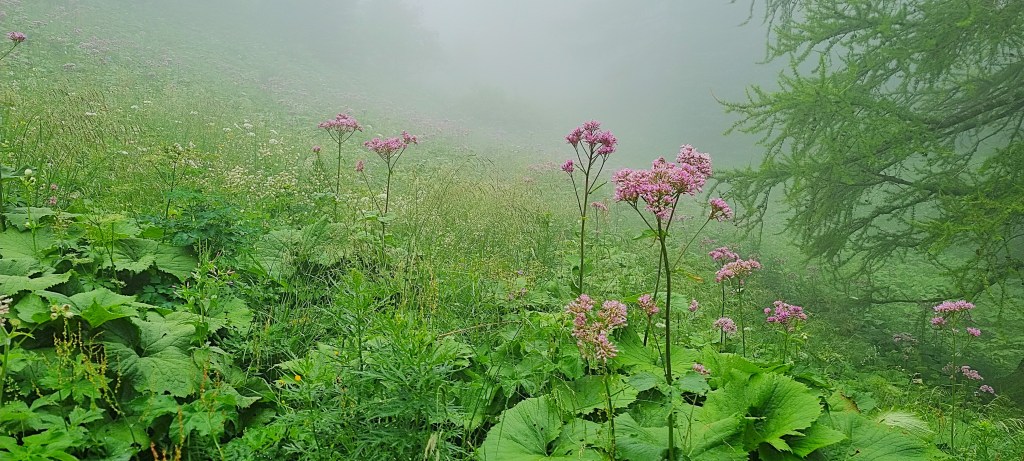
There are actually two waterfalls, one above the other, known as Engstligen I (97m) and Engstligen II (165m) respectively. The total drop is some 600m.
Together they form the second most powerful set of waterfalls in Switzerland, after the Rhine Falls in Schaffhausen, which are the most powerful in Europe.
We began by walking to the base of the lower waterfall, where the cascade emerged from the mist.

Then we began a steep, rocky ascent through the adjacent cliffs, using the same trail that the cows follow each year, up to their summer pastures. This is said to be the steepest cow track in Switzerland!
The annual cattle drive takes place late in June. This year it took place on 21 June, so the cows had come this way exactly a fortnight earlier.
Some 350 cattle are driven up to the Enstiglenalp plateau, where they remain for about 100 days, until September. Both the ascent and the descent are regarded as a local spectacle and an opportunity for celebration.
We found most of the other group ascending the same path. Marianne had decided they had a better chance of enjoying the waterfall on foot, given that the view from the gondola would be shrouded in mist.
The cloud did begin to clear as we climbed higher, but not quickly enough to reveal the full splendour of the waterfalls.
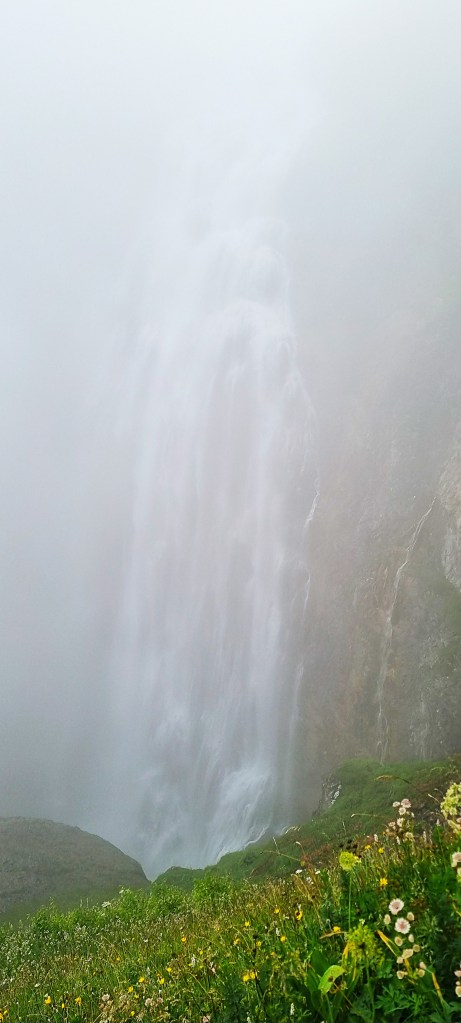
Still, I console myself with the fact that it is surprisingly difficult to get a good picture of a waterfall, even in the best of conditions.
Eventually we emerged onto the Enstiglenalp plateau, where we stopped at a small cafe. We bought some coffee and consumed our packed lunches, waiting for the cloud to lift.
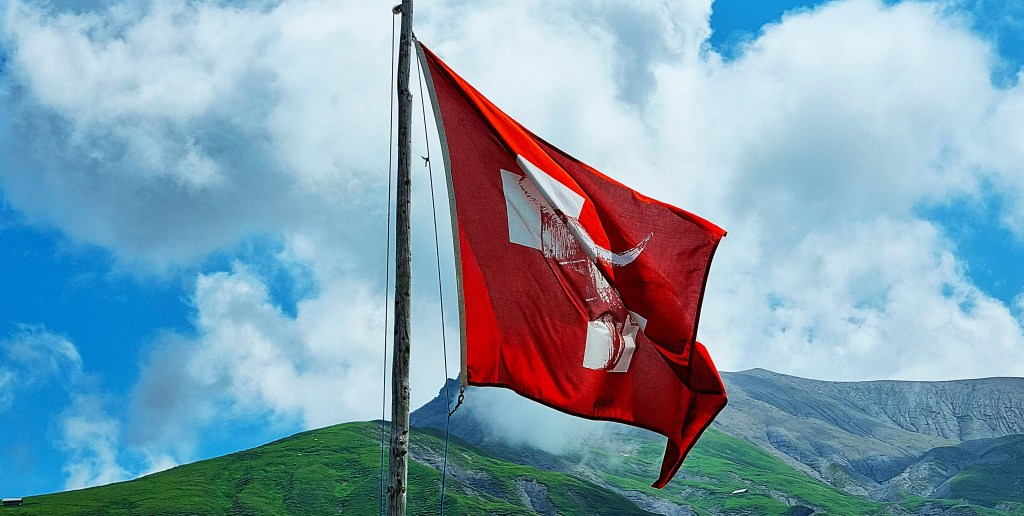
Quite suddenly, around midday, it did so. We left the cafe and began the 5km circular walk around the plateau, either avoiding or engaging with the cows, according to our lights.
Apparently, this one needed a scratch behind its ear!

The Enstiglenalp is an area of seven square kilometres that sits roughly 2000 metres above sea level. It is said to be the largest high plateau in Switzerland.
It is surrounded by mountains, the Wildstrubel dominating, and has been used to pasture cattle since medieval times. These days, it is owned by a co-operative of around 100 local farmers. Their main product is a Bernese Alp cheese so prized that it is only sold privately.
Martin, our guide, submerged himself in a mountain stream, which he said was his favourite swimming place.
On reaching the gondola station, we could see the waterfall a little more clearly, perhaps.
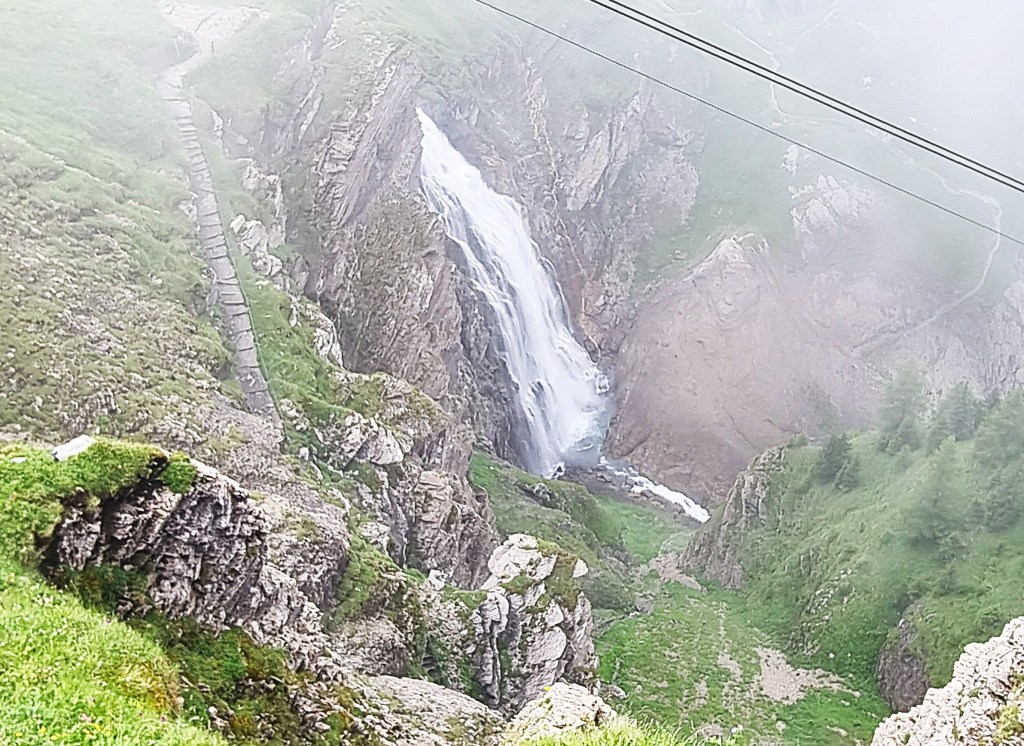
Here we made the acquaintance of Globi, a blue parrot wearing a beret and a pair of red and black checked trousers.
Globi was created by Swiss cartoonist Robert Lips (1912-1975). Lips was also a fencer who competed in the 1948 London Olympic Games. Globi was invented to advertise a Swiss department store, Globus, on the occasion of its 25th anniversary in 1932.
Globi appeared in his own cartoon strip and then in a book called ‘Globi’s World Voyage’ (1935). A magazine, ‘Der Globi’ was printed each year from 1934 to 1970 and he has now sold over nine million books. The first Globi Club was formed by a fan in 1936 and, by 1952, there were over 700 of them. There is also an extensive range of Globi merchandise.

The old Globi was unreconstructed, prone to bouts of racism, sexism and animal cruelty but, during the 1980s, he reinvented himself, acquiring a girlfriend called Globine and becoming interested in environmental issues.
We descended in the gondola, taking further waterfall pictures, then walked along the riverbank back into Adelboden.
Four of us returned to the Alte Taverne, where two of us raised a glass to Kate. Back in the Hotel, while Tracy went swimming, I had some quiet time to myself.
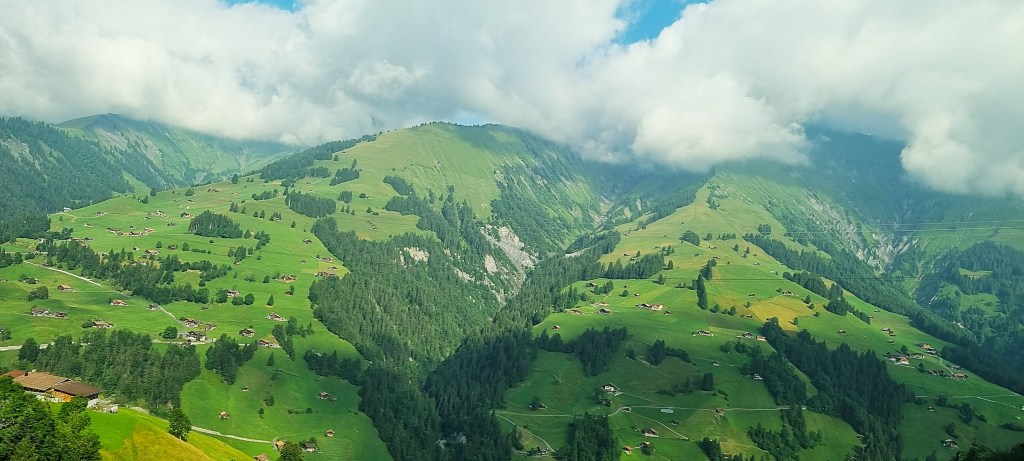
Day 7: Elsigenalp and Elsighorn
The original advertised route took in two further locations: the Golitschenpass (2178m) and a neighbouring mountain, Stand (2321m). But, owing to a closure, these were no longer accessible.
At 08:25 we were driven by minibus to the Elsigbach gondola station, some way to the north of Adelboden, on the way to Frutigen.
Then we used our gondola passes once more, as we were lifted 500m to Elsigenalp, 1,800 metres above sea level.
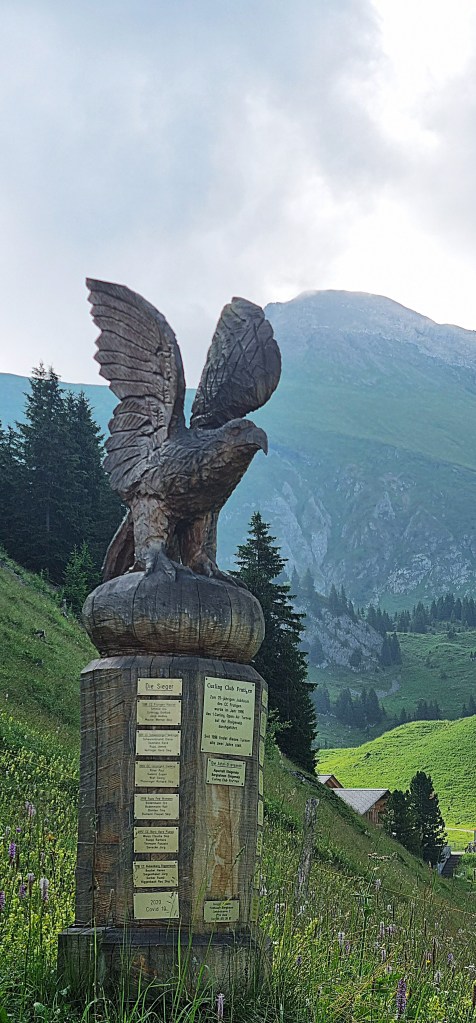
This wooden trophy, near the upper station, belongs to Frutigen Curling Club, which seems to hold an open air curling tournament nearby. Judging by the Club’s website, the last event was held in 2022.
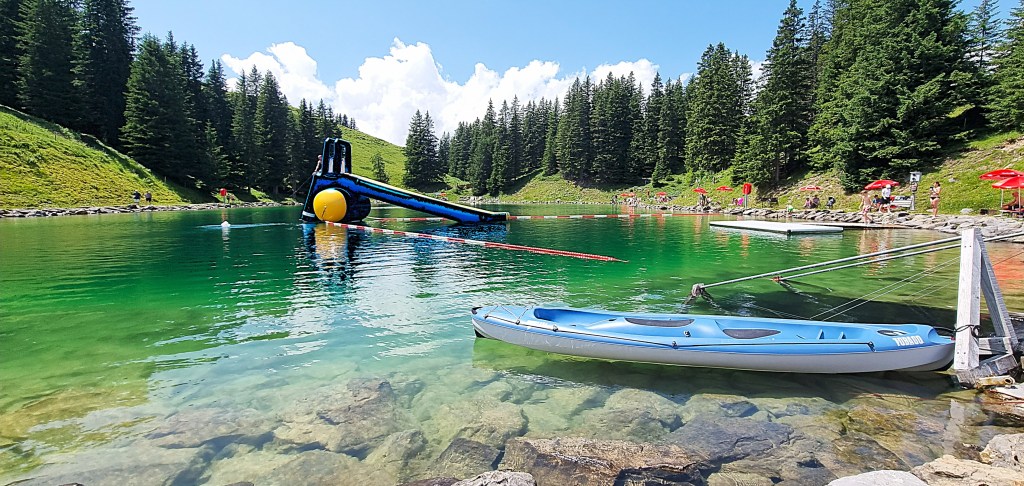
As we began to climb we could also see a swimming lake, the Brandsee, with its blue plastic slide, far below.
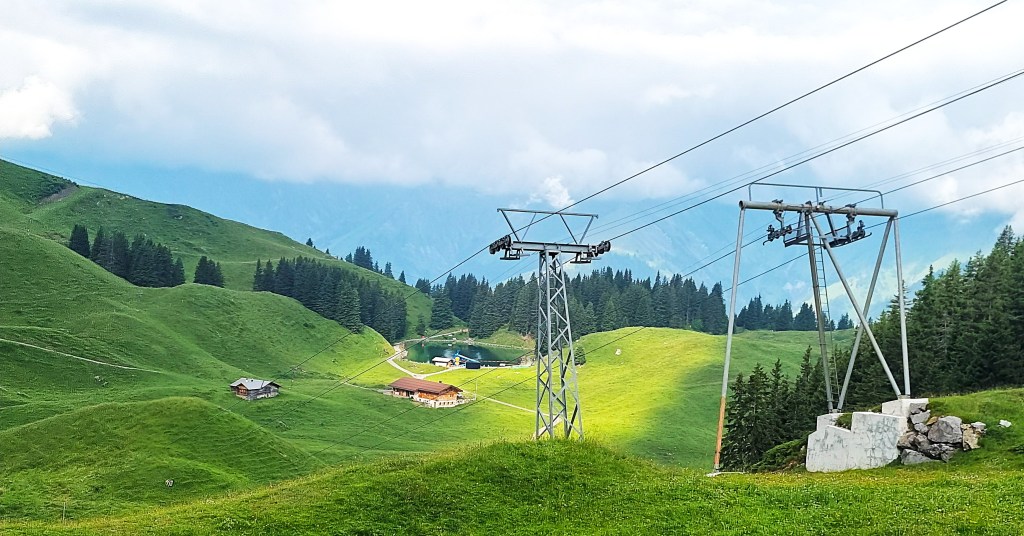
We followed our own pace up the extended climb, keeping an eye open for Edelweiss and Marmots. There were plenty of other flowers to admire as well.

As we pushed higher, the air grew thinner and the cloud began to wreathe around us. Rather than stop and start, I found it easier to set a slow but steady rhythm and push on for the summit.
The Elsighorn stands at 2,342m, so was the highest we would be climbing all holiday. There was a small wooden crucifix on top, and a memorial plate which, translated, reads:
‘SM7
In memory of
Dr. Fritz Müller-Jaton
(26.07.28) from Biel
He had an accident on November 17, 1983, a few meters
below this summit, while hiking the ridge from Kandersteg to Frutigen.’
He died from the consequences of his accident the following day.

By the time I arrived, at around 10:45, the cloud was clearing briefly, only to swirl in again for some minutes before clearing once more. In the distance I could occasionally see Lake Thun. It was much harder to spot the Eiger, Mönch or Jungfrau though.

When Martin arrived, he spotted a rare patch of Edelweiss on the edge of the precipice. I took my pictures from a distance, sending Tracy to get the close-up!

Eventually we began the lengthy descent, back the way we had come. On this occasion I unfurled my poles, which were more helpful than otherwise. Perhaps I am a grudging convert.
By around 12:30 we had reached the Elsighutte, a traditional Alpine restaurant. We ordered drinks and one of our number received a huge mound of ice cream and meringue. It was also time to eat our sandwiches.

Next we took a path beside a small lake, the Elsigsee, where several groups were preparing food, or simply enjoying the scenery, which was reflected in the blue-grey water.
As we emerged, the cloud had formed a clear line across the top of the mountains ahead.

Soon we reached the Brandsee, where some of us changed in a random hut before heading in for a swim. Here the water was a greener shade.
I foolishly decided to enter from the pontoon, only to find how difficult it was to get out again. A couple of braver souls went down the water slide.
With some time at our disposal, we decided to walk back towards Adelboden, taking a little used path along the side of the valley. During the descent we passed this impressive collection of cow bells.

We also had a close encounter with two curious young cows, who seemingly wanted to follow us home. I took evasive action.
Soon afterwards, two paragliders floated overhead.

Reaching the outskirts of Adelboden, we caught a bus to take us the last mile or so back to the hotel, arriving at around 17.00.
After our final dinner together, we said our farewells to the American couple who were heading off elsewhere, and retired to bed.
Homeward
Marianne had to leave early next morning, to pick up the following week’s holidaymakers, so we were left to our own devices.
Because of the weight of traffic, our driver, who spoke very little English, took the best part of three hours to reach Zurich Airport.
Once there, we were disappointed to find no online check-in facilities, just the usual queue for the manned desks.
Having reached Departures, we spent some considerable time wandering the endless corridors, trying (and ultimately failing) to access the observation platform.
Along the way we picked up two rolls and two coffees, which cost a hefty £30.
We took off late once more, but arrived back at Heathrow on time. I was pleased to discover that the biometric gates no longer require me to remove my glasses.
Annoyingly though, the baggage carousel broke down mid-exodus. With the aid of my pilates training, I reached Tracy’s bag, marooned on the chute, with my fingertips, managing not to touch the carousel in the process.
But I had to wait for a repair before my own case appeared.
We caught the Superloop bus home, which was fast but very warm. There had been a thunderstorm, leaving large puddles on the road.
It was Sunday evening so, once we’d alighted, we had some difficulty tracking down a shop from which to buy a pint of milk.
There was some irony to this, given the superfluity of cows we had encountered over the previous week!
P.S. My personal thanks to everyone in our group, and especially Martin and Marianne, for helping us to enjoy such a marvellous holiday.
TD
July 2025



 Eponymous
Leave a comment