
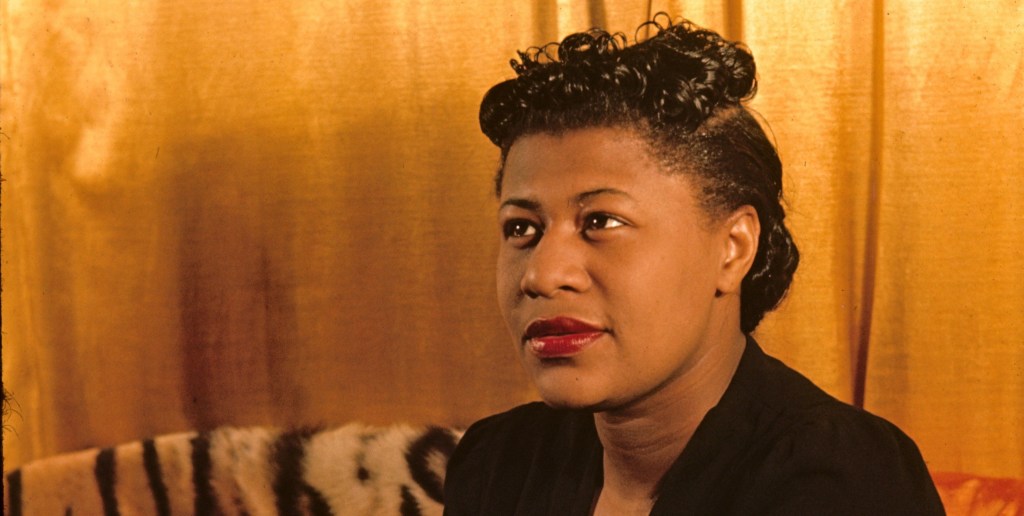
This is the sixth in a sequence of twelve monthly posts, each about a piece of music that has personal significance. Each choice is linked, however tenuously, to its immediate predecessor.
May’s selection was ‘Saturday Night’ by the Blue Nile (1989), while June’s is ‘Ev’ry Time We Say Goodbye’ by Ella Fitzgerald (1956). The connection between these two is that the Blue Nile were Glasgow-based and Ella Fitzgerald’s UK debut also took place in Glasgow, in September 1948.
Prior to the Blue Nile, I have featured – in reverse order – ‘Blue Sky’ by the Allman Brothers Band (1972), ‘Sweet Fanta Diallo’ by Alpha Blondy (1987), ‘Autorail’ by Orchestre Baobab (1981) and ‘Ya Jean’ (Remix) by Madilu System (1993).
I am confidently expecting that my twelfth and final choice, in December 2025, will link in some way with ‘Ya Jean’ and Madilu, thus completing Ouroboros – the snake with its tail in its mouth.
Cole Porter
‘Ev’ry Time We Say Goodbye’ was written in 1944, almost a generation before Ella Fitzgerald recorded it. The composer and writer was Cole Porter (1891-1964), a name synonymous with Broadway musicals and the scores of Hollywood movies.
Porter was born into a wealthy Indiana family, enjoying a privileged childhood. He learned piano, violin and musical composition. In 1905 he went to a boarding school in Worcester, Massachusetts, progressing to Yale in 1909.
There he studied English literature and music, also joining the 1913 edition of the Yale a capella singing group, the Whiffenpoofs. This had been formed in 1909, was closed to women until 2018, but continues to this day. He was also president of the mixed Yale Glee Club, founded in 1861.

After graduating from Yale he enrolled at Harvard Law School, intending to fulfil his father’s wish that he become a lawyer. He soon realised his mistake, transferring his loyalties to music instead. Following some limited further study he left Harvard for New York
During this period he wrote several musical comedies that were performed in student circles and, as early as 1915, contributed a song to the Broadway show ‘Hands Up’ which ran for 52 performances at the 44th Street Theatre.
The following year he staged his own first production, ‘See America First’, at Maxine Elliott’s Theatre. This survived for only 15 performances, but it was his first experience of composing the music and writing the lyrics for a complete show.
In July 1917 he crossed to France, ostensibly to support the American War effort. There is some confusion about the exact nature of his service, enhanced by almost certainly fabricated stories that he enlisted in the French Foreign Legion.
He certainly became a notorious Paris socialite, renowned for the scale and extravagance of his parties, fuelled by a heady mix of drugs, alcohol and promiscuity.
The Broadway production of ‘Hitchy-Koo of 1919’ opened in October of that year at the Liberty Theatre, Porter again writing both music and lyrics. This was rather more successful, eventually embarking on a United States tour.
In December 1919 he married Linda Lee Thomas, a wealthy and well-connected divorcee. It was a marriage of convenience, extending his social circle and providing a convenient screen for his many homosexual affairs. The couple were close but did not have a sexual relationship.
They continued to live in Paris with occasional periods in Venice and other European hotspots. Porter had some degree of success with one-off songs and jointly composed a short ballet.
He had high hopes for the 1924 edition of ‘The Greenwich Village Follies’ but, disappointed by its negative reception, he contemplated giving up his songwriting career.
Then in 1928, he had his first major success, with ‘Paris’, as a substitute for Rodgers and Hart, who were otherwise engaged. This featured his first big hit, ‘Let’s Do It; Let’s Fall in Love’.
His career took off during the first half of the 1930s, reaching its zenith with the show ‘Anything Goes’ (1934).
Classic Porter songs from this period include ‘Love for Sale’ (1931), ‘Night and Day’ (1932). ‘I Get a Kick Out of You’ (1934), ‘Begin the Beguine’ (1935) and ‘I’ve Got You Under My Skin’ (1936).
His Hollywood scores at this time included ‘Born to Dance’ (1936) which featured ‘I’ve Got You Under My Skin’ and ‘Rosalie’ (1937) which included ‘In the Still of the Night’.
But in October 1937 he was hospitalised for several months following a serious riding accident which left him disabled and in constant pain. Arguably, his career never fully recovered.
The impending World War Two prompted his return from Europe and in 1940 the couple set up home in the Berkshires near Williamstown, Massachusetts.
During these War years, Porter’s shows had long runs, but yielded few outstanding songs. They included ‘Panama Hattie’ (1940), ‘Let’s Face It’ (1941), ‘Something for the Boys’ (1943) and Mexican Hayride’ (1944).
‘Seven Lively Arts’, which ran for 183 performances between December 1944 and May 1945, was deemed a flop. It featured several eminently forgettable songs, plus ‘Ev’ry Time We Say Goodbye’.
It was performed in the show by Nan Wynn, a band singer and actress whose real name was Masha Vatz, alongside the fleetingly famous Jere McMahon. Wynn typically appeared in films cast as a nightclub singer, also suppying Rita Hayworth’s singing voice in several of the latter’s wartime films.

‘Seven Lively Arts’ was a revue featuring music, theatre, ballet, opera and painting. (The sixth and seventh ‘arts’ were supposedly ‘radio’ and ‘concerts’.) It featured a ballet composed by Stravinsky for Alicia Markova, as well as Benny Goodman and Teddy Wilson. There were even seven paintings by Salvador Dali, displayed in the Theatre’s Lounge, but later destroyed by fire.
The New York Times of 8 December 1944 said:
‘Cole Porter has written the music for the show, and the tunes definitely are not his best. Probably the nearest approach to the old Porter style – he will regret having written all those good ones in former years – is ‘Ev’ry Time We Say Goodbye’.
Alongside his stage shows Porter was still writing Hollywood film scores, even co-operating (after a fashion) with his own largely fictional biopic ‘Night and Day’ (1946) starring Cary Grant in the leading role. This reproduced the foreign legion myth, but was principally a vehicle for Porter’s songs, Warner Brothers having paid him $300,000 for the rights.
‘Ev’ry Time’ was not one of them.
There were some later successes, notably ‘Kiss Me Kate’ (1948), ‘Silk Stockings’ (1955) and the film ‘High Society (1956), but Porter’s star was waning. His wife had died in 1954 and he had one of his legs amputated in 1958, after which he became notably more reclusive. He died in 1964.

Ella Fitzgerald
Ella Fitzgerald (1917-1996) was born in Virginia, to unmarried parents. When they separated, Fitzgerald’s mother moved with a new partner to New York, and a younger half sister was born there in 1923. The family belonged to the African Methodist Episcopal Church, which provided her earliest musical experiences.
Her mother died in 1932, after a car accident and, in 1933, she left her (possibly abusive) stepfather’s care to live with her aunt in Harlem. Ella drifted towards the outer echelons of the criminal underworld. She was placed in an orphanage and, subsequently, a reformatory school.
She ran away from the school, and probably spent some time on the streets of Harlem in 1934, eventually emerging to perform at an Amateur Night at The Apollo Theater, on 17 November that year. She won.

In 1935 she was introduced to band leader Chick Webb, possibly by Bardu Ali, a musician and promoter who was acting as Webb’s MC; possibly by vocalist Charles Linton; possibly by someone else entirely.
Webb gave her a trial at a Yale University dance. The quality of her singing overcame her stocky, shy, unglamorous exterior, not to mention her teenage gawkiness. She joined Webb’s band, which had a residency at the Savoy Ballroom.
Her first record, ‘I’ll Chase the Blues Away’, was recorded with the Chick Webb Orchestra in June 1935. She first entered the US charts in 1936, singing with a Teddy Wilson Octet, her version of ‘My Melancholy Baby’ reaching Number 6 that year.
In 1937 she and Webb signed a contract with Decca and beat Billie Holiday to ‘best female vocalist’ in at least one poll. The following year, ‘A-Tisket, A-Tasket’, recorded with the Chick Webb Orchestra, made Number 1.
By this time, however, Webb was in declining health, eventually dying from spinal tuberculosis in June 1939. His band was renamed ‘Ella Fitzgerald and Her Famous Orchestra’.
She certainly fronted the band, though it would be an exaggeration to call the 22 year-old band leader. Responsibility for organising and running the thirteen-strong orchestra lay initially with trumpeter Taft Jordan, then with saxophonist Teddy McRae.
Even so, the outfit still sounded much the same as it had always done, and a good deal of Fitzgerald’s material was of questionable quality.
In December 1941 she married dockworker Bernie Kornegay, but it became apparent that he had a criminal past and was intent on living off her. The marriage was annulled in 1942. Meanwhile, she featured in an Abbot and Costello film.
Tensions within the band centred on pay, and the control exerted over the musicians by their manager Moe Gale. Eventually, in July 1942, it disintegrated. Fitzgerald began singing with a trio: The Three Keys, but they split up when the other two members were drafted.
As big bands declined in popularity, and Sinatra introduced a new blend of romanticism and sexual magnetism, Fitzgerald seemed increasingly old-fashioned and urgently needed to reinvent herself.
Late in 1944 she recorded ‘Into Each Life Some Rain Must Fall’ with the Inkspots, which went to Number One. She toured extensively with them, while singing with the Cootie Williams Band. She also recorded with Louis Jordan and the Delta Rhythm Boys.
And around this time she began to perfect the scat singing technique that was her hallmark. This coincided with the emergence of bebop, which she had been following closely.
Two seminal recordings from this period are often cited: ‘Flying Home’ (1945) and ‘Oh Lady Be Good’ (1947). Both marked a major departure from the thinner material, often with a novelty dimension, that she had typically recorded up to that point.

When these two songs were released together in 1947, Down Beat’s review purred:
‘Not only is her intonation perfect, her instrumental conception magnificent, the rhythmic effect climactic, but she tosses in some sly digs at Dizzy, Babs, Slam, Hamp, Leo Watson, and others by singing variations on their better-known ideas.’
The New York Times added:
‘…One of the most influential vocal jazz records of the decade….Whereas other singers, most notably Louis Armstrong, had tried similar improvisation, no one before Miss Fitzgerald employed the technique with such dazzling inventiveness’.
Dizzy Gillespie had for some time been trying to develop bebop in a big band context and, early in 1947, he recruited Fitzgerald to this cause. But quite possibly as a counterweight, because he associated her with the swing era, thinking she would balance the speed and complexity of bebop, making it more digestible for the listener.
From Fitzgerald’s perspective the Gillespie tour enabled her properly to join the small clique of top bebop musicians. In achieving the difficult transition from swing to bebop she was virtually unique amongst jazz performers.
Fitzgerald formed a relationship with Ray Brown (1926-2002), Gillespie’s bass player. They married in December 1947, later adopting a son born to her half-sister in August 1949. The marriage with Brown survived until 1953. They were both hectically busy or away on tours, so care of their son often devolved to Fitzgerald’s aunt.
Alongside her exposure to bebop, Fitzgerald had also established a partnership with promoter and producer Norman Granz, who recruited her onto his extended series of ‘Jazz at the Philharmonic’ concert tours.
These continued into the mid-1950s, by which point Granz had also become her manager. She finally left Decca and Granz formed Verve Records in 1956 to release her subsequent recordings.
This allowed her to reinvent herself a second time, as she later recollected:
‘I had gotten to the point where I was only singing be-bop. I thought be-bop was ‘it’, and that all I had to do was go some place and sing bop. But it finally got to the point where I had no place to sing. I realized then that there was more to music than bop. Norman… felt that I should do other things, so he produced ‘Ella Fitzgerald Sings the Cole Porter Song Book’ with me. It was a turning point in my life.’
Granz wanted to expose Fitzgerald to listeners outside her existing cult following, but also encouraged her to deliver these musical theatre songs with a new jazzy feel.
The columnist Frank Rich has argued that Fitzgerald:
‘…performed a cultural transaction as extraordinary as Elvis’ contemporaneous integration of white and African-American soul. Here was a black woman popularizing urban songs often written by immigrant Jews to a national audience of predominantly white Christians’.
The ‘Cole Porter Song Book’ was the first of eight in the series, all released between 1956 and 1964.
It was recorded in Hollywood in February and March of 1956. Fitzgerald sang with a studio orchestra, the arrangements written by wunderkind Buddy Bregman, who was also head of A&R at Verve.
Granz reputedly played the entirety of the album to Porter in his hotel suite at the Waldorf Astoria. Porter’s response was, allegedly:
‘My, what marvellous diction that girl has’
which is the definitive example of damning with faint praise.
To be fair, Porter was from a different generation, a different musical tradition, a different race and a different social class. Fitzgerald could understand his music and interpret his songs, but the appreciation was unlikely ever to be mutual.
Fitzgerald continued performing, touring and recording throughout the ‘60s, ‘70s and ‘80s, her last professional recording taking place in January 1992.
In later years she suffered from diabetes and related complications. Both her legs were amputated in 1993. She died in June 1996.

Ev’ry Time We Say Goodbye
There is significant overlap between the songs Fitzgerald recorded on her eight Song Book albums and what has become known as ‘The Great American Songbook’.
This term is typically applied to the canon of popular songs, dating roughly from 1920-1960, created for Hollywood musicals or for Broadway and other musical theatre. Many of them have since become so-called jazz standards.
‘Ev’ry Time We Say Goodbye’ falls squarely in this tradition.
After Nan Gwynn with Jere McMahon, there were many other recordings, several preceding Fitzgerald’s.
The Benny Goodman Quintet were quick out of the blocks with their January 1945 release featuring vocals by Peggy Mann, which reached Number 12 in the US Charts.
That same month, Stan Kenton and his orchestra released the song with vocals by Gene Howard. The Teddy Wilson Quintet also got in on the act, with their singer Maxine Sullivan.
The Delta Rhythm Boys recorded the song in 1949. Then in 1953, Oscar Peterson included it on ‘Oscar Peterson Plays Cole Porter’ and, in November 1955, Stan Kenton recorded it again, this time as a duet with singer June Christy.
Since Fitzgerald’s, there have been hundreds if not thousands more versions. So, unlike some of my previous choices, this song is very well known indeed, important to a substantial proportion of the population, not just to me.
Perhaps its earliest fan was Dr Albert Szirmai (1880-1967), composer, musical director and musical editor for Cole Porter (as well as for George Gershwin, Jerome Kern and Richard Rodgers).
In 1949, Time magazine ran a profile of Porter which helpfully described his songwriting process, as well as Szirmai’s role in that:
‘The only top-ranking Broadway composer besides Irving Berlin who writes his own lyrics, he usually begins with a song title to fit the plot situation, then finds his melody, and later fits the words to it. He begins with the last line and works backward. Close at hand is an exhaustive library of rhyming and foreign dictionaries (he speaks French, German, Spanish and Italian), geographical guides and other reference books.
When a Porter song is finished, it generally has a few added staves that are the germ of an orchestral arrangement. He writes out the lyrics in a neat, print-like hand, to be typed by his secretary. First to hear the music is Budapest-born Dr Albert Sirmay, Chief Editor of Chappell & Co., Porter’s publishers, and also his musical secretary, friend and adviser for 22 years. While the composer plays the song on one of his baby grands, Dr Sirmay jots down notes and sometimes warns him about cribbing inadvertently from the 400 songs (250 of them published) that Porter has already written.’
Clearly Szirmay knew what he was talking about.
Just before the opening of ‘Seven Lively Arts’, he wrote to Porter:
‘I myself have a personal affair with your song ‘Every Time’. It chokes me whenever I hear it, it moves me to tears. This song is one of the greatest songs you ever wrote. It is a dithyramb to love, a hymn to youth, a heavenly beautiful song. It is not less a gem than any immortal song of a Schubert or Schuman. Contemporaries usually fail to recognize real values. I don’t care what critics may say, this song is a classic and will live forever…’
So why is this simple little song so outstanding?
Analyzing ‘Ev’ry Time’
‘Every time we say goodbye, I die a little
Every time we say goodbye, I wonder why a little
Why the Gods above me, who must be in the know
Think so little of me, they allow you to go.
When you’re near, there’s such an air of spring about it
I can hear a lark somewhere begin to sing about it
There’s no love song finer
But how strange the change from major to minor
Every time we say goodbye.’
The short answer is that so much is compacted into these nine lines.
The rhyme scheme ostensibly consists of four rhyming couplets – AA-BB-CC-DD – plus a refrain that is repeated twice within the rhyme scheme and once more at the end.
There are also several internal rhymes and repetitions. The first two lines repeat the refrain, so there is an internal rhyme on ‘goodbye/goodbye’ but also on ‘die/why’.
This pattern isn’t repeated in the second couplet, which only includes the internal rhyme ‘me/me’. But ‘little’ is repeated, so taking up the end rhyme of the first couplet.
The third couplet includes the internal rhyme ‘air/somewhere’ and there is almost a third rhyme with ‘near’.
The fourth and final couplet contains the internal rhymes ‘strange/change’ and ‘major/minor’, which replicates the end rhyme ‘finer/minor’, but rhymes only on the final syllable.
Each ‘every’ is strictly an ‘ev’ry’, since it is supplied with only two syllables rather than three.
The song is in the voice of one of a pair of lovers. They say goodbye frequently, so must be expecting – or at least hoping – to meet again.
They may be parting because they are not yet living together, or their partings may be attributable to external circumstances. They may live far away from each other, or one or both may have other responsibilities that require them to be elsewhere.
When this song was written it was wartime. Lovers were frequently parted when one or both were posted, or were required for a mission of some kind. It was also quite possible that when one left they would never return.
The effect of each parting on the singer is profound and negative, in that they ‘die a little’ – it is as if a small part of their life has been extinguished and, consequently, they feel less alive while they are apart from the other.
And each goodbye causes them to wonder why, but only a little, as if mildly questioning the situation rather than railing against it wholeheartedly.
The ‘wondering why’ may be taken to refer to the preceding ‘dying a little’ as well as to the subsequent lines: the singer is perhaps wondering why their partings are so affecting.
But the principal object for this mild wondering is essentially fate, personified as ‘the Gods above me, who must be in the know’.
Porter decides not to refer to a single God, but ‘Gods’ is given a capital letter. Consequently, the phrasing may be acceptable to those who are religious and those who are merely fatalistic: the reference may be to classical Greek or Roman gods, who weren’t averse to interfering in the lives of their human counterparts.
‘Who must be in the know’ adds a vernacular slant which allows us to identify with this wonderer as Everyman or Everywoman.
The singer wonders why these gods hold such a low opinion of her that they permit such partings to occur: the notion is that, if the gods held her in higher regard, they would prevent them.
There is very much the sense here of being the plaything of fate, of chance, of destiny, which must have been particularly prevalent in wartime.
In the second verse attention switches from the gods to the lover. When they are close by ‘there’s such an air of spring about it’.
‘Air’ is doing some heavy lifting here, in that it is deployed to mean ‘atmosphere’ or even ‘quality’, as in the phrase ‘an air of confidence’. But we are also meant to think of the freshness of spring air – of a breath of fresh air.
‘About it’ is used in this line to mean ‘surrounding it’, the ‘it’ referring vaguely to their relationship, but also to the atmosphere the other creates by being near. ‘Spring’ is of course redolent of fresh growth, fertility – and mating!
But in the following line, ‘about it’ is used in the different sense of ‘on the subject of it’.
The singer can hear a song within the song, but it is the song of a lark, stereotypically cheerful and joyous, redolent of hope and new beginnings. Larks are associated with spring, with love and courting couples, while the lark’s soaring flight may be emblematic of escaping earthly troubles – several First World War poets made use of such symbolism.
The ‘somewhere’ is humorously indicative that the lark’s singing is imaginary, conjured by the singer’s love for their partner.
‘There’s no love song finer’ refers directly to the beautiful song of the lark, which the singer can hear when their partner is near, but also each time they say goodbye. However, on these occasions there is a subtle change in the song, from a happy, major key to a sad minor key.
There is a musical joke here, as if encouraging the singer to switch from a major to a minor key for the words ‘major’ and ‘minor’.
The overall tone of the song is gently humorous – the singer is in love and the partings are painful, but they are not at the end of their tether, simply wryly observant.
It is a beautifully crafted song, which was typical of Porter, but the song itself is not really typical of Porter’s oeuvre or of the wider musical theatre tradition. Porter was a byword for sophisticated wit, yet this song’s perspective is more naive than sophisticated, and therein lies its charm.
Musically, Fitzgerald’s singing is similarly restrained, which stands out against the saccharine arrangement, opening with Corky Hale plucking his harp behind a cello and a dozen violins.
The first line begins with eight identical notes; the second line with seven.
She takes the lines very slowly, proceeding at funereal pace, enunciating each phrase with great precision (and her excellent diction). The overwhelming sense is one of controlled power – perhaps the self-control of the lover, trying to stay calm at parting.
Only on three occasions does Fitzgerald allow this controlled precision to lapse slightly, at the end of each verse. She elongates the final syllable: ‘go-oh’ at the end of the first and ‘bye-eye’ at the end of the second verse. For the reprise of the final verse, she does this with the last two syllables, extending them ever so slightly further: ‘goo-ood byee-eye’.
After Fitzgerald has sung the two verses, with her excellent diction and constrained power, the violins and harp take over again for a few bars before Ted Nash gets a short burst on his flute, soon joined by Bob Cooper on oboe. Barney Kessel strums away on guitar behind them.
When Fitzgerald reprises the second verse, the violins are once more schmaltzing away in the background.
In a strange way, the oleaginous ooziness of the musical accompaniment helps to emphasise the pared back sparseness of the vocal track. The sheer beauty of Fitzgerald’s phrasing, encountered amid the large empty spaces she leaves, keeps our attention locked firmly on her words.
That said, Fitzgerald is so amazing that an a cappella version could have been even more powerful.
As individual artists, Porter and Fitzgerald were foremost in their fields. By combining them together, a powerful new dimension is added, the whole far greater than the sum of its parts.
Personal significance
There are songs that, though they may have no particular significance, are part of the soundtrack of one’s childhood.
In our house it was routine to have the radiogram tuned to ‘Family Favourites’ while eating our Sunday dinner.
Each week there would be a home presenter and two or three more stationed in various British Forces Post Office (BFPO) regions – maybe Germany, Hong Kong, Aden or Australia. As I recall it, the home presenter was on duty throughout the programme and each overseas presenter shared a 30 minute slot with him.
The two presenters took it in turns to read out dedications from families separated by distance, and to play pieces of music that they hoped would bring them closer together.
I am sure this is where I first heard and appreciated Ev’ry Time’: I suspect it was a popular choice. It stood out amongst so much of the dross that graced the Light Programme in those years.
Later, as a teenager, I would have excoriated such music as old-fashioned, belonging to a previous generation. And, indeed, ‘Ev’ry Time’ passed out of my life for about half a century.
Then, in 2018, it suddenly became important.
In July 2017 my wife Kate died of breast cancer aged 56, a little more than a year after first diagnosis. It was a huge loss but, after the initial numbness, I felt I was coping fairly well.
Kate and I had planned to celebrate our silver wedding anniversary, in 2019, with a major trip to Canada. Kate had been once before and was particularly keen to revisit Banff.
My son and I decided that we would arrange our own excursion to Canada in July 2018, to mark the first anniversary of Kate’s death. It would be the next best thing to going herself.
We booked a 12-day circular trip through the Canadian Rockies on the Rocky Mountaineer, followed by a week in a hotel on Vancouver Island.
But, by, May 2018, I was beginning to struggle badly as my mental health deteriorated. I knew that I wasn’t in a fit state to travel, let alone enjoy the holiday.
And, as I was preparing to leave, I was also falling in love. The speed with which love followed loss didn’t help my mental stability, while my father’s rapidly declining health meant I would shortly have two bereavements to handle.
The last thing I wanted was separation from my new partner for three longs weeks, at a time when I needed her emotional support so badly. But I felt that I couldn’t cancel at such short notice, that others were depending on me to go and that, when Kate had suffered so much, the least I could do was to visit Canada in her stead.
The entire holiday was an immense struggle to maintain equilibrium, to see it through without cracking up. I was helped hugely by our daily WhatsApp messages, which crossed the time zones, bringing us together.
Somewhere along the line we’d also agreed to send each other pieces of music each day, to help bridge the divide – much like Family Favourites, all those years before.
Choosing the right music to send her became incredibly important, especially during that final, desperately slow week on Vancouver Island.
‘Ev’ry Time’ was an obvious choice, speaking, as it did, of our separation – its self-control echoing the control I needed to impose on myself, to ensure I could get home in one piece.
Though once redolent of family Sunday dinners, it now evokes the painful memory of holding on, amid an endless succession of snow-capped mountain peaks, until I could be home again, and back in the arms of the woman I love.
TD
June 2025









 Eponymous
Leave a comment