
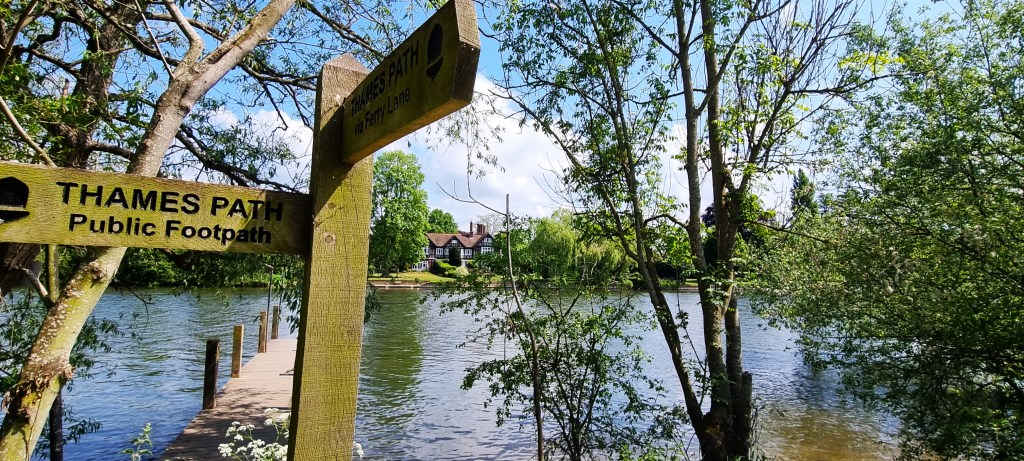
We returned to the Thames Path in mid-May 2025, having completed the section from Pangbourne to Henley in August 2024.
We travelled by train and tube to Paddington, from where we caught the 10:08 departure to Twyford, changing there on to a Henley service full of sulky teenagers.
Day 1: Henley to Marlow
Reaching Henley shortly after 11:00, we took the shortcut down to Meadow Road and on to the Thames path just after the obelisk. Passing the row of small boats moored along the bank, we approached Henley Bridge, before crossing its five spans to reach the opposite, Berkshire bank.
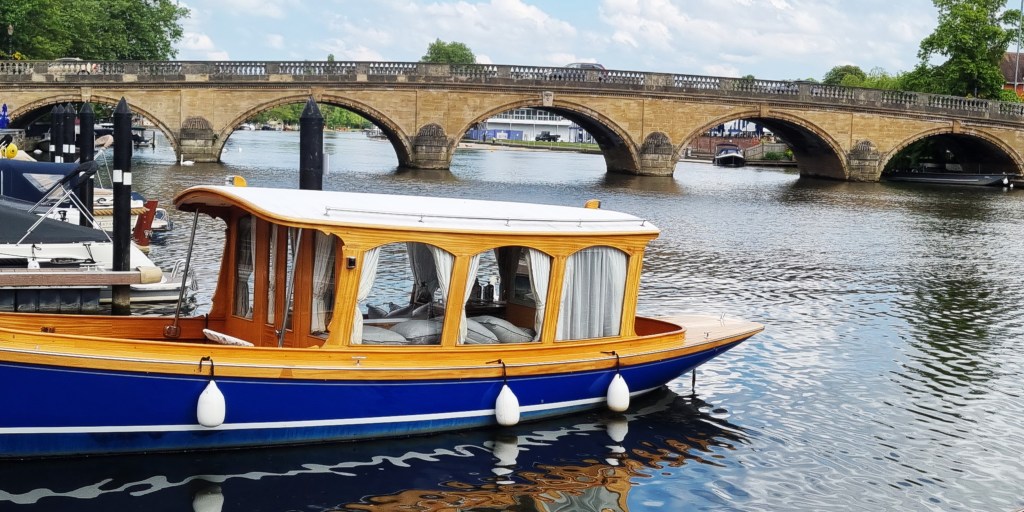
The present bridge was constructed in 1786 to a design by William Hayward. The keystones of the central arch feature Isis on one side and Tameisis on the other. Both were carved by Anne Seymour Damer (1748-1828). There is also this rather confusing sign.

The inaugural Oxford v Cambridge boat race finished here in 1829, the crews having begun their competition at Hambleden Lock.
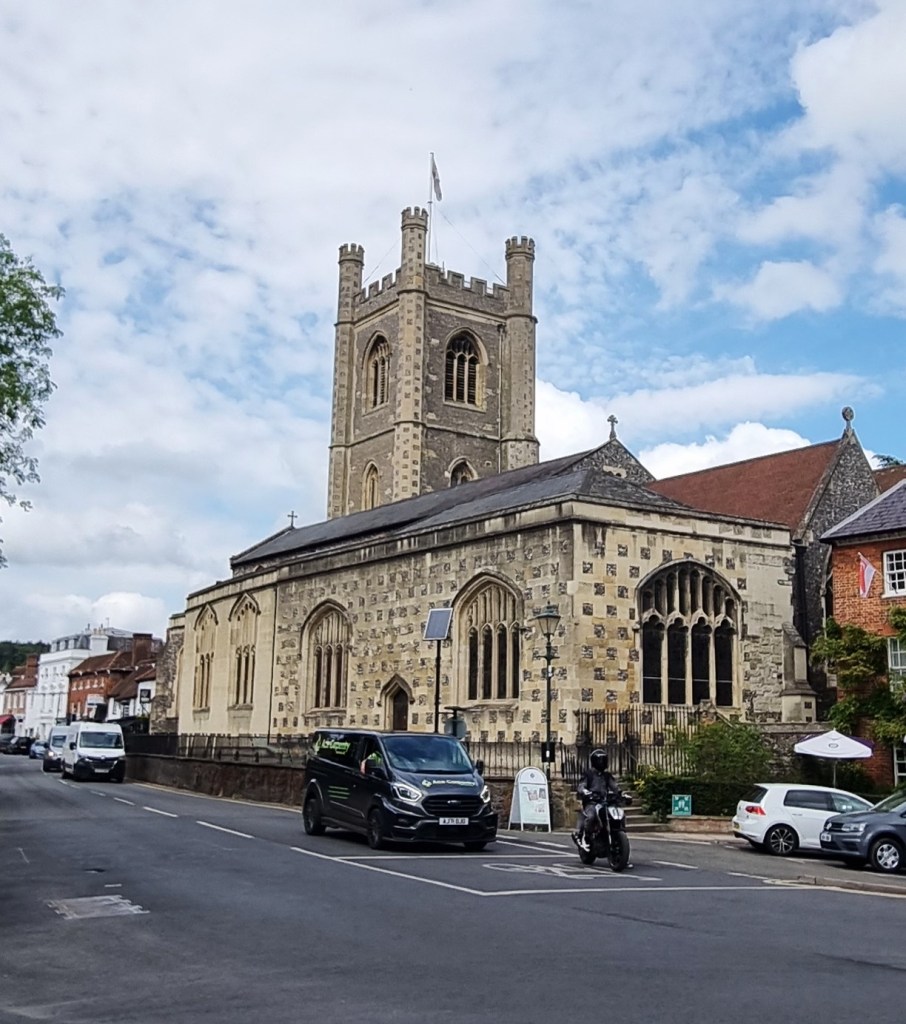
We admired the Sixteenth Century tower of St Mary the Virgin, where Dusty Springfield is buried, as well as a rather fetching set of late Nineteenth Century boathouses, before crossing to the Berkshire side.

Here, initial preparations were under way for some sort of Henley Regatta. The Royal Regatta, lasts several days, ending on the first weekend in July. The first regatta was in 1839, the ‘Royal’ being added in 1851 when Prince Albert became patron.
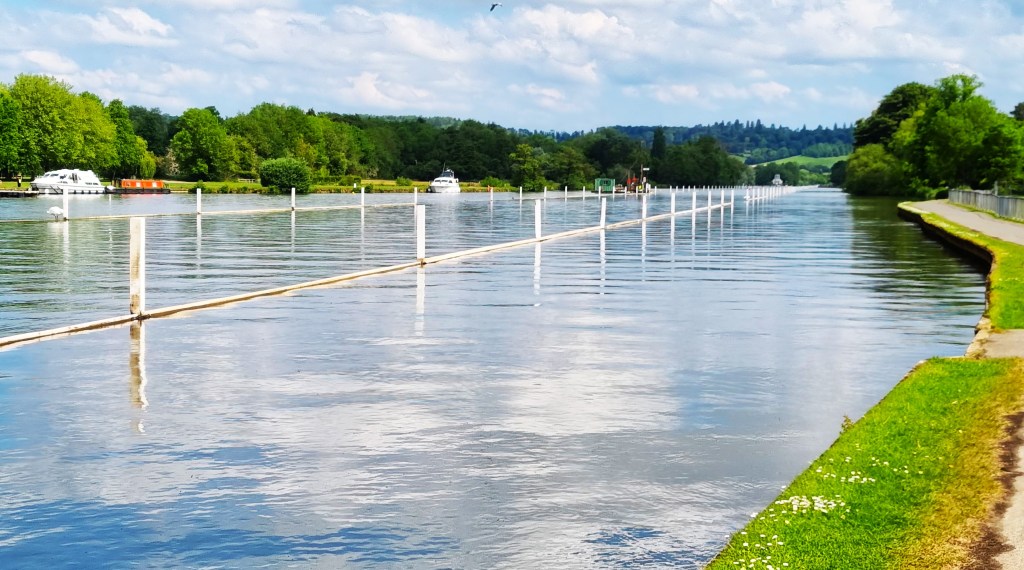
The course stretches down towards the start at Temple Island, so-called because it hosts a folly built in 1771 after a design by architect James Wyatt (1746-1813). It was originally a fishing lodge belonging to nearby Fawley Court, owned by Sambrooke Freeman (c1721-1782), then Member of Parliament for Bridport in Dorset.

Henley Royal Regatta acquired the Island and its temple in 1987. Visitors need written permission from the Royal Regatta Committee.
Several oarspeople were working their way along the course in one direction or another, while contractors worked on erecting hospitality tents along the bank.
Halfway along sits the Remenham Club, formed in 1909 by the members of six amateur rowing clubs located on the Thames, including Kingston Rowing Club (founded 1858), Twickenham Rowing Club (founded 1860) and Molesey Boat Club (founded 1866). The Club acts as the finishing line for the Henley Women’s Regatta.
A little beyond Temple Island, opposite Henley Business School, Tracy released some dried petals into the River, in memory of her former partner.

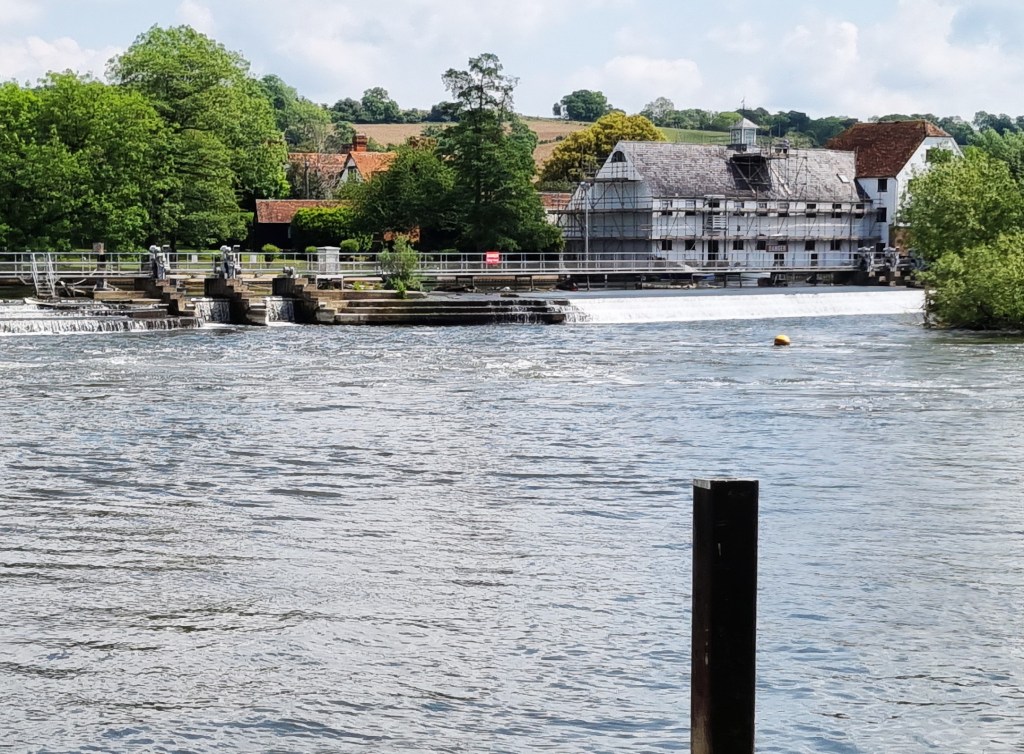
Rounding the bend, we arrived at Hambleden Lock and its Weir. The lock was constructed in 1773, then rebuilt in 1870 and again in 1994. The stretch from here to Henley Bridge is two-and-a-quarter miles long, and that inaugural race in 1829 was won by Oxford.
The Lock also features in Jerome’s ‘Three Men in a Boat’ (1889):
‘We found ourselves short of water at Hambledon Lock; so we took our jar and went up to the lock-keeper’s house to beg for some.
George was our spokesman. He put on a winning smile, and said:
“Oh, please could you spare us a little water?”
“Certainly,” replied the old gentleman; “take as much as you want, and leave the rest.”
“Thank you so much,” murmured George, looking about him. “Where—where do you keep it?”
“It’s always in the same place my boy,” was the stolid reply: “just behind you.”
“I don’t see it,” said George, turning round.
“Why, bless us, where’s your eyes?” was the man’s comment, as he twisted George round and pointed up and down the stream. “There’s enough of it to see, ain’t there?”
“Oh!” exclaimed George, grasping the idea; “but we can’t drink the river, you know!”
“No; but you can drink some of it,” replied the old fellow. “It’s what I’ve drunk for the last fifteen years.”
George told him that his appearance, after the course, did not seem a sufficiently good advertisement for the brand; and that he would prefer it out of a pump.
We got some from a cottage a little higher up. I daresay that was only river water, if we had known. But we did not know, so it was all right. What the eye does not see, the stomach does not get upset over.’
Hambleden itself is some way north of the Lock: the small settlement on the opposite bank is the hamlet of Mill End, its name derived from Hambleden Mill, adjacent, a water mill dating from the late Eighteenth Century, which was surrounded with scaffolding when we passed.
A few minutes later we were entertained by what seemed to be a ‘play fight’ between two young red kites.

A short while later the Path veers away from the Thames at Aston Slipway. A wooden council sign (metal was clearly not good enough) alerts drivers to peacocks in the vicinity.
The lane emerges beside the picturesque Flower Pot Hotel, built in 1895 by the Brakspear Brewery.

After a short road section, the route enters fields lying between the River and Culham Court, a substantial red-brick house built in 1771 for a lawyer, Robert Mitchell, who derived wealth through his wife’s interest in Antiguan sugar plantations.
It was owned by Urs Schwarzenbach, a Swiss financier and art collector, who bought it for £35m in 2007 but moved back to Switzerland in 2017. The property is presumably still within the Schwarzenbach family.
The Culham Court land is part of the much larger Culden Faw Estate, also owned by Schwarzenbach. We encountered that last time, while recounting the sorry tale of the Marsh Lock diversion!

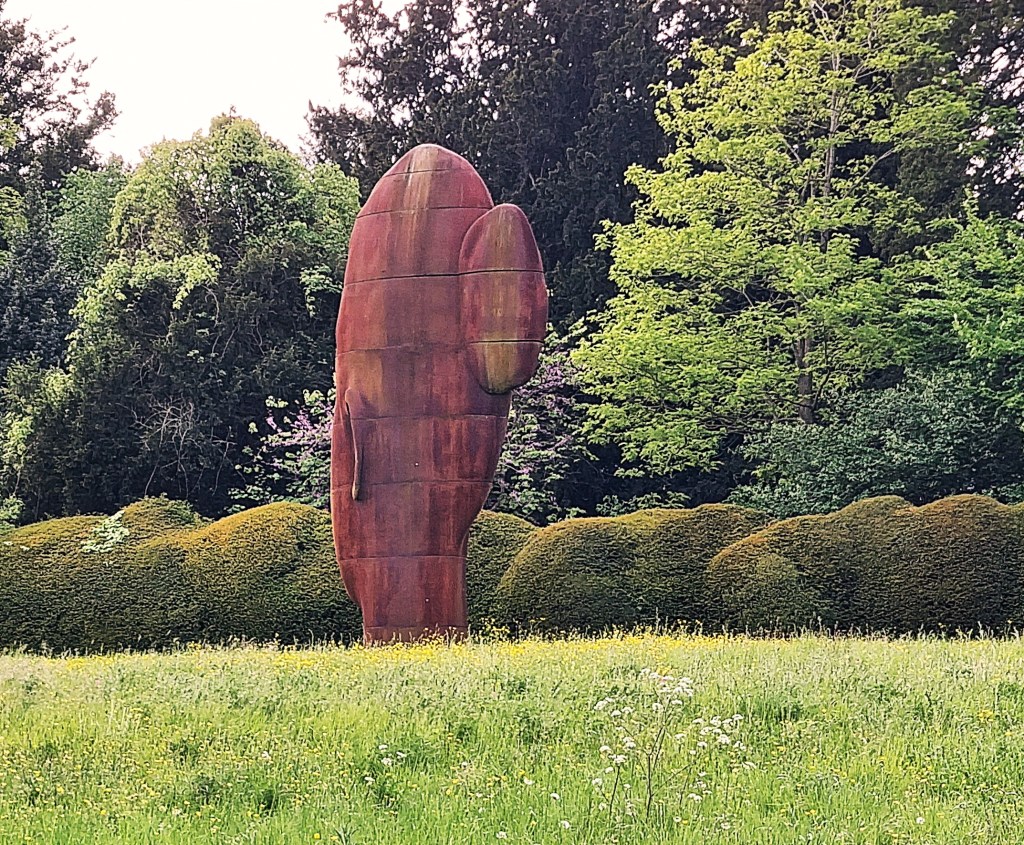
There is an interesting folly in one of the fields here, as well as a large female head in the garden!
We made our way into the deer park, a small herd of predominantly white venison enjoying the shade of a large tree. Above stood the squat rectangle of Christ the Redeemer, a Roman Catholic chapel of ease added by Schwarzenbach.

Having left the park, we found our way back down to the Thames, where we sat on a log and enjoyed our picnic lunch, just shy of Medmenham, on the opposite bank.
This was the site of a Cistercian Abbey which, after the Dissolution, fell into the hands of the Duffield family. They were in possession when Sir Francis Dashwood (1708-81) began to use it for his version of the Hellfire Club, meeting there in the 1750s and 1760s before transferring to the caves under West Wycombe Hill.
The notion that these meetings were were devoted to Satanic rituals seems wide of the mark: the members were mostly busy with drinking, carousing and orgies with bevies of prostitutes.
Continuing on our way, we passed Hurley Riverside Park and could see the top of Danesfield House Hotel high on the opposite bank.

This neo-Tudor pile was built between 1899 and 1901 for Robert William Hudson (1856-1937), the son of a soap powder manufacturer, but he quickly sold it on. During the Second World War it housed the RAF’s Joint Service Imagery Intelligence Unit (IMINT), eventually becoming a hotel in 1991.
Arriving at Hurley Lock, we decided to sit for a while to watch it in operation.
A group of six aboard a Le Boat had a few problems tying up, and seemed a little bit hesitant about what to do next. It was probably their first self-service lock.
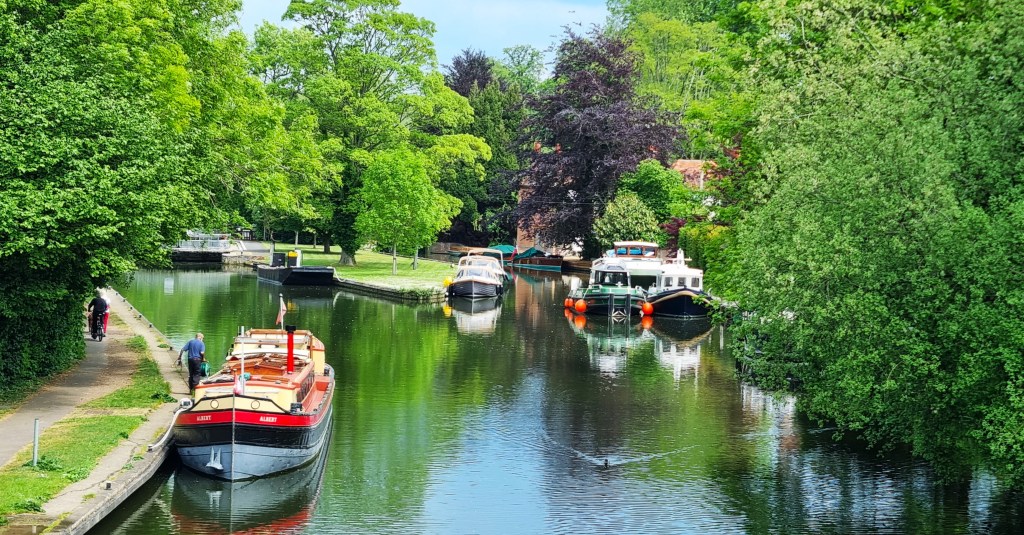
Hurley Lock was first built in 1773, but has been much repaired over the years. The Lock sits on one of several islands adjacent to the Village, which contains a few traces of a moated Benedictine priory, founded in 1086 and dissolved in 1536. The priory church survives, originally Twelfth Century, altered in the Fifteenth and restored in 1852.
As we left Hurley Lock Island, an old Red Setter followed us over the bridge, apparently convinced that we were its new owners. It was only with some difficulty that we persuaded it to return from whence it came.
We saw a Muscovy Duck in the River. They are supposedly abundant in England, but this was the first we could remember finding on the Thames.

Shortly after Hurley Lock, we had been expecting to cross over to the opposite bank, courtesy of the Temple Footbridge. The official guide refers to:
‘Temple footbridge, which spans the Thames on the line of the ferry that closed in 1953. This graceful 150-foot (46-metre) wooden arch was opened in 1989, very effectively solving one of the Thames Path’s crossing problems. Cross it gratefully…’
Unfortunately it was closed on 15 May 2023, owing to the condition of the deck boards, and remains closed two years later.
Apparently, the bridge’s ‘design life’ was a mere 30 years, so the deterioration is not unexpected. By September 2023 the Environment Agency had established that it would need to be partially dismantled before refurbishment. Then it joined the long queue for Government funding.

According to this BBC report from 1 May 2025, the EA says it has now secured £500,000 to fund both this repair and Marsh Lock besides.
This may have something to do with alleged adjustments to the EA’s criteria for prioritising capital expenditure projects: in the past all footbridges were classified improperly, as leisure facilities, incapable of income generation.
It expects to ‘set up a contract with a supplier for later this year’ (ie 2025). But don’t hold your breath! Even when work finally begins, it will likely take at least a year to complete.
The diversion is lengthy and tedious, following the road through Bisham and then all the way to Marlow Bridge. There is zero access to the River for some two miles.
On arriving in Marlow, insult was added to injury. We had planned to finish with coffee and cake at ‘The ‘M’ Cafe’ which looks on to the riverside across Higginson Park.

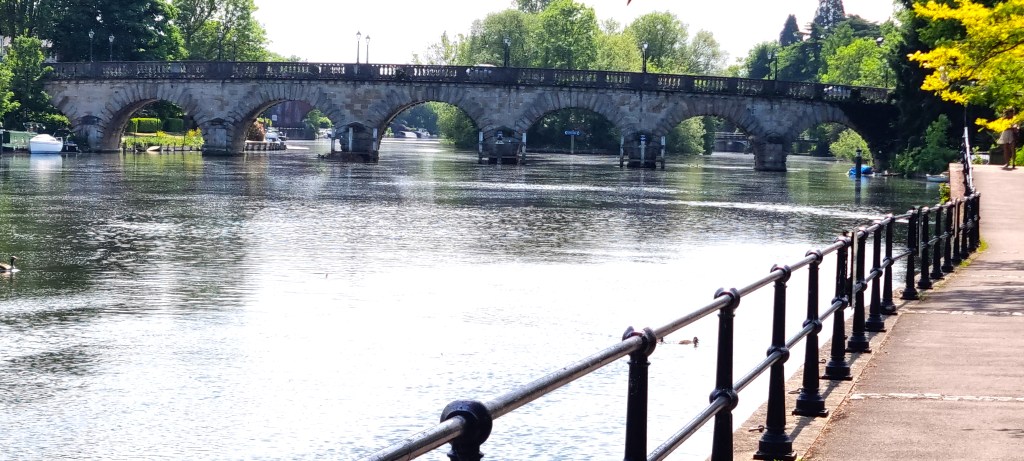
Having finished on the wrong side, we first needed to cross Marlow Bridge. It was completed in 1832 to a design by William Tierney Clarke (1783-1852), an early specialist in suspension bridges, who also spanned the Danube! There was a major restoration in the 1950s.
However, the Park had been closed off for some ‘pub in the park’ do, so we had to circumnavigate the extensive perimeter fencing.
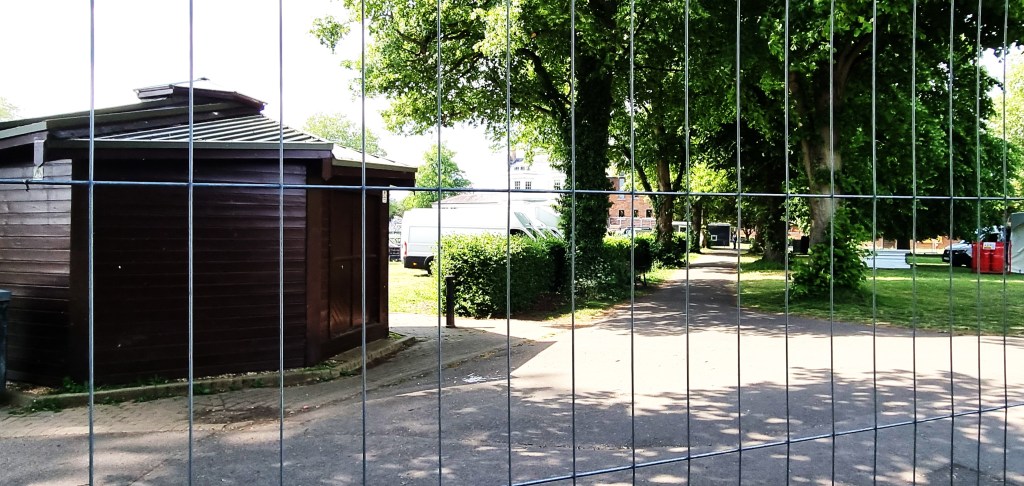
Eventually I enjoyed a very nice slice of gluten-free carrot cake.
Adjacent to the Bridge on the Marlow side sits All Saints Church, built in 1835 after the spire of the previous edifice collapsed.

The Shelleys were resident at Albion House, on West Street in Marlow from March 1817 to March 1818, before removing to Italy and, while here, Mary Shelley published Frankenstein.
Thomas Love Peacock (1785-1866) also lived on West Street from 1815 to 1819 and, while visiting him on Boxing Day 1817, Shelley began ‘Ozymandias’.
TS Eliot moved to a third house in West Street in 1918, where Bertrand Russell enjoyed his affair with Eliot’s first wife, Vivienne Haigh (1888-1947).

We had booked a room at the Compleat Angler Hotel, advertised as in ‘a tranquil setting’, next to the Bridge and directly opposite All Saints Church.
Unfortunately our room was situated just above the end of the weir, which stretches upstream several hundred metres from Marlow Lock, ending next to the Hotel.

This was far from tranquil, especially in the middle of the night. The only solution was to close the windows and turn on the air con, so drowning out one undesirable noise with another.
I’m pretty sure this is where my late wife Kate worked as a waitress during her student holidays, circa 1979-80. She was not then complimentary about the kitchens, referring disparagingly to their ‘boil in the bag’ cuisine.
The gastronomy has improved substantially since then. We had been intending to dine in Town, only to find that our preferred establishment was closed. Instead we visited the Sindhu Restaurant, located inside the Hotel but operating as a separate business.
Our meal was truly excellent, the portions huge, washed down with a very drinkable Indian wine – Sula Dindori Reserve Shiraz.

Day 2: Marlow to Maidenhead
It wasn’t a great night’s sleep, but I had just enough shut-eye to function on this second day.
We descended to breakfast at 08:00, just before the rush. We were soon joined by a group of glamourous women, probably in their 30s or 40s, from a variety of international backgrounds.
They were all well-dressed and heavily made up, most bearing huge handbags. They clearly had some interest in common, but they hadn’t met before.
We left the Hotel at around 09:00, recrossing the bridge and passing through a footpath to the rear of All Saints Church. We continued through well-heeled suburbia, noting the entrance to Marlow Lock but not bothering to stop.
A juvenile magpie had unfortunately come to a stop in the middle of the road, but hopefully his mother would arrive before a car.

Once we reached it, the Riverside path out of Marlow proved extremely popular with dog walkers, as well as a smattering of joggers. On the opposite bank there were several swish boathouses, with larger villas nestling on the lower slopes of Winter Hill.
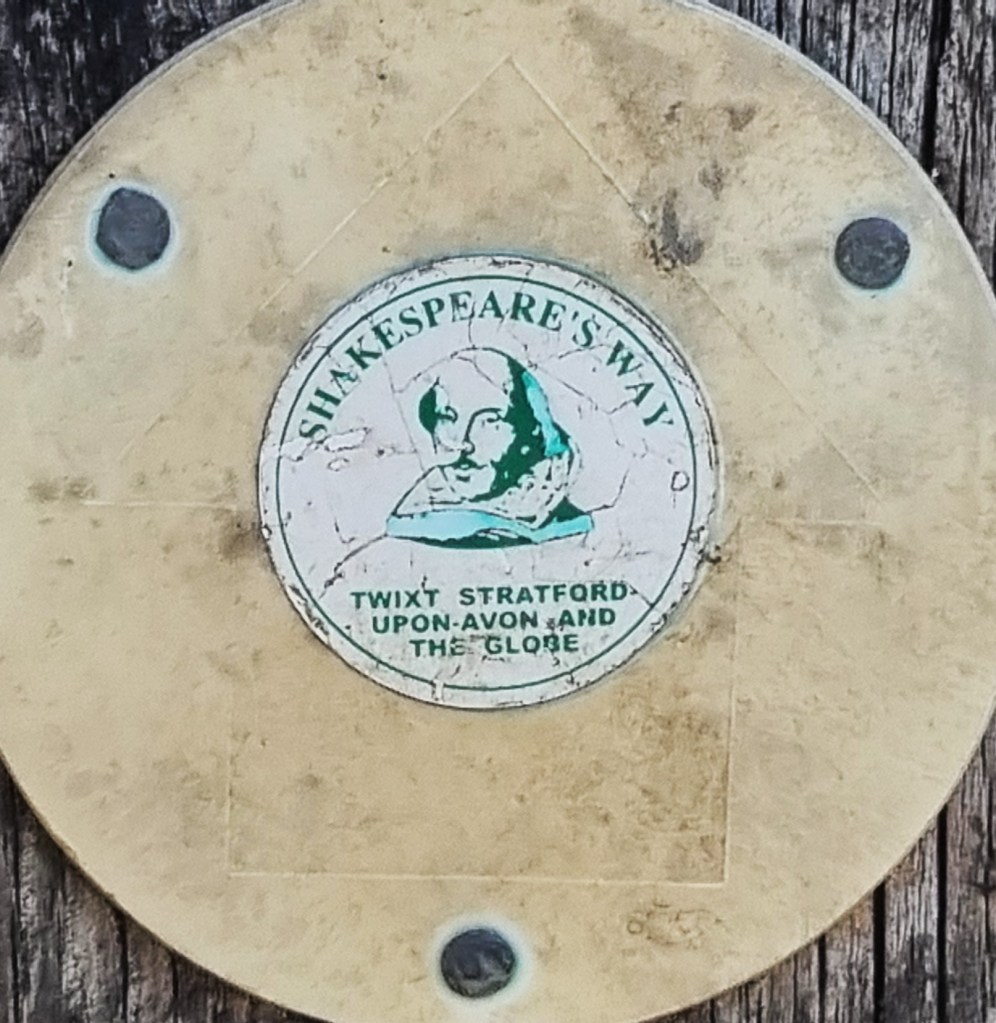
Coming in sight of Bourne End we passed two paddle boarders heading in the opposite direction. We also noticed a marker for Shakespeare’s Way, a 146-mile walking route from Stratford-on-Avon to the Globe Theatre on London’s South Bank.

Skirting many riverside chalets and moored river craft at Bourne End, we swiftly made our way to Lee’s, on The Parade, for a large coffee and exceptionally good strawberry and rhubarb cake.
Lee’s is highly popular, particularly with local workmen, who arrived in a steady stream while we sat outside. I strongly recommend a diversion to Lee’s in all circumstances.
Returning to the River, the route crosses to the opposite bank via the railway footbridge. It is cantilevered from the side of the rail bridge and only arrived here in 1992.
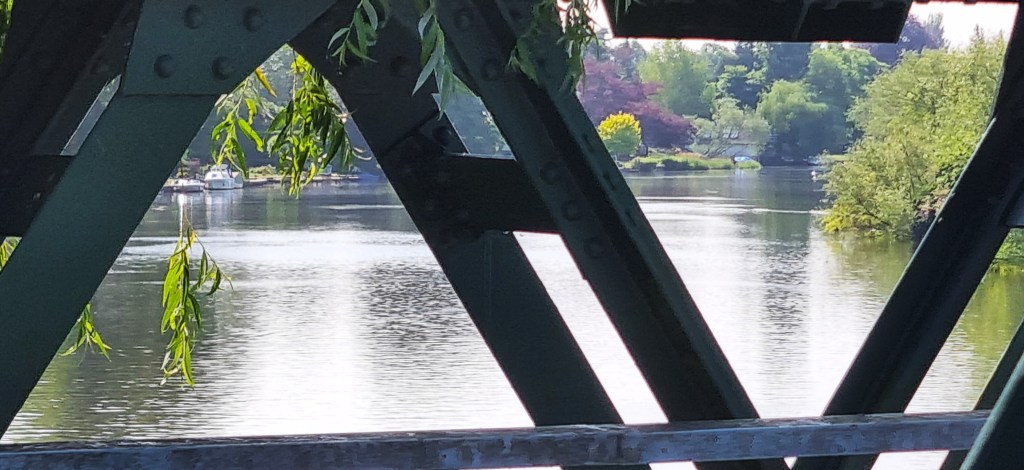
As we crossed, the stanchions made neat triangular frames for the river scenes beyond, but our attention was soon diverted by a large group of Red Kites performing a swooping ballet against the vivid sky.

We were now passing through an area of National Trust land called Cock Marsh, which supplied a beautiful stretch of riverbank.
Four Bronze Age burial mounds were excavated here from 1884-87.

But I was more worried by the small herd of cows, looking and behaving exactly like water buffalo, each equipped with their own personal bell.
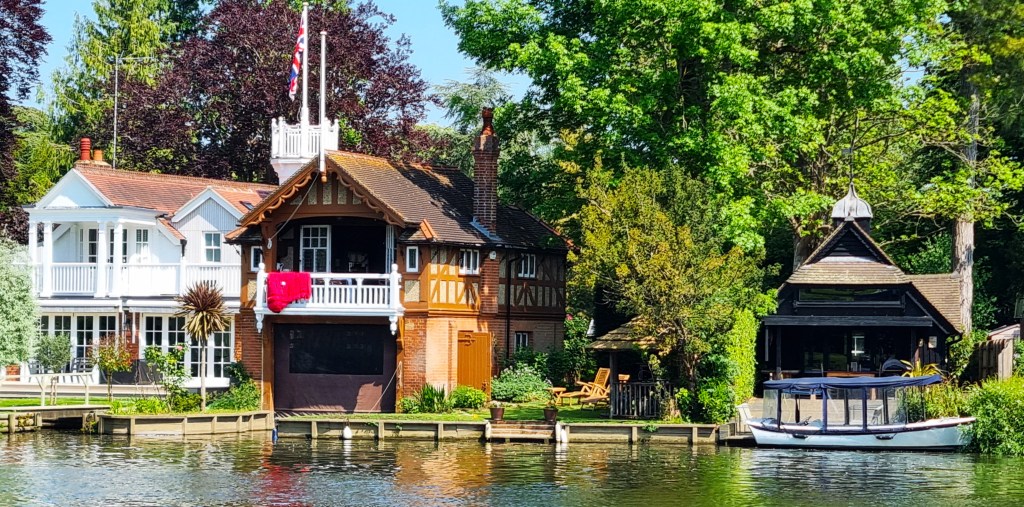
Approaching Cookham, we coveted several more picturesque boathouses, including this one with a large red quilt spread over the balcony to air.
Our route now departed the River once more, routed through Holy Trinity’s churchyard and past the small Stanley Spencer Gallery, formerly a Methodist chapel, on the corner of the High Street.

Holy Trinity itself dates from the Twelfth Century, though with many later additions, including the tower, which was built around 1500.
The remains of an Anglo-Saxon monastery have also been discovered here. It was thriving in the Eighth and Ninth Centuries but seems to have been abandoned.
Cookham has or had several famous residents, including Chris Barrie, Wendy Craig, Kenneth Grahame, Ulrika Jonsson, Timmy Mallett, Marconi and Chris Rea. But it will forever be associated with Stanley Spencer.
Spencer was born here in 1891, lived her for much of his life and captured many local scenes in his paintings, including ‘The Resurrection, Cookham’ (1924-27), which features many of his family and friends in and around Holy Trinity’s churchyard. He, too, was buried there in 1959.
Slightly beyond the Spencer Gallery we found a handy public toilet block, which slightly lessened the pain of another extended detour from the Thames.
This is attributable to Cookham’s street plan and the River’s fragmentation into four separate channels flowing between three islands. Not to mention the unhelpful absence of public rights of way.
The official route passes along Mill Lane, then through woodland for some considerable distance. One has the feeling that one is being kept away from several desirable residences belonging, no doubt, to the extremely rich and famous.
Finally, the path emerges back on to the Thames below Cliveden on the opposite bank, at a location called My Lady Ferry. There is still a Ferry Cottage on the Cliveden side, which can now be rented as a holiday cottage.
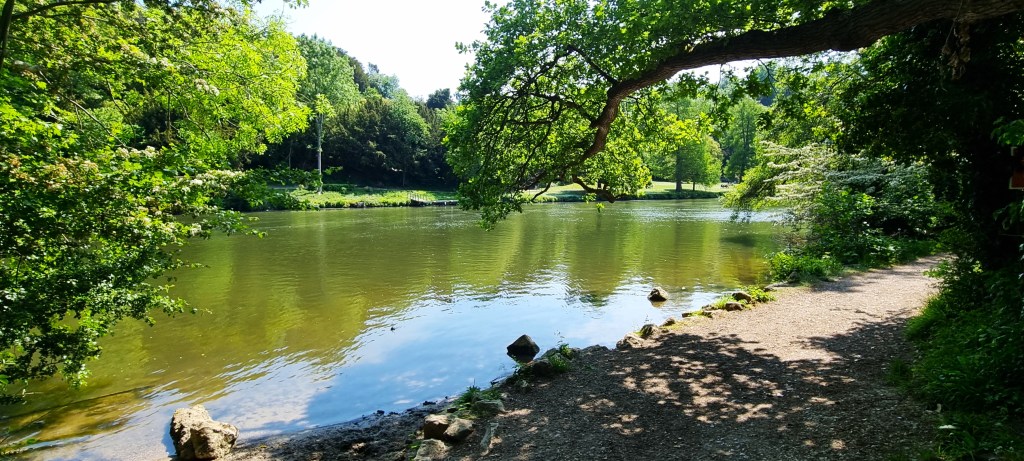
Cliveden itself belonged to George Villiers, 2nd Duke of Buckingham (1628-1687), but that house burned down in 1795, while its successor met a similar fate in 1849.
The present house was erected in 1851 for George Sutherland-Leveson-Gower, 2nd Duke of Sutherland (1786-1861).

The American-English millionaire William Waldorf Astor (1848-1919) bought the property in 1893, presenting it to his son Waldorf Astor (1879-1952) in 1906, upon the latter’s marriage to Nancy Langhorne (1879-1964). Waldorf donated it to the National Trust in 1942.
Meantime, our side of the River was unencumbered by mansions for a while, though I did spot a handsome tree-house across the fields.

We came upon this apparently pointless wooden gate and opposite, moored against the other bank, a small white cabin cruiser, Ripple Rider, from which ethereal music seemed to drift across the River.

Eventually we came upon a row of expensive waterfront houses, the first of which was the grandest. As we passed, two workmen seemed to be adding the finishing touches to an ornamental bridge in the garden.
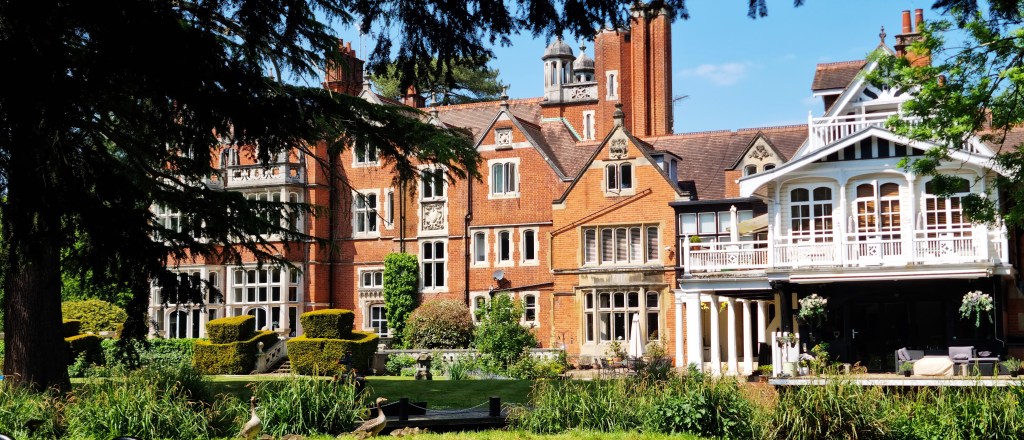
This turns out to be Islet Park House, formerly the home and studio of Gerry Anderson (1929-2012) of Thunderbirds fame, now a block of flats.
Arriving at Boulter’s Lock, it was growing quite warm, so we decided to rest awhile. We consumed a banana and a Tunnocks between us while observing a mild ‘domestic’ between a couple navigating their narrow boat upstream.
The woman required the man to pay attention to her urgent question, while the man intended to devote all his attention to steadying their boat.
The present Lock was constructed in 1912. Its immediate predecessor features in ‘Boulter’s Lock, Sunday Afternoon’ (1885-97), a painting by Edward John Gregory (1850-1909).

It was so long in gestation that the women are sporting markedly different fashions. The reclining figure in a boat to the right is Gregory himself, no doubt utterly exhausted by the effort.
On reaching Maidenhead Bridge, we diverted to the Station. Which seemed an inordinate distance away, via some of the less salubrious parts of Town.
I inadvertently crashed into a lamp-post while navigating and we also had a minor altercation with a teenage cyclist who came round the corner far too fast.
So our adventure was bookended by teenage angst.
We caught the Elizabeth Line service back to Paddington and, despite problems with the local trains, made it home by mid-afternoon.
TD
June 2025
.






 Eponymous
Leave a comment