
A.S. Byatt (1936-2023) was born Antonia Susan Drabble, the eldest child of a barrister (later a QC) and an academic. One of her younger siblings was the novelist Margaret Drabble (b. 1939).
Byatt was born in Sheffield, but the family moved to York to avoid German bombing during WW2.
Shortly after graduating from the University of Cambridge she married Ian Byatt, an economist, moving with him to Durham.
When that marriage ended in 1969, she married Peter Duffy, retaining her previous surname for writing purposes.
From 1972 to 1984 she was a Senior Lecturer in English and American Literature at UCL, thereafter devoting herself to writing full-time.
Her previous novels were published in 1964 and 1967 respectively. ‘The Virgin in the Garden’ was her third, published in 1978 while she was at UCL, and is self-evidently an ‘academic’s novel’.
It is also the first of a tetralogy featuring the character Frederica Potter, the three later volumes interspersed throughout Byatt’s subsequent career.
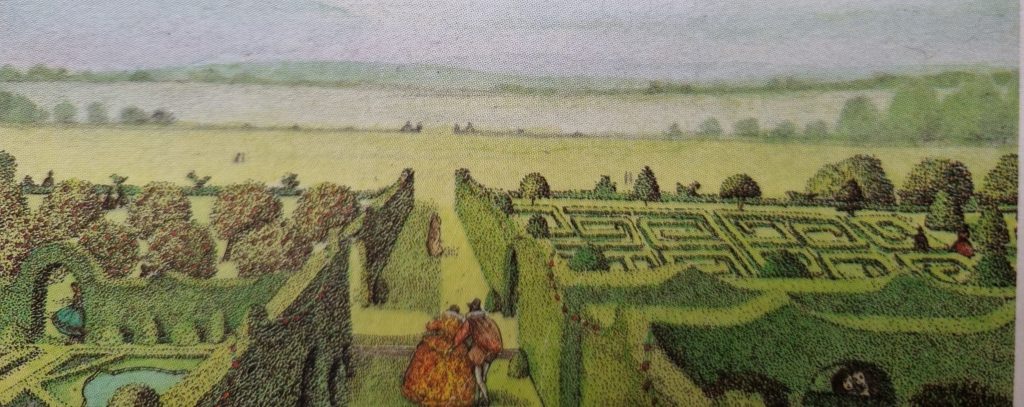
The book is set 25 years before it was published, in 1953, the year of Queen Elizabeth II’s Coronation. Its centrepiece is the performance in a country house garden of a play about Queen Elizabeth I, intended to mark her namesake’s accession to the throne.
Frederica is a precocious 17 year-old A level student living with her family in a house attached to Blesford Ride, the public school where her father, Bill, teaches.
He bullies and terrorises the rest of the household, comprising his long-suffering wife, Winifred, and his other two children: Stephanie, a teacher, and the youngest, Marcus.
Other teachers at Blesford Ride include Alexander Wedderburn, Lucas Simmonds and Geoffrey Parry.
Thirty-something Wedderburn is dashingly good-looking, but rather a wimp. He is the author of the play. Redheaded Frederica is cast as the Young Queen, largely because of her physical resemblance.
Frederica is on a quest to discard her virginity, ironically enough, given the role she is playing. She falls for Wedderburn, almost twice her age, and her affections are eventually reciprocated, Wedderburn having finally diverted his attentions away from Jenny Parry, Geoffrey’s wife.
Neither relationship seems destined to be consummated, however. At the crucial moment, Wedderburn is distracted by the presence of Jenny’s baby, Thomas, or (quite reasonably) disturbed by the prospect of deflowering his colleague’s teenage daughter.
Ultimately, though, Frederica achieves her quest at the hands of Wilkie, a fellow actor in the play, who transports her to Scarborough on his motorbike, and matter-of-factly performs the deed in a bedroom at the Grand Hotel.
Meanwhile, much to Bill’s disgust, Stephanie has married Daniel Orton, a heavily-built young curate and quickly becomes pregnant by him, taking on the role of church wife.
And Marcus falls under the sway of Lucas Simmonds. They begin to conduct psychic experiments together. Once the relationship begins to take on a sexual dimension, Simmonds grows increasingly unstable and is ultimately removed to a psychiatric hospital.
This also seems to tip Marcus over the edge, though the psychiatrists conclude that the true cause of the breakdown is fear of his father.
Of the three children, Frederica is the least affected by Bill,s emotional bullying, probably because she has many similar characteristics. She is not very likeable: almost completely self-absorbed, driven by her literary studies, and almost oblivious to much that is going on around her.
The novel is compelling, the characterisation complex and powerful. The suffocating sexual mores of a northern provincial town in the early 1950s are closely observed.
But the narrative is dense, stuffed with literary allusions and oblique references to the life and times of Elizabeth I. Sometimes, this academic layer threatens to overwhelm the narrative, intruding itself to the detriment of Byatt’s way with words.
Just occasionally, though, a beautifully written paragraph without such allusions helps to remind the reader how good a stylist Byatt could be:
I particularly liked this observation, from the description of a party Bill throws to celebrate Frederica’s A Level results:
‘Winifred, to whom nobody had said anything, stood as near as she dared to Marcus, watching him watch space. He had gone away somewhere worse and further than he had always been gone. If she tried to go after him, or so she thought, he might vanish entirely. If he did not, a lifetime’s or at least a marriagetime’s experience had taught her that if she showed agitation Bill would come and club one or both of them with too much love or hate, would yank or drive them into some girning, daemonic clinch, to avoid which stillness and more stillness was the only resort.’
I am sure I shall return to Byatt before long.
TD
May 2025









 Eponymous
Leave a comment