
We’ve arrived at the fifth in this series of twelve monthly posts dedicated to exploring music of particular personal significance.
Each post is connected, however tenuously, to its predecessor and I’m hoping to end in December where I began last January.
The series began with Ya Jean by Madilu System, before moving on to Autorail by Orchestre Baobab, Sweet Fanta Diallo by Alpha Blondy and Blue Sky by the Allman Brothers.
This month’s selection is ‘Saturday Night’, the final track on the 1989 album ‘Hats’ by The Blue Nile.
The connection is, straightforwardly, ‘blue’.
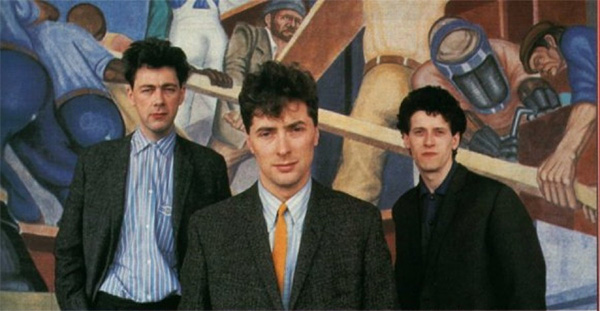
The Blue Nile
The Blue Nile was formed in 1981 by three recent graduates of the University of Glasgow.
Paul Buchanan was born in Edinburgh in 1956. His family moved to Bishopriggs on the outskirts of Glasgow and he attended St Ninian’s High School, Kirkintilloch, where he was a couple of years ahead of actor Peter Capaldi.
At University Buchanan studied literature and medieval history, followed by a post-graduate teaching qualification. He worked for a while as a teacher, then as public relations manager for a Glasgow theatre company.
Robert Bell was born in 1952. He was at school with Buchanan before reading maths at Glasgow. He graduated a few years earlier and became a freelance journalist.
Paul Joseph (P J) Moore was a near contemporary of Buchanan’s, born in 1957, also from Bishopriggs, but the two only became friendly as students. Moore studied electronics and fine art, becoming a sound engineer with Scottish Television.
They played together initially in a five-piece band called McIntyre, named after a Glasgow University building. Then all three progressed to another outfit called Night by Night, after the Steely Dan song of that name on ‘Pretzel Logic’.
They struggled to maintain a consistent line-up, experiencing particular problems with drummers. They would rehearse intensively for several weeks, only to discover that their drummer had decided to move, get a job or switch bands. There were precious few gigs as a consequence.
By 1981, the band had shrunk to three: Buchanan, Bell and Moore. Buchanan sang and played guitar badly, Bell played bass and Moore keyboards. In an attempt to solve their drum issue, they borrowed a friend’s drum machine, battered and basic with a limited repertoire of predominantly Latin rhythms. They taped these to use in rehearsals.
They confined themselves exclusively to cover versions, even though Buchanan and Bell had been writing original songs together for some time.
Finally, in 1981, they scraped together enough money to record a limited edition single, ‘I Love This Life’, with its B-side, ‘The Second Act’. It was distributed via their own vestigial label, Peppermint Records.
They’d recorded it at Castlesound Studio in Pencaitland, east of Edinburgh. This was owned by a friend, Calum Malcolm. He was formerly keyboard player with The Headboys, who’d released their one eponymous album on RSO Records in 1979.
A copy of ‘I Love this Life’ made its way to RSO via Malcolm. RSO agreed to license the record for wider distribution, and it even received some limited airplay. But then RSO foundered in a series of legal disputes, causing it to disappear without trace.
As one of its final acts, RSO did get round to requesting a follow-up demo, so the band returned to Castlesound. Some sources say that the band also owes its name to RSO’s head of A&R. Other say it’s borrowed from the title of Alan Moorehead’s book about Nineteenth Century explorers, still more that it was picked out on a map.
As Blue Nile mythology has it, Calum Malcolm was a friend of Ifor Tiefenbrun, founder of the Linn Audio hi-fi company. Linn were testing out their speakers at Castlesound and wanted to use some of the music recently recorded there.
So Malcolm played them this new demo, ‘Tinseltown in the Rain’.
Linn were also planning a record label, Linn Records, dedicated to promoting high quality analogue recordings on vinyl, in the face of competition from digital recording to CD.
They offered the Blue Nile a contract on the strength of ‘Tinseltown’, but it allegedly took the trio a full nine months to respond positively to this offer, allegedly via a public telephone.
They were short of money, having given up their jobs to concentrate on rehearsals, usually conducted with a borrowed amplifier in a tiny bedroom in a shared flat on Glasgow’s Otago Street.
Linn Records specialised in folk and classical music, so there was no commercial imperative: they left the trio free to develop their music at their own pace. This was fortunate since the Blue Nile were very slow workers.
They no longer had to rely on cheap electronic technology and sheer ingenuity, Linn having provided a healthy advance. But they still had to overcome their technical inadequacies, as well as their perfectionism.
They soon found they had two trump cards.
First, their uncanny ability to conjure up and sustain an atmosphere, a soundscape, that many listeners found peculiarly redolent of Glasgow, or else their own home cities. This was largely the result of Moore’s keyboards, backed up by Bell’s sparse, left-handed bass and the adept use of synthesisers.
Second, Buchanan’s intensely soulful vocals, often crooning, occasionally yelping, and dripping with introspective, melancholy lyricism.
Buchanan has argued:
‘The care that we took in recording, and also the care that we exercised in the manufacture of the records was really designed to leave as much emotive impact in the sound as was possible.’
But their perfectionism was also an obstacle. Malcolm recalled:
‘They were always particularly sensitive to not doing the wrong thing and making sure it had absolutely the right emotional impact: there were times when I’m sure everyone else felt something was done and then someone would throw a spanner in the works over some little thing.’
Bell once said:
‘We wanted to walk before we could gallop. We didn’t want to do the usual kind of first album. You know: one or two half-decent songs and the rest padding. We wanted to take it slowly and have a result worth listening to.’
‘Tinseltown’ was one of seven songs featured on this first album, ‘A Walk Across the Rooftops’, recorded in Castlesound Studio during five months of 1983, but not released until April 1984.
Only 2000 copies were pressed, until Virgin took over the UK distribution, influenced by lobbying from members of Big Country. Eventually the album reached number 80 on the UK Albums Chart, while ‘Tinseltown’ made it to 87 on the UK Singles Chart.
Steve Lillywhite pronounced ‘Rooftops’ the best debut album of the last five years, while Peter Gabriel allegedly ordered boxes of 25 to share amongst his friends. Phil Collins and Ricky Lee Jones were also fans.
Videos of the single generated valuable exposure in Europe, while A&M records also released the album in the United States.
Reviews were mostly glowing, for example this, from the Melody Maker:
‘Good music can always complement the mood you’re in, but you know you’re onto something really special when songs can create and influence these moods of their own volition. The Blue Nile’s stunning debut album seduces the emotions as well as the senses, and instead of fighting its effect, the sensible thing to do is relax and enjoy it…
…Experimenting with texture is obviously a Blue Nile fascination… The authors are bent on moody intricacy without being artificially clever. Individually, the tracks weave patterns that leave traces of spectacular emotions. Nostalgia, romance, elation and reflection are woven into their fabric with gossamer-fine delicacy.’
The Blue Nile seemed finally to be in the ascendant. But then things began to fall apart, aided and abetted by that pesky perfectionism.
There were no plans to ‘tour the record’ – they decided they would record another album before tackling the complexities of reproducing on stage what they had created in the studio.
They were also feeling the pressure of having produced such a successful debut. Linn Records encouraged them back into the studio but, despite their best efforts, there was no new material to record.
The lived in a shared house nearby, but this further strained already difficult relationships, particularly between Buchanan and Moore.
Virgin added further pressure by starting legal proceedings against them, because they hadn’t generated the new material stipulated in their licensing agreement. A&M were also pressuring Virgin in the background.
They finally managed to record some material, but decided it wasn’t good enough, burning the tapes ceremonially in the courtyard.
Eventually, they had to vacate Castlesound to accommodate another band, who proved equally slow to complete their record. With little to show for their efforts, they returned home to Glasgow, where Buchanan was also affected by the disintegration of his parents’ marriage.
But being home seemed to unlock their creativity. Finally, when Castlesound became available, they returned with several musical ideas and were able to complete their new album, ‘Hats’, in a matter of weeks. ‘Hats’ was released in October 1989, more than five years after ‘Rooftops’.
Parts of the two subsequent albums reach the same level, but few would argue that ‘Hats’ marked the pinnacle of their career. It was all downhill from there, although not for the want of trying.
The songs on ‘Hats’ received considerable airplay in the United States, bringing them to the attention of other musicians. They toured the US in 1990 and visited Los Angeles, where they worked on material by Julian Lennon and Michael McDonald, amongst others. They also co-wrote ‘The Gift’ on Annie Lennox’s solo album ‘Diva’.
In 1990, they also played their first UK gigs, finally achieving the technological feat of reproducing their complex studio sound live on stage. Here they are in their pomp at Manchester Free Trade Hall.
Buchanan moved to LA, enjoying a relationship with Rosanna Arquette who was between her second and third marriages. Meantime, they had been released by Linn Records and Virgin.
In 1992, Buchanan unilaterally signed a deal with Warner Brothers. He claimed it was on the Band’s behalf but, since he was the only signatory, the Blue Nile essentially became his backing band.
They spent a few years wandering round Europe, unsuccessfully trying to find the ideal place to record their third album. But ‘Peace at Last’, released in 1996, was recorded in several different studios.
They toured in 1996-97, the tour culminating at Glastonbury in 1997. You can also still see their complete performance which is competent, though they don’t seem too comfortable: their music is far too subtle and intricate to work well in a festival setting.
Around this time, they also appointed Ed Bicknell as their first manager – perhaps indicative that their internal disagreements were growing insurmountable.
Bicknell promptly withdrew them from Warner Brothers, but couldn’t persuade them to take a more disciplined approach. He is on record as saying:
‘They really didn’t know what it meant to be a professional rock group, or whatever you want to call it. They always sort of played at being a band.’
And:
‘In terms of the modern recording world the history of the Blue Nile was the most screwed-up I had ever encountered.’
Between 1997 and 2004, the Blue Nile hibernated once more, making a single appearance in Dublin in 2001. Buchanan became ill for a while, and Bicknell left in 2004.
Then in August 2004, they released their fourth and final album ‘High’ on Sanctuary Records.
A tour was planned to promote the album, but Moore withdrew contact from Buchanan and Bell.
They eventually toured without Moore in May/June 2006, as part of a group of six. The gigs were billed as ‘Paul Buchanan plays the songs of the Blue Nile’. A handful of similar gigs followed in 2007 and 2008, the last in Galway, Ireland.
And, apart from endless conjecture about whether they might reform, that marked the end of Blue Nile’s career – four albums containing some thirty songs, roughly fifty gigs all-told, a smattering of alternative takes, bootlegs and ‘previously unreleased’ material.
Calum Malcolm remastered ‘Rooftops’ and ‘Hats’ in 2012, each including a disc of ‘bonus material’. A remastered ‘Peace at Last’ followed in 2014, while ‘High’ was re-released in 2020.
‘Rooftops’ and ‘Hats’ were originally mastered for vinyl rather than CD, so these later versions provide some much-needed ‘oomph’. But the bonus material doesn’t add greatly to the Blue Nile oeuvre.
Buchanan released a solo album in 2012. His vocals also appear occasionally on someone’s else’s release. In 2020 P J Moore formed a new band which released its first album in 2022.
As the younger members fast approach their 70s, there seems zero prospect of the three ever playing together again. Buchanan has occasionally seemed receptive, even mildly puzzled about what caused them to fall apart, but Moore is rightly adamant that the Blue Nile was of its time, and that time is past.
Hats
There are seven songs on ‘Hats’ which can be interpreted as a coherent narrative.
We, the listeners, are given access to a man’s internal monologue, as he explores subtle changes in his relationship with a woman, and how those make him feel.
He seems sensitive, introspective, introverted and insecure: an outsider who can feel lonely in the city, even amongst crowds. Sometimes he perceives this relationship as fragile, even precarious, fearing its termination, which will drive him back into unwelcome solitude.
Much is elliptical: little is spelled out explicitly, so the listener must make inferences. Interpretations will differ, but this is what the narrative means to me.
In the first track, ‘Over the Hillside’, our hero is contemplating a journey to be with this significant other:
‘Working night and day, I try to get ahead,
But I don’t get ahead this way,
Working night and day, the railroad and the fence,
Watch the train go roll around the bend.’
He convinces himself that he will make this journey, despite his partner’s apparent scepticism:
‘Tomorrow, I will be there.
Tomorrow, I will be there.
Tomorrow, I will be there.
Oh, you wait and see.’
But, ultimately, he can’t sustain this commitment and the song ends in vacillation. He seems trapped by indecision, wondering whether there’s any purpose in trying to escape his present circumstances, even though he’s dissatisfied with his lot.
His past experience suggests that he’s destined to fail:
‘I can’t go on and I can’t go back
I don’t feel so matter-of-fact
I tried and tried to make good sense
What’s the good to try it all again?’
In track two, ‘The Downtown Lights’, he finds himself walking alone through the city’s empty streets. The bright lights somehow help to reassure him that he and the woman have a brighter future, that he has much to offer her.
He asserts:
‘Sometimes I walk away
When all I really wanna do
Is love and hold you right.
There is just one thing I can say
Nobody loves you this way.’
He wants to share the empty streets with her:
‘Tonight and every night
Let’s go walking down this empty street
Let’s walk in the cool evening light
Wrong or right, be at my side.’
But the song expresses his inner doubts, through the constant repetition of:
‘How do I know you’ll feel it?’
followed by self-reassurance:
‘It will be alright.’
It closes with a sequence of images that encapsulate this cityscape as he has experienced it, both empty and full of people. This culminates in a determination not to face another broken relationship:
‘I’m tired of crying on the stairs.’
The first side of the album closes with ‘Let’s Go Out Tonight’, in which our hero tries to encourage the woman to join him out amongst the city lights.
She seems unwilling, and there is something on her mind. He asks:
‘Why don’t you say
What’s so wrong tonight?’
He pleads:
‘Baby, I’ll be good.’
Later adding:
‘I pray for love
Coming out alright.’
Side Two opens with ‘Headlights on the Parade’. Although this sounds more upbeat, our hero is still trying to persuade his woman that they have a future together.
He seems to be struggling to overcome her doubts and intuitions as they play out in his head:
‘And, if in love, she cried
Something wasn’t right
I’m sorry
Would be easy
To say I love you’
He strives to reassure her:
‘Close your eyes, come with me
Only love is alive
Close your eyes, can’t you see?
Only love will survive.’
And he adds:
‘The city wins while you and I can’t find a way.’
The cityscape has here become emblematic of solitary loneliness – the state of affairs that he is struggling to avoid.
The next track is the desperately sad ‘From a Late Night Train’. There is minimal instrumentation.
The man is travelling to meet the woman. He’s drawn inexorably to her, even though he knows their relationship is at an end:
‘There doesn’t seem to be a funny side.
It’s over now.
I know it’s over,
But I can’t let go.’
In the final lines, he admits:
‘It’s over now.
I know it’s over,
But I love you so.’
He can’t quite face up to the pain of parting, although it has become impossible to sustain the illusion that their love remains alive. He is destined to be cast out, alone again, in the rain.
But then the mood turns more positive with the penultimate track, ‘Seven AM’. Our hero begins by declaring:
‘All I want is you.’
But there is further vacillation. He cries out:
‘I need love to be true’
and he realises there is a cyclical process at work in their relationship that causes him emotional pain:
‘Each time I fall for you
It hurts me a little bit more
Than I want it to.
I don’t want it to.’
And, by the end of the song, he is once again unsure, the traffic lights reflecting this indecision:
‘Stop, go.
Stop, go.
Stop, go.
I don’t know.’
Which brings us, finally, to ‘Saturday Night’.
Saturday Night
The last track provides the resolution of our hero’s emotional dilemma. He begins by trying to pin down the essence of the woman he loves, asking himself:
‘Who do you love?
Who do you really love?
Who are you holding on to?
Who are you dreaming of?’
He is outside on a cold, winter Saturday, late in the afternoon There is starlight, but the darkness also exposes the multicoloured downtown lights. The shops have just closed and he has arranged to meet the woman at a quarter to five in a particular location, ‘outside the cherry light’.
This version of the cityscape is welcoming, despite the streets being ‘big and wide’, because he is with the woman he loves. He describes it as ‘paradise’.
He realises that this woman is just ‘an ordinary girl’, Everywoman, but ‘an ordinary girl’ is exactly what he needs, for he is Everyman:
‘An ordinary girl
Will make the world alright.
She’ll love me all the way.
It’s Saturday night.’
It is as if he’s realised there is no point to all his analytical introspection: he is an ordinary man who needs an ordinary girl to give herself to him emotionally and sexually on Saturday night, just like thousands of others. It doesn’t matter if it’s ‘wrong or right’: their being together will ‘make the world alright’.
The song culminates, optimistically, in crescendo, ending on a final note of firm conviction:
‘She’ll love me.’
(I would have preferred him to dispense with the future tense and gone with: ‘She loves me!’)
The musical accompaniment to Buchanan’s heartfelt, yearning lyrics begins as a series of chiming notes against a slow rhythm, possibly another train letting off steam and starting to leave the station.
Soon, though, the spaces in the melody are filled by the synthesiser equivalent of Mantovani violins. Strangely, this doesn’t seem mawkish or sentimental, but somehow fitting. There is a vaguely Hibernian lilt to the tune. As the song closes, the violins are superseded by the sound of a plucked instrument, almost ukulele-like.
Personal significance
I was late to the Blue Nile, but that’s hardly surprising given how sparing they were with their recordings and performances. I’d heard their name alright, but not their music.
Then, at 23.30 or so on 9 November 1996, I saw them on the opening episode of series 8 of ‘Later…With Jules Holland’. The other guests were Kula Shaker, Joe Cocker, Orbital and Jackson Browne.
They performed ‘Body and Soul’ from ‘Peace at Last’, then newly released, and, towards the end of the show, ‘Tinseltown’ from ‘Rooftops’. At the time of writing, both performances are still available, the former on YouTube, the latter on the ‘Later’ page of the BBC website .
I was completely bowled over. Within weeks, I had bought their (then) three CDs and listened to them constantly. Although I found great pleasure in all three, I soon concluded that ‘Hats’ was their masterpiece, and that ‘Saturday Night’ was the pinnacle of their achievement.
I bought ‘High’ as soon as it was released, but found it a pale imitation of their earlier work.
I never got to see the full Blue Nile line up, but I did make it to the Barbican, on Friday 2 June 2006, to see the Buchanan-Bell band perform many of their greatest hits, including ‘Saturday Night’.
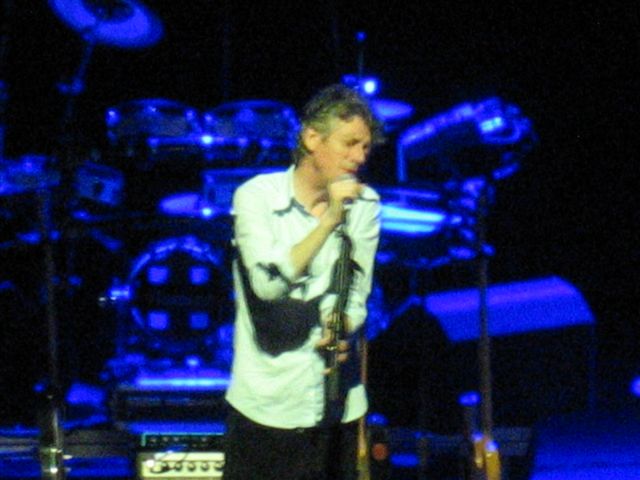
I went alone, after work, and I remember it as a magical evening, one of the best gigs I’ve ever seen. Most of the audience had waited the best part of a decade to see these songs performed live, and I suspect most of us knew most of them by heart.
As Buchanan sang them, we felt them, and remembered the past.
There is a Guardian review which doesn’t really do the event justice.
Over the years, ‘Saturday Night’ has come to stand as proxy for the time in my own life when I made that slow transition from sensitive, introverted, introspective and insecure young man, through the now startlingly obvious realisation that:
‘…an ordinary girl
Will make the world alright’.
TD
May 2025





 Eponymous
Leave a comment