
An occasional scrapbook, wherein I shall collect and reflect on some of the more egregious abuses of this appalling United States Government.
The entries are in reverse order, so the newest are at the top.
Exhibit 6: The letter to the Finnish Prime Minister: January 2026
This is the authentic text of a letter sent by Trump, as President of the United States, to Jonas Gahr Støre, the Finnish Prime Minister. It was also copied to several European Ambassadors to the United States.
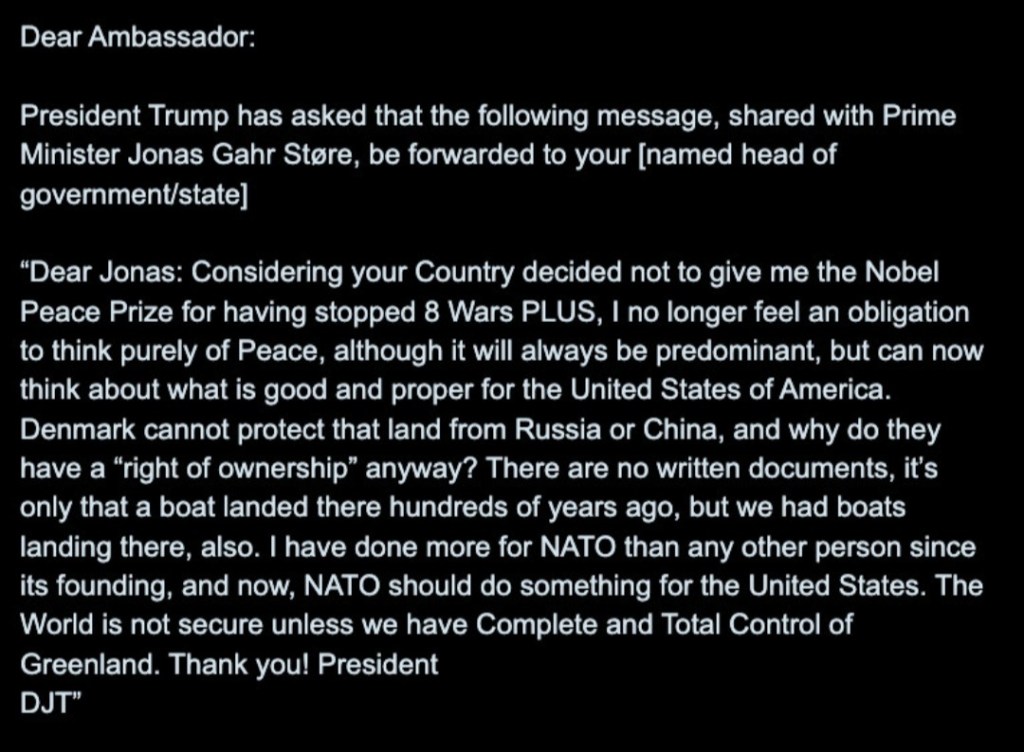
The level of ignorance that Trump exhibits here is positively breath-taking.
This is the most powerful man in the world, in control of weapons that could blow the earth to smithereens, yet his world view is now completely deluded.
He:
- Believes that Norway awards the Nobel Peace Prize, when this is undertaken by the independent Norwegian Nobel Committee;
- Claims to have been a peacemaker, stopping more than eight wars, but he knows this is factually inaccurate and amounts to hyperbole;
- Indicates that his failure to win the Nobel Peace Prize will incline him to be more bellicose, though peace ‘will always be predominant’;
- Believes that Denmark is exclusively responsible for protecting the territory of Greenland, despite the fact that NATO is responsible;
- Believes that China and Russia are threatening Greenland, despite there being no evidence of this.
- Contests the Danish right to administer the territory of Greenland, arguing that it rests on the fact that ‘a boat landed there hundreds of years ago’ and that no written documents exist. This is a highly misleading conflation of 1000 years of history, including the transfer of Greenland from Norway to Denmark under the Treaty of Kiel when those two countries separated in 1814. The first Norse settlers arrived in Greenland during the Tenth Century, while the Norwegian-Danish Crown re-established its presence there during the Seventeenth and Eighteenth Centuries, well before the founding of the United States. The USA occupied Greenland during the Second World War, following the German invasion of Denmark. In 1946, it offered Denmark $100m for the territory but this was rejected.
- Claims to ‘have done more for NATO than any other person since its founding’ despite overtly threatening NATO’s very existence by demanding a territory that belongs to another NATO member, whose population emphatically rejects transfer to the United States.
Under Section 4 of the 25th Amendment to the United States Constitution:
Whenever the Vice President and a majority of either the principal officers of the executive departments or of such other body as Congress may by law provide, transmit to the President pro tempore of the Senate and the Speaker of the House of Representatives their written declaration that the President is unable to discharge the powers and duties of his office, the Vice President shall immediately assume the powers and duties of the office as Acting President.’
Two-thirds of both Houses must vote in favour.
It begins to seem that this President is becoming incapable of making a rational decision, which would surely trigger an intervention under 25(4).
Meanwhile, the rest of the world has to live with the consequences of his increasingly irrational decisions.
Exhibit 5: The Greenland Ultimatum: January 2026
On 17 January 2026, Trump published the following post on his ‘Truth Social’ account.
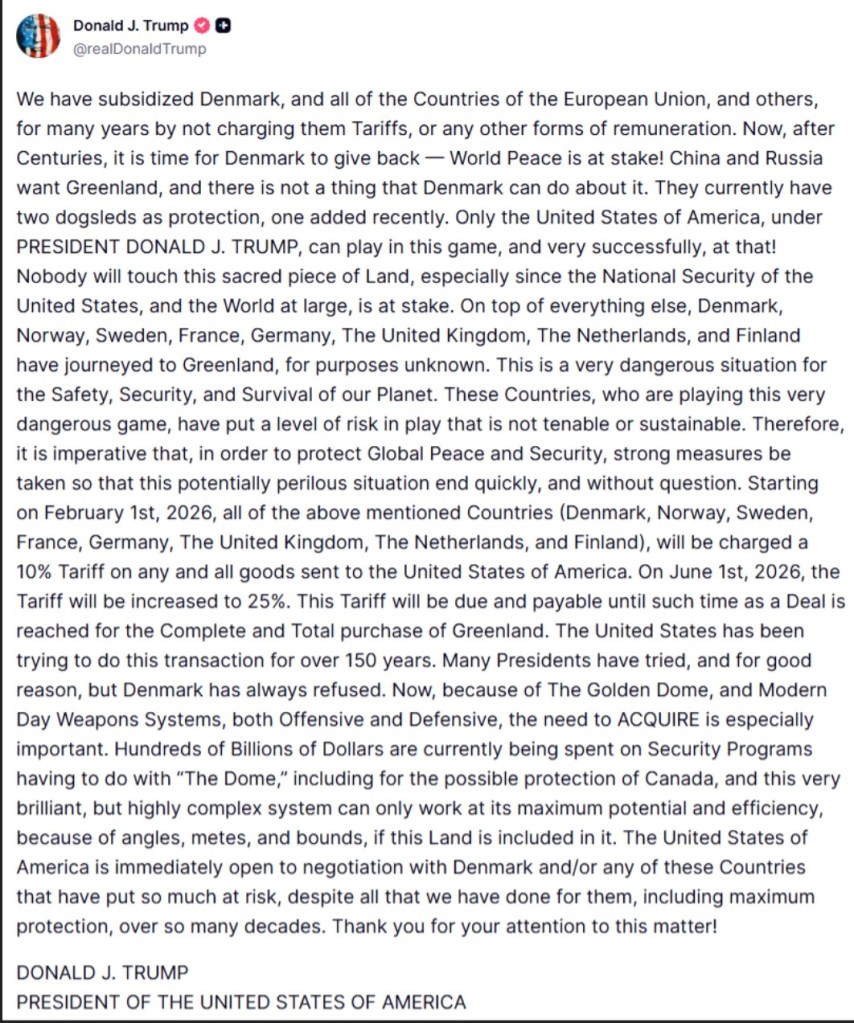
Until recently, anyone suggesting that the United States would shortly be announcing national policy decisions through ill-informed and vainglorious social media posts, ostensibly written by its soon-to-be-octogenarian President, would have been derided and ridiculed.
Over the last year, we might have become inured to such behaviour, but this sorry example really does beggar belief.
Background
According to Trump, the United States must possess Greenland, a self-governing territory which is part of Denmark. Reports emerged in 2019, during his first Presidency, that he was interested in buying Greenland from Denmark.
In January 2025, before the beginning of his second Presidency, Trump’s son, Donald junior, went on a trip to Greenland, while his dad claimed that the United States needed both the Panama Canal and Greenland ‘for economic security’.
He threatened Denmark with tariffs, if it did not surrender Greenland to the United States – and pointedly refused to rule out seizing the territory through military force.
A year into the second Presidency, these arguments have again resurfaced, though Trump has shifted his position, now claiming that possession of Greenland is essential for American national security.
Trump has claimed that, if the United States does not colonise Greenland, it will be seized by either Russia or China instead. He has even suggested, without any evidence, that the Russian and Chinese navies are already ‘all over the place’ around Greenland.
On 6 January 2026, several European countries and the UK published a statement:
‘Arctic security remains a key priority for Europe and it is critical for international and transatlantic security.
NATO has made clear that the Arctic region is a priority and European Allies are stepping up. We and many other Allies have increased our presence, activities and investments, to keep the Arctic safe and to deter adversaries. The Kingdom of Denmark – including Greenland – is part of NATO.
Security in the Arctic must therefore be achieved collectively, in conjunction with NATO allies including the United States, by upholding the principles of the UN Charter, including sovereignty, territorial integrity and the inviolability of borders. These are universal principles, and we will not stop defending them.
The United States is an essential partner in this endeavour, as a NATO ally and through the defence agreement between the Kingdom of Denmark and the United States of 1951.
Greenland belongs to its people. It is for Denmark and Greenland, and them only, to decide on matters concerning Denmark and Greenland.’
On 8 January, UK Prime Minister Starmer spoke with Trump by telephone. The outcome:
The leaders discussed Euro-Atlantic security and agreed on the need to deter an increasingly aggressive Russia in the High North.
European Allies had stepped up in recent months to defend Euro-Atlantic interests, but more could be done to protect the area, the Prime Minister said.’
A few days prior to this post, the Danish and Greenland Foreign Ministers held talks with the US Vice President and Secretary of State, making quite clear that neither were prepared to surrender Greenland to the United States.
At Denmark’s request, the UK, France, Germany, the Netherlands, Finland, Norway and Sweden sent a handful of military staff (just one from the UK) to help the Danes.
This reconnaissance mission was officially part of Danish-led joint NATO exercises called Operation Arctic Endurance. The United States has failed to respond to an invitation to take part.
The purpose of these exercises was partly to reassure the United States that European NATO members were willing to play their part in maintaining Greenland’s security.
Trump’s post
Trump suggests that Denmark’s surrender of Greenland to the United States must be seen as a quid pro quo for the historic generosity of the United States in not charging them tariffs!
He implies that Denmark is defenceless in the face of Chinese and Russian threats, completely ignoring the role of NATO in defending Greenland under such circumstances.
According to him ‘World Peace’ and ‘the National Security of the United States, and the world at large’ can only be achieved through United States ownership of Greenland.
He fails to explain – as he always fails to explain – why this cannot be achieved through NATO.
The section of the post beginning:
‘On top of everything else, Denmark, Norway, Sweden, France, Germany, The United Kingdom, The Netherlands, and Finland, have journeyed to Greenland for purposes unknown…’
is utter balderdash in the light of the background set out above. It is a non-existent justification for the ensuing statement, announcing the introduction of tariffs on all those countries.
These tariffs, which contravene and undermine his previously negotiated trade agreements with the UK and the EU, are set at 10% from 1 February, rising to 25% from 1 June, and are payable ‘until such time as a Deal is reached for the complete and total purchase of Greenland.’
I suppose we should be thankful for the small mercy that Trump is now focused on purchase, rather than seizing land from another NATO country by force.
In the final part of the post, it becomes apparent that Trump’s rationale for the ownership of Greenland is now ‘The Golden Dome’, his proposed space-based missile defence system.
This colossal White Elephant has a projected cost of $175bn and a scheduled completion date of 2028. Both are wildly optimistic.
Indeed, the cost is presently unknown, but could reach trillions of dollars, while the timescale might easily extend to 20 years. The project certainly won’t be operational during Trump’s Presidency, or his lifetime for that matter.
Apparently, the Pituffik Space Base, which the US operates in Greenland, will be useful in sustaining links between Golden Dome satellites operating in different orbital planes. But that Base already exists, so is not in itself an argument for United States’ annexation of the entire territory.
The only explanation must be that Trump does not want to be beholden to NATO, and may even be intent on abandoning it.
If part of the Golden Dome remains dependent on continuing NATO collaboration, the United States will be forced to stay within NATO for its own future security. Trump certainly doesn’t want that.
But, if the United States becomes entirely self-sufficient in this respect, and the Golden Dome is successfully erected, then it has no further need for NATO.
It might even manufacture a reason for leaving now, out of its disagreements with other members over the future of Greenland. Trump will have no compunction about throwing Ukraine under the bus in the process.
Then again, the standard Trumpian ‘two week deadline’ is once again in play.
These tariffs aren’t scheduled to begin until 1st February and, in such circumstances, when faced with implacable opposition, Trump Always Chickens Out.
But even if he does so, what a clownish way this is to run the Government of the most powerful country in the world. It inspires contempt rather than respect, mistrust rather than confidence, antagonism rather than co-operation.
Last words
Trump’s personal narrative will ultimately end in ignominious failure… and we’re all waiting for that now.
History teaches us that such men come to believe that they are invulnerable and invincible, even as they grow older and weaker.
But therein lies their Achilles Heel.
In striving for something too far beyond their capacity, they inevitably crash and burn.
Or, varying the metaphor slightly, perhaps Trump is destined to be crushed beneath his own colossal White Elephant.
Exhibit 4: United States National Security Strategy: November 2025
In November 1925, the United States Government published its ‘National Security Strategy’.
Second in the list of the USA’s overall priorities is (my emphasis):
‘We want to protect this country, its people, its territory, its economy, and its way of life from military attack and hostile foreign influence, whether espionage, predatory trade practices, drug and human trafficking, destructive propaganda and influence operations, cultural subversion, or any other threat to our nation.‘
The subsequent wish-list sets out the USA’s five core foreign policy interests, which include (my emphasis once more):
‘We want to support our allies in preserving the freedom and security of Europe, while restoring Europe’s civilizational self-confidence and Western identity.’
A third list, of basic principles that the US Government will adopt within its strategy, includes:
- A ‘predisposition to non-interventionism‘ which ‘should set a high bar for what constitutes a justified intervention’.
- ‘We seek good relations with the nations of the world…without imposing on them democratic or other social change that differs widely from their traditions and histories.’
- Efforts to protect the USA’s sovereignty, including: ‘attempts by foreign powers or entities to censor our discourse or curtail our citizens’ free speech rights, lobbying and influence operations that seek to steer our policies...’
Then the priorities above are restated in a completely different set of extended bullet points.
The second, which relates to ‘The Protection of Core Rights and Liberties’, includes:
‘…the rights of free speech, freedom of religion and of conscience, and the right to choose and steer our common government are core rights that must never be infringed. Regarding countries that share, or say they share, these principles, the United States will advocate strongly that they be upheld in letter and spirit. We will oppose elite-driven, anti-democratic restrictions on core liberties in Europe, the Anglosphere, and the rest of the democratic world, especially among our allies.‘
The second part of the Strategy considers various ‘regions’ of the world.
There is an extended preamble which applies to the entire ‘Western Hemisphere’ and describes how the USA proposes to enlist countries as ‘regional champions’ and expand the network of countries with which it has strong relations, wanting other nations to ‘see us as their partner of first choice‘.
Following a section dedicated to ‘Asia’, there is one focused on ‘Promoting European Greatness’. It highlights European economic decline before entering into a diatribe:
‘But this economic decline is eclipsed by the real and more stark prospect of civilizational erasure. The larger issues facing Europe include activities of the European Union and other transnational bodies that undermine political liberty and
sovereignty, migration policies that are transforming the continent and creating strife, censorship of free speech and suppression of political opposition, cratering birthrates, and loss of national identities and self-confidence.Should present trends continue, the continent will be unrecognizable in 20 years or less. As such, it is far from obvious whether certain European countries will have economies and militaries strong enough to remain reliable allies. Many of these nations are currently doubling down on their present path. We want Europe to remain European, to regain its civilizational self-confidence, and to abandon its failed focus on regulatory suffocation.’
Following a series of observations about the war in Ukraine, there is acknowledgement that:
‘…Europe remains strategically and culturally vital to the United States...American diplomacy should continue to stand up for genuine democracy, freedom of expression, and unapologetic celebrations of European nations’ individual character and history. America encourages its political allies in Europe to promote this revival of spirit, and the growing influence of patriotic European parties indeed
gives cause for great optimism.Our goal should be to help Europe correct its current trajectory. We will need a strong Europe to help us successfully compete, and to work in concert with us to prevent any adversary from dominating Europe.
America is, understandably, sentimentally attached to the European continent—and, of course, to Britain and Ireland. The character of these countries is also strategically important because we count upon creative, capable, confident, democratic allies to establish conditions of stability and security. We want to work with aligned countries that want to restore their former greatness.‘
A series of bullet point priorities includes:
‘Cultivating resistance to Europe’s current trajectory within European nations.’
Careful analysis of this document leads one, inescapably, to its glaring internal contradictions. Two in particular are highlighted here:
First, how the United States Government can reconcile its ‘predisposition to non-interventionism’, and avoidance of ‘imposing democratic or other social change’ on European countries, with an expressed desire to ‘stand up for’ European ‘freedom of expression’ and ‘unapologetic celebrations of European nations’ individual character and history’ and, in particular, to engage in ‘cultivating resistance to Europe’s current trajectory within European nations’.
It seems that the USA is reserving the right to engage in such interventions where it judges that its actions are consistent with European countries’ traditions and histories, and that this will prevent ‘civilizational erasure’ and somehow restore those countries’ national identities and self-confidence.
The United States Government seems to be saying that it knows better than the democratically elected Governments of those countries.
The United States Government is entitled to make those judgements about its own country, within its own borders, but it has no entitlement to second guess the democratic decisions taken by other governments in other countries, regardless of whether or not they run counter to its own ideological leanings.
Second, and related to that, by what logic the USA can portray itself as the defender of free speech within its own borders, as well as of freedom of expression in Europe, when it is so patently unwilling to tolerate the freedom of those, whether inside or outside the United States, to criticise the country, its government, its isolationist ignorance or the blatant contradictions within its blinkered ideology.
A fundamental insecurity lies at the heart of the US Government’s approach.
For this is a National Insecurity Strategy. It displays for all to see the insecurity of a critic who is afraid of criticism; the insecurity of a country that is bitterly divided against itself, and most likely in terminal decline; the insecurity of a relatively new country nursing an inferiority complex, with very little interest in the rest of the world and even less understanding of what goes on there.
People who live in glass houses shouldn’t throw stones.
Both the United Kingdom and Europe are beset with huge problems, made even more insurmountable in the face of United States isolationism. Patience with politicians of all stripes is wearing painfully thin. We are struggling to make any substantive improvement in our situations.
Even so, we will not listen to criticism from the US Government, or accept any intervention by it in our own affairs.
At least, not unless that Government is willing to extend the reciprocal right to us. Is the United States happy for Europe to ‘cultivate resistance to the current trajectory of the United States’?
No, I thought not.
Exhibit 3: Musk’s X Rant of 5 June 2025
Surprise, surprise! These Musk tweets have now been deleted but screenshots of the two I originally posted here are below:

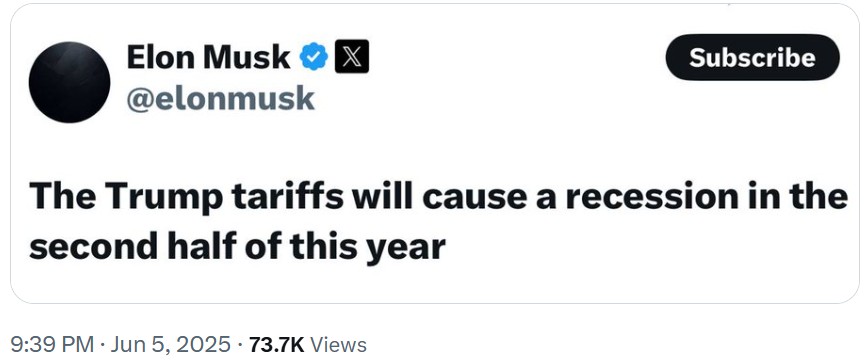
…And the two tweets below have also been deleted, so I’ve also replaced the links to them with screenshots.
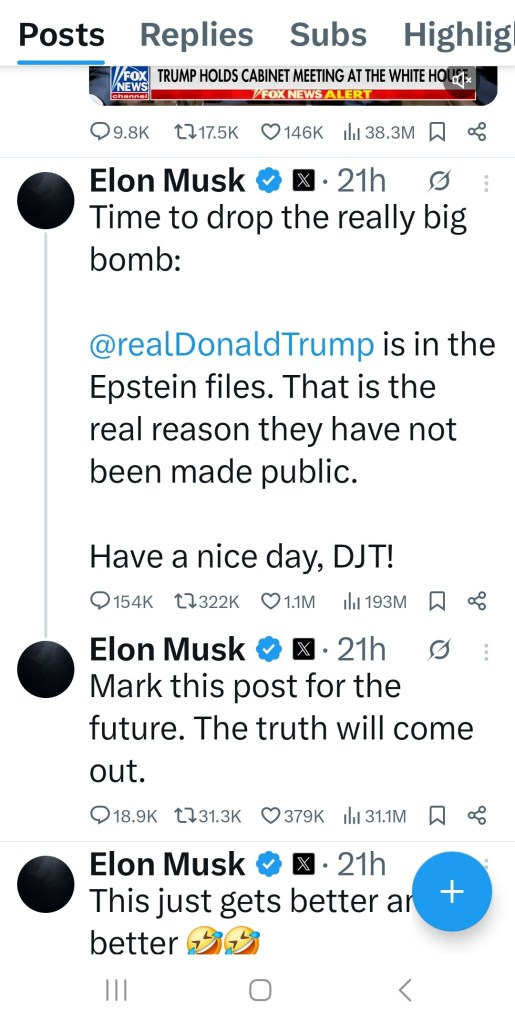

Exhibit 2: My Facebook post of 4 March 2025
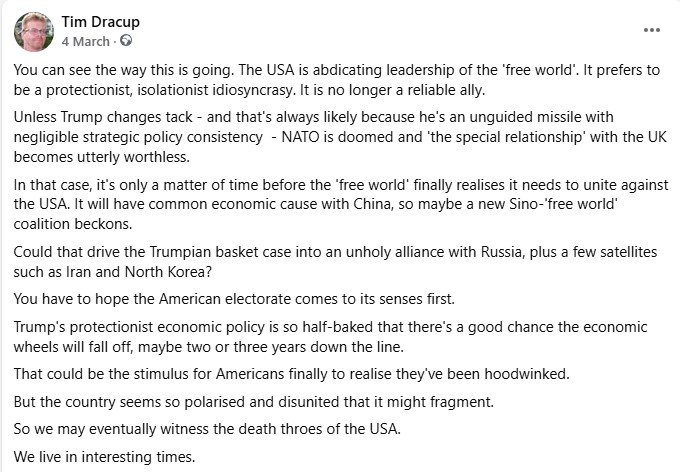
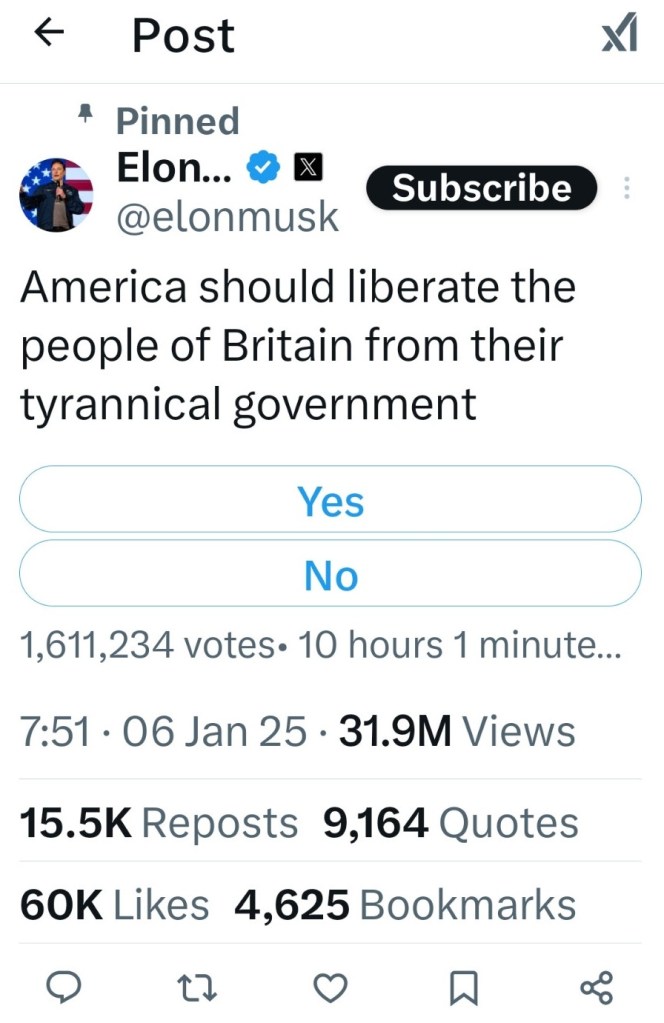
Exhibit 1:









 Eponymous
Leave a comment