
Emily Hilda Young (1880-1949) enjoyed an unconventional life.
She married a solicitor, John Arthur Daniell, settling in Clifton, Bristol. But she also began a lifelong affair with Ralph Bushill Henderson, a married teacher, theologian and fellow mountaineer. Henderson had married Beatrice Mansfield in 1901.
Although well into his 40s, Daniell served as a Sergeant Instructor with the Royal Garrison Artillery and was killed shortly before the Third Battle of Ypres.
By 1918, Henderson was Headmaster of Alleyn’s School, Dulwich and lived on Sydenham Hill. After her husband’s death, Young moved in to a flat in the Henderson’s house, becoming School Librarian at Alleyn’s.
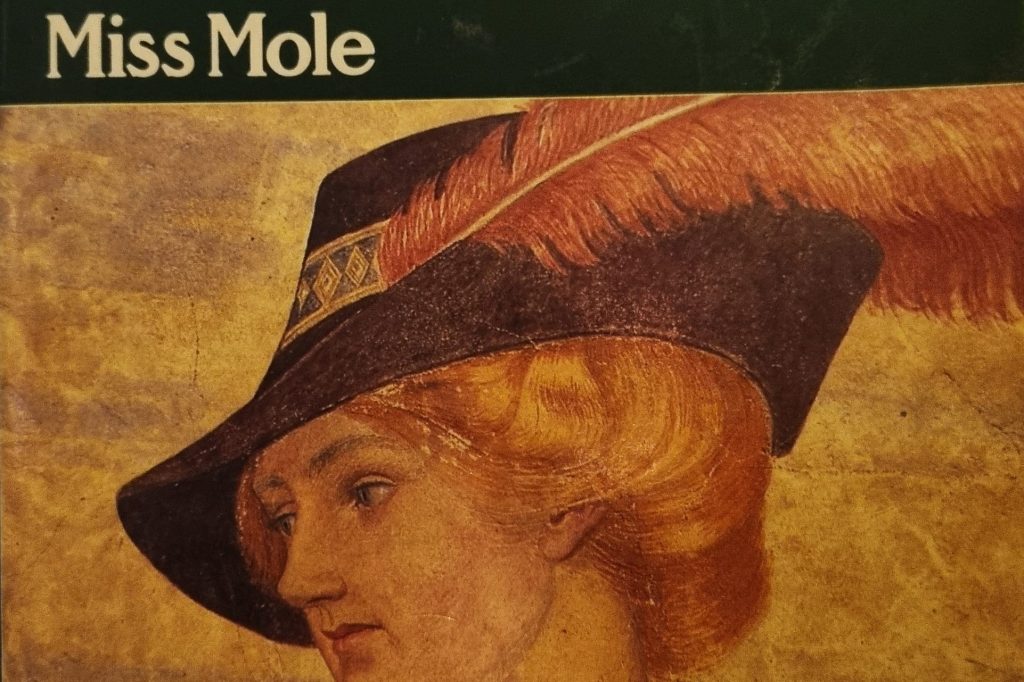
In the 1920s and 1930s she wrote several novels, many of them based in Clifton, which she renamed Upper Radstowe. Miss Mole (1930) is now widely regarded as her best.
The lady in question is fast approaching 40, a rather plain, down-at-heel woman who has worked in a succession of difficult, unrewarding jobs as a governess or lady’s companion.
She is also highly intelligent, with a biting wit that she often finds impossible to suppress. This does not go down well with her employers, who expect her to know her place.
It becomes apparent that she owns a small country cottage but has let it fall into the wrong hands.
She had once thought they were the right hands, belonging to a soldier, newly returned from the War but down on his luck. She gave him shelter, fell in love, but he did not reciprocate her feelings.
Eventually she left him in possession, finding work in the city, taking a succession of live-in jobs that would also supply another roof over her head.
Having helped to rescue a man who was trying to kill himself, Miss Mole makes friends with his landlady and, through her, gets to know another of her tenants, Mr Blenkinsop. He is a bank clerk who initially seems unsympathetic, unfriendly, even antagonistic.
With the help of her wealthy cousin, Miss Mole secures the post of housekeeper to the Reverend Corder. He is pompous, stupid and insecure. His wife is dead but he is blessed with two awful daughters, both sadly in need of a mother.
Miss Mole begins to turn round the household, striving to reform the daughters’ behaviour into the bargain. She has some success with the younger, Ruth, but the elder, Ethel, is a far harder nut to crack.
The situation begins to spiral out of control when Ethel becomes infatuated with Mr Pilgrim, a rival churchman who knew Miss Mole when she was cohabiting with her soldier lover, even calling upon her at the cottage to express his disapproval.
It seems that Miss Mole’s past will finally catch up with her.
But Blenkinsop to the rescue!
Having learned of the situation at the cottage, he turfs out the ungrateful veteran, declaring his own affections for Miss Mole, so revealing himself the wealthy man she has long hoped would save her from her plight.
The book is divided into 40 short chapters and deceptively easy to read. But the plot is revealed almost unwillingly, often indirectly, typically through hint and allusion. The reader gains little clarity until the last few chapters, when everything begins to fall into place.
But there are some splendid observations along the way, like these two, of Corder:
‘He had seen her as an unfortunate woman, undesired by any man, and he had despised her accordingly, and with the suspicion that Samuel Blenkinsop had found something in her which he had missed himself, he immediately set about searching for it and felt uneasy.’
‘…and, as she glanced up at Robert Corder, striding beside her, sure of himself and his little world, stepping over crevasses he did not see, blind to the clouds confronting him, amiably companioning the woman whose virtue he took for granted, because all decent useful women were virtuous, Hannah’s long nose took on its derisive twist.’
This is a highly entertaining novel. Although the process can be a little frustrating at times, it definitely repays the doggedly persistent reader.
TD
January 2025









 Eponymous
Leave a comment