
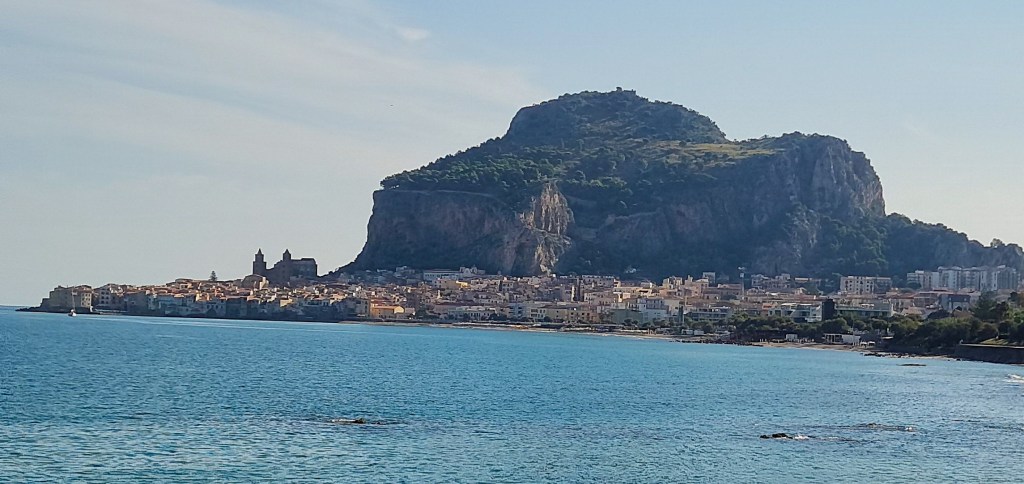
We thought it was time to take a ‘proper’ holiday – a week devoted primarily to rest and relaxation.
We wanted to discover if we could still relax sufficiently to enjoy such an experience, or whether we would be ground down by monotony and boredom.
We booked our week in Cefalu through First Choice Holidays. Once a holiday company in its own right, First Choice merged with TUI in 2007 and now operates as a distinct brand within the TUI stable.
Our flights were provided by Easyjet rather than TUI, and we flew from Gatwick, North Terminal to the Falcone Borsellino Airport, formerly known as Punta Raisi, which lies some 35km west of Palermo.
Giovanni Falcone (1939-92) and Paolo Borsellino (1940-1992) were Italian judges who prosecuted the Mafia. Both were assassinated by car bomb: Falcone on 23 May 1992, on the road between Palermo and the Airport, near Capaci; Borsellino on 19 July 1992 in the Via D’Amelio in Palermo.
Our outgoing flight was at 06:10 so we booked a taxi to deliver us to Gatwick by 04:15. The roads were very quiet in the early hours, but the Airport was already lively.
After negotiating Easyjet’s automated baggage drop, we adjourned to The Breakfast Club for sustenance. The food was OK…ish, not quite hot, while the coffee failed to arrive until we were midway through our meals.
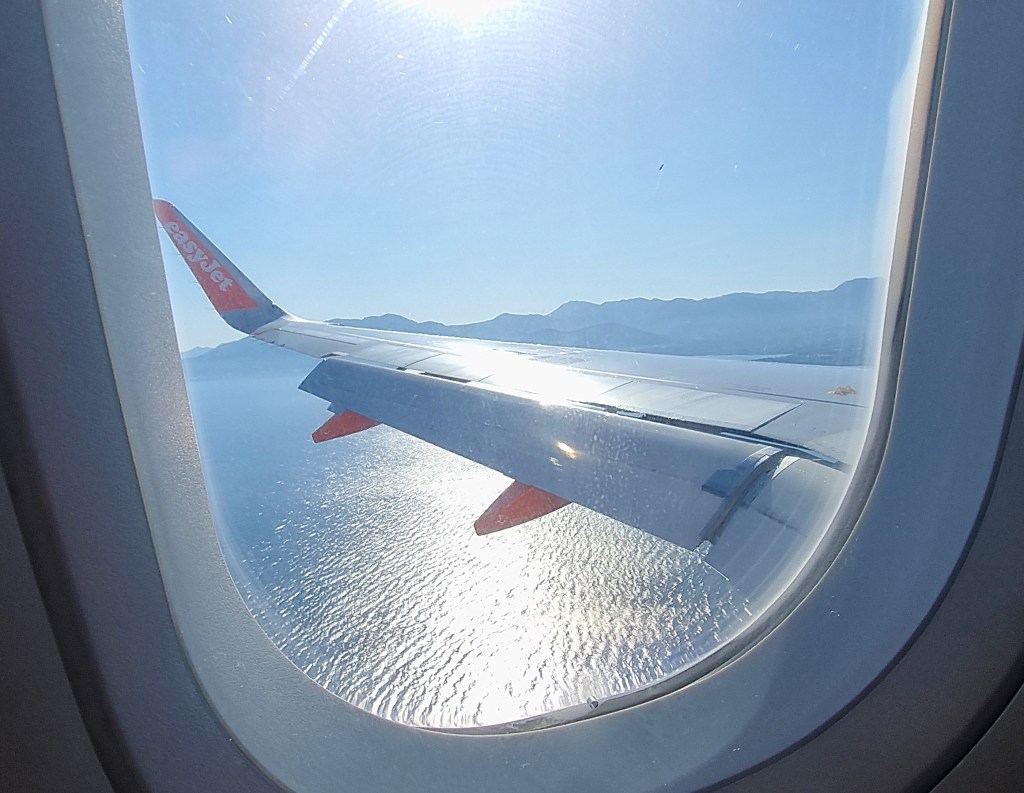
We were due to touch down in Palermo at 09:55 Italian time (an hour ahead of the UK). We took off some 20 minutes late, making up 15 of those in flight.
On arrival we made it through passport control fairly quickly, courtesy of two digital gates, and soon picked up our luggage.
We rendezvoused with our taxi driver in Arrivals and were driven with another couple to Cefalu, which lies to the east of Palermo, approximately 65km from the City and 100km from the Airport. The journey took about 75 minutes, so it was approaching midday when we reached our destination.
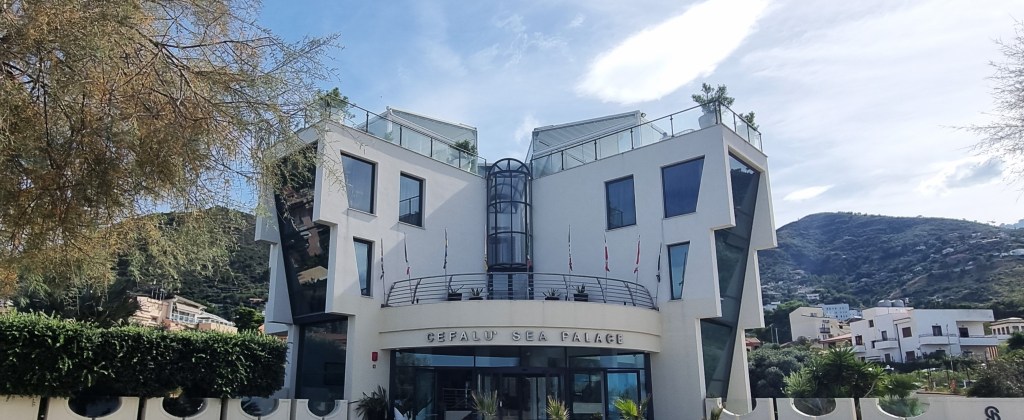
The Sea Palace Hotel
We had chosen the Sea Palace Hotel, largely because of its proximity to central Cefalu.
It is situated midway along the coast road, known as the Lungomare Giuseppe Giardina. This stretches about two kilometres westwards from the headland where the old town sits beneath its own personal mountain, La Rocca di Cefalu.
The road ends at another small headland featuring an equally small church, now inaccessible since integrated into Club Med Cefalu.

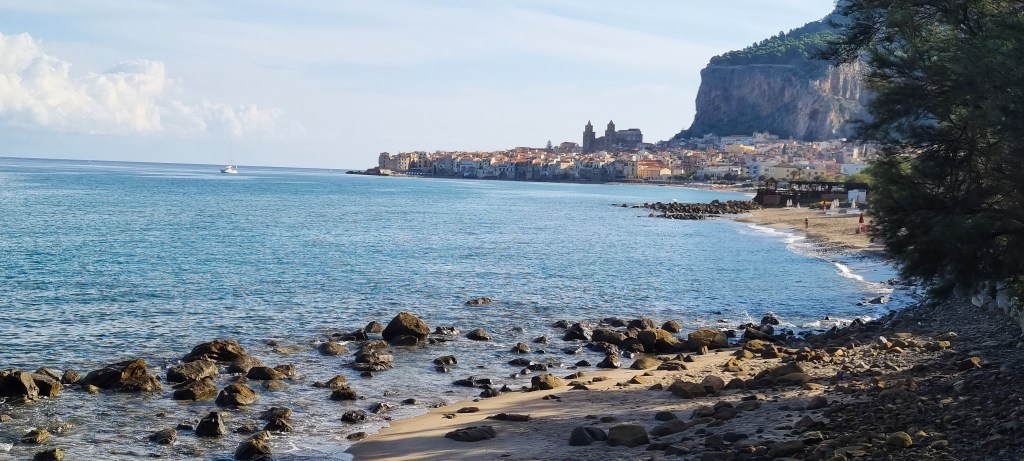
A narrow beach stretches the full length of this shallow bay, broadening somewhat at each end. The narrow section contains a row of small ‘beach clubs’. Most have sunbeds and umbrellas for hire; some have other facilities too.
One of these belongs to the Sea Palace and its sister hotel, the Victoria Palace, which is situated a little further along the Lungomare towards the old town. Sunbeds and umbrellas are available free to guests and beach/pool towels are supplied. There are also toilets, accessible with a key from the cafe, and a lifeguard on duty.
First Choice said this ‘private beach’ was available only until the end of September, but we found it operating in October, except that the café was not supplying food, only drinks.
The Sea Palace is relatively small, containing only 83 rooms. The grounds are very limited. There is a small grassy area immediately to the left of the building that looks out on to the street, but this was closed off, chairs stacked beneath a canopy.
Earlier in the season it may have been the location of the noisy parties that some guest reviews mentioned.
Beyond this there is a concrete area with sunbeds, umbrellas and a fairly large free-form swimming pool. This narrows as it approaches the Hotel’s ‘wellness centre’ and gym, neither of which we patronised.
The pool is not heated and, by October, these further reaches were distinctly chilly, because permanently in the shade of the buildings. This helpfully ensured that the pool was rarely busy!
The Sea Palace advertises a roof garden, but this is essentially the restaurant, where breakfast and dinner are served. Lunch was also mentioned in the blurb from First Choice, but this was no longer available. The only place offering lunch in October was a small bar beside the pool.
The view from the restaurant/roof garden is definitely the Hotel’s outstanding feature.

We never had dinner in the restaurant, having selected bed and breakfast terms. It would be a sad dereliction of duty not to sample the wealth of excellent restaurants in Cefalu.
So our experience was confined to breakfast, available from 07:00 to 10:00 daily. We usually arrived around 08:15, when there were still relatively few other guests and we could select a table with a view.
On our final day, having discovered that we would depart for the Airport at 07:25, we tried arriving for breakfast at 06:50. The female supervisor was not at all happy with our presumption, and we had to kick our heels until opening time.
We found the breakfast good considering the Hotel’s size. I typically began with muesli, walnuts and fresh fruit, followed by a few slices of baguette with ham and cheese then, to round off, a selection of small pastries. Cooked breakfasts were available and Tracy sometimes had a freshly-made omelette.
Coffee (Americano) was supplied in an urn. It tasted OK when fresh, but grew increasingly muddy. Those seeking other types of coffee could have it made by a lady with a machine, but I was in need of strong black Americano.
Our generous breakfasts made lunch unnecessary and, fortunately, there was no shortage of cafés at which to top up my caffeine intake.

We had decided to sacrifice a sea view, opting instead for a quieter ‘club room’ at the back, because of those allegedly noisy parties. This did not pay off, because the parties were no more.
We found ourselves in room 1.14, on the same level as Reception, but towards the Hotel’s rear.
The view from our balcony was of a sloping boundary wall studded with plants. Immediately beneath us was an extensive wire trellis, covered by a climbing plant, which masked an area frequented by staff.
A bank of ventilation fans sat level with us and just to the right. They ruled out sleeping with the balcony door open. Fortunately, though, the air conditioning was extremely quiet.
The room itself was a good size, containing a sofa, desk and stool, armchair, coffee table and television. The bed was formed of two large singles pushed together, but perfectly comfortable.
The wardrobe contained a safe and a small fridge. There was plenty of hanging space (though very few hangers) but only limited shelf- and drawer-space.
The internal bathroom was equipped with a decent shower, as well as a bidet, toilet, washbasin and hairdryer.

After we placed the ‘please make up our room’ sign on the door on our first morning, the room was cleaned daily, with fresh towels provided daily too. This seemed an unnecessary extravagance.
We requested a kettle from reception. It was temperamental, but always worked in the end. We had brought some tea bags with us and purchased some long-life milk in Town.
Several reviews complain of the Hotel’s unreasonable attitude to guests bringing even limited supplies of food and drink into their rooms.
We usually make do with tap water, but the water here was completely undrinkable, so we had no option but to buy bottles. And since a large bottle of water cost as little as 30 cents from the supermarket, why would one purchase small bottles from the Hotel at two euros apiece?
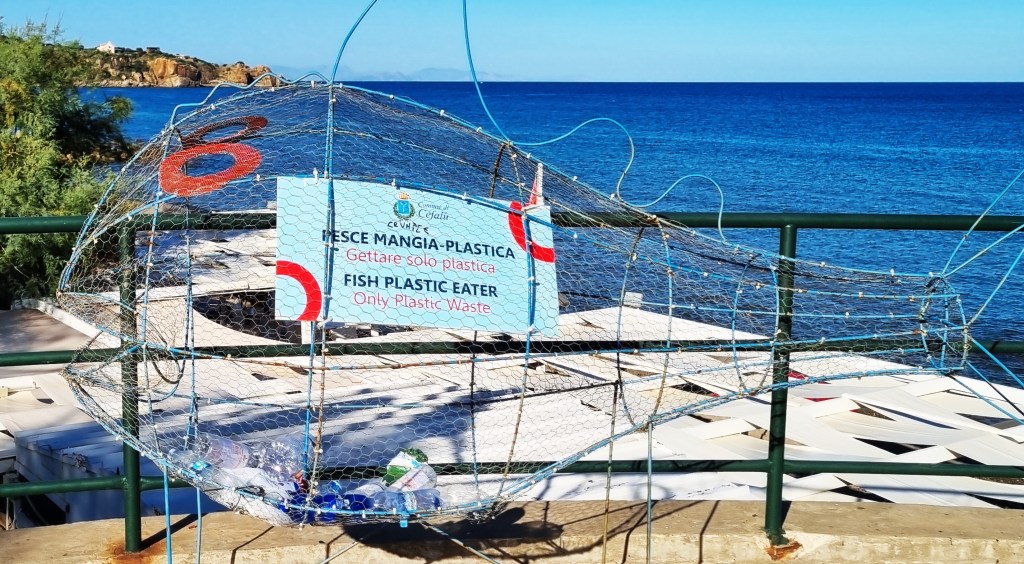
To be fair, we were never challenged at Reception when carrying water past in our rucksacks but, equally, we were careful to hide the bottles. A handy wire fish, just across the road, feasted daily upon our empties!
These quibbles apart, we were perfectly happy at the Sea Palace.
The weather
During our stay, the maximum daytime temperature varied between 25 and 30 degrees, while the night-time temperature remained at approximately 20 degrees.
When the sky was cloudless, the sun was still strong, so my Factor 50 and full-brimmed sunhat were much in evidence.
On the day we arrived, the breezy conditions had caused a wildfire to take hold on the lower mountain slopes just above the newer part of Cefalu, immediately behind the Hotel.
We watched as two helicopters and a seaplane made repeated trips to collect sea water, before dropping it from a height in an effort to douse the flames. They were ultimately successful, but it took a while.

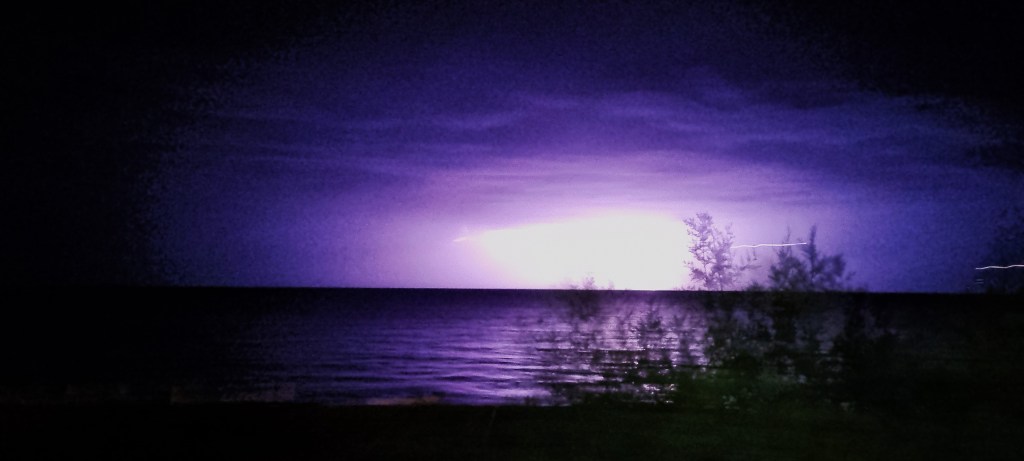
That evening we had our only rainfall – an extended shower that was by no means heavy. There was lightning over the Tyrrhenian Sea and in the direction of Palermo.
On a couple of days the sea conditions were sufficiently boisterous to bring out the surfers and, one evening, as we walked into Town, police and ambulance services had been called to attend a fatality on the beach.
Next morning, the local news website reported that a male tourist, aged about 40, had sadly died while trying to save his son, who had got into difficulty while swimming.
The son survived.
Given the sea conditions, it seemed to us utter madness to have tempted fate in such fashion. Unfortunately, one young man will be haunted by guilt for the rest of his life.
For much of the time the sea was far more benign, but the lifeguards employed by the various ‘beach clubs’ had very different views on whether it was safe to swim. This might have been because conditions did really vary considerably from segment to segment, or it may have been attributable to the subjectivity of their assessments.
Certainly, there were signs warning swimmers of rip currents, urging them to swim parallel with the shore if caught up in one.

I heard it intimated that the red flags have more to do with sewage than currents, but I am not competent to judge. Of course, there were no flags at all on those parts of the beach open to the general public.
Our own ‘beach club’ ran up its tattered red flag on the vast majority of days that we were in Cefalu. Only once did I venture across the white sandbag stepping stones, positioned to help bathers past the slippery rocks.
I took a few quick strokes, just to say I’d done so, before beating a hasty retreat.

Cefalu’s history
Like Sicily, Cefalu (pronounced tchef-alu) has a long and complicated history.
It first acquired significance in the Fourth Century BC, by which time the Greeks had named it Kephalodioin, denoting its mountainous headland, jutting into the sea. The latinised version was Cephaloedium, hence Cefalu.
I was puzzled by the apostrophe after ‘Cefalu’ on the Railway Station’s sign.
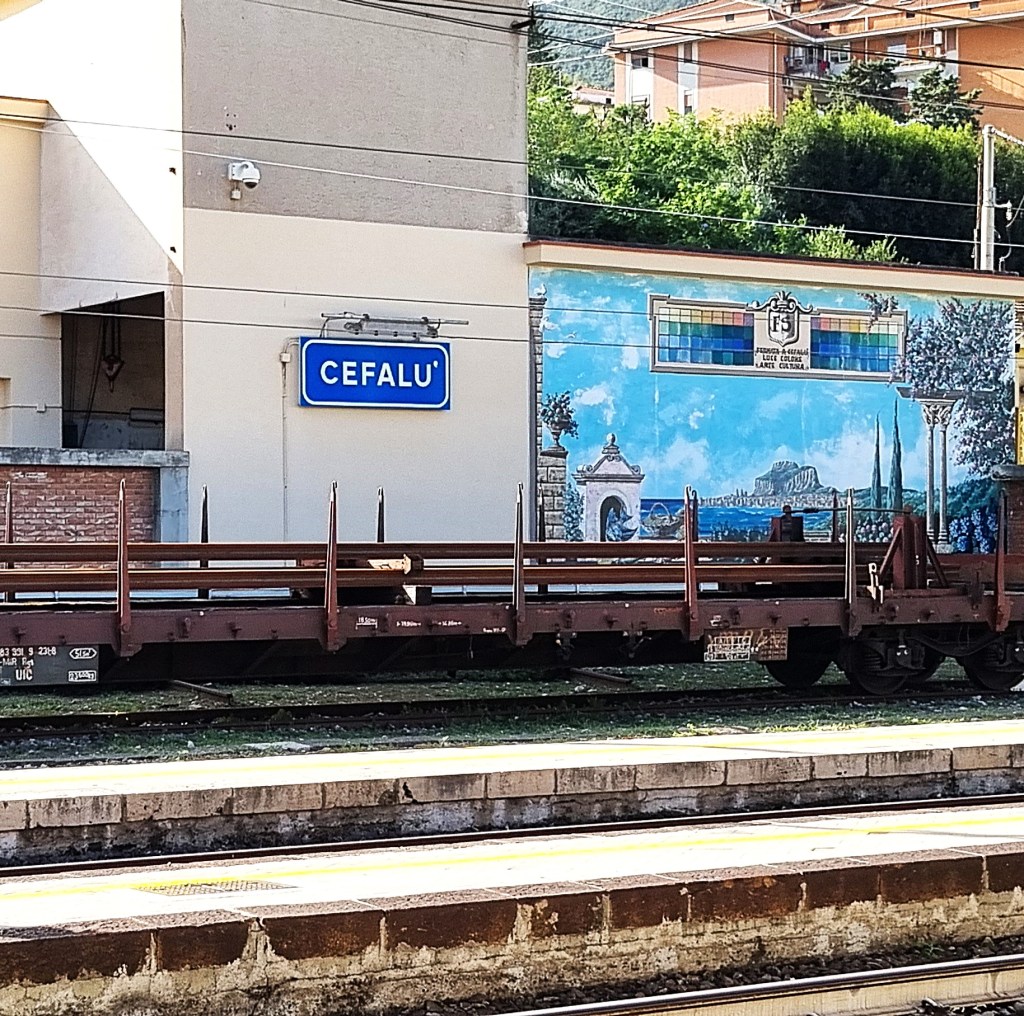
It turns out that the apostrophe substitutes for the ‘accento grave’ which places greater emphasis on the final syllable. I can find no convincing explanation of why sign-makers don’t deploy a proper grave accent instead.
Kephalodioin was probably not a significant Greek settlement, because Himera, which was a significant Greek settlement, lay only 20 kilometres to the west. It was more likely an outpost with a fortress, to help defend Himera.
Although it changed hands several times over the ensuing centuries, its significance grew rapidly. Cicero (106-43BC) referred to it as a prominent town in its own right.

With the collapse of the Roman Empire, it fell under the sway of the Byzantine Empire. Then, during the Ninth Century, it was besieged and conquered by an Arabian dynasty which drew it into the Muslim ‘Emirate of Sicily’.
By 1063, Norman Christians had taken over. King Roger II (1095-1154) was responsible for establishing the present-day old town at sea level, not least by commissioning the Cathedral in 1131.
But Christian influence was already longstanding. Some claim that the Diocese of Cefalu had been established as early as the Fifth Century, and the first known Bishop was already in place by AD 869.
The Diocese took control of Cefalu from 1451, shortly after Sicily had passed into the control of the Kingdom of Aragon, leading eventually to a lengthy period of Spanish rule.
After various other royal houses had tried their hands, the Kingdom of the Two Sicilies (consisting of Naples and Sicily) was formed in 1816, shortly before the achievement of Italian unification in 1861.

The old town
For the most part, the old town is laid out like a grid, built upon the headland between the Cathedral and the sea.
Narrow streets, lined with balconied flats, climb up the slope between the Via Vittorio Emanuele, which runs south to north at the bottom, and the Corso Ruggero, which takes the same direction at the top.

Most of the cafes and restaurants are in this quarter, interspersed with souvenir shops. These mostly sell ceramics, often strikingly ugly, alongside children’s toys.
Ceramic pine cones in various shades are ubiquitous, as are mustachioed ‘Moor’s Heads’. These are occasionally joined by ‘trinacria’: female faces surrounded by three legs, akimbo, very similar to the Isle of Man’s flag.
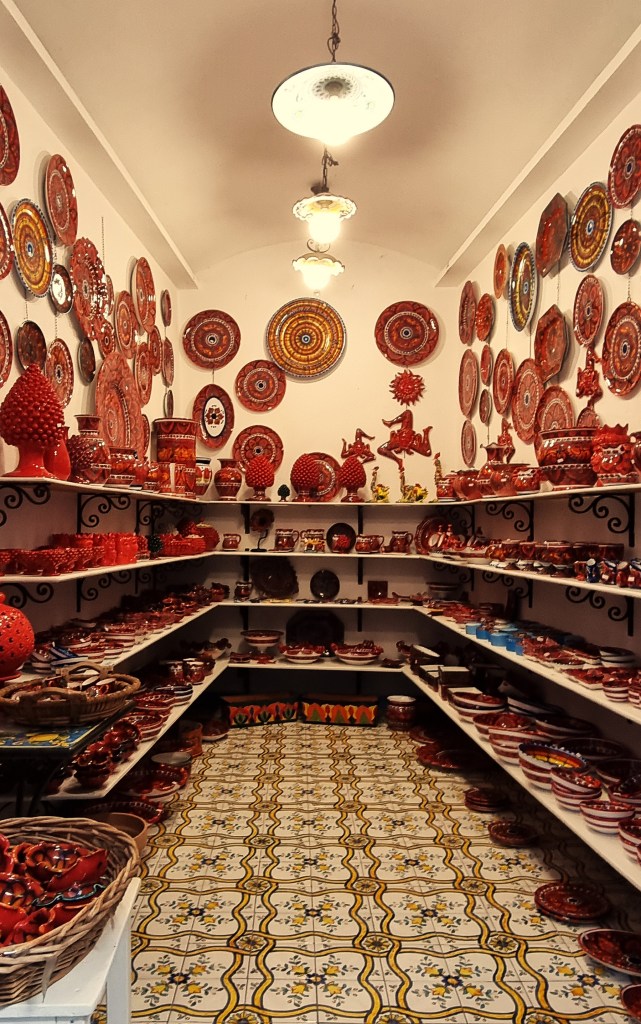
This symbol also adorns the official Sicilian flag.
Halfway along the Via Vittorio Emanuele there is a public laundry. It dates from 1514 but was restored in 1991 and is now part of the standard itinerary for guided tours.

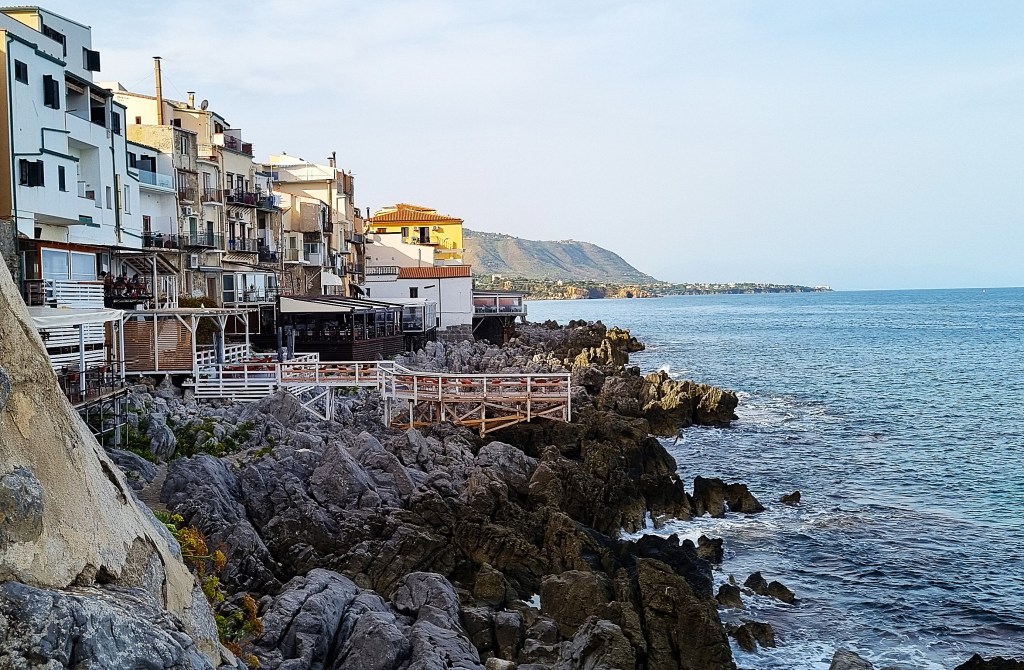
Behind the quay, the Via Carlo Ortolani di Bordonaro follows the new line of the headland, now running eastward. On the far side of the Cathedral it becomes the Via Porpora and then the Via Pierre. Several of the eateries along the left hand side have balconies that extend above the rocky foreshore, looking straight out to sea.
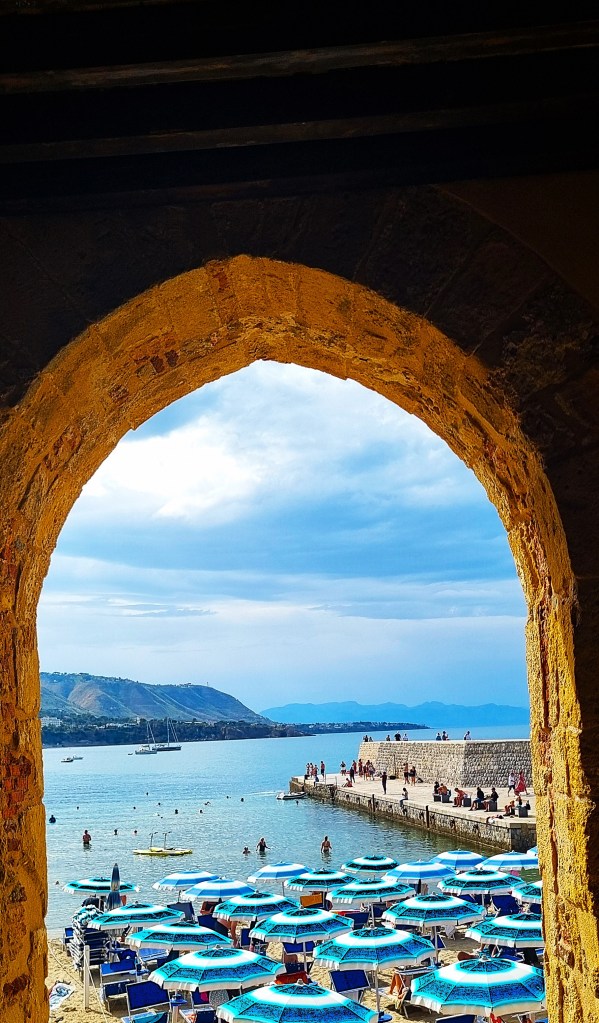
Further along, an archway looks out onto a small quay that juts into the sea – a favourite spot for those seeking an artsy photo.
The road continues, beyond where the houses give way, passing beneath the lighthouse. This sits above Cefalu’s main harbour, on the eastern side of the headland. The small white tower, mounted on top of the keeper’s house, was built in 1900 and electrified in 1930.

The coaches that bring streams of tourists to Cefalu pull up hereabouts, disgorging their contents before swinging round and down to the harbour, where there is a small café but not much else.
The coast turns temporarily southwards, but soon curves round towards a striking rocky promontory, topped by a ruin and surrounded by a handful of tiny islands. This is apparently called the Archipelago of Presidiana.
The principal main road, the SS113, runs just south of here, heading behind La Rocca and past the Cemetery before reaching the newer part of Cefalu, close to the railway station. It then runs behind – and parallel with – the Lungomare Giuseppe Giardina.

Cefalu Cathedral
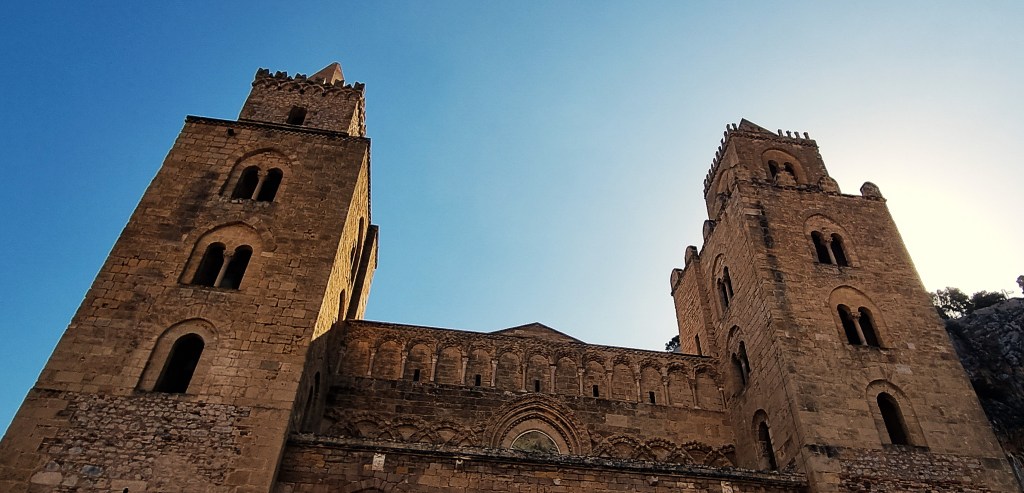
The Cathedral dominates the old town, its twin towers rising high above the surrounding buildings, no doubt visible miles out to sea. (The story goes that Roger II was caught in a storm at sea, and vowed to build the cathedral once he safely reached the shore.)
Along with the Cathedral at Monreal and several buildings in Arab-Norman Palermo, including Palermo Cathedral (see below), it forms a UNESCO World Heritage Site.
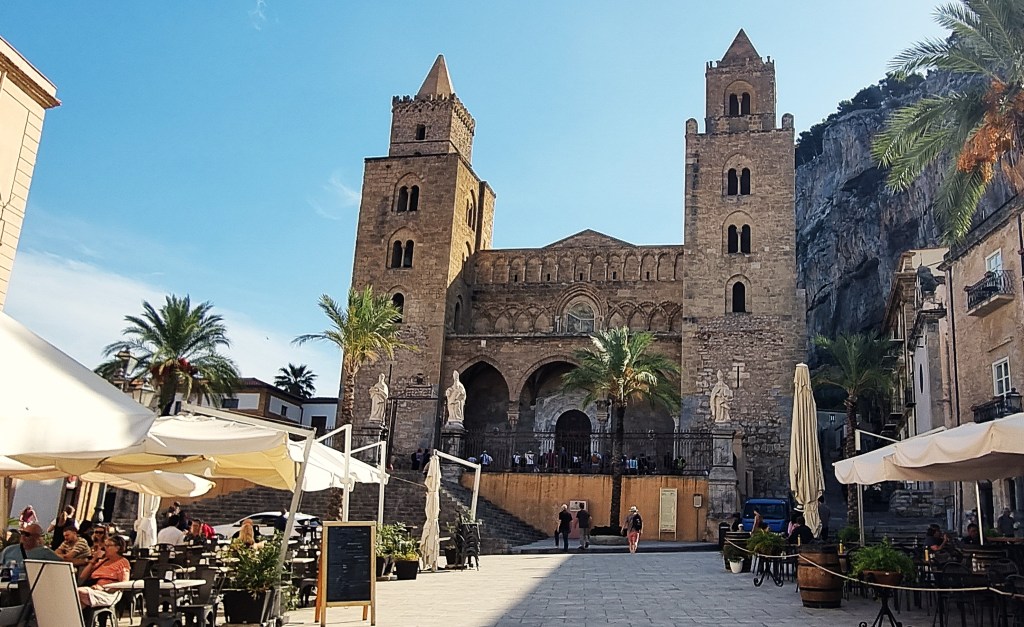
This huge building is approached across a square full of café tables. One climbs a shallow flight of stairs, passing through a wrought iron gate, flanked by clerical statues in white marble.

The main body of the Cathedral was completed by 1240, though the portico positioned between the towers – as well as the spires that top them – are Fifteenth Century additions.
We visited on our first morning in Cefalu, arriving shortly after 10:00, when there were still comparably few people inside. Much of the interior is freely accessible, so we wandered around, photographing what we could see.
The interior is dominated by the apse, which carries a striking golden mosaic, completed in 1148. It was worked by the best Byzantine mosaic artists from Constantinople and is amongst the finest examples in all of Italy.

The head and shoulders of Jesus are dominant – taking the iconographic form known as ‘Christ Pantocrator’ – the right hand raised in benediction, the left holding a Biblical text. This tells the congregation, in both Greek and Latin:
‘I am the light of the world, who follows me will not wander in the darkness but will have the light of life’ (John, 8:12).
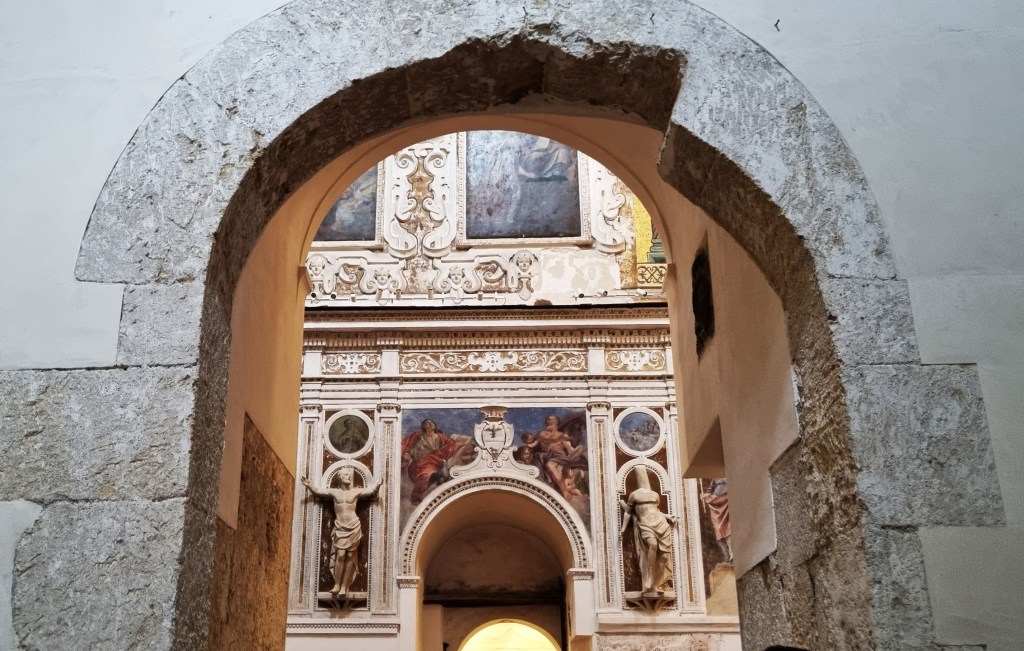
There are three tiers immediately below, the first containing Mary, accompanied by four archangels, the second and third containing the apostles.
Like other examples of Byzantine mosaic work at Monreal and Palermo, this was restored in the 1860s but, unlike the others, this was not damaged quite so much in the process.

Before leaving we stopped to light candles for those we have lost – two partners and two parents all-told – then emerged into the brightness and bought coffee in the square below.
La Rocca
On Sunday morning we climbed La Rocca – a compulsory pilgrimage for all reasonably fit visitors to Cefalu.
After mounting a narrow flight of steps decorated with coloured pots, known as the Via Giuseppe Fiore, we eventually reached base camp.

Here, a young woman was posted to collect our five euro entrance fees, insert them into a temperamental machine designed to disburse tickets automatically, and hand us the tiny pieces of paper it disgorged.
These contained QR codes, supposed to open the equally temperamental turnstiles. The tickets had to be positioned with precision before they were recognised.
The top of La Rocca is 268 metres above sea level. Much of the path is rock-strewn and fairly steep in places, so it takes a while to climb. On the way up, we passed a stray mountain goat.
It seems probable that, before Roger built his Cathedral, any local settlement was located up here.
One of the preserved features is a building known as the ‘Temple of Diana’, though no-one seems quite sure why.
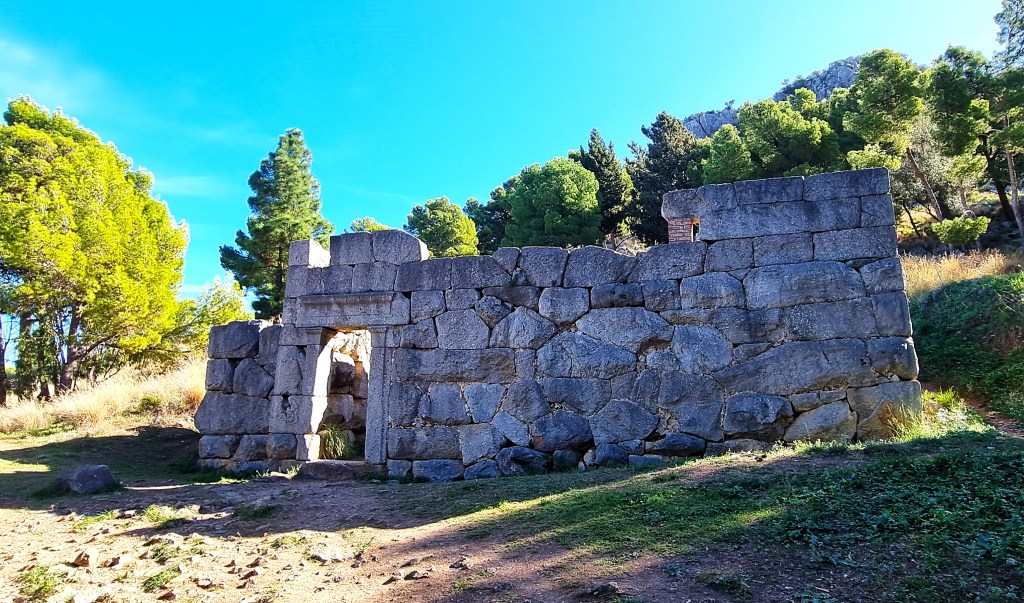
There is a low-slung stone ruin and a hole in the ground to collect rain water. Experts seem uncertain exactly how old they are, though some authorities claim they date from the Ninth Century BC. They almost certainly had religious significance, and were later converted into a Christian church.

The ruined castle at the top of La Rocca is probably Twelfth Century in origin, but was most probably destroyed by fire at the end of the Thirteenth. It was restored and then remained in use throughout subsequent centuries, demanding frequent renovation.
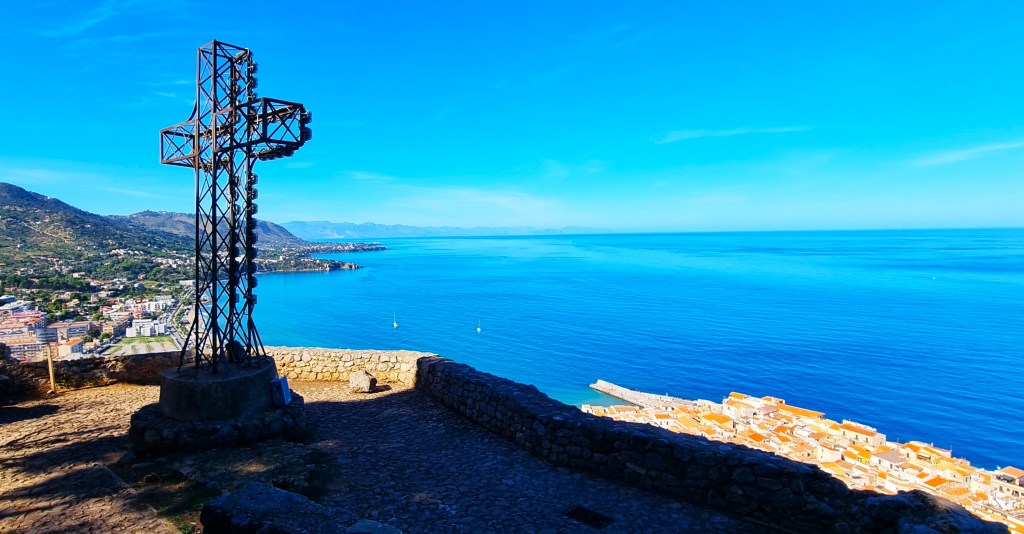
A medieval crenelated wall stretches round much of the perimeter further down. From here, one has a bird’s-eye view of the immense cathedral squatting directly below. A metal crucifix stands roughly three metres tall and, when illuminated at night, is widely visible below.

During our descent we met two different couples from our hotel, both on their way up. Both couples seemed to be struggling in the mounting heat, but both later claimed they’d made it to the top.
Having overtaken a large group of descendees, all wearing identical red shirts, and after negotiating the tricky gates, we made a beeline for the café at the foot of the steps – Antica Porta Terra – where we bought celebratory ice creams.
The Crowley Connection
Aleister Crowley (1875-1947), infamous occultist, arrived in Cefalu on 1 April 1920, where he was joined by two mistresses – Leah Hirsig and Ninette Shumway – and assorted children, one of whom soon died.

They rented an old villa – the Villa Santa Barbara – whose ruins may still be found behind La Rocca, fairly close to the Cemetery.
Crowley renamed it the Abbey of Thelema, a name he borrowed from ‘Gargantua and Pantagruel’. Rabelais describes it as an ‘anti-monastery’ without rules. It exists to celebrate its inhabitants’ free will and is devoted to their pleasure.
Various followers arrived to be inducted into the mysteries by Crowley, including silent film star Jane Wolfe, writer Cecil Frederick Russell and a young Oxford history graduate, Raoul Loveday, recently married.
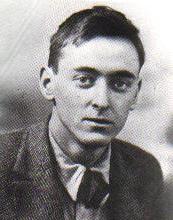
He had turned up with his wife, Betty May, in November 1922, but died in February 1923, most likely from a liver infection caught after drinking water from a polluted stream.
On returning to England, his widow sold her story to the tabloid press, claiming that Loveday died after drinking the blood of a sacrificed cat. This added further fuel to longstanding tabloid outrage at Crowley’s outlandish behaviour.
Persistent rumours about the evil goings-on at Thelema eventually led the Mussolini Government to deport Crowley on 13 April 1923, alleging obscene and perverted rites, as well as his cohabitation with an assortment of women outside marriage.
Crowley was unable to satisfy his wish to be buried near the ‘Temple of Diana’, escaping initially to Tunis. Thelema closed, the villa a neglected ruin, but there are still frequent visitors.
We never knew it was there.

Day Trip to Palermo
We decided to visit Palermo under our own steam, using the train that runs directly from Cefalu, taking slightly less than an hour.
We managed to book the tickets online, though were temporarily thrown by a recent innovation, whereby the tickets one purchases are stated to be invalid, until they become automatically ‘validated’ after midnight on the day of travel.
Return tickets cost us roughly 13 euros apiece.
We caught the 10:03 departure from Cefalu, arriving at Palermo Central at 10:52. The train was busy but there were seats available for everyone.
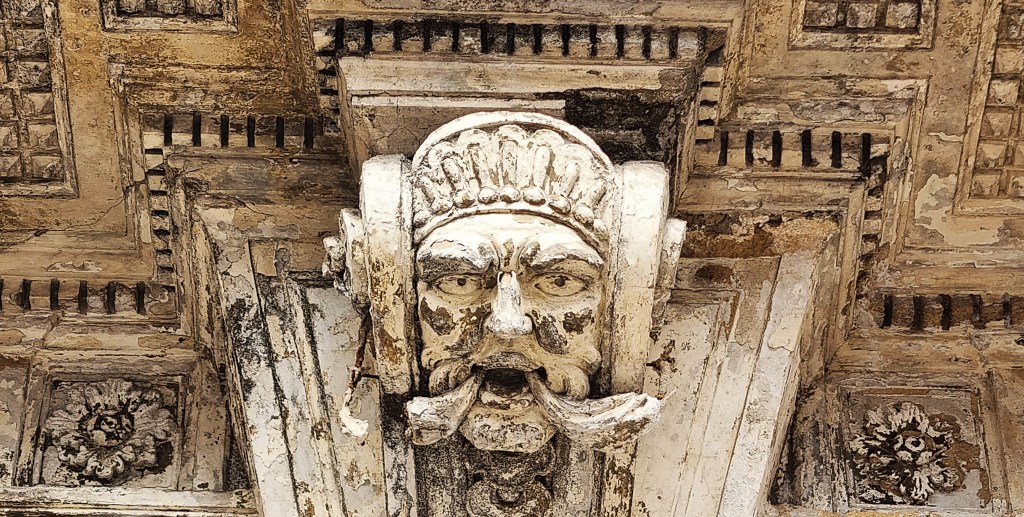
Palermo, the capital of Sicily, has a population of about 650,000, increasing to 1.2 million in the wider metropolitan area. It was heavily bombed during the Second World War and captured on 22 July 1943.
The City is synonymous with Cosa Nostra, aka the Mafia, a term first applied to Palermo street gangs in the 1860s.
Palermo Central is cavernous, so it takes some time to reach the exit on the Piazza Giulio Cesare. Our first task was to cross this, so as reach the Via Roma – a task that, even with traffic lights and a faint crossing marked upon the road, is not for the faint-hearted.
Ascending the Via Roma towards the principal sights, our first encounter was with the spectacular Fontana Pretoria, created in 1555 by the sculptor Francesco Camilliani (1530-1586) for installation in a villa near Florence.

In 1573 it was sold to the Senate of Palermo, dismantled and transported in 644 pieces. Significant adjustments were necessary to fit the new space, so the reassembled fountain wasn’t completed until 1584.
Passing behind the Fountain, we came upon the Church of Santa Maria dell’Ammiraglio and, alongside, the Church of San Cataldo, both constructed in the Twelfth Century.
Santa Maria was built for an admiral called George of Antioch in 1140, initially as a private chapel. Its interior is also known for its outstanding Byzantine mosaics.
San Cataldo was also built for an admiral, called Maio, who hailed from Bari. He served under William I of Sicily, Roger II’s son.
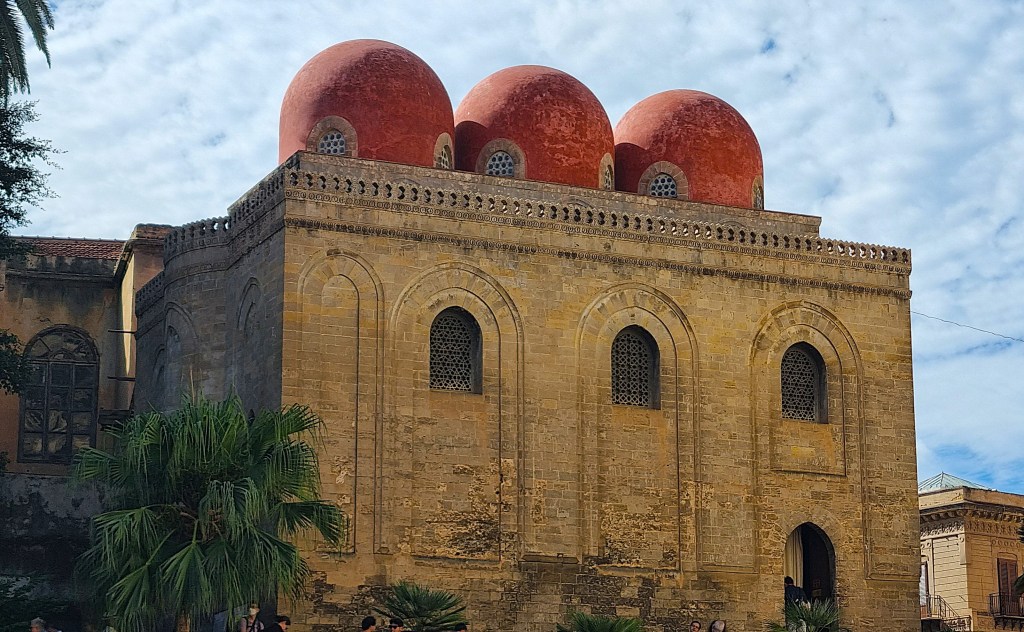
It was built between 1154 and 1161 and is particularly striking because of the three bulbous red ochre domes adorning the roof. These embody perfectly the Arab-Norman confluence of architectural styles so peculiar to Sicily.
Having wandered around the foot of these buildings, we paused to watch young people giving speeches in the square below. Judging by the laurel wreaths they wore, they were presumably celebrating their graduation from the University of Palermo, which has faculty buildings located nearby.
Our next stop was at a site known as ‘I Quattro Canti’ (the four corners) – where the Via Vittorio Emanuele intersects with the Via Maqueda.
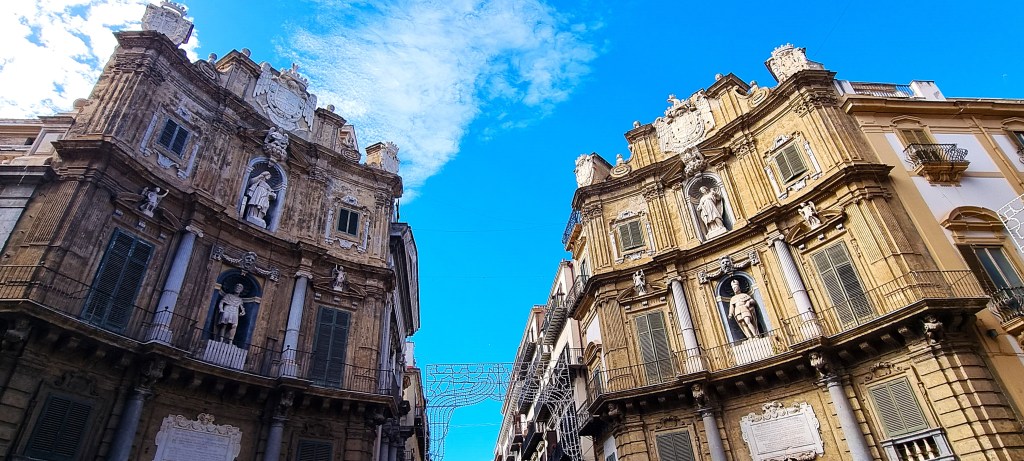
In fact, the corners have been removed, replaced with slightly concave facades, each resplendent with columns and statuary.
This superb example of baroque architecture was designed by Giulio Lasso (d 1612). Though begun in 1611, it wasn’t completed until decades later.
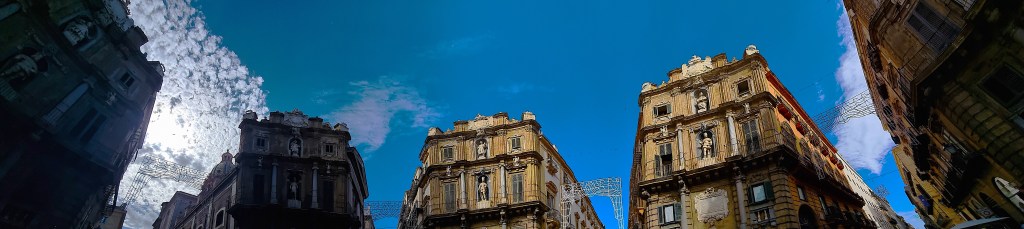
Some of the original statues were subsequently transferred elsewhere, notably the bronze of Holy Roman Emperor Charles V by Scipione Li Volsi (1588-1667), completed in 1630, which now stands in the Piazza Bologni nearby.
By great coincidence, we had also repaired to the Piazza Bologni, to take coffee in Bar Liberty, from where I could see the rather scrawny Emperor, perched atop his ornate marble pedestal.
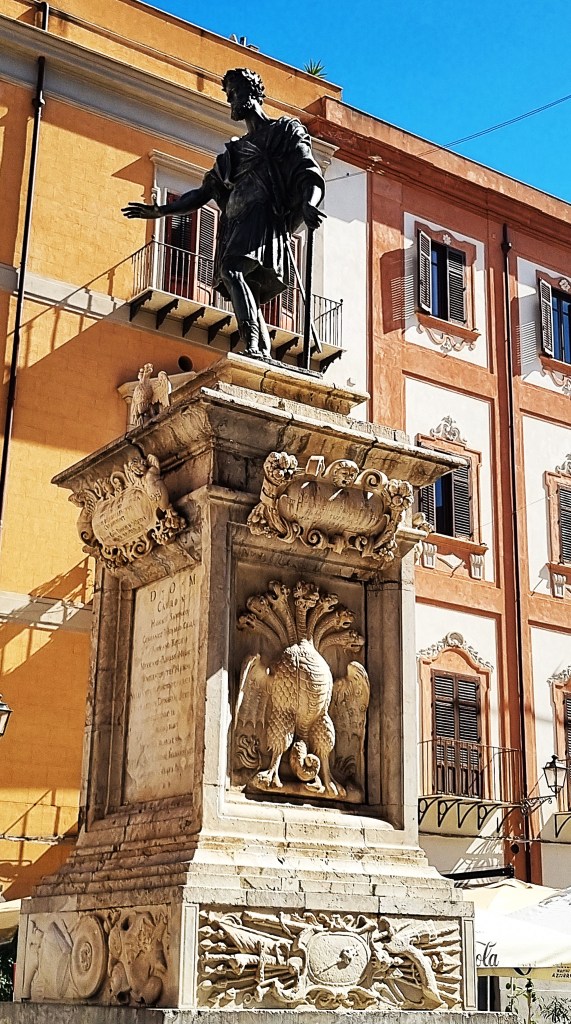
Much refreshed, we stepped in to the Biblioteca Centrale de la Regione Siciliana, further along the Via Vittorio Emanuele.
This was originally a Jesuit School, built in 1586. It contains rough one million works, the oldest dating back to the Tenth Century.
I was much taken with this pensive gentleman – I take him to be a librarian – whose bust rests on top of a couple of thick marble volumes. Judging by the name he carries, the sculptor was Mario Rutelli (1859-1941), so the bust is far more recent than it appears.

We approached Palermo Cathedral through the formal garden in front, which contains a statue of Santa Rosalie (1130-1166), the Patron Saint of Palermo.

The Cathedral itself is late Twelfth Century in origin, and replaced an earlier church that had been converted into a mosque when Sicily was under Arab rule. The corner towers were added in the Fourteenth and Fifteenth Centuries, followed by the porch a century or so later.

One assumes that this huge golden woman parked next to the Cathedral is also Santa Rosalia.

We walked on to the Palazzo dei Normanni, but the queue for tickets was far too long, so we decided to head elsewhere.
I successfully navigated us to the Ballaro Market, but rather wished I hadn’t.
We struggled from end to end, trapped in the crowd, passing through endless stalls, most selling food of various descriptions. All the stallholders bawled continuously, often over thudding music, while the masses thronged through the narrow throughfares.
It was a violent assault upon the senses, all of which were rapidly overloaded. At one point, a very stupid Sicilian decided to ride his scooter through the middle of the crowd.
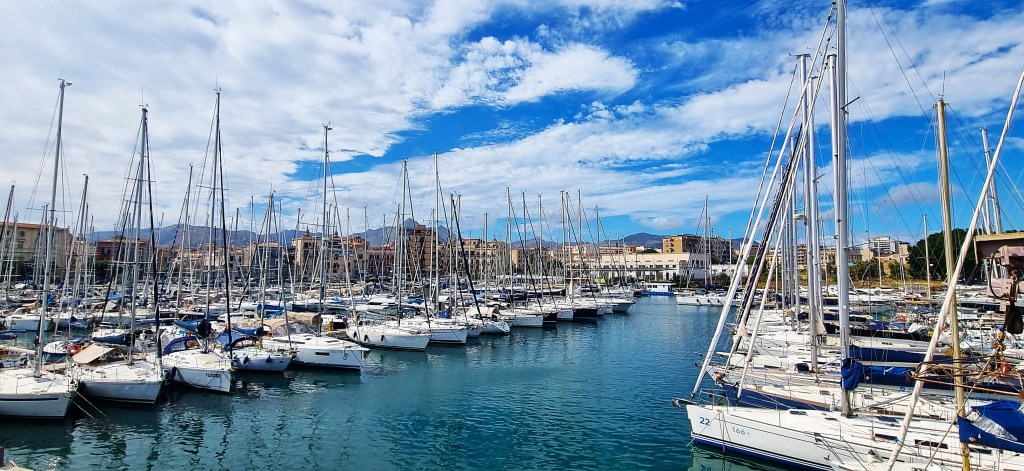
To clear our heads, we walked out to the sea and the marina, before doubling back through the Piazza San Domenico to the Via Roma.

Eventually we stopped for refreshment at the Osteria Al Casareccio, on a pedestrian thoroughfare called Via Maccherronai. We each had a glass of red wine and a large arrancini stuffed with spinanch, parmesan and gorgonzola. Delicious!
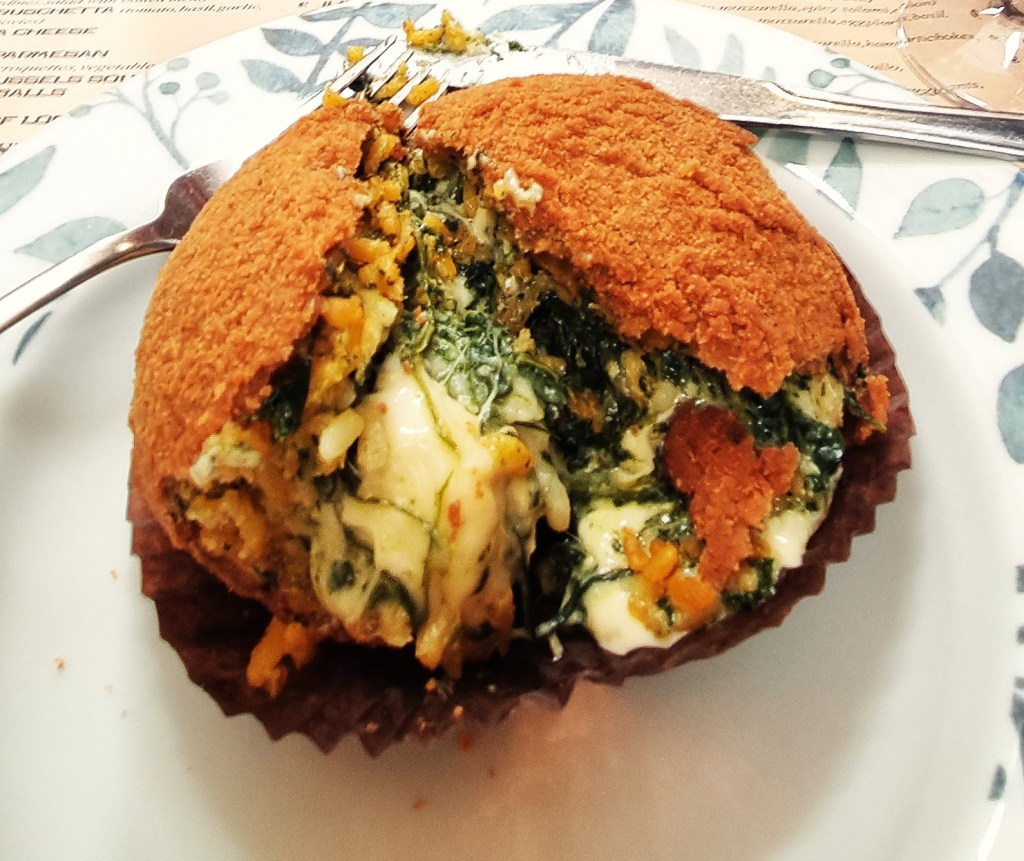
Following some further wandering, it was time to make our way back down to the Station, in time for the 15:52 departure to Cefalu. We stopped in Lidl to buy more water. Fortunately, the crossing to the Station was less frantic.
We positioned ourselves on the platform specified by the departure board, only to discover just in time that our train had pulled in to the neighbouring platform.
We reached Cefalu by 16:45 and, on our way back to the Hotel, chatted with a Danish couple who had also visited Palermo that day.
Eating and drinking
Cefalu boasts a vast number of restaurants, and many other food and drink outlets besides. We had assumed that this would make it easy to find space without booking, but we quickly learned that the more popular restaurants are in great demand, even in mid-October. It is advisable to book to avoid disappointment.
There is no fixed day when the majority of restaurants are closed, as one sometimes finds here in the UK: each seems to have a different ‘day off’.

Many of the restaurants have similar menus, so it can be quite difficult to find variety. However, the quality of the food is invariably high. The price is normally reasonable too (though not cheap) particularly if one sticks to the Sicilian house wine, which is usually very good.
The standard approach is to offer four courses – starter, pasta, main course and dessert – from which one can choose any combination. It is usually necessary to order a side dish alongside the main course.
Amongst the places we patronised, I should mention:
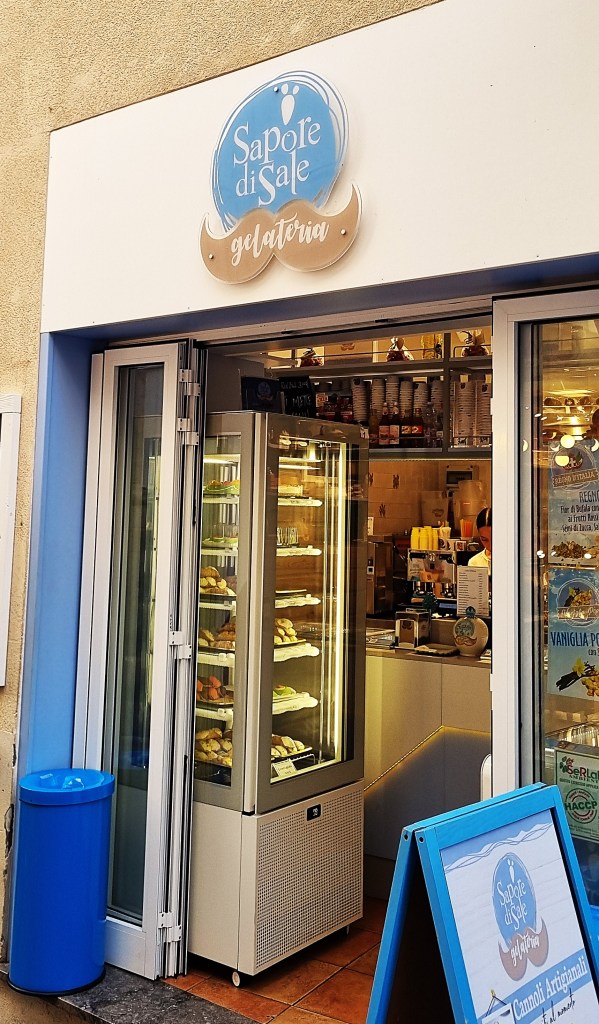
- Sapore di Sale Gelateria on the Corso Ruggero. I have no hesitation in declaring the pistachio ice cream we purchased here the best ice cream I have ever tasted. Tracy also very much enjoyed the signature flavour, ‘sapore di sale’, which blends seasalt, white chocolate and lemon.
- The Urban Jungle on the Via Bordonaro. It seems this was formerly the Kalapinta Beer Shop (see below) but has been sold to new owners who have rebranded it. The draft Sicilian ‘craft beer’ was fairly tasty, well-balanced and not too strong, but Tracy was disappointed to learn that they had no cider.

- Kalapinta Pub on the Via Carrettieri. We came here for a light meal and a drink. We shared the aperitif board and I enjoyed two helpings of the Pescara golden ale (4.9%). Still no cider for Tracy though. The guy behind the bar told me they didn’t supply the beer I’d had at Urban Jungle.
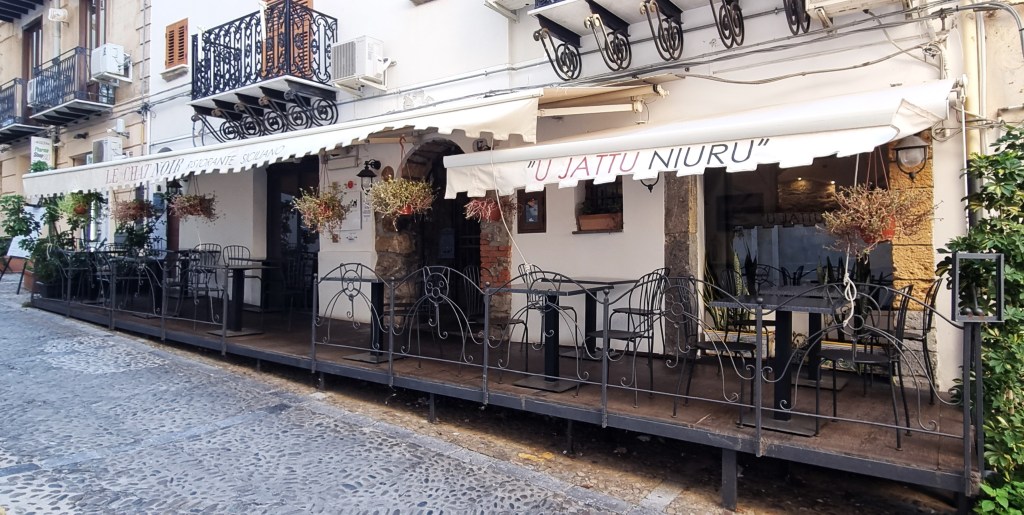
- Le Chat Noir on the Via XXV Novembre. We came here on our first evening and found a table inside without booking. The place was very busy but efficiently run. The red and white checked tablecloths are French-inspired but the food is authentically Sicilian. I particularly enjoyed my spaghetti with aubergines and ricotta.
- Bottega Tivitti is on the seafront, at the upper end of the Lungomare Giuseppe Giardina. We came here for the pizza, which was good, though perhaps not outstanding.
- Liberty on the Via Bordonaro. There was some talk of splitting tables to make it possible for us to sit on the terrace overlooking the sea, but this seemed somehow problematic, so we decided we were quite content on the roadside terrace instead. A pleasant meal, but we weren’t quite sure what we were getting as the waiter spoke very little English. Americans were preponderant, and a man endlessly playing the theme from the Godfather on an accordion. We’d encountered him playing exactly the same tune earlier that day.
- L’Oste al 7, is tucked away on the Via Carrettieri but well worth a visit, especially if the more popular, more central restaurants are all booked up. We sat on the small, square terrace outside. Tracy had Sea Bass while I enjoyed Lamb Cutlets.

- La Brace, a tiny restaurant on Via XXV Novembre with a red interior, not much more than 30 covers and a Dutch-Indonesian take on Sicilian cuisine. This was my favourite restaurant and, in my opinion, our best meal of the week, though it was disturbed by the penetratingly high-pitched voice of the American gentleman seated nearby. Tracy went for the baked banana and cream dessert, which was much delayed. Our bill was discounted accordingly, though we hadn’t complained.
- La Galleria, also on Via XXV Novembre, supplied our final meal of the week, which is traditionally when we ‘push the boat out’, so to speak. This had an artier, more pretentious atmosphere. We sat in the white-painted courtyard. Service seemed to be disrupted by a party of 14 who hadn’t booked – at least I assume that was the reason why we had to wait so long for our main courses. We both tried Black Pig (Nero Siciliana), which was worth waiting for.

Home
It was my Pearl Wedding Anniversary. Love and best wishes to Kate!
We’d paid our bar bill the evening before and attempted an early breakfast (see above), so as to be ready for our airport connection at 07:25. We made it on time and our two fellow guests were already aboard, so we departed immediately.
We called to pick up further passengers from two large self-contained resorts in Campofelice di Roccella, which we reached in roughly 20 minutes. Here a lady guest was having kittens, she and her partner having been told they would be picked up at 07:10!
She was voluble in her complaints, but settled down eventually.
There was a great deal of traffic on the way past Palermo, so we didn’t reach the Airport until 09:25, though our plane was scheduled to depart at 10:40.
However, this proved a blessing in disguise since we didn’t have to rush, or wait too long before boarding. There was just enough time to buy coffee, and baguettes to eat on the plane.
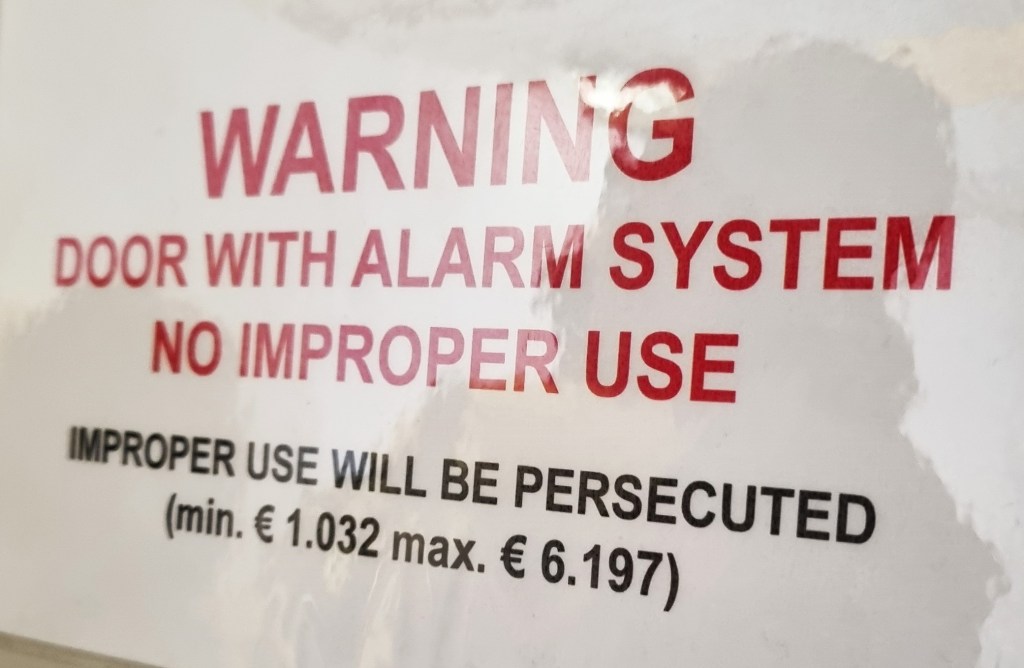
My mood was much improved by this notice, spotted just as we were descending to catch a bus out to the plane.
Once on board, we were told we would be held for 45 minutes, owing to an ‘air traffic control restriction’ at Gatwick, allegedly some sort of knock-on effect from early morning fog.
We arrived at Gatwick about half-an-hour late and caught trains home via Clapham Junction. Not for the first time, I was annoyed at the Gatwick announcements suggesting Oyster is valid for the entire journey into London.
That may be true of itself, but free travel with Oyster 60+ isn’t valid until East Croydon, so old people still have to buy a ticket for part of the journey. They don’t announce that, though.
Such idiocy is tailor-made to trip up unsuspecting travellers.
Had we managed a full unadulterated week of Rest and Relaxation?
Maybe not quite, but almost…more or less.
TD
November 2024



 Eponymous
Leave a comment