
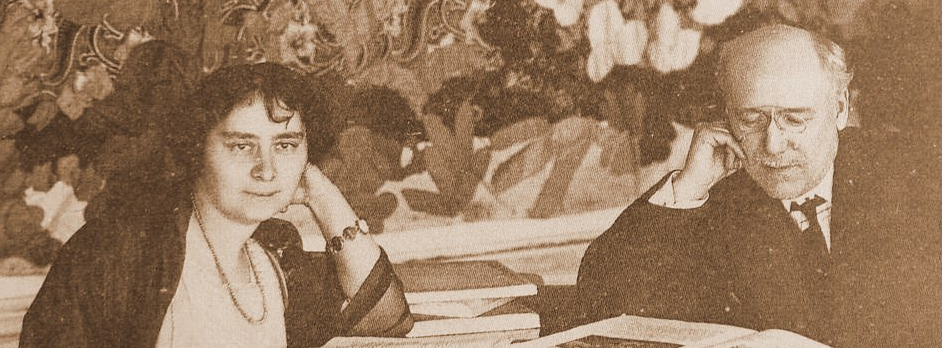
Fyodor Sologub was the pseudonym of F K Teternikov (1863-1927), a poet and novelist, part of the Russian Symbolist movement.
Here he is, circa 1910, posing alongside his wife, Anna Chebotarevskaya.
He began writing ‘The Petty Demon’ in the 1890s, but couldn’t get it published until 1907.
Sologub draws heavily on his own personal experience. Born into a humble family, his peasant mother whipped him mercilessly as a child, but his education was sponsored by the family that employed her as a servant.
Eventually qualifying as a teacher, he took up a post in a small provincial town. It took until 1892 for him to secure a post in St Petersburg, but in 1899 he was appointed a school inspector.
The principal character in ‘The Petty Demon’, Peredonov, is the epitome of antihero. He teaches Russian literature in a provincial town, but aspires to become an inspector.
His lover, Varvara, pretends to have influence over the appointment through contact with the powerful Princess Volchanskaya, but this is merely a ploy, to persuade Peredonov to marry her.
Peredonov deserves to be duped, for he has no redeeming features: he is vicious, sadistic, amoral and corrupt, delighting in having his young charges whipped, in denouncing his enemies to the authorities.
As the novel progresses, Peredonov grows more and more unstable, increasingly paranoid that friends and neighbours are conspiring against him. He becomes prey to hallucinations, invariably featuring a ‘nedotykomka’, his own personal demon.
This ‘grey, featureless, nimble creature’ torments him, appearing briefly, only to hide again:
‘This nedotykomka ran about under the chairs and in the corners and squealed. It was filthy, repulsive, frightening and reeked. By that time it was clear that it was hostile to Peredonov and had come specifically on his account, because earlier it had never existed anywhere. They had created it and then cast a spell over it. And now, to his terror and ruin, living right here, magic and omnipresent, following him, deceiving him and laughing. First it would roll around the floor, then it would pretend to be a rag, a ribbon, a branch, a flag, a cloud, a dog, a column of dust in the street. And it crept and ran everywhere after Peredonov, exhausting him and wearing him out with its vacillating dance. If only someone could get rid of it, either with a word or a solid whack. But he had no friends there, no one would come to save him and he himself would have to extricate himself before the malicious thing ruined him.’
Eventually, the nedotykomka persuades him to burn down the town hall, where a masquerade has been taking place, encouraging him to think that, if he does so, it will leave him in peace.
But he is deceived once more. The nedotykomka returns and, as the novel concludes, Peredonov is provoked into slitting the throat of his erstwhile friend.
I read this in the translation by S D Cioran (1990). The text was clumsily rendered in places, and I suspect that far too much was lost in translation. Fortunately though, an appendix included the substantial cuts that Sologub himself had to make to secure publication.
These quibbles aside, this remains a powerful novel, which has influenced many of Sologub’s contemporaries and successors. ‘Peredonovism’ is now a byword for characters who display such universally negative behaviour.
Adventurous readers should definitely give ‘The Petty Demon’ a try.
TD
August 2024









 Eponymous
Leave a comment