

During the dog days of August 2024, we decided spontaneously to walk another stretch of the Thames Path, having completed Wallingford to Pangbourne in June.
This time we made a two-day trip with an overnight stop at Sonning. The total distance should have been some 15.6 miles, but an extensive 2.7 mile off-river diversion between Upper Shiplake and Henley adds unwelcome extra distance.
Much more about that below.

We used in reverse the route home from Pangbourne we had selected last time: changing trains at Basingstoke and Reading respectively. This enabled us to reach Pangbourne before 10:30, taking in a second breakfast at Basingstoke.
It was a bit tight at Reading, but our incoming Cross Country service was early while the outgoing GWR service was two minutes late.
I was shocked to learn that Tracy had decided to bring her book: all 816 pages of ‘The Missing Sister’ by Lucinda Riley. She preferred to carry it throughout, rather than delay completing the final chapters!
Naturally, I had left ‘The Petty Demon’ at home.

Day 1: Pangbourne to Sonning
Once we’d worked out the route from our station exit, we soon made our way to Whitchurch Bridge, then across Pangbourne Meadow on the starboard bank of the River.
A couple of fishermen were seated close to the Bridge, while a conversation between two women of Irish origin was underway on a nearby bench, a gaggle of geese congregated beside them.
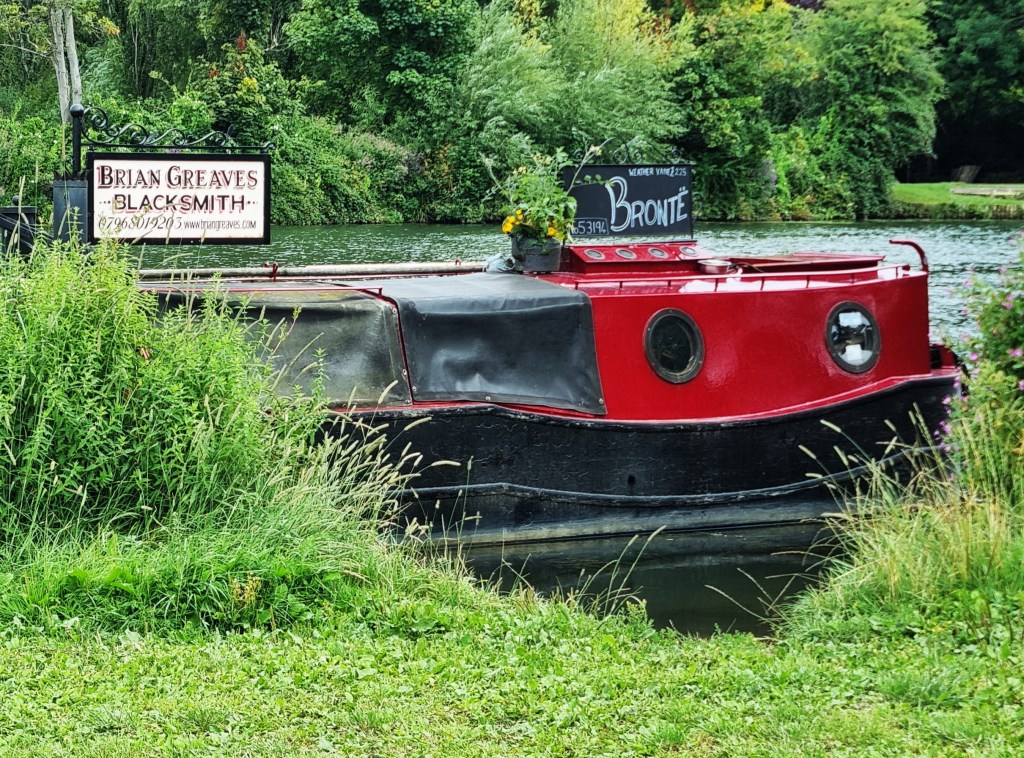
Almost immediately Tracy spotted ‘Bronte’, the canal tug converted into a waterborne smithy, which we encountered last time, at Cleeve Lock.
Before long we were opposite Hardwick House, built for the Tudor politician and landowner Richard Lybbe (1479-1528) and his immediate descendants.
Apparently, Charles I visited Hardwick while imprisoned at Oxford, playing bowls on the green at nearby Collins End Common.
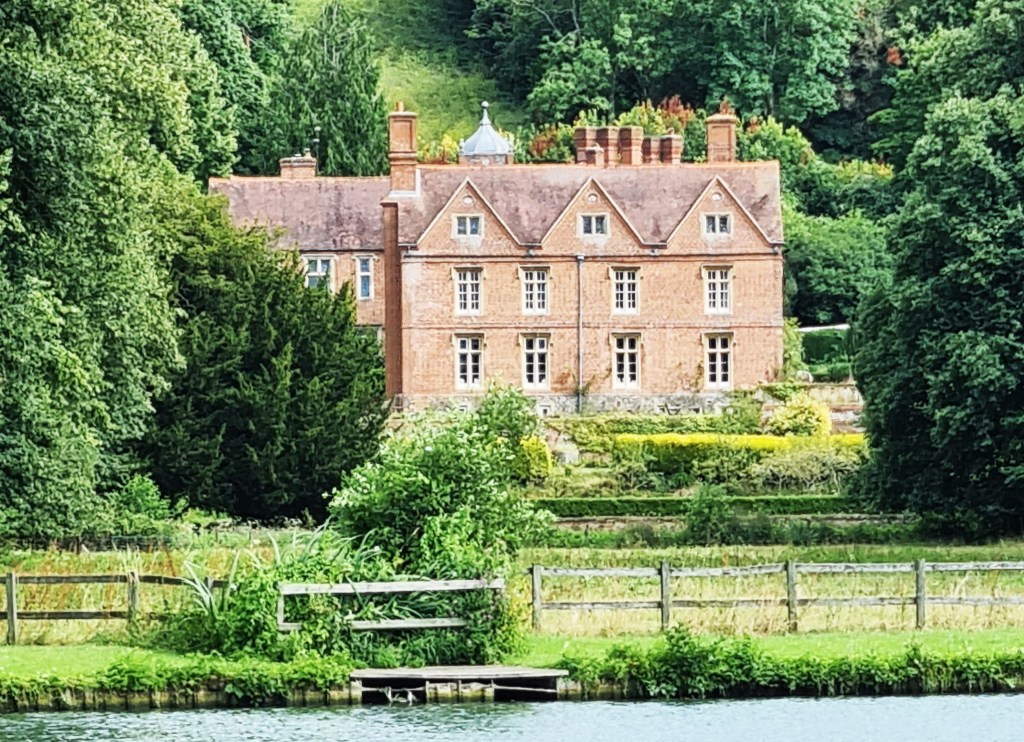
In 1909, it was purchased by Charles Day Rose (1847-1913), a Canadian-born politician and businessman, one possible inspiration for Toad in Kenneth Grahame’s ‘The Wind in the Willows’ (1908).
It is still owned by Rose’s descendants, who have established the Hardwick Estate as a pioneering organic farm and centre for diverse rural enterprises.
Shortly afterwards we caught our first sight of two men paddling a blue canoe, heading towards Mapledurham Lock.

We were to see them at least twice more during the course of the day, finally chatting as they moored for coffee opposite Lower Caversham.
They were paddling from Lechlade to Cookham over three days, completing Wallingford to Henley on this, their second day.
On the approaches to Mapledurham, we passed this derelict craft, moored on the opposite bank.
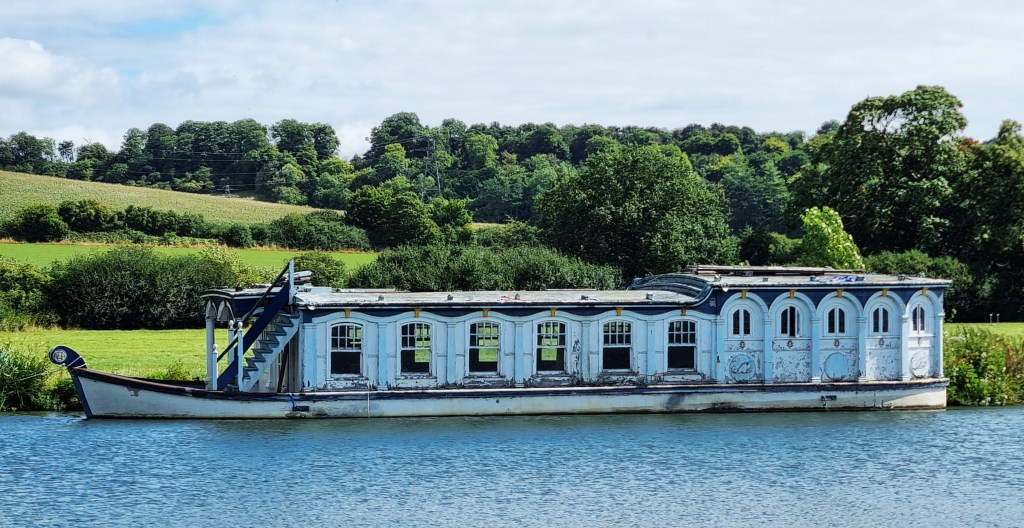
It looks suspiciously like the Magdalen College Barge, which passed into new ownership in 2023, having previously been owned by the Swan at Streatley.
It has a rare ferro-concrete hull and was built in 1927.
If I’m correct, the planned restoration does not seem to be proceeding apace!
At the Lock itself, we noticed a bench dedicated to actor Kingsley Edward Tudor Glover (1982-2022). After studying at the Rep College Drama School in nearby Purley-on-Thames – run by his parents – he was employed as one of the ‘resident Shakespeares’ by Tudor World in Stratford on Avon.
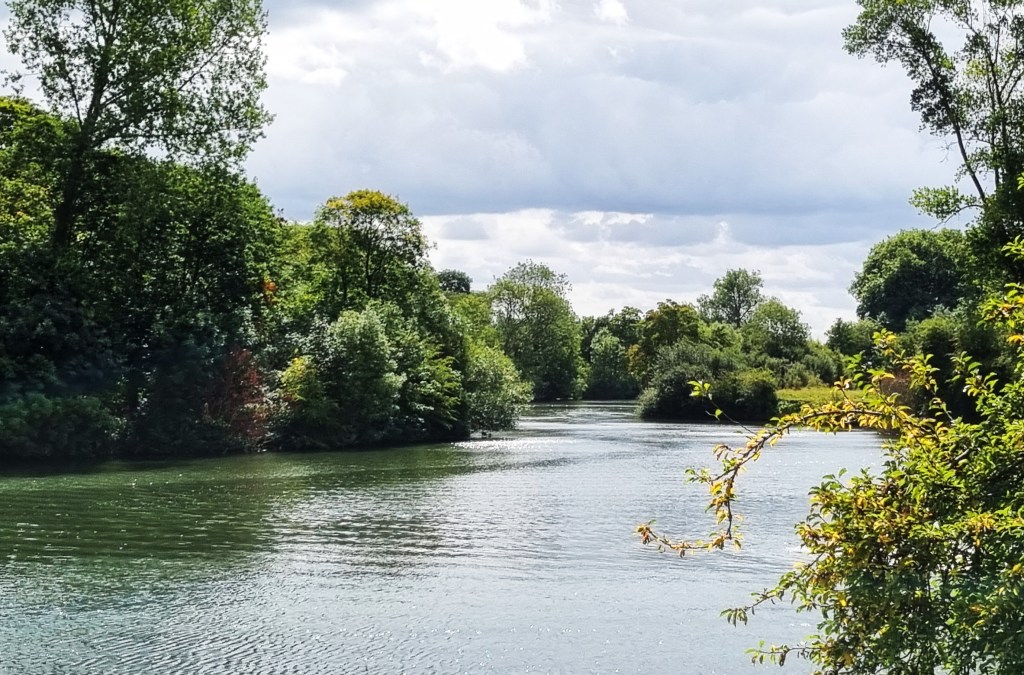
Just beyond the Lock sits beautiful Mapledurham House, on the opposite bank, but the Thames Path now follows what the official guide (published 2016) describes as a ‘temporary route’, heading inland to sample the delights of Purley-on-Thames.
Nothing happens quickly on the Thames Path.
We missed our turning here, misled by the signage, ending up at St Mary’s Church, before retracing our steps and continuing up New Hill.

The Church is frustratingly close to the River, but there is seemingly no way through. A gated marina called Purley Gardens Moorings blocks the way, as does the railway line.
Purley is said to be the halfway point on the Thames Path, but it has little else to commend it. There is a lengthy diversion before one rejoins the Thames shortly before Tilehurst Station, at what was formerly the Roebuck Hotel.
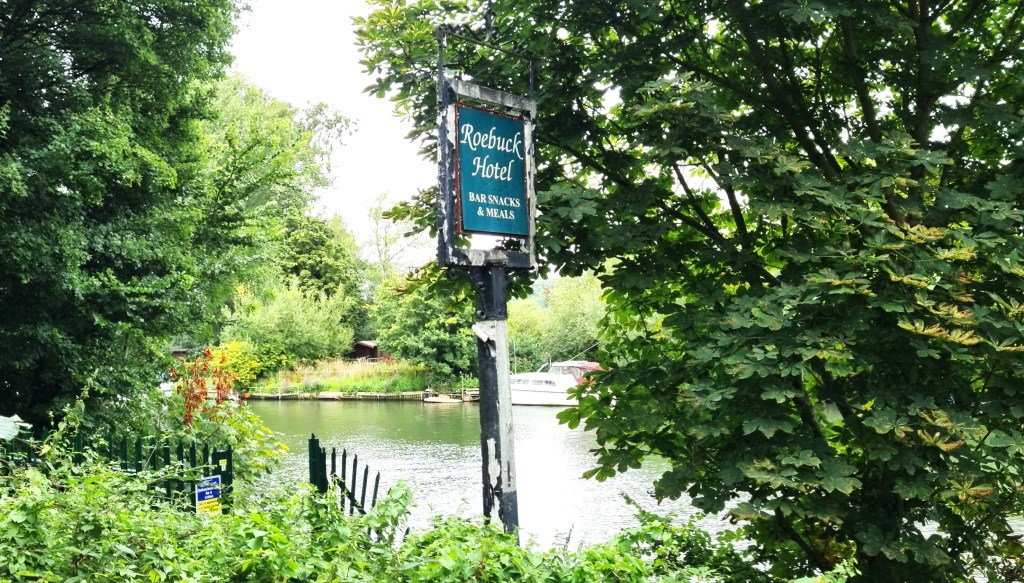
Some sources suggest this features in ‘Three Men in a Boat’, but Jerome’s solitary comment about this stretch is:
‘The river becomes very lovely from a little above Reading. The railway rather spoils it near Tilehurst, but from Mapledurham up to Streatley it is glorious.’
The railway continues to spoil things to this day, the track running alongside the Thames for at least a mile.
A miscellany of residential boats is moored along the bank, most in a state of disrepair. Several have spilled out their flotsam and jetsam on to the adjacent land. There are also occasional encampments set back in the trees, hard against the railway line.
At least this resident displayed a sense of humour.
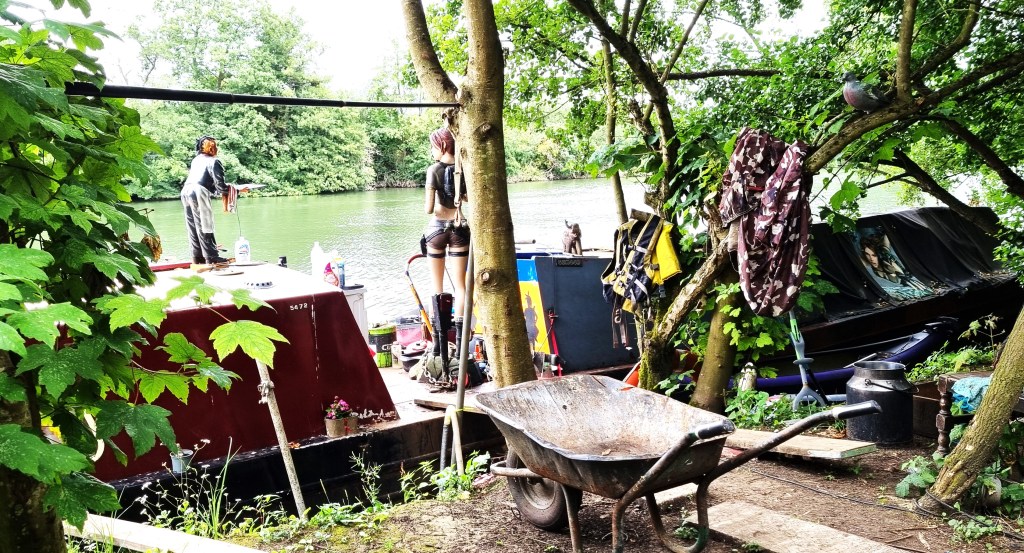
Just before reaching the end of Scours Lane, we passed a badly overflowing rubbish bin, with large residues of litter on the surrounding grass.
Some sort of roofed recreational area was set back in the trees, with what resembled punch bags hanging down. Two women sat in car seats watching us pass.
We had barely rid ourselves of the railway line before it was superseded by an endless green board fence, perhaps four or five metres high.

This marks the perimeter of the Reading Festival site, the event scheduled for two weeks hence. With huge lighting towers now being erected, the site had unfortunate echoes of wartime concentration camps.
The green wall continued still when, having reached the Promenade with its attractive green iron benches, we decided to stop for our picnic lunch.
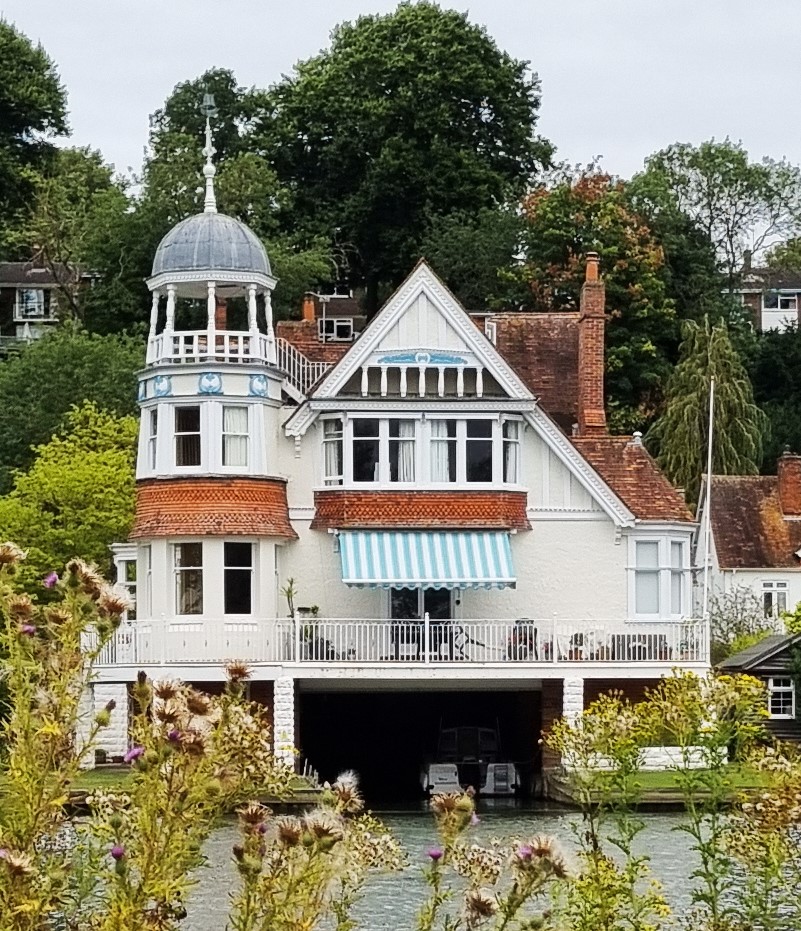
We sat opposite an ornate riverside property, complete with cupola. This is Isomer, a listed boathouse villa, constructed circa 1905.
Lunch completed, we passed beneath Caversham Bridge, opened in 1926.
I was more taken with Christchurch Bridge, just after Fry’s Island, where Robert de Montfort and Henry of Essex underwent trial by combat in 1163. Henry was wounded but escaped with his life, by joining the monastery where he was recovering.

Christchurch Bridge was opened in 2015. It has a span of 68 metres and is supported by 14 pairs of cables from its 39-metre mast.
Just after Caversham Lock, we were brought to a halt by wire fences protecting repairs to the Kings Meadow footbridge. We had to retrace our steps, past Thames Lido, to join the field on the other side of the stream.
Before doing so, I snuck a quick look at the twin Archimedes screw turbines employed by the Reading Hydro micro hydroelectric scheme.

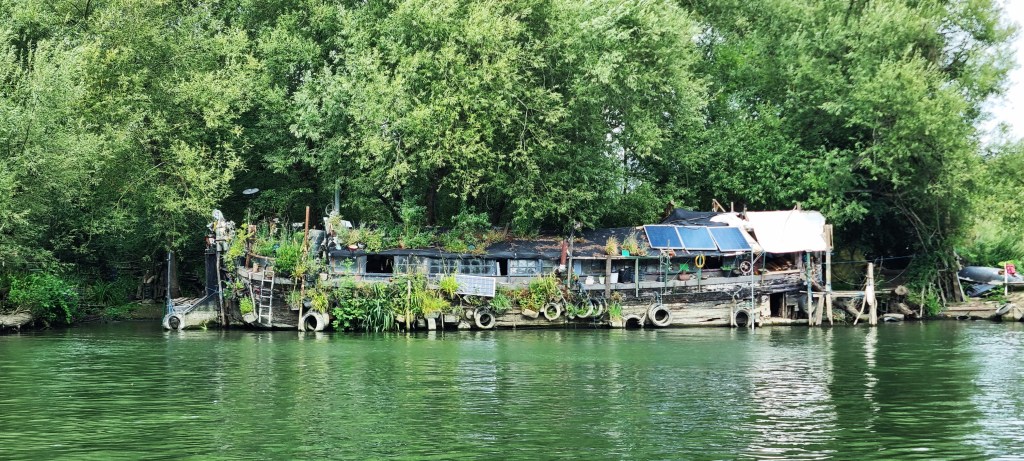
Coming abreast of the Marina on the opposite bank, we spotted this ‘junk’, which looked worryingly un-watertight but seemed to be growing into the river bank.
Reaching the junction between the Thames and the Kennet, we crossed the still unprepossessing Horseshoe Bridge, which clings to the side of the Brunel-designed railway bridge.
Dating from 1892, it was cleaned and repainted for its 130th anniversary, but is already reverting to eyesore.
Crossing the broad green space of the Thames Valley Park Nature Reserve, we watched one large group barbecuing a picnic, in open defiance of the conspicuous noticeboards posted every 50 metres or so along the bank.
Just round the bend, another group was emerging from a swim, similarly in defiance of the notices.
A model aircraft from the nearby club zoomed overhead.
Entering woodland, we passed the Reading Bluecoat School boathouse. Although founded in 1646, the School didn’t arrive in Reading until 1947.
We noticed a small launch, Isabella, which we had first spotted at lunchtime, watching as she passed through Sonning Lock.
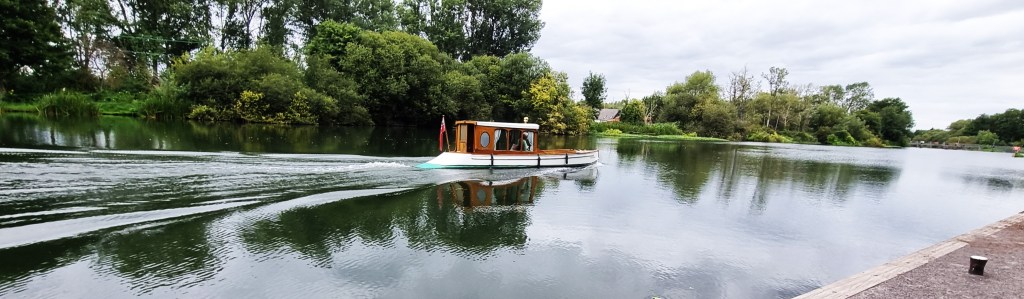
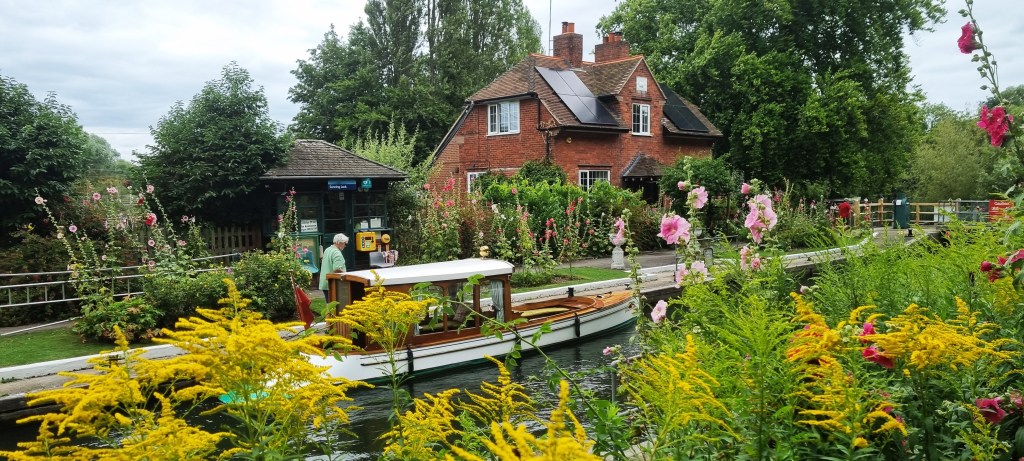
Although Isabella has vintage lines, she was built as recently as 1999. And, while Sonning lock was first built in 1773, it has been rebuilt three times since, most recently in 1905.
Between 1845 and 1878, the lock keeper was one James Sadler, poet and beekeeper.
In 1881, George Dunlop Leslie – whose book, ‘Our River’ (1888), was a source for Jerome K Jerome’s – described Sonning Lock as:
‘…much celebrated for its roses and bees, which are both cultivated and attended to by Mr Sadler the lock-keeper; this old gentleman is a great character on the river, and possesses a variety of accomplishments. He has paid great attention to the roses in his garden, having budded a number of the finest varieties, some of which may be seen blowing amongst the withies along the river banks, budded on to the original wild-rose stems wherever they happen to grow.
Mr Sadler is likewise a great bee-master and maker of bee-hives of a very ornamental character. Besides being known as a rose grower and bee-master, he lays claim to celebrity as a poet, having written several Georgic strains on the care and management of bees and roses, and other verses which he calls Summer Recreations.’
Jerome himself describes the village of Sonning thus:
‘It is the most fairy-like little nook on the whole river. It is more like a stage village than one built of bricks and mortar. Every house is smothered in roses, and now, in early June, they were bursting forth in clouds of dainty splendour. If you stop at Sonning, put up at the “Bull,” behind the church. It is a veritable picture of an old country inn, with green, square courtyard in front, where, on seats beneath the trees, the old men group of an evening to drink their ale and gossip over village politics; with low, quaint rooms and latticed windows, and awkward stairs and winding passages.’
But his ‘three men’ do not follow this sage advice: instead, they camp out on one of the islands near Shiplake (see below).
Sonning is a veritable magnet for celebrities. Amongst those resident or formerly so are: George and Amal Clooney, Uri Geller, Glenn Hoddle, Theresa May and Jimmy Page.
Before repairing to The Bull, we went first to The Village Hamper for excellent coffee and cake, sharing the small garden with the resident guinea pigs.
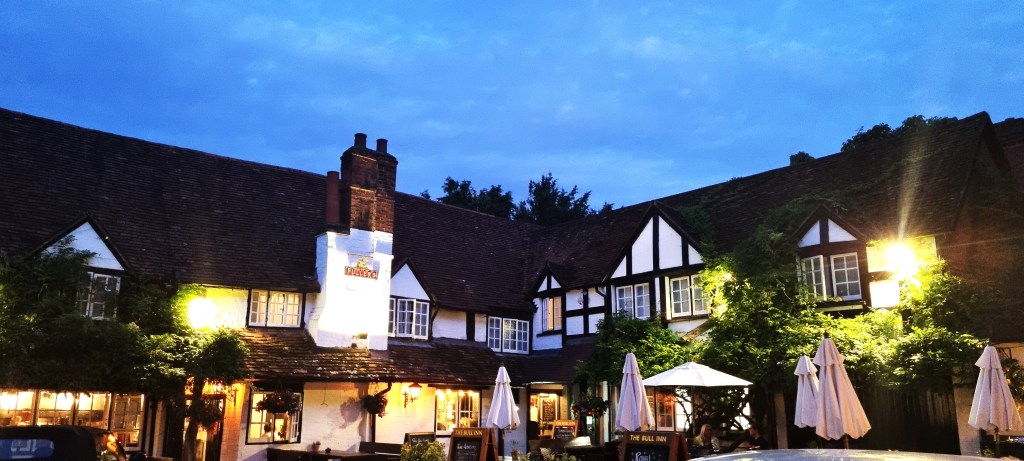
The Bull is owned by St Andrew’s Church next door, who rent it to Fullers. The oldest parts date from the late Sixteenth Century.
All the bedrooms are named after features from Three Men in a Boat and, quite appropriately, we found ourselves in ‘Kingston’. (The boat trip begins at Kingston, just below Kingston Bridge.)
We enjoyed a splendid dinner – mine comprising chicken liver parfait, duck breast and bread and butter pudding – during which Matt Hudson-Smith won a silver medal in the men’s 400 metres in Paris, in a European Record time of 43.44s.
Four elderly men, sat nearby, discussed the Olympics – and much else besides. We heard them again at breakfast, so they must have been resident too.
After dinner we went for a stroll around the churchyard before repairing to ‘Kingston’, where ‘The Missing Sister’ made her presence felt.

Day 2: Sonning to Henley
The forecast for our second day was mixed: starting brightly but clouding over with some chance of rain.
There being no cafés much before Henley, I opted for a Full English Breakfast, while Tracy was a little more restrained, choosing Eggs Benedict instead.
We were under way before 9:00, retracing our steps to Sonning Bridge, brick-built with eleven arches in 1775.
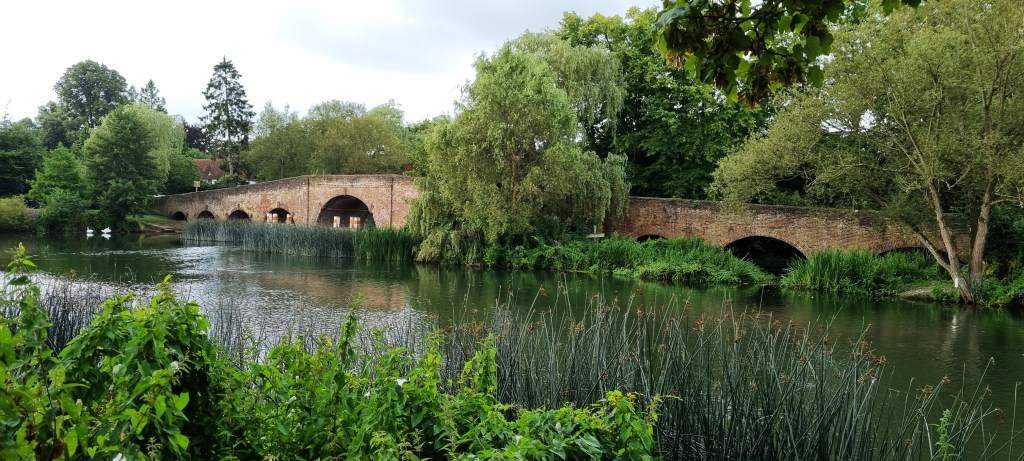
The River here forms the boundary between Oxfordshire and Berkshire, and we were crossing to the Berkshire side.
A month or so before our arrival, Oxfordshire artist Impro had installed a cashpoint machine on one of the central pillars. He has previously provided a post box (2013), a black door (2016) and a telephone (2021) in exactly the same location.
This stretch out from Sonning was very attractive: Tracy released some more petals beneath a beautiful willow tree.
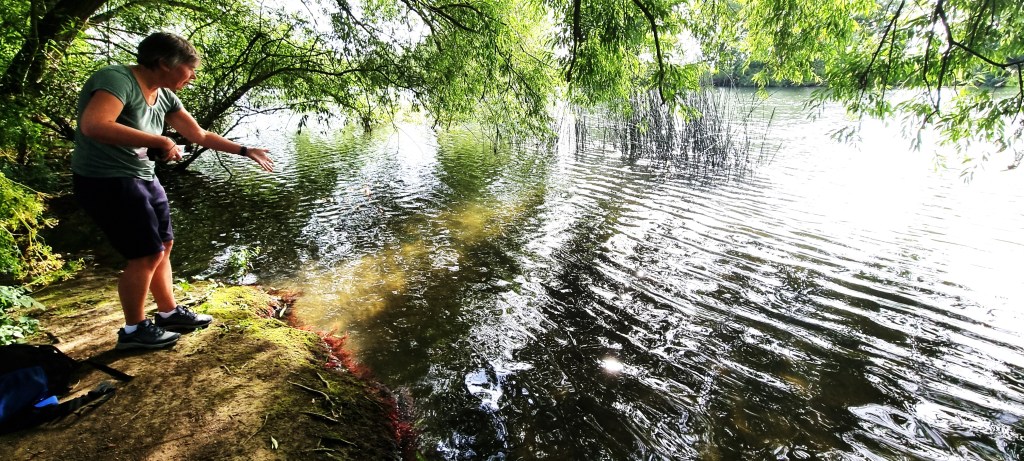
For some unknown reason, my pocket chose to make Whats App video calls to both Tracy and my brother, which was embarrassing..
As we drew abreast of Shiplake College, the students from the summer rowing camp were lowering their boats into the water.

We diverted to avoid a short section of the towpath closed owing to a sink hole: a small harbinger of what was to follow, perhaps.
The path passes the outskirts of Shiplake, close to the church where Tennyson was married to Emily Sellwood in June 1850.
On the large green space between Shiplake and Lower Shiplake, preparations were in hand for the 2024 Wargrave and Shiplake Regatta, just a day or two hence.
As we passed, contractors were busy erecting a large marquee directly across the Thames Path. There was only just enough room to skirt round the bank.
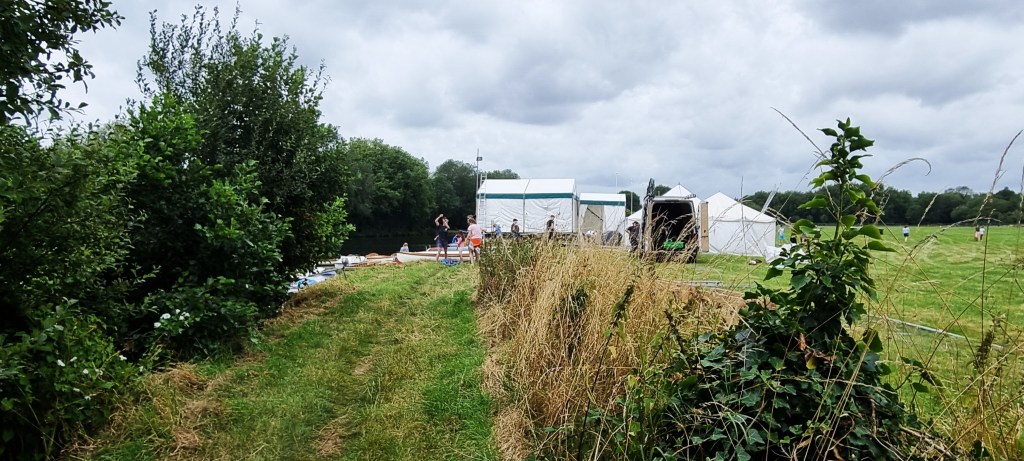
As we passed, I overheard one of the contractors saying they should:
‘stop people walking round there’,
to which I responded:
‘you’re right on top of the Thames Path, mate’,
to which he responded:
‘I know’.
This has happened before, with Henley Regatta. Given what was to follow, it added insult to injury.
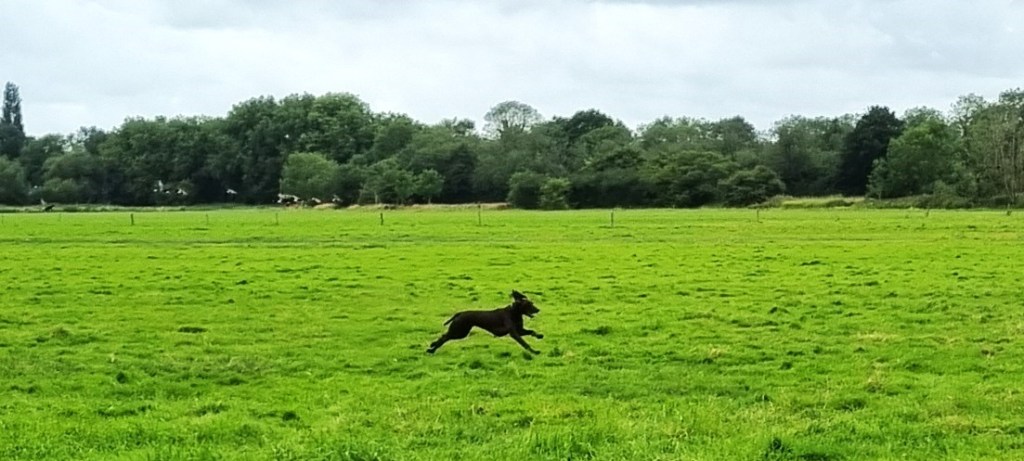
As we approached Lower Shiplake, a manic black dog hurtled after the geese sitting in the neighbouring field, scattering them in all directions, before bounding past us on the path.
We marvelled at the ugliness of this thatched building on the opposite bank, just before the Path heads off into Lower Shiplake.
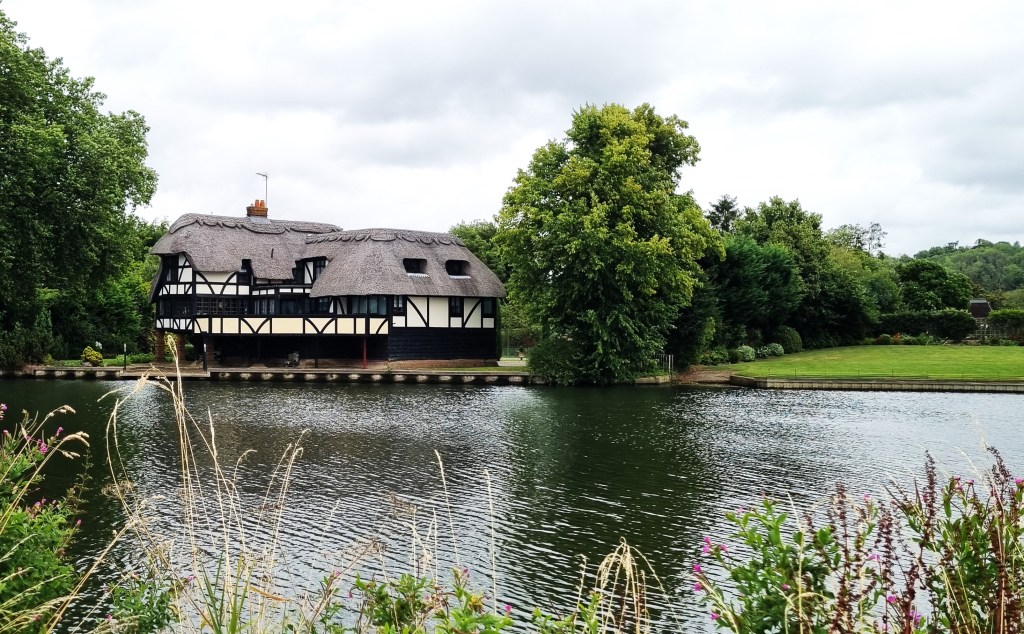
There has long been a diversion at this point. The 2016 Guide Book says:
‘It is hoped that the final route, following more of the river bank, will be available before too long’,
but there is no towpath on this bank beyond the point from where the Lashbrook Ferry once operated. It has always been necessary to enter Lower Shiplake.
We had hoped to grab coffee from the Baskerville Arms but, although signs said it was open, the door was still closed.
So we bought our coffee instead from the village stores opposite, drinking it on a handy picnic bench outside. The friendly proprietor summarised the story of our next diversion (which I have laid out in full below).
Because we now faced a diversion from the diversion!
The original route ran along beside the railway line, then into Bolney Road, rejoining the Thames just at the point where the Bolney Ferry once operated.
Most of that route is still walkable, except the final stretch. For a time, there was a short diversion here, across private land, beside Marsh Lock Horsebridge, but then that, too, was discontinued.
Instead there is now a whopping 2.7 mile diversion inland, through Harpsden woods. One doesn’t re-emerge on to the towpath until Marsh Lock, just short of Henley. Walkers are discouraged from using the A4155 as a shortcut because it is considered too dangerous.
Why?
The story is complex and convoluted. What follows is pieced together from reliable online sources.
Marsh Lock Horsebridge was originally closed in May 2022, owing to safety fears. The closure was expected to last for a few weeks only.
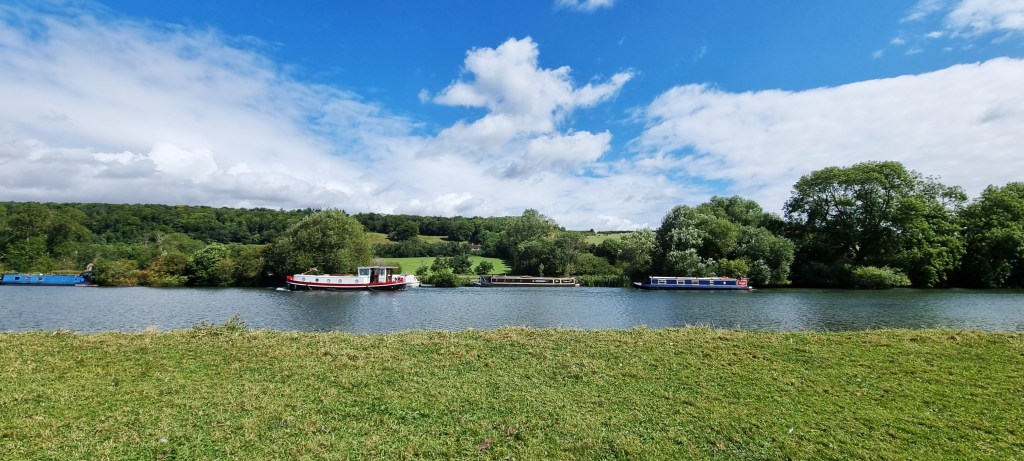
An above-water inspection was conducted by Capita almost immediately, that same month, but an underwater inspection by Red7 was not completed until September 2022. The total cost was some £46,000, incurred by the Environment Agency (EA).
Following the closure, the Culden Faw Estate, owned by the Schwarzenbach family, offered a temporary diversion, including a bridge across an intervening stream.
However, in December 2022, the family instructed their Estate Manager to withdraw the diversion, with effect from 1 April 2023.
They cited:
‘The increased use of the route by horses and vehicles…and also the inordinate amount of time it has taken the EA to progress things.’

It took until February 2023 for the EA to establish that either a major refurbishment or a replacement bridge would be necessary. They estimated the cost at £1m, and anticipated that the Horsebridge would likely remain closed throughout 2023.
In light of this, the Culden Faw Estate kindly agreed to extend the deadline for closure of their temporary diversion, which remained open until 31 March 2024.
By September 2023, the EA continued to expect the bridge to remain closed for the remainder of 2023 but added that it:
‘…continue[d] to work to resolve the issue as soon as possible’.
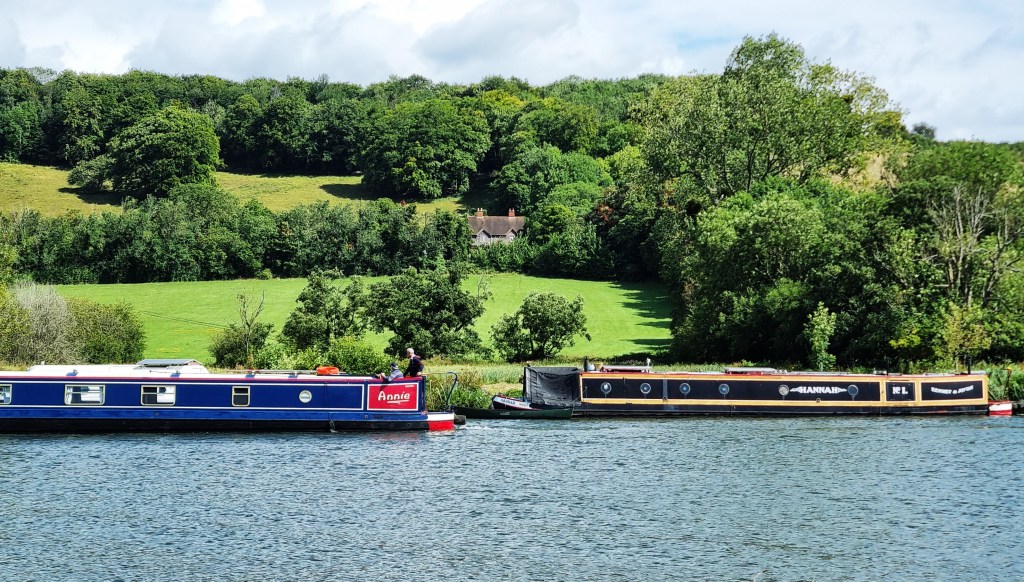
But, in April 2024, the EA admitted that it had:
‘…only recently confirmed that we (the Environment Agency) are the legal owners of Marsh Horsebridge.’
Quite who else might have been the owner is not revealed. Maybe they suspected the Oxfordshire County Council, or possibly Wokingham Borough Council, or possibly even the Culden Faw Estate?
Confirmation of ownership led to the project’s belated inclusion in the Agency’s ‘medium term Navigation capital investment programme’.
But, given the likely costs and competing priorities, the Agency still thought it likely that the Bridge would be closed throughout 2024.
However, it revealed that it was discussing with Oxfordshire County Council:
‘…the potential for a temporary crossing to be established over the existing bridge.’
It does not explain why this had not been considered before.

In July 2024, Oxfordshire County Council issued another Notice of Temporary Footpath Closure under the Road Traffic Regulation Act 1984:
‘Henley-on-Thames, Marsh Lock (Footbridge between Marsh Lock & Horsebridge) Date of Order: 22/07/2024 Coming into force: 28/07/2024
This order continues in force a footpath closure by emergency notice on 8 July 2024 for public safety reasons because the bridge is unsafe to use and requires repairs. The work is added to the capital programme where funding has to be prioritised and may not be completed until January 2026.
The effect of the Order is to close temporarily the footbridge between Marsh Lock & Horsebridge at RG9 4HB. Exemptions are included for emergency services and for the works…This Order will remain in force initially for 6 months and may be extended with the consent of the Secretary of State for Transport. (Ref: T14305(EM)/MR)‘
It is unclear whether the capital programme mentioned is the Council’s or the Environment Agency’s.
However, it is clear that no resolution is likely for at least another 18 months. Nor does the procrastination to this point fill one with confidence that this latest deadline will be met.
As recently as March 2024, a Henley Town Councillor alleged that the EA and Oxfordshire County Council were still unable to agree which was responsible for paying to repair the bridge.
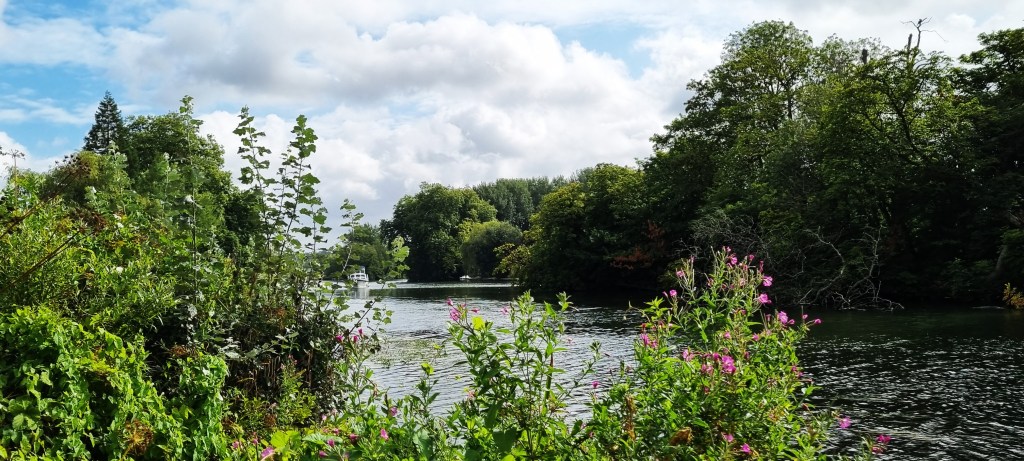
None of the principal actors emerge from this sorry tale in a good light:
- The Environment Agency has dragged its heels for far too long, while apparently trying to escape its legal responsibility for the work;
- Oxfordshire Council also seems in no hurry to resolve the issue, apparently taking the view that the matter is exclusively for the EA. To date, it has been unable to agree with the EA the installation of a temporary crossing above the existing bridge;
- Culden Faw Estate might reasonably have maintained its own temporary diversion, or perhaps even stumped up half of the funding necessary to repair the bridge. It is owned by a billionaire, after all, while neither the Agency nor the Council is awash with funds.

Arriving at Marsh Lock, we walked out on to the offending bridge, which still seemed to be open at this end.
Frustrated walkers had scrawled graffiti on the Thames Path signs.
Passing the wishing tree, we repaired to Henley Piazza on Mill Meadows, where we had lunch.
As we watched, a large Red Kite swooped down above a bench on the towpath and carried off food. This is now a regular occurrence in Henley.
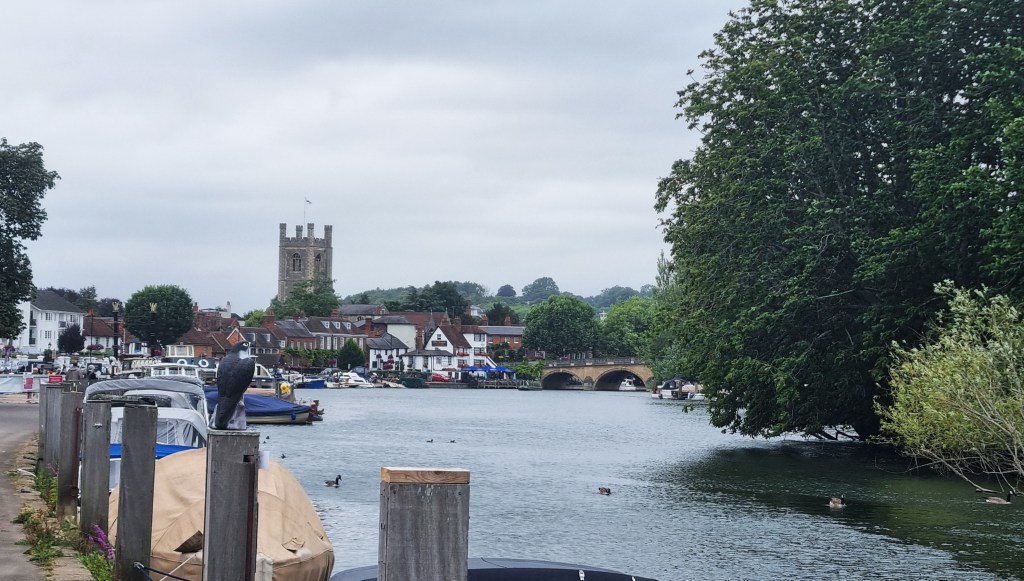
Shortly afterwards, we walked briskly to the Station and went home, via Twyford, Paddington and Waterloo.
TD
August 2024







 Eponymous
Leave a comment