
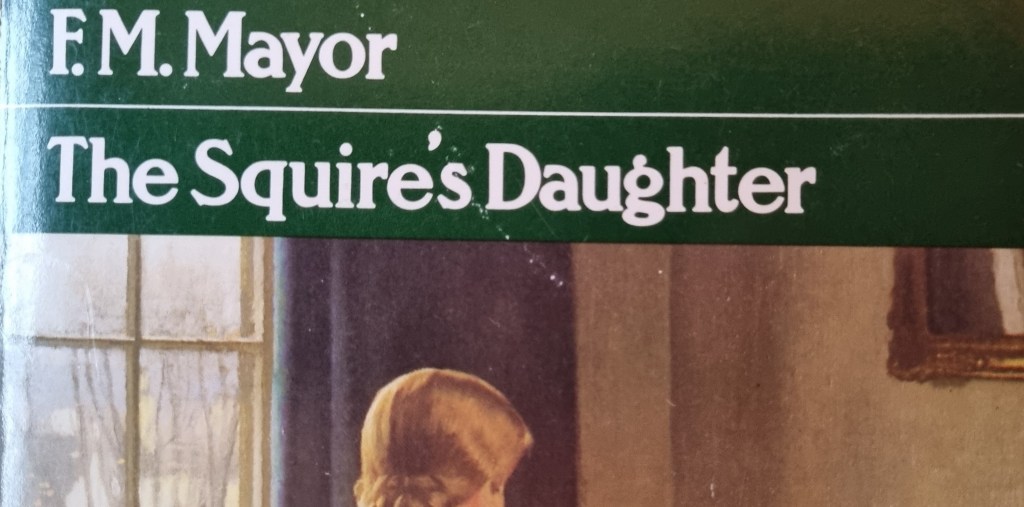
Flora MacDonald Mayor (1872-1932) is best known for ‘The Rector’s Daughter’ (1924), often cited as a neglected masterpiece.
‘The Squire’s Daughter’ (1929) is not quite in that league – is perhaps more of a curate’s egg.
It deals with the ‘generation gap’, as it manifested a century ago, between two generations of the De Lacey family, landed gentry with a country seat.
Sir Geoffrey is the squire, Edwardian to his core. Following a distinguished military career – awarded a VC during service in India; coming out of retirement to serve again in France throughout the Great War – he assumes the role of English country gentleman.
But times are increasingly hard, his health is compromised, his wife is a weak-willed waste of space and, as for his children…
Collette is a nonentity, but miraculously ensnares a wealthy American husband.
Oswald apparently shirked the War, until conscription forced his hand (we learn, belatedly, that he had a temporarily gammy leg, but never let on). Now he’s a feckless waster who lives on parental handouts before trying to embezzle the company that employs him. This is successfully hushed up, but the family must repay the debt.
Then there is Veronica – known as Ron – a beautiful flapper; a seductive vamp. Though a far stronger character, she is conflicted, egotistical and largely conscience-free.
She freely pops pills (she calls them ‘tabloids’), joins her brother’s ‘fast set’ and flirts through a series of empty affairs.
Only to fall heavily in love with Bob Manners, an upright vicar with a moral compass. Fortunately, she jilts him: marriage with her would have destroyed him.
As Sir Geoffrey and his country pile slowly fall apart, Ron helps matters along by overspending wildly on clothes, very nearly wrecking Manners’ next relationship into the bargain.
Only her father’s death can make Ron and her siblings start to grow up. But Mayor constructs an improbable ending, in which Ron bewitches her sensible cousin and, by marrying him, exchanges wild flappery for the delicate role of diplomat’s spouse.
Maybe because of my age and gender, I found it impossible to empathise with this anti-heroine. That curtailed my enjoyment of the narrative, especially when she avoided a sticky end.
I could only hope that her own children would eventually repay her in kind.
But if, like me, you’re fascinated by the social history of 1920s England, this story has much to commend it.
I’d definitely give it a try.
.
TD
July 2024









 Eponymous
Leave a comment