
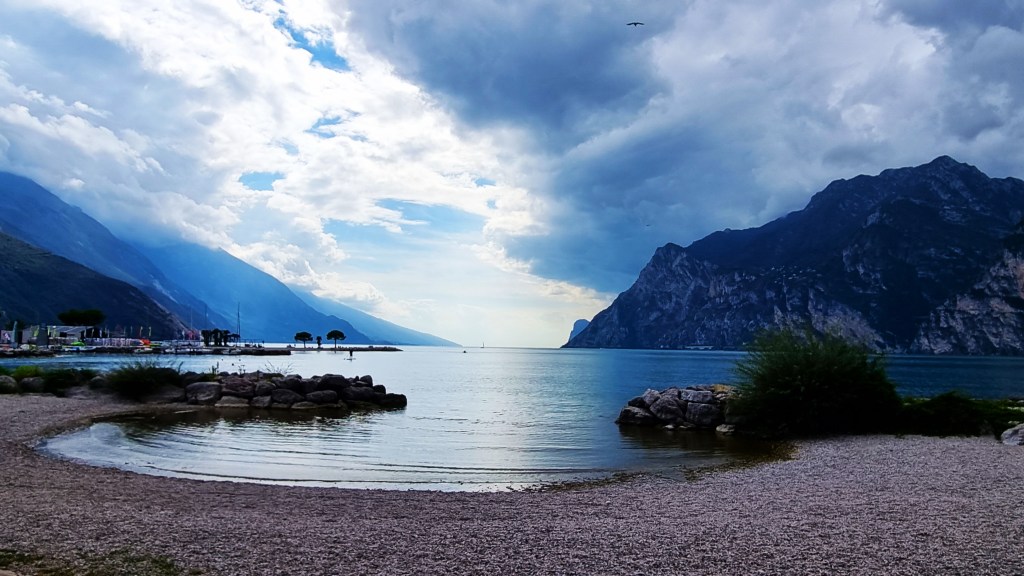
We spent a week in Riva del Garda, at the northernmost point of Lake Garda, in late September 2023.
We had booked a seven-night package with Inghams, staying in a hotel room at the Du Lac et Du Parc Grand Resort.

It was branded as a walking holiday, but there was no set itinerary – Inghams is trying to offer a more flexible package than the specialist walking holiday companies, allowing its customers to walk as much or as little as they like.
Some walks are recommended and, at the time of our visit, the company was trialling a short programme of guided walks led by local guides.
For those who wish to stray further afield, a programme of organised coach and/or ferry excursions was also available.
Getting there
We carefully scrutinised the flight options on different departure days, wanting to secure the earliest possible arrival time.
Consequently, we chose a Wednesday flight with British Airways, from Gatwick Airport to Verona, departing at 06:45. All being well, we would arrive in Riva by late morning, Italian time.
But, some eight weeks prior to departure, Inghams informed us about:
‘a minor change to your flying schedule due to British Airways changing the times of your flight in such a way that would not coincide with transfers to and from resort’.
We were now booked on an alternative Easyjet service, departing Gatwick at 13.00 on Wednesday, due to arrive in Verona, Italy at 16.00 Italian time, (one hour ahead). Allowing for the transfer to Riva, it would be almost evening by the time we reached the Hotel.
In correspondence with Inghams, it became apparent that British Airways was not at fault: they had been allocated a different slot by Italian air traffic control.
We could see from the Inghams website that, were we to travel on Tuesday, there was still a morning BA flight available, departing at 07.55. We proposed departing on Tuesday instead.
At first, Inghams said they only offered departures on Wednesdays and Saturdays, which was patently wrong since their website clearly indicated otherwise.
Eventually, they conceded that we could fly on Tuesday, but it would cost us an additional £598, on top of the £2,938 we had already paid. This included a further premium payable to Inghams, plus an additional sum for changing our air tickets.

Inghams refused to waive their share, arguing that, under their terms and conditions, this did not constitute a substantive change of schedule.
Reluctantly, we decided to stick with the amended itinerary. In one respect, this was a wise decision: I discovered later that the 07.55 BA departure on Tuesday morning had been delayed until midday!
I had not recently encountered an Easyjet flight.
It turns out that, unless you pay extra to carry aboard a large cabin bag (maximum 56 x 45 x 25cm), you a restricted to a small cabin bag (maximum 45 x 36 x 20cm), and this cannot be stowed in overhead lockers, but must be placed under the seat in front, so drastically reducing the available legroom.

It seems that short haul air travel has become a race to the bottom, with rival companies vying to supply the most uncomfortable core service, charging for the maximum number of ‘extras’, all of which were once deemed part of that core, and so available gratis. This is the service equivalent of ‘shrinkflation’.
We caught the train to Gatwick, via Clapham Junction, which took only 45 minutes. Then we took the shuttle to the North Terminal, where Easyjet resides.
After navigating our way through the self-service bag drop, we enjoyed a tasty brunch at Pret.

It was a breezy day at Gatwick, with gale force gusts, but most flights were getting away on time. However, our boarding was delayed, and it was 13:15 before the plane was fully loaded.
At which point, the captain announced that air traffic control had given him a 14:10 slot for take-off. He anticipated that he would ‘taxi to a remote spot’ and switch off the engines pending take-off. (There was no clear explanation of the cause of this delay.)
Unfortunately, though, he didn’t have an auxiliary power unit (APU) on board, so there would be no air conditioning. (I had naively assumed that all commercial aircraft were equipped with APUs.)
It was already unbearably hot in the cabin while he told us this, and the announcement was met with groans.

Fortunately, though, we were caught in a long queue of taxiing aircraft, so never quite reached our ‘remote spot’.
It was just before 17:00 Italian time when we reached Verona. After recovering our suitcases, clearing customs and finding the Inghams rep, six of us were loaded aboard a small minibus and ferried along the busy Autostrada A22.
There were delays in the opposite direction, seemingly associated with a burnt-out lorry pulled up on the verge, but we progressed with due speed, arriving at our Hotel in Riva at around 18:40.

Our Hotel
From the front, the Du Lac et Du Parc looks like any another unprepossessing hotel. It is located a little to the east of central Riva del Garda, along the Viale Rovereto, just past the sports ground and opposite the Blue Garden Shopping Centre.
Several wings seem to have been added on to the main building over the years, while self-contained apartments are scattered around the extensive grounds, which stretch down to the walkway and cycle path on the edge of Lake Garda.
I believe the total number of rooms is 175.
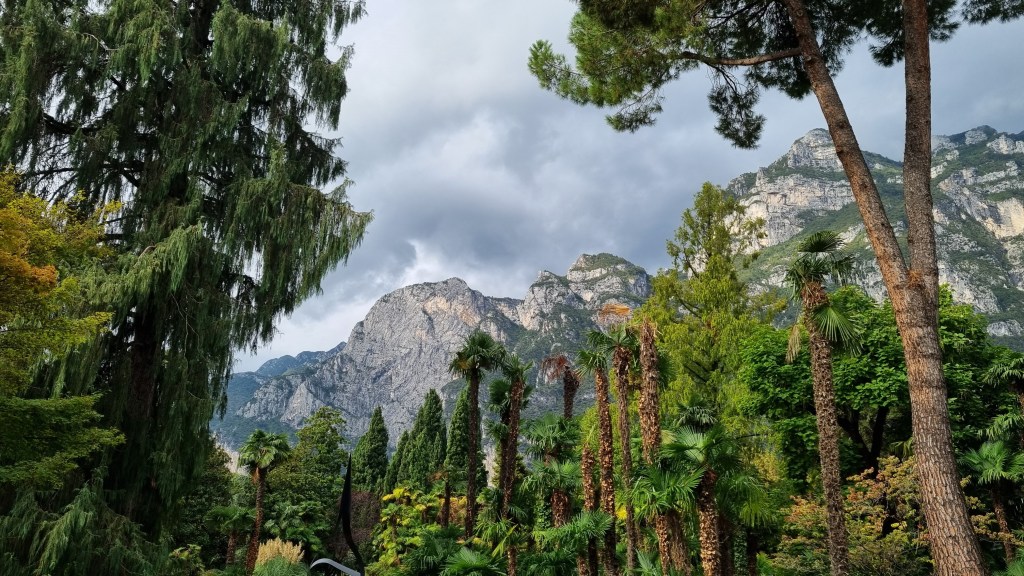
The gardens are beautiful, containing a handsome lake with ducks and many varieties of tree, as well as two swimming pools (one for adults only), a pool restaurant and a spa with indoor pool.
Dressing gowns were provided in the rooms, which guests routinely wore to visit the spa and the swimming pools in the grounds. This always seems louche to my English eye, but is eminently practical, as long as one is not dripping on the return journey!
We were placed in a so-called Parc Room, on the 4th floor of a wing to the side of the main building, our balcony looking out on to part of the grounds, as well as further rooms, located at right angles to our own.

It was spacious – some 25 square metres – and had a functional, square, windowless bathroom attached, with bath, overhead shower, bidet and hairdryer.
There were two large twin beds pushed together to form a huge double, a television, fridge, safe, air-conditioning and tea/coffee making facilities.
The balcony was roofed and just large enough to accommodate two chairs and two deckchairs besides. We generally preferred to sleep with the door open rather than switch on the air con overnight.
Inghams offer this Hotel on half-board terms and, though initially reluctant to forgo the pleasure of visiting different restaurants in the vicinity, we were pleasantly surprised at the quality of the food.
Breakfast and dinner were served in a large, brightly lit restaurant. For breakfast, and sometimes for dinner, a large, square covered terrace – La Veranda – was also available, with views into the garden.

We preferred the more relaxed ambience here, even when torrential rain was thudding on to the roof and leaking in at the edges, or when the garden birds descended to steal our unguarded breakfast.
However, I understand that the terrace is closed permanently from the end of September.
The choice of breakfast was comprehensive, including eggs and bacon cooked to order. I particularly enjoyed the custard-filled croissants, as well as the strong, rich Italian coffee.
At dinner, we were offered a four course meal, with a common starter and two or three choices for the second, pasta course and the main course.

Dessert was a buffet, comprising a selection of small tartlets and a few larger options, invariably strawberries, tiramisu, crème caramel and strudel or cake. While perfectly adequate, this didn’t quite reach the standard of the preceding courses.
There was an extensive wine list including several local wines, as well as those from further afield. White wine tended to be slightly cheaper than red; the cheapest bottles costing around 25 Euros.
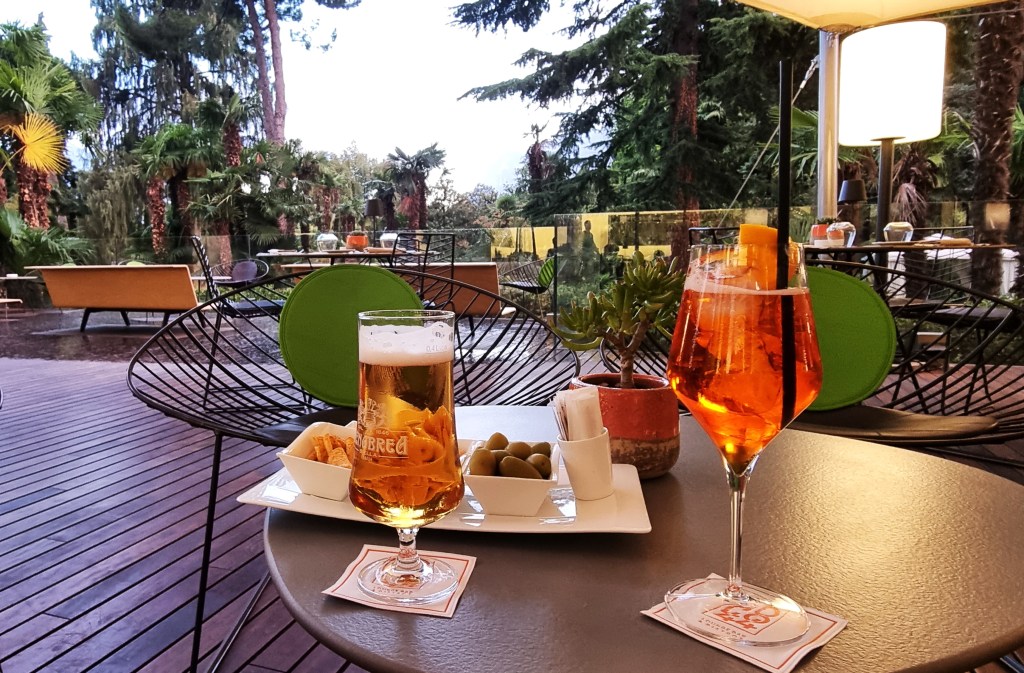
Occasionally, we drank an aperitif in the moderately comfortable Molo44 lounge bar and bistro, favouring the outside tables over those indoors. We never made it to the pool restaurant, which specialised in pizza
Thursday – Riva and Torbole
After breakfast, we headed into Riva for our ‘orientation’ meeting with the Inghams rep.
We were working our way round the lakeside, into town, but were blocked by the preparations for the Town firework display, arranged for Friday evening.
With some difficulty, we navigated our way back to the sports ground and then by road to the rendezvous point, beside the Gelateria Cristallo, arriving some 15 minutes late.
Fortunately, we spotted our small group inspecting the ferry departure board nearby, joining them for an hour-long tour of the central thoroughfares and various points of interest.
Invariably called Riva, the Town has a population of some 17,000 and is the second largest on the Lake.

There was a Roman settlement here, and subsequently it was controlled by the Franks, the Prince-Bishopric of Trent, the Venetian Republic and the Holy Roman Empire. During the Nineteenth Century, it was part of the Austro-Hungarian Empire
Following the Third Italian War of Independence in 1866, the Treaty of Vienna placed the remainder of Lake Garda in Italian hands, but Riva remained Austrian. Only in 1918 did it become part of Italy.

Tourism developed in the mid-Nineteenth Century, initially as a place for wealthy Austrians to visit for their health. Sanatoria were established here that attracted the wealthy and famous.
Later visitors included Thomas Mann, Nietzsche, Kafka, Rilke and D H Lawrence, who arrived in September 1912, prior to renting a flat in nearby Gargnano for six months with his mistress Frieda von Richtofen, ahead of their marriage in 1914.
The principal buildings include the Rocca – a medieval fortress which, in an earlier incarnation, belonged to the Scaligeri family, rulers of Verona in the Thirteenth and Fourteenth Centuries. It now houses the Town museum.

Also the Torre Apponale, a Thirteenth Century tower which once belonged to a larger fortress. Two of the gates from the medieval city walls also survive.

Perched above the Town, on the slopes of Monte Rochetta, the Bastione is often in view, a fortification dating from the early Sixteenth Century, reachable by funicular railway. We postponed our own visit until the end of week.

Further up the mountainside, one can just spot a small chapel, dedicated to Santa Barbara, built in 1935 by miners working on the construction of the Ponale Hydroelectric Plant.
The Plant’s imposing main building, located down in Riva, next to the ferry station, was constructed in the late 1920s, designed by architect Giancarlo Maroni who had moved here in 1919.
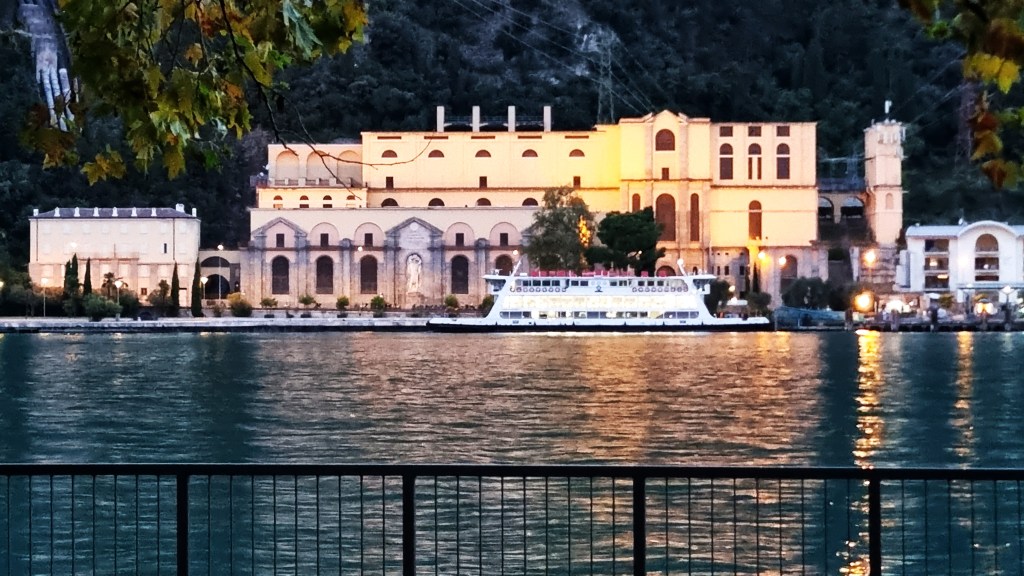
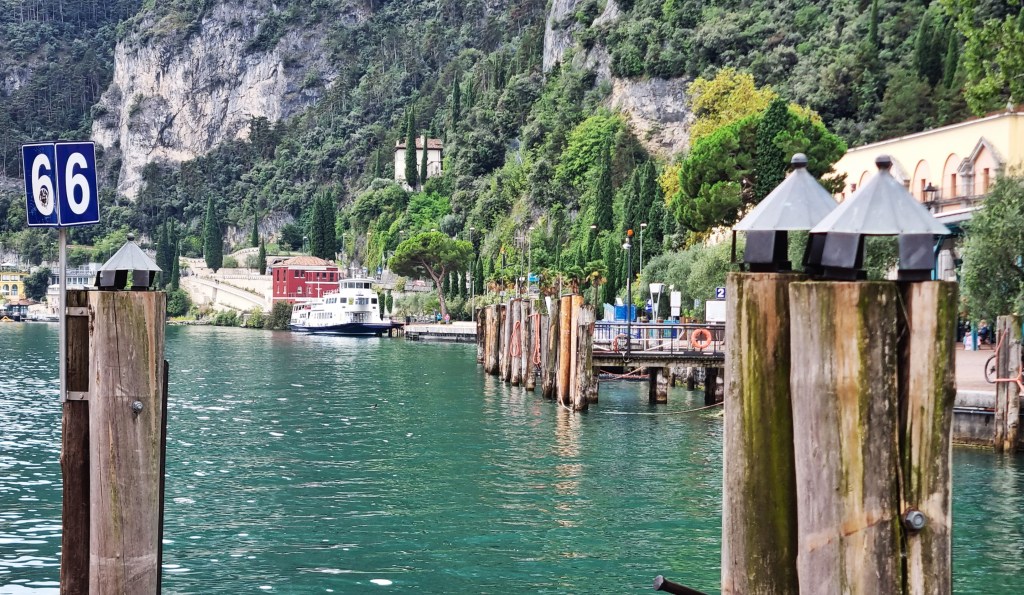
Having completed our tour, and regained the lake front, we walked around the coast to Torbole, the next significant settlement in an easterly direction. This took us past the San Nicolo Marina, which houses up to 150 yachts, and is overlooked by the San Nicolo Fort, built from 1860-61.
As we passed, a small corps of Italian marines was hovering in the vicinity.
Climbing up through the picturesque gardens, which offer an equally picturesque view of Riva, we continued on the dual use walking and cycle path.

The large number of inexperienced leisure cyclists, all travelling at different speeds, meant that constant caution was required.
Eventually, the path leaves the road, continuing past a campsite and a small headland before crossing a bridge over the Sarca River.
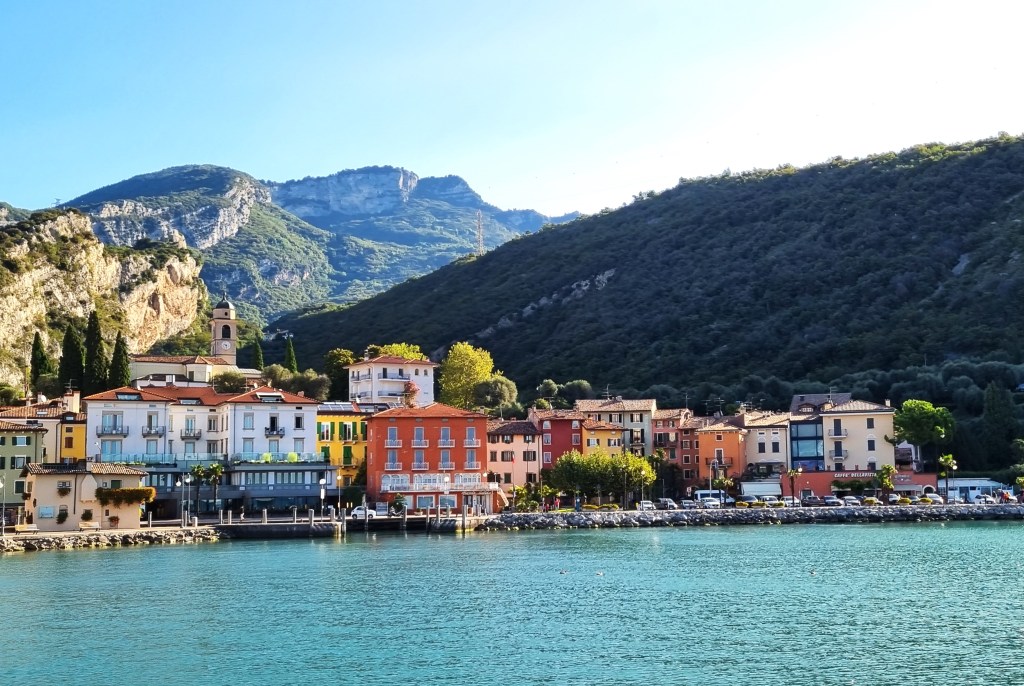
Soon we had reached Torbole, which has a population of about 3,000. The harbour boasts a beautiful early 18th Century customs house. There is also a church and a castle, and Goethe was much impressed when he visited, in 1786.
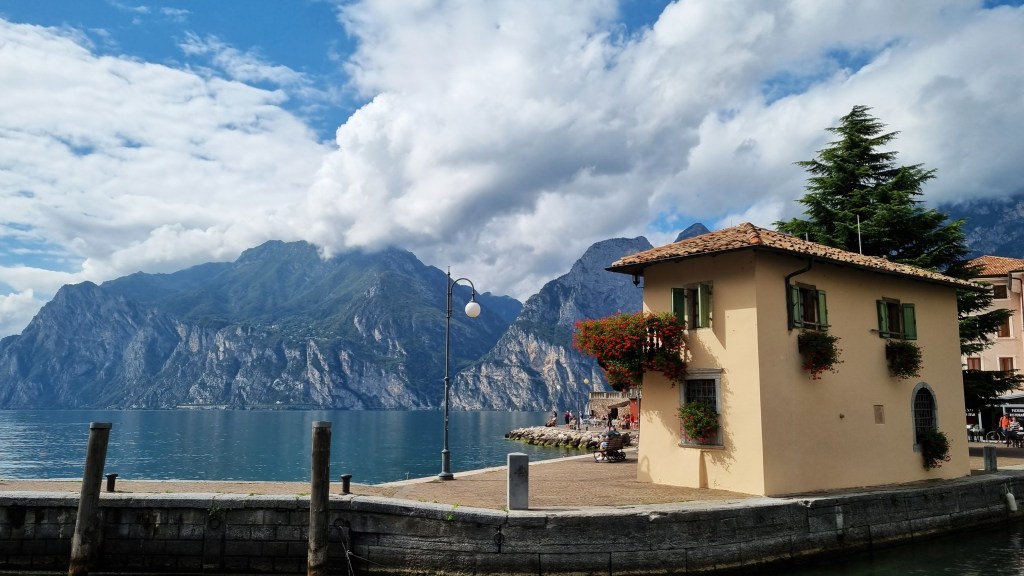
Rather than explore the few streets, we continued along the lake front, seating ourselves close to the small ferry terminal to admire the view, before seeking out a likely lunch spot on the walk back.
The sun was now beginning to emerge from the clouds and, with it, several of the windsurfing fraternity who are drawn to this place.
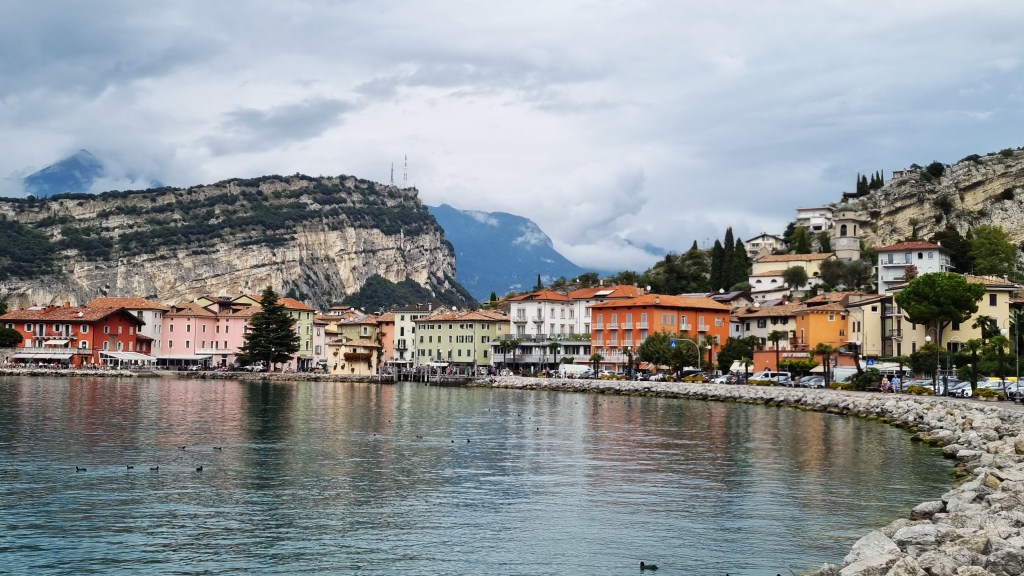
We stopped at a café forming part of the Hotel Lido Blu, where we each polished off a substantial filled roll, mine containing beef and cheese, and a cooling can of sprite, for the afternoon was now distinctly warm. A small lizard darted out to scrutinise us.
While we were eating, a large group of young people cycled up, parked their bikes, stripped down to their swimming costumes and went to stand in the water for a gossip.

On returning to the Hotel, we planned a siesta, followed by a first visit to the pool. We managed the first, but not the second.
Heading down early for dinner, we diverted to the bar, where I was introduced to the pleasures of the Aperol Spritz, an aperitif first created in 1919, but suddenly immensely popular.
We were sheltered from the rain, which began to fall quite heavily, presaging the next day’s deluge.

Friday – Rain
…was almost entirely a washout. After breakfast, we read on the balcony, waiting for a break in the weather. By around 11:00, the rain eased off sufficiently for us to walk into Riva. But, halfway there, the heavens reopened, and we were forced to change into our waterproofs.
We looked around some of the streets we had missed the previous day, and walked along the lakefront, beyond Riva, to the start of the Ponale Path, which we had intended to walk that day but had now postponed until Saturday.

At lunchtime we stopped for a slice of pizza and a coffee at the Hotel Centrale, where we sat next to a group of Portuguese on a cycling tour and watched the tourists getting wet. An enterprising young man was selling them umbrellas.
Back at the Hotel, I fancied a swim in the rain, but both outdoor pools were closed. We tried the indoor spa pool instead, having first reconnoitered to see which way to go, what to wear and how to behave!

Later, we managed a quick pre-dinner stroll, exchanging pleasantries with the only person swimming in the Lake, an Englishman, who said it was warmer than the sea at home.
Dinner included ‘Bloody Mary, Lukewarm Octopus, Cherry Tomatoes and Leccine Olives’. It tasted a great deal nicer than it sounded.
The firework display was a victim of the rain, postponed until the following day.
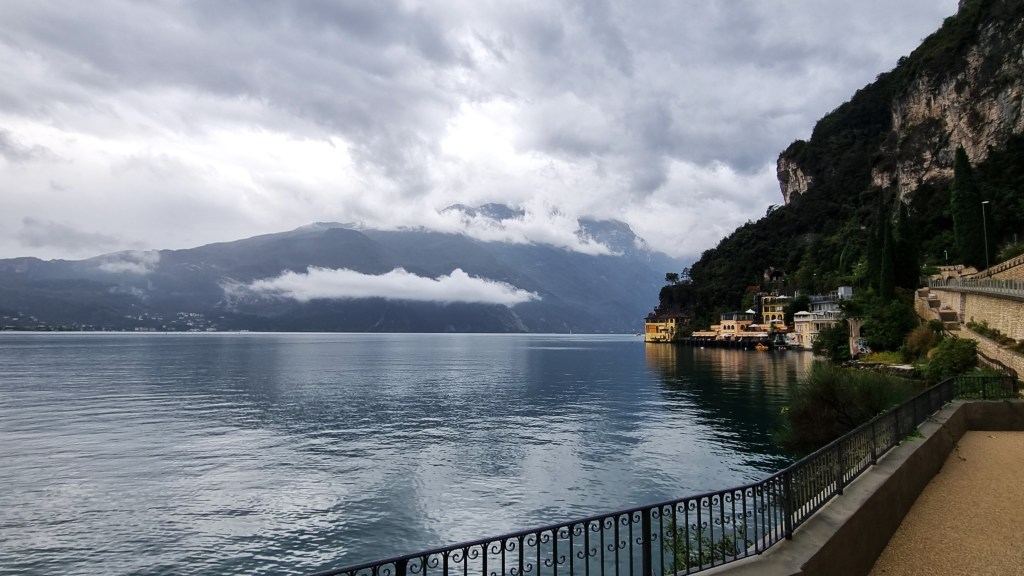
Saturday – Ponale Path to Lake Ledro
We were all set to walk the Ponale Path although, in retrospect, it might have been better to wait for a quieter day.
The Path was once the road connecting Riva with the suspended Ledro Valley, which runs at right angles to Garda and contains its own water feature – Lake Ledro.
The road was begun in 1848, the idea of a wealthy Riva merchant called Giacomo Cis. It was completed in 1851, but gradually fell out of use when a new long tunnel was bored in 1990. Since 2004, it has been restricted to walkers and cyclists only.

There are eight shorter tunnels through the rock, three of them dating from 1849, the others constructed more recently. In the early stages one also encounters the Tagliata del Ponale, a substantial fortification over five floors that was carved out of the rock between 1904 and 1918.
We were down to breakfast by 07:30, when the service began, discovering a completely different cadre of guest, most of them Americans on a cycling tour.
We popped quickly over the road to the Co-op, to buy our packed lunches, before heading through Town to the start of the Path, a little way beyond the power station.
It was already 23 degrees centigrade and felt warmer, the heat increasing as we climbed.

Early on, we mistook the route, and found ourselves inspecting the Tagliata del Ponale at close quarters, scrambling up the concrete steps until we reached the highest point.
On retracing our steps, we were passed by increasing numbers of cyclists, some in groups of about 20 to 30. The guidance is for walkers to stay on the left – nearest the Lake – which we dutifully did.
At one point, we were up on a raised section, intended exclusively for walkers and two or three cyclists came up behind us, asking to be allowed through.
We had the following exchange in English:
Me: ‘This is the section for walkers.’
Cyclist: ‘I know.’
Me: ‘Well then, you shouldn’t be on here, should you?’

This episode quite spoiled my mood, until we arrived at the Alto Belvedere bar, hanging over the ravine, which was opened as a restaurant in 1900.
Here we had cold drinks and admired the view. To visit the toilets, situated over the road, we had to rescue the relevant key, soaking in hand gel, from the outside bar.
Getting under way again, we followed the road inland and upwards, finding ourselves, after twenty minutes or so, in almost exactly the same place, only a few hundred feet higher.
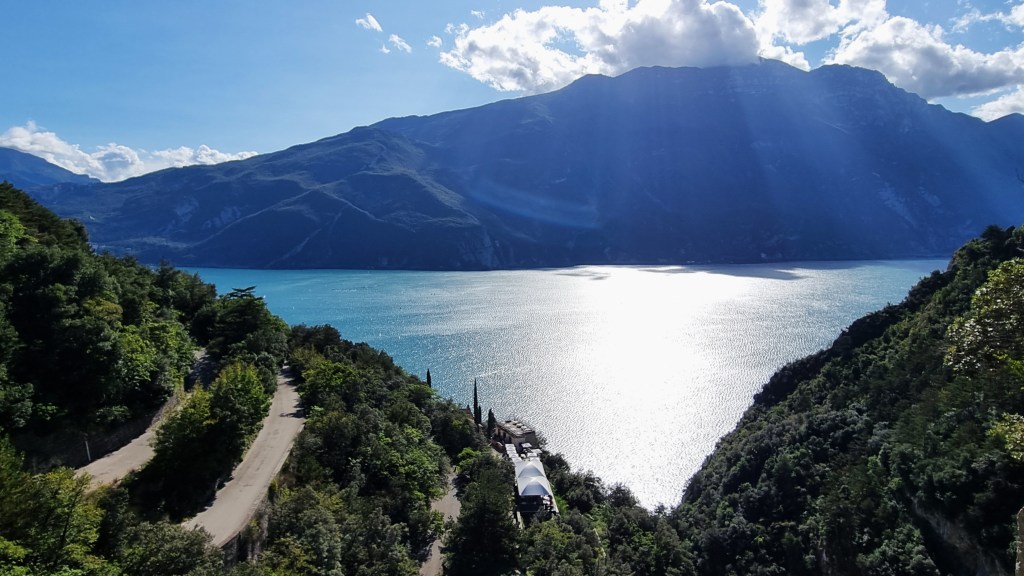
The total walk is billed at only 10km, but that doesn’t allow for the extensive ups and downs, which grew more difficult in the increasing heat. It took us about three-and-a-quarter hours, including the stop mid-way.
The route passes through three villages – Biacesa di Ledro, Predi Ledro and Molina di Ledro – before Lake Ledro is finally revealed.
We walked down, past the archaeological museum (closed), and along the southern side of the Lake until, beyond the last few buildings, we found a wooden bench upon which we sat to eat our lunch.

A little further on, a couple were sunbathing and swimming from a tiny ‘beach’ on a rocky promontory just below the Via Val Maria.
Lake Ledro has an area of 2.2 square kilometres, a maximum depth of 48 metres and is celebrated as one of the most beautiful in the region.
In 1929, when work was being undertaken for the Riva Power Station, archaeologists discovered a settlement of Bronze Age houses built in the water on piles, hence the Museum.
Consulting the helpful Trentino App, we belatedly discovered one advantage of coming here on a Saturday – an additional bus service back into Riva at 13:10 (we had expected to wait until 14:20).

This app is useful, offering free bus travel within Trentino, as well as several other benefits, but it is also seriously compromised by the fact that ferry travel is largely excluded.
Arriving back at Riva, we picked up some ice creams from the extremely popular Flora Gelateria, close to the Hotel.
Later, we made it to the main swimming pool, which sported one or two children who had successfully evaded school. From thence to the Bar, where we again had the foresight to sit outside, under shelter, while another storm passed through.
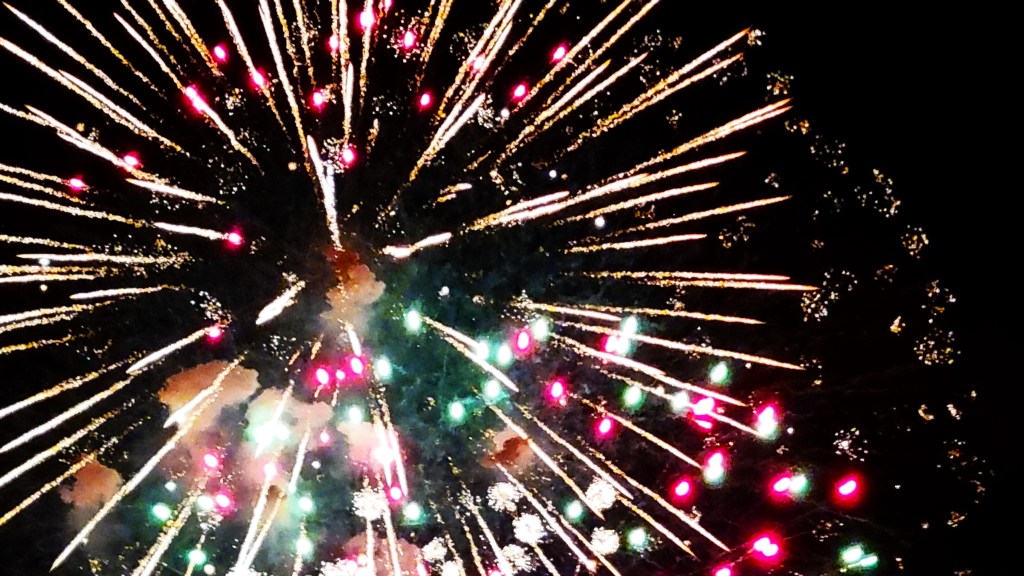
After dinner, we watched the impressive firework display from our balcony, its impact enhanced by the explosions reverberating round the mountains above.
Sunday – Limone
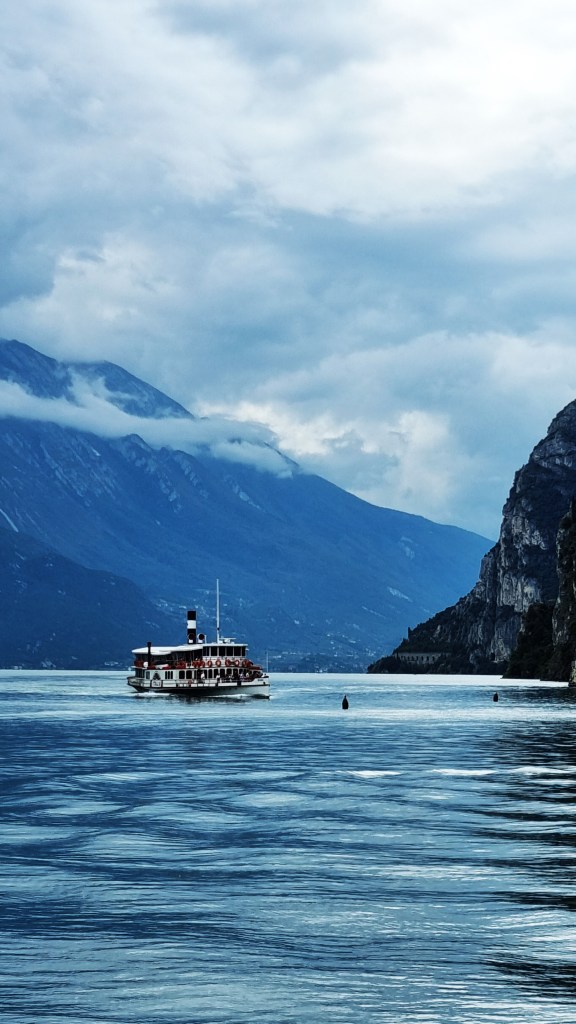
Another early breakfast was necessary, so we could catch the 09:15 ferry departing for Limone.

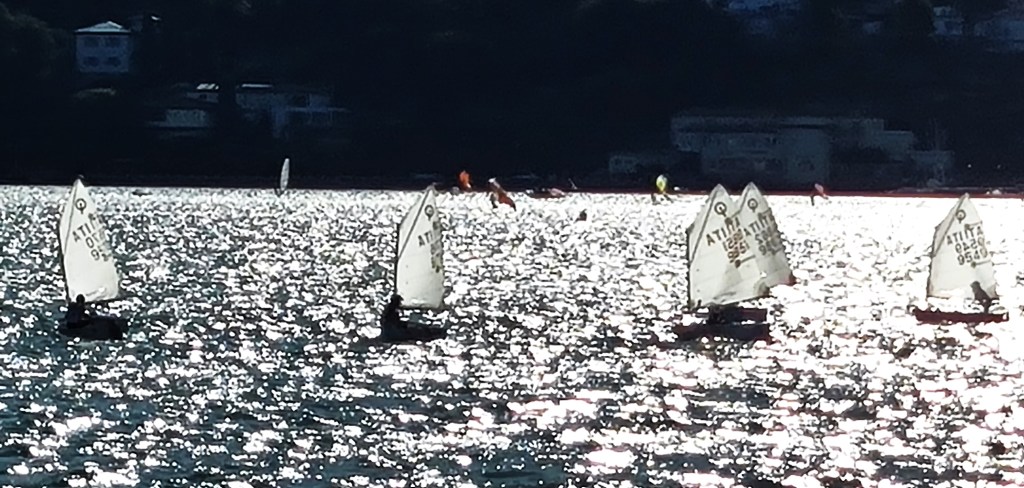
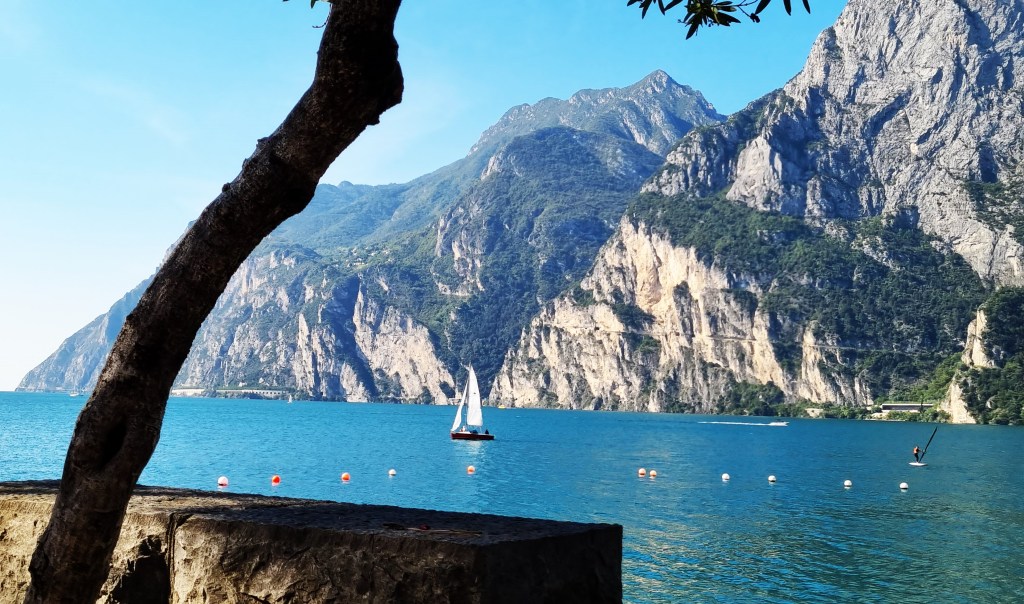
It was a day of sun and wind. The ferry had to dodge hundreds of yachtsmen, windsurfers, kiteboarders and windfoilers, many of whom seemed possessed of a death wish.

Limone sul Garda lies just over the border from Trentino, in the province of Brescia, on Garda’s west coast, several miles to the south of Riva.
Although the place has long been associated with the cultivation of lemons, its name is more likely derived from the Latin for a border (limes), or to denote the prevalence of elm trees (lemos).
Lemon trees have been grown on the shores of Garda since medieval times and ‘lemon houses’ – to protect the fruit during cold winter weather – have been constructed in Limone since the 17th Century.

Previously known as Limone San Giovanni, the settlement was relatively inaccessible until the road connecting it to Riva was completed in 1932.
The old town is a network of narrow streets, crammed with shops and eateries, stretching back from the small harbour. There are half a dozen churches, the oldest being San Pietro, said to have been founded in the Ninth Century.

Some scenes from the Bond film, Quantum of Solace (2008), were shot here, and the place is a magnet for tourists, even on a Sunday in late September.
When we arrived, at around 10:45, it was still relatively quiet, but we rejected the town in favour of a walk along the Garda Cycle Path, the Ciclopedonale, which extends some five kilometres northwards along the coast to Corno de Reamol, and the border with Trentino.
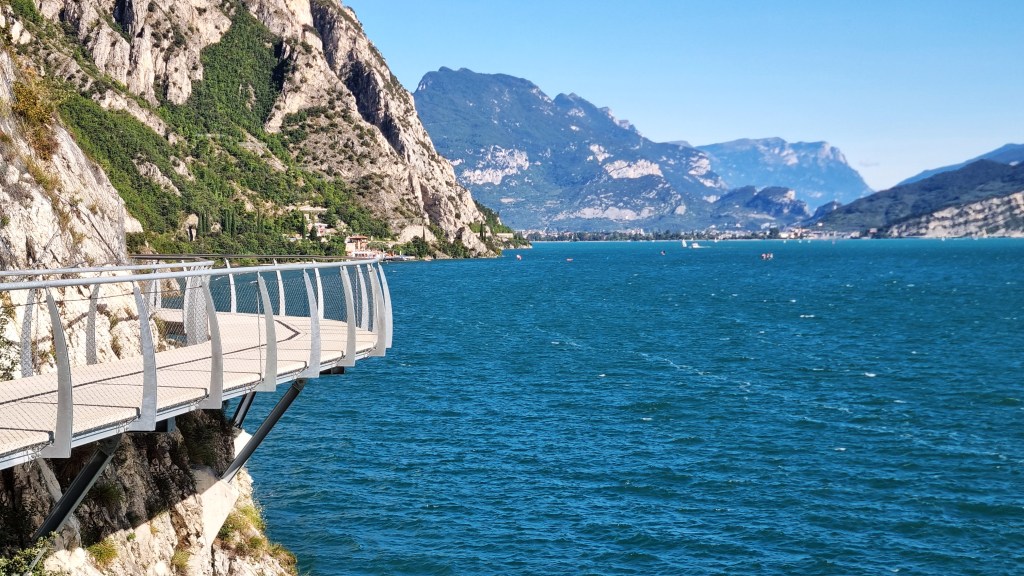
The path was opened only in July 2018 and is often used to advertise ambitious plans for a cycle path around the entirety of Lake Garda, due for completion in 2026.

As if there weren’t enough cyclists already!
The second half is newly constructed, initially comprising a concrete road before several cantilevered sections, some quite dizzying, suspended above the edge of the lake.

At the end, there is a war memorial but, unfortunately, no café. So the only option is to retrace one’s steps.
Arriving back on the outskirts of Limone, we found a vacant table on the terrace of the Villa Romantica, where we had cold drinks and then an early lunch.
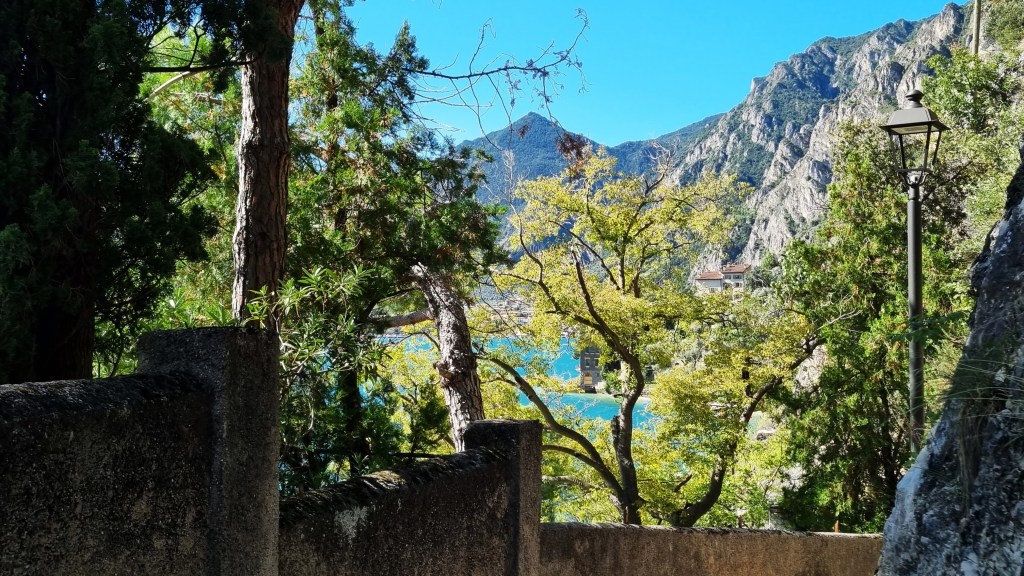
Briefly, we joined the heaving throng milling through the streets, but it was oppressive and undignified, so we joined instead the jostling queue waiting to climb aboard the 13.25 ferry back to Riva.
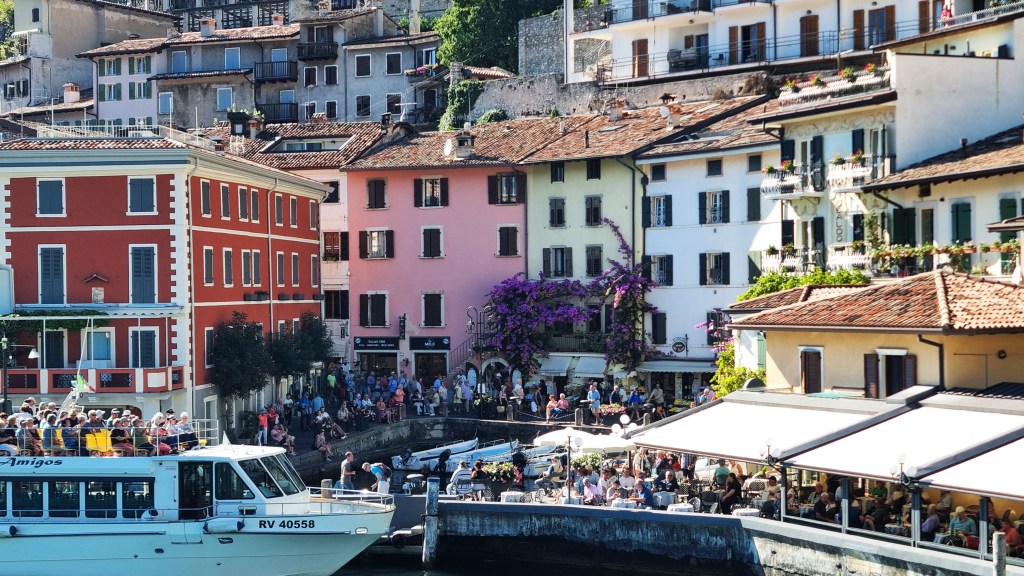
On climbing ashore, we picked up cooling ice creams before returning around the lakefront – now unblocked after the fireworks.
This time we headed to the adults-only pool, which was far more relaxing as, after a few desultory lengths, we were joined on the surrounding grass by ducks, thrushes and a blackbird.
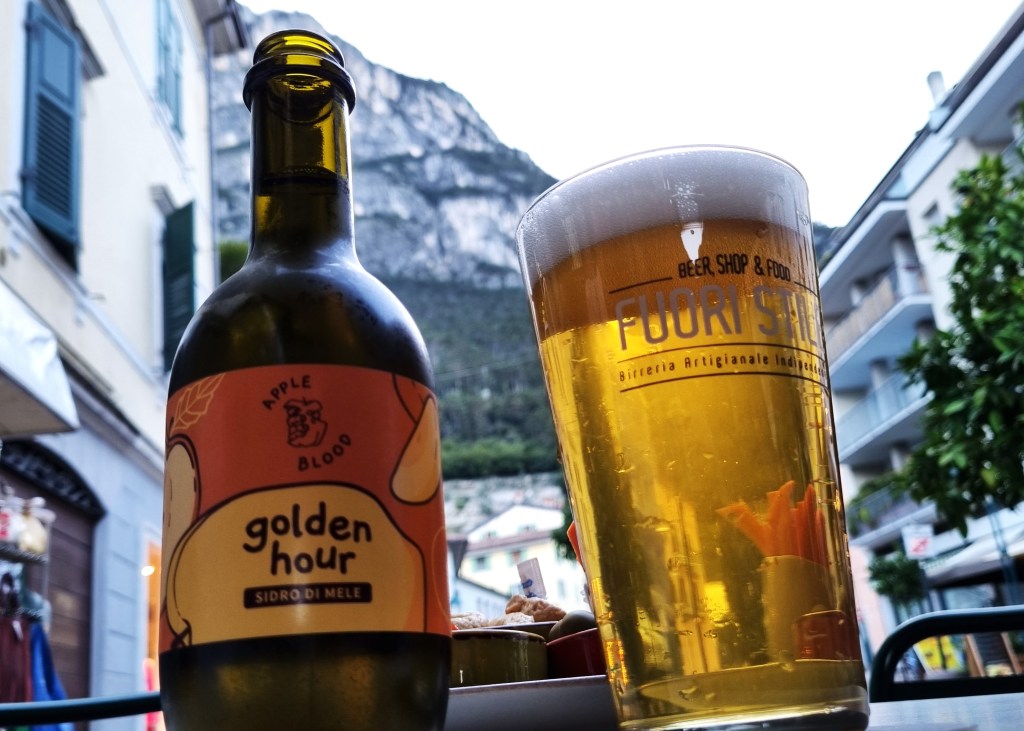
Before dinner, we walked back into Riva to visit Fuori Stile, a ‘beer shop’ operated by an independent craft brewery. Tracy sampled the Golden Hour Cider, while I partook of the Statale 52 American Pale Ale. Both are recommended.
Monday – Malcesine
We enjoyed our third consecutive early breakfast, since it was necessary to catch the same 09:15 ferry, which called at Malcesine immediately after Limone.
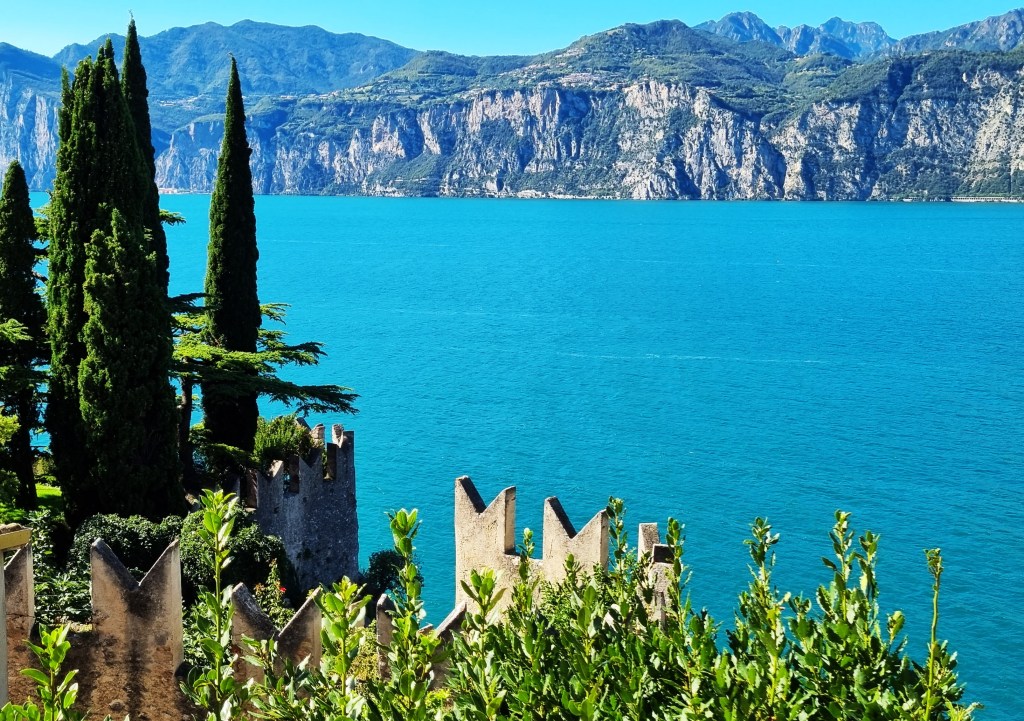
Malcesine is on the east coast of Garda, a little further south, just in the province of Verona. It was part of the Venetian Republic from 1405 until 1797, then briefly formed part of the Austro-Hungarian Empire until, in 1866, it joined the Kingdom of Italy.
Arriving by ferry, the view is dominated by the Castello Scaligero.

There was a castle on this site as early as the Fifth Century but, by 1277, it had fallen into the hands of Alberto della Scala, Lord of Verona, and it remained with his family for the next century.
In 1786, Goethe was taken in for questioning after sketching the castle, under suspicion of being an Austrian spy. It was declared a national monument in 1902.

The ferry docked beside the small harbour, a little to the south of the castle.
We had decided to walk some 4km along the coast in a southerly direction, to the area called Cassone di Malcesine.
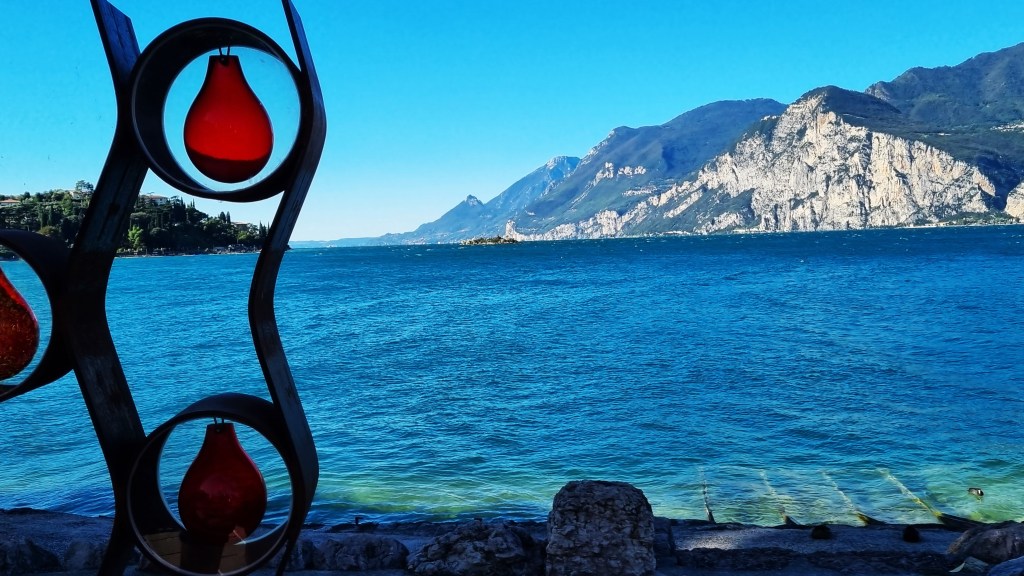
Initially, we followed an attractive lakeside promenade, the Via Lungolago, which runs around the bay, past a tiny island – Isola dell Olivo – and on to a small hook-shaped headland. This culminates in a second, larger island – Isola del Sogno, just twenty metres off shore.
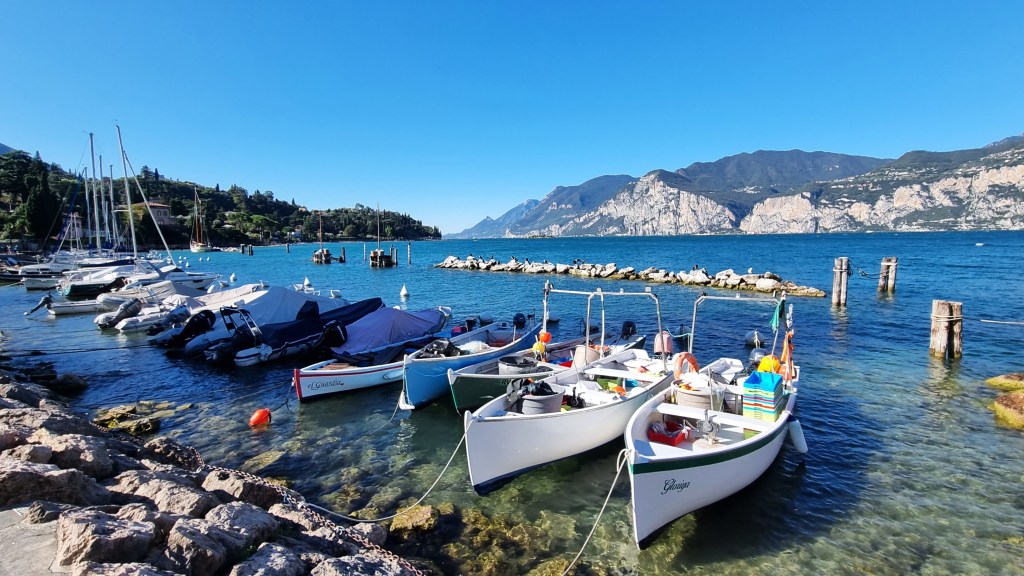
The Via Val di Sogno takes over from the Via Lungolago next to a small supermarket, and soon arrives back beside the Lake, still heading south.
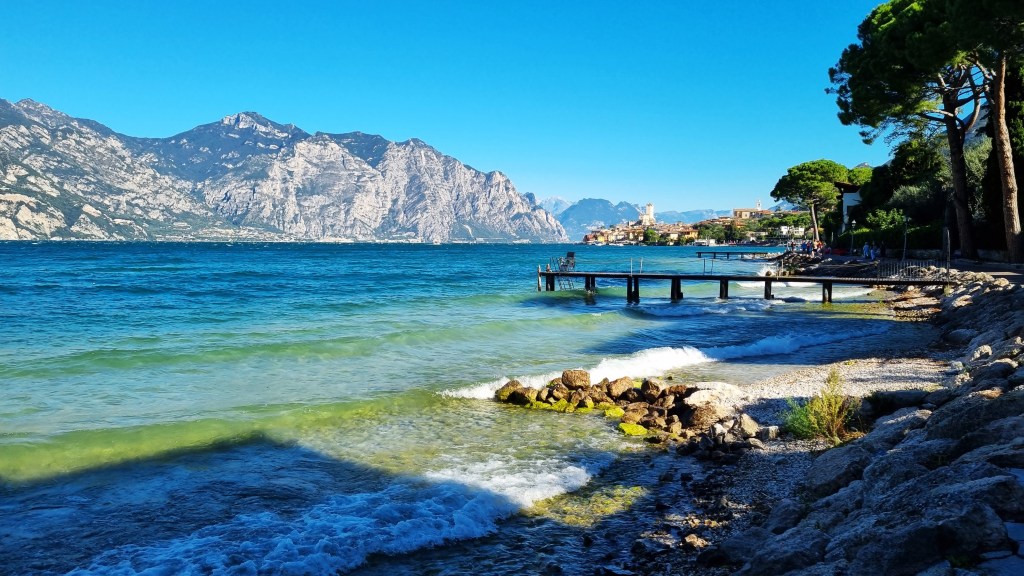
We stopped at the Porticciolo di Cassone, next to the maritime museum and beside the tiny Aril River, which flows into Garda from the foot of Monte Baldo, some 175 metres distant. It is claimed to be the shortest river in Europe, if not the world, complete with three bridges and a watermill.

Klimt painted the church here in 1913.
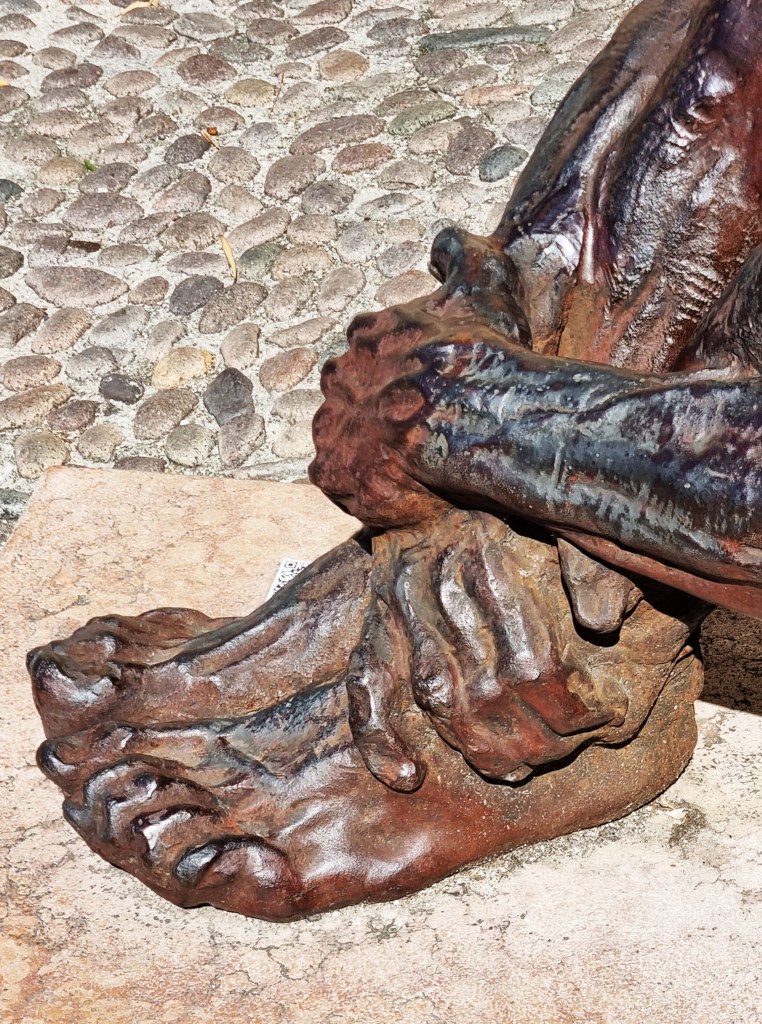
I was quite taken by a bronze statue of a woman (La Bagnante (1987) by Luisa Granero); a real woman reclining just beyond.

Retracing our steps back to central Malcesine, we stopped for caffe freddo shakerato and panini at the Caffe Gelateria Andreis, beside the harbour. We had to wait in line for some time to access the single toilet, then walked round, admiring the Castle from outside.
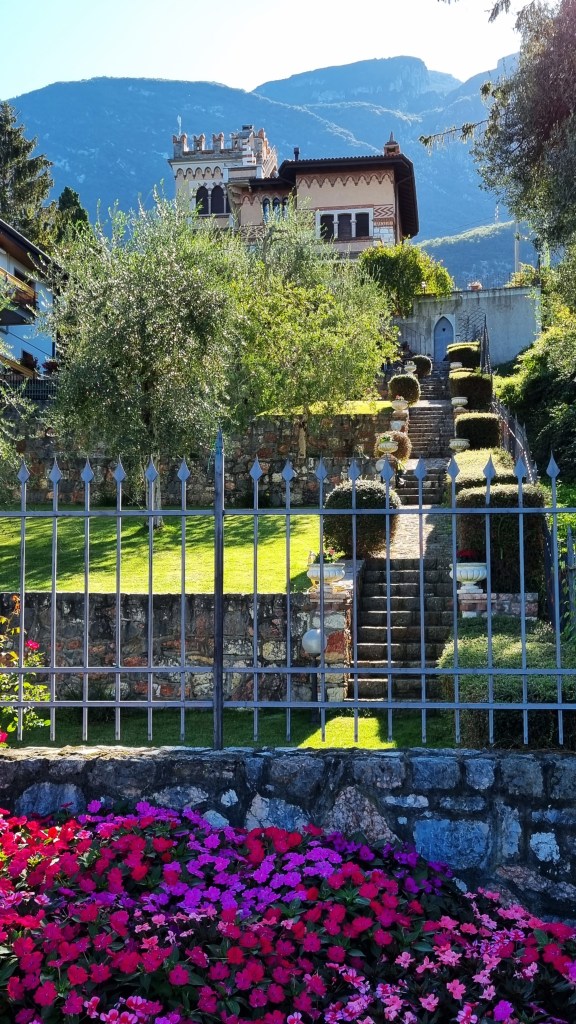
We passed two further statues on the Piazza Porto Vechio, right beside the Lake, one depicting a strange tortoise woman – Donna Tartaruga by Novello Finotti – the other, El Zulo (1948), by Victor Ochoa.
Climbing aboard a huge ferry, we arrived back in Riva by 16:00. After a quick swim, we about turned to visit the Punta Lido Bar, on the lakefront, only to find it closed.
So we walked on to a café on the Piazza III Novembre from where we watched a busker finish his set. Then it was back to the Hotel for dinner.
Tuesday – Riva
This was our day for unfinished business.
It was already hot and sunny by the time we arrived at the bottom of the funicular up to the Bastione.

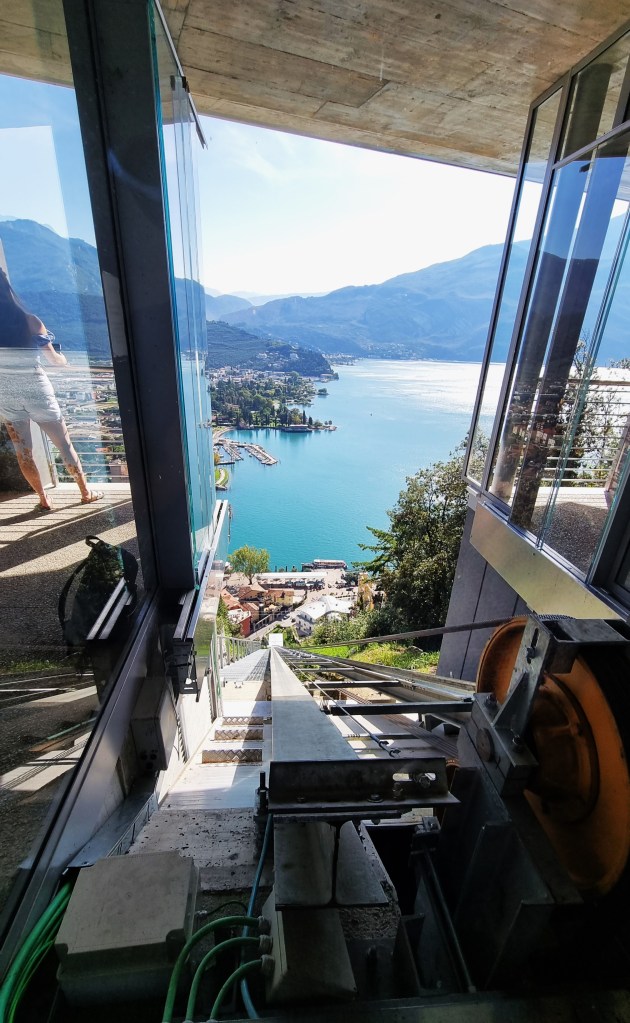
A chairlift carried passengers up here in the 1950s but, when that closed in the 1980s, one had to hike up the side of Mount Rochetta until the funicular was constructed in 2020.
It transports tourists in its rectangular glass cabin, ascending some 130 metres in three minutes. The journey is free with the Trentino app.
At the top, one first encounters a modern restaurant but, passing across its terrace the ruins of the Bastione itself are fully accessible.

It is a large circular keep with thick walls and three distinct floors, built quickly, between 1507 and 1508, by the Venetian Republic, to help protect Riva and reinforce the border with the Episcopal Principality of Trento to the north.
But the Principality soon acquired the territory anyway, so the Bastione became largely redundant.
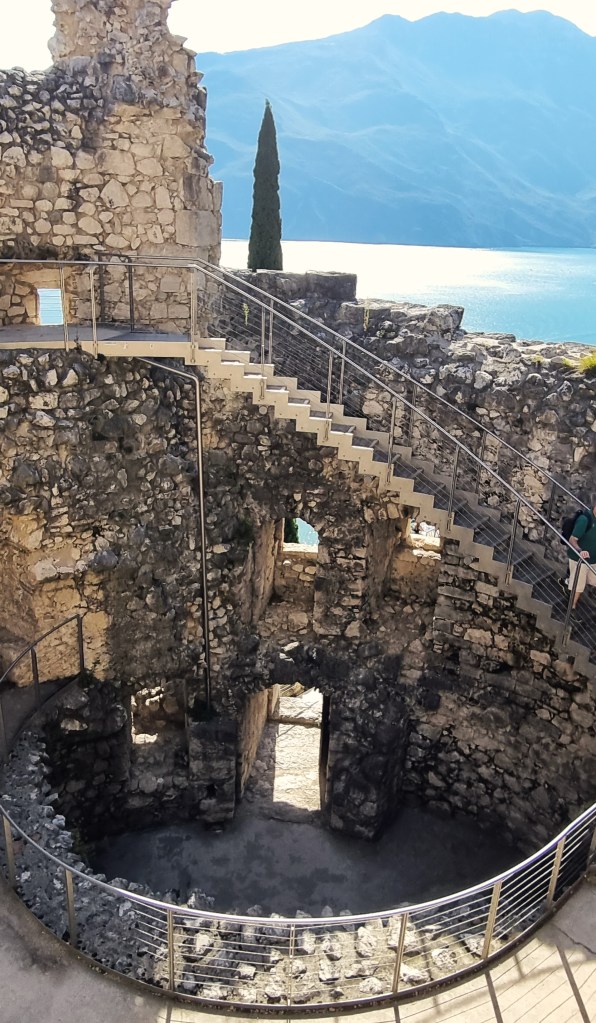
In 1704, it was partly demolished by the French during their invasion of Trentino, and left in a ruined state until its restoration in 2007.
It being too hot to continue up the mountainside, to get a closer look at the Santa Barbara Chapel, we descended the way we had come and indulged in a spot of souvenir hunting.
On the way back to the Hotel, we stopped off for more caffé freddo shakerato, having acquired a taste for them the day before.
Then it was time for a brief swim in the Lake, from a point just below the Hotel grounds. Bracingly refreshing!
That afternoon we revisited the Flora Gelateria, for ice cream sundaes in place of lunch and, in the early evening, reprised our earlier trip to Fuori Stile, where I had a beer called ‘Dave’.
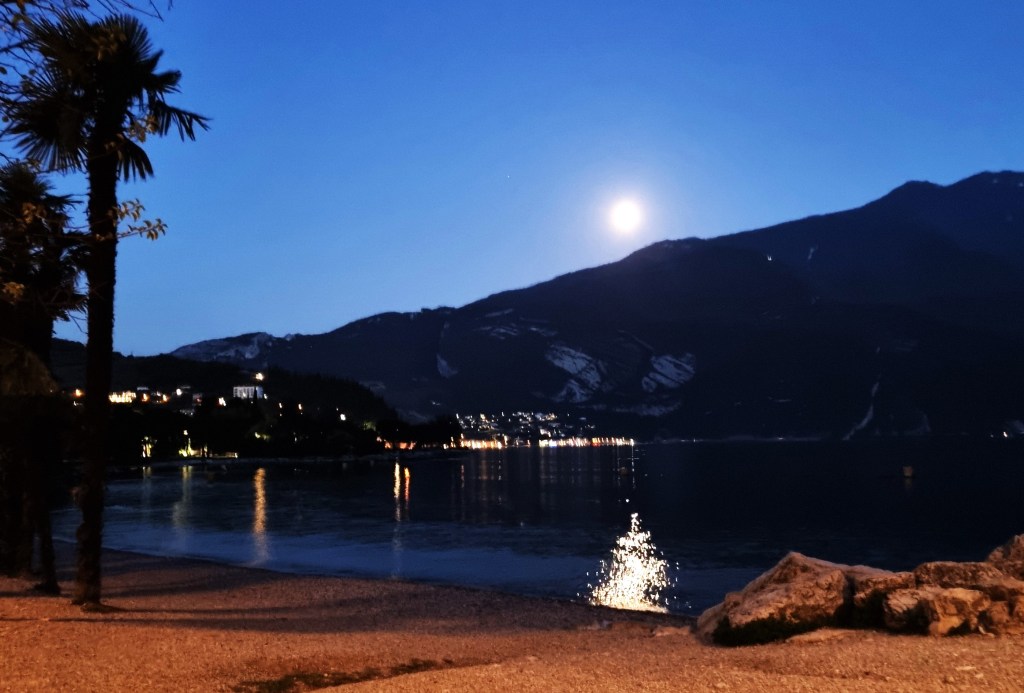
Wednesday – Home
Our departure was set at 12:45, so we had time to waste, but insufficient time to do anything too adventurous.
After finishing our packing and a leisurely breakfast, we walked again in the direction of Torbole, stopping at the small park beside the San Nicolo Fort.
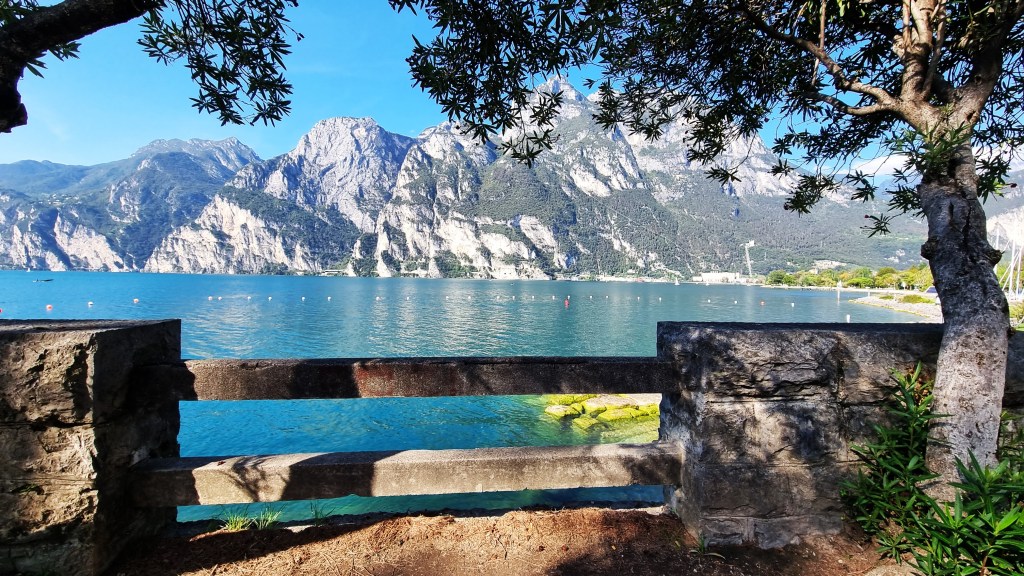
Here we sat for some time, admiring the view across the Lake, and watching the windsurfers’ mostly futile attempts to reach the shore without swimming.
After stopping at a lakeside bar for cold drinks, we ambled back to the Hotel, where we were picked up with another couple by a six-seater, which whisked us back to Verona.
We reached the Airport by 14:00, despite the efforts of a German driver who repeatedly refused to let us overtake, speeding up as soon as we drew abreast. At the fifth attempt, he finally gave up.
I gave him an ironic wave – the one I have perfected for drivers here who cut across me on zebra crossings.

We stopped at the café in ‘Departures’ for a late lunch, since the baggage drop was not yet open. We were due to depart at 16:30, but were 25 minutes late boarding and, once aboard, held another 30 minutes for a ‘slot’.
The captain blamed the shortage of air traffic control staff at Gatwick. According to news reports, our return coincided with a bout of Covid in the control tower.

Because roughly a third of the staff was off sick, the Airport had to impose a daily cap of 800 flights, causing numerous delays and diversions.
The fact that Gatwick has entirely failed to secure contingency arrangements is indicative of this country’s rapid decline into its present, parlous state.
I remember when Italy had such a reputation, but now it seems a model of efficiency by comparison.
Arriving about an hour late, we made our way home by train. It wasn’t a strike day, mercifully.
TD
October 2023



 Eponymous
Leave a comment