
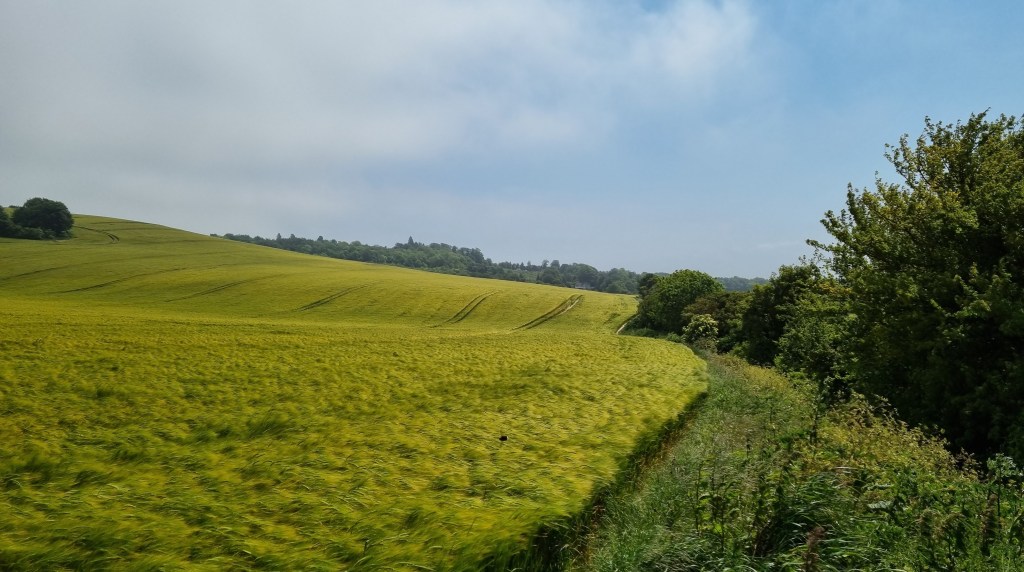
Six weeks on from our Sandling to Hollingbourne experience, we returned to Hollingbourne in June 2023.
We’d opted to walk on Friday for a second trip in succession, departing from our normal Saturday excursions to benefit from better rail services.

We travelled to London Victoria, connecting there with the 09:55 Southeastern service to Ashford International, which reached Hollingbourne on time, at 11:09 precisely.
We planned to walk to Charing which, including the connections with stations, was approximately ten miles. We would be completing one of the official legs in the Guide – from Detling to Lenham – and starting another – from Lenham to Wye.
The weather was perfect: dry and sunny, but not unpleasantly warm.

We renewed our acquaintance with All Saints’ Church and Hollingbourne Manor, before turning right beside the Dirty Habit pub, still showing no prospect of reopening.
We had now rejoined the Pilgrims’ Way, and would be following it, travelling in a more or less straight line, all the way to our destination.
We stopped to admire the mural of monks and nuns on bicycles before heading down the road, which quickly became a gravel track, passing between rolling arable farmland.

The first noticeable landmark was a timber-framed building – the Dutch House. I have been unable to establish why it is called that and, anyway, it was formerly known as Deodora House.
We crossed Stede Hill, continuing in the same direction on the other side. Soon we caught glimpses of Harrietsham through the trees, notably the 11th or 12th Century tower of the Church of St John the Baptist.
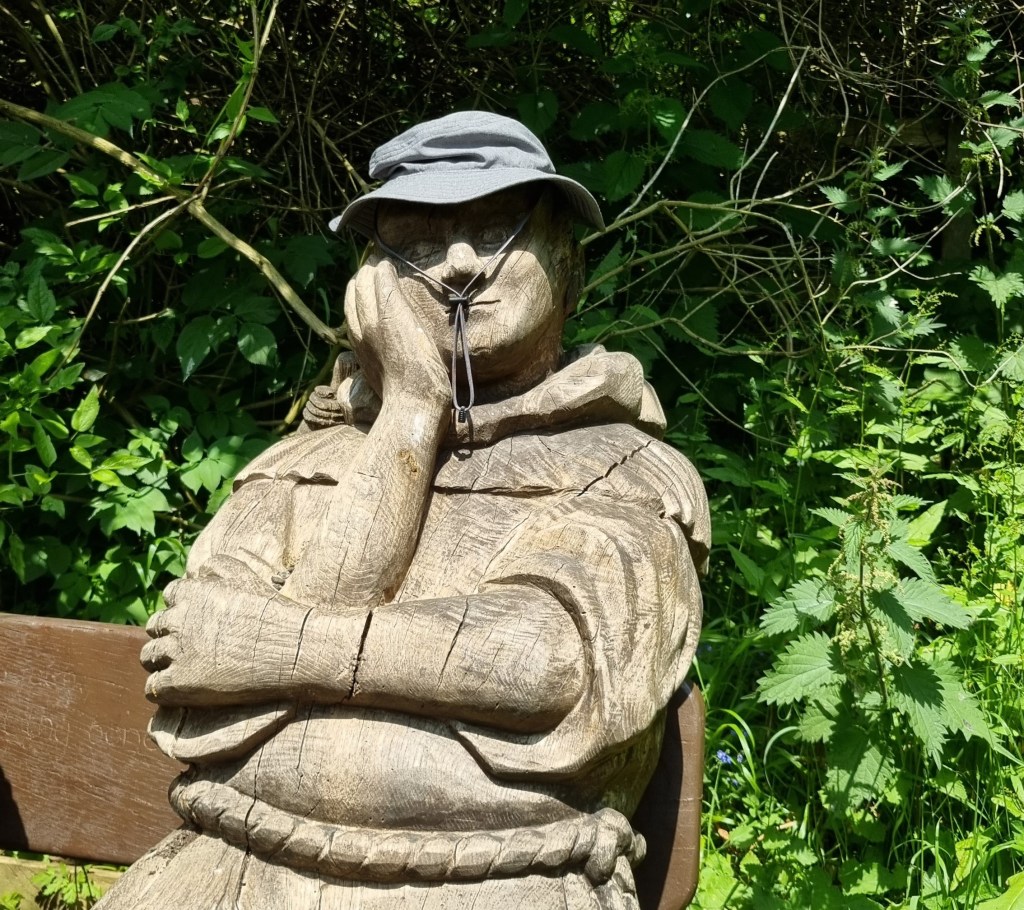
Soon we arrived at the Pilgrim’s Rest Bench, where Brother Percival reclines, dozing in the warm sun. We joined him for a while, donating him a sun hat and taking selfies until it was time to press on.
The Guide promised a lengthy stretch dominated by the Marley factory, but much of it was hidden behind trees. Marley was established by one Owen Aisher, a builder and plasterer who, in the 1920’s, began to specialise in concrete roof tiles.
During the Second World War, his Company took on war work instead, including the construction of several Mulberry Harbours used in the Normandy Landings.
Passing above Lenham, we encountered many poppies in the field borders and a major infestation of ermine moths in the hedgerow, creating dense white webs spun across the branches.
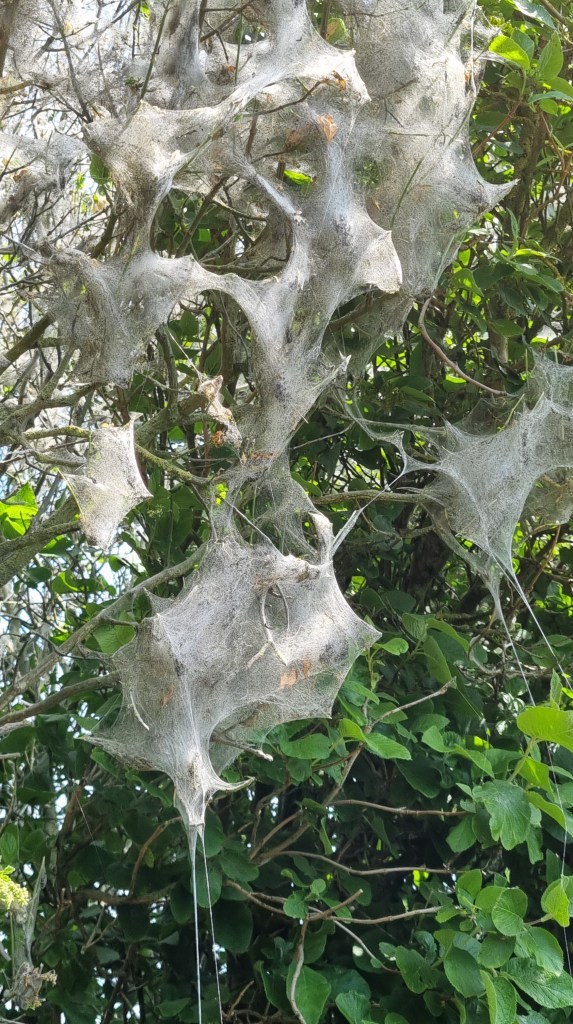
These typically occur in May and June, disappearing when the moths take flight.
We took our lunch at the Lenham Memorial Cross, curiously a listed building, which was constructed by local volunteers in 1922, according to the design of the Village’s headmaster.
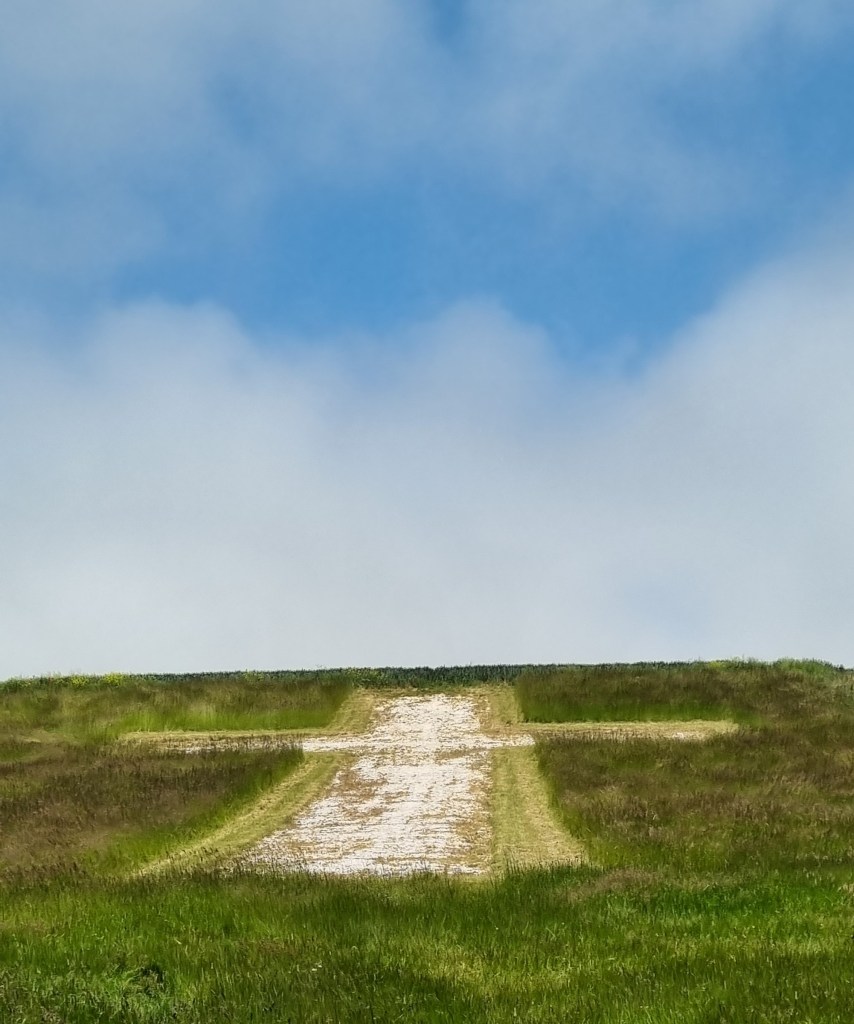
Forty-two Lenham men lost their lives in the Great War; 14 more during the Second World War.
In 1977, a bench was supplied by the Ashford Branch of the REME Association.
A handwritten memorial was nearby:
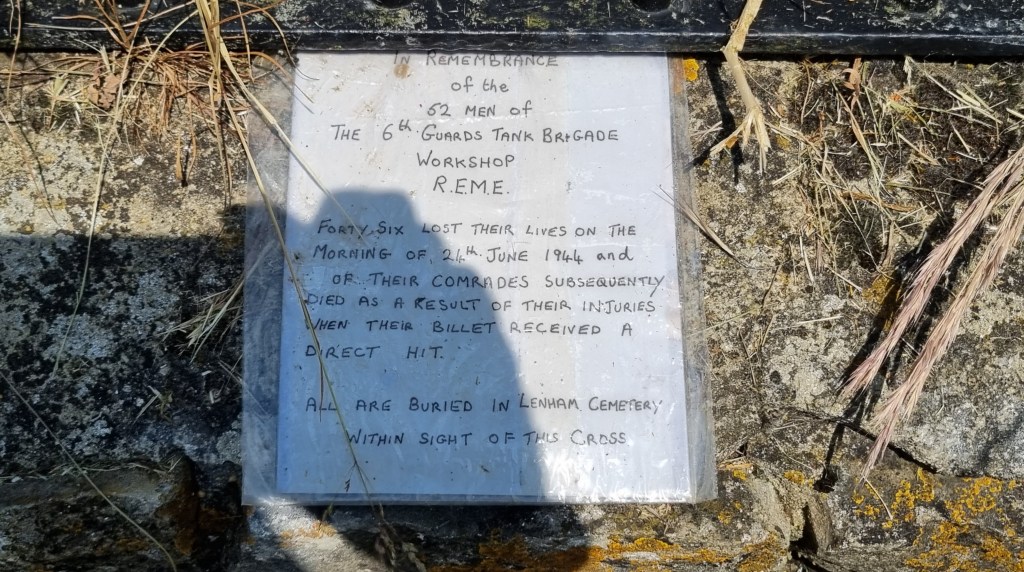
The Workshop was based between Lenham and Charing, while awaiting transfer to Normandy, when their camp was hit by a V1 flying bomb in June 1944.
Lunch completed, we passed another North Downs Way milestone, recording the distance completed as 92 miles. Some anti-metric madman had scratched out the equivalent distances in kilometres.

On the way into Lenham, we came across extensive pipe-laying work by Southeast Water: several footpaths seemed to be closed for six months, but our route was unaffected.
Soon we were descending into Charing.
We walked down the High Street to Charing Stores for celebratory ice creams, consuming them on a bench in Clewards Garden before trying out the human gnomon sundial.
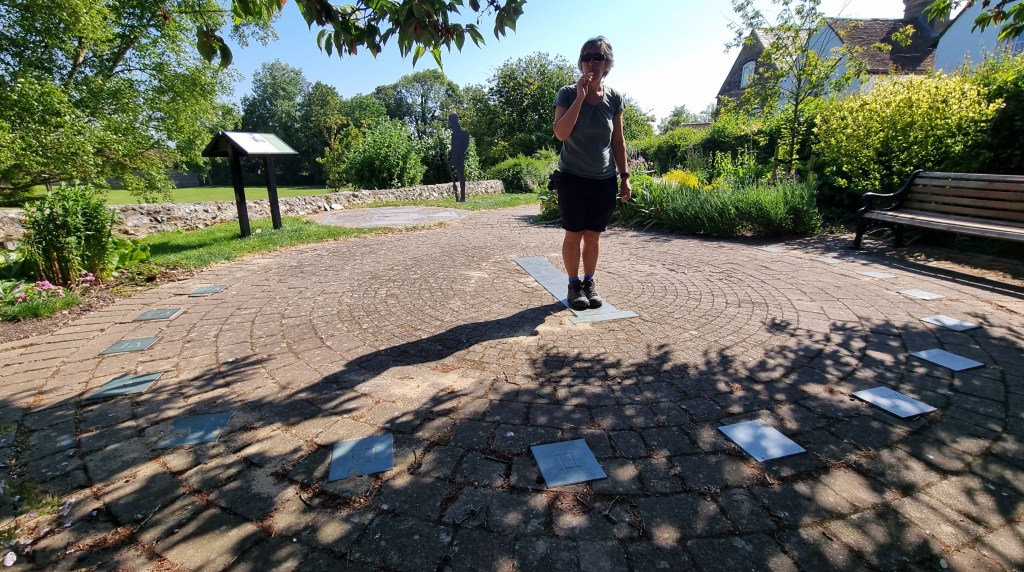
A gnomon is that part of a sundial which provides the shadow and, in dials such as these, a human casts it, taking care to stand in the correct position.
The British Sundial Society (who knew?) describes this as a ‘conventional human gnomon dial’, adding:
‘Shows 6am to 8pm BST in hours. Date scale uses 1sts of months except for solstices. Light coloured setts with numerals and date scale being black.’
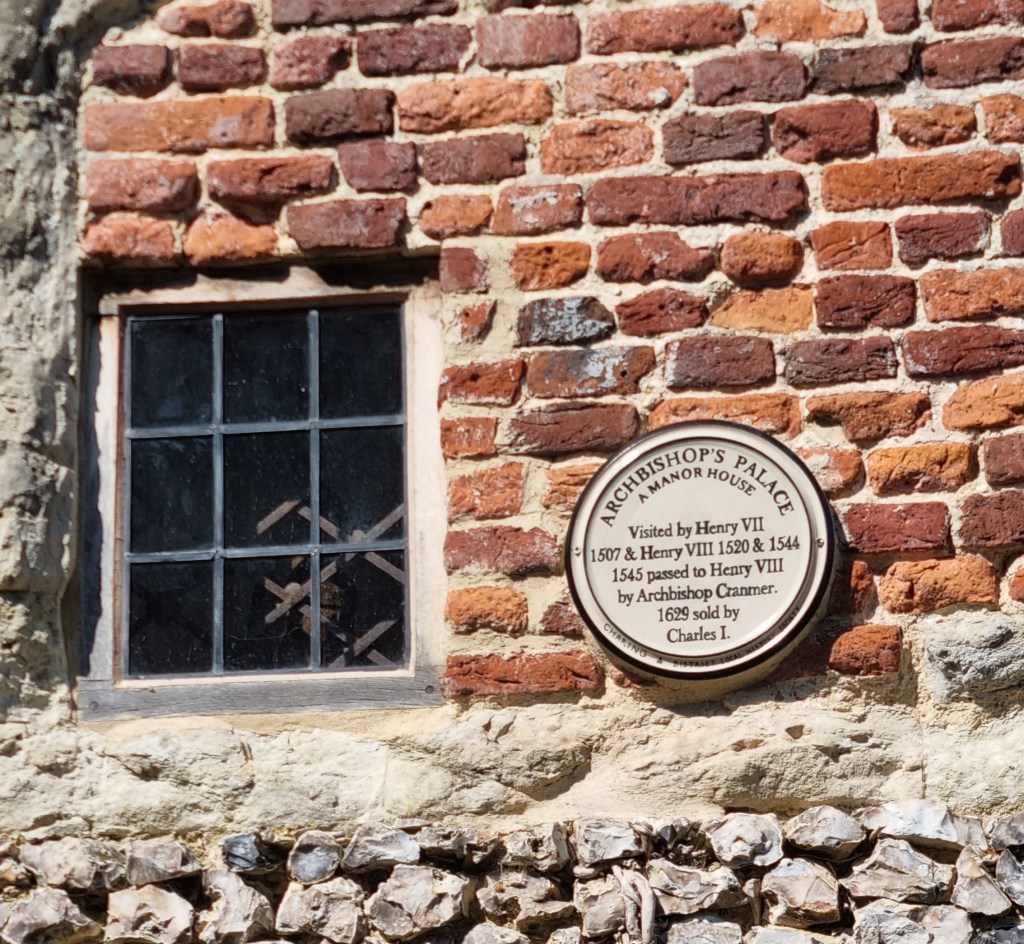
Afterwards, we admired the remains of the Archbishop’s Palace, one of 17 once owned by the Archbishopric of Canterbury. Some 25 years before the Dissolution of the Monasteries, Henry VIII and Catherine of Aragon stayed here en route to the Field of the Cloth of Gold.
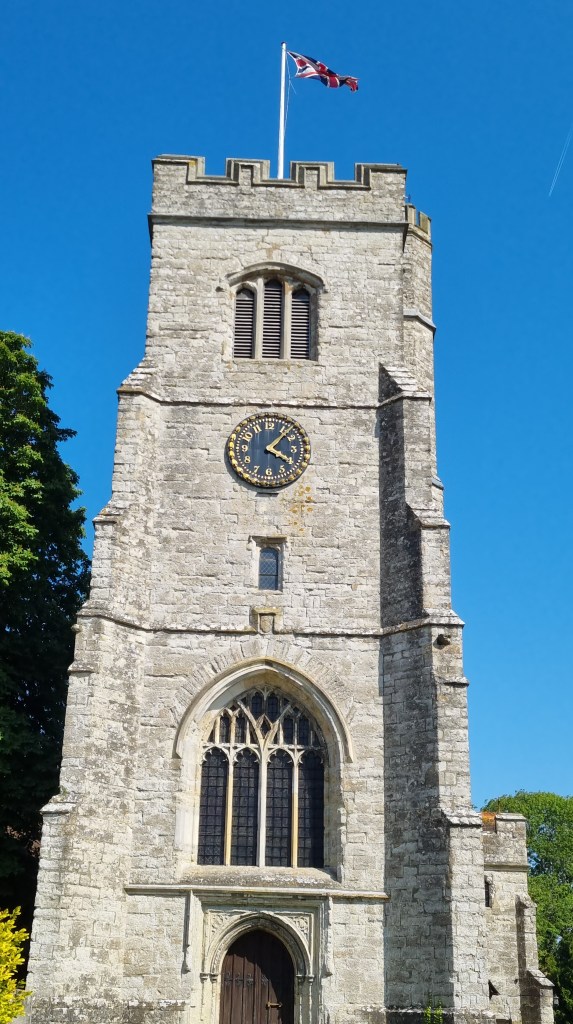
St Peter’s and St Paul’s Church, next door, has a 13th Century tower. It was once claimed to contain the stone block upon which John the Baptist was beheaded.
It does accommodate an extremely rare example of a vamping horn – a primitive megaphone invented by Samuel Moreland in 1671.
Eventually, we made our way to Charing Station, from which we returned to London Victoria. We had to wait some time since the first service was cancelled, owing to a mysterious ‘obstruction on the line’.
TD
June 2023









 Eponymous
Leave a comment