
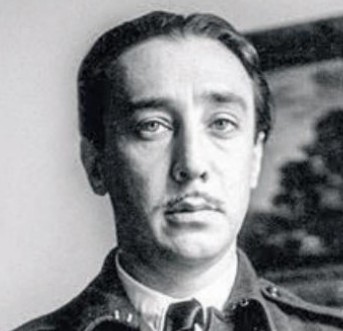
Romain Gary (1914-1980) was born Roman Leibovich Kacew in Vilnius, then part of the Russian Empire. His parents, both Jewish, divorced in 1925.
After periods in Moscow and Warsaw, he and his mother arrived in Nice. He studied law before joining the French Air Force in 1938, training as a pilot. Following the French Armistice with Nazi Germany he defected to the Free French Air Force.
He served for a while as a bombardier with 342 Squadron of the RAF, flying numerous low-level bombing sorties over France and the Netherlands. He was decorated for bravery and, unlike almost all of his peers, managed to survive the War.
Until 1961 he pursued a post-war career in the French diplomatic service, spending several years in New York and Los Angeles.
In 1944 he had married the English writer Lesley Blanch but, in 1962, American actress Jean Seberg gave birth to his son. He divorced Blanch and married Seberg, 24 years his junior, though that relationship ended in a second divorce in 1970.
Gary published his first novel in 1945, winning the Prix Goncourt for ‘Les Racines du Ciel’ (1956). ‘Les Cerfs-volants’ (1980) was the last novel he published in his lifetime. I read the English version, ‘The Kites’, which was translated by Miranda Mouillot and published in 2017.
During the latter part of his career, Gary also wrote several books under the pseudonym Emile Ajar, but did not reveal his true identity. Under this name he won the Prix Goncourt an unprecedented second time, in 1975.
On 2 December 1980 he shot himself, leaving a suicide note in which he admitted to being Ajar. He conceded that he had struggled with depression throughout his adult life, but denied any connection between his own suicide and Seberg’s, a year earlier.
‘The Kites’ describes a love affair between Ludo, who lives with his uncle in Clery, a Normandy village, and Lila, the daughter of a Polish aristocrat.
Ludo’s uncle is Ambrose Fleury, a rural postman and acclaimed kite-maker. Lila comes to stay at a nearby chateau with her parents, her brother Tad and Bruno, a young adopted pianist. Her German cousin Hans is Ludo’s rival for her affections and, inevitably, they fight.
Both Ambrose and Ludo are regarded by their neighbours as a little ‘touched’, but Ludo’s ‘excess of memory’ qualifies him for appointment as personal secretary to Lilo’s father.
Shortly before the outbreak of war, Ludo visits the family on their Polish estates, close to the German border. Hans is also present, crossing the border to visit Lila.
Returning to France, Ludo is judged mentally unfit for military service, but his ‘excess of memory’ is particularly useful to the French Resistance. One day they rescue Bruno, now a pilot with the RAF who has crash-landed in France. He has no news of Tad and Lila, who are both believed to be with the Polish Resistance.
In March 1942, Ludo re-encounters Lila, her father and Hans in the ruins of their chateau. They are in the company of Von Tiele, an aristocratic German general.
Later, Lila reveals that she has secured her own and her father’s survival through Hans’s protection and, when he is posted, by sleeping with a succession of diplomats and German officers. She believes herself defiled.
Eventually, they made it to France, where they came under Von Tiele’s protection. It turns out that he is Hans’s uncle and that his estates were just across the German border from their own. Despite appearances, she denies that she is Von Tiele’s mistress and, in any case, Ludo loves her unconditionally.
As the War progresses, Ambrose Fleury is arrested for protesting against the persecution of French Jews. He moves elsewhere to join a network that is protecting and hiding Jewish children. He is later captured and transported, first to Buchenwald, then to Auschwitz.
Meanwhile, Lina has persuaded Hans to try to blow up Hitler, but the plot fails. Hans escapes and Von Tiele asks Ludo to arrange his passage to Spain. Unfortunately, the level of Gestapo activity his escape has provoked makes it impossible for the Resistance to operate. Hans kills himself, as does Von Tiele, but Lila miraculously escapes with Von Tiele’s assistance.
She is interrogated, but survives, returning to Clery just before the Normandy landings. The pair are spared by a German tank commander who does not fire at them.
After the Germans have retreated, the local populace shave Lila’s head, as punishment for fraternising with Nazi occupiers. The couple refuse to be cowed and, just before their wedding, force the barber to shave her once more.
Ambrose Fleury is liberated from Auschwitz and returns home, largely unaffected by his ordeal. But Bruno has been killed and Tad is never heard of again.
‘The Kites’ is a sophisticated morality tale, featuring good and bad Germans and good and bad Frenchmen alike. Gary maintains a careful distinction between honourable German officers from aristocratic backgrounds and the brutally dishonourable Gestapo.
Heroism may be displayed in many ways, and is not necessarily dependent on physical violence. Those who are ostensibly our enemies may prove to be our friends – and vice versa.
Several of the characters are beautifully drawn, especially Marcellin Duprat, the celebrated restaurateur, determined to uphold the French reputation for culinary excellence throughout the Occupation; and Julie Espinoza, once madam of a Parisian brothel, now masquerading as the Countess Esterhazy, who displays a photograph signed ‘from her friend, Adolf Hitler’ but quietly supports the Resistance.
The plot is, frankly, unbelievable and, just occasionally, the translator is no match for some of Gary’s more cryptic lines.
But these are minor quibbles, for this is a remarkable novel, even in translation.
TD
January 2026





 Eponymous
Leave a comment